E - Sufi philosophical thought about the nature of God and religious experience
 Call Kai
 Learn
Learn Practice Test
 Spaced Repetition
 Match
Match Flashcards
 Knowt Play
1/33

There's no tags or description
Looks like no tags are added yet.
Name | Mastery | Learn | Test | Matching | Spaced | Call with Kai |
|---|
No analytics yet
Send a link to your students to track their progress
34 Terms
What does Sufism centre on?
What are Sufis sometimes described as, what is their aim?
Sufism centres on the quest for personal enlightenment in the hope of union with God.
Sufis are sometimes described at the mystics (spirituals) of Islam.
A Sufis aim is to increase their spirituality and follow a spiritual path to God.
What command is at the heart of Sufi understanding?
At the heart of Sufi understanding lays the command of the Quran to remember God often (taqwa), i.e. remember and prayer God from the heart (dhikr).
The Sufi is one who seeks to enter deeper into the remembrance of God, to such an extent that one lives constantly in the knowledge that one is in the presence of God.
Who do Sufi’s mediate on as the perfect example, what is something some of them aim to do?
Sufis mediate on Muhammad as the perfect example and express love for him by celebrating his birthday.
Some Sufis aim to experience a vision of Muhammad in their dreams.
They also visit the tombs of Sufi saints and remember their examples.
What are different Sufi rituals?
Sufis practice different rituals from Sunni and Shia Muslims.
They gather on Thursday evenings for dhikr meditations, singing of Islamic songs called qasidas.
They meditate with dance into a trance in which they experience the loving reality of God.
For Sufis this is part of their spiritual journey upwards on an arc of ascent through spiritual stations towards heaven.
Who is the Qutb, what are they considered to be?
The Qutb is the spiritual teacher who has a spiritual connection with God who guides their teachings, and they are considered infallible and trusted spiritual leaders.
The perfection and infallibility of the Prophet is manifested and shown through the Qutb.
Where is the Qutb for his followers and what is at the centre of the Qutb’s life?
what does the Qutb do for Sufis?
The Qutb is at the centre for his followers, the axis of their life.
Allah and the spiritual life is at the centre of the Qutb’s life, thereby creating an example to inspire others.
For Sufis the Qutb provides spiritual guidance and must be obeyed.
What does the Qutb represent, and what are they?
What did a famous Sufi, Ibn Arabi write about Qutb’s?
The Qutb represents the perfect human being.
The Qutb is the Sufi spiritual leader who has a divine connection with God and servers as the central figure in Sufism.
However, their identity remains unknown to the world.
A famous Sufi, Ibn Arabi, wrote a Qutb does not necessarily mean a person present on earth.
The Qutb can be an abstract concept of a being to be imagined.
What does the Qutb represent, what does this do?
What is their role essential for?
The Qutb represents the pinnacle of spiritual attainment in Sufism, bridging the gap between the divine and the human.
Their role is essential for the existence of the world, even if their identity remains veiled from most.
What happens between the teacher (Shaykh) and the follower (mureed)?
In Sufism the teacher (Shaykh) has followers called mureed.
They give an oath (bayah) to the teacher of allegiance and devotion.
The mureed kneels before the Shaykh, who places his hands upon the head of the follower and recites words from the Quran.
The follower is asked if they are willingly giving obedience to the Shaykh and then they recite Surah Fatihah.
Fellow Sufis will greet, hug and kiss the new mureed as if they are a new-born baby welcomed into their family, share the news with other brothers and sisters in the Sufi order and celebrate with a meal at the end.
What does the Sufi teacher do?
What is the relationship like?
The Sufi teacher guides the follower to the religious knowledge, which they believe the ordinary person cannot access.
This is similar to the concept of Imam in Shia Islam.
The relationship is like a servant and master.
The servant gives love and devotion to the master, who in turn feels the servants’ needs and adjusts his teachings in order to support spiritual development.
Sufis commonly kiss the hands of their Shaykh and ensure they visit him as regularly as possible.
Being in his presence gives them blessings.
Shaykhs are humble and shun gifts and luxuries.
Where do Sufis believe taking the oath stems from?
Today, why do many Muslims not accept giving an oath to a Shaykh?
Sufis believe taking the oath (bayah) stems from a practice during Muhammad’s life when many converted to Islam and gave allegiance to Muhammad during the 7AH (when Muhammad took back the city of Mecca.)
Today many Muslims do not accept giving an oath to a Shaykh as it elevates them above everyone else, and the only allegiance that should be made is to Allah.
What have Sufis used parables to do?
Sufis have used parables from the Quran and Hadith to teach others (the student) about Islam and help them understand the religion and encourage them to change their attitude to life.
What are examples of parables that are used?
The light - represents knowledge and inspiration.
The spider’s web - represents someone who builds their lives on gods other than Allah.
What are the parables used for?
Parables are used as a teaching tool so the student can immerse themselves in these stories and serve as a bridge between the ordinary and the mystical, guiding seekers towards deeper understanding.
What is Asceticism, how may it be shown, what tradition does it follow?
Asceticism, called zuhud in Islam, means to detach yourself from the world in order to gain a deeper relationship with God.
This may be shown by living alone in quiet places including deserts or caves.
This follows the tradition when Muhammad used to go to caves in order to meditate and get away from civilisation in order to find the meaning of life.
What does Asceticism include?
Asceticism may include fasting, giving up material wealth, wearing only a single woollen cloak, sleeping on the ground, living by begging, some may live a life of celibacy.
Asceticism includes not only giving up possessions but also thoughts, all thoughts that benefit oneself are given up.
Sufis who have reached higher levels of spiritual consciousness may lose all knowledge of themselves and their surroundings and appear to be lost, distant, unable to communicate.
They gain a deeper consciousness of Allah and put their trust entirely in him.
What is a key quote from Rabis Basra - a sufi?
Rabia Basra, a Sufi from Basra in Iraq once said:
‘I detached my heart from the world and lessened my desires so much that for 30 years I have performed every prayer as though it were my last.’
What are the personal/mystical religious experiences Sufis can go through in order to experience God?
There are many personal/mystical religious experiences Sufis can go through in order to experience God.
Maqam - a deeper consciousness
Fana - to let the self die.
Hal- a deep state when one loses control
What is Maqam - a deeper consciousness?
This may include starting with the 5 pillars and then progress to additional prayers (wird prayers).
On Thursday evenings Sufis can follow rituals which include chanting God’s name, singing Islamic songs.
What is Fana? - to let the self die
To give up desires for oneself, to lose one’s ego and focus instead on God.
What is Hal? - a deep state when one loses control
During Sufi Dhikr a Sufi may reach a state of ecstasy when they jump up in a trance-like dance, unaware of their surroundings.
Hal can be achieved by letting go of routines, attachments, formal worship.
What are two key quotes about personal/mystical religious experience as a way of experiencing God?
‘Anyone pulled from a source longs to go back’
‘The beloved is alive and the lover is dead’
What does Ibn Arabi, a Sufi believe about the way God can be understood and experienced?
Ibn Arabi, a Sufi believed God can be understood and experienced through one’s own thoughts and experiences.
Sufis like Ibn Arabi claim they are not rejecting the revelation of the Quran and traditional forms of Islamic learning.
They are saying that meditation and self-realisation help them to gain a higher spiritual awareness of God.
Ibn Arabi refers to sayings of Muhammad which states that ‘‘to know oneself is to know God.’’
What is a key quote from Muhammad about going beyond?
‘‘My servant never ceases drawing near to Me through supererogatory (doing more than what is expected from you) works until I love him. Then, when I love him, I am his hearing through which he hears, his sight through which he sees, his hand through which he grasps, and his foot through which he walks.’’ - Hadith qudi Prophet Muhammad
What are some examples of different Suf practices?
There are many different Sufi practices, for example: some visit the tombs of holy people to remember their examples.
Sufis in Pakistan practice ‘little hajj’, they circle the tomb of the saint and stone 3 pillars.
This stems back to when poor converts were unable to travel to Mecca.
According to these Sufis, since God lives in the heart of the true believer, a visit to saints tomb enables the pilgrims to partake in the true meaning of Hajj, without the less important physical journey.
What is a key quote about Dhikr (rememberance) from Muhammad?
Muhammad said to his companions ‘‘Shall I tell you about the best of deeds… he said ‘remembrance of Allah’’
What is Dhikr (remembrance)? - an example of devotional practices
Dhikr takes place usually on Thursday evenings (after Maghrib prayer) and begins with recitation from the Quran and then can continue onto remembrance of Allah through chanting the names of Allah repeatedly.
Then Dhikr continues with signing Islamic songs, possibly Sufis jumping into a state of dance and ecstatic energy, they may even enter the state of hal.
In Africa Dhikr service includes drums.
What is Muraqaba (Sufi meditation)? - an example of devotional practices
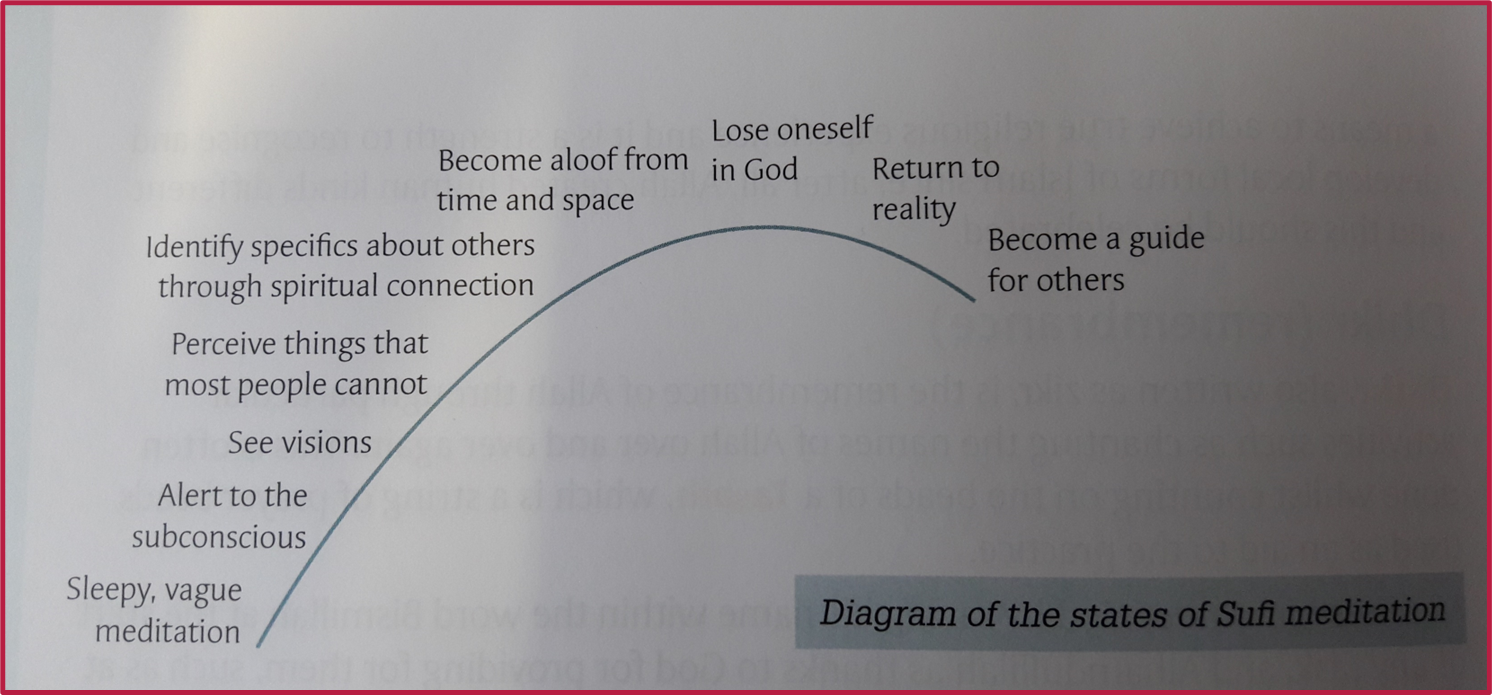
There are various stages of meditation which help Sufis develop their spiritual awareness.
Only the most experiences teachers would be expected to reach the high levels of meditation.
Sufis are cautioned that these practices can be very powerful and that it is essential to choose a spiritual guide to carefully prepare and counsel the follower.
What did Mansur Hallaj declare? (sufi meditation)
Mansur Hallaj declared that ‘I am God’ due to his close meditation with Him.
This crossed the line for many Muslims who felt he was declaring shirk.
What does Rumi’s poetry contain?
The poetry of Rumi, a famous Sufi, contains deep mystical poems representing forms of meditation in which he refers to God as his beloved.
Diagram of the states of Sufi meditation
What is Sama (spiritual listening, specifically whirling)? - an example of devotional practices
How did this practice start?
The Turkish dervishes, who follow Rumi, perform a particular symbolic whirling dance as part of their devotions.
Spinning in circles represents the planets of the solar system.
The ritual act of the whirling is called sama.
The practice started when Rumi was walking through the market and heard tap tap tapping of the jewellery makers.
This reminded him of Sufi chants, and he stretched out his arms and started whirling in delight.
What do the dervishes wear, what doe it represent?
What do they do and what does it represent?
The dervishes wear long white robes and a high hat, which represents the gravestone of the ego of the self.
They enter wearing a black cloak which is removed for the dance, this symbolises spiritual rebirth.
Beginning with arms folded, this represents the unity of God, during the whirling the right hand is pointed upwards towards God’s blessings and the left hand down to earth.
The ritual is said to develop purity and love in the mind of the believer.
Rumi thought of the circling of the Kabah when performing the dance, making the spiritual connection with the holy city.

