Lecture 15 - Eukaryotic Microbes (Protozoan parasites)
 Studied by 0 people
 Call Kai
 Learn
Learn Practice Test
 Spaced Repetition
 Match
Match Flashcards
 Knowt Play
1/14

There's no tags or description
Looks like no tags are added yet.
Name | Mastery | Learn | Test | Matching | Spaced |
|---|
No study sessions yet.
15 Terms
Define the various kinds of organismal interactions (mutualism, cooperation, commensalism, predation, parasitism, ammensalism, competition). What is parasitism and how does it differ from predation or ammensalism?
Mutualism = relationship that benefits both organisms and is obligatory
obligatory → both organisms need each other to survive
Cooperation = relationship benefits both, but is not obligatory
Commensalism = one organism is helping the other and gets no benefit in return
Predation = one organism kills another for its benefit
Parasitism = intimate association with another organism
Parasites benefit at the expense of the host
a longer-lived relationship than predation
Ammensalism = one organism causes harm to another and does not benefit
eg. antibiotics
Competition = 2 species competing for the same resources
relationship where 1 organism wins or both organisms coexist at lower levels of resource
Can organisms switch between relationships?
Yes, relationships are not inherent to the characteristic of the organism
Some relationships are obligatory (required) or facultative (capable, but not restricted to)
What relationships are beneficial?
Mutualism
Cooperation
Commensalism
Parasitism
Can a parasite be beneficial to the host?
NO! By definition, a parasite will harm the host, not help it
What is an intermediate host vs a definitive host for a parasite? Distinguish between sexual reproduction and asexual reproduction.
Intermediate host = parasite does not undergo sexual reproduction while living in this host
can only undergo asexual reproduction (just cell division)
Definitive host = the host in which sexual reproduction occurs
formation of 2 different gametes that combine and mix to form 1
the benefit of sexual reproduction is that a lot more diversity is generated
sometimes, death of the intermediate host may facilitate transmission to the definitive host that ate the intermediate
What is an example of an organism that uses death to jump between intermediate and definitive hosts?
Toxoplasma gondii
this parasite infects mice (intermediate host)
cats then eat mice and become the definitive host
Compare and contrast 4 fundamental processes that are conserved in both prokaryotes and eukaryotes
Both cell types evolved from LUCA
central dogma is the same in both, except their mechanisms differ
Fundamentals of metabolism still apply
central pathways are the same
ATP is needed to carry out important functions
macromolecules are the same
Membrane permeability is still controlled
channels and transporters are still present
secretion pathways with signal peptides are still present but different
Sensing and signaling mechanisms are different, but still present
phosphorylation is still a common signal transduction
eukaryotes don’t have simple 2-component systems
their secretion systems are much more complex, with multiple components
still regulate protein amount and activity
Compare and contrast 4 fundamental qualities that are unique to eukaryotes (not found in any prokaryotes)
Eukaryotes have a nucleus and organelles
Transcription and translation are not coupled
transcription occurs in the nucleus
translation occurs in the cytoplasm at the rough ER
RNA cannot have a short half-life
there are 5’ and 3’ modifications to provide mRNA stability
Cytoskeleton inside eukaryotes
provides stability and structure to the cell
made up of actin, microtubules, or another flexible protein
can be remodeled constantly due to being in the interior of the cell, as it has better access to enzymes and machinery
can be broken down when needed
Sexual reproduction - all eukaryotes are diploid
can have haploid stages in complex life cycles
parasite in intermediate host = asexual (haploid)
Explain, from an evolutionary and geological time perspective, why there are qualities that are unique to protists, and why protists are so diverse as a group.
Protists evolved long before the modern eukaryotes
Because of their “early” evolution, they have had time to evolve into many different groups, one of which is the protozoa
What distinguishes apicomplexans? Define apical complex, rhoptry, and microneme. Are these secretion organelles similar to bacterial secretion systems? Do you think they evolved from a single secretion system? Why or why not.
Apicomplexons are named such due to the presence of the apical complex, which is used to deliver things into a cell and for invasion of the host cell
The apical complex is formed really specifically at one end of the cell
most notable components are micronemes and rhoptries → secretory organelles secrete things needed to take over the host cell
Functionally, the secretory organelles are similar to bacterial secretion systems type 3 and 4 because they inject proteins directly into the host cell cytoplasm, but mechanistically…
NO! The apical complex is very different and much more complex compared to a bacterial secretion system
Apical complex is a large multi-organellar complex that involves the coordinated, regulated exocytosis (release of vesicle contents) of multiple organelles into the extracellular environment or host cell membrane.
Bacterial secretion systems actively pump or inject specific proteins through a channel in a one-step or two-step process, one at a time
Protozoan parasites often have complex life cycles and have different morphologies depending on its life cycle stage. Give an example of a parasite that changes shape depending on its life cycle.
What do you think this means regarding cell biology (where fundamental processes take place)?
Would you expect all the organelles will be present in all stages, or that they disappear in some stages?
Plasmodium is a protozoan that changes morphology depending on its life cycle stage
Intermediate host = humans
Definitive host = mosquito
infected mosquito bites a host and releases sporozoites
sporozites target the liver and turn into merozites
Merzouites released from the liver infect RBCs
the parasite then undergoes asexual reproduction and multiple morphologies in the RBC cycle and bursts out of RBCs
the RBC cycle causes all the symptoms to form
mosquito then gets infected with human blood
sexual reproduction occurs in the mosquito gut, and the cycle continues
Asexual reproduction in the intermediate host is usually what causes the disease to manifest
This means, as a parasite goes through different life cycles, different cues and signals are expressed, which affect the genes that are being made which dictate what the cell does (its shape and function)
Fundamental processes like metabolism, motility, secretion, and replication are regulated differently across morphologies.
It is unlikely that all organelles are present for every stage, as it depends on the cues being expressed and the function of each life stage, meaning some aren’t needed for certain processes
What is the defining feature of the kinetoplastids? What is contained in the kinetoplast?
*we did not discuss the function of the kinetoplast, you do not need to know this, only what it contains.
Kinetoplastids are defined by the prescence of kinetoplasts = extended large network of DNA inside a large/expanded mitochondria (kDNA)
contain multiple copies of the mitochondrial genome
have circular DNA in varying sizes - maxicircles and minicircles
Name two apicomplexan parasites and two kinetoplastid parasites. (genus species)
Ampicomplexan:
plasmodium = malaria
toxoplasm gondii = toxoplasmosis (sexual reproduction in cats)
Kinetoplastids:
trypanosomes = have a flagella that spans the length of the cell
leishmania = infects skin wounds
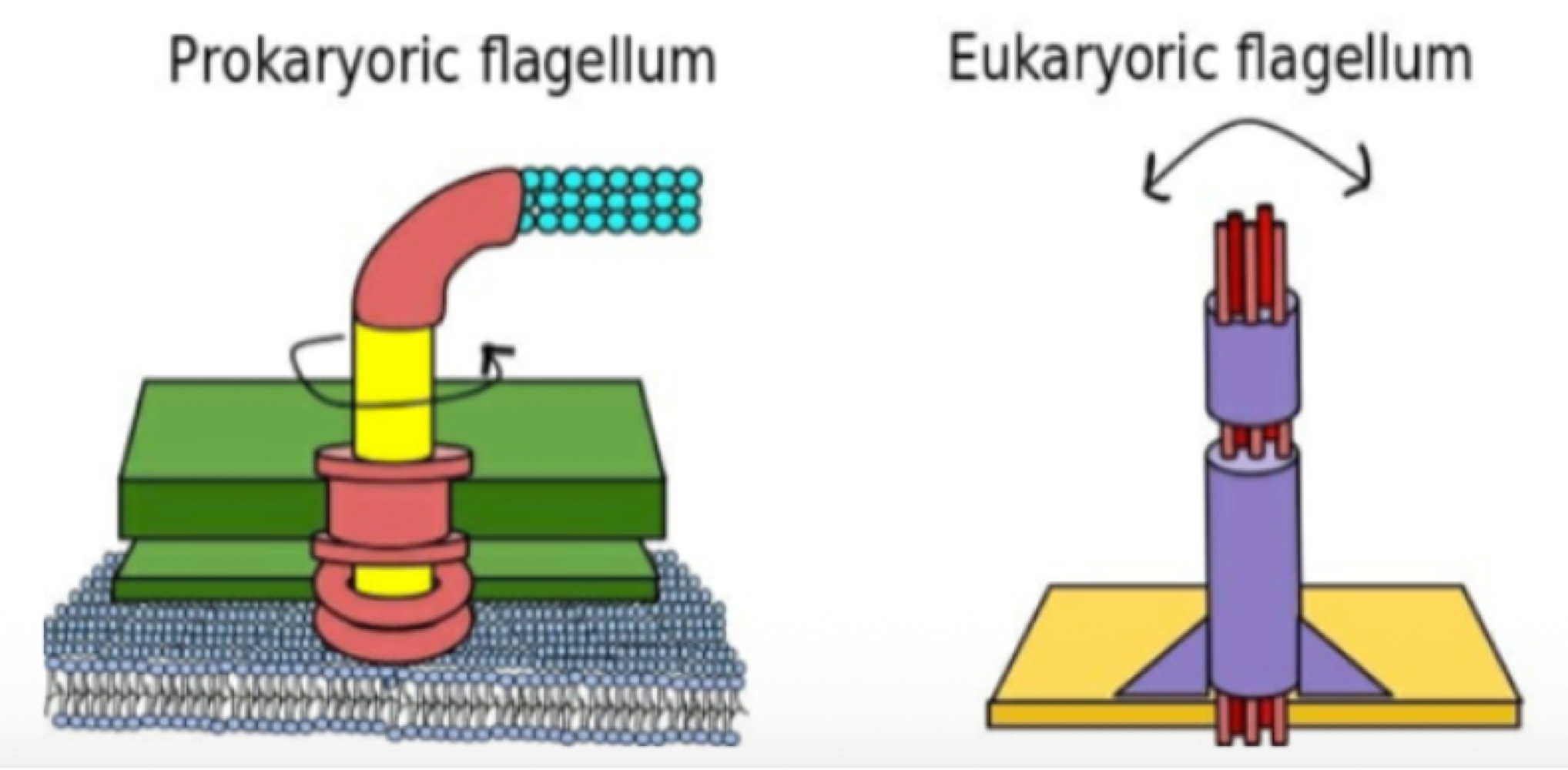
Compare and contrast prokaryotic and eukaryotic flagella. How do their structures and function differ?
Prokaryotic flagella:
use flagellin protein
proton motive force as energy source
move in a clockwise motion
no membrane → external apendage
use a 2 component system to change direction
Eukaryotic flagella:
structure is more similar to cillia and more complex
consists of microtubule filaments with motor proteins and actin, and uses motor proteins for flagella movement (side-to-side)
uses ATP hydrolysis as energy source
moves in waves rather than rotation
membrane-bound extension of the cell
can also do gliding through focal adhesions → more directed because can control where focal adhesions go
What determines the shape of eukaryotes and bacteria?
Eukaryotes = cytoskeleton
not fixed, can be broken and remodeled if needed
Bacteria = cell wall
shape is inherent to the cell and will not change
 Note
Note  Flashcards (29)