Electrical Unit Notes
 Studied by 0 people
 Call Kai
 Learn
Learn Practice Test
 Spaced Repetition
 Match
Match Flashcards
 Knowt Play
1/47

There's no tags or description
Looks like no tags are added yet.
Name | Mastery | Learn | Test | Matching | Spaced | Call with Kai |
|---|
No analytics yet
Send a link to your students to track their progress
48 Terms
Electricity
Movement of free electrons from one atom to another.
Matter
Anything that takes up space and has mass. Can be liquid, gas, solid, or plasma.
Atoms
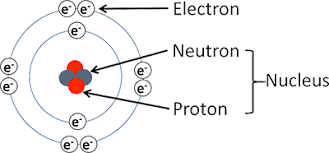
Small particles that make up elements. Basic unit of all matter.
Atom make-up:
Proton: positive charge
Neutron: no charge (neutral)
Electron: negative charge
Law of charges:
Like charges repel each other
Unlike charges attract each other
Electron Theory:
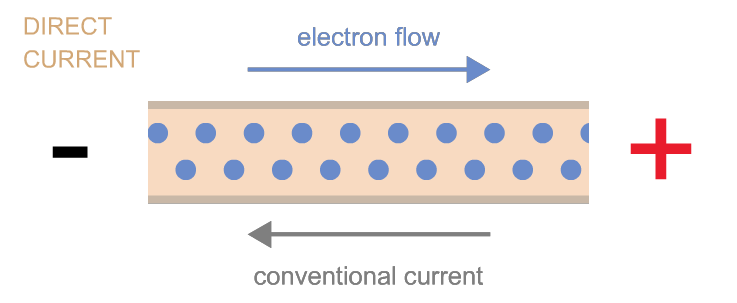
(negative to positive)
Electrons will flow from where there are many (- terminal) electrons to where there are few (- terminal) electrons.
This theory is the one that is generally accepted by the electronic industry. (real theory) → Reality
Conventional Theory:
States that electrons flow form positive to negative.
This theory is the oldest and serves as the basis for all wiring diagrams.
used for diagnosing cars.
Car batteries are what?
DC - Direct current (electrons only flows one way)
Conductors:
Conductors (roads) have 1-3 electrons in outer orbit of an atom. They are easily knocked out of orbit.
Materials such as silver, coper, aluminum, and gold make good conductors.
(1-3 electrons in atomic structure, more conductible)
Transition metals in the periodic table of elements.
Insulators:
Insulators have 4 or more electrons in outer of the atom. Hard to knock the electrons out of orbit because they have a strong magnetic pull to the protons in the nucleus of the atom.
Glass, ceramics, plastics, rubber, fiber, porcelain, paper, and wood are common insulators.
(Asian cars use soy → Animals love to eat it.)
(Honda → Bitter tasting agent → animals stop eating wires due to bitter taste.)
Ways you create electricity:
Electrochemical (battery) *
Electromagnetic (alternator) (all power sources) *
Electrostatic
Photovoltaic (solar energy) (30% efficient) *
Piezoelectric (pressure on crystal)
Volatge:
(electromotive force, EMP)
Pressure or amount of push behind the electron flow. This pressure is known as voltage.
Volage is measured in volts with a voltmeter. (multimeter does all)
Label = v
Kv = kilovolts or 1000 volts ( thousands of volts)
mV = millivolts or .001v (smaller than 1)
School Zone (speed) → low voltage
NASCAR Race (speed) → High voltage
conductors = roads
Amperage:
Quantity of how many free electrons flow through a conductor.
Current flow is measured in amperes (amps).
Label = A
Measured with an ammeter.
milliamps = 0.100 amps (less than 1)
Amps = current (same term)
Late Saturday night (amount of people driving at that time) → low amps
4:00pm Friday rush hour traffic (amount of people driving at that time) → High Amps
Amount of electrons/cars on the road/conductors.
*AMPS CAUSES HEAT*
Resistance:
The opposition to current flow. Caused by electrons bumping into each other. A poor conductor has greater resistance than a good conductor.
Measured in Ohms with an ohm meter.
symbol is omega (horse shoe) Ω
4 things that effect the resistance:
Type of material
length of the wire - longer wire has more resistance.
Width of the wire - this wire has more resistance. ( bottle neck, the bigger the better)
Temperature - heat increases resistance.
Always there you can never get rid of resistance completely just minimize it.
Construction on a road closing 2 out of 3 lanes, all cars/electrons need to travel on that one tiny lane on the road/conductor.
electromagnet:
a magnet that is created by using electricity.
Wrap a wire around an iron core and run electricity through the wire will generate a magnet
3 ways to increase strength of magnetic field:
use more loops of wire
use thicker (larger) wire
Run more electricity through the wire
Magnetic induction:
use magnetism to create electricity
pass a wire through a magnetic filed will cause electrons to flow in the wire.
4 ways to increase the output or amount of electricity:
run more loops of wire through the filed.
run longer wire through field ( thicker)
Run wire through filed faster
create a stronger magnetic filed
Circuits
something which has a beginning point, an ending point, and a specific path to follow. It repeats over and over again.
5 basic components an electrical circuit must have!
power source (battery)
conductor (wires for electrons to flow through)
Load (something to operate, like a light bulb or motor)
Switch (control device)
Fuse (circuit protection)
Circuit breakers ( house example/ comparison)
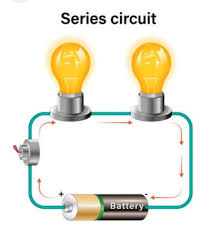
Series circuit:
Characteristics: (not lights)
Only one path for current to flow.
Each load is dependent on the other in order to work.
One goes out, they all go out.
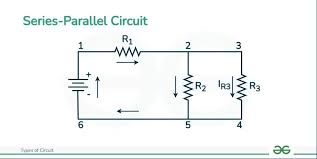
Series parallel circuit:
It is a mix of both
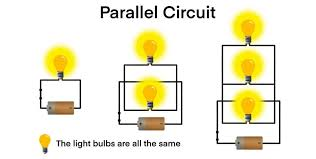
Parallel circuit:
Characters:
multiple paths for the electrons.
Each load is separate from each other.
Ground:
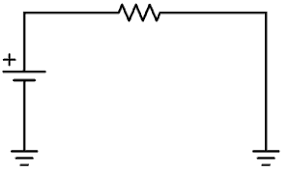
Ground means to complete the circuit back to source of power. (Chassis Ground = alternative name)
Ground symbol (picture)
Ground goes from positive to the top of the loads. Everything past that is (no charge/volts) (not really but we are not being literal.)
Ohm’s Law:
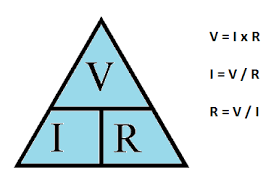
I = Amperes (current)
R = Ohms (resistance)
E = Volts (electromotive force)
Ohm’s Laws formulas:
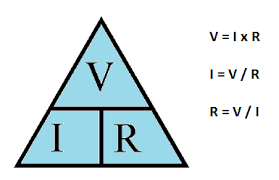
I = E/R
E = I x R
R = E/I
Series Circuit Rules!
In a series circuit, amperage will always remain the same, but the voltage will change.
2 ways to find total voltage = Et
Et (total v) = I • Rt or the sum of all voltage drops Er1 + Er2
2 ways to find total resistance = Rt
Rt = Et/I
The sum of all R1 + R2 = Rt
Voltage Drop
The voltage that is lost at it travels through a load or through any resistance.
Symbol - Er1
Formula is Er1 = I • R1
DMM/DVOM/Multimeter
digital multi-meter (DMM)
Digital volt ohm meter (DVOM)
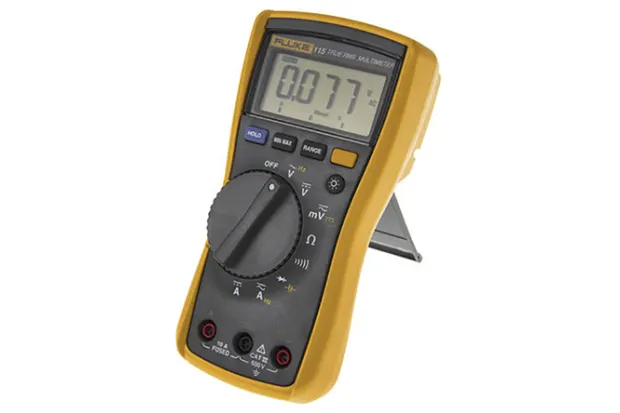
DMM FUNCTIONS:
volts AC (alternation current)
Volts DC (direct current)
300 millivolts DC
Ohms (Ω)
Tone/Diode - can be used as a ohmmeter.
Amps AC
Amps DC
DMM connections:
V/OHM/DIODE - Red lead lives here when measuring these things.
COM - black lead always lives here.
IOA - Red lead goes here when measuring 10A or lowers.
300mA - Red lead goes here when measuring under 300 mA.
How to hook up a DMM: (Volts) + How does DMM get the volt reading?
Volts - black lead on ground, red lead where you want to get information.
It takes what it sees at the red and black lead, then subtract the 2.
How to hook up a DMM: (Amps) + How does DMM get the Amp reading?
Amps - break the circuit, red lead on one side, black lead on the other.
The meter sees how much current is going through the DMM.
How to hook up a DMM: (Ohms) + How does DMM get the ohm reading?
Ohms - Turn all the power off from the circuit, put the red and black lead before and after the area you want to test.
The DMM sends out a small voltage from the red lead and it sees how much voltage comes back from the black lead.
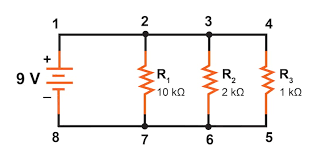
Parallel Circuit ohm’s law: What are the rules and what does a parallel circuit look like?
In a parallel circuit, each load receives its own 12 volts and each load will drop the whole 12 volts.
2 ways to find amperage:
- Total amps = Total volts / total resistance
- The sum of all amp flow for each load Ir1 + Ir2 + Ir3 = It (I total)
2 ways to find Total resistance = Rt, If the loads are the same resistance values, then Rt = R/N
R = how much resistance is the load?
N = how many loads are there?
(YOU CANNOT ADD UP RESISTANCE LIKE A SERIES CIRCUIT)
2 ways to find total resistance = Rt
If the resistors are unequal Rt = 1/Rt + 1/R2….
Find the lowest common denominator, add fractions, invert and divide.
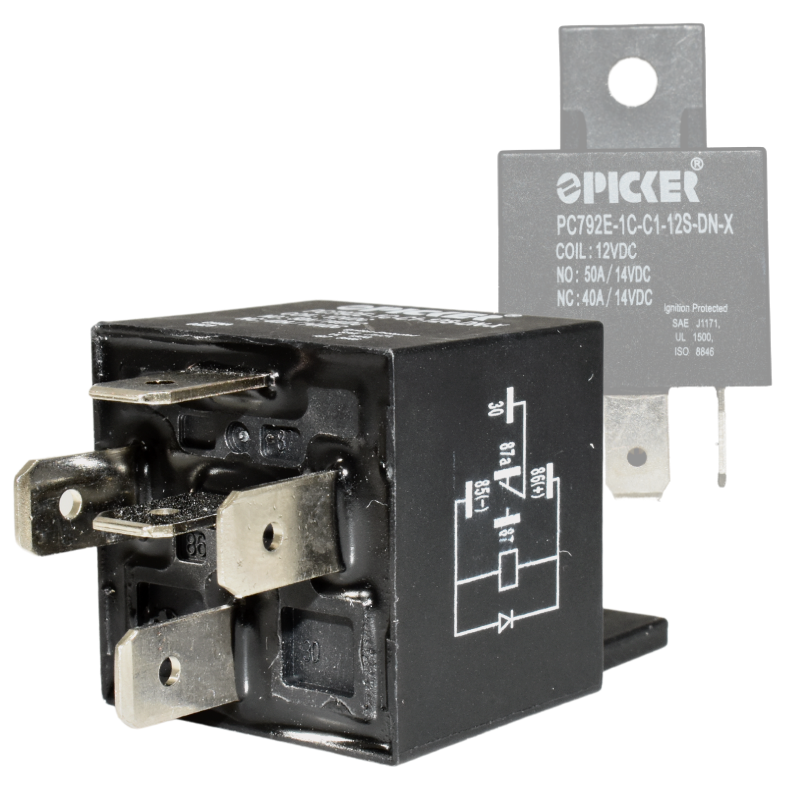
What is a Relay?
Electrically operated switch
Allows a small, low current/amp dash switch to control another high current amp circuit from a distant point.
Allows vary small wires to be used behind the dash, while large wires may be needed in the relay-operated circuit.
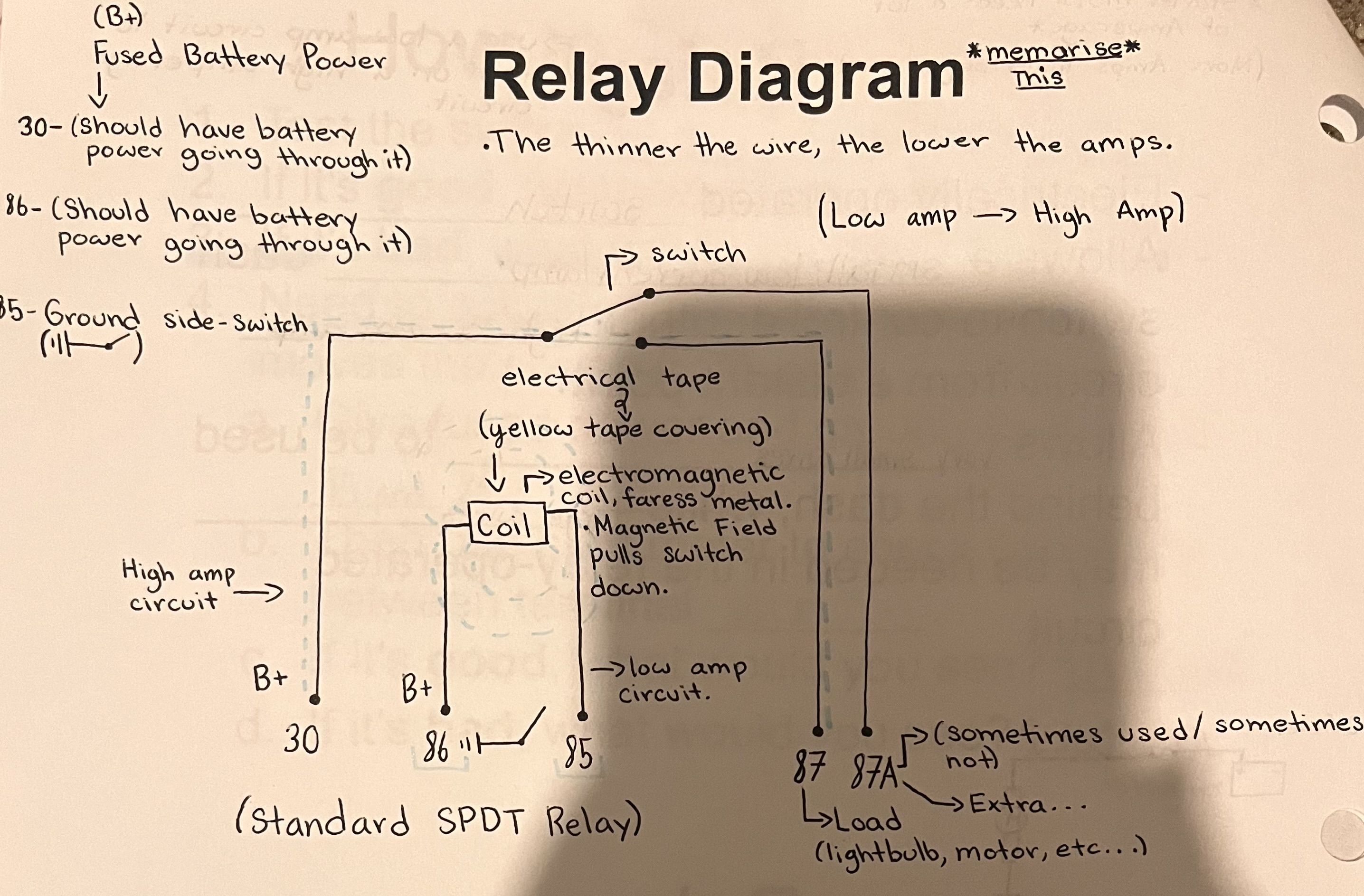
Draw a Relay Diagram and everything that goes along with it:
How does a relay work?
Power must flow through the coil using terminals 85 and 86. This creates a magnetic field in the coil.
Electromagnet causes switch to move in the relay from 87A to 87.
What are common problems for relays?
Worn, burned or sticking contact points between 30 and 87/87A.
Coil windings between 85 and 86 can break causing no magnetic field to be created.
Excessive resistance (corrosion)
How to test a Relay (85 and 86):
1) Check to make sure the COIL circuit is operational. Use an ohm meter, measure resistance between terminal 85 and 86.
a) This is a COIL of very thin wire (size of a hair on your head) looped thousands of times.
b) What resistance value do you think you should see? 60-100ohms
c) This COIL is a load, so you should see some resistance, usually 60-100ohms.
d) What if you see OL? (Bad, open circuit)
e) What if you see 1 ohm? (Bad, shorted out wires, wire has gotten smaller, a loss of resistance)
How to test a Relay (30 and 87a):
1) Test the switch 30-87a with ohm meter.
2) If it’s good, what would you see? 1 ohm or less.
3) If it’s bad, what would you see? 1 ohm or higher or OL
4) Need to activate the COIL to see if it moves the switch from 30-87.
a) Give fused power and ground to terminal 85 and 86.
b) Then use ohm meter to check continuity between terminal 30-87.
c) If it’s good, what would you see? (1 ohm or less).
d) If it’s bad, what would you see? 1 ohm or OL.
Circuit problems? What are they and what happens with them?
Open-circuit: Wire is broken, fuse is blown, light bulb burnt out. (Horn won’t honk, headlight doesn’t work, sounds like something just not working).
High-resistance: Causes voltage drop, due to poot connection or corrosion. (turn on my lights and they are dim/less bright, blinker light is blinking really fast, window motor is slow).
Short-to-ground: Causes fuses to blow immediately, wire is touching ground before the load. (I keep putting in knew fuses but it just blows immediately!).
Short-to-power or short-to-voltage: causes a load to be turned on even if the circuit/switch is turned off. “Hot” wire crosses over to another circuit.
Wire sizes?
The size/thickness of a wire will vary with the amount of current (amps) that is needed to flow through it to operate that component. (How big is the road)
Wire size is measured by its Gauge:
The higher the gauge #, the smaller the wire is.
The smaller the gauge #, the bigger the wire is.
Example: A battery cable is 5 gauge, while a headlight wire is only 18 gauge.
AWG (American Wire Gauge) is the standard used to measure automotive wires.
Color Coding:
All wires are color coded to make identification of individual wires easy.
They can be solid colors or colors with contracting bands or stripes.
By adding these stripes, it creates thousands of different combinations to identify specific wires. Makes identification of wires even easier.
Circuit Protection Types:
Fuse
Fuse Box + Relays
Fusible Link
Circuit Breaker
Fuse (Circuit Protection):
Fuse:
Protects circuits against damage caused by excessive current or a short circuit.
High current heats and melts the link in the fuse, creating an open circuit which stops current flow.
There are many different types of colors, sizes, and ratings of fuses!
Fuses are located in a fuse box located either under the dash or in the engine compartment usually called a central junction box.
Fusible Link (Circuit Protection):
Fusible Link:
Small section of wire designed to burn in half when excess current is present in the circuit.
Often used as protection between the battery and main fuse box.
If a major wire is shorted, the fusible link will burn in half to prevent an electrical fire and further damage.
Common for cars from the 70’s, 80’s, and 90’s) No vary common in modern cars.
Circuit Breaker (Circuit Protection):
Circuit Breaker (Re-Usable) Ex. In house…
Preforms the same function as a fuse.
Disconnects the power source from the circuit when current becomes too high (hot).
Most breakers will reset when current returns to a normal level. (only on certain circuits: Window motors, Seat motors, etc).
 Note
Note  Flashcards (70)