Biochem Exam 3
 Call Kai
 Learn
Learn Practice Test
 Spaced Repetition
 Match
Match Flashcards
 Knowt Play
1/45

There's no tags or description
Looks like no tags are added yet.
Name | Mastery | Learn | Test | Matching | Spaced | Call with Kai |
|---|
No analytics yet
Send a link to your students to track their progress
46 Terms
Write the overall reaction that occurs during ETS
NADH + H+ + ½O2 → NAD+ + H2O
The energy released during ETS is captured
and used to make ___ by oxidative
phosphorylation.
ATP
Do half redox reactions occur in isolation?
NEVER
What are the two things transferred in redoc reactions?
e- and H+
The molecule with the greater reduction potential has a higher/lower affinity for electrons
higher
What does voltage potential measure?
The difference between the two reduction potentials
Electrons flow spontaneously from a species with a more postive/negative E0 to a species with a more positiv/negative e E0
Negative, positive
The lower the reduction potential, the more likely a species is to act as a ____ agent
reducing
Why is there more NAD+ than NADH and more NADPH than NADP+ in the cytosol
NAD⁺ is high in the cytosol to support glycolysis.
NADPH is high in the cytosol to support anabolic pathways like fatty acid synthesis, cholesterol synthesis, and antioxidant defense.
Can nicotinamide coenzymes cross the mitochondrial membrane?
no
Now do nicotinamide coenzymes bind to enzymes?
Transiently
What are nicotinamide coenzyme polarity?
highly polar and water soluble
What are flavin coenzyme polarity?
hydrophobic and buried deep in the hydrophobic clefts of proteins.
Now do flavin coenzymes bind to enzymes?
serve as prosthetic groups
How many electrons can NAD+/NADP transfer compared to FAD?
2 electrons with a proton compared to 1 or 2 electrons
What is the overall reaction for aerobic metabolism?
Carbon fuel (glucose) + O2 → CO2 + H2O + Energy (ATP)
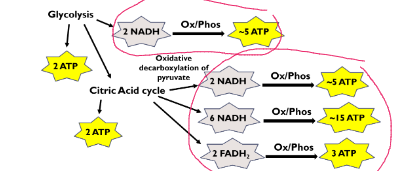
How does aerobic glycolysis compare to anaerobic glycolysis
ANAEROBIC Glycolysis yields directly 2 ATPs
Aerobic glycolysis to Krebs cycle directly 4 ATPs
What is the overall reaction of the citric acid cycle?
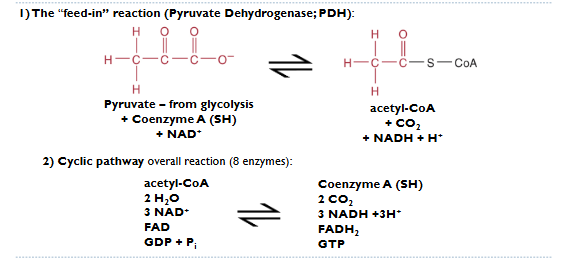
Pyruvate + H+ + 2H2O + 4NAD+ + FAD + GDP + Pi
→ 3 CO2 + 4 NADH + 4H+ + FADH2 + GTP
What are the two parts of the citric acid cycle?
1. the “feed-in” reaction. Pyruvate to Acetyl CoA
Cyclic Pathway (8 enzymes)
In the production of acetyl-CoA from pyruvate, how many
NADHs, CO2s, and acetyl-CoAs are made from 1 glucose
molecule!
2 NADH, 2 CO2, 2 acetyl-CoA
What are all the subtrates and products of the “feed-in” reaction and what enzyme mediates it?
Is it irreversible or reversible?
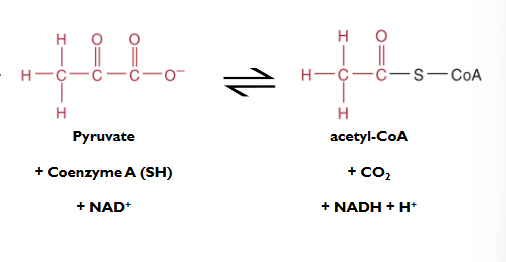
Pyruvate Dehydrogenase (PDH) converts
pyruvate, Coenzyme A, and NAD+ to
Acetyl-CoA + CO2 + NADH+ + H+
Irreversible bc it is highly exothermic
Why can’t rxns that produce CO2 be reversed in cells?
Due to the very low concentration of anhydrous CO2 in cells
The primary function of Acetyl-CoA is to
act as an acyl carrier without being oxidized
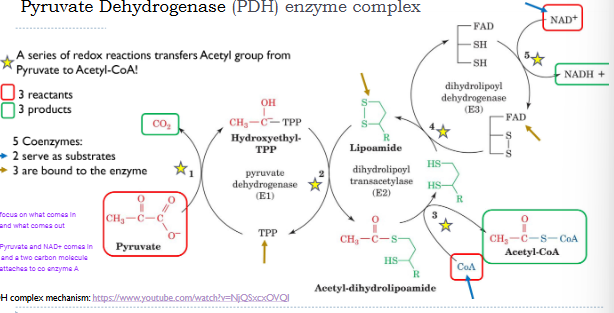
Pyruvate dehydrogenase has many copies of ___ subunits, ____ , _____, ____.
3,
E1, E2, E3
Pyruvate dehydrogenase uses ___ different coenzymes with 3 reactants and 3 products. The 3 reactants are ______. The 3 products are ____
5,
Pyruvate, CoA, NAD+
CO2, Acetyl-CoA, NADH
Describe the E1 Reaction of the PDH Complex in converting Pyruvate to Acetyl CoA
E1 (pyruvate DH) decarboxylates the Pyruvate. The remaining acetyl group of the Pruvate is added to a TPP
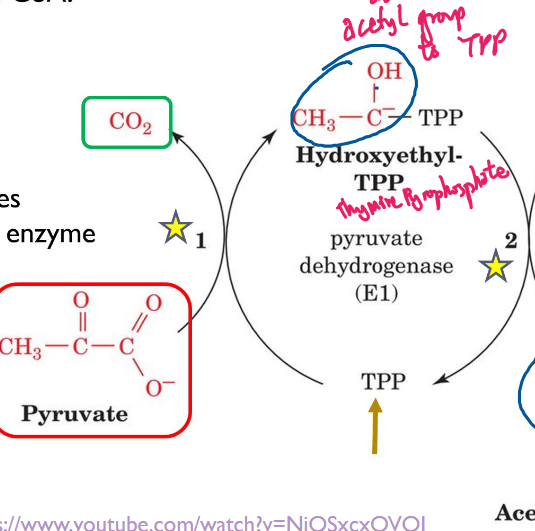
Describe the E2 Reaction of the PDH Complex in converting Pyruvate to Acetyl CoA
E2 (dihydrolipoyl transacetylase) transfers the acetyl group from Hydroxyethyl-TPP to Lipoamide. Lipoamide becomes Acetyl-dihydrolipoamide.
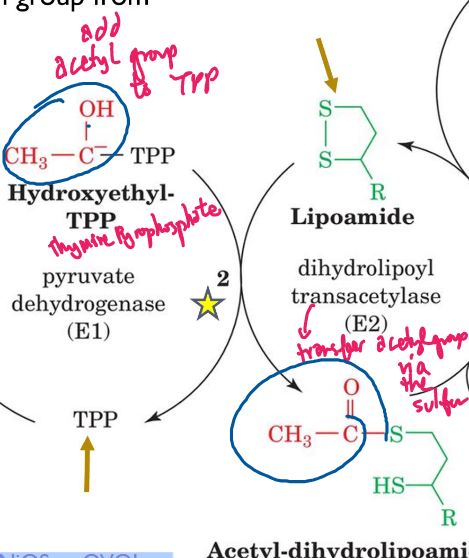
Describe the post E2 reaction PDH Complex in converting Pyruvate to Acetyl CoA
CoA attacks the acetyl group in Acetyl-dihydrolipoamide, creating dihydrolipoamide and Acetyl CoA.
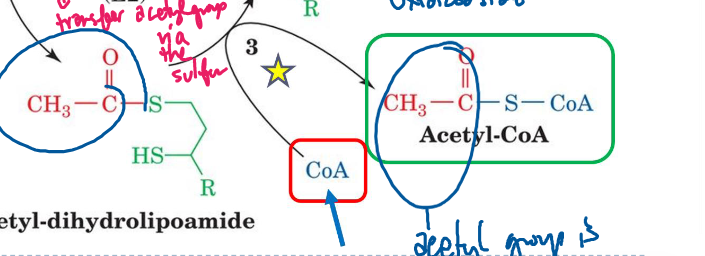
Describe the E3 Reaction of the PDH Complex in converting Pyruvate to Acetyl CoA
Dihydrolipoyl dehydrogenase returns dihydrolipoamide to its oxidized state (lipoamide) to continue the cycle by using FAD and NAD+ (→NADH)
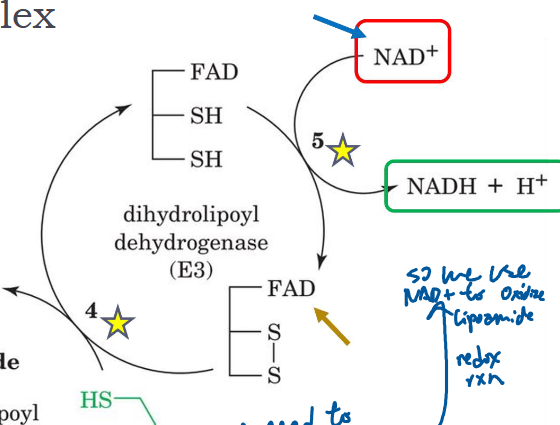
What are all of the intermediates in order of the krebs cycle
Citrate
Isocitrate
a-ketoglutarate
Succinyl-CoA
Succinate
Fumarate
Malate
Oxaloacetate
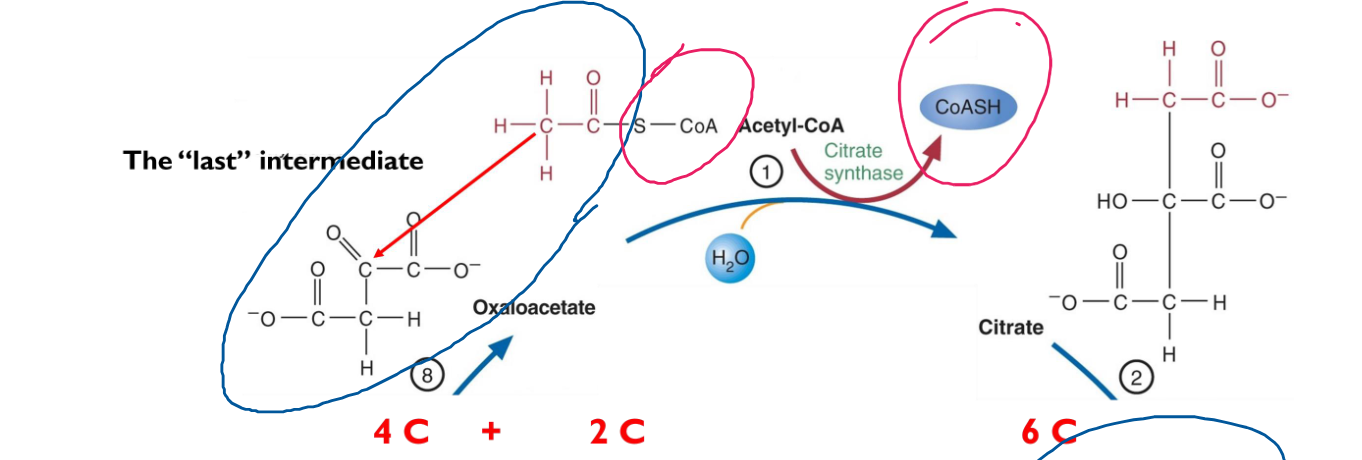
Acetyl CoA entry into Krebs cycle. How many Carbons? reversibility?
Citrate Synthase uses the acyl group of Acetyl CoA to nucleophily attack the ketone carbonyl in Oxaloacetate, turning the 4C Oxaloacetate and 2C Acetyl- CoA into Citrate. Requires H2O. CoA gets recycled to CoASH.
4C+2C→ 6C
irreversible
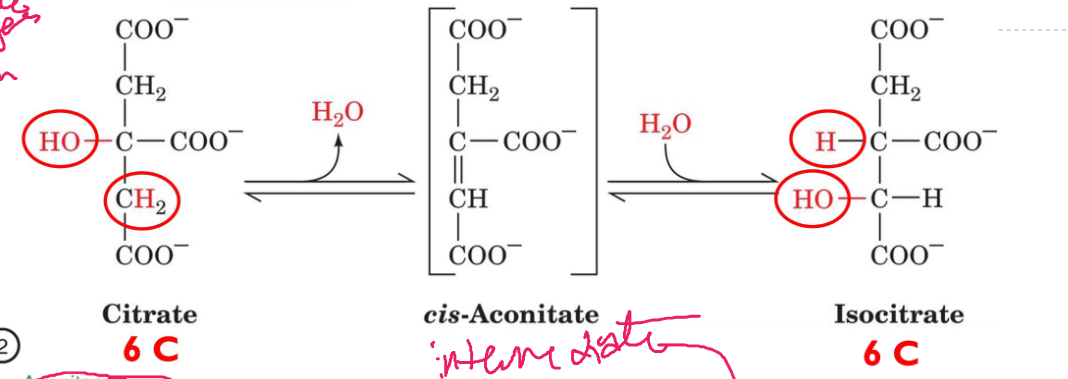
Citrate to Isocitrate. How many Carbons? reversibility?
Aconitase rearranges the alcohol in citrate so that it turns from a tertiary to secondary alcohol tha can be oxidized.
6C→ 6C
reversible
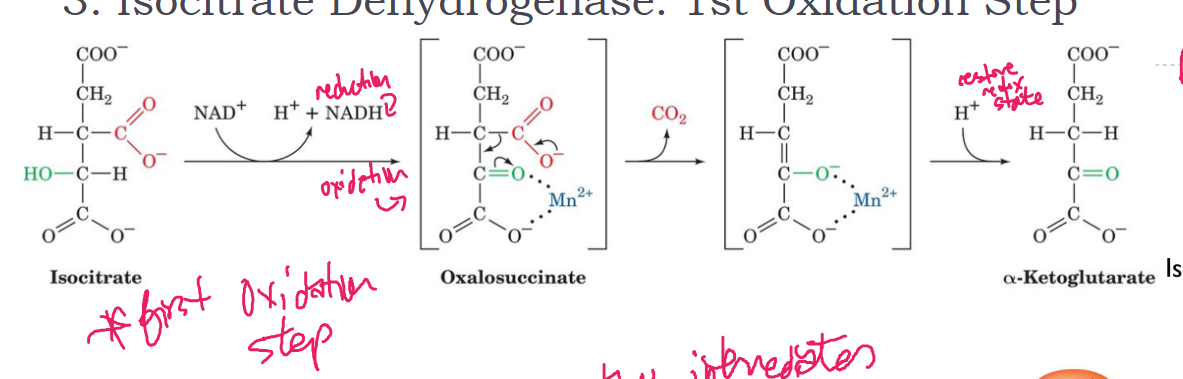
Isocitrate to a-ketoglutarate. How many Carbons? reversibility?
(first oxidation step) Isocitrate dehydrogenase oxidizes the alcohol group in isocitrate into a ketone. Decarboxylation. NAD+ reduced to NADH
6C→ 5C
irreversible
a-ketoglutarate to Succinyl-CoA. How many Carbons? reversibility?
(second oxidation step) a-ketoglutarate dehydrogenase brings CoASH and NAD+ to oxidize and decarboxylate a-ketoglutarate. CoA attaches to the product, Succinyl-CoA.
5C→ 4C
irreversible
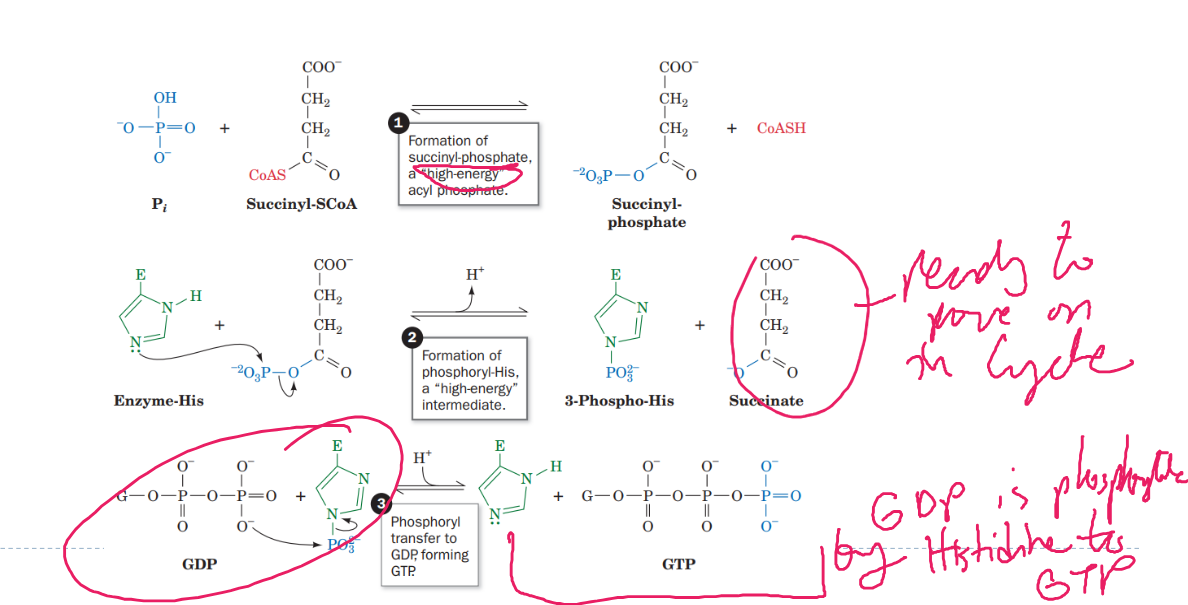
Succinyl-CoA to Succinate. How many Carbons? reversibility?
The energy captured by Succinyl-CoA is used by Succinyl-CoA synthase to produce GTP which is later converted to ATP. CoASH bond is cleaved.
4C→ 4C
irreversible
Succinyl-CoA synthase has three steps.
The first step:
___and ___ form ___ and ____ to form a high energy acyl phosphate.
The second step:
Enzyme Histidine nuc atks the ___ group of ____, forming the product ____
The third step:
GTP is made by ___ attacking the ___ group of _____
Pi + Succinyl-CoA → Succinyl-Pi + CoASH
Pi, Succinyl-Pi, Succinate
GDP, Pi, Enzyme Histidine
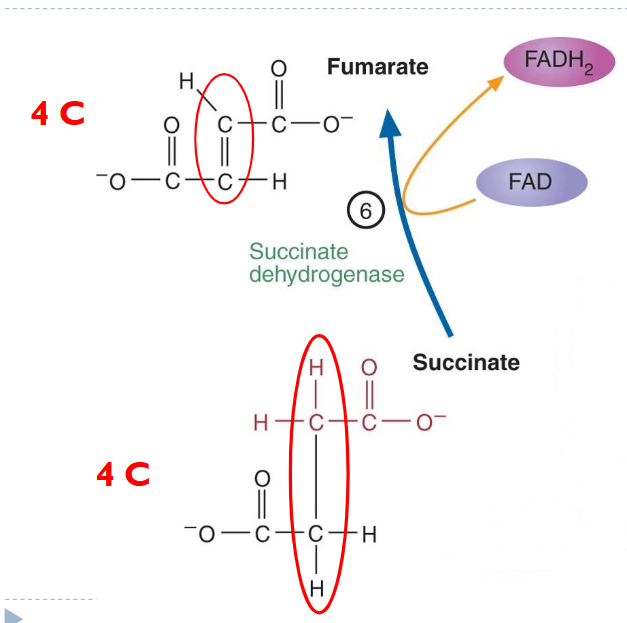
Succinate to Fumarate. How many Carbons? reversibility?
(third oxidation) Succinate Dehydrogenase oxidizes succinate to fumarate by converted a C-C bond to a C=C bond. releasing a H+. FAD is converted to FADH2. (not NAD because theres not enough energy change in this reaction)
4C→ 4C
irreversible
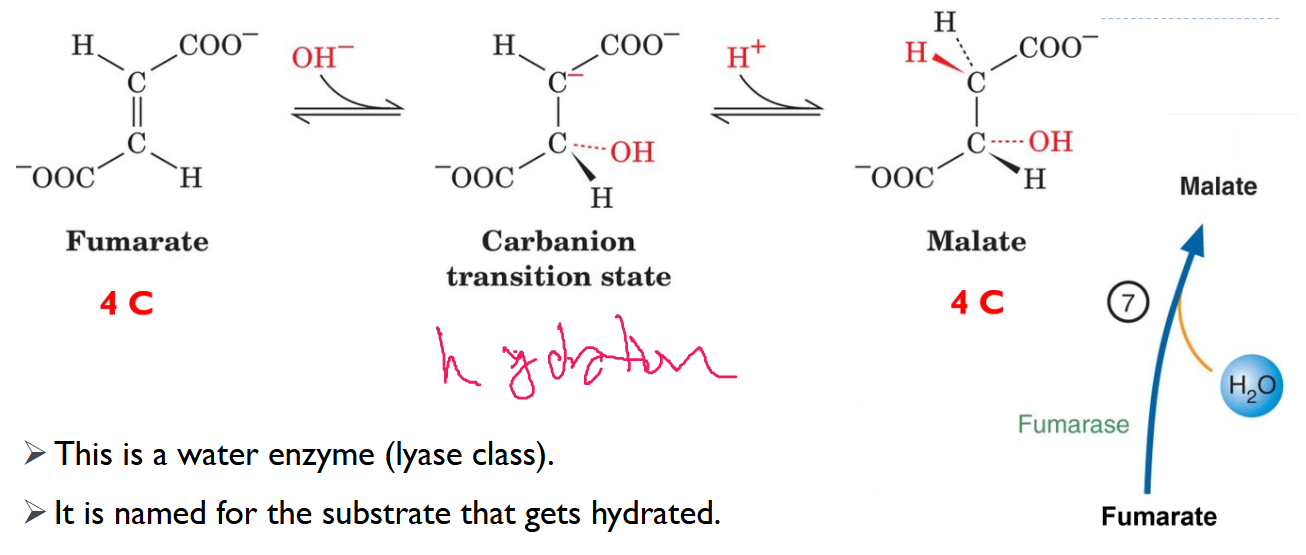
Fumarate to Malate. How many Carbons? reversibility?
Fumarase hydrates fumarate into malate
4C→ 4C
reversible
Malate to Oxaloacetate. How many Carbons? reversibility?
Malate dehydrogenase converts the Alcohol group of malate to a ketone, creating oxaloacetate. NAD+ → NADH
4C→ 4C
irreversible
What are the most important Enzymes for regulating Citric Acid
Cycle?
Pyruvate dehydrogenase
• Citrate Synthase
• *Isocitrate dehydrogenase
• α-Ketoglutarate dehydrogenase
The Krebs cycle enzyme inhibited by NADH and acetyl-CoA
Pyruvate dehydrogenas
The Krebs cycle enzyme inhibited by NADH, ATP, citrate, and succinyl-CoA
Citrate Synthase
The Krebs cycle enzyme activated by ADP and Ca2+ and inhibited by ATP and NAD
Isocitrate dehydrogenas
The Krebs cycle enzyme inhibited by NADH and succinyl-CoA, and activated by Ca2+
α-Ketoglutarate dehydrogenase
anaplerotic reactions
Reactions that add intermediate molecules

