integ: abpsych sir sy (personality disorders
 Call Kai
 Learn
Learn Practice Test
 Spaced Repetition
 Match
Match Flashcards
 Knowt Play
1/29

There's no tags or description
Looks like no tags are added yet.
Name | Mastery | Learn | Test | Matching | Spaced | Call with Kai |
|---|
No analytics yet
Send a link to your students to track their progress
30 Terms
cluster A: odd thinking and eccentric behavior
paranoid personality disorder
schizoid personality disorder
schizotypal personality disorder
cluster b: dramatic and errotic behavior
antisocial personality disorder
borderline personality disorder
histrionic personality disorder
narcissistic personality disorder
cluster c: severe anxiety and fear
avoidant personality disorder
dependent personality disorder
obsessive-compulsive disorder
paranoid personality disorder
a pervasive distrust and suspiciousness of others such that their motives are interpreted as malevolent
schizoid personality disorder
a pervasive pattern of detachment from social relationships and a restricted range of expression of emotions in interpersonal settinf
schizotypal personality disorder
a pervasive pattern of social and interpersonal deficits marked by acute discomfort with reduced capacity for close relationships, as well as by cognitive or perceptual distortions and eccentricities of behavior
antisocial personality disorder
a pervasive pattern of disregard for and violation of the rights of others
borderline personality disorder
a pervasive pattern of instability of interpersonal relationships, self-image, affects and control over impulses
histrionic personality disorder
a pervasive pattern of excessive emotion and attention seeking
narcisstic per
a pervasive pattern of grandiosity (in fantasy or behavior), need for admiration, and lack of empathy
avoidant personality disorder
a pervasive pattern of social inhibition, feelings of inadequacy, and hypersensitivity to negative evaluation
dependent personality disorder
a pervasive and excessive need to be taken care of, which leads to submissive and cloinging behavior and fears of separation
obsessive compulsive personality disorder
a pervasive pattern of preoccupation with orderliness, perfectionism, and mental and interpersonal control, at the expense of flexibility, opnness, and efficiency
Paranoid Personality Disorder
A. A pervasive distrust and suspiciousness of others such that their nfiotives are inter-
preted as malevolent, beginning by early adulthood and present in a variety of con-
texts, as indicated by four (or more) of the following:
1. Suspects, without sufficient basis, that others are exploiting, harming, or deceiving
him or her.
2. Is preoccupied with unjustified doubts about the loyalty or trustworthiness of friends
or associates.
3. Is reluctant to confide in others because of unwarranted fear that the information
will be used maliciously against him or her.
4. Reads hidden demeaning or threatening meanings into benign remarks or events.
5. Persistently bears grudges (i.e., is unforgiving of insults, injuries, or slights).
6. Perceives attacks on his or her character or reputation that are not apparent to oth-
ers and is quick to react angrily or to counterattack.
7. Has recurrent suspicions, without justification, regarding fidelity of spouse or sexual
partner.
B. Does not occur exclusively during the course of schizophrenia, a bipolar disorder or
depressive disorder with psychotic features, or another psychotic disorder and is not
attributable to the physiological effects of another medical condition.

Schizoid Personality Disorder
A. A pervasive pattern of detachment from social relationships and a restricted range of
expression of emotions in interpersonal settings, beginning by early adulthood and
present in a variety of contexts, as indicated by four (or more) of the following:
1. Neither desires nor enjoys close relationships, including being part of a family.
2. Almost always chooses solitary activities.
3. Has little, if any, interest in having sexual experiences with another person.
4. Takes pleasure in few, if any, activities.
5. Lacks close friends or confidants other than first-degree relatives.
6. Appears indifferent to the praise or criticism of others.
7. Shows emotional coldness, detachment, or flattened affectivity.
B. Does not occur exclusively during the course of schizophrenia, a bipolar disorder or
depressive disorder with psychotic features, another psychotic disorder, or autism
spectrum disorder and is not attributable to the physiological effects of another medical
condition.
Schizotypal Personality Disorder
A. A pervasive pattern of social and interpersonal deficits marked by acute discomfort
with, and reduced capacity for, close relationships as well as by cognitive or perceptual
distortions and eccentricities of behavior, beginning by early adulthood and present in
a variety of contexts, as indicated by five (or more) of the following:
1. Ideas of reference (excluding delusions of reference).
2. Odd beliefs or magical thinking that influences behavior and is inconsistent with
subcultural norms (e.g., superstitiousness, belief in clairvoyance, telepathy, or
“sixth sense”: in children and adolescents, bizarre fantasies or preoccupations).
3. Unusual perceptual experiences, including bodily illusions.
4. Odd thinking and speech (e.g., vague, circumstantial, metaphorical, overelaborate,
or stereotyped).
5. Suspiciousness or paranoid ideation.
6. Inappropriate or constricted affect.
7. Behavior or appearance that is odd, eccentric, or peculiar.
8. Lack of close friends or confidants other than first-degree relatives.
9. Excessive social anxiety that does not diminish with familiarity and tends to be as-
sociated with paranoid fears rather than negative judgments about self.
Antisocial Personality Disorder
A. A pervasive pattern of disregard for and violation of the rights of others, occurring since
age 15 years, as indicated by three (or more) of the following:
1. Failure to conform to social norms with respect to lawful behaviors, as indicated by
repeatedly performing acts that are grounds for arrest.
2. Deceitfulness, as indicated by repeated lying, use of aliases, or conning others for
personal profit or pleasure.
3. Impulsivity or failure to plan ahead.
4. Irritability and aggressiveness, as indicated by repeated physical fights or assaults.
5. Reckless disregard for safety of self or others.
6. Consistent irresponsibility, as indicated by repeated failure to sustain consistent
work behavior or honor financial obligations.
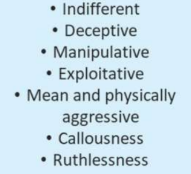
7. Lack of remorse, as indicated by being indifferent to or rationalizing having hurt,
mistreated, or stolen from another.
B. The individual is at least age 18 years.
C. There is evidence of conduct disorder with onset before age 15 years.
D. The occurrence of antisocial behavior is not exclusively during the course of schizo-
phrenia or bipolar disorder.
Borderline Personality Disorder
A pervasive pattern of instability of interpersonal relationships, self-image, and affects,
and marked impulsivity, beginning by early adulthood and present in a variety of contexts,
as indicated by five (or more) of the following:
1. Frantic efforts to avoid real or imagined abandonment. (Note: Do not include suicidal
or self-mutilating behavior covered in Criterion 5.)
2. A pattern of unstable and intense interpersonal relationships characterized by alternat-
ing between extremes of idealization and devaluation.
3. Identity disturbance: markedly and persistently unstable self-image or sense of self.
4. Impulsivity in at least two areas that are potentially self-damaging (e.g., spending, sex,
substance abuse, reckless driving, binge eating). (Note: Do not include suicidal or self-
mutilating behavior covered in Criterion 5.)
5. Recurrent suicidal behavior, gestures, or threats, or self-mutilating behavior.
6. Affective instability due to a marked reactivity of mood (e.g., intense episodic dysphoria,
irritability, or anxiety usually lasting a few hours and only rarely more than a few days).
7. Chronic feelings of emptiness.
8. Inappropriate, intense anger or difficulty controlling anger (e.g., frequent displays of
temper, constant anger, recurrent physical fights).
9. Transient, stress-related paranoid ideation or severe dissociative symptoms._______
Narcissistic Personality Disorder
A pervasive pattern of grandiosity (in fantasy or behavior), need for admiration, and lack of empathy, beginning by early adulthood and present in a variety of contexts, as indicated by five (or more) of the following:
1. Has a grandiose sense of self-importance (e.g., exaggerates achievements and talents, expects to be recognized as superior without commensurate achievements).
2. Is preoccupied with fantasies of unlimited success, power, brilliance, beauty, or ideal love.
3. Believes that he or she is “special” and unique and can only be understood by, or
should associate with, other special or high-status people (or institutions).
4. Requires excessive admiration.
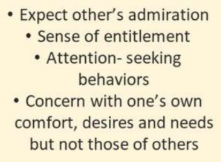
5. Has a sense of entitlement (i.e., unreasonable expectations of especially favorable
treatment or automatic compliance with his or her expectations).
6. Is interpersonally exploitative (i.e., takes advantage of others to achieve his or her own
ends).
7. Lacks empathy: is unwilling to recognize or identify with the feelings and needs of others.
8. Is often envious of others or believes that others are envious of him or her.
9. Shows arrogant, haughty behaviors or attitudes.
Avoidant Personality Disorder
A pervasive pattern of social inhibition, feelings of inadequacy, and hypersensitivity to negative evaluation, beginning by early adulthood and present in a variety of contexts, as indicated by four (or more) of the following:
1. Avoids occupational activities that involve significant interpersonal contact because of
fears of criticism, disapproval, or rejection.
2. Is unwilling to get involved with people unless certain of being liked.
3. Shows restraint within intimate relationships because of the fear of being shamed or ridiculed. '
4. Is preoccupied with being criticized or rejected in social situations.
5. Is inhibited in new interpersonal situations because of feelings of inadequacy.
6. Views self as socially inept, personally unappealing, or inferior to others.
7. Is unusually reluctant to take personal risks or to engage in any new activities because
they may prove embarrassing.
Dependent Personality Disorder
A pervasive and excessive need to be taken care of that leads to submissive and clinging
behavior and fears of separation, beginning by early adulthood and present in a variety of
contexts, as indicated by five (or more) of the following:
1. Has difficulty making everyday decisions without an excessive amount of advice and
reassurance from others.
2. Needs others to assume responsibility for most major areas of his or her life.
3. Has difficulty expressing disagreement with others because of fear of loss of support
or approval. (Note: Do not include realistic fears of retribution.)
4. Has difficulty initiating projects or doing things on his or her own (because of a lack of
self-confidence in judgment or abilities rather than a lack of motivation or energy).
5. Goes to excessive lengths to obtain nurturance and support from others, to the point
of volunteering to do things that are unpleasant.
6. Feels uncomfortable or helpless when alone because of exaggerated fears of being
unable to care for himself or herself.
7. Urgently seeks another relationship as a source of care and support when a close re-
lationship ends.
8. Is unrealistically preoccupied with fears of being left to take care of himself or herself.
Obsessive-Compulsive Personality Disorder
A pervasive pattern of preoccupation with orderliness, perfectionism, and mental and interpersonal control, at the expense of flexibility, openness, and efficiency, beginning by early adulthood and present in a variety of contexts, as indicated by four (or more) of the following:
1. Is preoccupied with details, rules, lists, order, organization, or schedules to the extent that the major point of the activity is lost.
2. Shows perfectionism that interferes with task completion (e.g., is unable to complete a project because his or her own overly strict standards are not met).
3. Is excessively devoted to work and productivity to the exclusion of leisure activities and friendships (not accounted for by obvious economic necessity).
4. Is overconscientious, scrupulous, and inflexible about matters of morality, ethics, or values (not accounted for by cultural or religious identification).
5. Is unable to discard worn-out or worthless objects even when they have no sentimental value.
6. Is reluctant to delegate tasks or to work with others unless they submit to exactly his or her way of doing things.
7. Adopts a miserly spending style toward both self and others; money is viewed as something to be hoarded for future catastrophes.
8. Shows rigidity and stubbornness.
clinical aspects of antisocial personality disorder
self-centeredness
lack of empathy
comorbidities
self-centeredness
lack of empathy
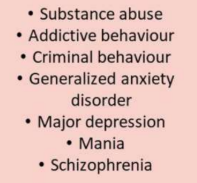
substance abuse
Behavioral Inhibition System (BIS) and Behavioral Activation/Reward System (BAS)
A prominent explanation of Antisocial Personality Disorder (ASPD) focuses on an imbalance between:
Behavioral Inhibition System (BIS)
Responsible for anxiety, fear, and sensitivity to punishment
Behavioral Activation/Reward System (BAS)
Drives impulsivity, reward-seeking, and approach behavior
Weak BIS → ↓ fear, ↓ punishment sensitivity
Overactive BAS → ↑ impulsivity, ↑ reward-seeking
What happens in ASPD when it comes to BIS and BAS

