APHG Unit 4
 Studied by 0 people
 Call Kai
 Learn
Learn Practice Test
 Spaced Repetition
 Match
Match Flashcards
 Knowt Play
1/64

There's no tags or description
Looks like no tags are added yet.
Name | Mastery | Learn | Test | Matching | Spaced | Call with Kai |
|---|
No analytics yet
Send a link to your students to track their progress
65 Terms
State
Country
Nation
Nationality: group of people sharing common culture, language, religion
Ex: Kurds
Nation-State
A country where most people share the same national identitiy
Ex: Japan
Statless Nation
A nation that does NOT have its own state. Often want autonomy/independence
Ex: Kurds
Mulitnational State
One state that contains many different nations
Ex: Canada (English, French, Indigenous)
Multistate Naton
A nation divided amough multiple states
Ex: North and South Korea, they are all Korean
Autonomous Region
A part of state that governs itself & has a lot of self ruleHas , but still belongs to a country
Semi-Autonomous
A part of a state that has some self-rule, but less freedom than an autonomous state. The central government has the control
Theocracy
A form of government in which religious leaders control the state and laws based on religious. State & religion intertwined
Ex: Vatican City-Popo serves as the poltical & religious leader
Sovereignty
The authority of a state to govern itself without external interference
Ex: China
Self-Determination
The right of the people to decide their politicla status and form of governement
Ex: South Sudan (2011)
Colonialism
Direct political and economic control of territory by a FOREGIN powers
Ex: British India
Imperialism
Expansion of power through military, economic, or political domaniance, often w/settlement
Ex: Scramble of Africa
Independence movements
Efforts by colonized or dominated people to gain soveriegty
Ex: Ghana
Devolution Along National Lines
Transfer of power from a central government to regions based on ethnicity/nationality
Ex: Scotland (UK)
Devolution
The transfer of power from a central government to regional/local governments often to address ethnic, cultural, or economic differences
Ex: Scotland gaining its own parliament within UK
Balkanization
The fragment of a stat into smaller, units along ethnic, cultural, or eligious lines. It is usualy violent
Ex: Breakup of Yugolslavia into Bosnia, Crotia, Slovenia, Serbia etc.
Differences between Devolution & Balkanization
Devultion: peaceful/organized transfer of power within a state- can prevent Balkanization by giving regions autonomy before conflict escalates
Balkanization: violent into fragments of a state- when centrifugal forces overwhelm centripetal forces
Neocolonialism
Indriect economic and political influence over former colonies by wealthy states
Ex: United States maintains control a significant portion of the Global Market in the Philippines
Shatterbelt
Politically unstable region caught between cometeting powers
Ex:Middle East
Choke Point
Strategic narrow passage controlling trade/military movement
Ex: Straight of Hormuz
Territroiality
Strong connection between people, culture, economy, and land often tied to identity & sovereignty
Ex: Indigenous land rights
Heartland Theory
Halford Mackinder 1904
Whoever controls the center of the contienent (heart) can control the world
Rimland Theory
Nicholas Spyman 1942
Whoever controls the coastal edges of contients can control the world
Domino Theory
If one country falls, nearby countries will fall next
Organic Theory
A country is like a living body- it
Relic Boundary
Boundary that is no longer functional but still impacts culutre/politics
Ex: Wall of China, Berlin Wall
Superimposed Boundary
Imposed by external powers without reguard to local cultures
Ex: Scramble of Africa
Subsequent Boundary
Established after settlement to reflect cultrual differences
Antecedent Boundary
Established before population settlement.
Ex: US-Canada border
Geometric
Straight-line boundary using lat/long, most are super imposed and break up cultures
Ex: US-Mexico
Consequent Boundary
Follows physical or cultural features after settlement
Nature & Function of Boundaries
Defined= written in treatie
Delimited-drawn on mas
Demarcated= physically marked on land
Administered= enforced by states
Contested boundaries
Boundaries where 2 parties disagree, leading to disputes over ownership, control, or location
Ex: Senkaku/Diaoyu Islands in the East China Sea, which are controlled by Japan but claimed by both China and Taiwan
United Nations Convention on the Law of the Sea (UNCLOS)
Territorial Sea: 12 nautical miles- state = full sovereignty
Exclusive Economic Zone (EEZ): 200 naurical miles = fish, gas, oil
Compact state
Everywhere is equal distance from the center
Good for communication
Centralized governemt
Easier to defend
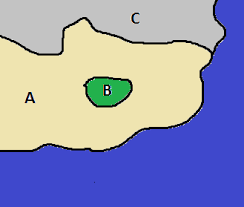
Prorupted State
Usually compact, but with a little tail
Ex: Thailand
Perforated State
Completely surrounds another, smaller state
Ex: South Africa around Lesotho
Elongated State
Long, narrow
Ex: Chile
Fragmented State
Mulitple pieces
Usually Isalnds
Ex: Indonesia
Landlock state
No direct access to ocean
Trade disadvantages, economic dependency on neighbors, relys on rivers
Ex: Niger
Enclave
A territory completely surrounded by another state BUT culturally/politically distinct from it
Dependent on surrounding state for trade & acess
Exclave
A territory of a state serperated from the main part of the country by another state’s territory
Ex: Alaska
Voting Districts
Geographic units for electing representatives
Ex: US congressional distrcts
Reapportionment
The process of redistritubtuing seats in the legislative body based on population changes determined by the census
Ex: After 2020 census, Texas gained 2 seats in HOR while NY & CA lost seats
Redistricting
Redrawing district boundaries after census data
Can be fair or biased, ties into gerrymandering
Gerrymandering
Manipulating district to favor a political party/group
Ex: Packing & cracking minorities
Unitary State
Power concentrated in the central governement, promotes uniformity
Ex: France, Japan
Federal State
Power shared between national and local governments
Ex: USA
Physical Geography
Mountians/distance isolate regions
Ex: Himalayas
Ethnic Separatism
Groups seeking political autonomy/independence
Ethnic Cleansing
Forced removal of ethnic groups to create homogeneity
Ex: 1990s
Terrorism
Violence used to destabliize governments and influence politics
Ex: ISIS
Economi
Creating economies of scale
Pooling resources & coordinating policies reduce production & distribtuoin costs]La
Larger markets boost effciency
EX: EU single market allows free movement of goods, services, labor
Military alliances
Collective security means an attack on one is an attack on all
Members coordinate defense and may station troops collectively
Ex: NATO- limits independent military control
 Note
Note  Flashcards (64)