PSYC2050
 Studied by 0 people
 Call Kai
 Learn
Learn Practice Test
 Spaced Repetition
 Match
Match Flashcards
 Knowt Play
1/183

Earn XP
Description and Tags
Final exam
Name | Mastery | Learn | Test | Matching | Spaced | Call with Kai |
|---|
No analytics yet
Send a link to your students to track their progress
184 Terms
habituation
getting used to it response
what is Watson's Methodological Behaviourism
Measure behaviour to infer learning
Limited to observable effects
what is Skinner's Radical Behaviourism
Measure behaviour to infer learning
Limited to observable effects
Complex processes can be broken into small behavioural stimulus and response units
what is US: unconditioned stimulus
A stimulus that naturally and automatically triggers a response without prior learning.
UR: unconditioned response
The natural reaction to an unconditioned stimulus that occurs without prior conditioning.
CS: conditioned stimulus
Stimulus to learn to respond
CR: conditioned response
Response to learnt CS
INNATE vs learned (conditioned or unconditioned)
unconditioned vs conditioned
. Phases of a typical conditioning experiment
habituation
aquisition
extinction
what happens during Habituation
CS presented alone
what happens during Acquisition
Present CS + US
what happens during Extinction
CS presented alone
Learning processes during extinction
Spontaneous recovery + Renewal effect + Reinstatement
Spontaneous recovery VS Renewal effect VS Reinstatement
reintroduce CS after break. CR reappears VS when extinction is context specific VS Present US alone after extinction
Factors influencing acquisition curve
Intensity of US (more intense, more rapid learning
Order and timing (CS coming before US is better)
describe delay conditoning short
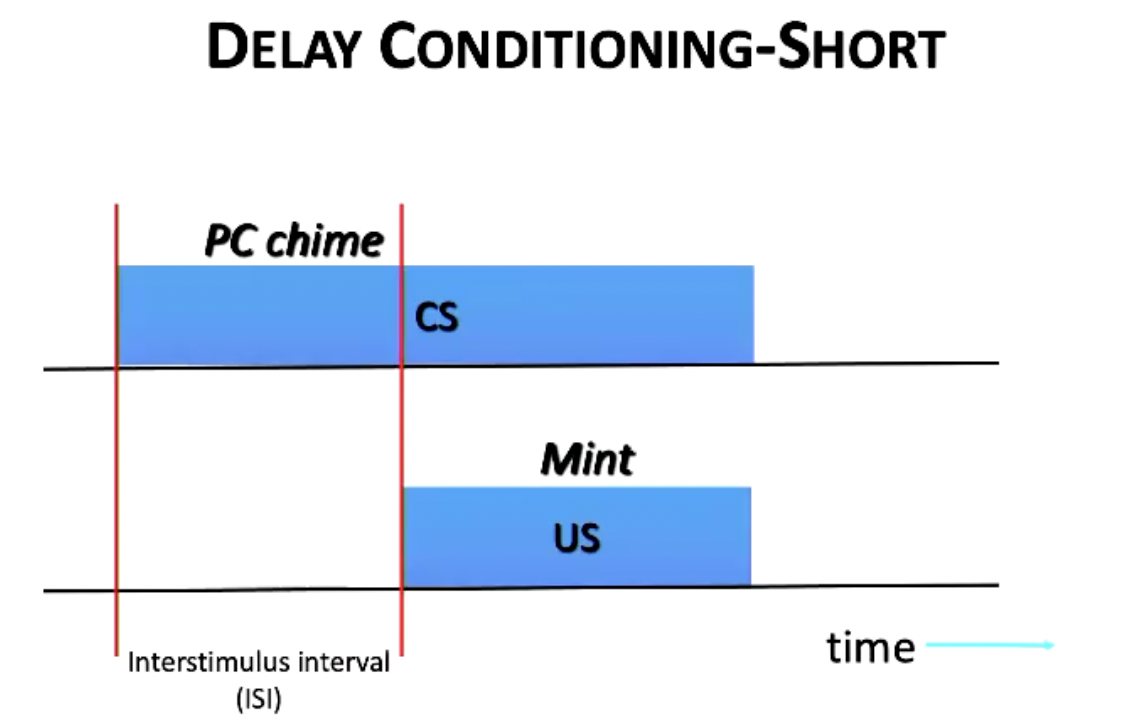
describe delay conditioning long
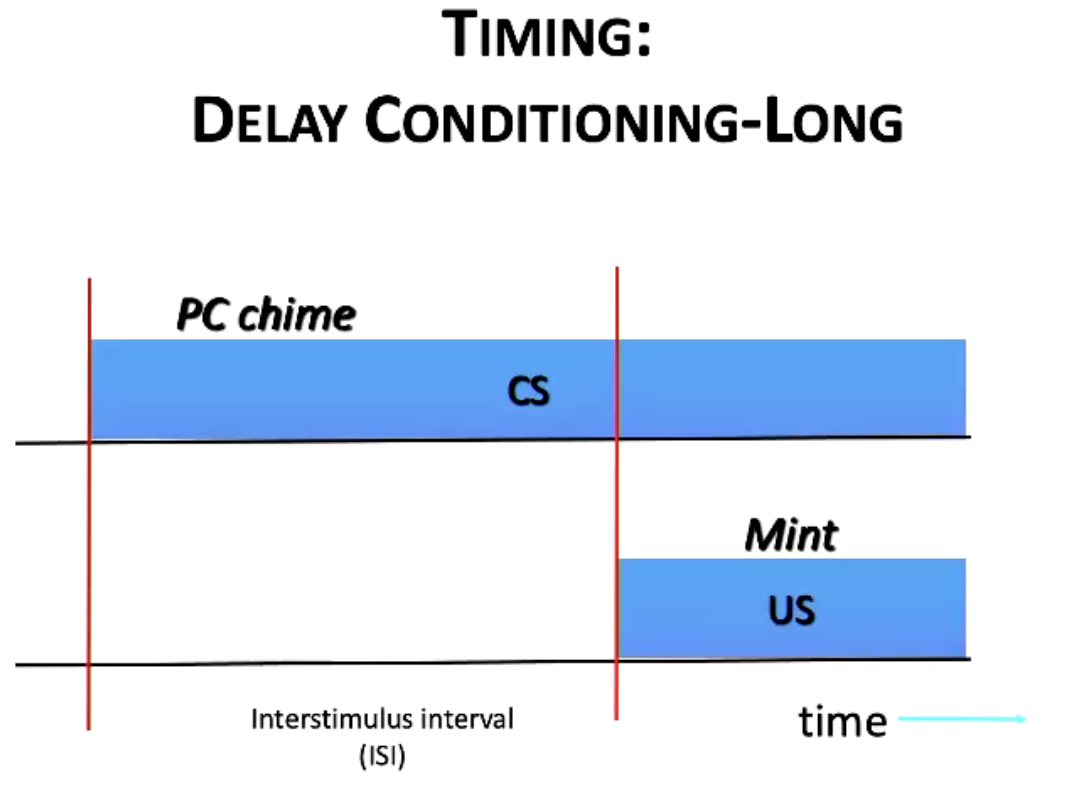
describe trace conditioning
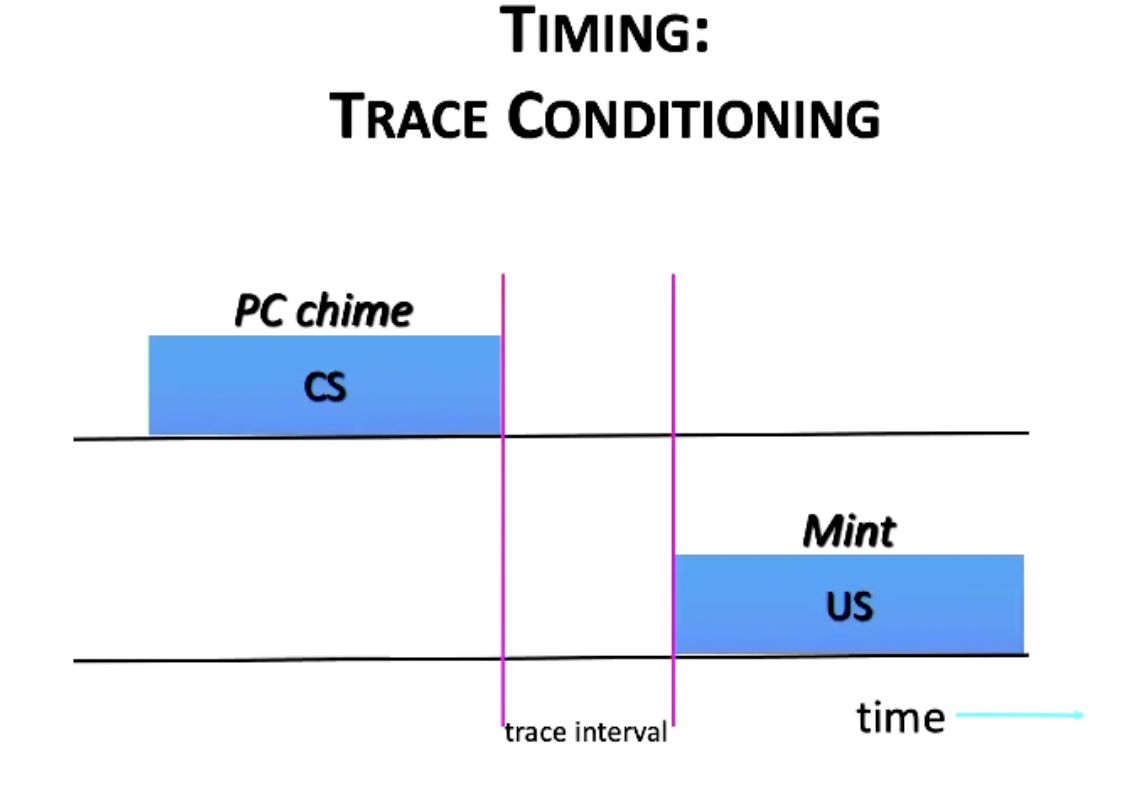
describe simultaneous conditioning
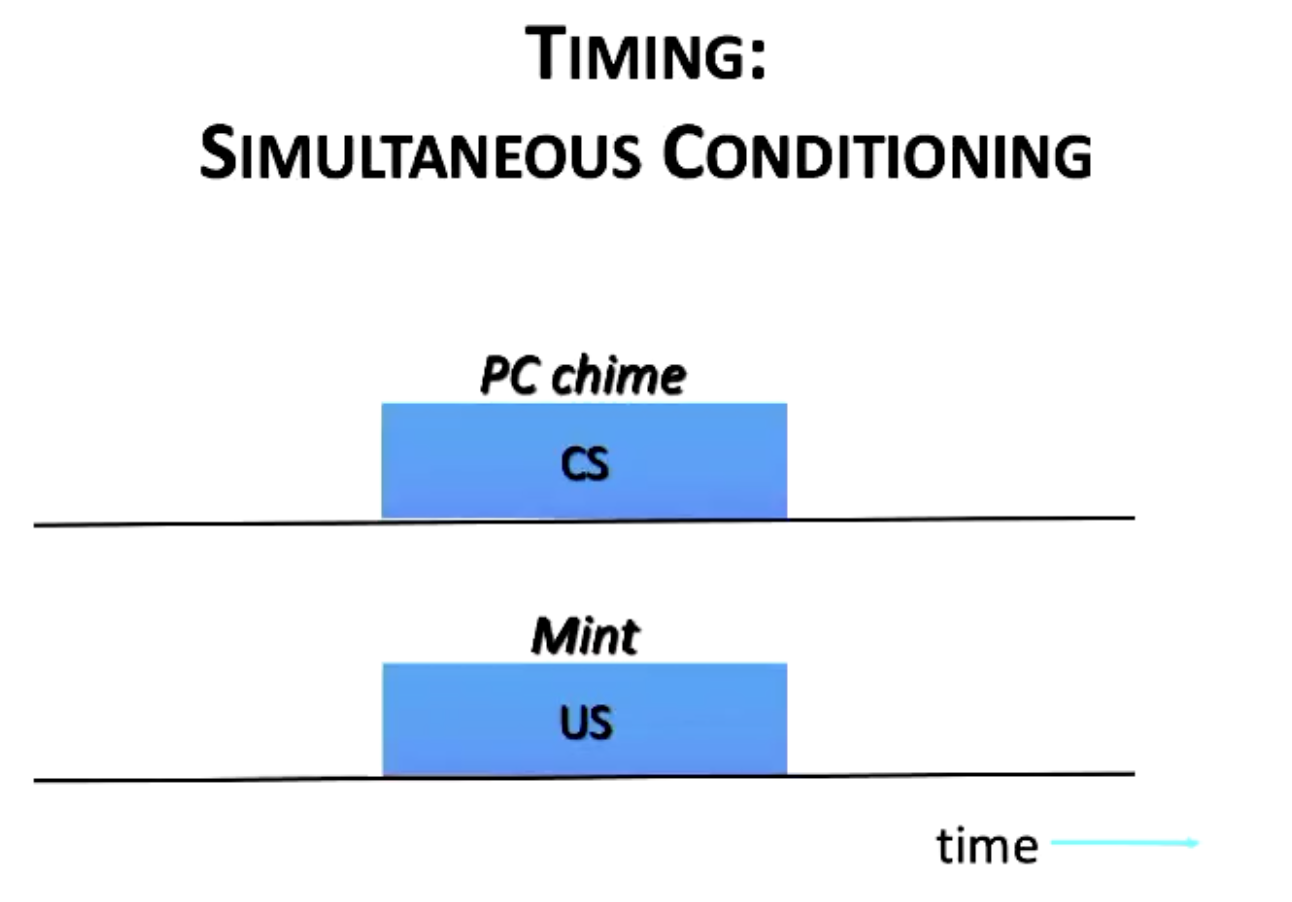
describe backward conditioning
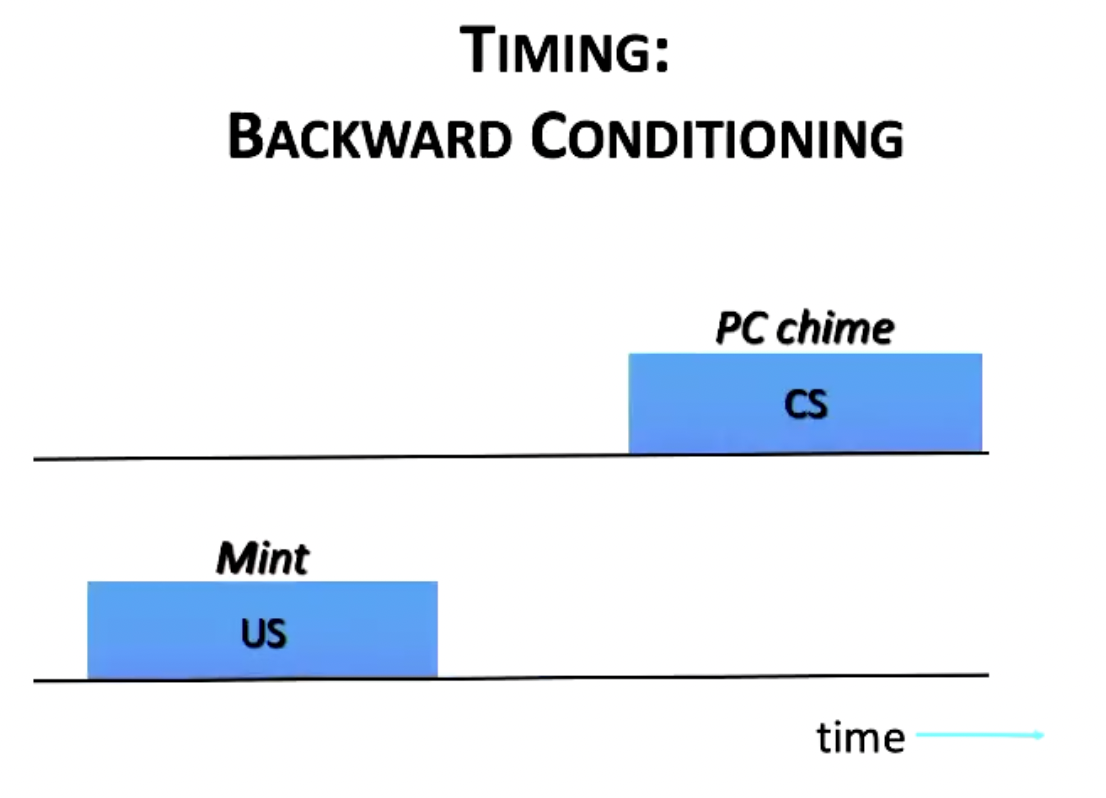
describe temporal conditioning
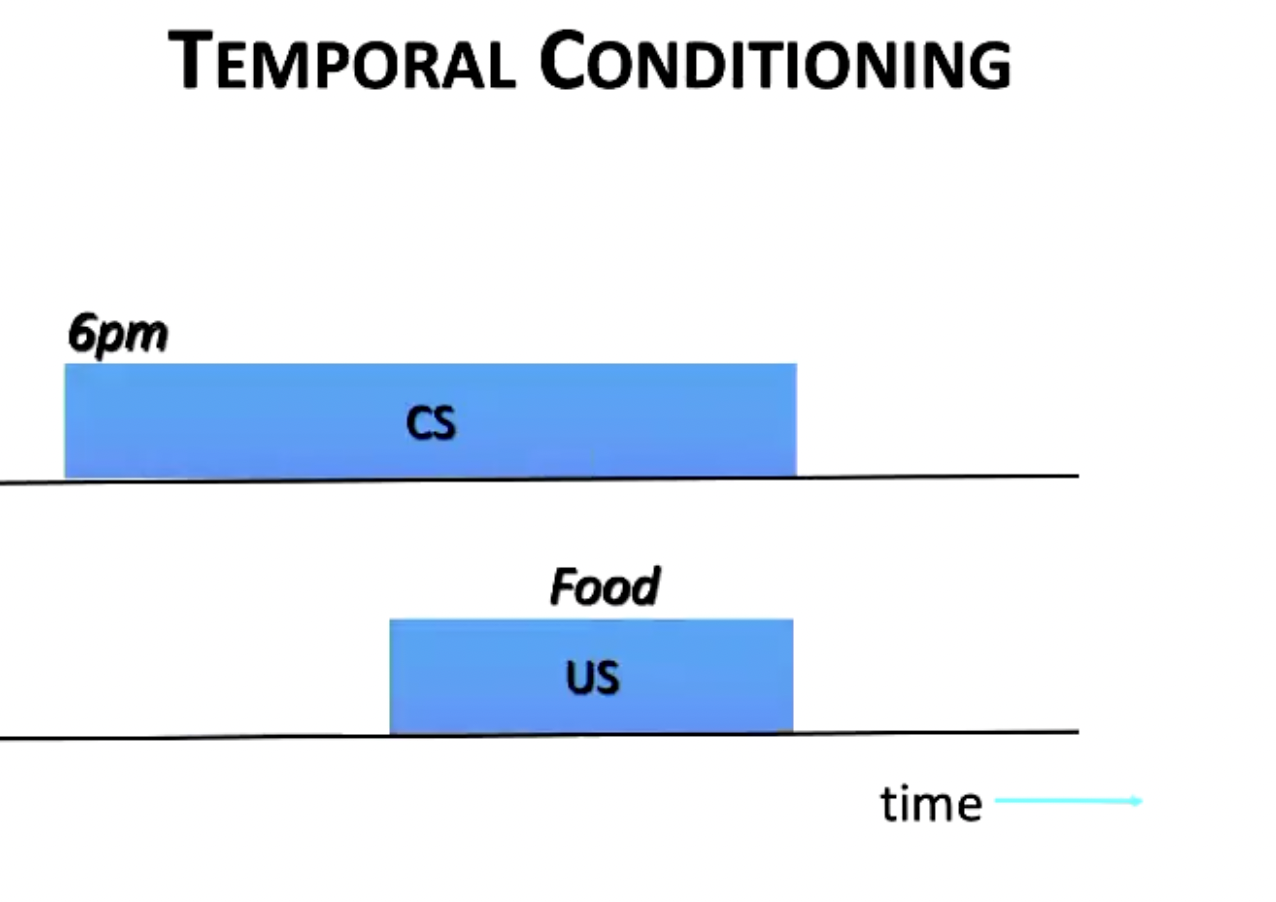
Excitatory
CS predicts occurrence of US
exam excitatory
if 'A' is bell… A-US, A-US, A-US -> A lead to CR
Inhibitory
CS predicts absence of US or different US
example of Inhibitory
E.g. if 'B' is light, so no US… A-US, A-US, AB, A-US, AB
Animal learns that B predicts absence of US, so no CR
How do we know if animal has learned smth about inhibitory stimulus?
summation and retardation tests
Retardation test (what takes place, how to test
Inhibitory conditioning takes place
A-US, A-US, AB, A-US, AB
B becomes inhibitor 'I'
To test: Train 'I' and neutral stimulus 'N' -> excitatory
I-US, I-US, I-US
N-US, N-US, N-US
Slower learning to inhibitor: I< N
You don’t learn as well to it because it was originally an inhibitory stimulus
summation test (what takes place, how to test
Inhibitory conditioning takes place
A-US, A-US, AB, A-US, AB
To test:
New excitatory CS alone: N
New excitatory CS + inhibitor: N + I
CR time is faster for N compared to N + I
retardation vs summation
What it is: A test to see if a stimulus takes longer to become excitatory.
How it works: After a stimulus has been trained as a conditioned inhibitor (meaning it signals the absence of an outcome), it is then paired with an outcome to become a conditioned excitor. If it functions as a true inhibitor, it will take more trials for the organism to learn the excitatory association compared to a novel stimulus.
Purpose: To determine if the prior inhibitory training has retarded the acquisition of an excitatory response. VS Inhibitory presented WITH new stim
Equipotentiality
any two stimuli can be paired together
Contiguity
the more two stimuli are paired, the stronger the association
Contingency
conditioning changes trial to trial in a regular way
Blocking
when a neutral stimulus and excitatory stim r paired with the US
no learning of neutral stimulus with the US
superconditioning
when a neutral stimulus and inhibitory stim r paired with the US
strong association of neutral stimulus with the US
example of blocking
E.g. rats in either 'blocking' and 'control group'
Control: light + noise -> shock , repeat till CR
Just light-> avoid
Blocking: noise -> shock, repeat till CR THEN light + noise -> shock
Just light-> no avoidance
Blocking effect: history of learnt blocks learning of new stimulus
example of superconditioning
Noise-> no shock , so safe. (inhibitor)
Tone + light -> shock
Rats showed stronger conditioning to light then control
CS pre-exposure (latent inhibition) ( retardation, summation?)
Longer you are presented with CS before learning protocol -> less likely to learn
Context specific
Passes retardation test
Does not pass summation test
testing Generalisation
Test:
CS1 (e.g. tone)- US
Test different groups with CS1(e.g. tone w diff frequency) CS2(e.g. tone w diff frequency) , CS3(e.g. tone w diff frequency) …
-> generalisation
E.G. Rabbit eye blink response
US: mild electric shock
UR: eye blink
CS+: 1200 Hz tone
-> Tone-shock; Tone-shock; Tone-shock
-> response
-> playing other frequency (e.g. 400 Hz, 800Hz) -> learning occurred, but learning is less compared to 1200Hz
*other similar stimuli may produce CR
More similar to CS, more likely to elicit CR
* as learning continues, organism learns the best CS associated with US (discriminate)
Garcia effect (preparedness)
Some association are learnt faster
US sickness (taste- sickness > noise + light- sickness)
US shock (taste- shock> noise + light- shock)
Because noise + light are commonly associated with lightning, which is like common sense
Rescorla-Wagner model
Explains how organism learns prediction of US
Expected VS actual strength of US
Big difference-> surprise
Expectation is based on prior experience with US
Strength of US is fixed
Describe a new fear conditioning experiment and use it to illustrate the renewal effect
CS: whistle
US: angry dog
UR: flinching
CR: flinching
Renewal effect: get extinction in one condition, one context, but in another context it comes back
E.g. administer shock in context A till extinction-> context B, CR comes back
Classical conditioning vs Operant conditioning
Classical conditioning | Operant conditioning |
Ivan Pavlov | B.F. Skinner |
Learning via association | Learning via reinforcement |
Relies on reflective associations between stimuli | Relies on consequences of past actions influencing behaviour |
Involuntary responses | Voluntary behaviours |
Chaining (teaching new behaviour)
Best to shape behaviour, best to start with the last behaviour on the chain (learning backwards)
Positive reinforcement
adds smth to increase behaviour (e.g. star for good behaviour)
Negative reinforcement
taking smth away to increase behaviour (remove discomfort)
Positive punishment:
adds smth to decrease behaviour (e.g. getting told off)
Negative punishment:
takes smth away to decrease behaviour (losing licence)
Strongest rate of learning: VI, FR, VR, FI
Strongest rate of learning: VR, FR, VI, FI
Schedules of reinforcements
Continuous (CRF)
More effective
Partial, Intermittent (ratio- instances of behaviour & interval- time of behaviour; fixed & variable)
Fixed ratio: every nth action is associated with an action (e.g. every 10th visit get free coffee)
Variable ratio: on average, every nth action (e.g. gambling 'wins' after placing bets)
Most resistant to extinction
Fixed interval: first behaviour after n seconds (e.g. pocket money every week for cleaning room)
Variable interval: on average, first behaviour after n seconds (e.g. checking messages)
Partial, Intermittent (Schedules of reinforcements)
ratio- instances of behaviour & interval- time of behaviour; fixed & variable
Fixed ratio
every nth action is associated with an action (e.g. every 10th visit get free coffee)
Variable ratio
on average, every nth action (e.g. gambling 'wins' after placing bets)
Most resistant to extinction
Fixed interval
first behaviour after n seconds (e.g. pocket money every week for cleaning room)
Variable interval
on average, first behaviour after n seconds (e.g. checking messages)
Successful punishment:
|
• understand the various reward variables that affect reinforcement
Drive: Reinforcement depends how much the subject wants it (motivation)
Magnitude/size: size matters (e.g. amount of food given)
Delay: delayed reinforcement reduces learning
Reinforces work better when:
– Drive/desire is higher
– Reinforcer is larger (but this tapers off)
– Reinforcer is given right away
Three term contingency
1. The discriminative stimulus - Sets the occasion
2. The operant response - The behaviour 3. The outcome (reinforcer/punisher) that follows - The consequence |
• understand the mechanism of stimulus control
|
Shaping (successive approximations)
Gradually develop new behaviour Reinforce behaviour that leads to desired behaviour |
Operant conditioning:
You don't need to experience responses or consequences for learning to occur
Behaviour regulation theory (premack
what if stimuli aren't reinforcers but behaviours are
E.g. water X -> drinking water
TV X -> watching TV
Escape learning
emit a response that terminates an aversive consequence (negative reinforcement)
Avoidance learning:
after escape learning has been learnt enough, emit a response that prevents an aversive consequence altogether
Avoidance learning- anxiety example
E.g. fear of snakes
Avoid going on bushwalks where snake could appear
Avoid the aversive feeling of snakes being around
Flooding method
Flooding (e.g. exposure to snakes with no negative consequence)
escape can't take place
Learned helplessness
Effect of unavoidable aversive experience
Functional analysis
What is the problem of behaviour? When does it occur? Identify reinforcers Stimuli, behaviour, consequence |
Positive parenting program
|
Using operant conditioning
Using chaining and reinforcement
E.g. sending kids to school
Teach kids behaviour to perform
Set a routine
Reward for desired behaviour
Avoid nagging or hassling
Turn it into a game
Selective attention
Ignoring irrelevant stimulus
MORE difficult the more similar the two things are
Endogenous/goal-directed (top-down) control
E.g. tuning out of dull convo and tuning into another
Exogenous/stimulus-driven (bottom-up) control
E.g. attention captured by shattered glass
Endogenous VS Exogenous
Endogenous/goal-directed (top-down) control VS Exogenous/stimulus-driven (bottom-up) control
Inattentional blindness
When you focus your attention, you miss other changes in plain sight
Change blindness
Changes are missed because they occur alongside brief visual disruption (e.g. blinks, windshield wipers)
Balint's syndrome simultanagnosia
Bilateral occipital/parietal lobe damage prevents patients from perceiving more than 1 stimulus at once, but you can link them together.
Describe evidence that attention spreads across objects
Balint's syndrome simultanagnosia Red dots- participants identify red Green dots- participants identifies green Red and green dots- participant only identifies red Linking red n green dots- participant identifies red n green |
Overt
Divert eyes to location of attention
Covert
Eye focuses on else where but attention is else where
Late selection
Distractor influences target processing
Something I didn't pay attention to but still extract meaning from it
Early selection
Distractor doesn't influence target processing
I know its colour, its blah
You target with something in mind before already
Perceptual load
Low load- numbers are higher, slower
High load- numbers are lower
Describe attention and the early vs. late selection issue
What impacts early or late selection is due to perceptual load.
Under what condition do you get late selection under the load theory
Conditions of Low perceptual load
High working memory load
Late selection Much easier to be distracted |
Low perceptual load =
VS
High working memory load =
Low perceptual load = late selection
VS
High working memory load = late selection
Low working memory load task
Number (e.g. 7
Reaction time task
Was the number a 7
High working memory load task
Number (E.g. 197365
Reaction time task
Was 7 a number
Broadbent's filter theory
Structural
Predicts early selection
Attentional limitations
Kahneman
Attention -> resources
Number of current task that can be performed depends on difficulty (resource demands)
Available resources increases under arousal/motivation
Automaticity -> training improves attention
Feature vs conjunction search
Feature (disjunctive) | Conjunction |
Parallel | serial |
Pop-out (doesn't matter how many distractors) | Increase distractors- longer search time |
E.g. red X amongst black X | E.g. red X amongst black X and red O |
Unaffected by search set size | Affected by search set size |
Pre-attentive | Attentive |
Efficient | Inefficient |
Target absent, conjunction search - takes longest time
Feature (disjunctive)
Feature (disjunctive) |
Parallel |
Pop-out (doesn't matter how many distractors) |
E.g. red X amongst black X |
Unaffected by search set size |
Pre-attentive |
Efficient |
Conjunction search
Conjunction |
serial |
Increase distractors- longer search time |
E.g. red X amongst black X and red O |
Affected by search set size |
Attentive |
Inefficient |
Feature integration theory (FIT)
|
Rapid serial visual presentation (RSVP)
Limitations:
|
Two target RSVP- attentional blink (AB)
Task: report the 2 letters amongst numbers
What varies is the number of distractors (e.g. 3 distractors in between -> lag 3)
People are good at lag 1
Easier identified T1-> reduce AB as less time to process
AB: rejecting distractions (if you remove distractions, there is no AB)
Task switching
E.g. T1: letter? T2: colour? Task set: rules to do a task Cost: disabling one task set/disengaging from prior task for another
Moving assembly line: focus on one task/pp The more similar two tasks are, the more difficult to switch (vise versa Practise reduce cost
Switching to EASIER task is MORE DIFFICULT -> hard to disengage from hard task |
Theories of switch cost
The theories differ in:
|
Automaticity
The more you learn a task, consumes fewer resources
Baddeley's Working memory (short term memory) model
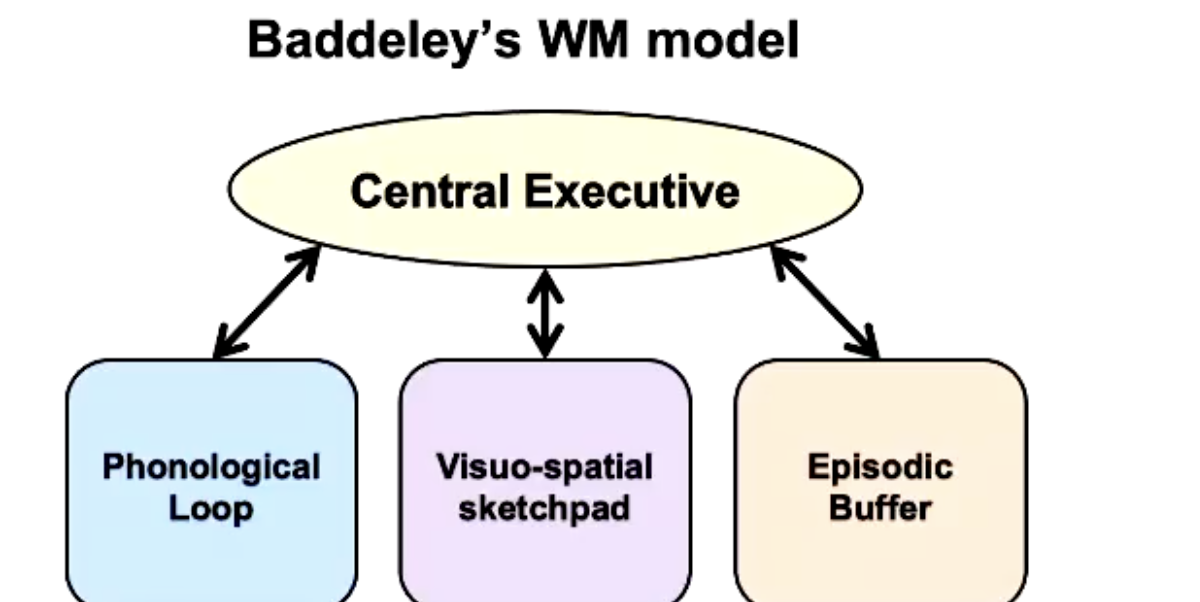
CENTRAL EXECUTIVE:
CENTRAL EXECUTIVE:
Attentional controller
Links working memory and long term memory
Switching attention
Mental manipulation of attention
No storage capacity
 Note
Note  Flashcards (115)