Week 1 Theory - Oral Health Sciences
 Call Kai
 Learn
Learn Practice Test
 Spaced Repetition
 Match
Match Flashcards
 Knowt Play
1/36

Earn XP
Description and Tags
DENT2010
Name | Mastery | Learn | Test | Matching | Spaced | Call with Kai |
|---|
No analytics yet
Send a link to your students to track their progress
37 Terms
What are the functions of the tongue?
Speech
Mastication
Swallowing
Sensory
Explain the function of mastication of the tongue briefly.
It involves crushing food against the palate and moving food around the mouth.
What does the sensory function of the tongue involve?
Pain
Temperature
Touch
Gustation (tasting)
What are the 2 types of muscles the tongue has and explain the difference between them?
Intrinsic - change the shape of the tongue
Extrinsic - change the position of the tongue
Describe intrinsic muscles in the tongue.
All origins & insertions are WITHIN the tongue.
Attaches to peripheral & central connective tissue
What 3 planes are intrinsic muscles in the tongue known by?
Vertical
Transverse (across/horizontal)
Longitudinal: superior & inferior
Describe extrinsic muscles in the tongue.
All insertions are into the tongue
All origins are OUTSIDE of the tongue
List the functions of the extrinsic muscles.
Protrude
Retract
Depress
What are the origins of each of the extrinsic muscles?
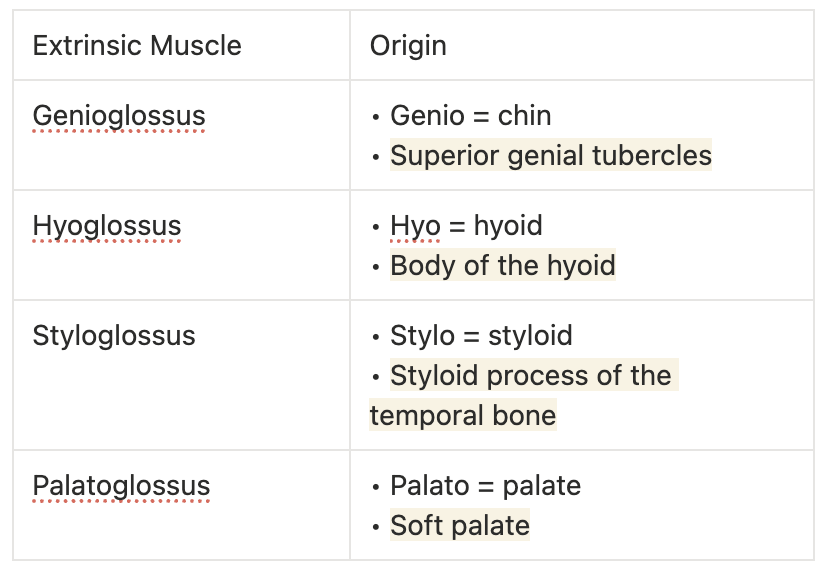
What are the insertion locations of each of the extrinsic muscles?
Genioglossus ⇒ inferior aspect of tongue & the hyoid
Hyoglossus ⇒ lateral aspect of the posterior half of the tongue
Styloglossus ⇒ Posterior bundles into the longitudinal intrinsic muscles on the lateral aspect of the tongue and the anterior bundles into the inferior aspect of the apex (tip)
Palatoglossus ⇒ Posterolateral surface of the tongue
What are the actions of each of the extrinsic muscles?
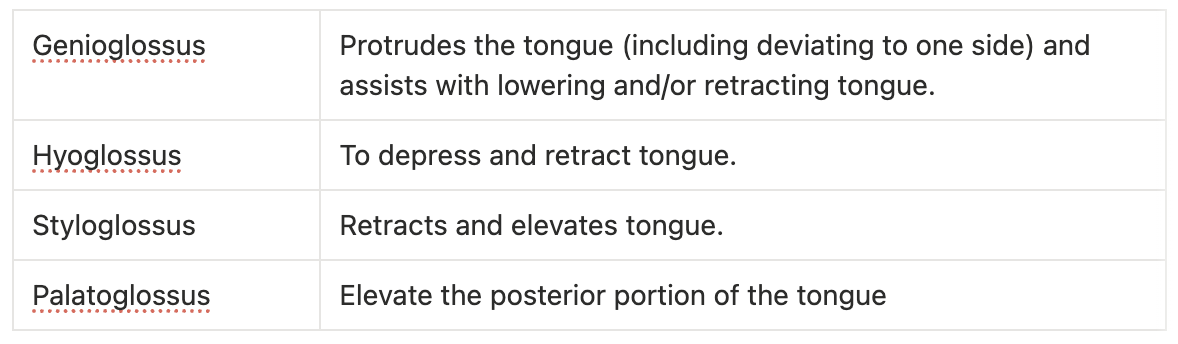
What are the innervation of each of the extrinsic muscles?
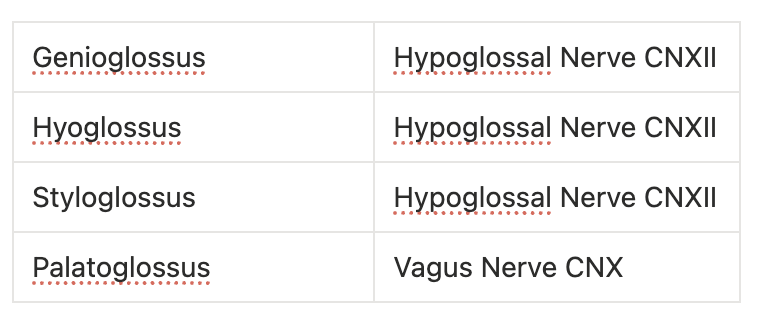
List the different borders of the floor of the mouth.
Inferior : Mylohyoid muscle
Lateral : Medial surface of the mandible
Anterior : Medial surface of the mandible
Superior : Oral mucosa & tongue
Posterior : Inferior aspect of the palatoglossal arch.
State the origin, insertion, action and innervation of the mylohyoid.
Origin: mylohyoid line on the medial surface of the mandible.
Insertion(s): mylohyoid raphe & body of the hyoid
Action: Elevate the floor of mouth and/or depress the mandible
Innervation: 5th Cranial Nerve, mandibular division (3rd branch) of the trigeminal nerve
List the contents of the floor of the mouth.
Salivary glands & associated structures
Nerves
Blood vessels
Lymphatics
List the salivary glands & associated structures that are located in the floor of the mouth.
Submandibular salivary gland
Sublingual salivary gland
Wharton’s duct
Various minor ducts
Submandibular fossa
Sublingual fossa
List the nerves of the floor of the mouth.
Sensory: predominantly lingual nerve.
Motor: Hypoglossal (CNXII), Mylohyoid branch (CNV3)
Compex variations with many anastomoses possible.
The palate is the superior border of the oral cavity. Which 2 regions is the palate divided into?
Hard Palate & Soft Palate
Describe the anatomical features of the hard palate.
Approximately anterior 2/3 of the palate
Tissue firmly bound to periosteum
Palatal rugae
Minor salivary glands
List the functions of the hard palate.
Separates nasal and oral cavities
Speech
Suckling & Mastication
Briefly describe the soft palate.
Approximately, the posterior 1/3 of the palate *with the uvula hanging from the middle
Flexible muscular flap extending from the posterior edge of the hard palate
Attached to the lateral walls of the pharynx
What are the functions of the soft palate?
Swallowing: When tensed, it assists the tongue by directing food into the pharynx without regurgitation into the nose.
Breathing: can seal off the mouth to allow breathing whilst sucking and chewing to limit the danger of inhaling food.
Coughing: seals off nasopharynx to allow the blowing of air through the mouth
Muscles of the soft palate are made up of what?
Made up of a fold of mucous membrane which encloses 5 pairs of muscles.
List the muscles of the soft palate and their functions.
Tensor Palati - tenses the soft palate & possibly opens the auditory tube
Levator Palati - elevates the soft palate
Palatoglossus - pulls soft palate downwards as well as elevating the tongue.
Palatopharyngeus - constricts the oropharynx & elevates the larynx.
Muscularis Uvulae - elevates/retracts the uvula.
Describe the innervation of the palate.
SENSORY NERVES:
These nerves are branches of Cranial Nerve V2 (maxillary division of the Trigeminal)
Nasopalatine supplies the premaxilla
MOTOR NERVES:
Soft Palate
These are mostly from branches of CN X (Vagus)
Describe the blood supply of the palate.
The greater palatine artery meets with nasopalatine artery to supply the hard palate and associated glands.
The lesser palatine artery supplies the soft palate & its muscles
Additional minor supplies are received from branches of the facial and external carotid arteries.
Describe the pharynx.
A muscular tube lined with mucosa that is approximately 12cm long
Attached to the cranial base
Connects the outside worlds to the lungs and Gastrointestinal Tract
What 3 regions is the pharynx divided into?
Nasopharynx - dorsal to the nasal cavities
Oropharynx - dorsal to the mouth
Laryngopharynx - dorsal to the larynx
Describe the nasopharynx.
Continuous with the nasal cavity
Continuous to humidify & warm air as it travels toward the lungs
Mucous production
Adenoids or pharyngeal tonsils
Describe the oropharynx.
Separated from the oral cavity laterally by the palatine tonsils that sit between the palatopharyngeal fold (posterior tonsillar fauces) and the palatoglossal fold (anterior tonsillar fauces)
Aids in swallowing
Mucous production
Describe the laryngopharynx.
Directly continuous with oesophagus
Continuous with the vestibule of the larynx
Ventral to inferior regions bordered by epiglottis
Mucous production
Describe the pharynx.
A muscular tube lined with mucosa that is approximately 12cm long
Attached to the cranial base and connects the outside world to the lungs and G.I.T
What 3 overlapping muscle groups does the pharynx consist of?
Superior constrictor
Middle constrictor
Inferior constrictor
What does the superior constrictor muscle group consist of?
2 bilateral muscles
Origins include:
Pterygomandibular raphe.
Pterygoid hamulus.
Mandible.
Mucous membrane of the mouth.
Lateral aspects of tongue.
Inserting at the posterior median pharyngeal raphe
What does the middle constrictor muscle group consist of?
Two bilateral fan shaped muscles.
Origins include stylohyoid ligament & hyoid bone.
Inserting at the posterior median pharyngeal raphe.
Lies superficial to the superior constrictor.
What does the inferior constrictor muscle group consist of?
Inferior and superficial to the middle constrictor.
Origins are from the thyroid & cricoid cartilages of the larynx.
Inserts into the posterior median pharyngeal raphe.
What is the origin, insertion and function of the right & left stylopharyngeal muscles?
Origin – styloid process of the temporal bone
Insertion – posterior & lateral pharyngeal walls
Functions to elevate & widen the pharynx

