Ch. 12 - ESA, FED land, and FIFRA
 Call Kai
 Learn
Learn Practice Test
 Spaced Repetition
 Match
Match Flashcards
 Knowt Play
1/54

There's no tags or description
Looks like no tags are added yet.
Name | Mastery | Learn | Test | Matching | Spaced | Call with Kai |
|---|
No analytics yet
Send a link to your students to track their progress
55 Terms
Endangered Species Act (ESA)
President Nixon signed it into law in 1973
Goal: To protect critically imperiled species from extinction as a result of economic growth and development unmoderated from concern and conservation of the environment or its resources
It was passed in response to an alarming decline in animal and plant species
It is one of many federal laws designed to protect plants, animals, birds, and fish
ESA was amended in _______.
1978, 1982, 1988, and 2004.
Evolution of ESA
1978 ESA Amendment
Federal agencies could jeopardize listed species if approved by Cabinet-level committee
Critical habitat had to be designated at the time the species was listed
A program for conserving fish, wildlife and plants, including listed species, and land acquisition authority was granted to all such species.
1982 ESA Amendment
Status of a species, solely on biological and trade information (does not consider possible economic or other effects)
Status of species decision had to occur within 1 yr, unless withdrawn (used to be 2 yrs)
Some listed species defined as “experimental populations”
Evolution of ESA (cont.)
1982 ESA Amendment
Prohibited removal of plant species from federal lands
Allowed “incidental take” permits, which allowed permittees to use endangered species habitat under certain conditions (H.C. plan; minimize? Mitigate? Money?)
1988 ESA Amendment
Monitoring of candidate/recovered, emergency listing → sig. risk
Public participation was required in recovery plans and consideration req.
5 yr minimum monitoring; biennial reporting of dev. and implement. Of plans and status of all species with plans
Financial reports for monies spent on a species-by-species basis
Malicious destruction or other “takes” that violate State law prohibited for plants in Federal lands
Evolution of ESA (cont. 2)
2004 ESA Amendment
Dept. of Defense exempted from critical habitat designations, so long as an integrated natural resources management plan is formed and the Secretary of the Interior approves of it.
ESA is administered by the:
Fish and Wildlife Service (FWS), which is a part of the Department of Interior.
National Marine Fisheries Service (NMFS), which is a part of the National Oceanic and Atmospheric Administration (NOAA)
Enforcement of ESA (cont.)
National marine fisheries service (NMFS) is responsible for marine environments and anadromous fish (born in freshwater but migrate to the ocean to breed)
Fish and Wildlife service (FWS) manages species in terrestrial and freshwater environments, and migratory birds
Other agencies may be able to cite ESA in executing their responsibilities → EPA can prohibit use of a pesticide if it adversely affects the habitat of a listed species.
ESA is a contested political issue that _______.
pits environmentalists, who generally do not want the act to be revised in any significant way, against opponents with differing viewpoints.
Private landowners → some argue that a few landowners bear the entire cost of public benefit. Some preemptively destroy habitat of potentially endangered species, hinder collection of information about endangered species on their property, or even kill listed species (a.k.a. “shoot, shovel, and shut-up”)
What about natural selection? Some argue that we may be interfering with natural processes that could be driving that species to extinction naturally aka going against nature.
Threatened Species
Those that are likely to become endangered in the foreseeable future
Endangered Species
Those in danger of extinction (confined to a small area) throughout all or significant portion of its range
Listing a Species
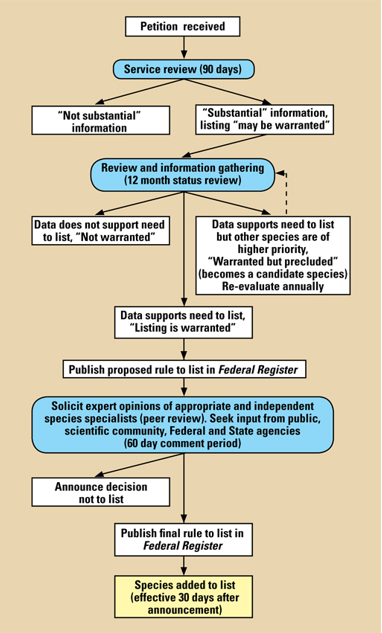
The agency (NMFS/FWS) receives a formal petition supported with biological data
Agency must review within 90 days (if practicable)
Listed species are managed based on a priority system based on threat (most important), immediacy of threat, and the taxonomic distinctiveness of the species.
The priority of the system gives no preference to popular species, “higher life forms”, and/or economic consequences → But what about the public? Elected officials represent the public, right? → Public may skew towards protecting “charismatic megafauna” instead of other endangered species
How is a threat determined?
These are the factors that are considered when determining the magnitude of threat, which is the most important factor in reviewing if a species is endangered or threatened.
Present or threatened destruction, modification, or curtailment of the species’ habitat or range
Over-utilization for commercial, recreation, scientific, or educational purposes
Disease or predation
Inadequacy of existing regulatory mechanisms
Other natural or artificial factors affecting the species’ survival
ESA Review Process
If after reviewing all this information and the agency makes a positive substantial information finding, then the review process begins
Agency has 1 year to make a decision that stipulates:
- Listing is warranted but precluded
- Listing is warranted
Warranted but Precluded Process
By definition → listing of a species as endangered or threatened is warranted, but will not occur due to higher priorities
If this finding is reached, subsequent findings on each succeeding anniversary of the petition is required until either a proposal/petition is undertaken (or warranted) or not warranted finding is made.
If not warranted is the final result, then the species is not listed.
The Beginning of the Warranted Process
The agency publishes a notice of review that identifies candidate species to solicit biological information to complete the status reviews for this species.
The public has approximately 60 days to add additional information or comments
The agency must complete their review of findings within 1 year of the listing proposal.
Warranted Process: Review Products
The agency will:
Create a final listing rule is published as proposed or revised based on the best available biological data
Withdraw proposal because biological data does not support it
Extend the proposal for six months because there lacks scientific consensus warranting its listing
If approved, the final listing rule becomes effective approx. 30 days after publication in the Federal Register
If a candidate (FWS term) or species of concern (NMFS term) does not qualify for listing, it ________.
does not necessary mean “doom and gloom” for said species.
Agencies may decide to initiate conservation activities designed to mitigate damages to the species without restricting its educational, commercial, recreational, or economical uses.
This might include entering into agreements with other governmental or private agencies (or even individuals) to lessen damages to the species.
A practical example of this might include the FWS entering into Candidate Conservation Agreements with Assurances for Non-Federal Landowners
If landowners implement various conservation activities, they will not be subject to additional restrictions if the species becomes listed later.
Post-listing Management
The ESA now applies to the listed species and its habitat. At the time of listing or within 1 year of listing, designation of critical habitat must occur.
Thus, the species should benefit from ESA, by:
Protection from adverse effects of federal activities
Restrictions on taking, transporting or selling
Development of a recovery plan designed to rebound from damages
Acquisition of critical habitat to ensure survivability
Aid (financial, logistical support, etc.) to state wildlife agencies
Recovery plans include goals, tasks required, estimated costs, and estimated timeline to recover listed species.
These plans usually target a 3 year recovery period, based on FWS policy.
ESA places special restrictions on how individuals _______.
can interact with listed species, but puts particular emphasis on takings and private property
What is a take?
ESA defines this as “to harass, harm, pursue, hunt, shoot, wound, kill, trap, capture, or collect a listed species” → any interaction with an endangered species
These protections apply to federal lands (e.g., national parks, beaches, and other public lands) AND to private properties.
In other words, almost any form of interaction with an endangered species could be defined as a take, especially with respect to economic gain.
Ex: taking an up-close picture of the animal, taking a feather, walking on endangered plants, etc.
In addition to “take” laws with respect to ESA, the act also forbids _______.
other violations that apply to live or dead animals, parts of the animals, and seeds.
Import, export, deliver, receive, carry, transport, or ship a listed species in interstate or foreign commerce in the course of a commercial transaction
Offer for sale (without an indication of the need for a permit), or sell a listed species in interstate or foreign commerce
Take a listed species on the high seas
Possess, ship, deliver, carry, transport, sell, or receive unlawfully taken wildlife
Remove and reduce to possession any listed plant from an area under federal jurisdiction
Maliciously damage or destroy an endangered plant on areas under federal jurisdiction
Remove, damage, or destroy an endangered plant in violations of state law
ESA Exemptions
Species held in a controlled environment or in captivity at the time they were listed may continue to be held for noncommercial activities
Transactions that take place entirely within a single state are not covered by the ESA, but could be covered by state law
Antiques, such as scrimshaw, with proper documentation
Noncommercial loans and gifts, such as breeding agreements between zoos
Hybrid offspring of a listed parent and a non-listed parent, bred in captivity
Seeds from artificially propagated specimens of threatened plants
Situations covered by special rules for certain species (e.g., American alligators) and issuance of permits (more on this later).
These exemptions could be covered by other laws. This list is not exhaustive other situations may exempt an individual from ESA. Examples of these situations: killing in self-defense, sustenance, or part of religious observance
Types of ESA Permits
Incidental take
Enhancement of survival
Recovery and interstate commerce
Incidental take permit
Required when a nonfederal activity will result in a take (as defined earlier) of a listed species
Applicants must develop a habitat conservation plan,
This is a binding agreement between an agency and a private entity or state that specifies conservation measures to be implemented in exchange for a permit.
The taking must “not appreciably reduce the likelihood of the survival and recovery of the species in the wild.”
There must also exist adequate funding and provisions to address any unforeseen circumstances.
Enhancement of survival permit
May be required for activities that may benefit a listed species through conservation of its habitat.
Applicant must develop a safe harbor agreement or a candidate conservation agreement.
A safe harbor agreement is a voluntary agreement between the agency and non-federal landowner to give owner assurances that agency will not later impose restrictions on land as a result of owner’s conservation actions.
Ex: controlled burn for some species of trees
Recovery and Interstate commerce permit
Required to engage in scientific research on or conduct activities to enhance the propagation or survival of a listed species, if those activities may result in a take (as defined earlier).
Under some circumstances, these permits may be needed for possession of tissues and/or body parts of listed species.
Abundance survey
Genetic research
Capture and marking
Others: relocations and telemetric monitoring
Tribal governments are ______.
separate and sovereign nations, and do not acknowledge ESA.
A special trust fiduciary relationship exists between tribal governments and the federal government. The US government is required to protect tribal lands and resources, unless otherwise unencumbered through mutual agreement.
There are special protections in place to prevent tribal governments from bearing a disproportionate burden of conservation of species under ESA.
Essentially, it is up to the tribal governments to engage in similar conservation efforts that the federal government uses. Ideally, agencies and tribal governments work cooperatively to manage listed species.
Tribal lands are not a part of federal lands, but the federal government is responsible for protection of these lands and tribal resources
ESA Restrictions on Federal actions
Section 7 of ESA requires all federal agencies to conserve threatened and endangered species to ensure that their actions do not jeopardize listed species or destroy or adversely modify critical habitat.
If an action by a federal agency will, or has potential to, negatively affect (as defined above) a listed species or its habitat, then that agency must consult with FWS or NMFS (depending on the species).
FWS/NMFS Consultation
Applicant requests from FWS/NMFS regarding presence of listed species
If none, great → action can continue unless a change occurs; otherwise…
Applicant informs FWS/NMFS if action will affect the listed species
“May affect” → includes positive and negative effects
“No effect” → no further consultation required; this includes “positive effects”; otherwise
If adverse effects are likely, formal consultation (takes a long-time) is required.
Applicant provides all necessary information regarding effect to listed species
Agency evaluates current status of listed species or habitat
Agency evaluates effects of proposed action on species and/or habitat
Agency provides a science-based biological opinion, which is “… the [likelihood that the proposed action will] jeopardize continued existence of listed species or result in destruction or adverse modification of critical habitat.”
The results of biological opinions can be challenged in courts.
Congress amended ESA that created an _______.
Endangered Species Committee (a.k.a. God Squad) to exempt some projects from ESA regulations.
The requirements for exemption are extremely exclusionary (doesn’t happen often)
As of 2013, < 10 exclusions have been granted.
National security concerns take priority over ESA, and thus overrule ESA.
Economics vs. Ecology?
ESA decisions often “boil down” to this. For example:
In the late 1980s, listing of the spotted owl resulted in the requirement of leaving at least 40% of old-growth forests intact within a 1.3 mi radius of any spotted owl nest or activity site à many industry workers lost their jobs.
In 1978, Tennessee Valley Authority v Hill et al. (not Mr. Hill). Environmental group blocked building a dam because it would impact an endangered snail darter fish → $80 million (that’s ~$317 m today) had already been spent on construction of the dam. Supreme Court ruled against construction citing that cost could not be considered.
Recall that economic considerations are not a factor in the management of listed species that we discussed earlier → only rely on biological data → why private land-owners dislike it
The federal government maintains a _______.
national list of threatened and endangered species, and authorizes state governments to develop their own lists of threatened and endangered species (like CWA).
State lists cannot contradict or go against federal lists
Impacts on listed species must also be considered by agencies implementing NEPA requirements.
“Major construction activity” requires a biological assessment of their project site.
Federal Lands
Include general public land (Bureau of Land Management), national parks (NPS), national wildlife refuges (FWS), and national forests (U.S. Forest Service)
Management of wildlife refuges, national parks, and national wilderness areas are _______.
less complicated, and focused primarily on conservation.
no takes or use at all
Federal Insecticide, Fungicide, and Rodenticide Act
AKA FIFRA, was signed into law by President Truman in 1947.
The act authorizes the EPA to review and register pesticides for specific uses and to suspend or cancel the registration of a pesticide if subsequent information shows that continued use would pose unreasonable risks to human health and the environment.
Pesticide is defined as any _______.
substance intended for preventing, destroying, repelling, or mitigating any pest or a substance used as a plant regulator, defoliant, or dessicant.
It does not include substances that have actual effects of a pesticide if the substance is not intended for that purpose (e.g., pepper spray)
Pest is defined as _______.
insects, rodents, worms, fungus, weeds, plants, virus, bacteria, micro-organisms, and other animal life
source of discomfort and compete with our resources
History and evolution of FIFRA
Collectively these amendments:
Strengthened enforcement provisions of FIFRA
Broadened the legal emphasis on protecting health and the environment
Regulated the use of pesticides
Extended the scope of federal law to cover intrastate registrations
Streamlined the administrative appeals process
Regulation of pesticides
The EPA reviews and scrutinizes a pesticidal product based on:
Efficacy: effective for its advertised purpose
Safety: potential risk or side-effects to human health and the environment when used as intended
Proper labeling: presence of specific directions and precautions on the basis of scientific data; and description for product uses, who can use it, where, how much, and how often.
Individuals may need to become certified to use ______.
certain pesticides, and the type of certification affects the manner in which these chemicals can be applied
private and commercial applicators
Private applicators
Certified to use or supervise application only on their own property
Commercial applicators
Certified to use or supervise applications on other peoples’ properties
Public health pesticides are used primarily _______.
for public health programs.
Public health programs rely on pesticides to control mosquitos to prevent spread of vectors
Risk of disease vs. risk of product?
Hurricanes, nor’easters, and other significant flooding
Pesticide residue in food
EPA sets standards and FDA enforces standards
These standards are called tolerance levels, which are the allowable levels of pesticide residue on foods. Ideally, set to levels that will not result in short- or long-term damages to human health.
Like CWA and ESA, state governments can enact laws that are more stringent than FIFRA.
EPA can cancel a ______.
pesticide if there is a high probability of harm to health or the environment
This process may take months or years (rare cases of emergency suspension)
Formal process begins with notice of intent to cancel a pesticide’s registration
After notice, public comment and hearings begin to gauge public opinion
Burden of proof on manufacturer to show that the risk is not unreasonable
If registration is canceled, product no longer shipped/sold in the US. There are no restrictions on exporting of the product – it can still be produced in the US.
Federal Food, Drug and Cosmetic Act (FFDCA)
Signed into law by President Roosevelt in 1938 and has been amended numerous times.
It is implemented by the FDA.
The goal is to protect public health by ensuring consumers are purchasing foods that are safe, wholesome, and properly labeled.
In 2009 it was amended to regulate foods, medical products (e.g., therapeutic drugs), dietary supplements, cosmetics, and tobacco.
How food is defined by FFDCA:
Products that are “food and drink” for consumption by humans or other animals
Some less obvious examples: chewing gum, spices, coffee beans, cooking oils, etc.
Meat and poultry products are not regulated by FDA; they are regulated by USDA (recall sticker information on meat products: USDA Grade A Beef)
FDA does not regulate foods prepared and served in restaurants. Recall the Foods lecture, these are regulated by local health departments.
Food labeling
As mentioned earlier, EPA creates tolerance limits for pesticide residues in food, and the FDA enforces these regulations.
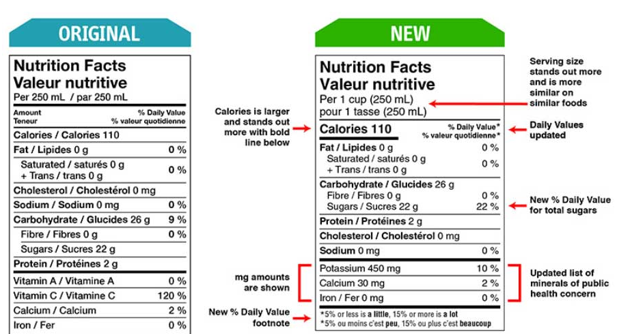
FDA also establishes food label requirements including: basic ingredients, quantity, disclosure of additives (e.g., artificial flavoring, coloring, chemical preservatives), nutrition information, trans-fat content, and ingredients associated with allergies (e.g., peanuts, wheat, cow’s milk, shellfish)
FDA must approve of _______.
any new drug before it is marketed in US
FDA must determine if the drug is safe and effective for its intended use (not risk free)
Balances risk vs. benefits
Dietary supplements are ______.
not regulated as drugs; they are regulated as foods (no risk vs benefits assessment)
Examples include: vitamins, supplements, energy bars, etc.
Ephedrine alkaloid dietary supplements are chemical stimulants previously sold for weight loss
Consumption of these dietary supplements resulted in severe side effects (e.g., heart attack, stroke, etc.)
FDA banned use of them in 2004 after 20 years of use.
FFDCA puts burden of proof on FDA requiring years of scientific evidence to support the ban, which is why it took so long – change needed?
Summary
ESA was passed in response to large declines in animal and plant species, and offers many protections for listed species. This Act governs how individuals, entities, and governmental agencies can interact with public and private lands based on presence of listed species.
Opposition to ESA tends to be primarily centered around economics and private property uses; but there exist exemptions for individuals and the federal government.
Exemptions require that actions by an individual or federal agency will not substantially damage the survivability of the listed species
Management of general public lands and national forests tends to be more complicated than wildlife refuges, national parks, and national wilderness because of their differing allowable uses
FIFRA authorizes EPA to review and register pesticide uses to ensure that they are not a threat to health and the environment
FFDCA authorizes EPA to set standards for pesticide residual in foods, but FDA regulates them. FDA also regulates some foods (not meat/restaurants), drugs, and dietary supplements.
Management of general public land and national forests is guided by _______.
Federal Land Policy and Management Act (43 USC Sect. 1701)
Conservation, recreation, and environmental concerns are not always the top priority in management of these lands.
In some cases, grazing, mineral extraction, and logging (economic uses) are given priority.
Preservation vs conservation
Preservation: prevent change/protection
Conservation: preservation for tomorrow → does allow some consumption → use it but don’t deplete it
Characteristic Megafauna
Species the public care about because they are cute
FWS regulates endangered species in habitats ______.
on land and freshwater, while NMFS regulates endangered species in habitats on marine environments.

