RP 5: Determination of resistivity of a wire using a micrometer, ammeter and voltmeter.
 Call Kai
 Learn
Learn Practice Test
 Spaced Repetition
 Match
Match Flashcards
 Knowt Play
1/13

There's no tags or description
Looks like no tags are added yet.
Name | Mastery | Learn | Test | Matching | Spaced | Call with Kai | Chat |
|---|
No analytics yet
Send a link to your students to track their progress
14 Terms
What is the method used to determine the resistivity of a wire? (8)
- Use a micrometer to measure the diameter of the constantan wire at several points along its length. Record the values and calculate the mean diameter.
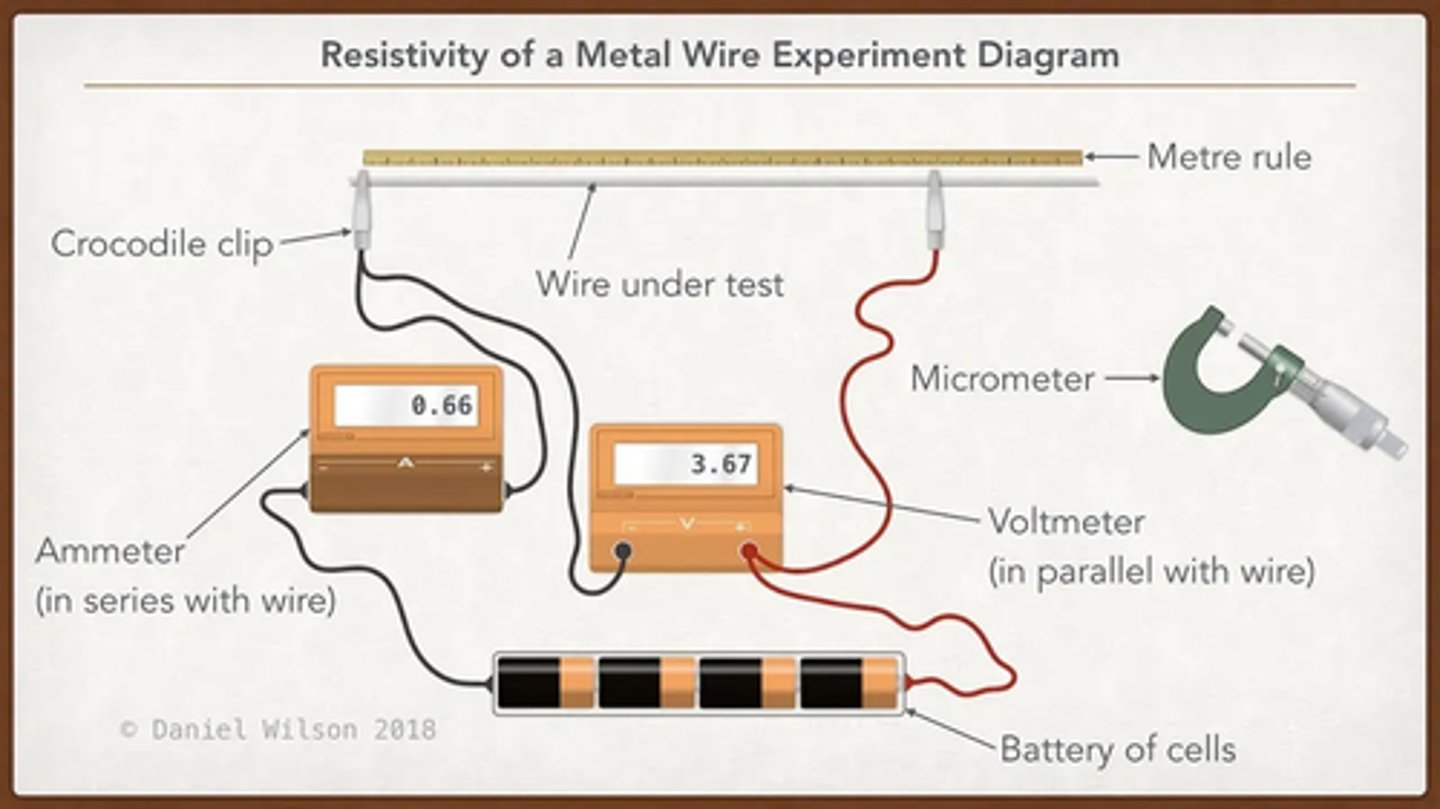
- Connect the wire into a circuit that includes an ammeter in series, a voltmeter in parallel across the measured length of wire, and a variable low-voltage power supply.
- Use crocodile clips to set the wire length to 0.100 metres. Measure this length using a metre ruler.
- Switch on the circuit and record the current from the ammeter and the potential difference from the voltmeter.
- Calculate the resistance for that length of wire using the formula R = V / I.
- Repeat the measurements for wire lengths of 0.200 m to 0.800 m, increasing by 0.100 m each time.
- For each length, repeat the experiment twice more and calculate the mean resistance.
- Use the resistance and length data to determine the resistivity of the wire.
What equipment is required to determine the resistivity of a wire? (8)
- 1 metre long constantan wire.
- Voltmeter.
- Ammeter.
- Low voltage power supply.
- Micrometer.
- Metre ruler.
- Crocodile clips.
- Connecting wires.
What does the setup used to determine the resistivity of a wire look like? (3)
What is the independent variable in the resistivity experiment? (1)
The independent variable is the length of the wire.
What is the dependent variable in the resistivity experiment? (1)
The dependent variable is the resistance of the wire.
What are the controlled variables in the resistivity experiment? (3)
- Controlled variables include the wire's material.
- Another controlled variable is the wire's diameter.
- Another controlled variable is the temperature.
How is the cross-sectional area of the wire calculated? (1)
Calculate the cross-sectional area (A) of the wire using A = (pi × d²) / 4, where d is the mean diameter.
What graph is plotted to determine the resistivity of the wire? (1)
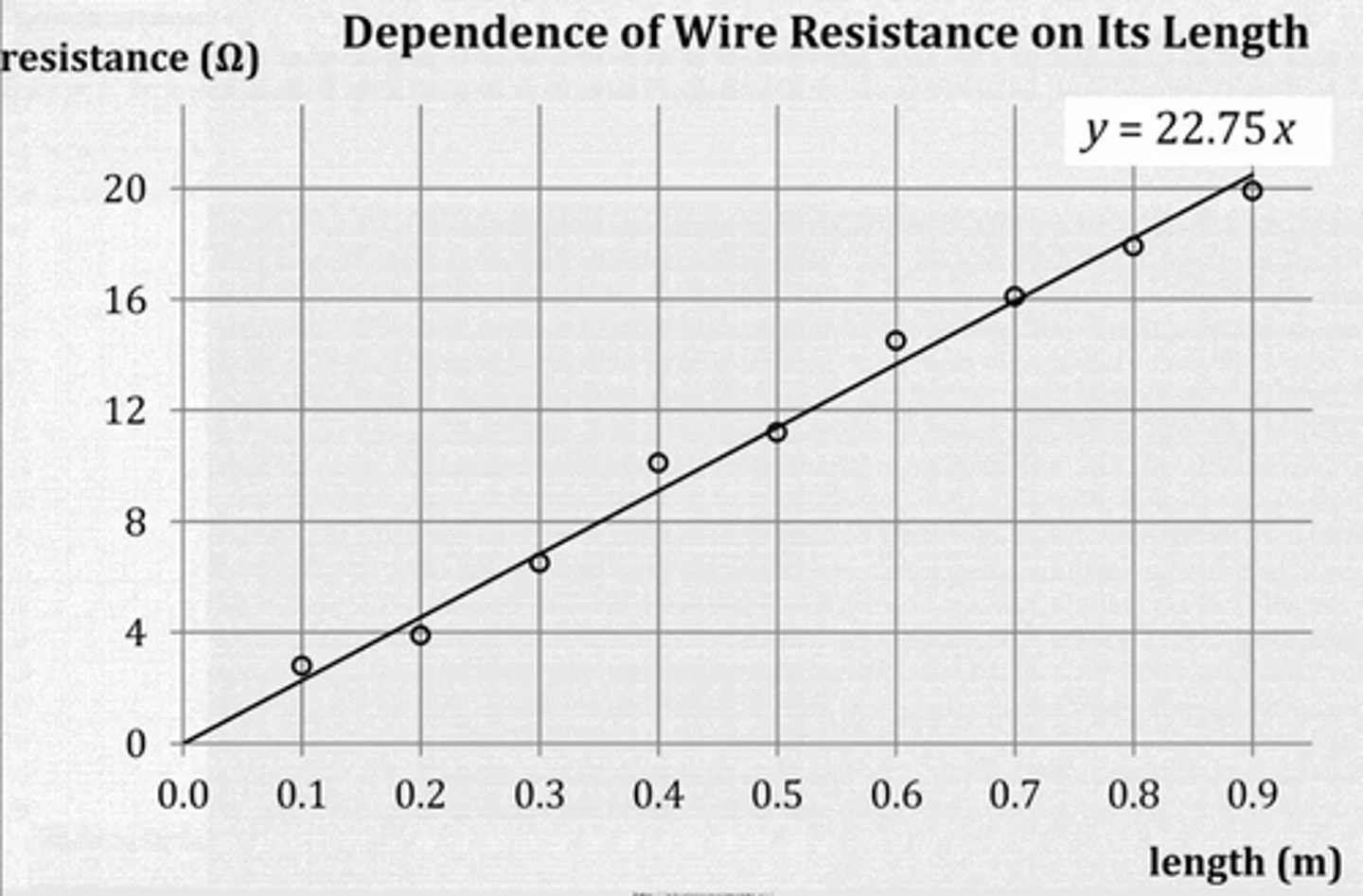
Plot a graph of resistance (R) against length (l) and draw a line of best fit. The graph should be a straight line through the origin.
What does the graph plotted to determine the resistivity of the wire look like? (3)
How is resistivity calculated from the graph? (1)
Multiply the gradient (G) of the graph by the cross-sectional area (A) to find the resistivity using ρ = G × A.
What safety precaution helps prevent burns in the resistivity experiment? (1)
Disconnect the crocodile clips between readings to prevent the wire from heating and causing burns.
What safety precaution protects against snapping wires? (1)
Wear safety goggles in case the wire snaps due to being pulled too tightly.
How can heating effects be reduced during the resistivity experiment? (2)
- Disconnect the circuit between readings to reduce heating of the wire.
- This is done as heating could affect resistance.
How can length measurements be made more accurate in the resistivity experiment? (1)
Ensure the wire is straight and free of kinks so that the measured length is accurate.