L5: Oestrous and Menstral cycles
 Studied by 0 people
 Call Kai
 Learn
Learn Practice Test
 Spaced Repetition
 Match
Match Flashcards
 Knowt Play
1/24

There's no tags or description
Looks like no tags are added yet.
Name | Mastery | Learn | Test | Matching | Spaced | Call with Kai |
|---|
No analytics yet
Send a link to your students to track their progress
25 Terms
Leanring objectives
hormonal changes that occur in a generalised ovarian cycle
similarities and differences in oestrus and menstrual cycles between animal species
effects of steroid hormones on the female reproductive tract and body across the ovarian cycle
differences between spontaneous and induced ovulation and seasonal effects in animals
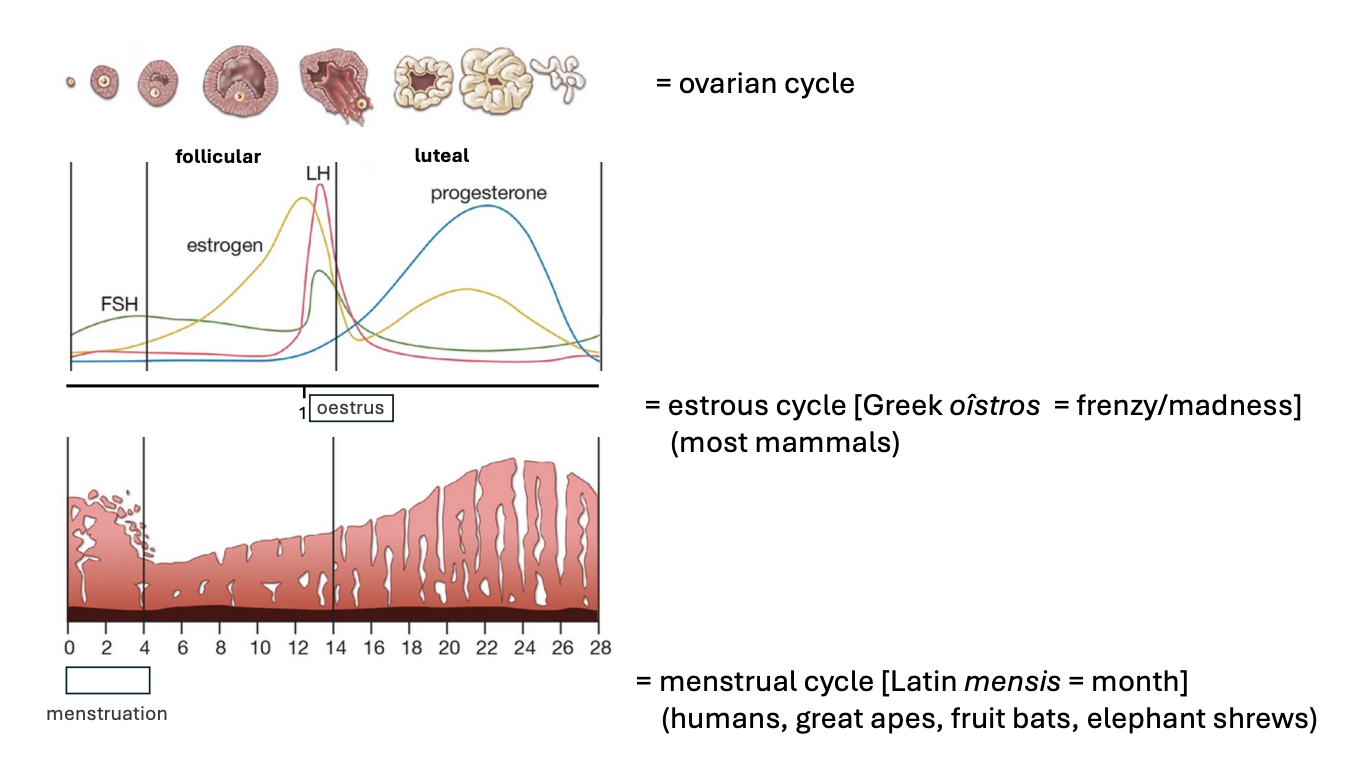
Ovarian vs estrous vs menstral cycle
Ovarian→ what is happening the ovary→ whole cycle of hormones etc
oestrous→ ‘frenzy’ most mammals→ to do with the behaviour which happens at the High Estrogen levels (see image)
Menstral cycle→ ‘month’, humans, great apes, fruit bats and elephant shrews, Starts with mensturation (see graph)
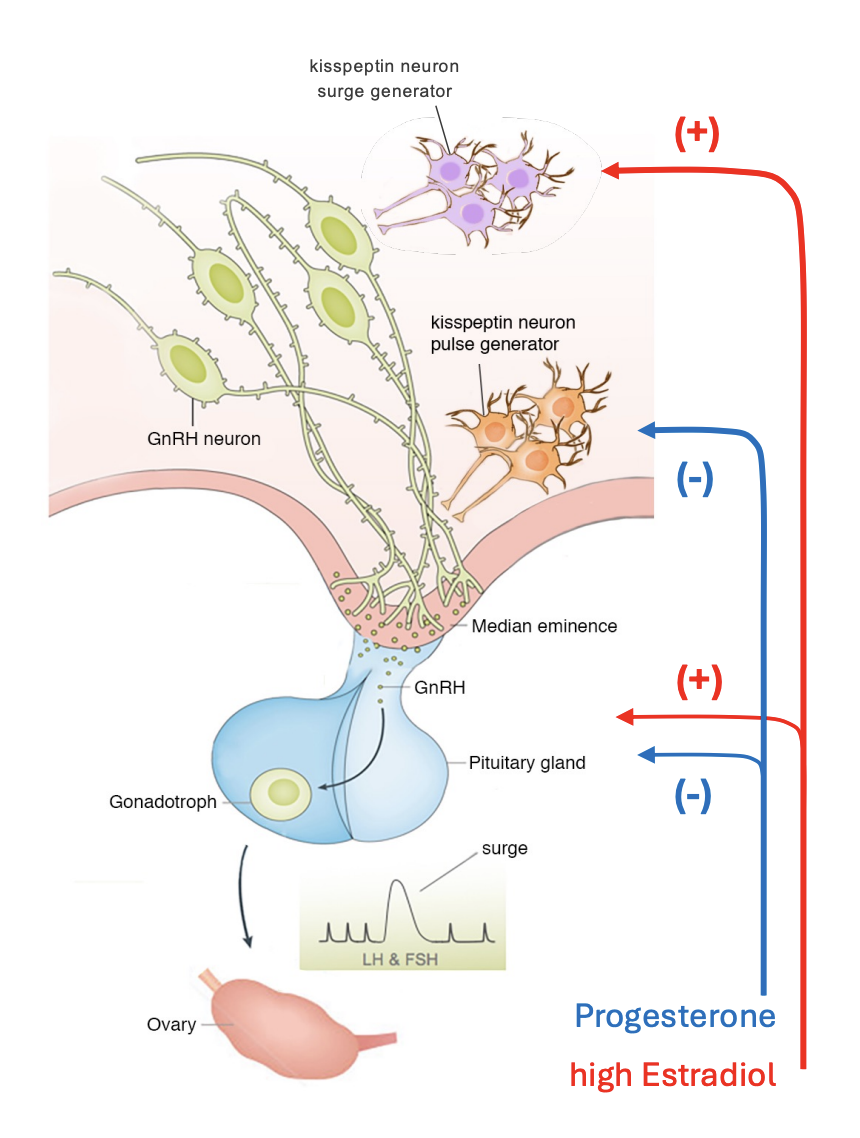
Hypothalamic-pituitary axis→ what do the parts do
Kisspeptin neuron pulse generator→ Pulsation→ Feeds into GnRH
Kisspeptin neuron surge generator→ causes a surge in GnRh
Neruons act on GnRH neurons and release is a combination of these
After the surge→ there is a decrease in the frequency of the pulse
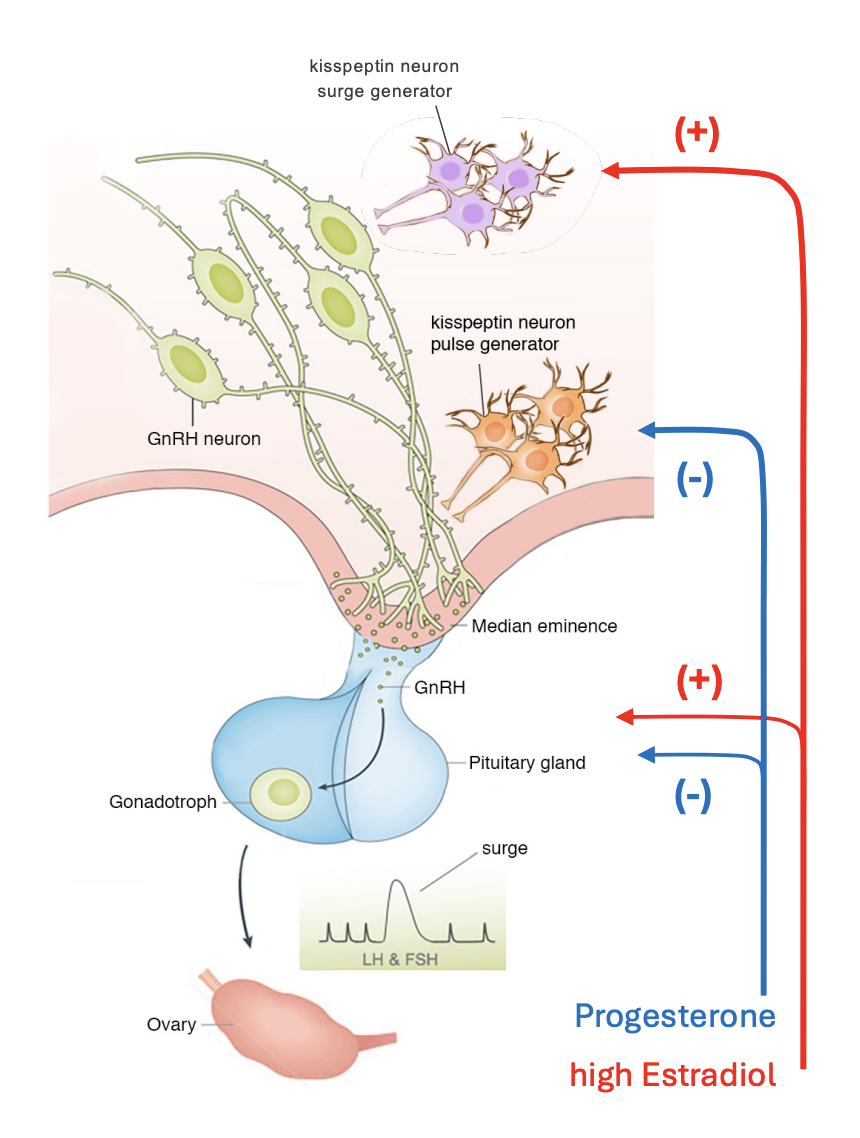
Feedback mechanisms in this axis
NEGATIVE: Progesterone→ inhibit GnRH and Pulse generator
POSITIVE: High estradiol→ increase GnRH and Surge generator
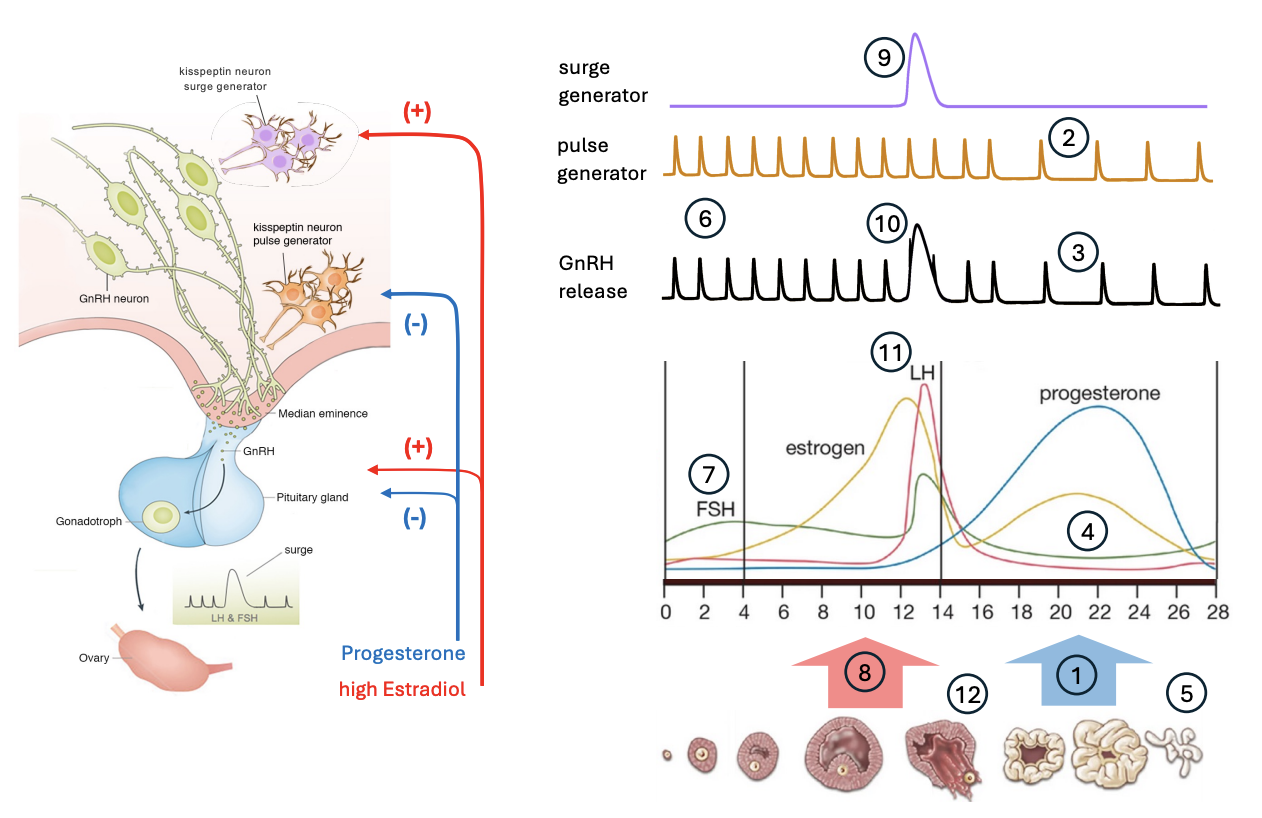
How this axis works in the menstural cycle (starting with corpus luteum)
Corpus luteum→ makes lots of progesterone and LH and FSH are low
Progesterone falls
pulse generator starts back at normal rate
increases FSH
critical for taking antral follicles and capturing around 20 (those that have the FSH receptor) to continue to ovulation
increase in estradiol and slight decrease in FSH again
causes generator surge
LH surge (also increase in FSH and decrease in estrogen)
Ovulation
Develops the corpus Luteum
high progesterone→Back to the same stage
How was inhibin work get incorporated into his cycle
Forms a private inhibitory feedback system with two inhibins
A and B
inhibin B→ released by granulosa cells
helps reduce FSH secretion just before the estrogen surge
Inhibin A→ also decreases FSH
released during hih progesterone
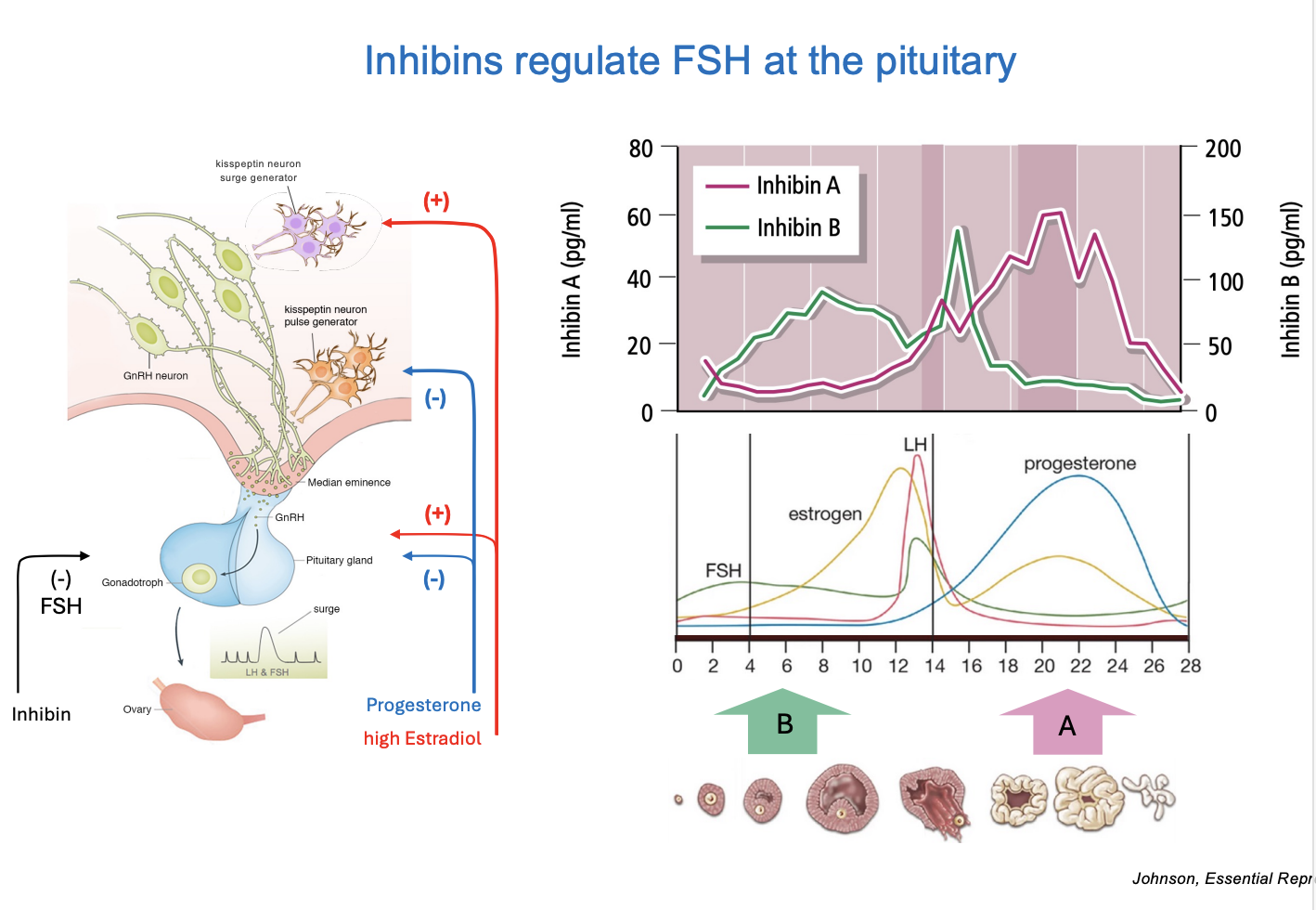
How does this negative feedback (which creates this regulated cycle) maintained constant
as long as estradiol is within the normal physiological range
provides relatively constant feedback during the cycle
one pulse per hour
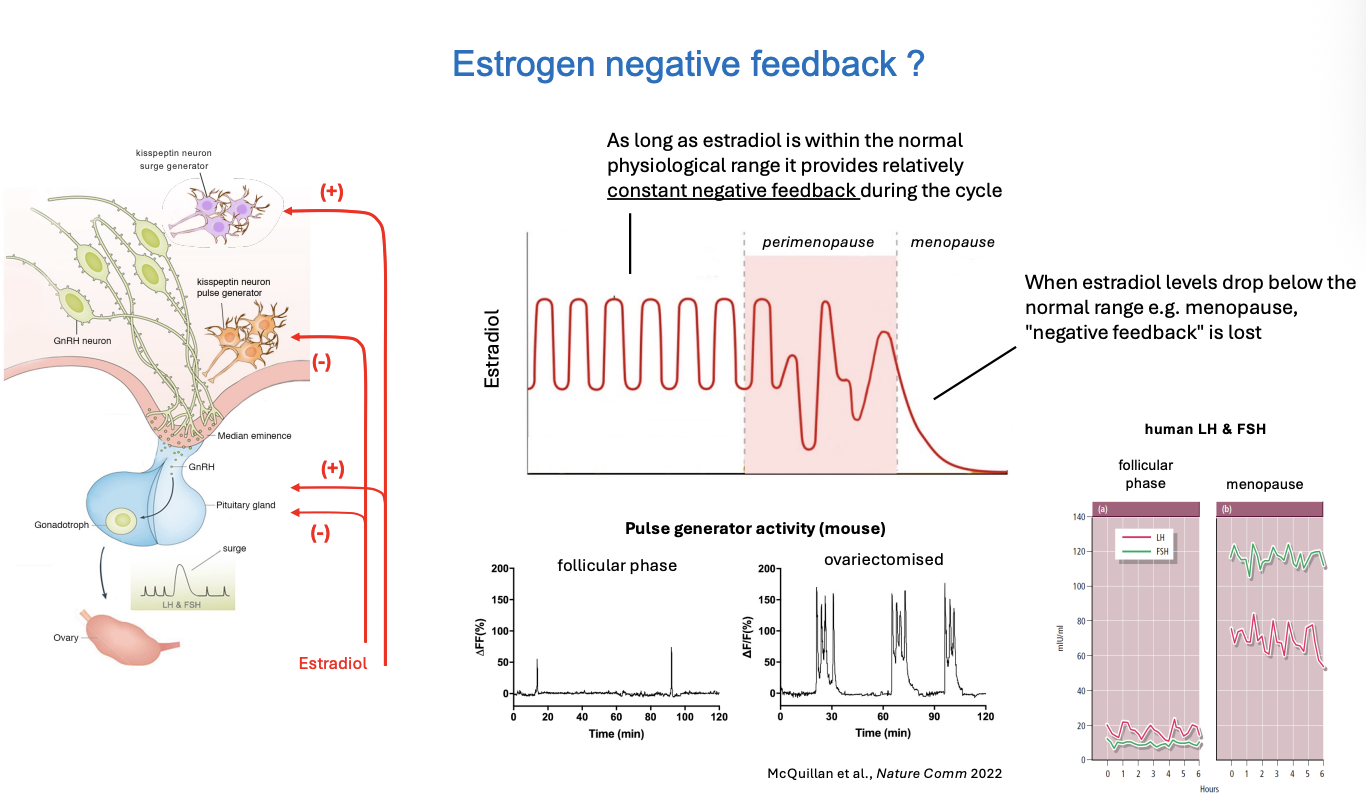
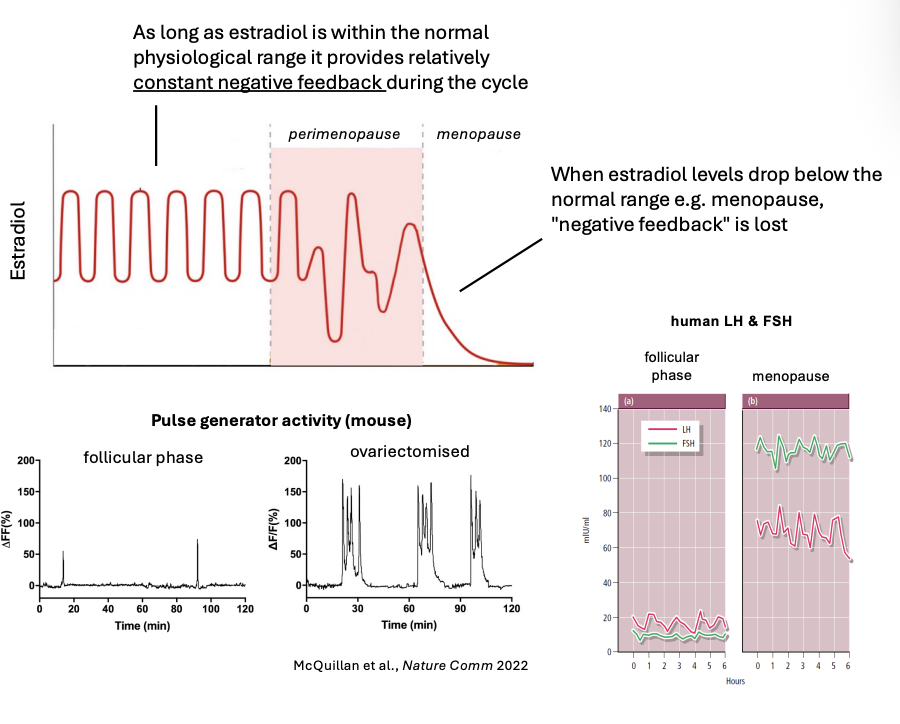
When happens in e.g the menopause
Estradiol levels drop before normal
negative feedback is lost
see graphs were the hormone regulation is no longer constant, disordered activity
get high levels of LH and FSH because no longer getting negative feedback from estradiol or progesterone
pulse is 1 every 3 hours
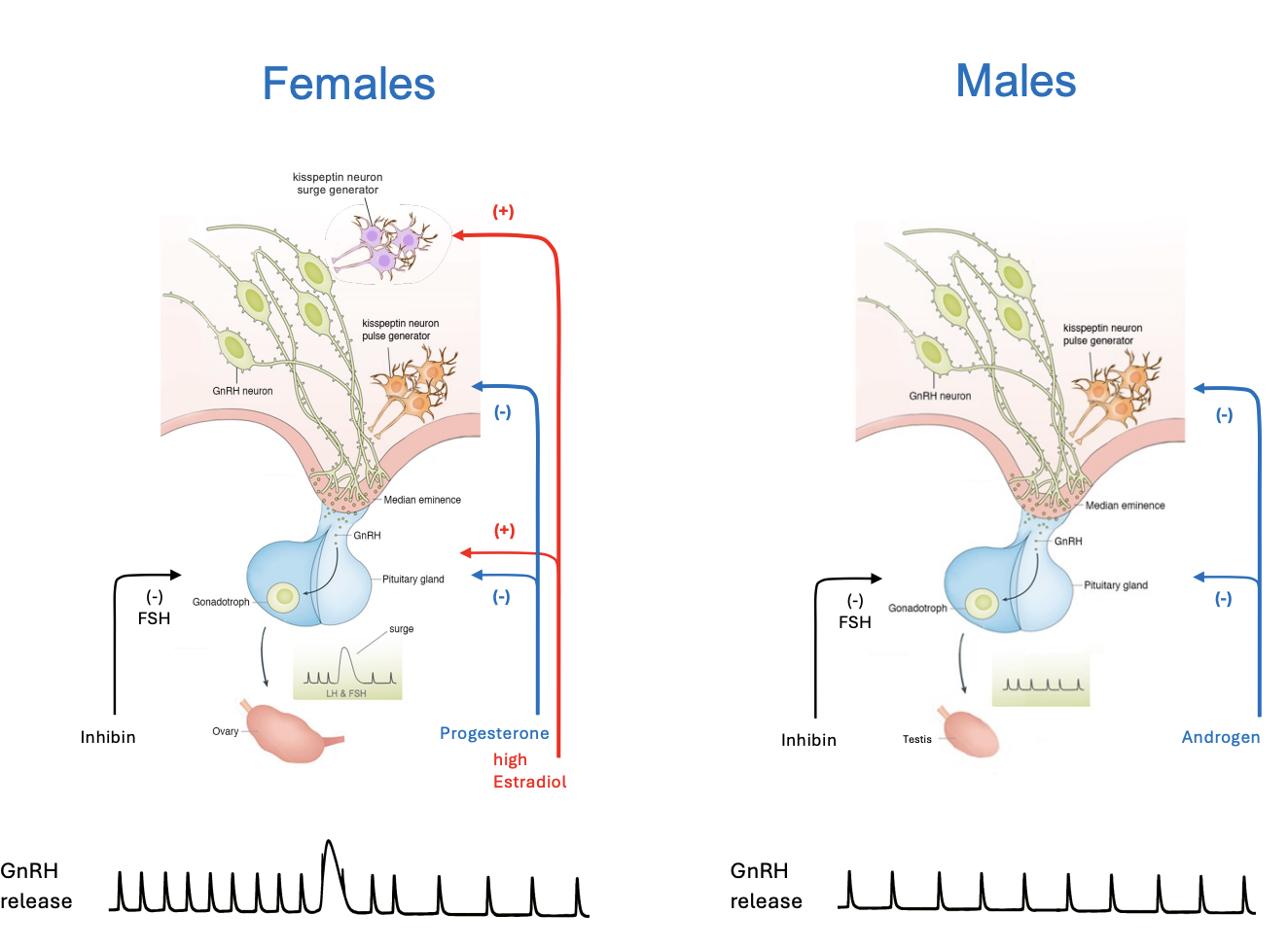
Hypothalamic- pituitary axis male vs female
Very similar but:
Differences:
no LH surge
no pulse generator→ just continuous pulsating
if you remove the gonads
→ high frequency LH pulses
Cyclical changes in women’s bodies
Endometrial changes
Cervical changes
Changes in the rest of the body
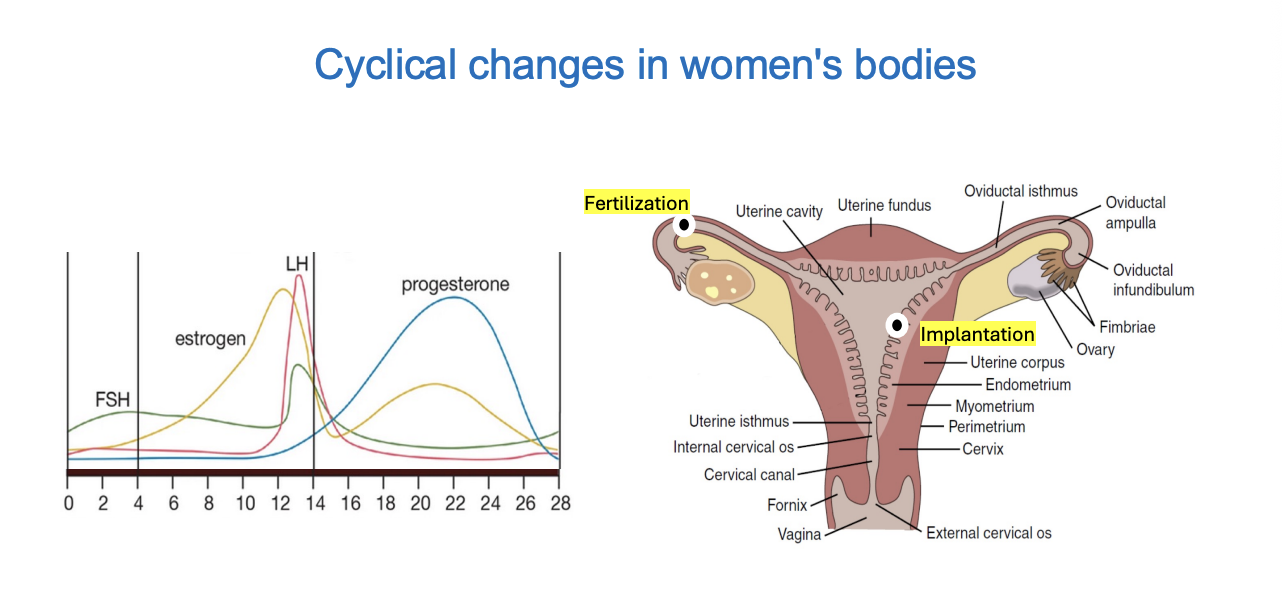
Endometrial changes
Proliferative phase
estrogen causes stromal thickening
increased surface epithelium
Secretory phase
Progesterone stimulates glands to secrete fluid rich in
glycoprotein, sugars and amino acids
Spiral artery proliferation
Menses
Shedding of endometrial lining
spiral arteries contract to reduce bleeding
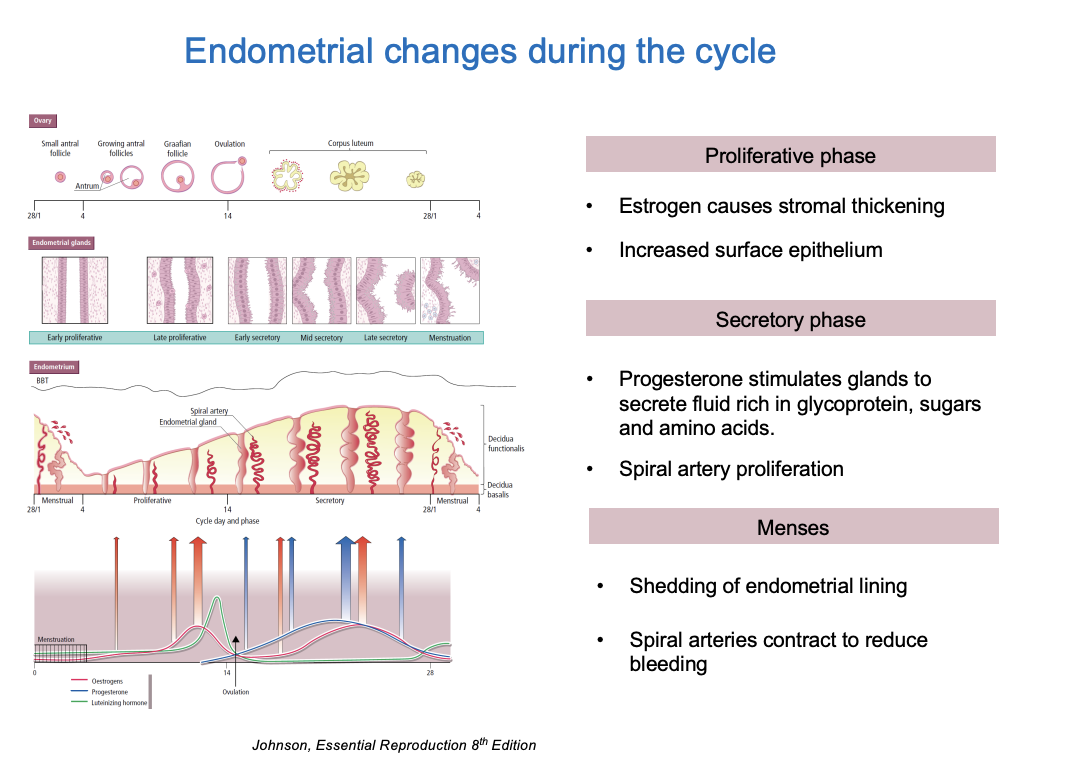
Cervical changes during the cycle
Estrogen→
thin mucus
relaxes cervix muscles
enhances sperm entry
Progesterone→
thick mucus
cervix muscles firmer
reduces sperm entry
ALSO→ 0.5 degree increase in body temp 1-3 days after ovulation
Features of mucus
Spinnbarkeit of mucus
lengths to which mucus thread can be stretch before snapping
Ferning of mucus
crystalised mucus when dried on a slide shows ‘fern-like’ strucutre
Sperm penetration
in vitro test of ability of sperm to penetrate the mucus
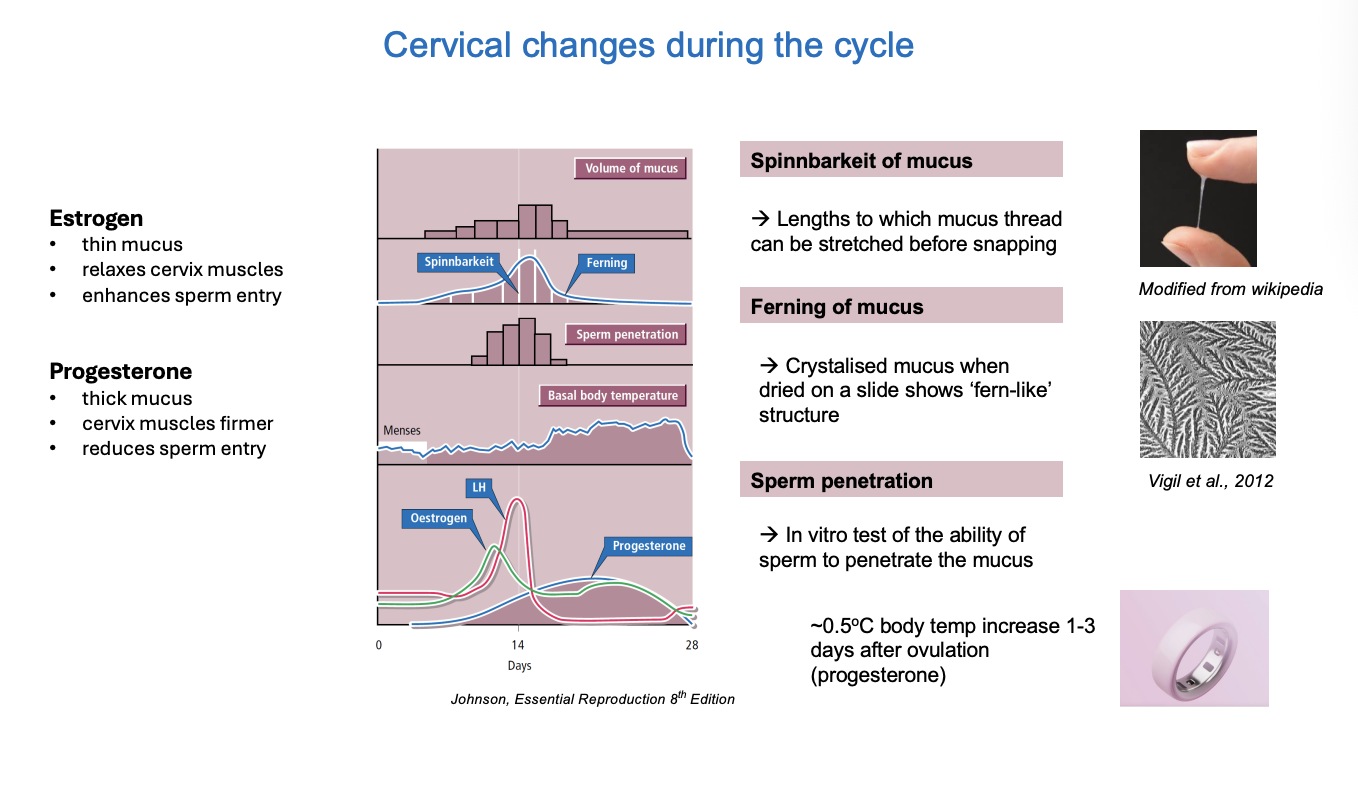
Changes in the rest of the body
most other organs have steroid receptors
rise and fall in progesterone and estrogen give rise to premenstral symptoms in 60-70% of women
Premenstrual dysphoric disorder PMDD
irritability, mood, anxiety, fatigue, concnetrtaion, eating, sleeping
Athletic performance
especially in elite athletes
How does hormonal contraception work
Enhancing progesterone actions on brain and uterus/cervix
Most use progesterone:
enhance progesterone
inhibits pulse generator
slow the pulses
hard for the reproductive cycle to stay cyclical
AND→ thick mucus and muscle→ hard for sperm to penetrate the cervix
A recently fertilised oocyte will not be able to implant if progesterone is around at the wrong time
i.e this shows that there is a window where progesterone is good/bad for implantation
‘ Progestins’ and ‘estrogens’
"Progestins" - norgesterone, desogestrel, drospirenone
"Estrogens" - ethinylestradiol
Estrous cycle→ in mammals e.g cats
no menstruation
Seasonal polyestrous induced ovulator
Seasonal→ only during long days→ so can reproduce when it is warm
Polyestrous→ multiple follicles going through the cycle
bouts of high estrogen
generates estrous behaviour
vocalize, pheromones, signalling
induced ovulator→ copulation evoked LH surge
i.e estrous behavour→ attract male→ copulation→ LH surge
Causes formation of the corpus luteum
How does induced ovulation work
Activation of the cervix
e.g barbed penis
relay to the spinal cord
to brainstem
to the GnRH neuron and to the surge generator
What animals are induced ovulators
cats
rabbit
some shrew
koala
hedgehog
Camels
Special case in camels/lammas
nerve growth factors (betaNGF) from seminal fluid
deposited in vagina
causes GnRH release
therefore shows there is more than one strategy to induce ovulation
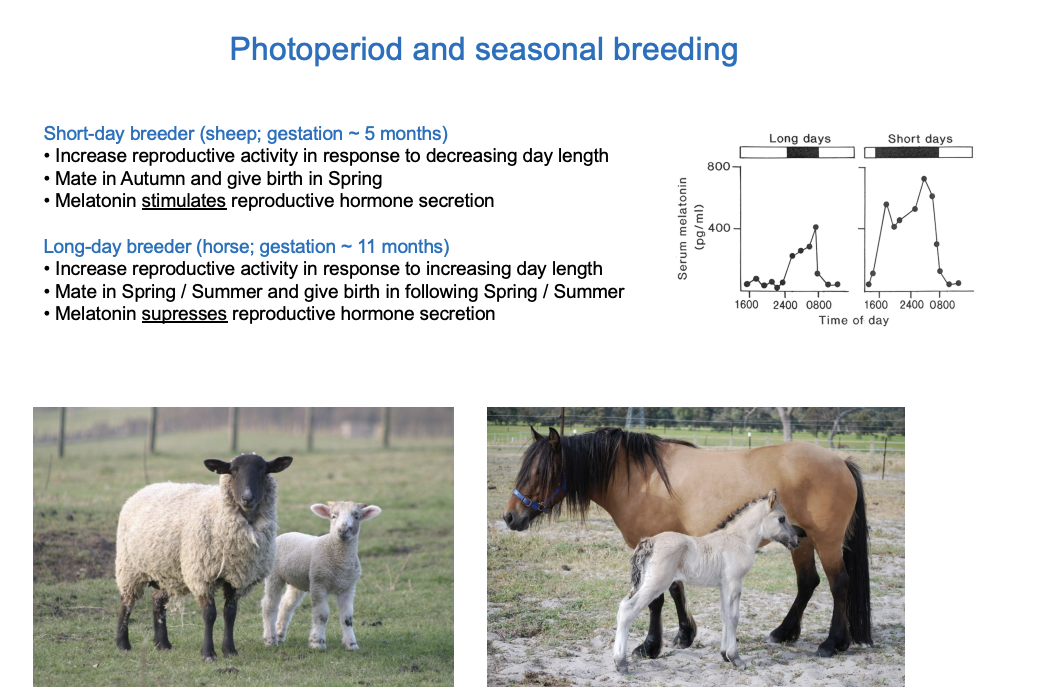
Photoperiod and seasonal breeding and what stimulates hormone secretion
Short day breeder→ sheep (gestation= 5 months)
Increase reproductive activity in response to decreasing day length
Mate in Autumn
give brith in spring
Melatonin stimulates reproductive hormone secretion
Long day→ Horse (gestation= 11 months)
increase reproductive activity in response to increasing day length
Mat in Spring/Sumer and give brith in following Spring/Summer
Melatonin Suppresses reproductive hormone secretion
Different day length depends on how long gestation period→ preferably want the offspring during the summer
in both cases use melatonin to affect hormonal secretion→ but melatonin response is different
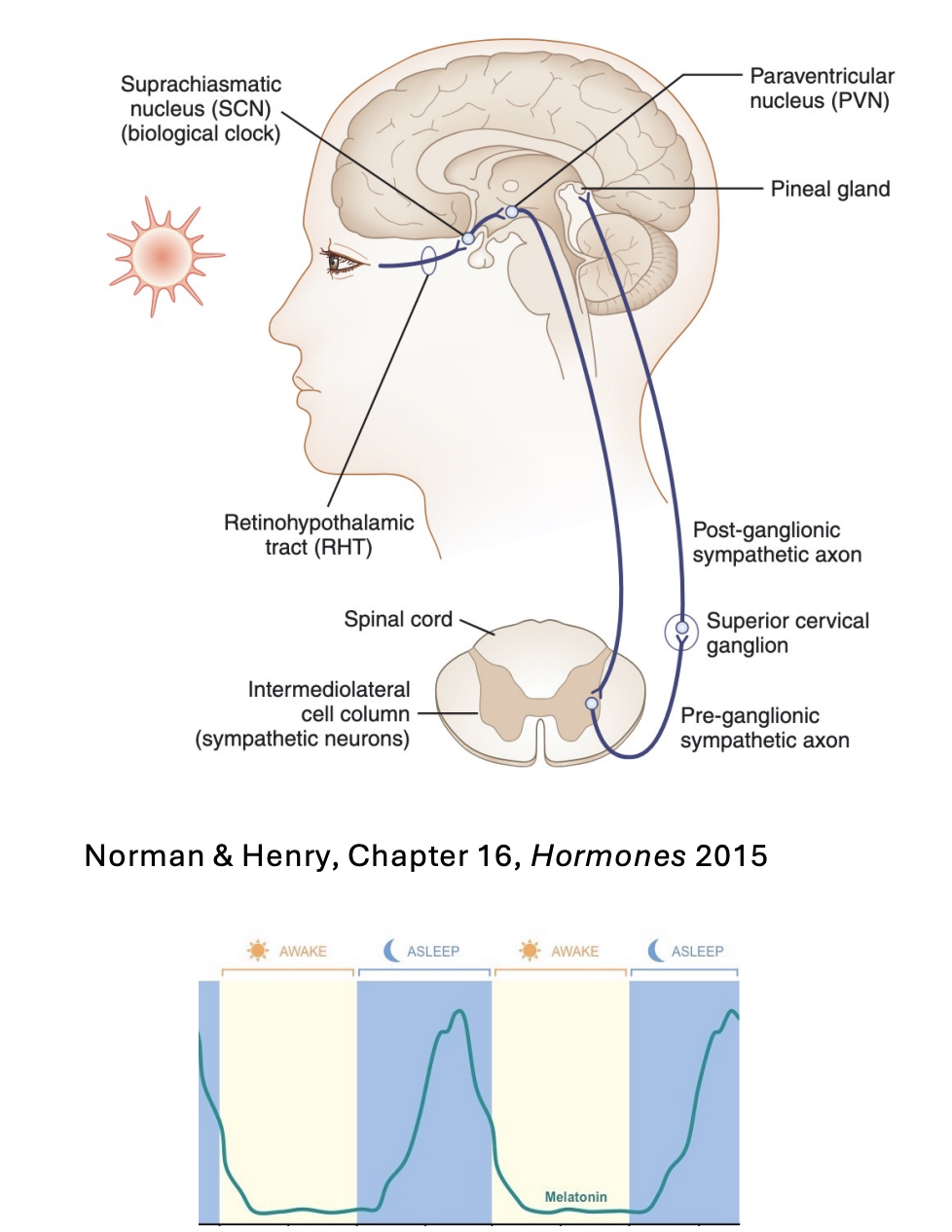
How is photoperiod detected and cause this hormonal regulation (light→ pineal gland)
Detect light in eye and send to
Retinohypothalamic tract
to suprachiasmatic nucleus (SCN) biological clock
To the Paraventricular nucleus (PVN)
Sent back down to the spinal cord→ pre-ganglionic sympathetic axon
To superior cervical ganglion→ post-ganglion sympahtetic axon
To the pineal gland
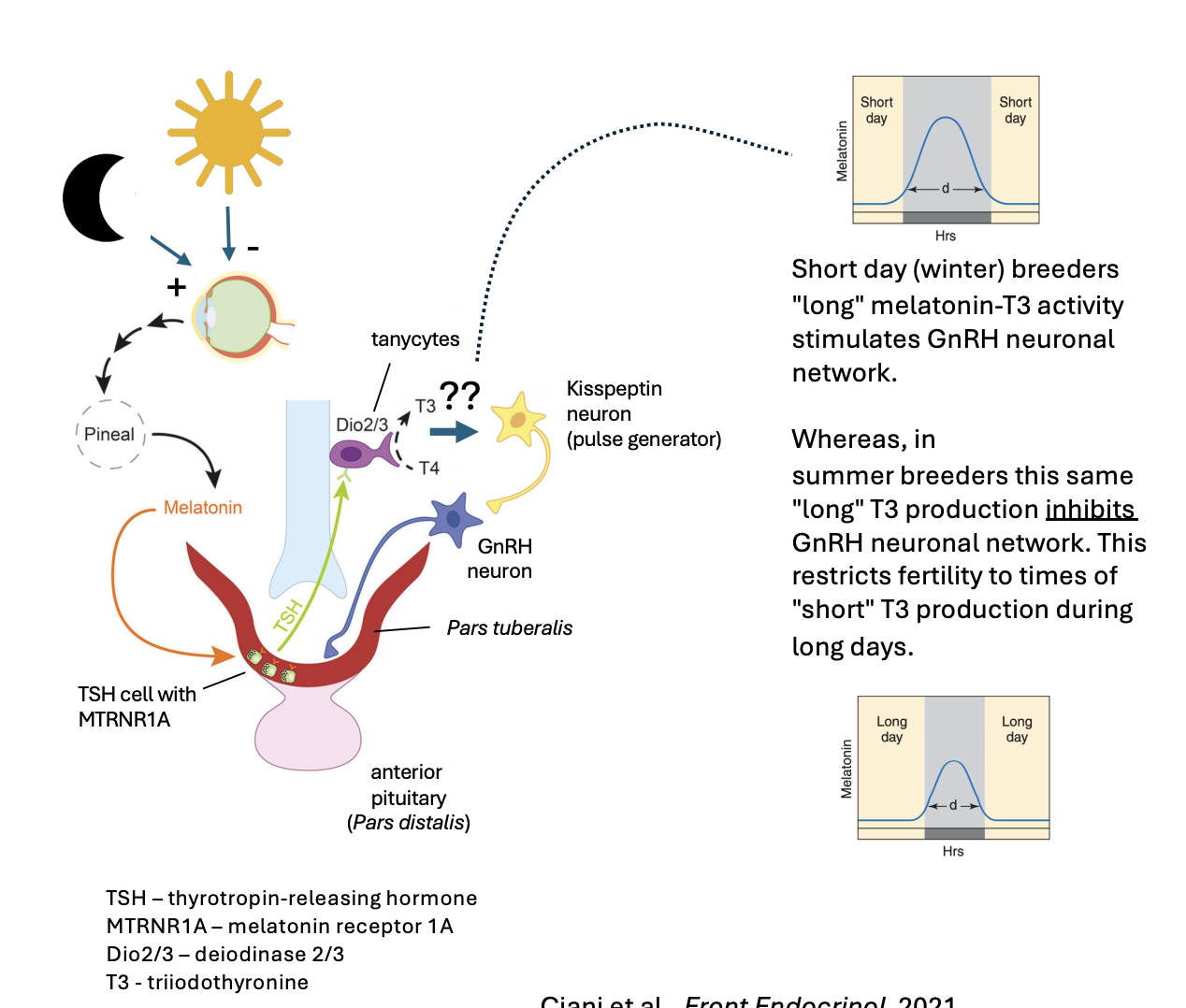
Response once gets to the pineal (although not completely known)
Pineal releases melatonin
Melatonin received at MTRNR1A (melatonin receptor 1A) on the TSH cell of the Pars Tuberalis
These cells release TSH (Thyrotopin-releasing hormone) onto
Tanycytes
Tanycyte used dio2/3 (deiodinase 2/3) to convert T4→ T3
stimulates kisspeptin neuron pulse generator
This stimulates the GnRH neuron (in different ways)
short day= melatonin-T3 activity→ stimulates GnRH neural network
long day= melatonin T3 production→inhibits GnRH neuronal network→ restricts fertility to times of short T3 production
This connects to the Pars tuberalis just above the anterior pituitray
Anterior pituitary stimulates to release LH/FSH
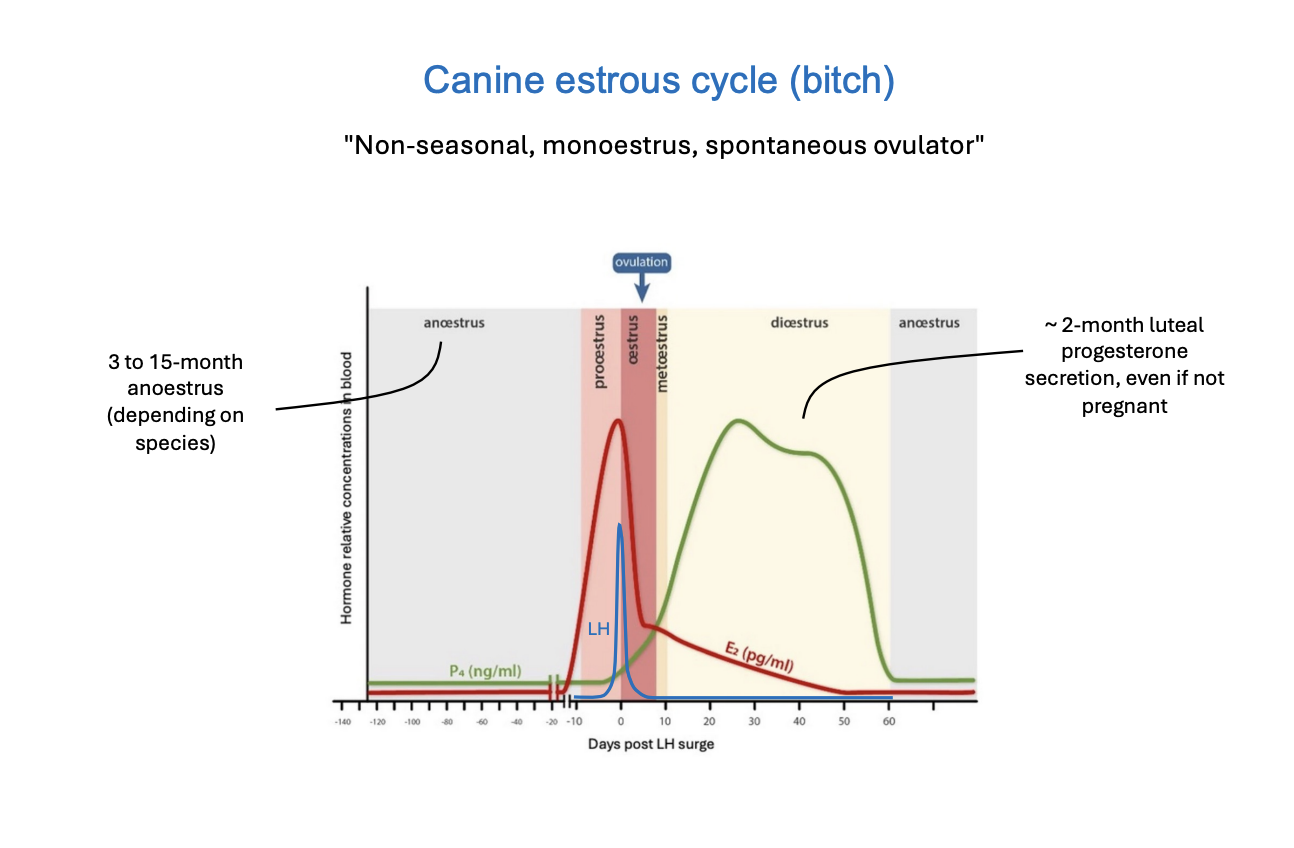
Canine estrous cycle→ bitch
Non-seasonal, monoestrus, spontaneous ovulator
non seasonal→ 3 to 15 month anoestrus (depending on species)
spontaneous ovulator→ 2 month luteal progesterone secretion, even if not pregnacy
sponatenous like humans
high level of estrogen stimulates ovulation
need the behaviour attracting the mate at the right time
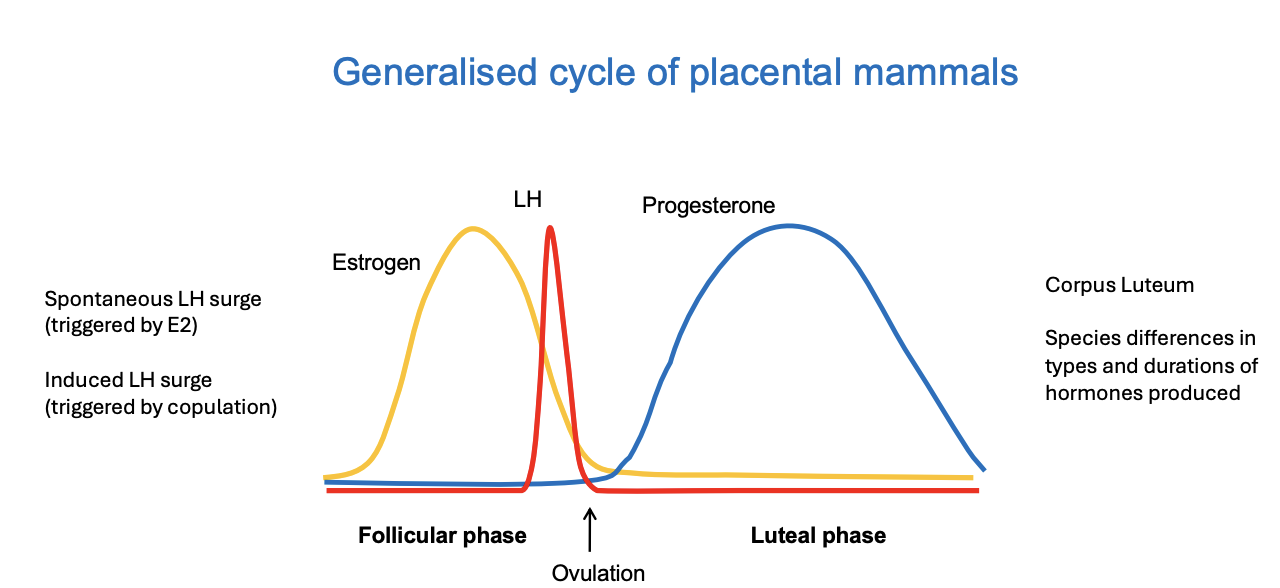
Generalised cycle of placental mammals
follicles developing
high estradiol
LH surge due to
spontaneous or
behaviour → copulation→ LH surge
High progesterone→ Luteal phase
there are species differences in types and durations of hormones produced
Please read
Herbison, Front Neuroendocrinol 2020
GnRH secretion through the cycle is deterimned by summed influence of
estradiol-clamped
progesterone-regulated
and estradiol-regulated surge generators
on the GnRH neuron
 Note
Note  Flashcards (105)