marketing 3&4
 Call Kai
 Learn
Learn Practice Test
 Spaced Repetition
 Match
Match Flashcards
 Knowt Play
1/538

There's no tags or description
Looks like no tags are added yet.
Name | Mastery | Learn | Test | Matching | Spaced | Call with Kai |
|---|
No analytics yet
Send a link to your students to track their progress
539 Terms
Choice Overload
Too many options can make decisions more difficult
Heuristics
Simplified decision rules that let consumers reach a "good enough" choice quickly and with less effort
alternative-based evaluation methods
One product at a time, calculate an overall score for each option independently.
Positive of alternative-based evaluation methods
Good when you have few options to compare
Negatives of alternative based evaluation method
Higher effot
attribute-based evaluation method
One attribute at a time; compare options feature by feature.
Positive of attribute based evaluation method
lower effort
compensatory evaluation method
strengths offset weaknesses; A high score on one attribute can make up for a low score on another. Every option gets a total utility score.
Non-compensatory evaluation method
Dealbreakers exist; Failing one attribute can eliminate an option entirely, regardless of how good it is elsewhere. Lower effort
What to consider when evaluating attributes
Can you understand the attribute? Do the attributes align?
alignable attributes (35 mpg vs 30 mpg)
easy to compare → favors attribute-based.
non-alignable attributes (35 mpg vs 3 miles/kWh)
hard to compare → favors alternative-based.
compensatory - simple additive decision strategy
Add up all attribute scores → pick highest total
compensatory - weighted additive decision strategy
Multiply each score by its importance weight, then add
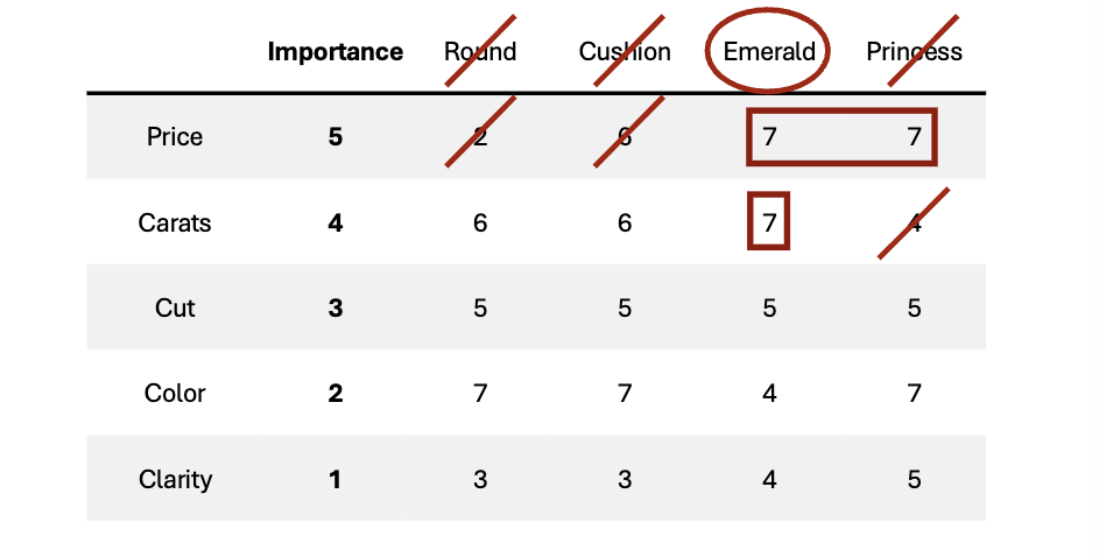
Non Compensatory - lexicographic strategy
Pick best on most important attribute; move onto new attribute if tied
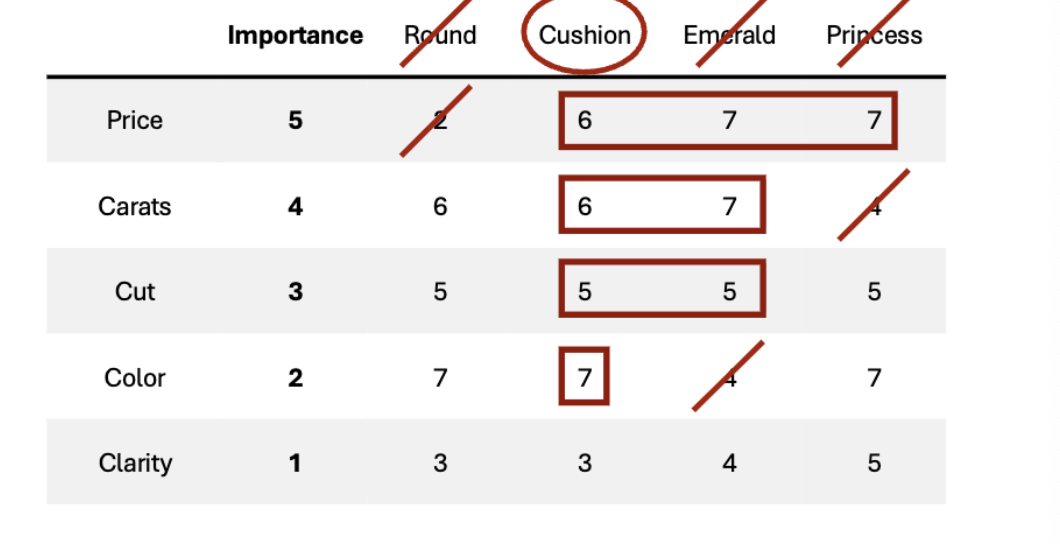
Non-compensatory — elimination by aspects (EBA)
Set a minimum cutoff; eliminate anything that fails
Conjoint analysis
A survey-based technique to measure how consumers value different product attributes. Participants rate product profiles with different attribute combinations; regression reveals the hidden value of each feature.
what are the coefficients of conjoint analysis regression
part-worth utilities
part-worth utilties
how much extra utility does the
consumer get for that attribute level level relative to the
baseline?
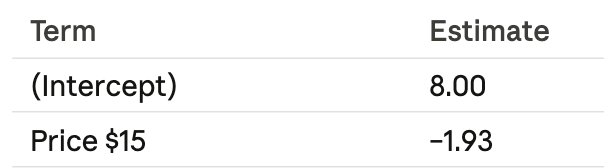
If baseline is brand A, basic features $10, what does the coefficient at price 15 mean
Going from $10 → $15 drops utility by 1.93
step 1 to calculate attribute importance
Find range of part-worths for each attribute = max(Part-Worths) - min(Part-Worths)
step 2 - compute the importance of each attribute
(range of part-worths for the attribute / Sum all of the ranges of part-worths for all attributes) x 100
Part-worths are relative to the reference level within their attribute which means
Can’t compare
across attributes
How to do a cross-attribute comparison
calculate attribute importance to show which attribute matters overall
what is attribute importance
range-based importance - the share of total preference variation
explained by changing this attribute within our chosen
configuration
why do we treat price as categories
Allows you to capture non-linear responses and lets each price point be a configuartion level
why not use interactions
the models assumes that attributes are independent
rating based conjoint design
Rate each profile on a scale
pros of rating-based design
most granular data, simple analysis, all configurations seen.
Cons of rating-based design
not realistic (consumers choose, not rate), decision fatigue, scale-use varies by person — within-subjects design helps control this.
rank-based conjoint design
Rank profiles from best to worst
pros of rank based profile design
easier than rating, all configurations seen.
cons of rank based profile design
can't measure how much better #1 is than #2 (no utility gaps), requires rank regression.
choice based design
Pick preferred option from a set
pros of choice based design
most realistic (mirrors real buying), can detect context effectsco
cons of choice-based design
choices explode with configurations, order effects, most complex analysis (logistic/multinomial regression).
What is an experiment
Descriptive (aka correlational) analyses test whether an outcome
variable is associated with some predictor variable(s)
Experimental analyses
test whether an outcome (aka dependent)
variable is caused by some predictor (aka independent) variable(s)
what is manipulated in an experiment
independent
what do we measure in experiments
dependent variable test whether it
significantly differs across our experimental conditions
experimental validity
The degree to which an experiment accurately and reliably tests
the hypothesis or causal relationships it intends to investigate
Internal Validity
Extent to which a study can establish a cause-and-effect
relationship between an independent variable (the manipulated
factor) and a dependent variable (the observed outcome)
Key Threats to Internal Validity
• Confounding/omitted variables
• Non-random assignment/selection bias
• Inconsistent procedures (e.g., different measurement
methods)
External Validity
Extent to which the findings of a study can be generalized beyond
the specific experiment
key threats to external validity
• Sample representativeness
• Ecological validity (i.e., is the design artificial or does it
resemble real-world conditions)
• Hawthorne Effect (i.e., individuals modify their behavior when
they are aware they are being observed)
• Changes over time
construct validity
Extent to which a test, measurement, or experiment accurately
represents the theoretical construct or concept it aims to study
key threats to construct validity
• Inadequate operationalization (i.e,. the measures and/or
manipulations do not fully or accurately capture the intended
construct)
• E.g., measuring job satisfaction based only on salary
• Demand effects (i.e., answering the way they think the
experimenter wants them to answer)
• Measurement error
Statistical Conclusion Validity
Extent to which the statistical analyses are appropriate and lead
to valid conclusions about the relationship between variables
Key Threats to Statistical Conclusion Validity
• Low statistical power (i.e., small sample size)
• Violation of statistical assumptions
Probability Sampling types
• Simple random sampling
• Stratified random sampling
• Cluster sampling
Non-Probability Sampling
• Convenience sampling
• Quota sampling
• Judgmental sampling
• Voluntary response sampling
Probability Sampling
Every unit in the population
has a known, non-zero probability of selection
Simple random sampling
Subjects in the study population are randomly selected with equal
probability
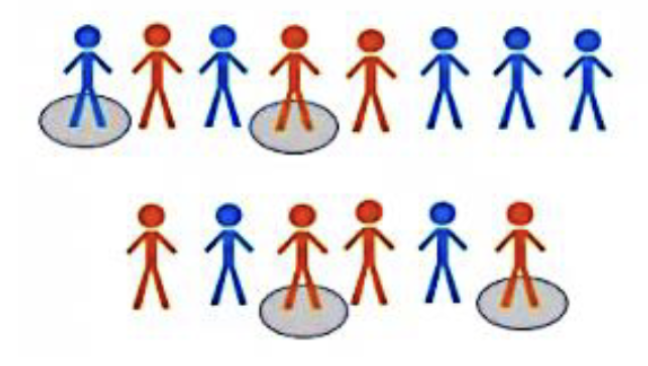
simple random sampling advantages
• Easy
• Unbiased
• Distribution of sample is
spread evenly over the entire
given population
• All members of the population
have equal probability of
selection
disadvantages of simple random sampling
• Sample may not be ideal for
answering research question
• No use of researcher expertise
• Requires unbiased study
population
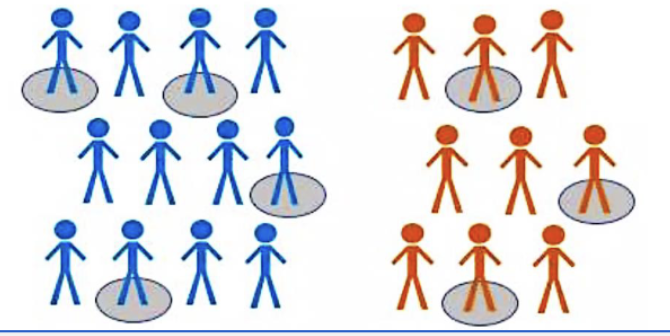
Stratified random sampling
Study population is divided into "strata" based on certain
characteristics, subjects within each strata are randomly selected with equal
probability (sometimes proportional to the size of the stratum)
stratified random sampling advantages
• Ensures sample
representation of all relevant
groups
• High statistical power
• Account for confounding
variables
stratified random sampling disadvantages
• Requires accurate information
on proportions of each stratum
• Requires careful selection of
strata criteria
• Hard for small samples
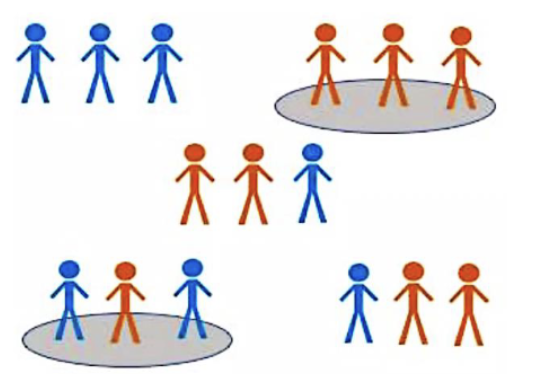
Cluster Sampling
Study population is divided into "clusters" based on certain
characteristics, entire clusters are selected with equal probability
cluster sampling advantages
• Easy when population is large
• Researchers can use existing
clusters such as district,
village/town, etc.
cluster sampling disadvantages
• Least representative of the
population
• Requires thoughtful selection
of cluster criteria
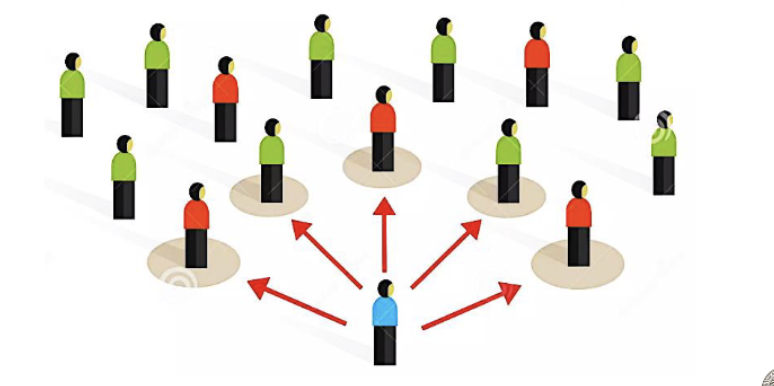
Convenience sampling
Subjects are selected because of their convenient accessibility
and/or proximity to the researcher
convenience sampling advantages
• Easy, cheap, quick
• Appropriate for relatively
homogenous population
Disadvantages of conveinience sampling
• Not appropriate for
heterogenous populations
• Less generalizability
judgement sampling
Subjects are selected at researcher's discretion based on ability
to help study the hypothesis
advantages of judgement sampling
• Good for exploratory research
• Cost-efficient (only get "good"
data)
disadvantages of judgemental sampling
• Requires expert knowledge
about the population and fit
with research question
• May not be representative of
population
Voluntary response sampling
• Non-probability sampling technique
• Subjects voluntarily choose whether to participate
Voluntary response sampling advantages
• Easy
• Cheap
voluntary response sampling disadvantages
• Not representative
• Selection bias
• Possibly time-consuming
Quota sampling
• You divide the population into categories
• You set targets ratios for each category
• Collect respondents until each quota is filled
quota sampling advantages
• More representative of study
population
• Time and cost efficient (stop
once you hit quota, no "wasted
data")
quota sampling disadvantages
• Quotas must be
thoughtfully/properly set
• Potentially limited
generalizability depending on
quota and population
proportions
Segmentation is identifying groups that have similar attributes ….
within the group
segmentation is identifying groups of prospective customers who have different attributes
between the groups
how do we define segments
benefit: why do they need it and how they feel about it
behaviors: how do they purchase the product
descriptors: who is buying the product (better for targeting)
what makes for good segmentation
substantial, accessible, identifiable/measurable, differential, relevant
Target market
Set of buyers who share common needs or characteristics that
the company decides to serve.
basis variables for target market
• Variables used to create customer segments
• Ideally capture customers’ needs, attitudes, and behaviors
descriptor variables for target market
• Variables used to target customers
• Typically demographics or other easy-to-know characteristics
evaluating segment attractiveness
segment profitability, structural attractiveness (competitors, substitute products bargaining power of buyers and suppliers), company objectives and resources
Undifferentiated (Mass) Marketing targeting strategy
• Focuses on common needs of all consumers
rather than different needs
• Design product & marketing to appeal to the
largest number of consumers
differentiated (segmented) marketing
target several market segments with separate offers for each, focus on different needs of each segment to extract higher sales/position
concentrated (niche) marketing
• Targeted to capture a large share of one or a few
small segments.
• Focuses on unique needs of one segment
ignored/overlooked by competitors.
micromarketing
• Tailoring products and marketing programs to suit
specific individuals or locations.
• Focuses on management at store level or individual
consumers (customization, personalized deals, etc.)
Positioning
What product stands for relative to competition in
target consumer’s mind

