biology topic 8
 Call Kai
 Learn
Learn Practice Test
 Spaced Repetition
 Match
Match Flashcards
 Knowt Play
1/36

There's no tags or description
Looks like no tags are added yet.
Name | Mastery | Learn | Test | Matching | Spaced | Call with Kai |
|---|
No analytics yet
Send a link to your students to track their progress
37 Terms
What are the types of mutation
substitution
Deletion/addition/insertion
Duplication - if one of more bases is repeated
Inversion - a group of bases separates from DNA then rejoins in the reverse order
Translocation - group of bases separates from DNA and inserts into the DNA sequence of a different chromosome
How are specialised cells created
By differentiation of stem cells (only some genes turned on)
What are stem cells
Undifferentiated cells that have the ability to divide by mitosis to self renew (keep dividing) and differentiate (daughter cells will be specialised cells)
What are the different types of stem cells
totipotent - can differentiate into any type of cell (all body cells and cells specific to embryo) only found for a limited time in early mammalian embryos
Pluripotent - can differentiate into any type of cell in the body. Found in embryo
Multipotent - can differentiate into a limited number of specialised cells
Unipotent - can only differentiate into a single type of cell. Derived from multipotent cells and made in adult tissue
What are iPS cells
A type of pluripotent cell produced in the lab from a differentiated cell. Differentiated cell can be almost any body cells
What does it mean if iPS cells are made from patient cells
The specialised tissue/cell that is produced will be genetically identical to the patient - no chance of rejection
What’s epigenetics
The process by which environmental factors cause heritable changes in gene function without changing the base sequence of DNA
What are nucleosomes
DNA is wrapped around histones to form structures
What is the epigenome
All epigenetic factors associated with a cells genome. They determine the shape of DNA histone complex
What is histone acetylation
The amino acids at the tails of the histone proteins are modified by acetyl groups. It causes the DNA structure to become less condensed, giving easier access to transcription factors, more transcription so genes become more active.
What is deacetylation
Removal of acetyl groups from histone will inactivate genes
acronyms to remember epigenetic control
Acetylation - Accessible, Active
Methylation - Muting
What is methylation
Cytosine bases in DNA can be methylated (add CH3), causing changes in chromatic so transcription factors cannot bind and transcription is inhibited as DNA is more tightly wound around histone proteins. Methylation of DNA can also attract proteins that deacetylate histone. Genes less active (silenced)
How can cancer arise from epigenetic tags
genes causing cancer are switched on due to decreased methylation
Increased methylation switching off genes that protect cancer
Epigenetic changes increasing the incidence of mutation
Why are transcription factors needed
As RNA polymerase binds only weakly at first so it needs assistance of a number of other transcription factors before it is activated and can start transcribing the gene
What happens to transcription factors when a gene is not being expressed
The site of the transcription factors that binds to DNA is not active so that it can’t bind to DNA and stimulate transcription
Describe regulation of transcription by steroid hormones eg oestrogen
Oestrogen released from ovaries and travels in blood. When oestrogen arrives at target cells, it diffuses across the phospholipid bilayer into the cytoplasm because (like all steroid hormones) it is lipid soluble, nonpolar, hydrophobic
Oestrogen binds to its receptor protein as it is a complementary shape to the binding site. This changes the tertiary structure of the oestrogen receptor so that it now has a correctly shaped DNA binding site. It is now an active transcription factor
The active transcription factor moves into the nucleus through a nuclear pore
In the nucleus, the transcription factor binds to a Specific DNA base sequence on the promoter of oestrogen-responsive genes, upstream of RNA polymerase
This binding stimulates RNA polymerase to transcribe the gene
What is cancer
Uncrontrolled mitosis
What’s the difference between malignant and benign
Malignant - cancerous tumour metastasises (spreads to other organs), can grow projections into other surrounding tissues
Benign - non cancerous tumour doesn’t metastasise, doesn’t invade surrounding tissues
What are oncogenes
Mutated proto-oncogenes (correct gene for proteins stimulating cell division, only an issue when mutated)
If a proto-oncogene mutates such that it is permanently switch on or codes for a protein where it is permanently active and cell division is uncontrolled it becomes an oncogene
What are some examples of what an oncogene could code for
a growth factor receptor that is permanently activated
An enzyme that stimulates cell division that is permanently activated
A growth factor to be produced in excessive amounts
What do tumour supressor genes code for
Code for proteins that
slow down cell division
Repair mistakes in dna
Regulate apoptosis (cell death)
What happens if a tumour suppressor gene has a mutation
it will produce a non functional protein that won’t slow down/inhibit mitosis or won’t repair damaged/faulty dna or stimulate cell death when necessary so could result in uncontrolled cell division, tumour, cancer
What’s the difference between oncogenes tumour supressor genes
Oncogenes are dominant cancer genes
Tumour suppressor genes are recessive cancer genes
How does abnormal methylation cause cancer
Increased methylation - increase methylation of tumour suppressor gene would inhibit transcription of tumour suppressor gene, the protein it codes for won’t be produced so it will not prevent mitosis, uncontrolled cell division, tumour,cancer
Decreased methylation -decrease methylation of oncogene will increase transcription of oncogene, protein it codes for won’t be produced in excessive amounts, uncontrolled mitosis, tumour, cancer.
What does increase of oestrogen increase risk of
Breast cancer, can stimulate transcription of genes which stimulate cell division in breast tissue, excessive oestrogen would increase rate of cell division and a tumour develops, increases chances of mutation, cells divide uncontrollably and tumour develops, uncontrolled division, tumour, increase chances of cancer
(Tumour increases, more oestrogen increases, further growth ie positive feedback)
What’s a problem with mRNA molecules
They have a fairly short lifetime - the quicker it’s broken down, the less protein can be made (this is another point where gene depression can be controlled)
What is RNA interference carried out by
Small interfering RNA (siRNA)
What does RNA interference (RNAi) prevent
Expression of gene
What are the key take away points from RNAi
siRNA is complementary to a specific mRNA base sequence
It will bind and this will rule in the mRNA being hydrolysed so that they cannot be translate to a protein
Reduced production of specific proteins
What is miRNA
MicroRNAs which are similar to siRNA but isn’t fully complementary to a specific mRNA so it can target several mRNA molecules. MiRNA can bind to RISC which binds to partially complementary mRnA which is either hydrolysed or prevent from atttachinf to ribosomes so not translated
What is RNA interfence mainly used by
Cells in defence against viruses. Since viruses use a host cell, in defence the host cell can make siRNA with complementary sequences to viral mRNA soorrventijg translation of viral protein so no viral particles
What is recombinant DNA
The DNA of 2 different organisms combined resulting in a genetically modified organism
Why is recombinant DNA technology possible
genetic code is universal
Mechanism of transcription is universal
Mechanism of translation is universal
What are the 3 main methods for isolating the required gene
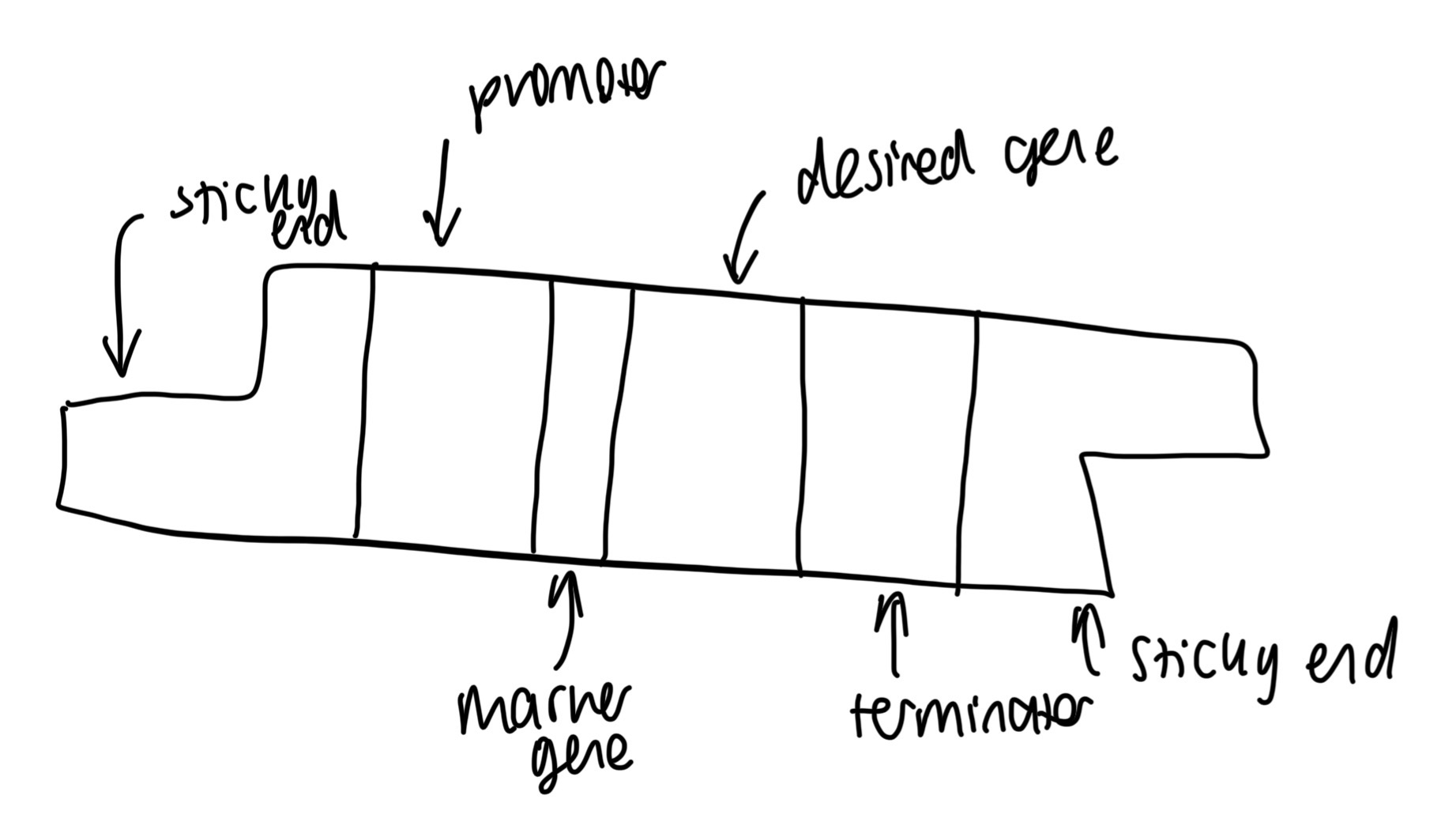
using restriction endonuclease to cut fragments of DNA containing the desired gene
Conversion of mRNA to cDNA using reverse transcriptase
Creating the gene in the gene machine usually based on a known protein amino acid sequence
(Only first method contains sticky ends, promotor, and terminator, the other 2 you will need to add)
What is required in a human gene to start transcription
Human desired gene needs to include promotor and terminator sequences to allow RNA polymerase to bind to start transcription and to unbind when transcription has finished