Language and the Brain
0.0(0)
 Studied by 1 person
 Call Kai
 Learn
Learn Practice Test
 Spaced Repetition
 Match
Match Flashcards
 Knowt Play
Card Sorting
1/125

Earn XP
Description and Tags
Last updated 8:37 AM on 5/24/23
Name | Mastery | Learn | Test | Matching | Spaced | Call with Kai |
|---|
No analytics yet
Send a link to your students to track their progress
126 Terms
1
New cards
What is language?
Uniquely human communication system.
\
Finite set of **elements** + **rules** of how to use them = infinite number of utterances
\
Finite set of **elements** + **rules** of how to use them = infinite number of utterances
2
New cards
How are other species communication limited?
* Other species communication is limited to the present moment
* Humans can express many more messages in language about the past and future and modal, abstract
* Not clear whether animals can understand concept of language or just associative learning
* Humans can express many more messages in language about the past and future and modal, abstract
* Not clear whether animals can understand concept of language or just associative learning
3
New cards
One building block of language are words. What is the important information about words and the mental lexicon?
* Representations stored in the mental lexicon (ML)
* This is like a catalogue of words
* The ML stores info like *spelling, pronunciation, meaning, grammatical category*
* Average person has 50,000 words in their ML
* This is like a catalogue of words
* The ML stores info like *spelling, pronunciation, meaning, grammatical category*
* Average person has 50,000 words in their ML
4
New cards
What are **phonemes**?
* Smallest sound units of language that allow discrimination between words
* Letters have different phonemes, but some letters have multiple phonemes
* 40 phonemes in English
* Letters have different phonemes, but some letters have multiple phonemes
* 40 phonemes in English
5
New cards
What is a spoonerism?
* When a phoneme in one word (normally the first) is swapped with a phoneme of another ‘**h**issed **m**istery lessons’
6
New cards
What is a **uniqueness point**?
Point in word where we recognise that it must be a particular word (allig for alligator)
7
New cards
What did Kuhl et al (1992) discover about infants and phonemes?
Infants can distinguish between most phonemes but tune to ones of the native language by age of 1
8
New cards
What is morphological stranding?
CHECK
9
New cards
What are morphemes?
* Smallest meaningful units in langue
* ‘Dog’ is a morpheme because it cannot be broken down
* ‘S’ and ‘ing’ are also morphemes
* Words can be morphologically complex or simple depending on number of morphemes
* ‘Dog’ is a morpheme because it cannot be broken down
* ‘S’ and ‘ing’ are also morphemes
* Words can be morphologically complex or simple depending on number of morphemes
10
New cards
What is a syllable?
* Rhythmic unit of language
* One vowel with or without surrounding consonants
* One vowel with or without surrounding consonants
11
New cards
What is stress?
* Relative emphasis on certain syllables
* Can alter meaning of word
* **Ob**ject vs ob**ject**
* Can alter meaning of word
* **Ob**ject vs ob**ject**
12
New cards
What are the 5 building blocks of language?
1. Words
2. Phonemes
3. Morphemes
4. Syllables
5. Stress
13
New cards
What is the expletive infixation rule?
* Insertion of expletive is only possible in words with multiple syllables
* Where the word’s main stress is preceded by a secondary stress and unstressed syllable
* ele-bloody-mentary
* Where the word’s main stress is preceded by a secondary stress and unstressed syllable
* ele-bloody-mentary
14
New cards
What did Broca find out about the neurobiological architecture of language systems?
Patient Tan had lesion in **left inferior frontal lobe (Broca’s area) -**
* This damage impaired language production, and writing
* But language comprehension intact
\
* This damage impaired language production, and writing
* But language comprehension intact
\
15
New cards
What are the symptoms of Wernicke’s aphasia?
Lesion in the **left posterior temporal lobe (Wernicke’s area)**
* Perfect pronunciation of words, but would incorrectly respond despite their mind thinking they answered the question (is the window open? ‘Close the door’)
\
* Perfect pronunciation of words, but would incorrectly respond despite their mind thinking they answered the question (is the window open? ‘Close the door’)
\
16
New cards
What was a key assumption of the classic language model?
(Broca-Wernicke-Gershwind model)
* Historically assumed language engaged only the left hemisphere
* Historically assumed language engaged only the left hemisphere
17
New cards
How are current views of language network different from the classic model?
* Language is much more **bilateral**
* Major role of **white matter tracts**
* Common regions: Broca’s area, superior, middle and inferior temporal gyri in both hemispheres
* Major role of **white matter tracts**
* Common regions: Broca’s area, superior, middle and inferior temporal gyri in both hemispheres
18
New cards
Who did Broca study?
Tan - could only produce sound “tan”
* Found damage in Tan’s brain in posterior lateral frontal lobe
* Found damage in Tan’s brain in posterior lateral frontal lobe
19
New cards
What is aphasia?
Generic term for language disorder
20
New cards
What did Vigneau et al (2010) meta analysis of 128 imaging studies show?
Different brain networks are engaged more or less for different types of information processed (phonological, semantic, grammatical)
21
New cards
Are language networks similar across all languages?
Yes, Malik-Moraleda et al (2022)
22
New cards
What are the three types of writing systems?
**Iogographic** - unique symbol for each word or morpheme (Chinese)
**Syllabic** - unique symbol for each syllable
**Alphabetic** - unique(ish) symbol for each phoneme (English, Russian etc.)
**Syllabic** - unique symbol for each syllable
**Alphabetic** - unique(ish) symbol for each phoneme (English, Russian etc.)
23
New cards
What is writing trying to capture about language?
The sound-meaning correspondence in written word
24
New cards
Give an example of a deep orthography and a shallow orthography.
Deep - English (letters represent different sounds in different contexts)
Shallow - Spanish (consistent correspondence between letters and phonemes)
Shallow - Spanish (consistent correspondence between letters and phonemes)
25
New cards
What is the role of regularity in written language?
Balance between an accurate representation of sound and the fast transmission of meaning
* English has deep orthography with many short words that cannot be distinguished phonetically (maid-made etc.) once learnt can get to meaning efficiently
* Finnish, Spanish have shallow orthography - long words and rich morphology so can afford to go 1-1 on sound meaning
* English has deep orthography with many short words that cannot be distinguished phonetically (maid-made etc.) once learnt can get to meaning efficiently
* Finnish, Spanish have shallow orthography - long words and rich morphology so can afford to go 1-1 on sound meaning
26
New cards
What are some basic findings on reading?
* Real words read faster than nonwords
* Regular words (dock) read faster than irregular words (yacht)
* Frequent words read faster than infrequent
(Regularity X frequency interaction)
* Regular words (dock) read faster than irregular words (yacht)
* Frequent words read faster than infrequent
(Regularity X frequency interaction)
27
New cards
What is a grapheme?
The smallest written unit of a language
28
New cards
What are some key components of the reading process?
* Sampling - extracting info from visual input
* Letter recognition
* Access orthographic lexicon
* And/or phoneme conversion
* Retrieval of word meaning
* Letter recognition
* Access orthographic lexicon
* And/or phoneme conversion
* Retrieval of word meaning
29
New cards
How do we extract info with eye movements?
* Fixation bring text into the fovea vision - highest concentration of photoreceptors (cones - higher acuity)
* 300ms saccade after fixation across words
* 300ms saccade after fixation across words
30
New cards
What are the two stages of letter recognition?
* Recognition of the letter’s visual characteristics
* Recognition of the letters identity (a=A etc.)
* Recognition of the letters identity (a=A etc.)
31
New cards
What is alexia?
* Loss of ability to recognise letters identity
* Lesions in the L posterior temporal occipital regions close to fuse form gyrus
* Near the *visual word form area* (VWFA)
* This area extracts identity of letter
* Lesions in the L posterior temporal occipital regions close to fuse form gyrus
* Near the *visual word form area* (VWFA)
* This area extracts identity of letter
32
New cards
What is dyslexia?
* Can read individual letters
* Struggle to put letters next to each other in the word and cannot understand the word
* Born with it
* Struggle to put letters next to each other in the word and cannot understand the word
* Born with it
33
New cards
What is the orthographic lexicon?
* Stores representations of spelling of words
* Activated when we read familiar word
* Followed by obtaining meaning of word from semantic system
* Activated when we read familiar word
* Followed by obtaining meaning of word from semantic system
34
New cards
What happens in priming tasks of letter recognition? (Dehaene et al 2001)
* Briefly presented with prime (below 29ms which is below consciousness level)
* Target is then shown for 500ms
* Ppts decide if prime is same as target
* Target is then shown for 500ms
* Ppts decide if prime is same as target
35
New cards
What do priming tasks show? (Dahaene et al 2001)
* When word is same, reaction time was much shorter
* Priming effective
* Change of case between prime and word did not effect reaction time
* Suggests not just low level processing going on
* But meaning of word captured during prime
* Priming effective
* Change of case between prime and word did not effect reaction time
* Suggests not just low level processing going on
* But meaning of word captured during prime
36
New cards
A model of reading must account for mapping (retrieving new words) and …?
* Assembling - new words we don’t yet know
* This is because we *can* read novel words and assemble the pronunciation from the letters
\
* This is because we *can* read novel words and assemble the pronunciation from the letters
\
37
New cards
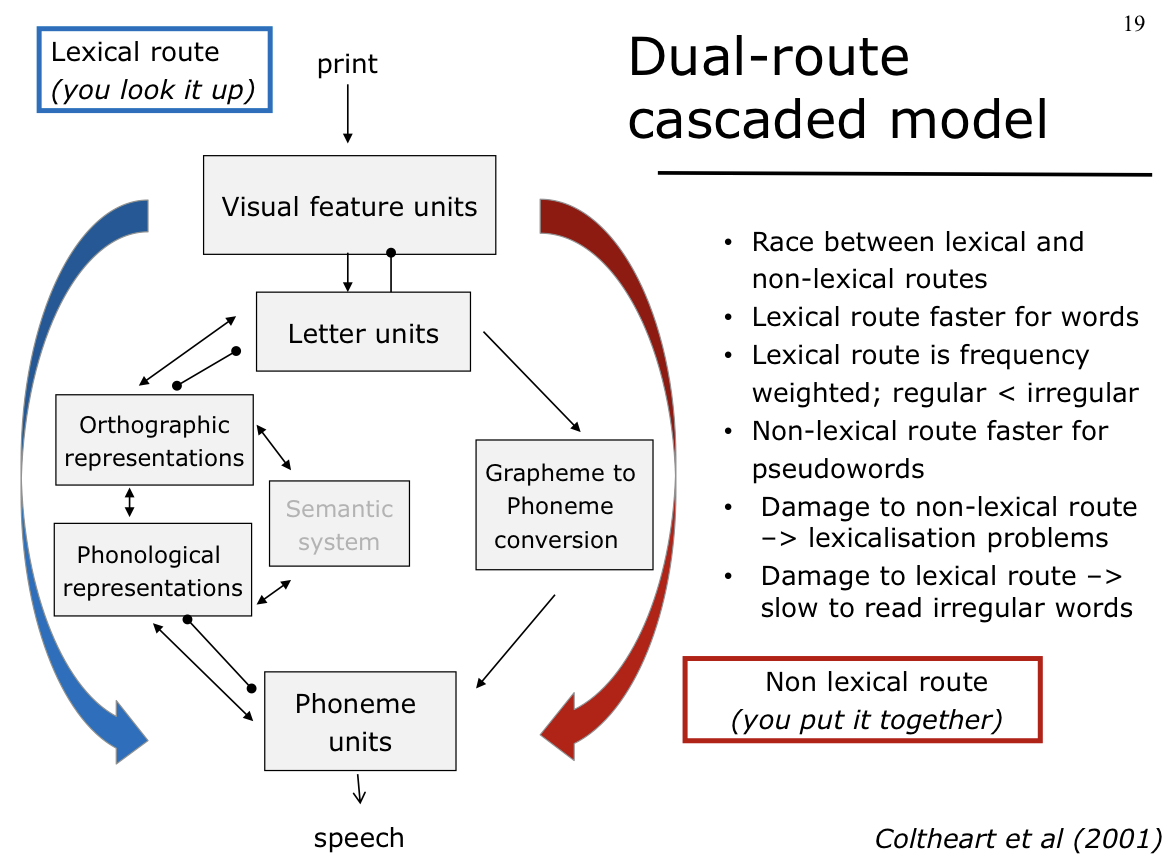
What is the idea of the **Dual-route cascaded** model? (Colt heart et al 2001)
1. lexical route (look up word in your lexicon)
2. non lexical route (you put the word together) - grapheme to phoneme conversion
Separate processes that do not work together, 1) faster for words, 2) faster for pseudo words
38
New cards
What is some patient evidence that the dual-model accounts well for?
* Number of patients (such as RG) have particular difficulty reading pseudowords
* Lexical route impaired
* Other patients (such as HTR) have particular difficulty reading irregular words (surface dyslexia)
* Suggests lexical route impaired
* Lexical route impaired
* Other patients (such as HTR) have particular difficulty reading irregular words (surface dyslexia)
* Suggests lexical route impaired
39
New cards
What is the main limitation of the DRC?
Does not account for learning in language
40
New cards
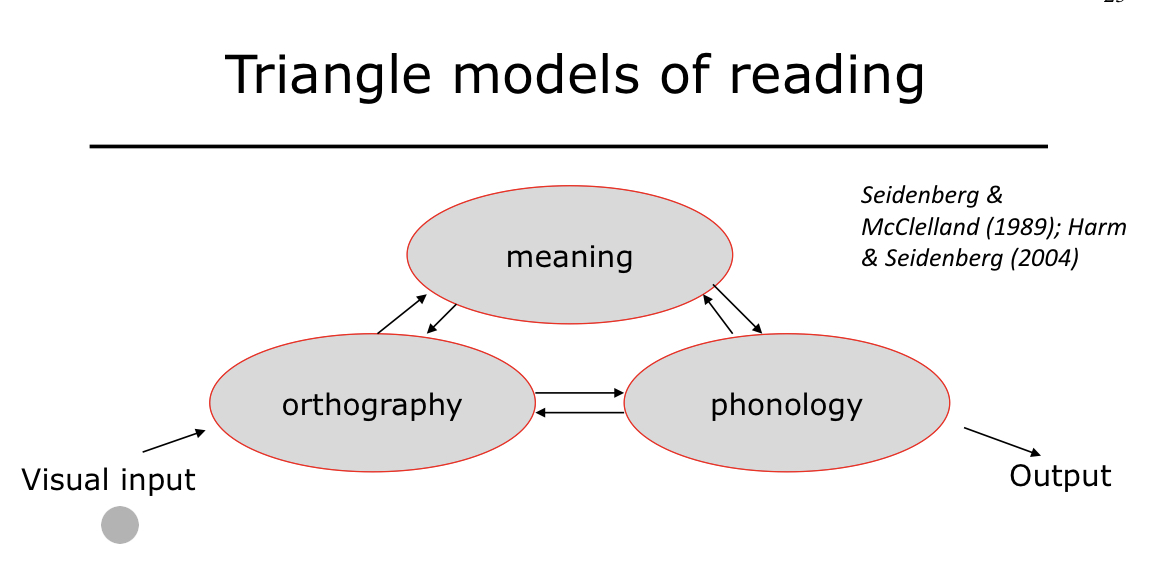
Explain the triangle model of reading (Seidenberg & McClelland 1989)
* One input and output for regular, irregular and pseudo words
* Learning of correspondence with spelling and sound
* Interconnected **semantic** and **orthographic** (both used for irregular words) and **phonological** units (important for pseudo words)
\
* Learning of correspondence with spelling and sound
* Interconnected **semantic** and **orthographic** (both used for irregular words) and **phonological** units (important for pseudo words)
\
41
New cards
What is an example of learning that goes on in language processing (letter to sound correspondence)?
* Stronger connections emerge between orthographic and phonological units that are co-activated more often
42
New cards
What units of the triangle model would be used to process pseudo words?
Phonological and orthographic (because the word lacks meaning)
43
New cards
What units are used to process irregular words? (Triangle model)
The semantic and orthographic units (as phonology is not obvious)
44
New cards
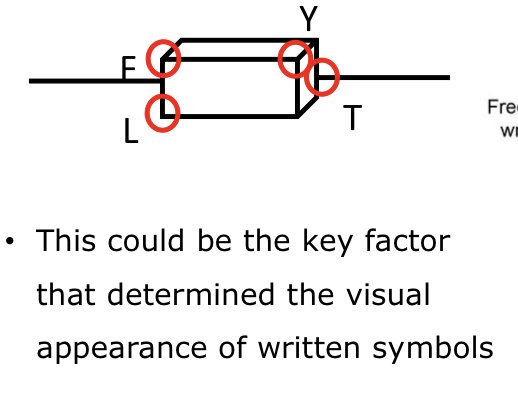
What is the **neuronal recycling hypothesis**? (Dehaene 2009)
* Reading “piggy backed” on older brained functions designed for visual processing
* Frequency rank symbols in written languages correlates highly with similar natural world shapes
\
* Frequency rank symbols in written languages correlates highly with similar natural world shapes
\
45
New cards
Why is it hard to discriminate between models of language comprehension?
* Both models account for basic experimental findings
* Both models account for neuropsychological data
* Both focus on English
* Neither specifies brain implementation
* Both models account for neuropsychological data
* Both focus on English
* Neither specifies brain implementation
46
New cards
What did neuroimaging data reveal about the time course of brain activation when reading (MEG, Marinkovic et al 2003)?
* Starts in **occipital pole** 100ms after word seen
* By 170ms it extends to **occipito-temporal** region (VWFA)
* Then to multiple temporal and frontal regions in left hemisphere
* By 170ms it extends to **occipito-temporal** region (VWFA)
* Then to multiple temporal and frontal regions in left hemisphere
47
New cards
What is speech recognition?
A process of progressively extracting invariant, discrete representations from a variable, continuous input
48
New cards
How do we break down the input of a sound (word)?
* **Metrical segmenatation strategy (MSS)**
* The rhythmic structure of English is stress-timed - some syllabus are emphasised
* This is how we tell when a word starts and ends
* English listeners assume that every strong syllable is the so set of a new content word
* The rhythmic structure of English is stress-timed - some syllabus are emphasised
* This is how we tell when a word starts and ends
* English listeners assume that every strong syllable is the so set of a new content word
49
New cards
Give examples of content words and grammatical words.
**Content:** nouns, verbs, adjectives
**Grammatical:** articles, pronouns, prepositions, conjunctions
**Grammatical:** articles, pronouns, prepositions, conjunctions
50
New cards
What is the supporting evidence for MSS (Cutler & Carter 1987)?
* Looked at 190,000 words
* 39% stressed syllables, 61% unstressed
* Found 3/4s of stressed syllables were the sole or initial syllable of a content word
* 39% stressed syllables, 61% unstressed
* Found 3/4s of stressed syllables were the sole or initial syllable of a content word
51
New cards
Is metrical segmentation strategy infallible?
* No
* It is a strategy and requires other additional sources of information
* It is a strategy and requires other additional sources of information
52
New cards
Describe the hierarchy of segmentation cues.
Tier 1: Sentential context and lexical knowledge
Tier 2: Phonotactics and acoustic-phonetics
Tier 3: Word stress
Tier 2: Phonotactics and acoustic-phonetics
Tier 3: Word stress
53
New cards
What happens after we segment a word that is spoken?
* **Lexical Selection -** searching process that determines the best fit between the input and abstract lexical representations
* Starts as soon as there is some info about the word (can be recognised within 175-200ms)
* Starts as soon as there is some info about the word (can be recognised within 175-200ms)
54
New cards
What is the process of acquiring evidence about time taken to process spoken words?
* **Shadowing** - get ppts to repeat words that they are hearing as fast as possible
* Can also determine if you are retrieving information, not just parroting, but mispronouncing words so that they have to correct it
* Can also determine if you are retrieving information, not just parroting, but mispronouncing words so that they have to correct it
55
New cards
What was the evidence found from shadowing about time taken to process spoken words (Marslen-Wilson 1975)?
* Participants corrected the words when repeating them
* Corrections occurred before the incorrect word presented in full
* Suggests spoken word processing is very quick
* Corrections occurred before the incorrect word presented in full
* Suggests spoken word processing is very quick
56
New cards
What is gating?
* Gradually increasing fragments of a word
* Ask ppts to guess word based on the fragments heard
* Find the point of uniqueness when you can guess the word accurately.
* Ask ppts to guess word based on the fragments heard
* Find the point of uniqueness when you can guess the word accurately.
57
New cards
What was found about word salience onsent (Cole & Jakimik 1980)?
* Ppts much more likely 70% instead of 30% to detect mispronunciations when word mispronounciation occured at start instead of end
* This is explained by lexical search being able to start immediately and guesses can be made about the word ending
* This is explained by lexical search being able to start immediately and guesses can be made about the word ending
58
New cards
Describe Allopenna et al (1998) study into additional late activation.
59
New cards
How do we access meaning after we have lexically selected a word from the sound?
* Different meanings initially activated: context info used to determine which words considered for recognition
* Context info critical for *selection* of the appropriate meaning
* Context info critical for *selection* of the appropriate meaning
60
New cards
What was Swinney (1979) investigation into access to meaning?
* Presented story talking about “bugs” but was ambiguous which meaning was meant
* Overtime the meaning became clear
* At the same time presented words on screen and were asked which word corresponded to real English word
1. ANT - related to dominant meaning
2. SPY - related to non-dominant (audio bugs)
3. SEW - unrelated control
* Overtime the meaning became clear
* At the same time presented words on screen and were asked which word corresponded to real English word
1. ANT - related to dominant meaning
2. SPY - related to non-dominant (audio bugs)
3. SEW - unrelated control
61
New cards
What did Swinney find in his priming test to see if one or two meanings are activated in the disambiguating context(1979)?
* When target presented earlier both ant and spy showed faster reaction times
* Context not used at first, both meanings activated
* When target presented later, only ant showed faster lexical decision
* Context used to determine which meaning is relevant after some time
* Context not used at first, both meanings activated
* When target presented later, only ant showed faster lexical decision
* Context used to determine which meaning is relevant after some time
62
New cards
What is Warren’s phoneme restoration effect?
* Brain restores missing phonemes that make it hard to notice a sound missing at all
63
New cards
What is the relevance of evolutionary context to speech processing in the brain?
* Non-human primates also communicate by exchanging meaningful calls
* Triggers bilateral activity in brain of macaque
* Suggests evolutionary continuity of the bilateral system that supports mapping from sound to meaning (language brain mechanisms may not have developed *de novo* in humans)
* Triggers bilateral activity in brain of macaque
* Suggests evolutionary continuity of the bilateral system that supports mapping from sound to meaning (language brain mechanisms may not have developed *de novo* in humans)
64
New cards
There are strong dorsal connections between the temporal and frontal areas in the left hemisphere in humans, what does this mean for speech processing?
* These areas related to grammatical and syntactic processes which are arguably human-unique
* These areas activated for more complex spoken inputs (sentences opposed to calls)
* These areas activated for more complex spoken inputs (sentences opposed to calls)
65
New cards
What are the roles of the ventral and dorsal streams in language?
Ventral - meaning
Dorsal - articulation
Dorsal - articulation
66
New cards
What are syntactic rules?
Rules that govern how words in the language can be combined
67
New cards
What does the **garden-path model** of sentence processing say (Frazier & Rayner 1982)?
* Initial resolving of a sentence into its components is purely syntactic
* Meaning is not involved in the selection of the initial syntactic structure - (in what sense?)
* Meaning is not involved in the selection of the initial syntactic structure - (in what sense?)
68
New cards
What do **constraint based theories** of sentence processing say (MacDonald et al, 1994)?
The initial interpretation depends on all available sources of information (syntactic, semantic, general world knowledge)
69
New cards
What does the **good-enough** theory of sentence processing say (Ferreira et al 2002)?
* Processing depth and type of information used depends on the task
70
New cards
What are some types of information that people use to understand sentences?
* Syntactic principles
* Statistical regularities
* Grammatical categories
* Prosodic cues
* Semantic information
* World knowledge
* Statistical regularities
* Grammatical categories
* Prosodic cues
* Semantic information
* World knowledge
71
New cards
How do **syntactic principles** help us to understand sentences? (Frazier 1987)
**Late closure principle:** new items are attached to the phrase or clause most recently processed, if grammatically possible
\
**Minimal attachment:** the parser builds the simplest structure that obeys the rules of language
\
**Minimal attachment:** the parser builds the simplest structure that obeys the rules of language
72
New cards
How do **statistical regularities** help us to understand sentences?
**Word order:** helps us (subject-verb-object is common)
\
**Actives** are more common and faster to process: “The man ate the cake” (active) vs “the cake was eaten by the man” (passive)
\
**Actives** are more common and faster to process: “The man ate the cake” (active) vs “the cake was eaten by the man” (passive)
73
New cards
How do **grammatical categories** help us to understand sentences?
* Individual words provide reliable cues for sentence interpretation “the horse galloped through the …” - some noun
* We can make a good guess based on the previous words and can guess the **type** of word
* “And” signals a new phrase node
* We can make a good guess based on the previous words and can guess the **type** of word
* “And” signals a new phrase node
74
New cards
How do **prosodic cues** help us to understand sentences?
***We*** have a lecture this Saturday?
Conveys different information to:
We have a ***lecture*** this Saturday?
Or
We have a lecture ***this*** Saturday?
Etc.
\
Conveys different information to:
We have a ***lecture*** this Saturday?
Or
We have a lecture ***this*** Saturday?
Etc.
\
75
New cards
How did Beach (1991) show the effect of prosodic cues on sentence processing?
* \
76
New cards
How does **semantic information** help us to understand sentences?
‘The old man the boats’ seems like nonsense, but interpreting ‘old’ to mean *elderly* and ‘man’ to mean *operate,* it makes sense.
\
\
\
\
77
New cards
How did Trueswell et al (1994) investigate the role of semantic information?
Presented ppts with two sentences:
1. The *witness* examined by the *lawyer* was useless
2. The *evidence* examined by the *lawyer* was useless
* The second was read faster
* Explained because “evidence” is inanimate and cannot be doing the examining
* However in 1 the witness could be doing the examining
1. The *witness* examined by the *lawyer* was useless
2. The *evidence* examined by the *lawyer* was useless
* The second was read faster
* Explained because “evidence” is inanimate and cannot be doing the examining
* However in 1 the witness could be doing the examining
78
New cards
How does **world knowledge** help us to understand sentences?
When sentence meaning clashes or is coherent with our knowledge of the world it may change the interpretation or meaning we extract from it
(Hagoort et al 2004 evidence)
(Hagoort et al 2004 evidence)
79
New cards
What are some neurobiological findings about syntax? (Rolheiser et al 2011)
* Correlation between syntactic comprehension and white matter density
80
New cards
A meta-analysis of 128 neuroimaging studies of syntactic processing was carried out, what was found? (Vigeau et al 2011)
* Extended fronto-temporal processing network
* Syntactic processing seems more dependent on left hemisphere
* Syntactic processing seems more dependent on left hemisphere
81
New cards
What does Friederici et al’s model (2011) say about the location of grammatical function?
* Strict left lateralisation - primacy of Broca’s area
* Two relevant neural computational systems:
* Ventral pathway for simple syntax “cat on the mat”
* Dorsal pathway for complex syntax “the juice that the child spilled stained the rug”
* Two relevant neural computational systems:
* Ventral pathway for simple syntax “cat on the mat”
* Dorsal pathway for complex syntax “the juice that the child spilled stained the rug”
82
New cards
What is the evolutionary context of the sentence processing system?
* (Rilling et al 2004) evolutionary expansion of the dorsal fronto-temporal pathway in humans
* (Fitch & Hauser 2004) non-human primates can process simple syntax but not complex
* (Fitch & Hauser 2004) non-human primates can process simple syntax but not complex
83
New cards
What did Peal and Lambert (1962) discover about bilingualism and intelligence?
* Found a positive correlation between the two
84
New cards
What are some proposed effects of bilingualism?
* Greater mental flexibility
* Ability to think more abstractly
* Easier concept formation
* Positive transfer between languages benefiting verbal IQ
(People used to think that it made it harder to acquire more information - made you stupider)
* Ability to think more abstractly
* Easier concept formation
* Positive transfer between languages benefiting verbal IQ
(People used to think that it made it harder to acquire more information - made you stupider)
85
New cards
What are the variety of influences on the way bilingualism affects cognition?
* Acquisition contexts (same as first language or after?)
* Reason to learn: choice, necessity, chance
* Other: practice, proficiency, exposure
* Reason to learn: choice, necessity, chance
* Other: practice, proficiency, exposure
86
New cards
What are some disadvantages of being bilingual?
* Children have disadvantage in receptive vocabulary in preschool (matching word to image of its referent)
* Suffer more from tip-of-the-tongue (Gollan et al 2005)
(These effects explained by frequency of word being less for bilinguals as they use different languages)
* Suffer more from tip-of-the-tongue (Gollan et al 2005)
(These effects explained by frequency of word being less for bilinguals as they use different languages)
87
New cards
Discuss brain activity when bilinguals processing cognates (words with same meaning and sound similar in different languages).
* For cognates, word in second language shows less brain activity than if it is a non-cognate (is in first language)
* Brain is using already learning information from first language
* Brain is using already learning information from first language
88
New cards
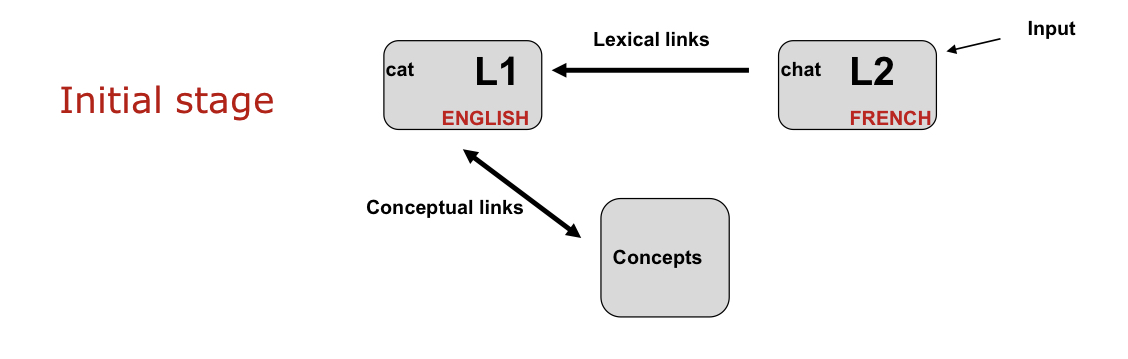
What are the links between concepts and languages when first learning a second language?
L2 direction is lexically linked to L1 (L1 not linked to L2)
There are conceptual links between the concepts themselves and L1 but not yet L2-concepts directly
There are conceptual links between the concepts themselves and L1 but not yet L2-concepts directly
89
New cards
Are the same areas involved in the processing of both languages in bilinguals?
* Yes
* Although sometimes stronger activation for L2
* Supposedly more difficult
* Depends on AoA, proficiency, task, exposure
* Although sometimes stronger activation for L2
* Supposedly more difficult
* Depends on AoA, proficiency, task, exposure
90
New cards
What are the links between concepts and languages at the initial stage of learning a second language? (**hierarchical model** of bilingual acquisition)
* L2 (word in second for same concept) and L1 are started to both be linked lexically, can go from word in L1 to word in L2 and vice versa
* Conceptual links forming between L2 and concepts
* Conceptual links forming between L2 and concepts
91
New cards
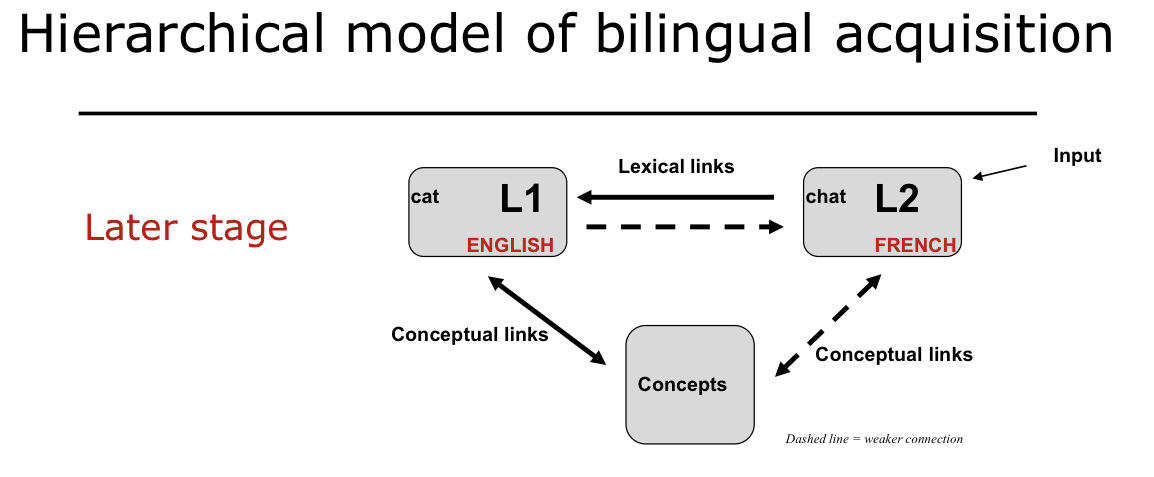
What happens at the later stage of language acquisition in bilinguals? (Hierarchical model)
* Conceptual links start to form between L2 and concept
* L1 direction to L2 start to form
* L1 direction to L2 start to form
92
New cards
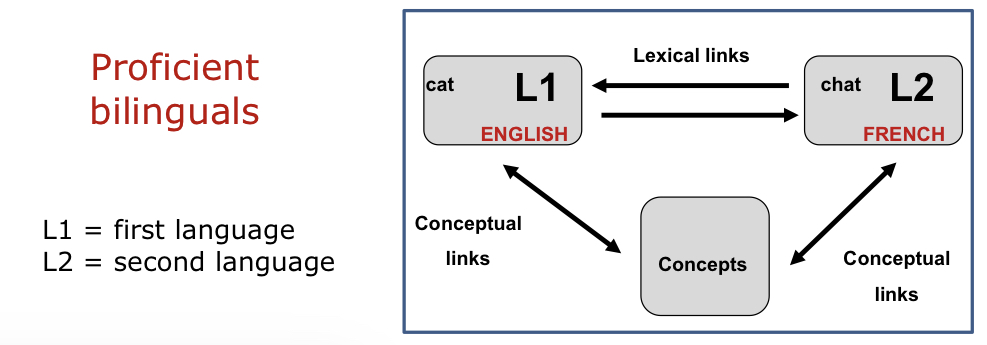
Describe the links between concepts and terms in proficient bilinguals. (Hierarchical model)
* Strong links between L2 and L1 (both ways)
* Also L2 and concept
* Also L2 and concept
93
New cards
Is there supporting research for the prediction of the hierarchical model that translation from L1 → L2 should be slower?
* Yes, found that translation of list of semantically related words from L1 → L2 was slower in English-Dutch bilinguals
94
New cards
Both languages in bilinguals are constantly active and competing for access, how do they produce words from L2? (Means translating from 2 to 1 is harder)
* They do this by inhibiting L1, allowing them to produce words from L2
* (Going from L1 to L2 is harder because you have to stop inhibiting L2)
* (Going from L1 to L2 is harder because you have to stop inhibiting L2)
95
New cards
What is metalinguistic knowledge?
* Knowledge *of* language
* That, for example, “dog” isn’t necessarily a label for a dog
* “Dog” is a symbol or tool for communicating the meaning of the concept
* Lead to more flexible and abstract creation of concepts
* That, for example, “dog” isn’t necessarily a label for a dog
* “Dog” is a symbol or tool for communicating the meaning of the concept
* Lead to more flexible and abstract creation of concepts
96
New cards
What did Ianco-Worall (1972) show about bilinguals and meta-linguistic knowledge?
* Bilingual children ages 4-6 more likely to accept that objects could have multiple names
97
New cards
What is the **Simon task**? (Simon effect)
* Get ppts to press a button with left/right hand depending on colour of stimulus presented
* Stimulus can be presented on left or right side of screen
* RT is faster if stim presented on right side and that is the side you meant to press for that colour
* **Simon effect** is the difference in accuracy or reaction time between trials in which stimulus and response are on the same side and trials in which they are on opposite sides
\
* Stimulus can be presented on left or right side of screen
* RT is faster if stim presented on right side and that is the side you meant to press for that colour
* **Simon effect** is the difference in accuracy or reaction time between trials in which stimulus and response are on the same side and trials in which they are on opposite sides
\
98
New cards
Discuss the relation between bilinguals and executive function (Performance on Simon task).
* Reduced Simon effect (response selection on incongruent trials in Simon task) and age effect for bilinguals
* Reduced working memory cost and age effects for bilinguals
* Bilinguals better prepared to cope with conflicting information
* Reduced working memory cost and age effects for bilinguals
* Bilinguals better prepared to cope with conflicting information
99
New cards
What did Craik et al (2010) find out about bilingualism and Alzheimer’s?
* Alzheimer’s diagnosed 4.3 years later in bilingual patients
* Onset of symptoms 5.1 years later
* Language experience may contribute to cognitive reserve, compensation for the effects of neuropathology
* Onset of symptoms 5.1 years later
* Language experience may contribute to cognitive reserve, compensation for the effects of neuropathology
100
New cards
What are some issues with the benefits-of-bilingualism literature?
* Some attempts at replication have failed
* Some found no link between bilingualism and improved exec function
* Possible methodological problems
* Publication bias - positive results more likely to be published than negative
* Some found no link between bilingualism and improved exec function
* Possible methodological problems
* Publication bias - positive results more likely to be published than negative
 Note
Note  Flashcards (70)