2. Global Water Cycle
 Studied by 0 people
 Call Kai
 Learn
Learn Practice Test
 Spaced Repetition
 Match
Match Flashcards
 Knowt Play
1/22

There's no tags or description
Looks like no tags are added yet.
Name | Mastery | Learn | Test | Matching | Spaced |
|---|
No study sessions yet.
23 Terms
What are the 4 main subsystems in the water cycle?
Lithosphere, hydrosphere, cryosphere, atmosphere
Describe the lithosphere
The Earth's solid outer layer, including the crust and upper mantle, forming continents and ocean basins.
Describe the hydrosphere
All the water on Earth, including liquid water in oceans, rivers, and lakes, as well as groundwater.
Describe the atmosphere
The layer of gases surrounding the Earth, essential for weather and climate regulation.
Describe the cryosphere
The frozen parts of the Earth's surface, such as glaciers, ice caps, sea ice, and permafrost.
Give an example of the cascading system?
Volcanos in the LITHOSPHERE erupt and release lots of particulate matter into the ATMOSPHERE which are nuclei for the formation of water droplets in the HYDROSPHERE which helps growth in the BIOSPHERE
What is the global make-up of water? (percentages)
97% is saline water stored in the oceans
Freshwater makes up the remaining 2.5% made up of:
- cryospheric water (land ice, glaciers (69% of the 2.5%) and permafrost)
- terrestrial water (groundwater, lakes, soil, wetland, rivers, biomass)
- atmospheric water
Describe oceanic water
- contains dissolved salts
- alkaline average of 8.1 but this has fallen in the last 250 years and is expected to keep falling due to atmospheric carbon making the water more acidic.
Name all the forms of cryospheric water
- Sea Ice
- Ice Sheets
- Ice Shelves
- Icebergs
- Alpine Glaciers
- Permafrost
Describe sea ice as a form of cryospheric water?
Frozen ocean water that forms on the sea and melts with seasonal changes.
It does not contribute to sea level rise when it melts because it's formed from ocean water
Has a high albedo so reflects solar radiation causing a positive feedback cycle to global warming.
Describe ice sheets as a form of cryospheric water?
Massive layers of glacial ice covering vast land areas (over 50,000 km²), found only in Antarctica and Greenland.
Their melting significantly impacts sea level rise.
Long term water store, high albedo
If all ice sheets melted the sea level would rise by 6m
Describe ice shelves as a form of cryospheric water?
These are ice sheets over the sea.
They help slow the flow of ice into the sea. They do this by providing a physical barrier and creating friction at the base of glaciers, essentially acting as a braking system.
Describe icebergs as a form of cryospheric water?
Chunks of ice that break off glaciers and ice shelves and drift into oceans
They raise sea level only when they first leave land and push off into water but not when they melt
Describe alpine glaciers as a form of cryospheric water?
Mountain glaciers which are important in the Himalayas because they support rivers which support South Asian countries. This may impact water security.
Describe permafrost as a form of cryospheric water?
Permanently frozen ground that remains below 0°C. It stores large amounts of carbon and methane.
Strong positive feedback to climate change.
What are 2 cryospheric processes?
1. Accumulation - The addition of snow and ice to a glacier or ice sheet. Happens through snowfall, avalanches, or refreezing of meltwater. Dominates in the upper zones of glaciers.
2. Ablation - The loss of ice due to melting, sublimation (ice → water vapor), or calving (icebergs breaking off).Dominates in lower zones of glaciers. Affected by temperature, albedo (reflectivity), and climate change.
Describe some forms of terrestrial water?
Lakes - collections of water in hollows greater than 2 hectares, the largest is the Caspian sea
Rivers - both a store and transfer of water and they're streams in confined channels. Eg: the Amazon
Wetlands - areas of marsh, fen, peatlands or water which supports lots of species
Biological water - the water stored in all the biomass
Soil water - affects runoff, flood control etc
Ground water - collects underground in the pore spaces of rock
What is an aquifer?
- underground water stores on a global scale
- shallow ones can store water for up to 200 years but deeper fossil aquifers can stores water for up to 10,000 years
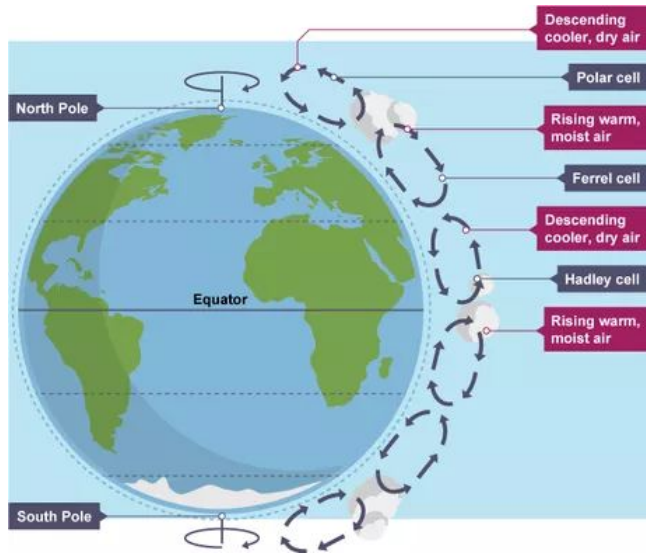
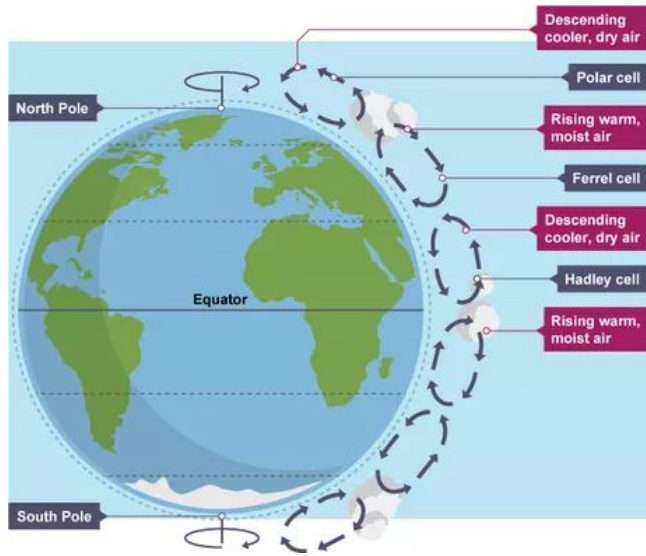
Describe what happens by the equator in the Hadley Cell? In the inter-troical convergence zone (ITCZ).
Temperature is very hot because it is by the equator meaning the air is less dense and so pressure is low.
Causes cumulonimbus clouds to form and convectional heavy rainfall and thunderstorms. This part is partly responsible for monsoons.
Also air will rise.
What happens to the ITCZ over the seasons?
It moves north and south as the position of the sun changes.
During Northern Hemisphere summer, it moves northward, bringing heavy rainfall to tropical regions.
Southern Hemisphere summer, it shifts southward towards the Tropic of Capricorn so trade winds converge further South
What happens to the air at deserts?
Because of the change in pressure in the Ferrel Cell from low to high the air sinks and gets cooler.
However some air goes back to the Hadley Cell because of the change in pressure forming trade winds.
What happens between the polar and ferrel cells?
There is low pressure so air rises again and holds more moisture.
Cold and warm air meet causing frontal rainfall.
What happens at the north pole?
Santa comes! 🎅 jokes. Air sinks here due to cold temperatures and high pressure
 Note
Note  Flashcards (128)