Psychology (Dr. C) Unit 2 Test
 Studied by 0 people
 Call Kai
 Learn
Learn Practice Test
 Spaced Repetition
 Match
Match Flashcards
 Knowt Play
1/148

There's no tags or description
Looks like no tags are added yet.
Name | Mastery | Learn | Test | Matching | Spaced | Call with Kai |
|---|
No analytics yet
Send a link to your students to track their progress
149 Terms
learning
the process of acquiring, through experience, new and relatively enduring information and/or behaviors; it is important because it allows us to adapt to our environment
how long, on average, does it take university students to learn new, desirable habits?
around 66 days (2 months)
behaviorism
the view advocated by the eminent early psychologist John B. Watson that psychology should be an objective science that studies directly observable external behavior without any necessity to consider internal mental processes
john b watson
founder of behaviorism
associative learning
learning that certain events occur together (pavlov's dog)
ivan pavlov
russian medical researcher who spent 20 years studying digestion. won a noble prize. while studying digestion, he discovered that as you chew, you maximize surface area of food
classical conditioning (pavlov)
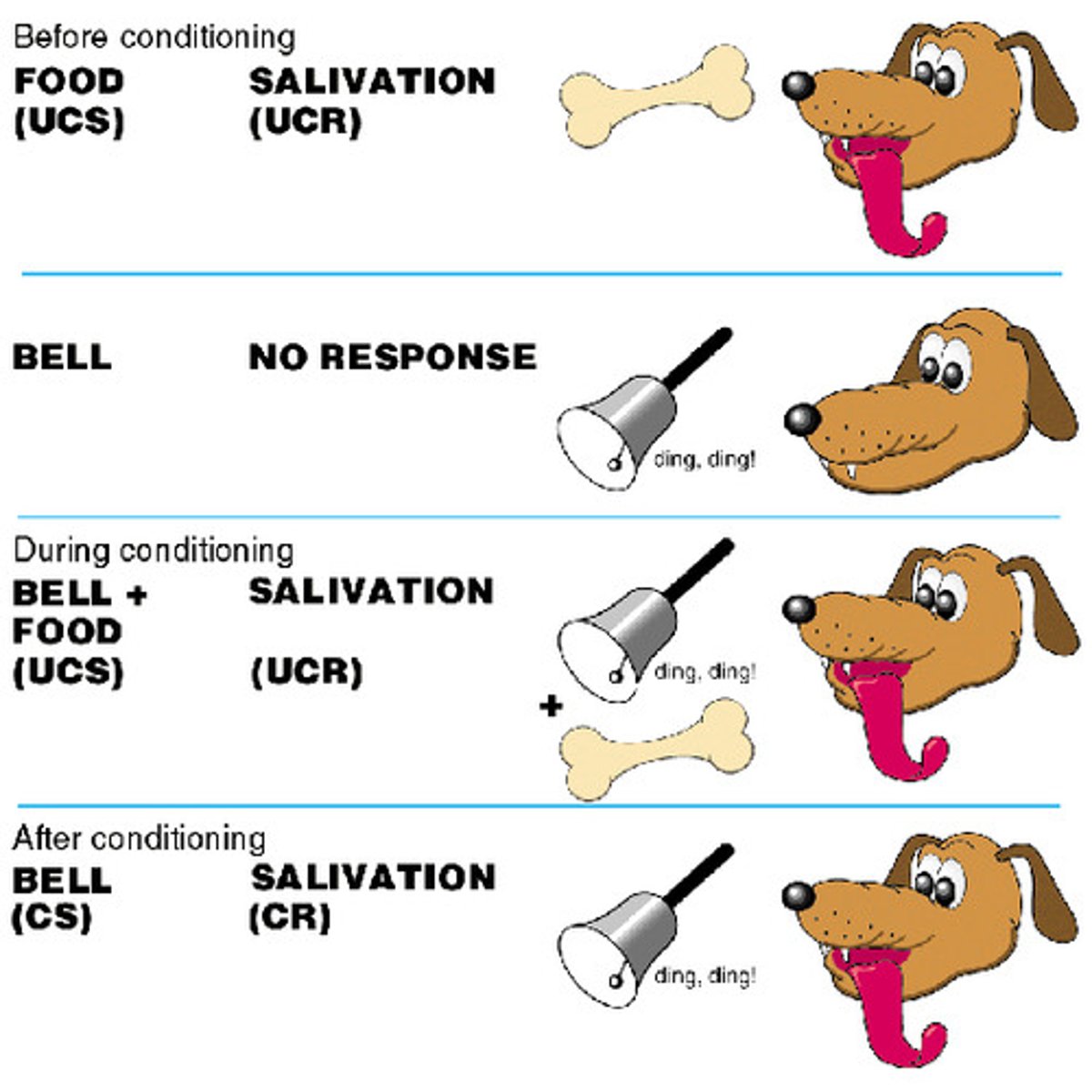
a kind of learning in which a subject learns to associate one stimulus with another stimulus that is followed by a certain event, such that the subject learns to anticipate that event and respond to the first stimulus as if it were the second stimulus
how did pavlov first come across classical conditioning
his dogs would salivate before they digested food/as they saw food/heard the attendant bring the food
pavlov's early experiment
pavlov would sound a musical tone, then he would give the dogs powdered meat, causing the animals to drool. after this event would be repeated, the dogs would drool after the musical tone was sounded because they associated the musical tone with the food
unconditioned stimulus
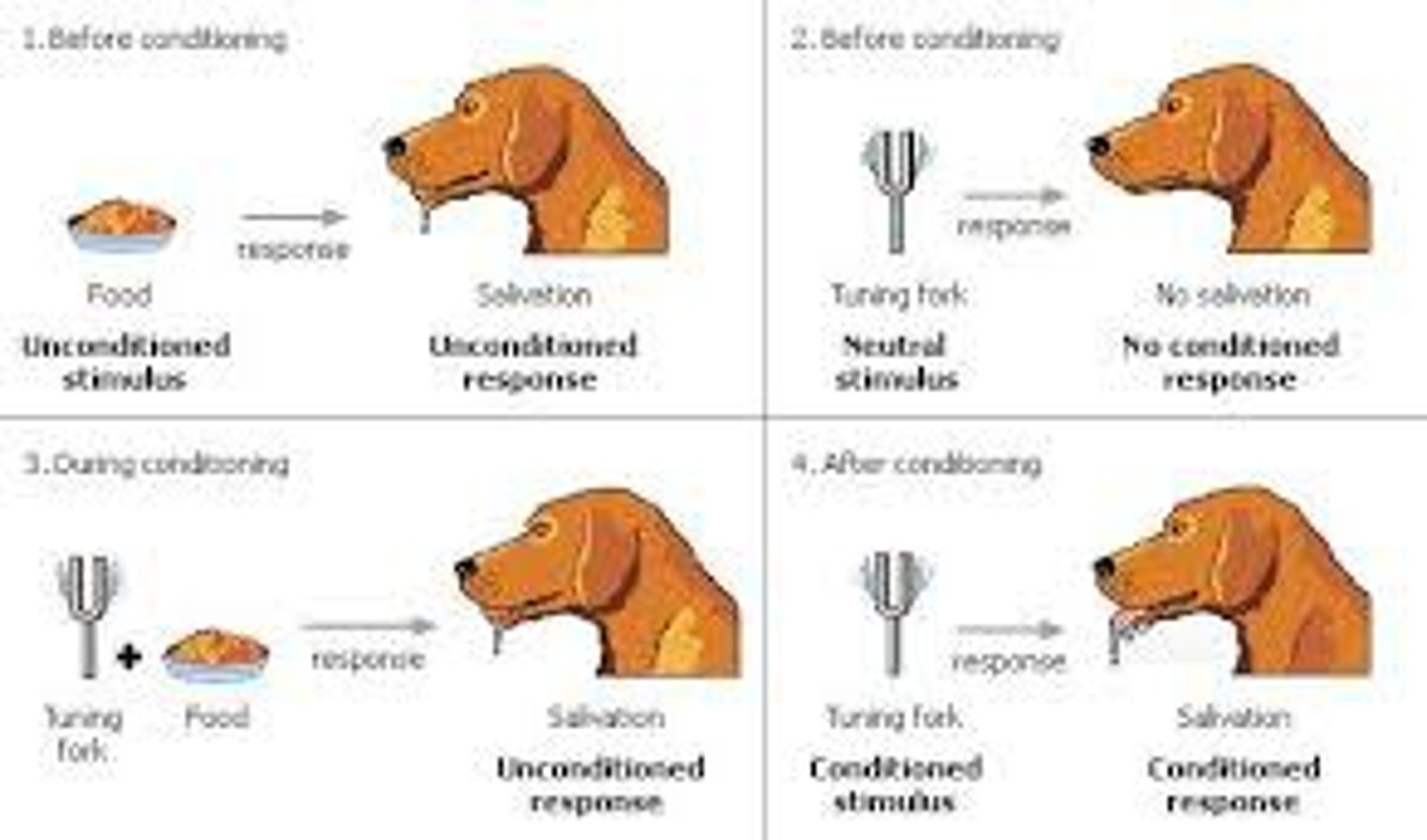
UCS/US; a stimulus that naturally brings about a response you are looking at, without any learning having to take place (food)

unconditioned response
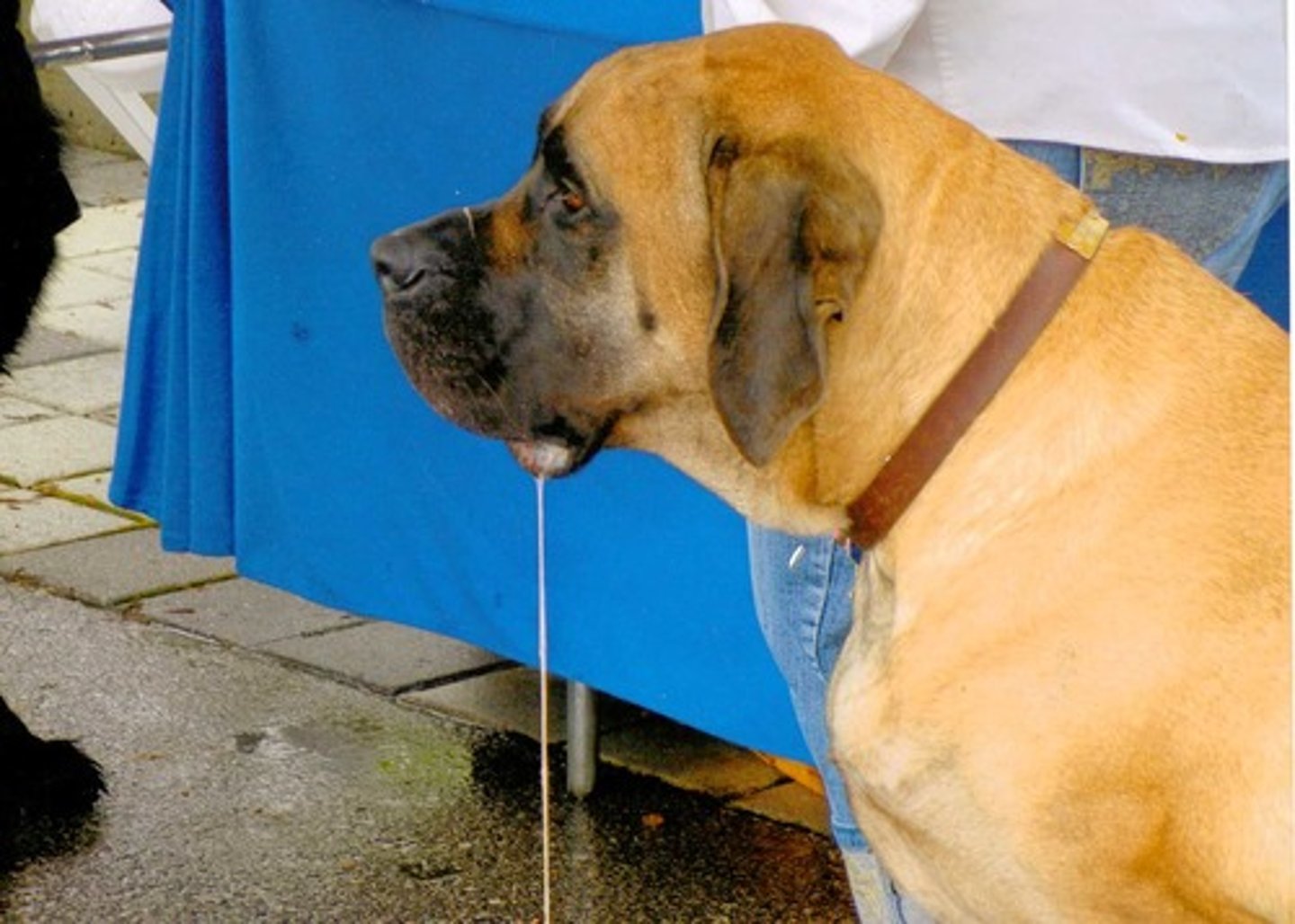
UCR/UR: a naturally occcuring response to the unconditioned stimulus, a response that does not require learning in order to take place (dog drooling)
unconditioned
natural, built-in, automatic, not requiring any learning in order to occur
neutral stimulus
NS; a stimulus that does not initially (naturally) bring about the response you are interested in (musical tone at first)

conditioned stimulus
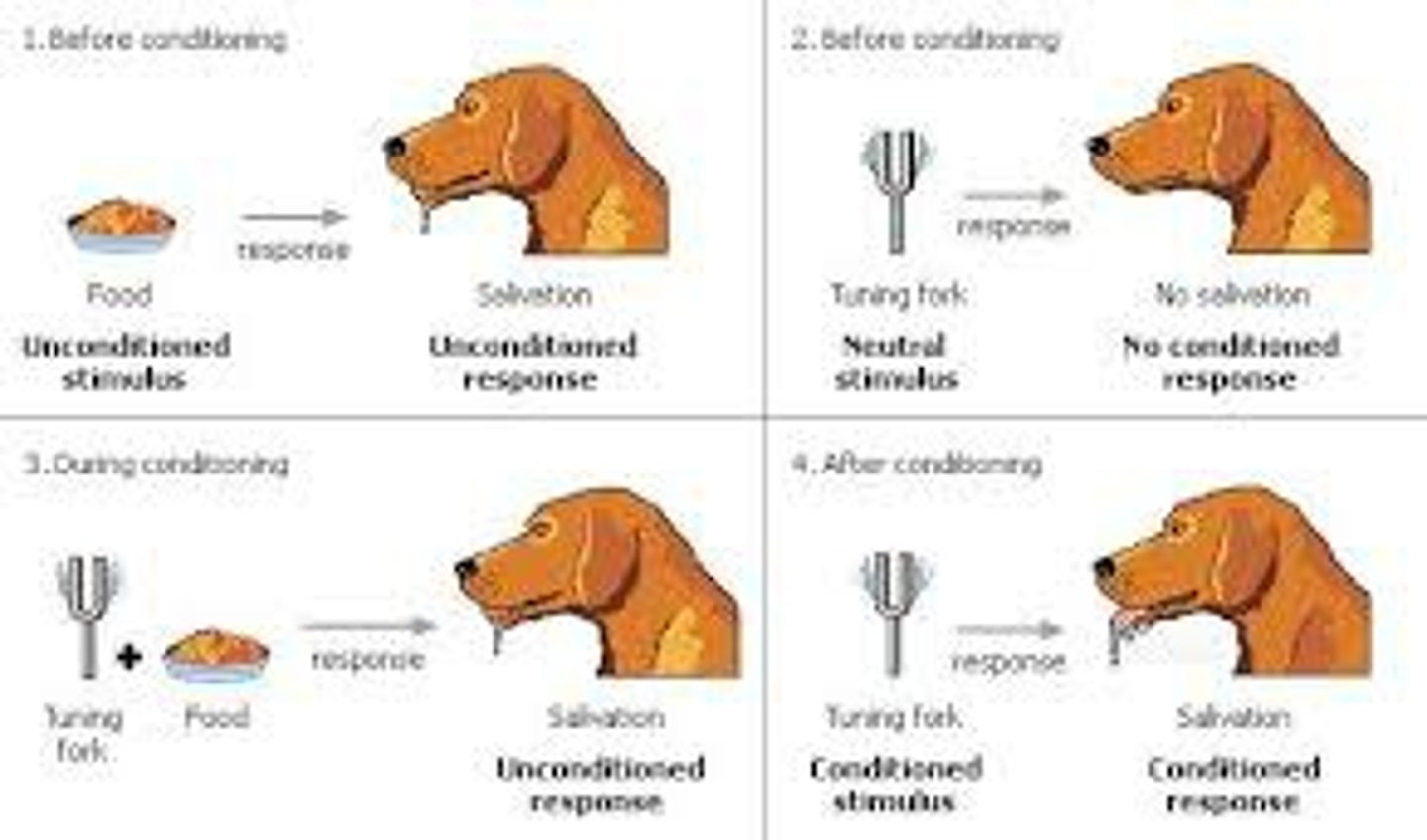
CS; an originally neutral stimulus that, after being associated with (paired with) an unconditioned stimulus, takes on the ability to bring about the response that originally followed the unconditioned stimulus (musical tone later)
conditioned response
CR; a learned response to a previously neutral stimulus that has now become the conditioned stimulus (drooling in response to the musical tone)
conditioned
not natural, not built-in, not automatic, something that would only happen if learning had occured
aquisition
the initial learning of a stimulus-response relationship in which a neutral stimulus is linked to an unconditioned stimulus, and the neutral stimulus becomes a conditioned stimulus capable of bringing about a conditioned response that is the same as the unconditioned response
in pavlov's original studies, what was the optimal interval between presenting the neutral or conditioned stimulus, and the unconditioned stimulus?
right away/the interval must be short. you must start with the neutral stimulus and follow it with the unconditioned stimulus
what is the usual result if the interval is too long, or if the conditioned stimulus comes after (not before) the unconditioned stimulus?
conditioning does not work
experiment with japanese quail
researchers took a male quail, put it in a cage, and turned on a red light. shortly after, they put a receptive female in the cage with the male, then they removed the female. this process was repeated several times. soon, when the red light went off, the male quail became sexually aroused before the female was placed in the cage
sexual arousal can be conditioned in humans
true; example: breaking up with someone who wore a specific perfume, and thinking about the person whenever you smelled the perfume
extinction
the diminishing of a conditioned response; specifically, in classical conditioning, when an unconditioned stimulus no longer follows the conditioned stimulus, until the conditioned response no longer appears; ex: once the food was not given to the dog after the musical tone, the response of drooling was extinguished
spontaneous recovery
the reappearance of a previously extinguished conditioned response after a pause in which there has been no training; ex: seeing your ex after a long time and calling them by their pet name ("hi cutie!")
generalization
following the establishment of a conditioned response, the tendency for stimuli that are similar to the conditioned stimulus to bring about similar responses (ex: pavlov projecting an ellipse instead of a circle to make the dog drool, Dr. C mistaking a left turn arrow for a green light)
discrimination
the learned ability to tell the difference between the conditioned stimulus that will be followed by the unconditioned stimulus, and other, similar stimuli that will not be followed by the unconditioned stimulus (ex: projecting a circle on the screen, giving the dog food, and alternating between projecting an ellipse and not giving the dog food -> dog will not drool for the ellipse because it knows it will not recieve food)
cognitions (internal thought processes) influence classical conditioning
true; this happens in attempts to condition alcoholics to stop drinking (antabuse is a drug that sensitizes you to alcohol/you get violently ill when you drink. an alcoholic knows that if they take the drug, it is the drug that is making them ill, and not the alcohol)
watson and rayner (1920) - little albert
wanted to demonstrate where fears in children came from. they hypothesized that it was a result of conditioning. in the experiment, they took an orphan (little albert) and put him in a playspace with a white rat. then, they hung a big metal bar behind him. anytime little albert tried to touch the rat, they banged the metal bar because children are scared of loud noises. after 7 times of doing this, little albert became terrified of white rats (conditioned stimulus)
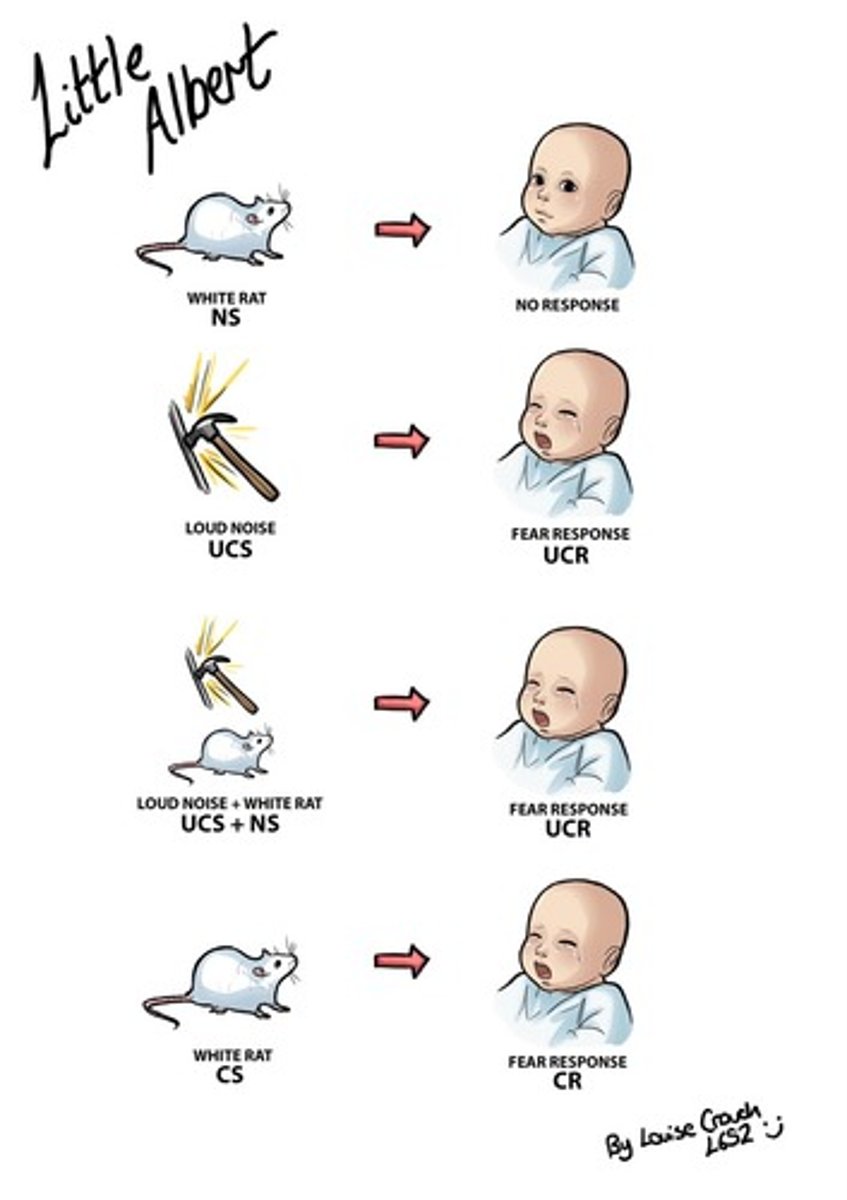
watson and rayner demonstrated...
1) fear can be conditioned
2) different but similar stimuli can initiate the fear response, so fear can be generalized (little albert became terrified of white coats, white rabbits, etc.)
what ultimately became of watson and rayner, and what ultimately became of little albert?
watson/rayner: watson had an affair with rayner. this became a scandal and he was fired. watson could not get a job in any university or college bc of this. eventually he married rayner, moved to NYC, became an advertisement designer, became an alcoholic, and died at 36. both of their children committed suicide
little albert: lived a long and happy life, however, he had a huge fear of dogs. died in 2007.
most of the time, fears produced in real life are a result of classical conditioning and generalization
true (example: story of Dr. C running over his daughter, and his daughter having a conditioned fear of being outside/anywhere near the front door (living room, dining room, etc = generalization)
classical conditioning vs. operant conditioning
in classical conditioning, the subject learns to form associations between events (stimuli) it does not control, resulting in behaviors it does not choose; in operant conditioning, the subject learns associations between its own voluntary (operant) behavior and the events (consequences) that result from it
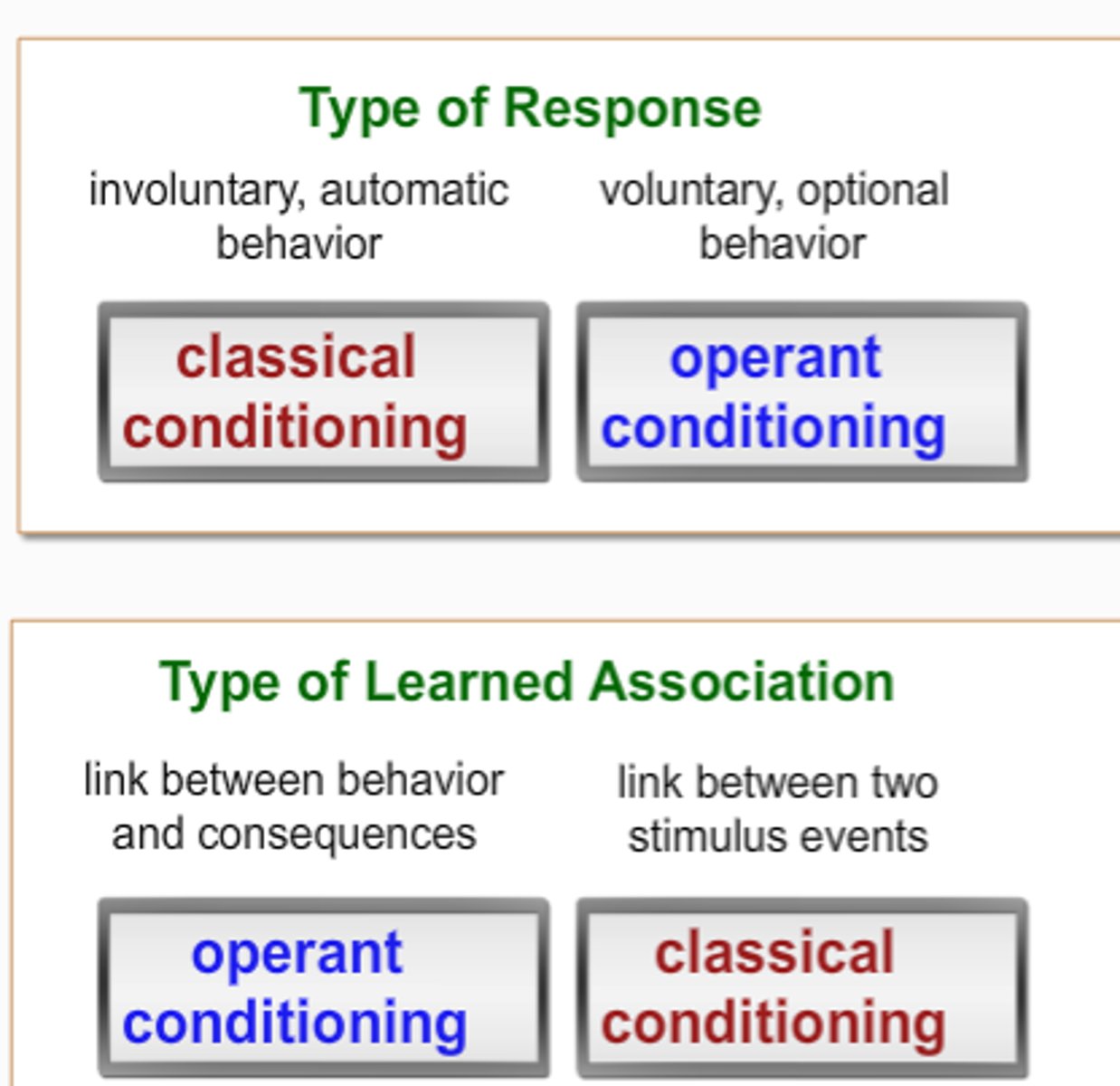
operant conditioning
a type of learning in which voluntary behavior is strengthened if it is followed by reinforcement (some form of reward) and diminished if it is punished or not followed by reinforcement
respondent behavior
behavior that occurs automatically in response to certain stimuli (we observe such behavior in CLASSICAL CONDITIONING)
operant behavior
voluntary behavior that operates on the environment to produce either rewarding or punishing consequences (we observe such behavior in OPERANT CONDITIONING)
B. F. Skinner
pioneered the study of operant conditioning and behavior; english undergraduate (20th century); based his earlier work on project pigeon
thorndikes law of effect
behaviors that are followed by favorable consequences become more likely, while behaviors followed by negative consequences become less likely
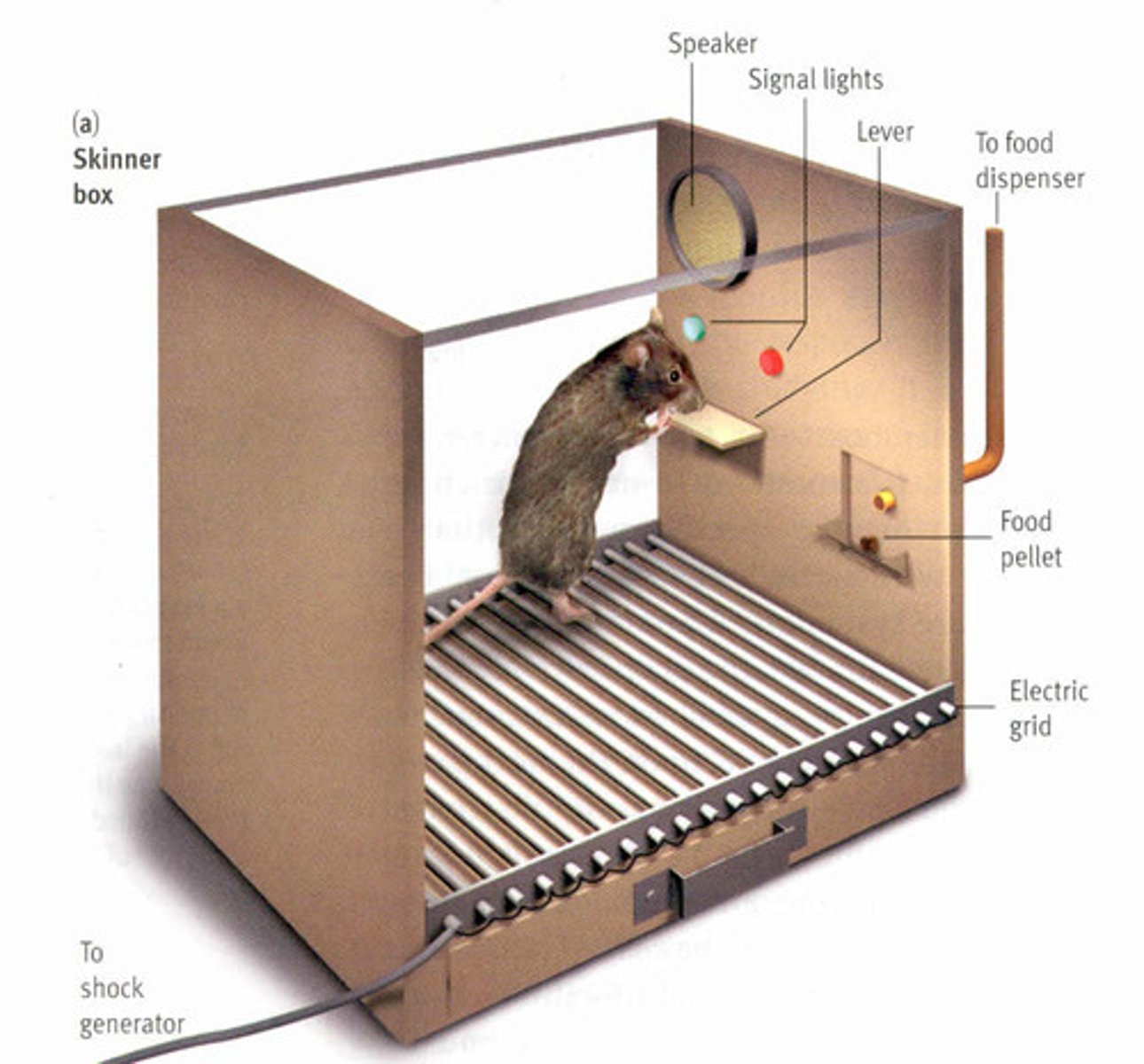
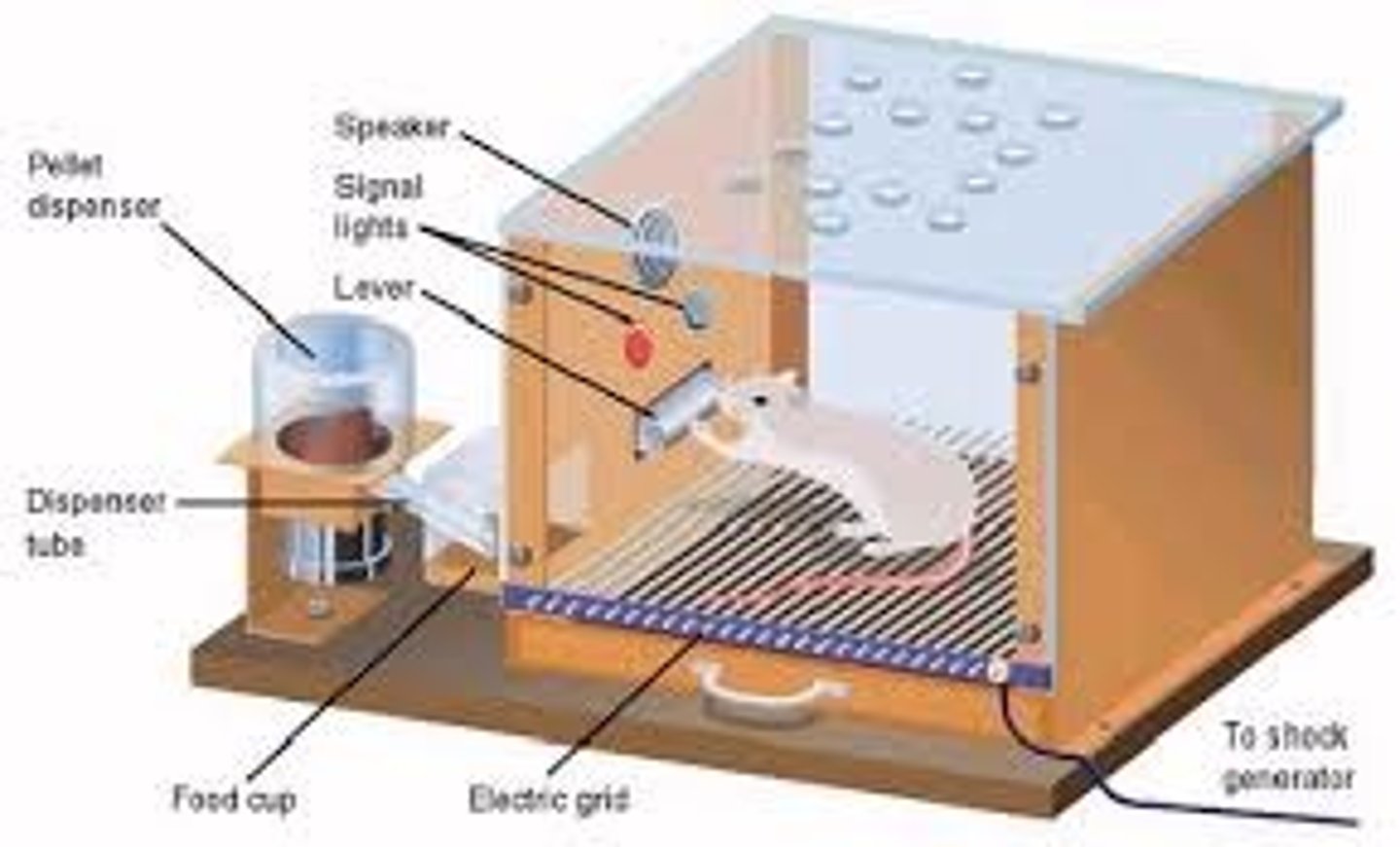
skinner box (operant chamber)
an isolated cage or chamber in which a subject (like a rat or pigeon) can do something (like push a bar or peck an object) in order to get a reward (like food or water) while a mechanical device records and counts the subject's responses
shaping
an operant conditioning procedure in which reinforcers (rewards) guide behavior toward closer and closer approximations of a desired goal
reinforcer
any event that strengthens the behavior it follows; some kind of reward, usually
primary reinforcer
an innately reinforcing stimulus, such as one that satisfies a built in biological need; a reinforcer that requires no learning in order to be rewarding (ex: if someone is hungry and you give them food as a reward, the food is a primary reinforcer)

secondary reinforcer
a stimulus that gains its reinforcing power though its association with a primary reinforcer; a reinforcer that the subject has to learn to associate with a primary reinforcer (ex: money)
how would you use shaping to get a pigeon to bowl?
the experiment would be set up so that a pigeon is inside a big cage with a bowling ball and miniature bowling pins. the pigeon needs to be hungry and you would have a system of rewarding food. in order to get the pigeon to bowl, you would need to reward each step in the right direction. do not reward steps in the wrong direction. eventually, the pigeon will accidentally bump or peck at the ball, and you will need to reward it as it pecks the ball in the right direction (towards the pins)
you can use pavlov's classical conditioning to get a pigeon to bowl
false; bowling isn't a built-in, natural response to any stimulus
you can use thorndikes law of effect to get a pigeon to bowl
false; you would need the pigeon to bowl the first time (this is difficult to do). punishing the pigeon for not bowling would be pointless because it doesn't know what bowling is
the point of operant conditioning
if you have a technique of learning so powerful that i can bring about a new way of learning (getting a pigeon to bowl), you can apply it to real life problems
animals on television, in movies, in circuses and shows, in police/ service work, etc. are trained to do what they do through operant conditioning
true; two of skinner's students founded an animal behavior enterprise and trained 15,000 animals
positive reinforcement
strengthens a response by adding a positive stimulus after that response; positive reinforcement increases the probability that the subject will repeat the response that preceded it (ex: rewarding students with a dollar to say the answer Dr. C wants) the behavior does not have to make "sense" to the subject in order for it to occur
negative reinforcement
strengthens a response by removing a negative, aversive, unpleasant stimulus after the response (ex: sounding a terrible noise to a rat in a skinner box. once the rat knows that it can push down a bar to make the noise stop, it pushes down the bar) (real world example: hitting a snooze button)
terminal goal
the target behavior, the last (terminal) response the subject makes in a chain of learned behaviors; once achieved, the conditioning process is finished (terminated). the terminal goal must be defined in objectively measurable terms, so that there is no question whether it has or has not been achieved (example: getting a child to sit in a chair and be quiet)
baseline behavior
the behavior patterns of the subject before training begins. like the terminal goal, the baseline behavior must be objectively measurable, so that it is clear whether or not any progress is being made. (example: find of average of the behavior that is happening- child runs around the room 2 minutes out of every three). it is important to observe and record the baseline behaviors because you want to know if you're going in the right direction.
reinforcing successive approximations to the goal
rewarding (reinforcing) any slight behavioral change that is a step in the right direction until you finally reach the terminal goal; steps in the wrong direction are not reinforced. this would work in a real world example by asking a child what they want and then eventually building up to that reward when they reach the terminal goal.
immediate reinforcer/immediate reinforcement/immediate gratification
a reward that comes right after the desired behavior. an example would be to give a dog a treat after they perform a desired behavior
delayed reinforcer/delayed reinforcement/delayed gratification
the reward is rewarded later; this is used in people rather than animals. an example would be going to class to get a college degree, using that degree to get a nice job, which eventually leads to the terminal goal of a nice lifestyle
how do humans and animals, and mature persons and immature persons, respond differently to delayed reinforcers?
animals do not respond well to delayed reinforcers, as well as immature persons
schedules of reinforcement
patterns of when and how often reinforcement will occur
continuous reinforcement
rewarding the subject every time they do the right thing
continuous reinforcement leads to a rapid acquisition of a response
true
continuous reinforcement isn't very vulnerable to extinction and is very practical
false- it is vulnerable to extinction and is often not practical
partial reinforcement
you do not reward the subject every time it does what you want; only sometimes
how does partial reinforcement or intermittent reinforcement influence acquisition of a response?
the acquisition phase is slower; however, there is a slow extinction of a response
skinner's experiment demonstrating intermittent reinforcement involving a pigeon
at first, the pigeon got rewarded every time he pecked a button. then, the pigeon got rewarded only some of the time when he pecked the button. at one point, the pigeon pecked the button 150,000 times before it got the reward
staying in a relationship for a very long time because sometimes the relationship is good is a human example of persistence (slow extinction) of a response maintained with intermittent reinforcement
true
fixed ratio schedule of reinforcement
schedule of reinforcement in which the number of responses required for reinforcement is always the same; since the the reinforcement is fixed, the responding is fixed and they look forward to the reward. example: part-time contractor jobs
variable ratio schedule of reinforcement
schedule of reinforcement in which the number of responses required for reinforcement is different for each trial or event (stays close to a number, but is not always that number; is an average). this schedule of reinforcement has a strong rate of responding. real world example: casinos (you might win something big on the first try)

fixed interval of reinforcement
A form of partial reinforcement where rewards are provided after a specific time interval has passed after a response. the subject typically picks up on the pattern and only works/responds near the time you picked. ex: Dr. C's class trying to hang Harriet
variable interval schedule of reinforcement
in operant conditioning, a reinforcement schedule that reinforces a response at unpredictable time intervals. this increases responding. an example would be not telling students when you'll have a test (students will be studying all the time)
punishment
an event that decreases the behavior that it follows
punishment v. negative reinforcement
punishment decreases a behavior through unpleasant consequences, by introducing something negative after an undesirable behavior; negative reinforcement increases a behavior through consequences that remove something negative after a desired behavior
positive punishment
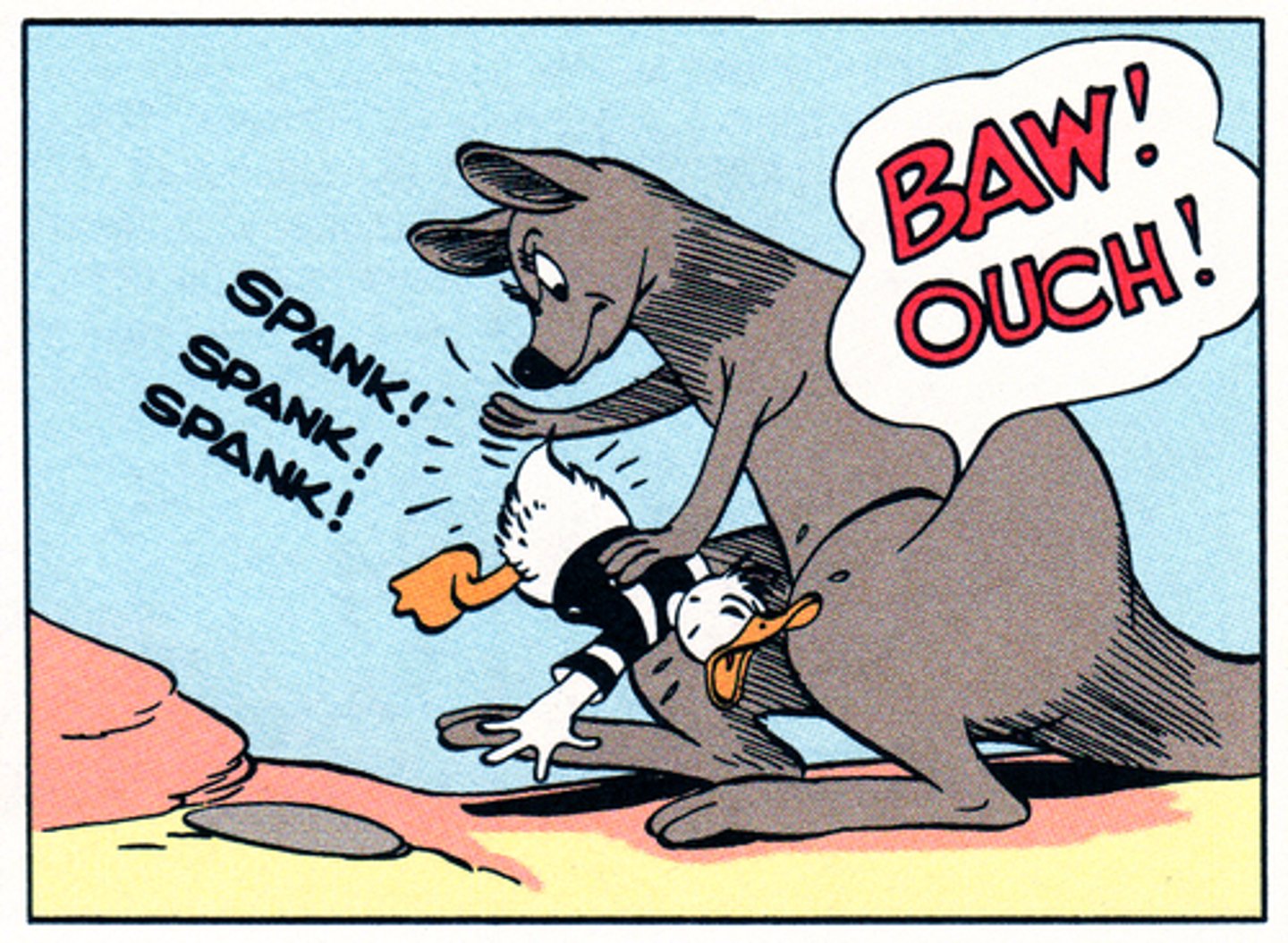
adding an aversive stimulus usually after undesirable behavior. ex: spanking
negative punishment
removing a pleasant stimulus usually after undesirable behavior. ex: taking away video games

two main problems with punishment
1. all you get is a temporary repression of response (they do not forget about the undesirable behavior
2. it doesn't build up positive behavior
undesirable side effects of punishment
1. physical punishment creates fear
2. punishment increases aggression because it models aggression
3. the fear of punishment generalizes to the source of punishment/situation
4. punishment creates resentment
5. punishment creates resistance
6. punishment teaches you when you can get away with it
in real life, when might you use punishment anyways?
with children- child acting up in walmart
how should you use punishment?
1. sparingly
2. mildly
3. consistently
punishment works better than rewarding
false; reward works better than punishment. punishment rarely corrects the unwanted behavior in the long run.
main criticisms of skinner and other behaviorists
1. he ignores biological aspects of conditioning
2. some responses are biologically built in (taste aversion)
3. he ignores the importance of cognitive factors
there are built in biological influences on what can and cannot be conditioned
true
overjustification effect
the effect of promising a reward for doing something a person already likes to do, often with the result that, once the reward is removed, the person enjoys and engages in the activity less than if the person had never been rewarded at all. this increases extrinsic motivation (doing something to get an external reward or avoid internal punishment) and decreases intrinsic motivation (doing something for its own sake, because it is an inherently good thing to do)
how was the overjustification effect demonstrated in an experiment with children?
1st group of children: were allowed to go ahead and play with toys
2nd group of children: were paid to play with the toys
after the experiment, the 1st group wanted to stay and play with the toys, while the 2nd group didn't want to and rated them less enjoyable
real life examples of overjustification effect
paying kids for grades- once the kids are in college, they are less motivated to make good grades bc they arent getting paid
observational learning
learning by observing others; studied extensively by albert bandura (stanford psychologist)
what were the method and results of Bandura's most famous study of observational learning in children
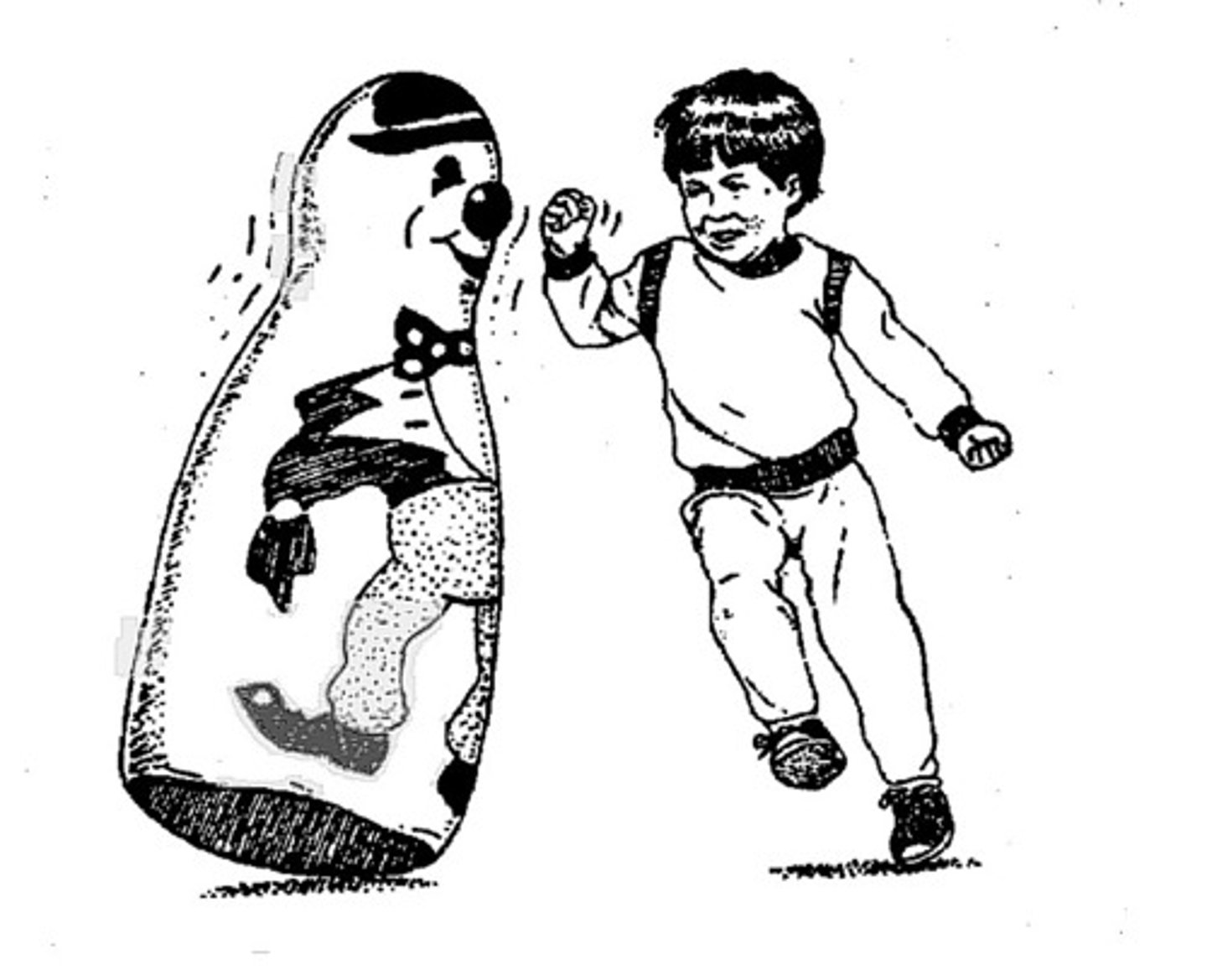
preschoolers were taken into a room and were given coloring books. on the other side of the room, there was an adult sitting next to a bobo doll. the adult starts to yell and scream at the bobo doll. the children are taken into a second room were there are lots of toys to play with. the adult tells the children that they cannot play with them. next, the adult takes them to a third room with broken down toys, and the kids get frustrated. they start yelling and screaming at a bobo doll in the room.
vicarious learning/vicarious punishment
observing other people's rewards and punishments without experiencing them ourselves, but changing our behavior as a result of the rewards and punishments we see others recieve
there is a biological basis for observational learning
true
mirror neurons
neurons in the frontal lobes of the brain that may fire when we engage in certain actions and also when we observe other people doing so; mirror neurons may enable both imitation and empathy
observational learning does not have a very powerful effect in the real world
false; it has a very powerful effect
antisocial behavior
behavior that harms other people. alot of the time, it is a result of observational learning. real world examples: public shootings, airplane hijackings, tv violence
prosocial behavior
positive, constructive, helpful behavior. the opposite of antisocial behavior. real world examples: training/roleplaying to handle situations, letting people in during rush hour creates a chain of letting people in
what will children model: what their parents say, or what their parents do?
children will model what their parents do
memory is very important to being who you are
true; you wouldn't know who you are, your parents, why you're here, etc. if you didn't have memory
memory
the persistence of learning and representations of experiences over time, through the storage and retrieval of information
encoding
the processing of information into the memory system
storage
the retention, over time, of information encoded into memory
retrieval
the process of getting stored information back out of the memory
sensory memory
the immediate and very brief initial recording of information in memory by the sense organs
how long does visual sensory memory (iconic memory) typically last?
1/2 a second
how long does auditory memory of sounds (echoic memory) typically last?
3-4 seconds
short-term memory
memory of limited capacity that holds a few items briefly, before the information is either stored or forgotten
long-term memory
your relatively permanent store of memories, with virtually unlimited capacity
working memory
a newer conceptualization of the classic three-stage model, especially with respect to the second stage (short term memory): an active processing of selected incoming information and also relevant information retrieved from long term memory, on a temporary basis, to work with and evaluate the information until the new information is either discarded or processed into long-term memory
 Note
Note  Flashcards (63)