Gene Expression: Transcription, Translation, and Mutations in Biology
 Call Kai
 Learn
Learn Practice Test
 Spaced Repetition
 Match
Match Flashcards
 Knowt Play
1/103

There's no tags or description
Looks like no tags are added yet.
Name | Mastery | Learn | Test | Matching | Spaced | Call with Kai |
|---|
No analytics yet
Send a link to your students to track their progress
104 Terms
What is gene expression?
The process by which DNA directs protein synthesis, including transcription and translation.
What are the two stages of gene expression?
Transcription and translation.
Who first suggested that genes dictate phenotypes through enzymes?
Archibald Garrod in 1902.
What does the one gene-one enzyme hypothesis state?
The function of a gene is to dictate the production of a specific enzyme.
What organism did Beadle and Tatum use in their experiments?
Neurospora, a type of bread mold.
What was the outcome of Beadle and Tatum's experiments?
They identified three classes of arginine-deficient mutants, each lacking a different enzyme necessary for synthesizing arginine.
What is the revised hypothesis of Beadle and Tatum's original idea?
The one gene-one polypeptide hypothesis, acknowledging that many proteins are composed of several polypeptides.
What is the role of RNA in gene expression?
RNA acts as a bridge between genes and the proteins they code for.
What is transcription?
The synthesis of RNA using information from DNA.
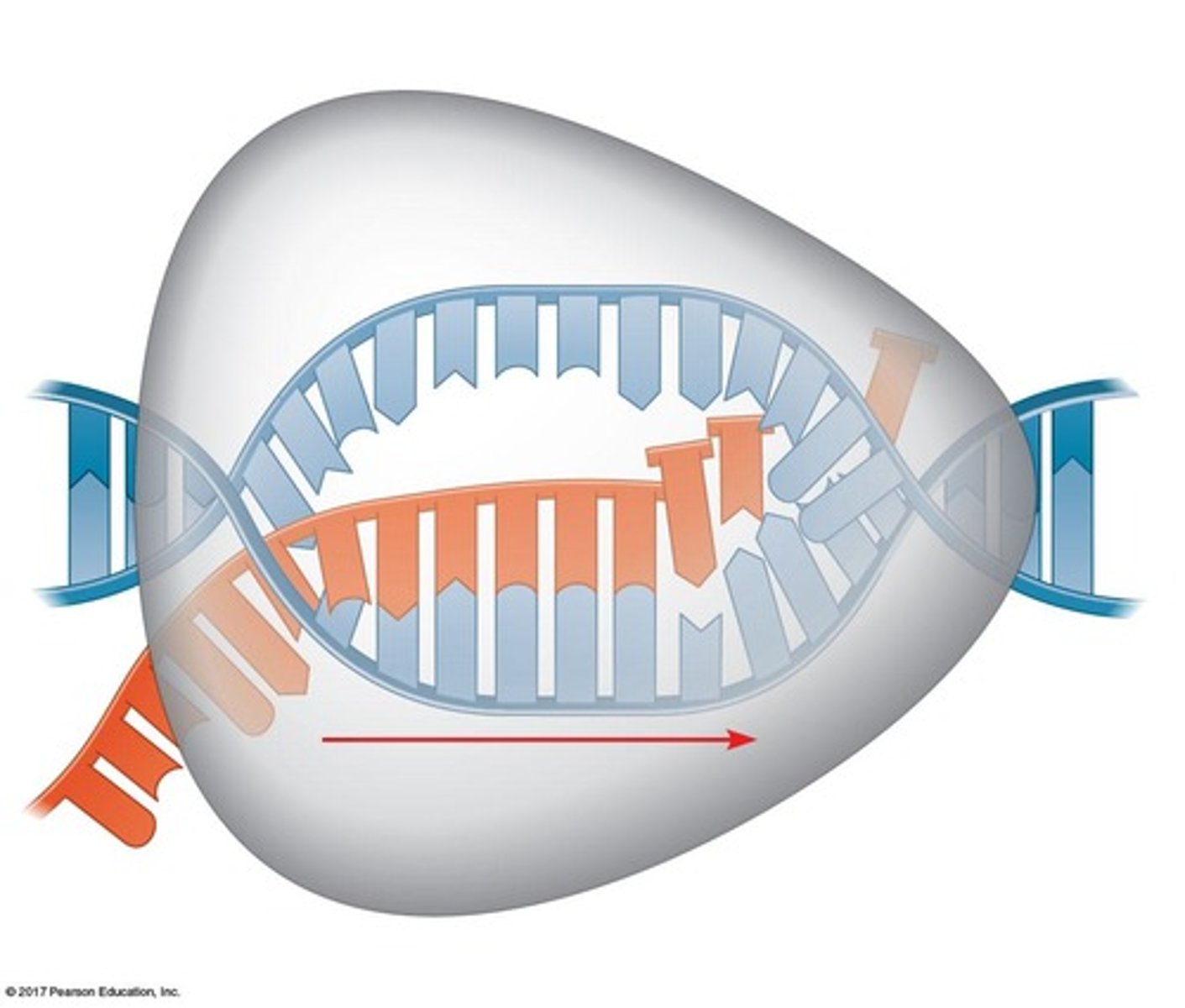
What does transcription produce?
Messenger RNA (mRNA).
What is translation?
The synthesis of a polypeptide using information in the mRNA.
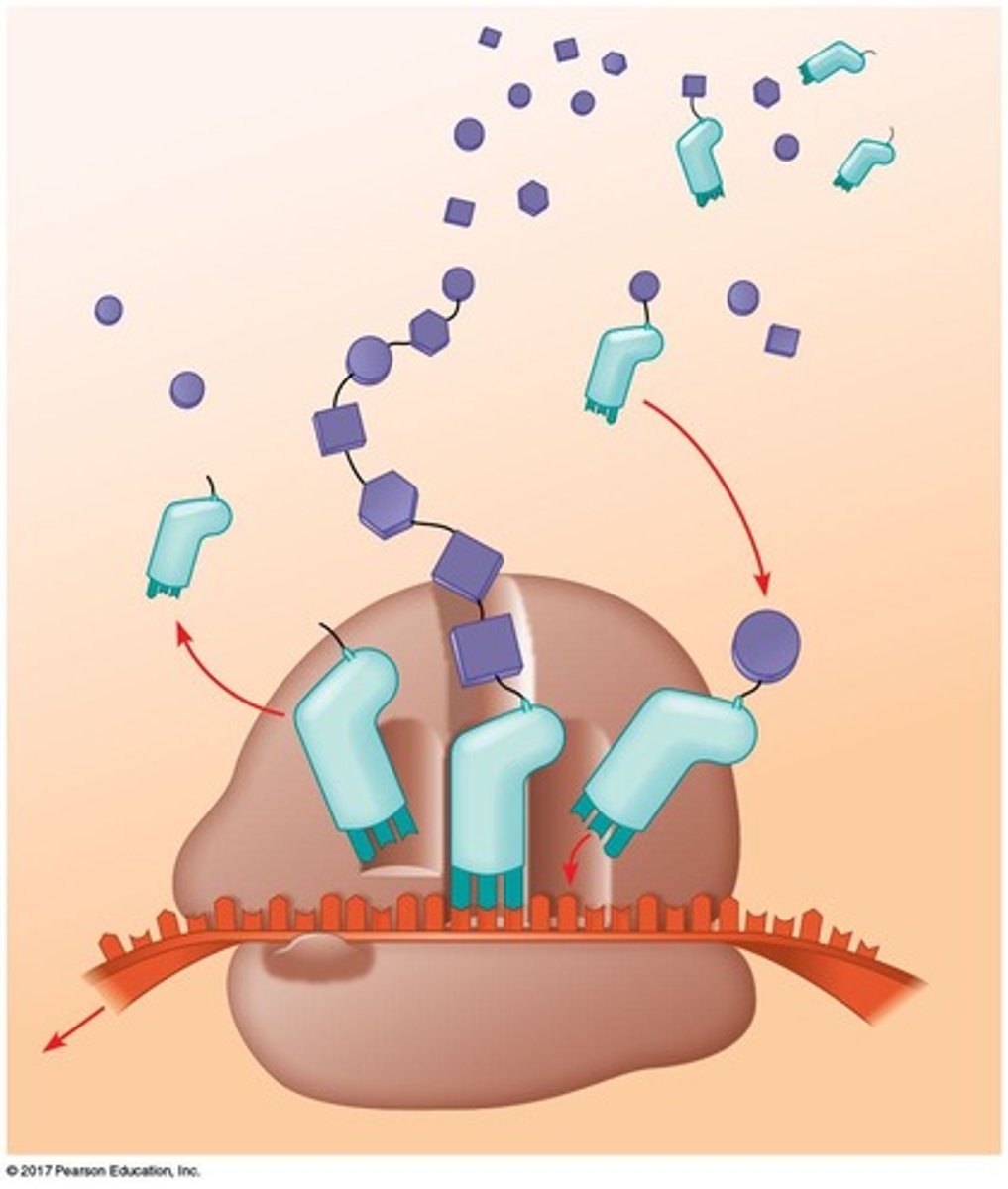
Where does translation occur?
At the ribosomes.
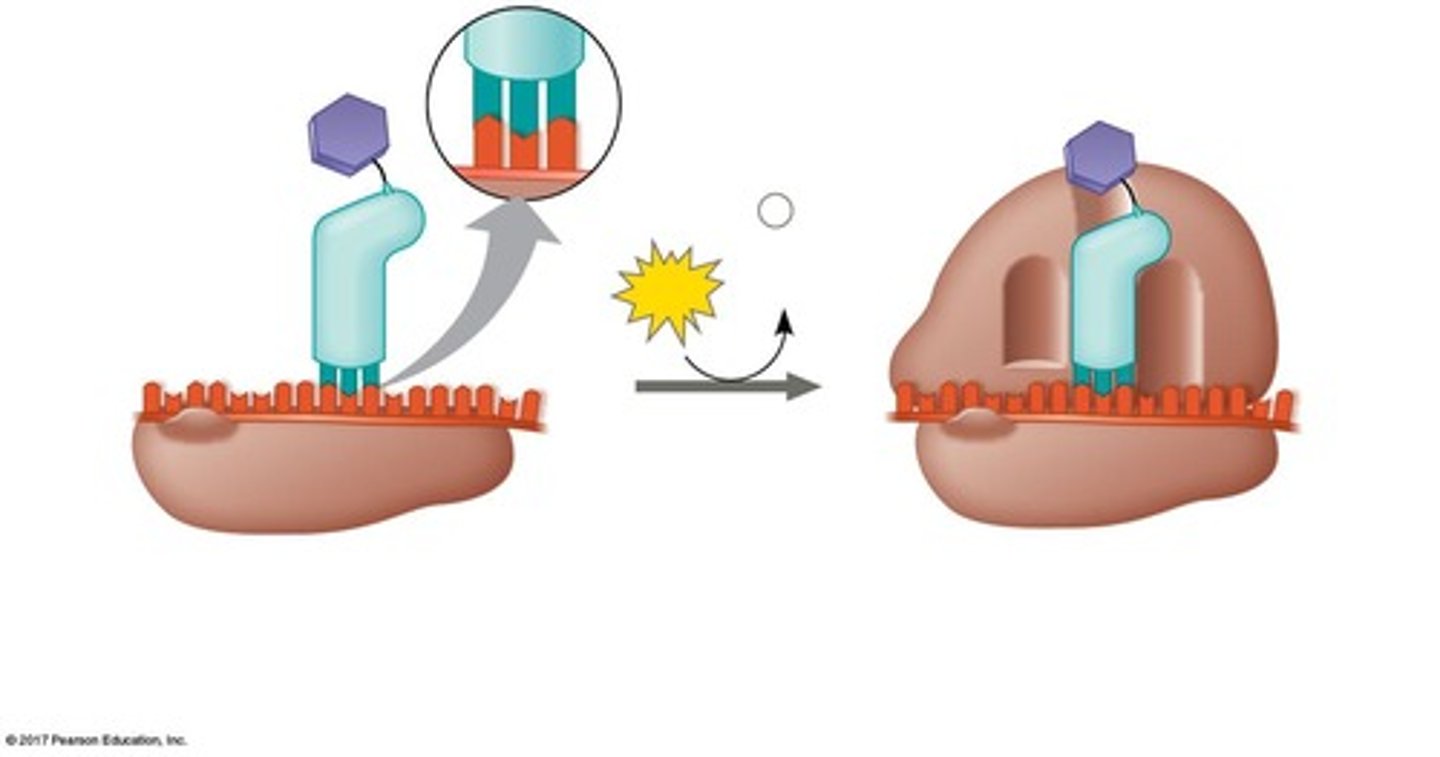
How does translation differ in prokaryotes and eukaryotes?
In prokaryotes, translation can begin before transcription has finished; in eukaryotes, the nuclear envelope separates transcription from translation.
What is a primary transcript?
The initial RNA transcript from any gene prior to processing.
What is the central dogma of molecular biology?
The concept that cells are governed by a chain of command: DNA → RNA → protein.
How many nucleotides correspond to one amino acid?
Three nucleotides make up a codon, which corresponds to one amino acid.
What is a codon?
A triplet of nucleotides that specifies an amino acid.
What is the significance of the genetic code being redundant?
More than one codon may specify a particular amino acid.
What are stop codons?
Three codons that signal the end of translation.
What is the importance of reading frames in translation?
Codons must be read in the correct reading frame to produce the specified polypeptide.
What is the difference between the template strand and the coding strand?
The template strand is used for transcription, while the coding strand has the same sequence as the mRNA (with T replaced by U).
What did the experiments with Neurospora reveal about metabolic pathways?
They showed that cells synthesize and degrade molecules in a series of steps, indicating the role of enzymes in metabolic pathways.
What is the function of enzymes in metabolic pathways?
Enzymes catalyze specific chemical reactions necessary for metabolism.
What is the relationship between genotype and phenotype?
Genotype refers to the genetic makeup, while phenotype refers to the observable traits, linked by the synthesis of proteins.
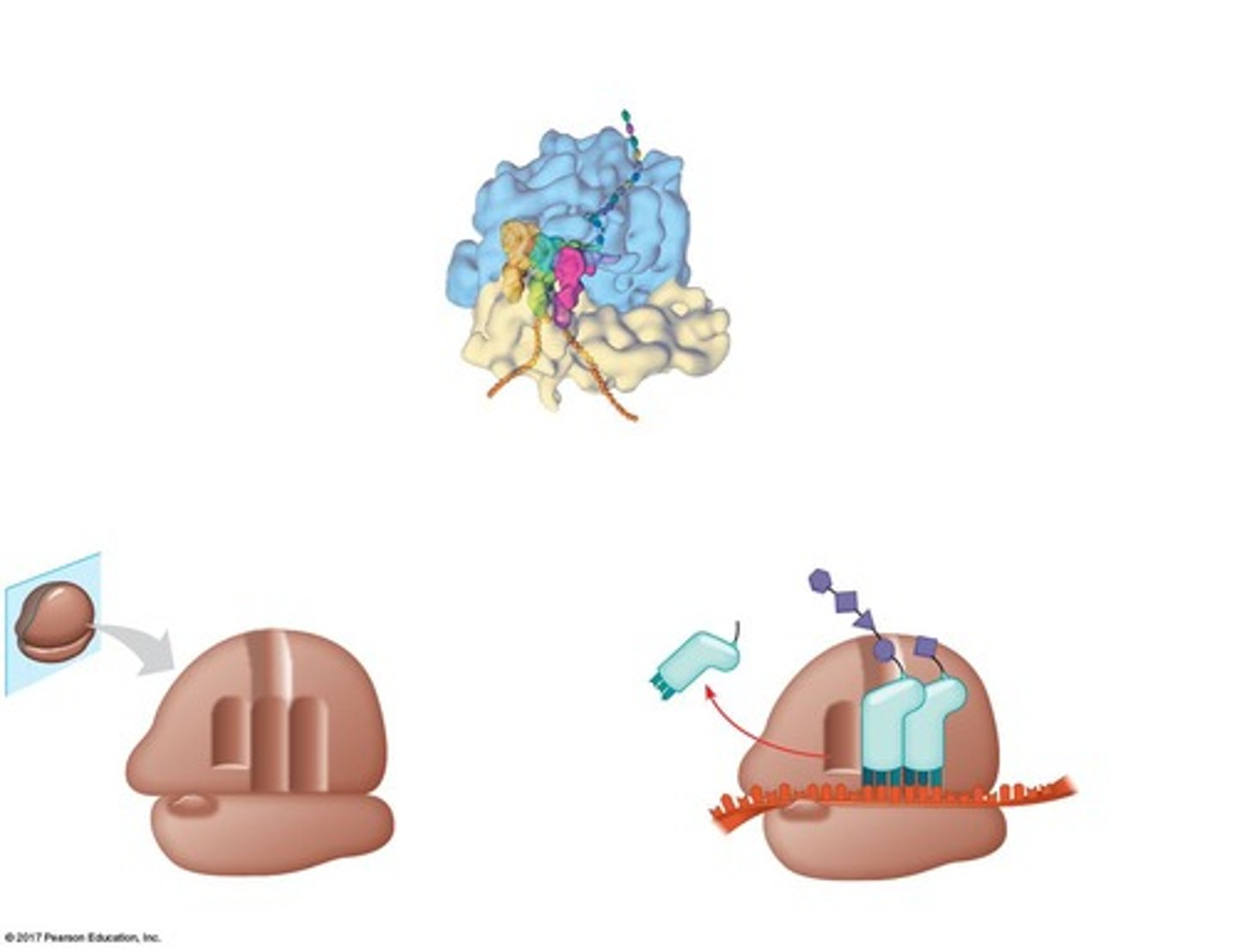
What is the role of ribosomes in protein synthesis?
Ribosomes are the sites where translation occurs, synthesizing polypeptides from mRNA.
What did the study of nutritional mutants in Neurospora contribute to genetics?
It provided evidence for the one gene-one enzyme hypothesis, showing that specific genes are responsible for specific enzymes.
What is the significance of the triplet code in genetics?
It allows for the encoding of amino acids in proteins using combinations of three nucleotides.
How did early geneticists confirm the function of genes?
Through experiments that linked specific genes to the production of specific enzymes and proteins.
What is the first stage of gene expression?
Transcription
What enzyme catalyzes RNA synthesis?
RNA polymerase
What is the role of RNA polymerase during transcription?
It pries the DNA strands apart and joins RNA nucleotides.
What is the DNA sequence where RNA polymerase attaches called?
Promoter
What is a transcription unit?
The stretch of DNA that is transcribed.
What are the three stages of transcription?
Initiation, elongation, and termination.
What is the significance of the TATA box in eukaryotic transcription?
It is crucial for forming the transcription initiation complex.
What happens during the elongation stage of transcription?
RNA polymerase moves along the DNA, untwisting the double helix and adding nucleotides to the RNA strand.
How does transcription terminate in eukaryotes?
RNA polymerase II transcribes the polyadenylation signal sequence, and the RNA transcript is released.
What modifications occur to pre-mRNA in eukaryotes?
Both ends are altered, and introns are removed while exons are spliced together.
What is added to the 5′ end of a pre-mRNA molecule?
A modified nucleotide 5′ cap.
What is added to the 3′ end of a pre-mRNA molecule?
A poly-A tail.
What are introns?
Noncoding stretches of nucleotides that lie between coding regions.
What are exons?
Regions of RNA that are expressed and usually translated into amino acid sequences.
What is RNA splicing?
The process of removing introns and joining exons to create a continuous coding sequence.
What is a spliceosome?
A complex of proteins and small RNAs that carry out RNA splicing.
How does RNA polymerase synthesize RNA?
It follows the same base-pairing rules as DNA, with uracil substituting for thymine.
What is the direction of transcription?
Downstream, from the 5′ to the 3′ end.
What is the role of transcription factors?
They mediate the binding of RNA polymerase and the initiation of transcription.
What is the significance of the polyadenylation signal sequence?
It signals the end of transcription in eukaryotes.
What happens to mRNA after transcription in eukaryotes?
It undergoes processing before being exported to the cytoplasm.
What is the rate of transcription in eukaryotes?
Transcription progresses at a rate of 40 nucleotides per second.
What is the function of the 5′ cap and poly-A tail?
They facilitate mRNA export, protect from enzymes, and help ribosomes attach.
What is the difference in termination mechanisms between bacteria and eukaryotes?
In bacteria, transcription stops at the terminator; in eukaryotes, it involves the polyadenylation signal.
What are ribozymes?
Catalytic RNA molecules that function as enzymes and can splice RNA.
What belief was rendered obsolete by the discovery of ribozymes?
The belief that all biological catalysts were proteins.
What are the three properties of RNA that enable it to function as an enzyme?
1. Can form a three-dimensional structure. 2. Some bases contain functional groups for catalysis. 3. Can hydrogen-bond with other nucleic acids.
What is alternative RNA splicing?
A process where some genes can encode more than one kind of polypeptide depending on which segments are treated as exons during splicing.
How does alternative RNA splicing affect protein diversity?
It increases the number of different proteins an organism can produce beyond its number of genes.
What is exon shuffling?
A process that may result in the evolution of new proteins by combining different exons.
What is the role of transfer RNA (tRNA) in translation?
tRNA transfers amino acids to the growing polypeptide in a ribosome.
What is the basic concept of translation?
The RNA-directed synthesis of a polypeptide from mRNA.
What does each tRNA molecule carry?
A specific amino acid on one end and an anticodon on the other end.
What is the significance of the anticodon in tRNA?
It base-pairs with a complementary codon on mRNA.
What is the structure of tRNA?
A single RNA strand about 80 nucleotides long that folds into a cloverleaf shape.
What are the two steps required for accurate translation?
1. A correct match between a tRNA and an amino acid. 2. A correct match between the tRNA anticodon and an mRNA codon.
What is wobble in the context of tRNA?
Flexible pairing at the third base of a codon that allows some tRNAs to bind to more than one codon.
What are the three binding sites of a ribosome for tRNA?
1. P site (holds tRNA with the growing polypeptide chain). 2. A site (holds tRNA with the next amino acid). 3. E site (exit site for discharged tRNAs).
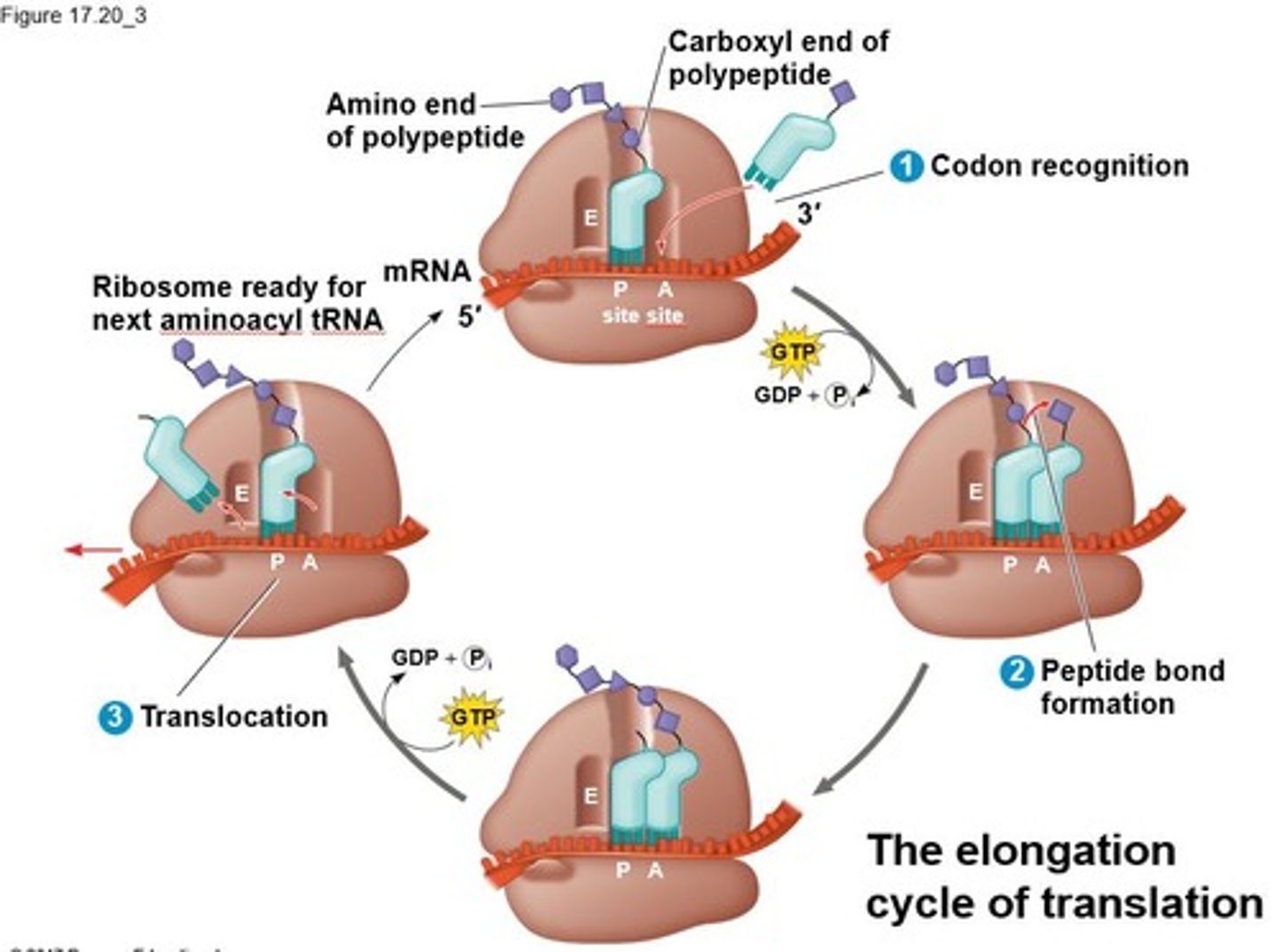
What are the three stages of translation?
1. Initiation. 2. Elongation. 3. Termination.
What signals the start of translation?
The start codon (AUG).
What is the role of initiation factors in translation?
They bring in the large ribosomal subunit to complete the translation initiation complex.
What occurs during the elongation phase of translation?
Amino acids are added one by one to the C-terminus of the growing chain.
What happens when a stop codon reaches the A site of the ribosome?
A release factor is accepted, causing the addition of a water molecule instead of an amino acid, releasing the polypeptide.
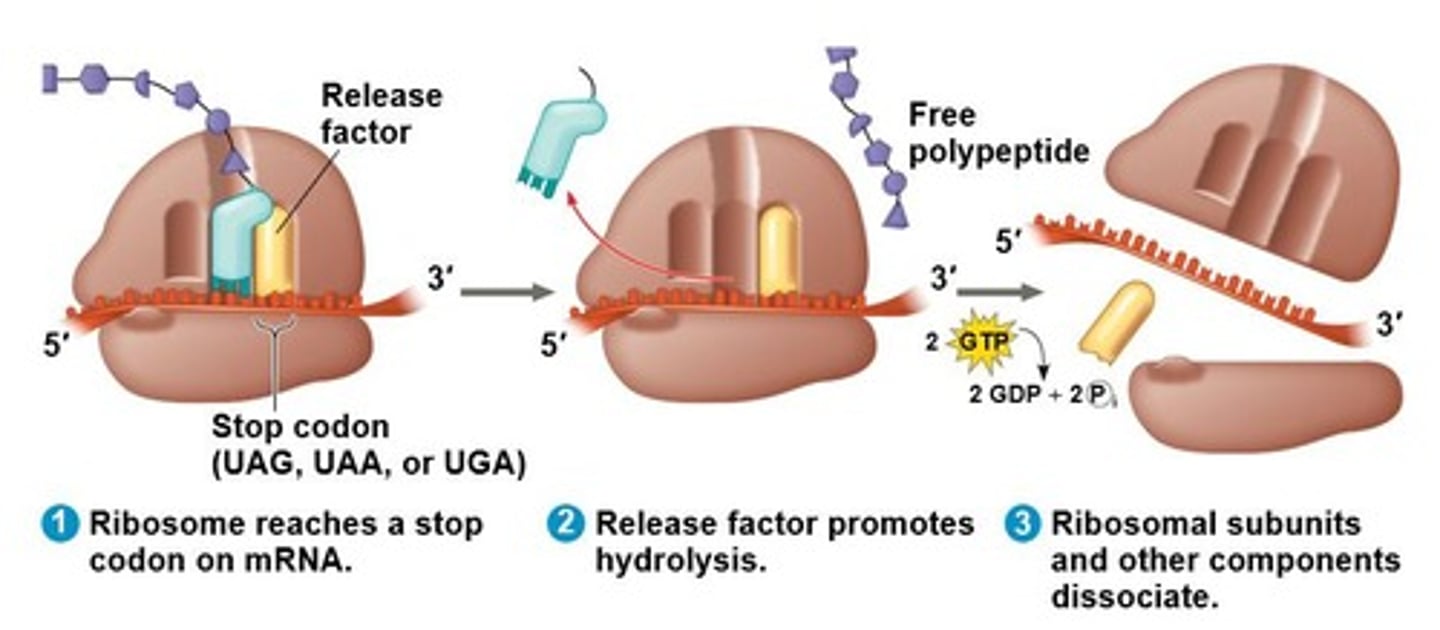
What is required for some steps during the translation process?
Energy is required for some steps, particularly during elongation.
How does the ribosome move during translation?
Translation proceeds along the mRNA in a 5′ → 3′ direction, moving codon by codon.
What is the function of aminoacyl-tRNA synthetase?
It ensures a correct match between a tRNA and an amino acid.
What is the relationship between exons and protein domains?
Different exons often code for different domains in a protein.
What is the significance of ribosomal RNA (rRNA) in ribosomes?
rRNA is a key component of ribosomes, which are made of proteins and rRNA.
What distinguishes bacterial ribosomes from eukaryotic ribosomes?
They are somewhat similar but have significant differences, which some antibiotics target specifically.
What is often required after translation to make a functional protein?
Polypeptide chains are modified or targeted to specific sites in the cell.
What determines the primary structure of a protein?
A gene determines the primary structure.
What are the two populations of ribosomes in cells?
Free ribosomes (in the cytosol) and bound ribosomes (attached to the ER).
What do free ribosomes primarily synthesize?
Proteins that function in the cytosol.
What do bound ribosomes produce?
Proteins of the endomembrane system and proteins that are secreted from the cell.
What marks polypeptides destined for the ER or secretion?
A signal peptide.
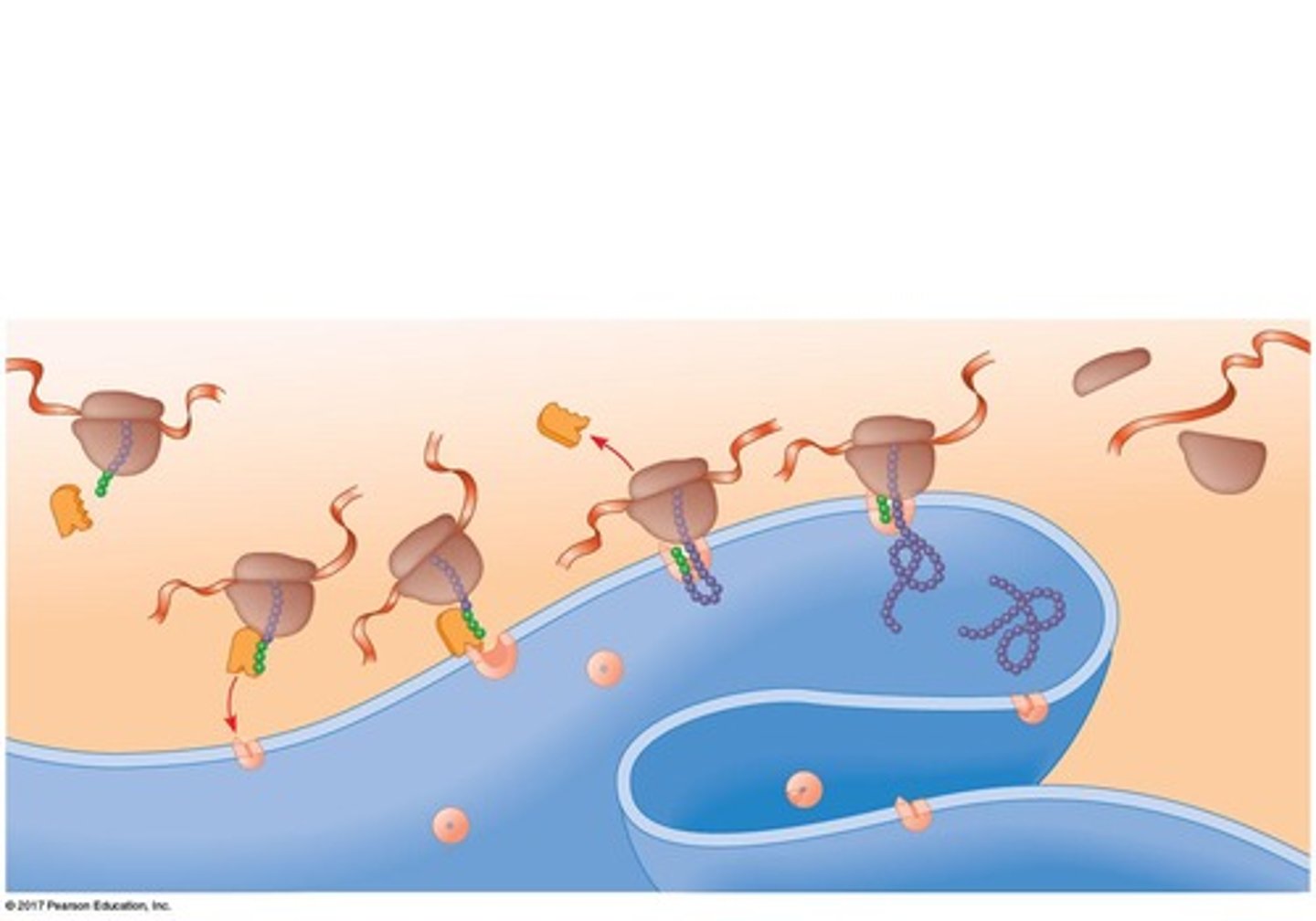
What is the role of the signal-recognition particle (SRP)?
It binds to the signal peptide and escorts the ribosome to a receptor protein in the ER membrane.
What is a polyribosome?
A structure formed when multiple ribosomes translate a single mRNA simultaneously.
How do bacterial cells streamline protein synthesis?
By coupling transcription and translation.
What are mutations?
Changes in the genetic information of a cell.
What are point mutations?
Changes in just one nucleotide pair of a gene.
What is a genetic disorder?
A condition caused by a mutation that adversely affects the phenotype of an organism.
What are the two categories of point mutations?
Single nucleotide-pair substitutions and nucleotide-pair insertions or deletions.
What are silent mutations?
Mutations that have no effect on the amino acid produced due to redundancy in the genetic code.
What are missense mutations?
Mutations that code for an amino acid, but not the correct one.
What are nonsense mutations?
Mutations that change an amino acid codon into a stop codon, often leading to a nonfunctional protein.
What are insertions and deletions in the context of mutations?
Additions or losses of nucleotide pairs in a gene, often causing frameshift mutations.
What can cause spontaneous mutations?
Errors in DNA replication, recombination, or repair.
What are mutagens?
Physical or chemical agents that can cause mutations.
How has the definition of a gene evolved?
A gene is now defined as a region of DNA that can be expressed to produce a final functional product, either a polypeptide or an RNA molecule.
What is the effect of a frameshift mutation?
It alters the reading frame, potentially producing a completely different protein.
What is the role of RNA processing in eukaryotes?
RNA undergoes processing before leaving the nucleus, separating transcription from translation.
What happens to the signal peptide during protein synthesis?
It is removed by a signal-cleaving enzyme after the polypeptide is synthesized.

