AP Psychology Unit 4 - Sensation and Perception (review)

0.0(0)
studied byStudied by 3 people
call kaiCall Kai
learnLearn
examPractice Test
spaced repetitionSpaced Repetition
heart puzzleMatch
flashcardsFlashcards
GameKnowt Play
Card Sorting

1/62

encourage image

There's no tags or description

Looks like no tags are added yet.

Last updated 1:52 AM on 10/28/25
Name
Mastery
Learn
Test
Matching
Spaced
Call with Kai

No analytics yet

Send a link to your students to track their progress

63 Terms

1
New cards

sensation

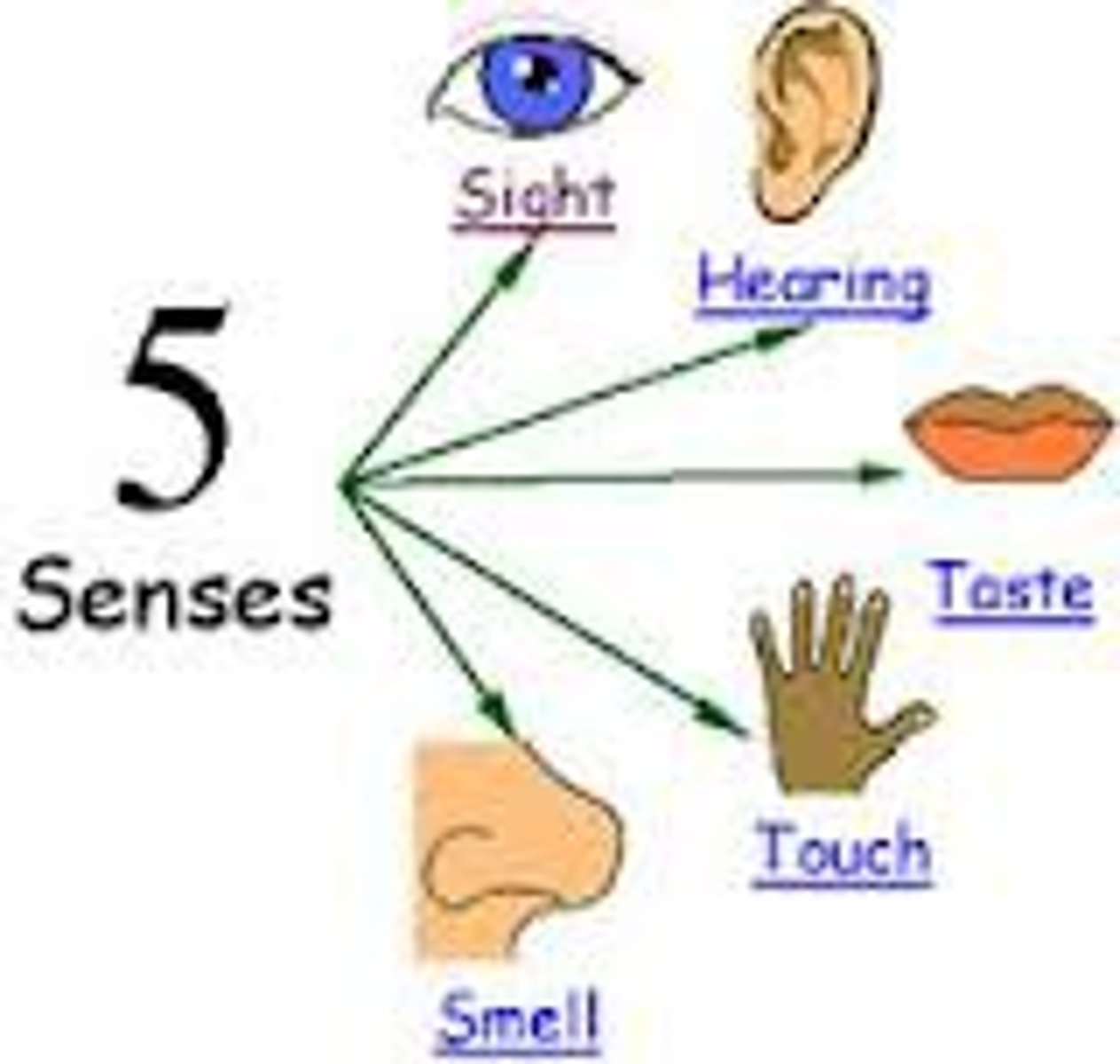
the process by which our sensory receptors and nervous system receive and represent stimulus energies from our environment.
<p>the process by which our sensory receptors and nervous system receive and represent stimulus energies from our environment.</p>
2
New cards

perception

the process of organizing and interpreting sensory information, enabling us to recognize meaningful objects and events.

<p>the process of organizing and interpreting sensory information, enabling us to recognize meaningful objects and events.</p>
3
New cards

bottom-up processing

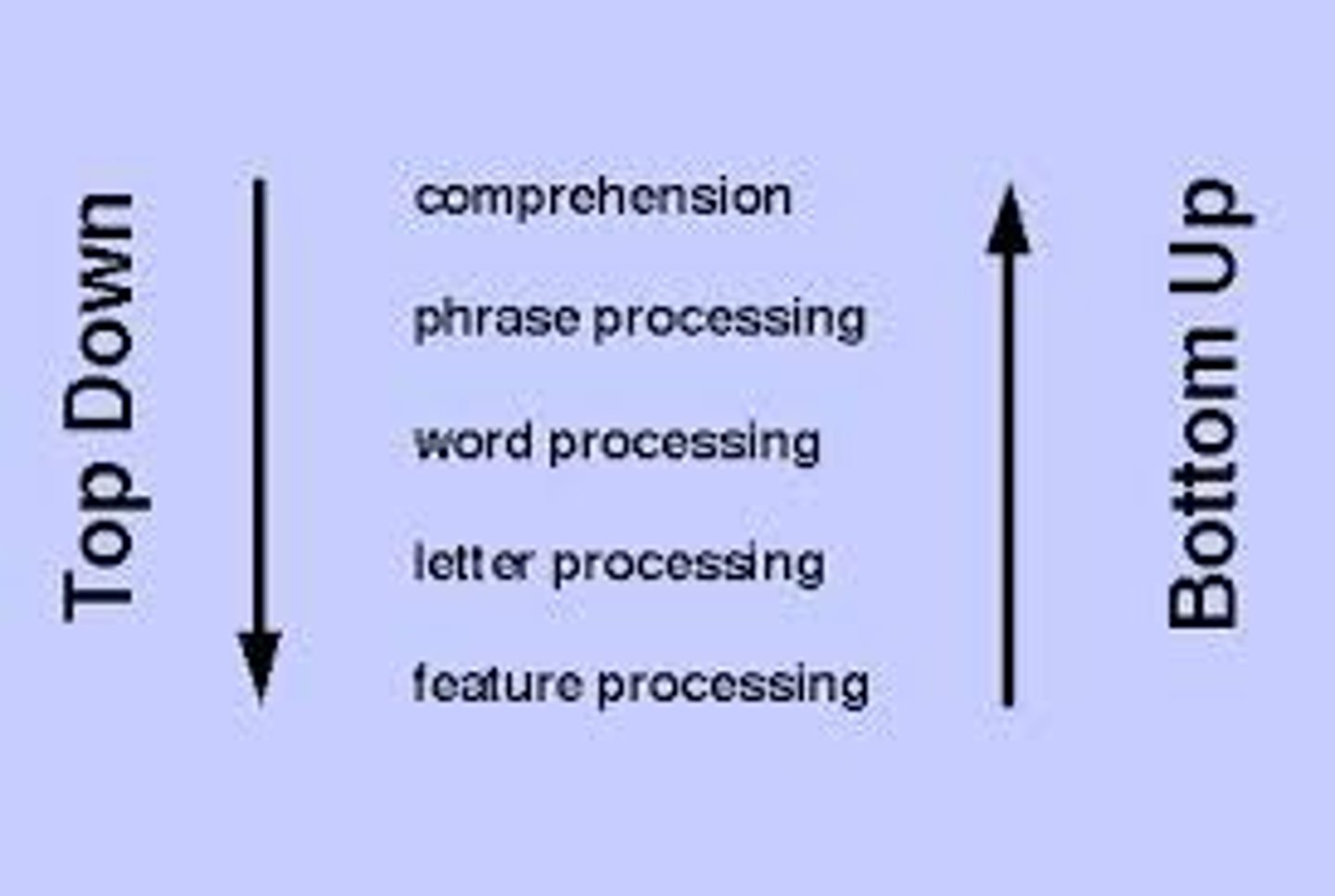
analysis that begins with the sensory receptors and works up to the brain's integration of sensory information.
<p>analysis that begins with the sensory receptors and works up to the brain's integration of sensory information.</p>
4
New cards

top-down processing

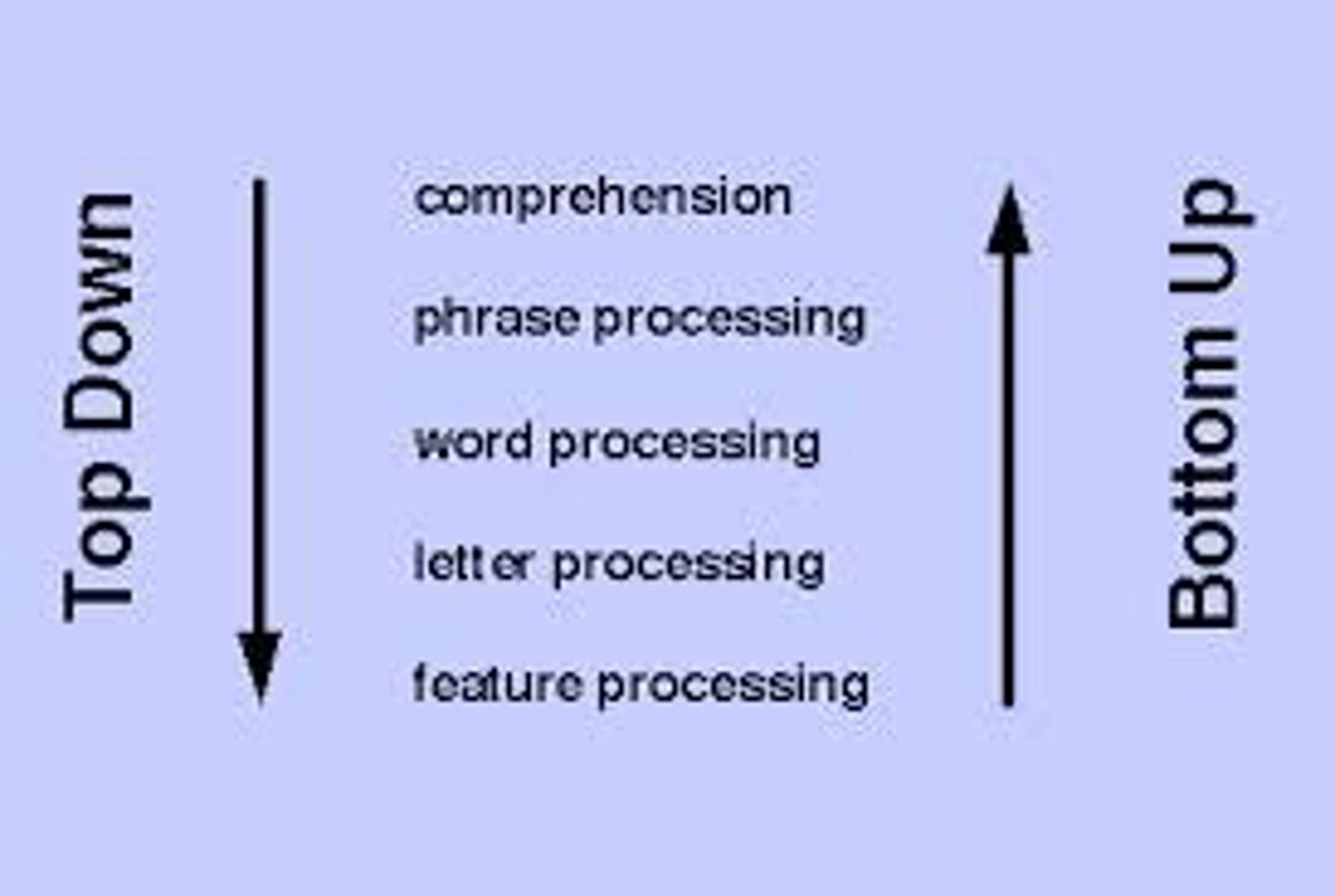
information processing guided by higher-level mental processes, as when we construct perceptions drawing on our experience and expectations.
<p>information processing guided by higher-level mental processes, as when we construct perceptions drawing on our experience and expectations.</p>
5
New cards

selective attention

the focusing of conscious awareness on a particular stimulus.

<p>the focusing of conscious awareness on a particular stimulus.</p>
6
New cards

inattentional blindness

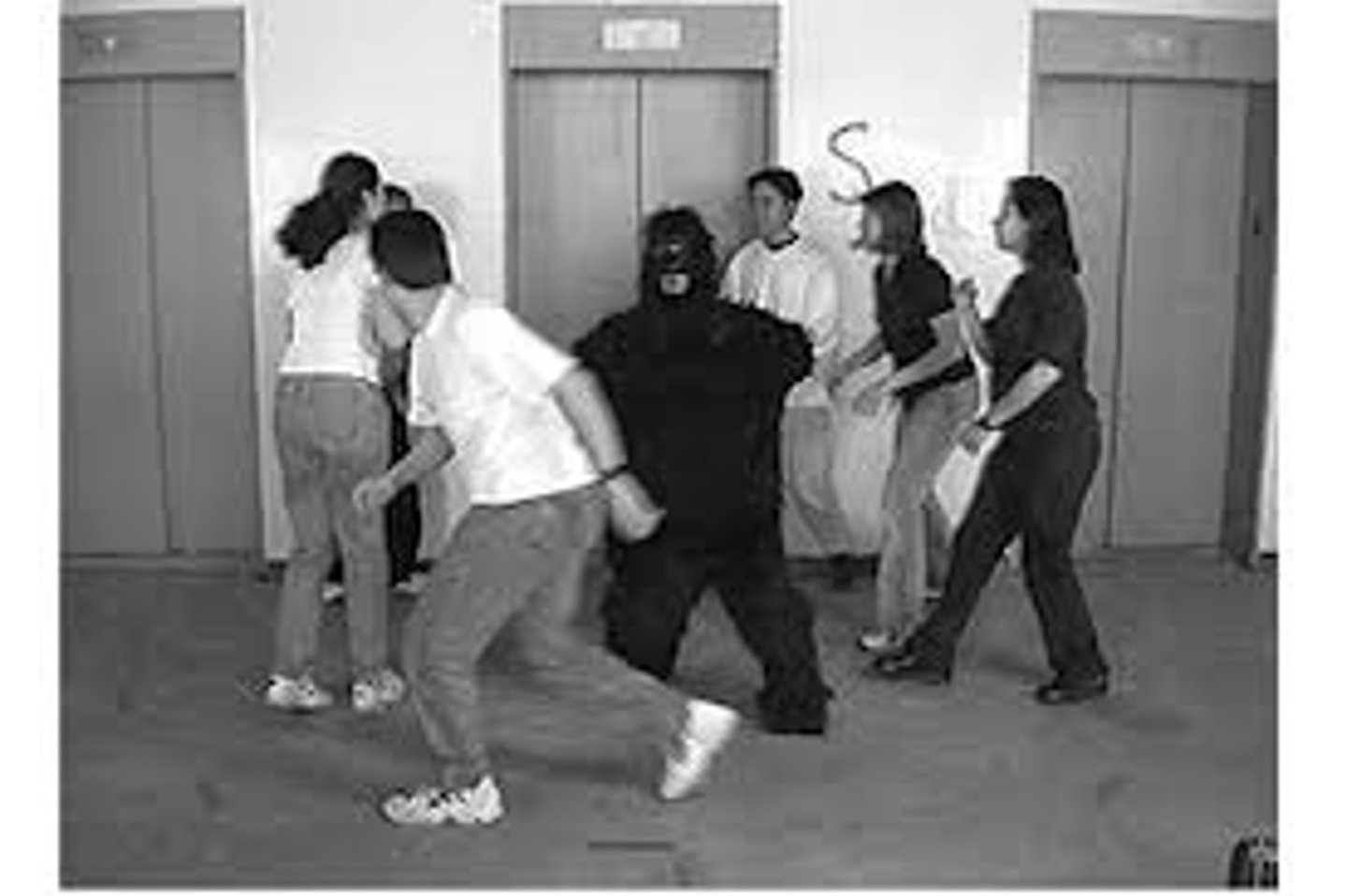
failing to see visible objects when our attention is directed elsewhere.
<p>failing to see visible objects when our attention is directed elsewhere.</p>
7
New cards

change blindness

failing to notice changes in the environment.
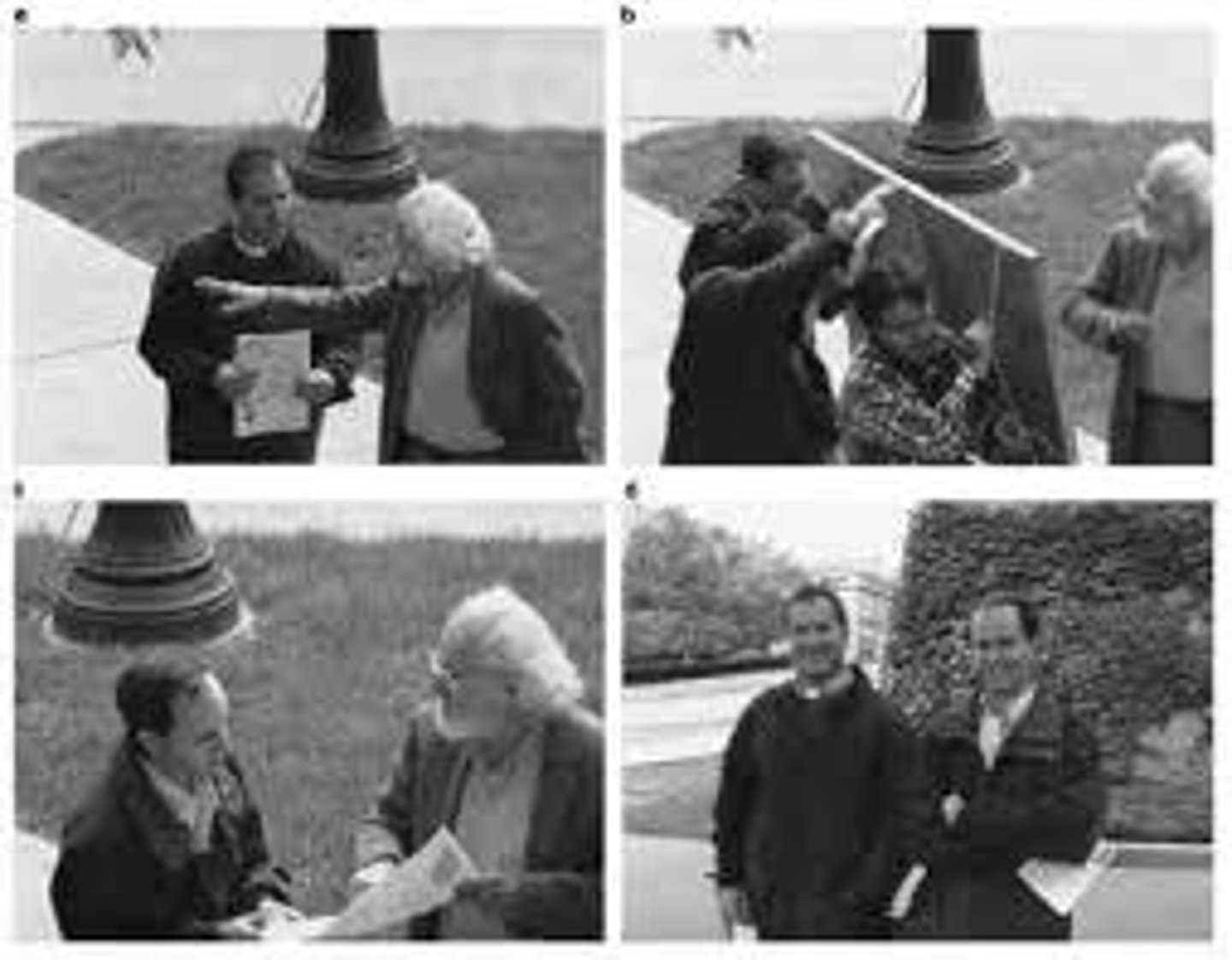
<p>failing to notice changes in the environment.</p>
8
New cards

psychophysics

the study of relationships between the physical characteristics of stimuli, such as their intensity, and our psychological experience of them.
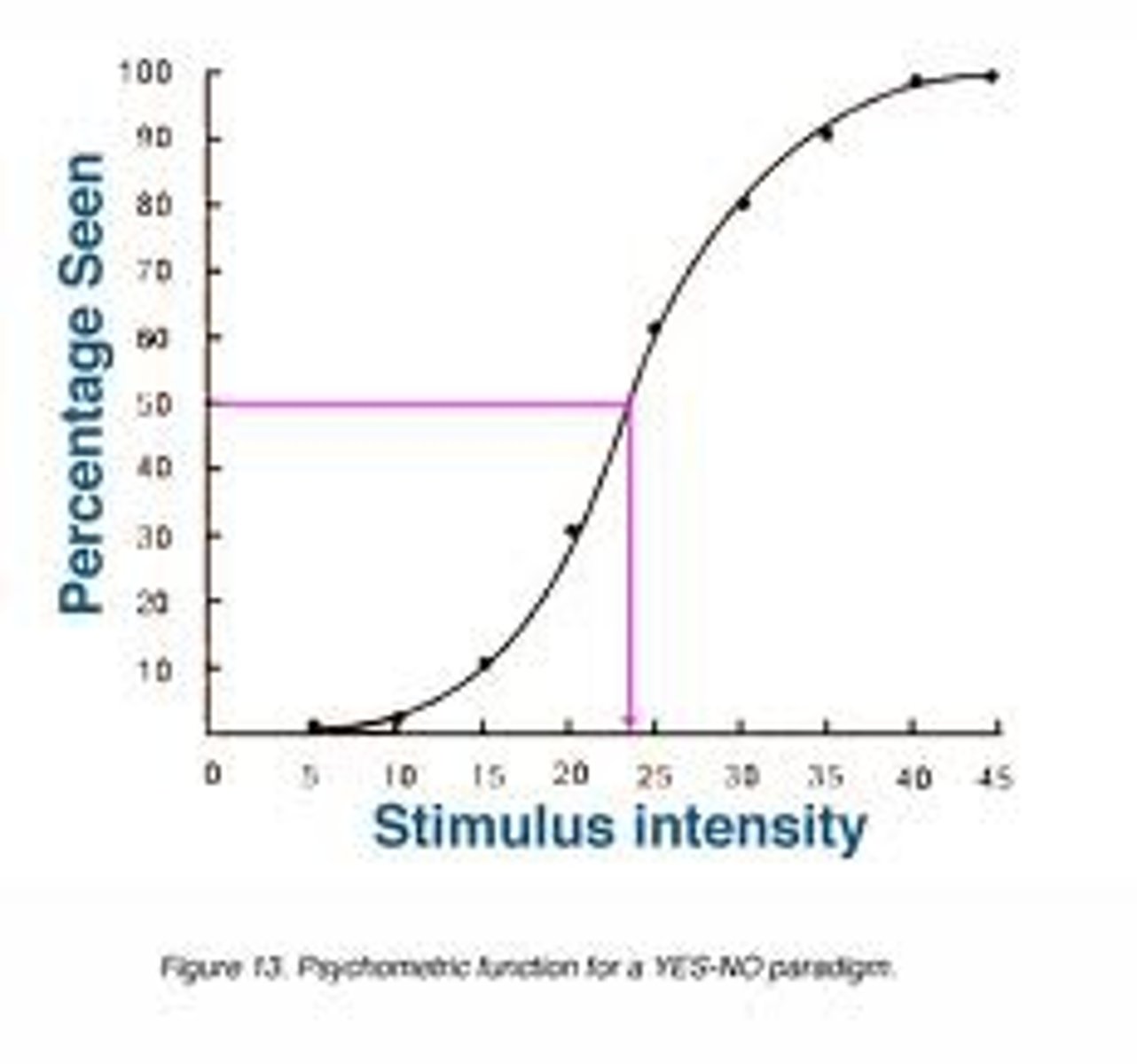
<p>the study of relationships between the physical characteristics of stimuli, such as their intensity, and our psychological experience of them.</p>
9
New cards

absolute threshold

the minimum stimulation needed to detect a particular stimulus 50 percent of the time.
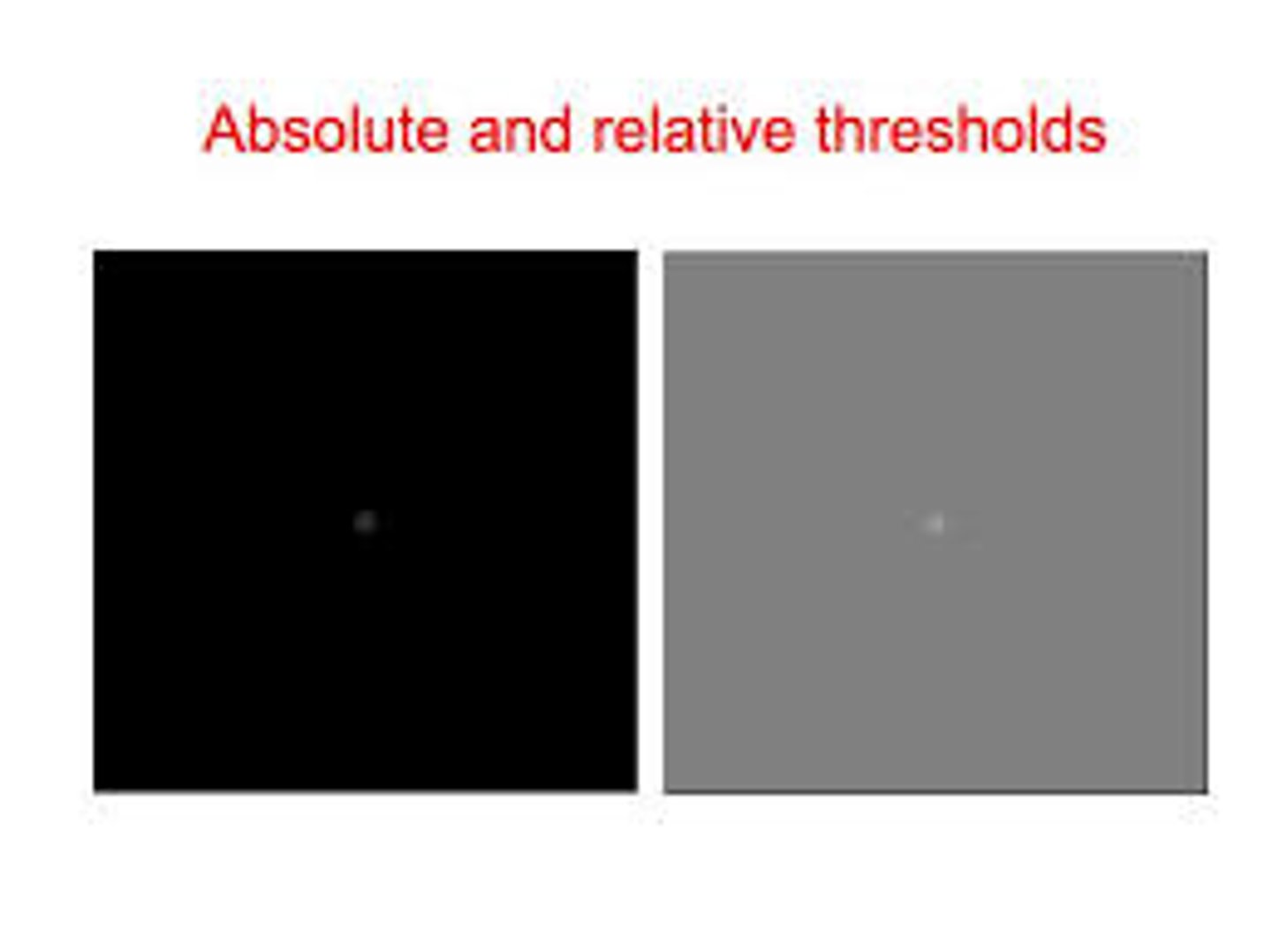
<p>the minimum stimulation needed to detect a particular stimulus 50 percent of the time.</p>
10
New cards

signal detection theory

a theory predicting how and when we detect the presence of a faint stimulus (signal) amid background stimulation (noise). Assumes there is no single absolute threshold and that detection depends partly on a person's experience, expectations, motivation, and alertness.
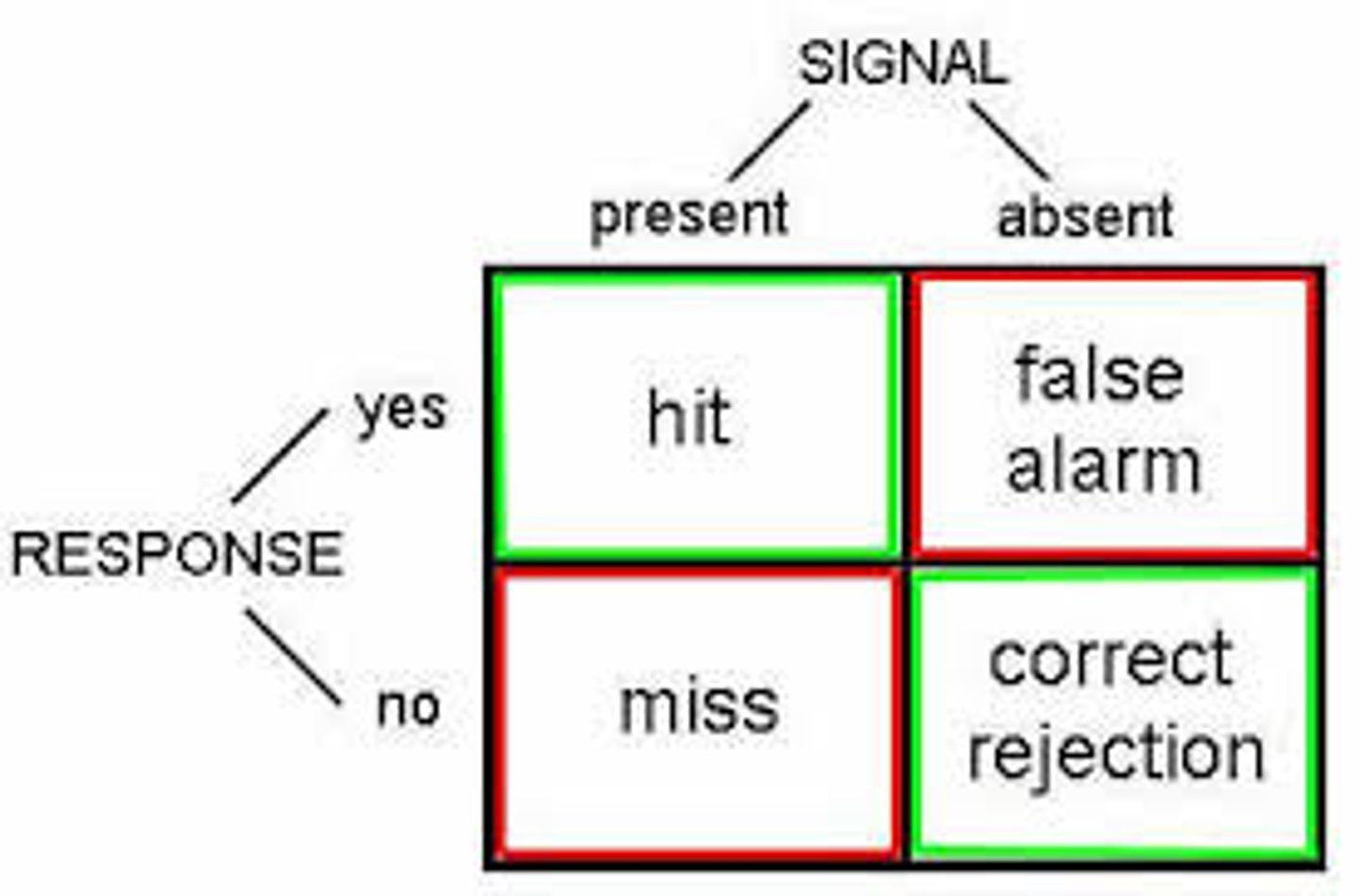
<p>a theory predicting how and when we detect the presence of a faint stimulus (signal) amid background stimulation (noise). Assumes there is no single absolute threshold and that detection depends partly on a person's experience, expectations, motivation, and alertness.</p>
11
New cards

subliminal

psychoanalytic defense mechanism by which people re-channel their unacceptable impulses into socially approved activities.

<p>psychoanalytic defense mechanism by which people re-channel their unacceptable impulses into socially approved activities.</p>
12
New cards

priming

the activation, often unconsciously, of certain associations, thus predisposing one's perception, memory, or response.

<p>the activation, often unconsciously, of certain associations, thus predisposing one's perception, memory, or response.</p>
13
New cards

difference threshold

the minimum difference between two stimuli required for detection 50 percent of the time. Also called the just noticeable difference (jnd).
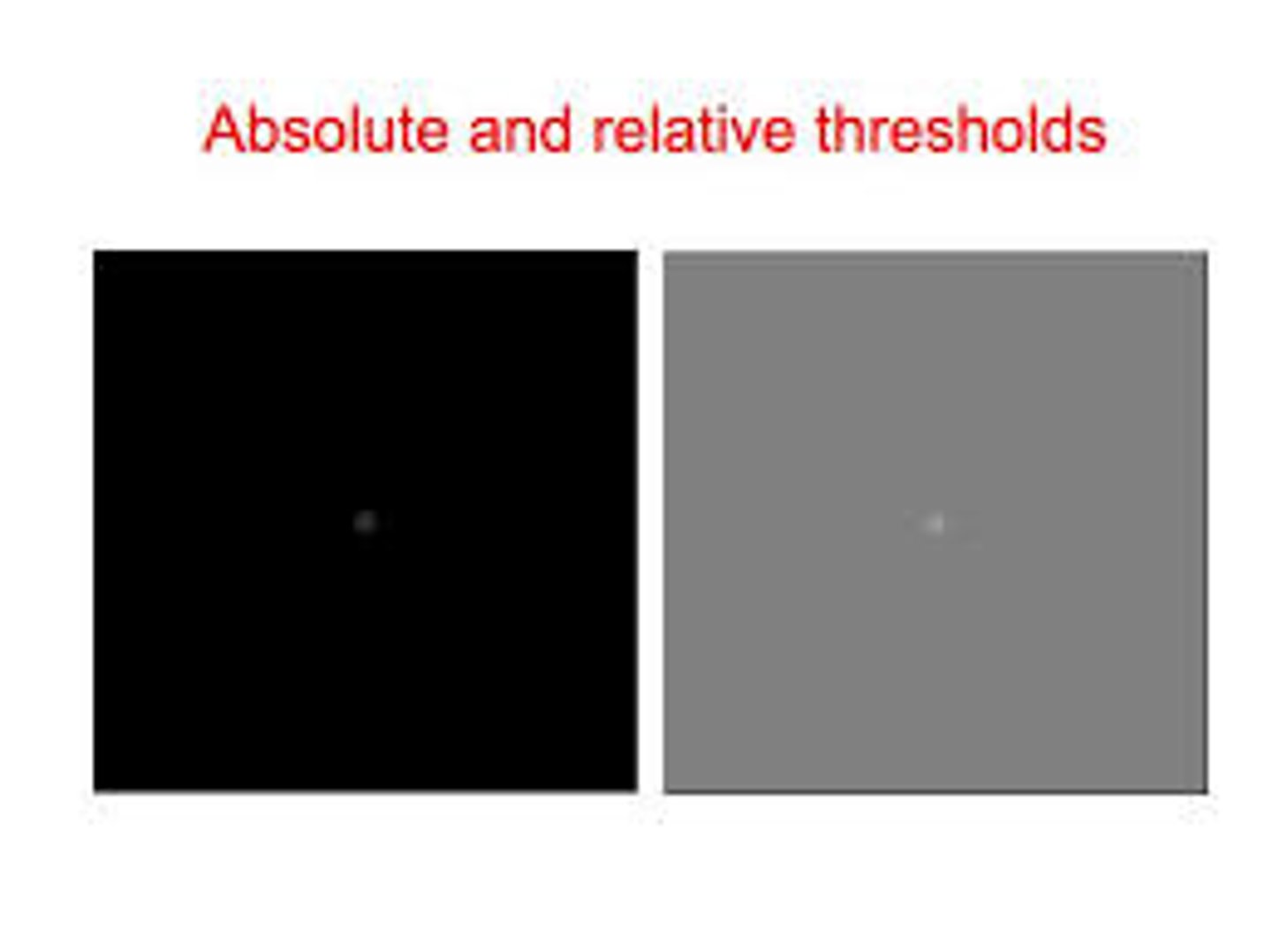
<p>the minimum difference between two stimuli required for detection 50 percent of the time. Also called the just noticeable difference (jnd).</p>
14
New cards

Weber's law

the principle that, to be perceived as different, two stimuli must differ by a constant percentage (rather than a constant amount).
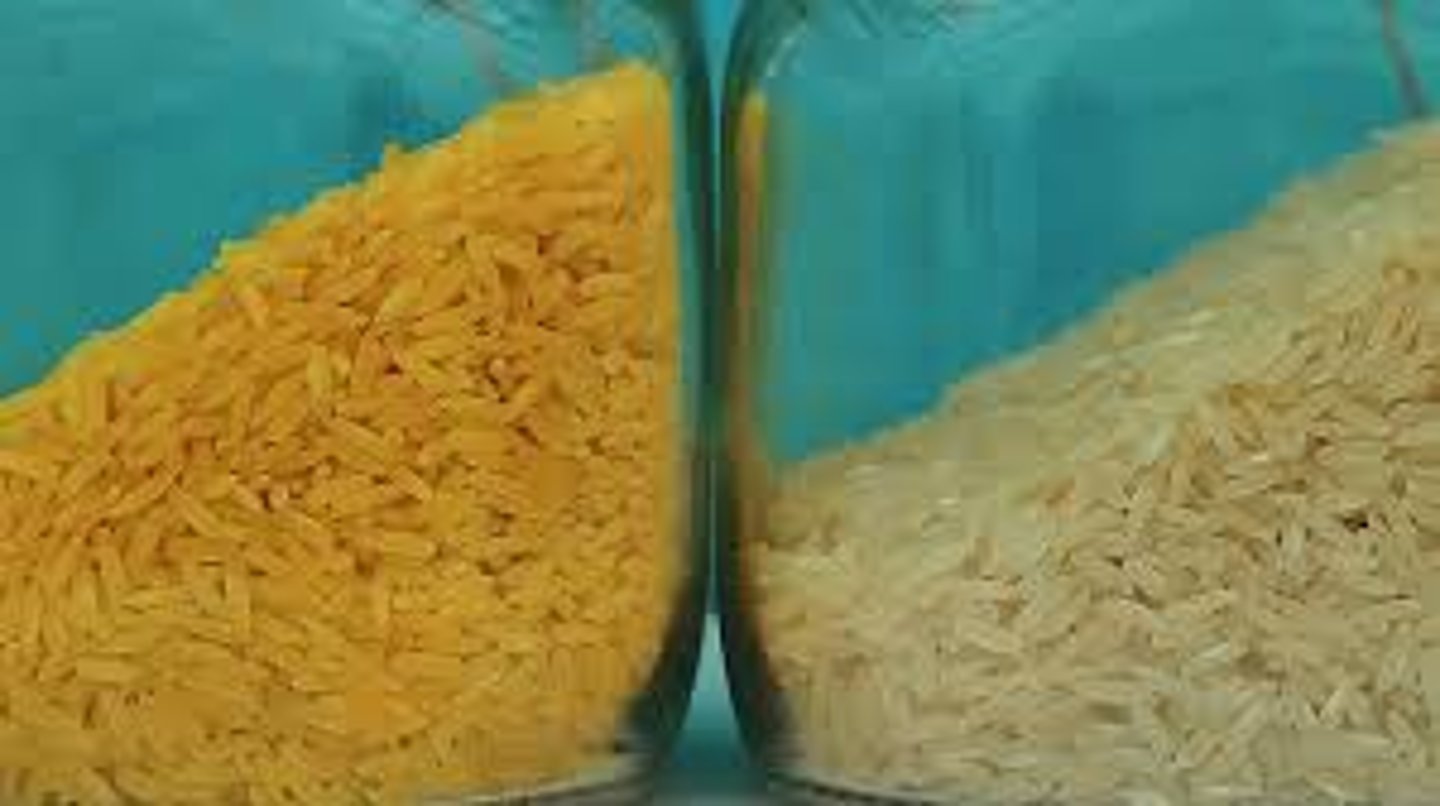
<p>the principle that, to be perceived as different, two stimuli must differ by a constant percentage (rather than a constant amount).</p>
15
New cards

sensory adaptation

diminished sensitivity as a consequence of constant stimulation.

<p>diminished sensitivity as a consequence of constant stimulation.</p>
16
New cards

transduction

conversion of one form of energy into another. In sensation, the transforming of stimulus energies, such as sights, sounds, and smells, into neural impulses our brains can interpret.
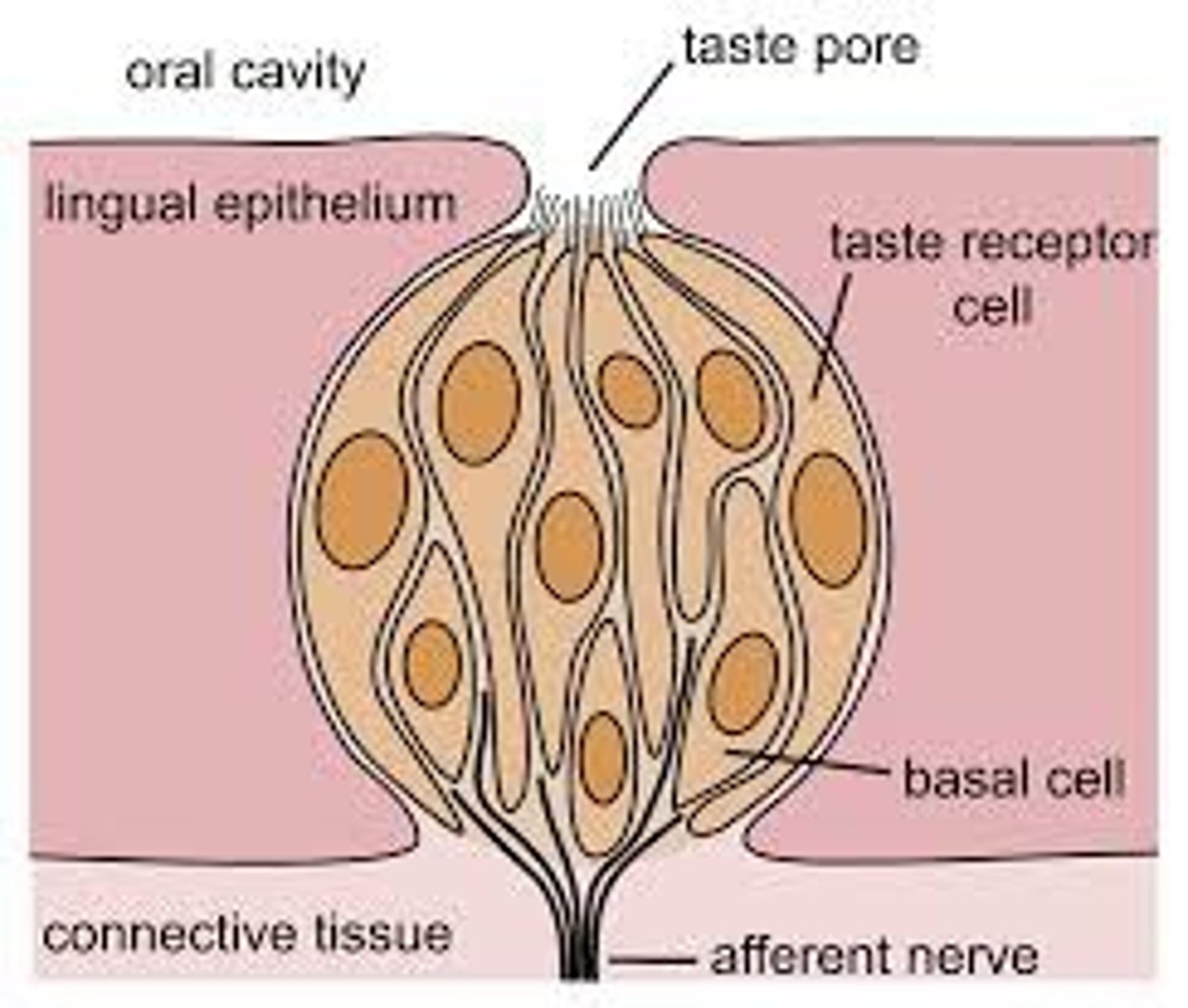
<p>conversion of one form of energy into another. In sensation, the transforming of stimulus energies, such as sights, sounds, and smells, into neural impulses our brains can interpret.</p>
17
New cards

wavelength

the distance from the peak of one light or sound wave to the peak of the next. Electromagnetic versions of this vary from the short blips of cosmic rays to the long pulses of radio transmission.
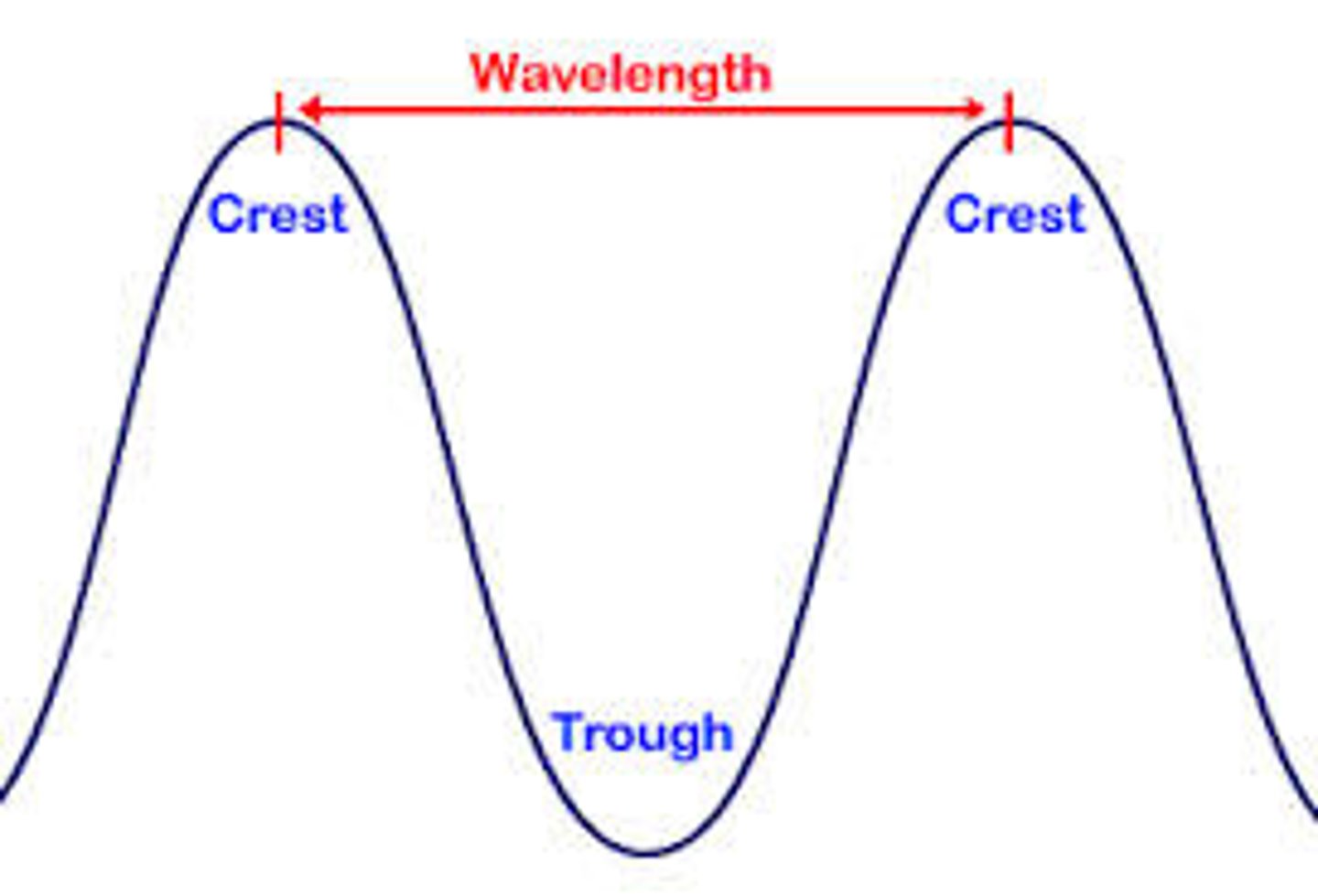
<p>the distance from the peak of one light or sound wave to the peak of the next. Electromagnetic versions of this vary from the short blips of cosmic rays to the long pulses of radio transmission.</p>
18
New cards

hue

the dimension of color that is determined by the wavelength of light; what we know as the color names blue, green, and so forth.

<p>the dimension of color that is determined by the wavelength of light; what we know as the color names blue, green, and so forth.</p>
19
New cards

intensity

the amount of energy in a light or sound wave, which we perceive as brightness or loudness, as determined by the wave's amplitude.

<p>the amount of energy in a light or sound wave, which we perceive as brightness or loudness, as determined by the wave's amplitude.</p>
20
New cards

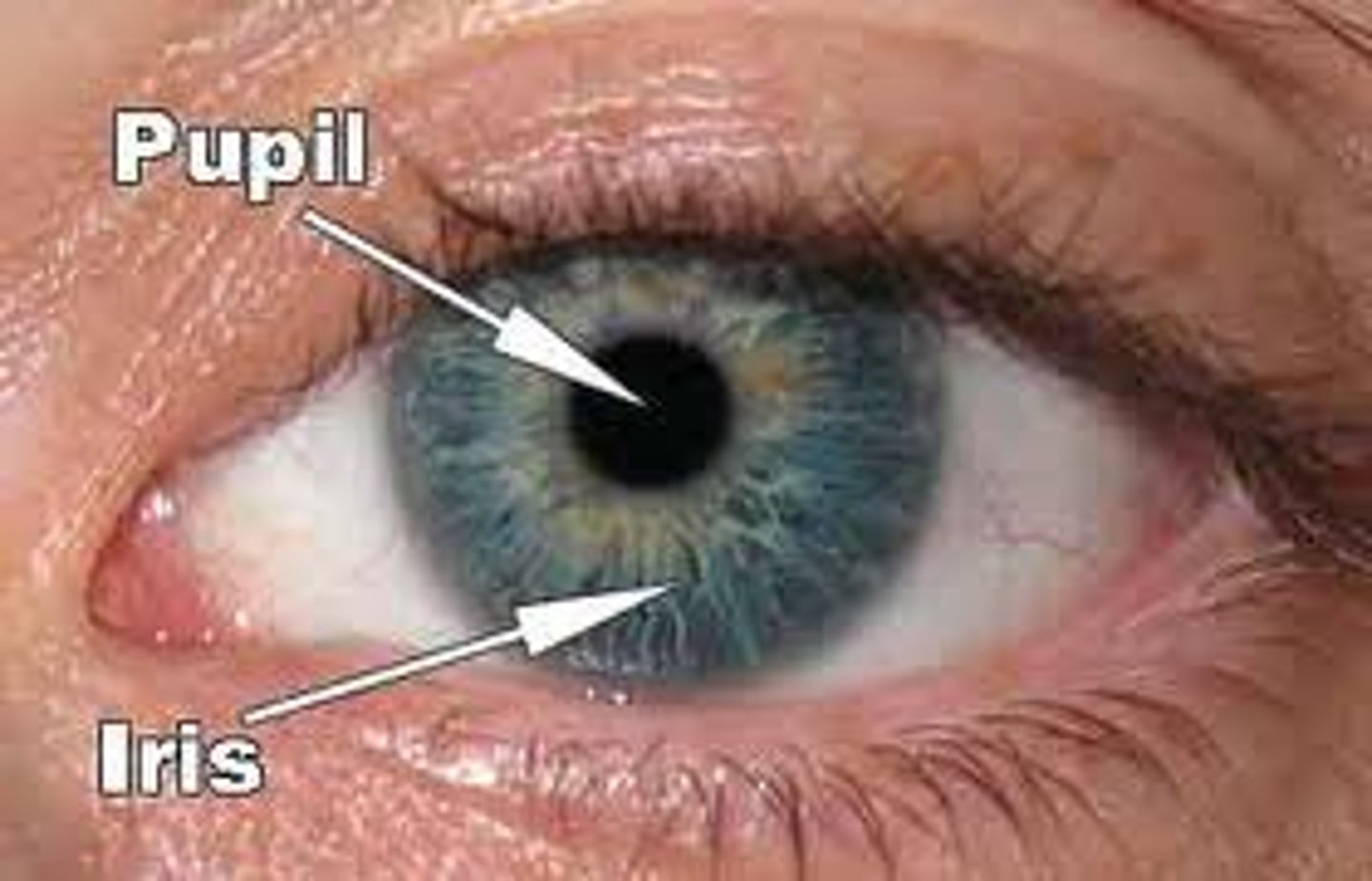
pupil

the adjustable opening in the center of the eye through which light enters.
<p>the adjustable opening in the center of the eye through which light enters.</p>
21
New cards

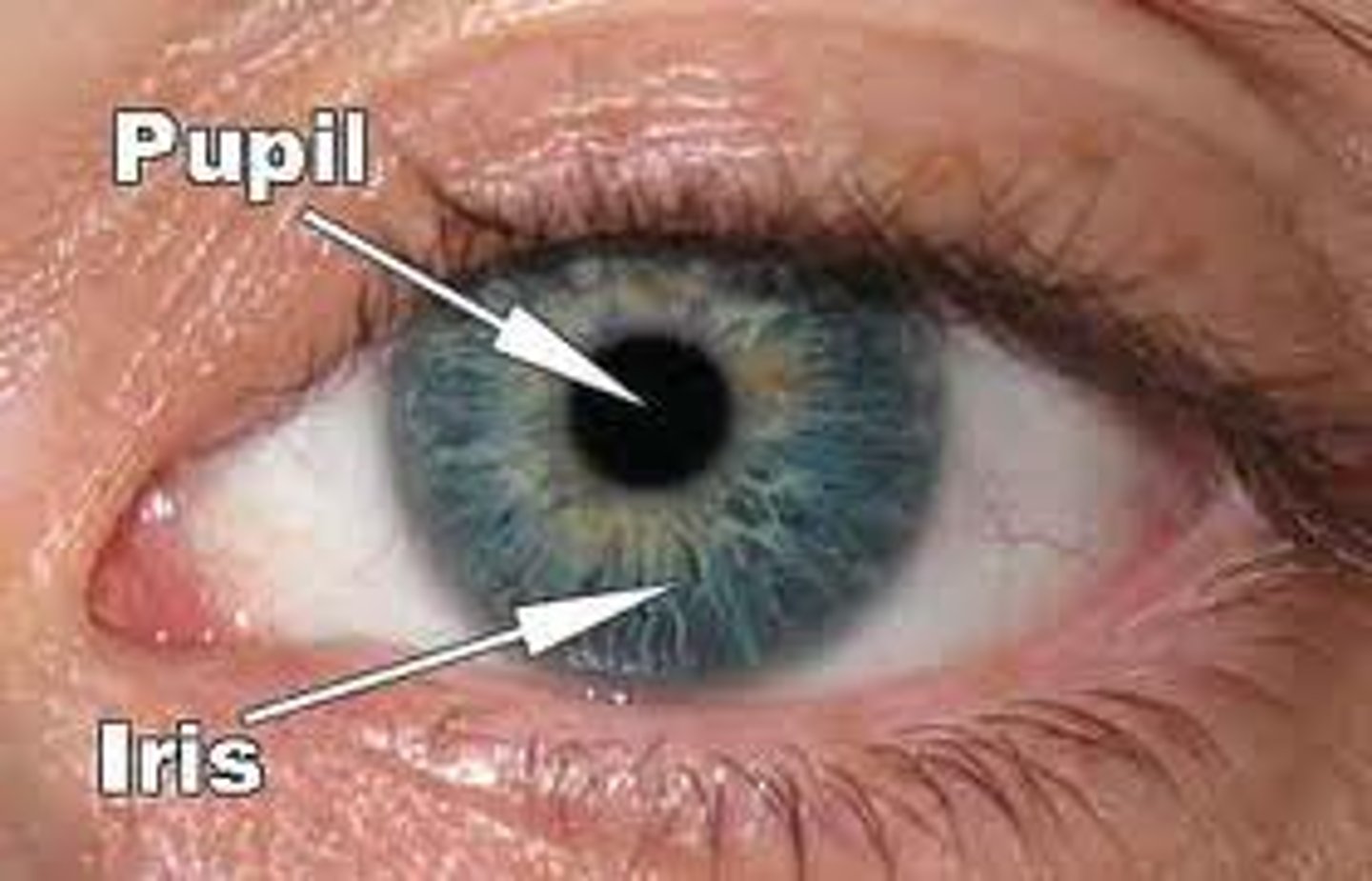
iris

a ring of muscle tissue that forms the colored portion of the eye around the pupil and controls the size of the pupil opening.
<p>a ring of muscle tissue that forms the colored portion of the eye around the pupil and controls the size of the pupil opening.</p>
22
New cards

lens

the transparent structure behind the pupil that changes shape to help focus images on the retina.

<p>the transparent structure behind the pupil that changes shape to help focus images on the retina.</p>
23
New cards

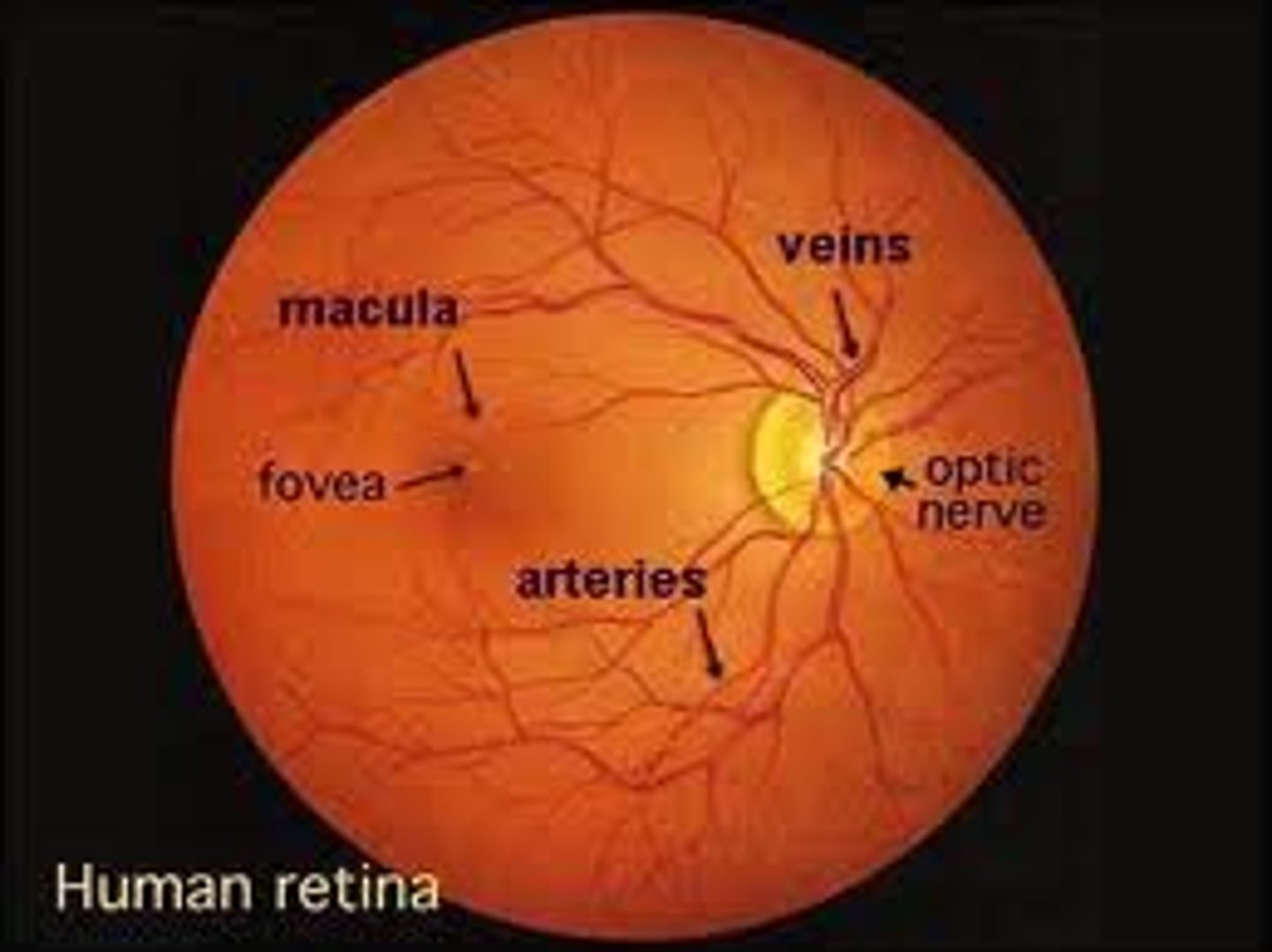
retina

the light-sensitive inner surface of the eye, containing the receptor rods and cones plus layers of neurons that begin the processing of visual information.
<p>the light-sensitive inner surface of the eye, containing the receptor rods and cones plus layers of neurons that begin the processing of visual information.</p>
24
New cards

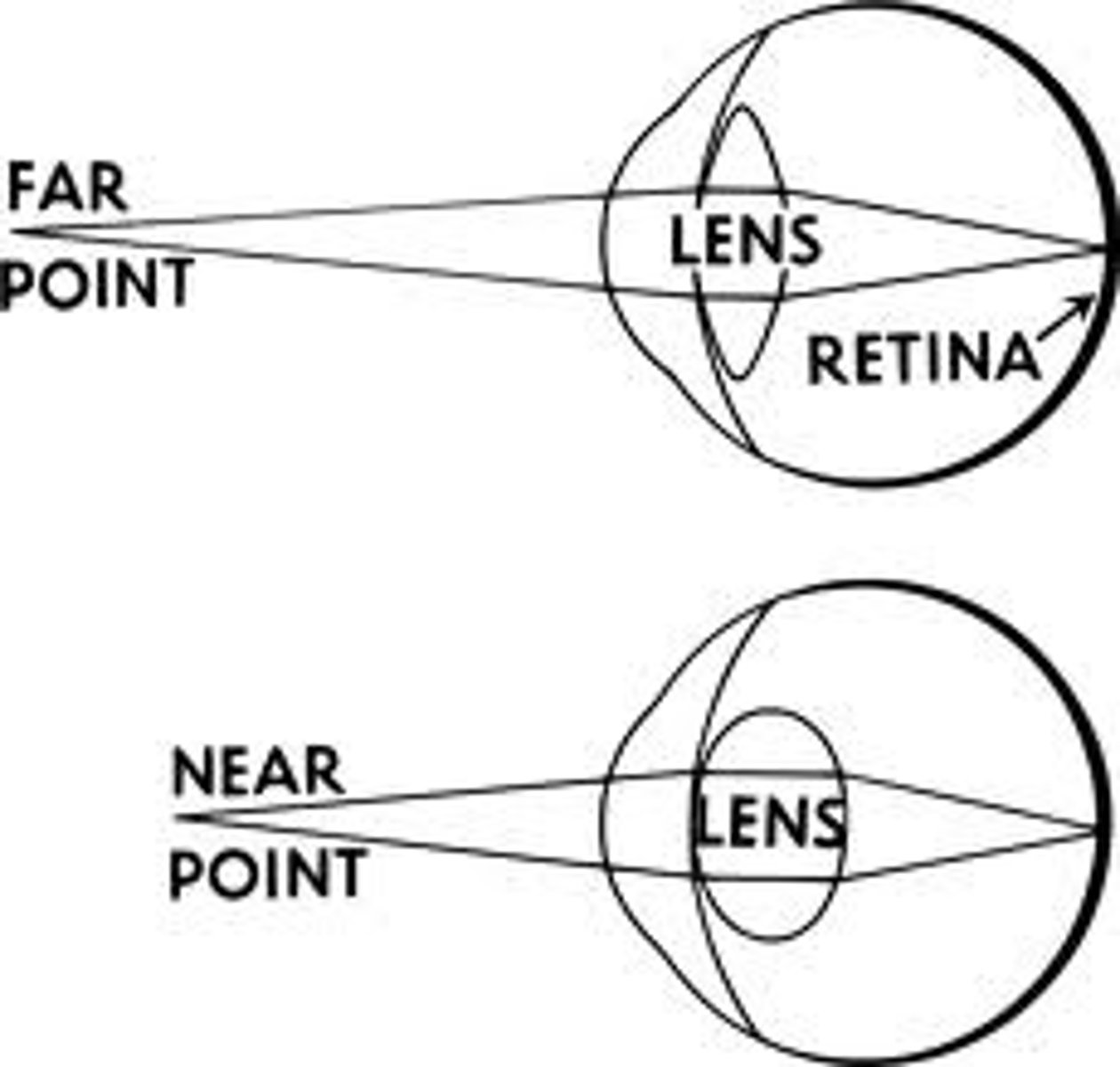
accomodation

Sensation - the process by which the eye's lens changes shape to focus near or far objects on the retina.
<p>Sensation - the process by which the eye's lens changes shape to focus near or far objects on the retina.</p>
25
New cards

rods

retinal receptors that detect black, white, and gray; necessary for peripheral and twilight vision, when cones don't respond.
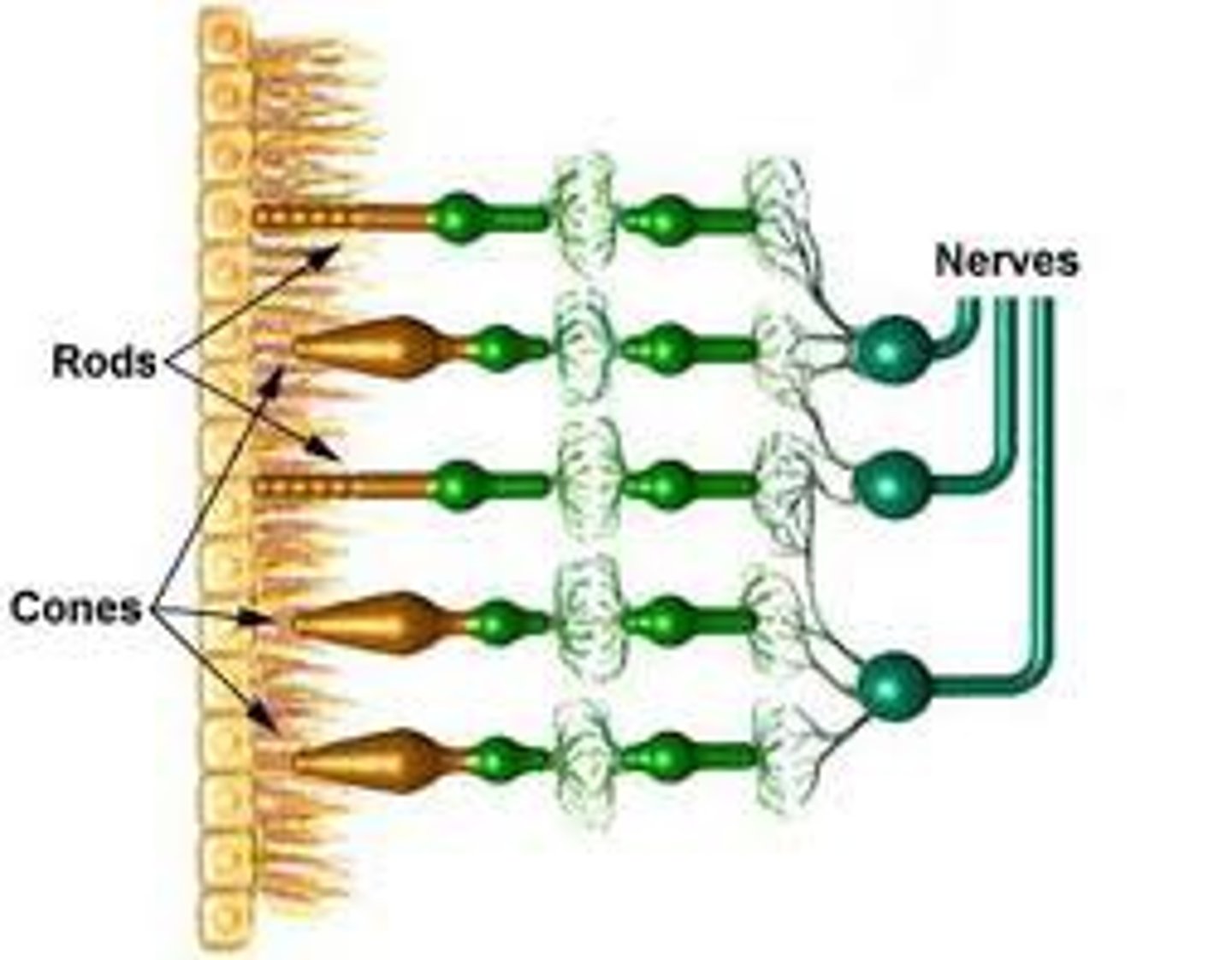
<p>retinal receptors that detect black, white, and gray; necessary for peripheral and twilight vision, when cones don't respond.</p>
26
New cards

cones

retinal receptor cells that are concentrated near the center of the retina and that function in daylight or in well-lit conditions. These detect fine detail and give rise to color sensations.
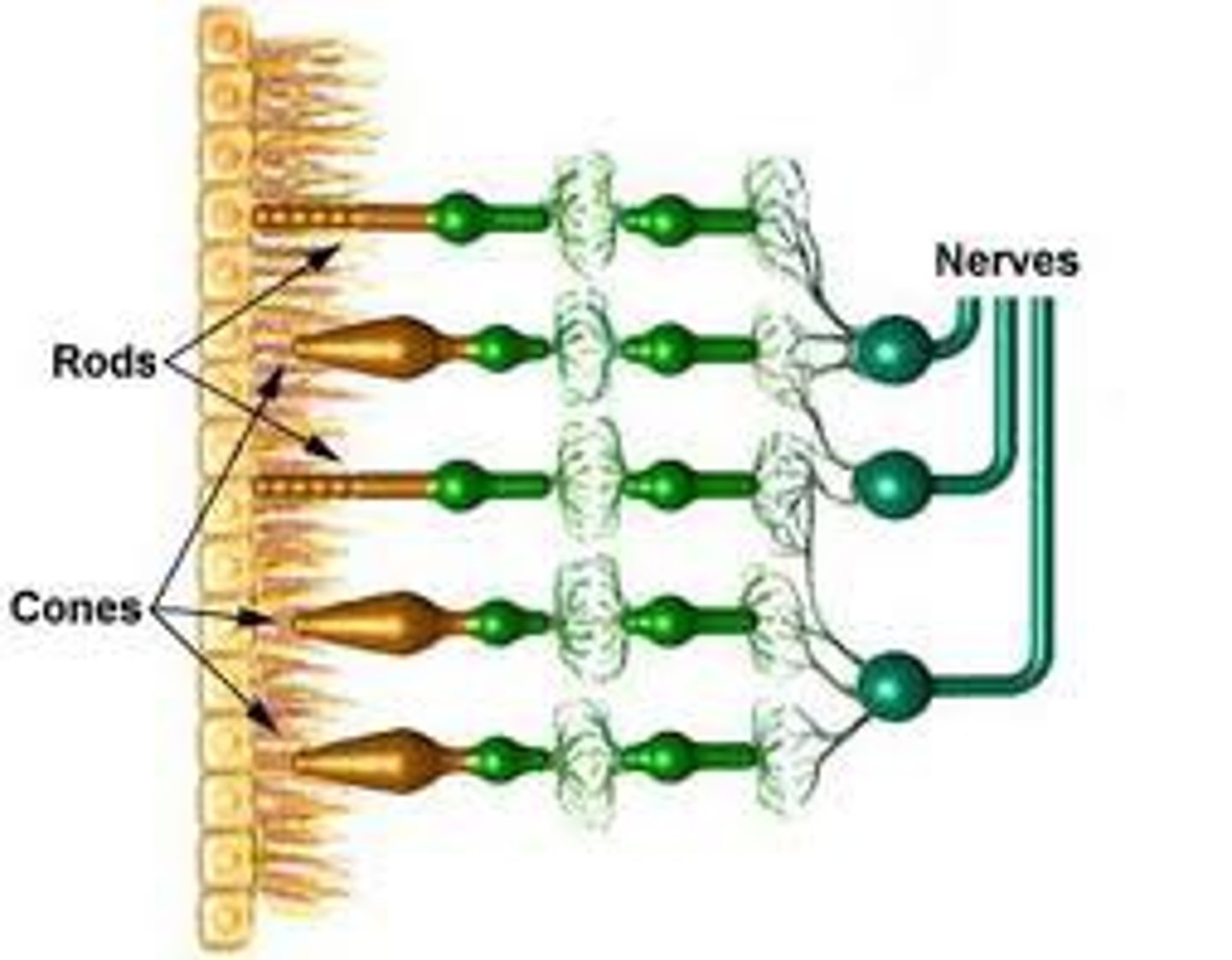
<p>retinal receptor cells that are concentrated near the center of the retina and that function in daylight or in well-lit conditions. These detect fine detail and give rise to color sensations.</p>
27
New cards

optic nerve

the nerve that carries neural impulses from the eye to the brain.
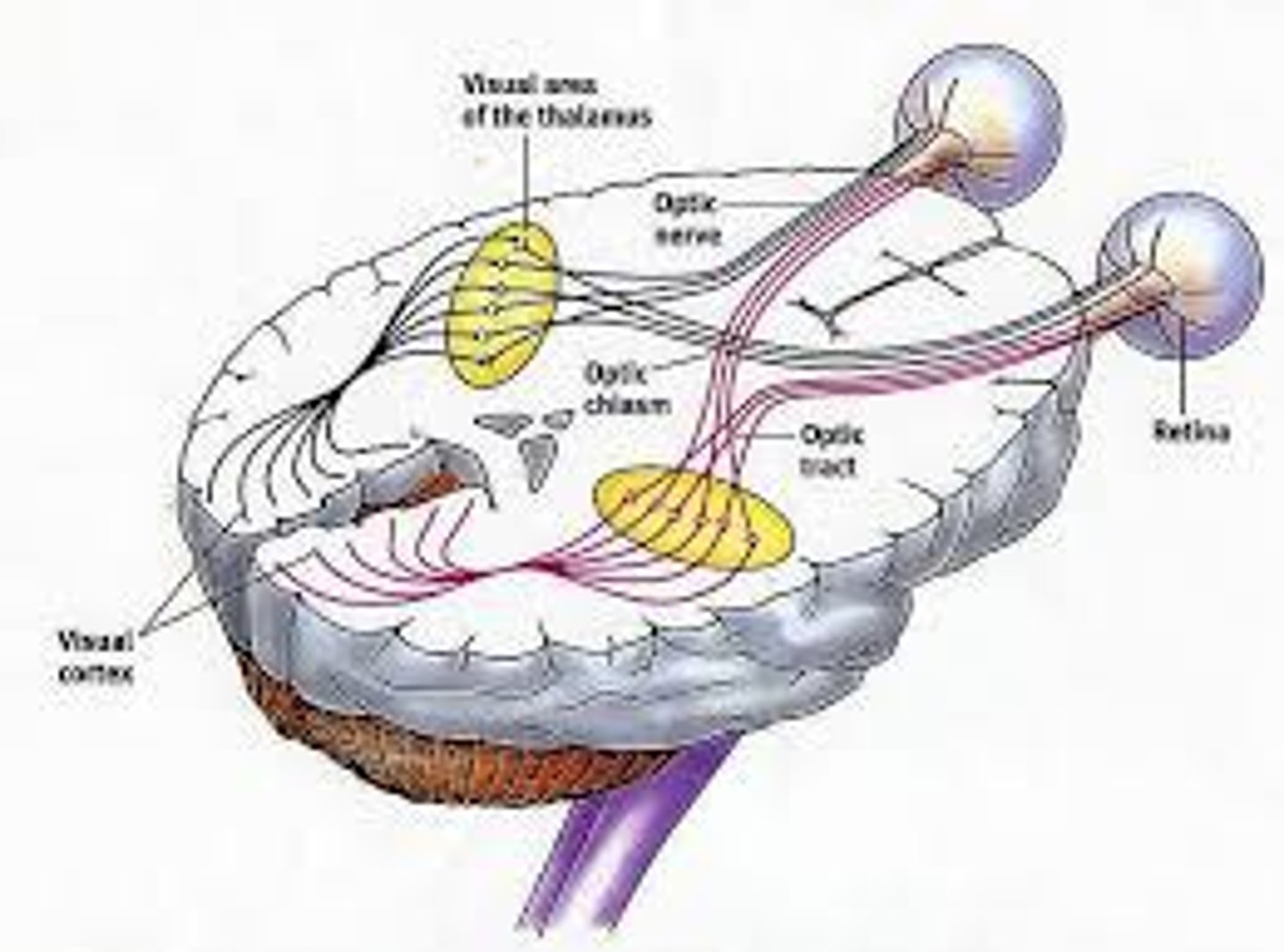
<p>the nerve that carries neural impulses from the eye to the brain.</p>
28
New cards

blind spot

the point at which the optic nerve leaves the eye and no receptor cells are located there.
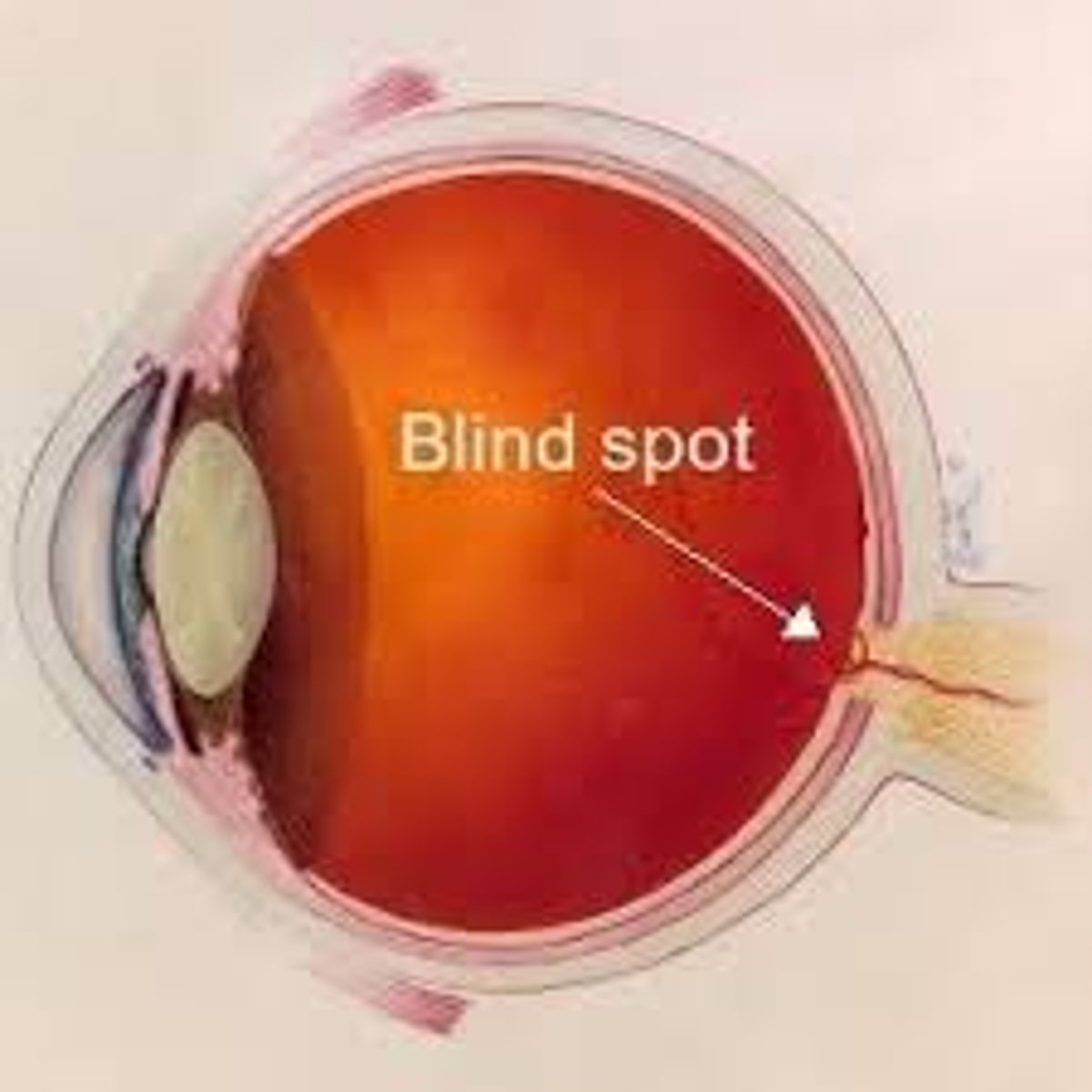
<p>the point at which the optic nerve leaves the eye and no receptor cells are located there.</p>
29
New cards

fovea

the central focal point in the retina, around which the eye's cones cluster.
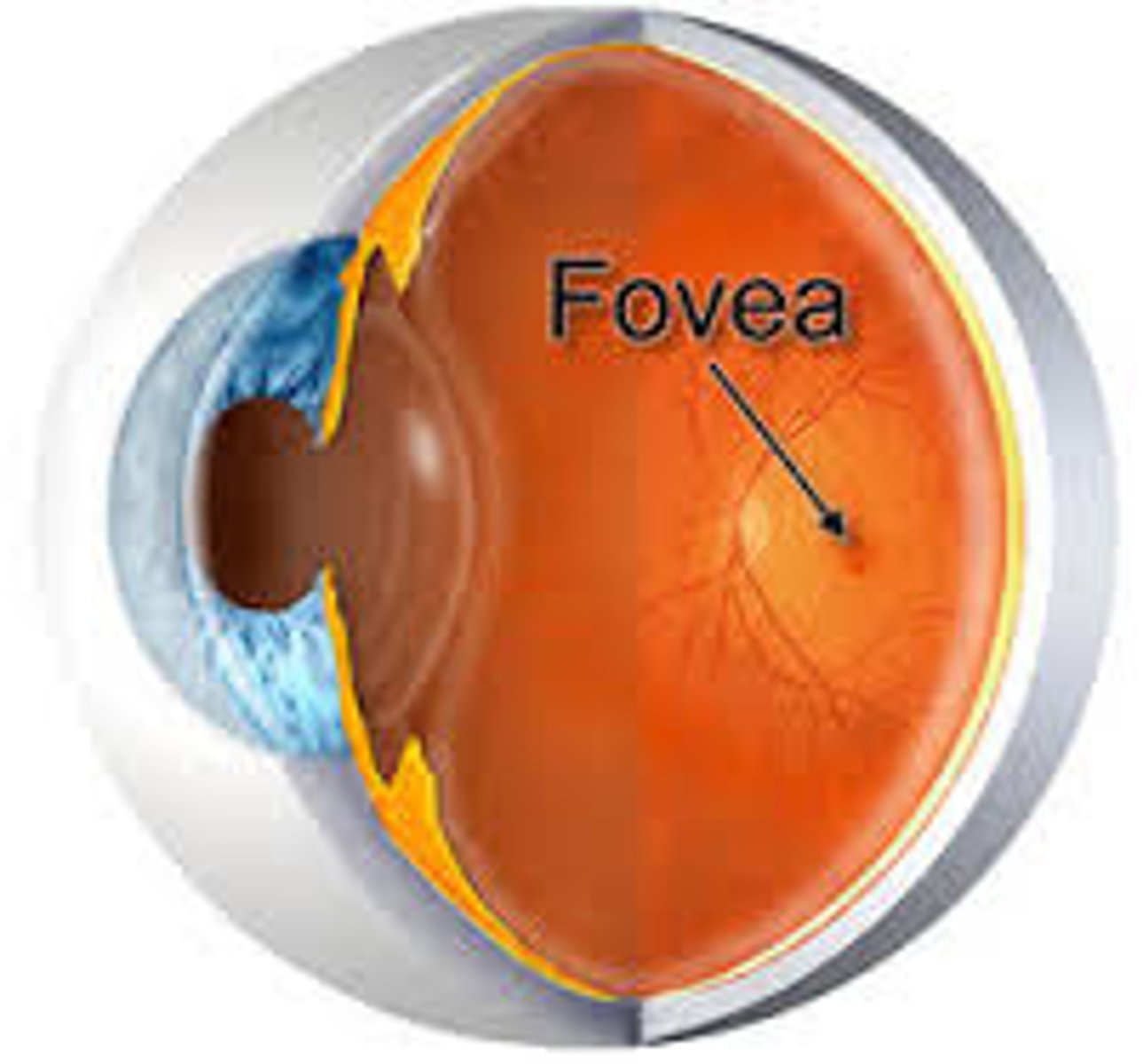
<p>the central focal point in the retina, around which the eye's cones cluster.</p>
30
New cards

feature detectors

nerve cells in the brain that respond to specific features of the stimulus, such as shape, angle, or movement.
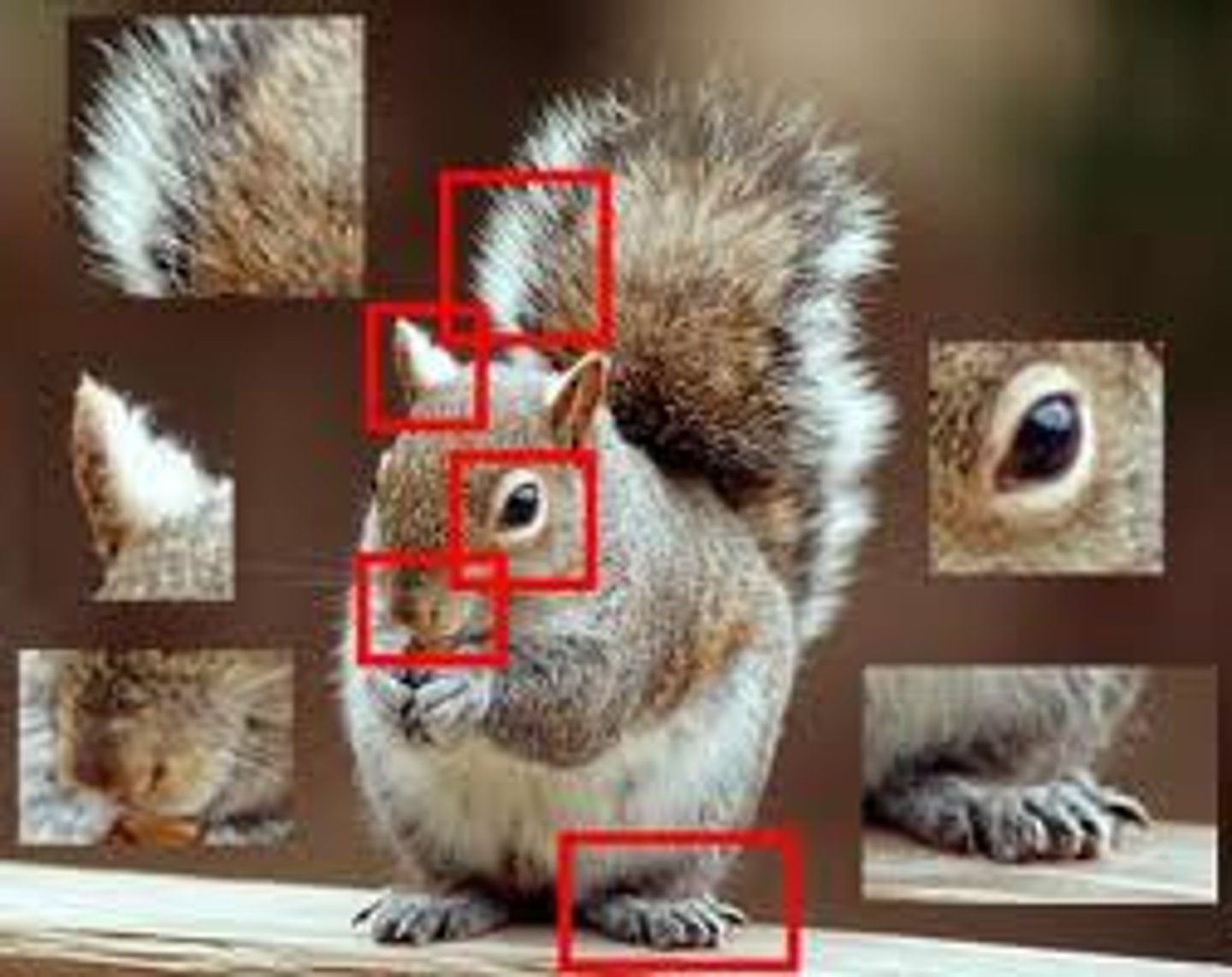
<p>nerve cells in the brain that respond to specific features of the stimulus, such as shape, angle, or movement.</p>
31
New cards

parallel processing

the processing of many aspects of a problem simultaneously; the brain's natural mode of information processing for many functions, including vision. Contrasts with the step-by-step (serial) processing of most computers and of conscious problem solving.
<p>the processing of many aspects of a problem simultaneously; the brain's natural mode of information processing for many functions, including vision. Contrasts with the step-by-step (serial) processing of most computers and of conscious problem solving.</p>
32
New cards

Young-Helmholtz trichromatic (three-color) theory

the theory that the retina contains three different color receptors—one most sensitive to red, one to green, one to blue—which, when stimulated in combination, can produce the perception of any color.
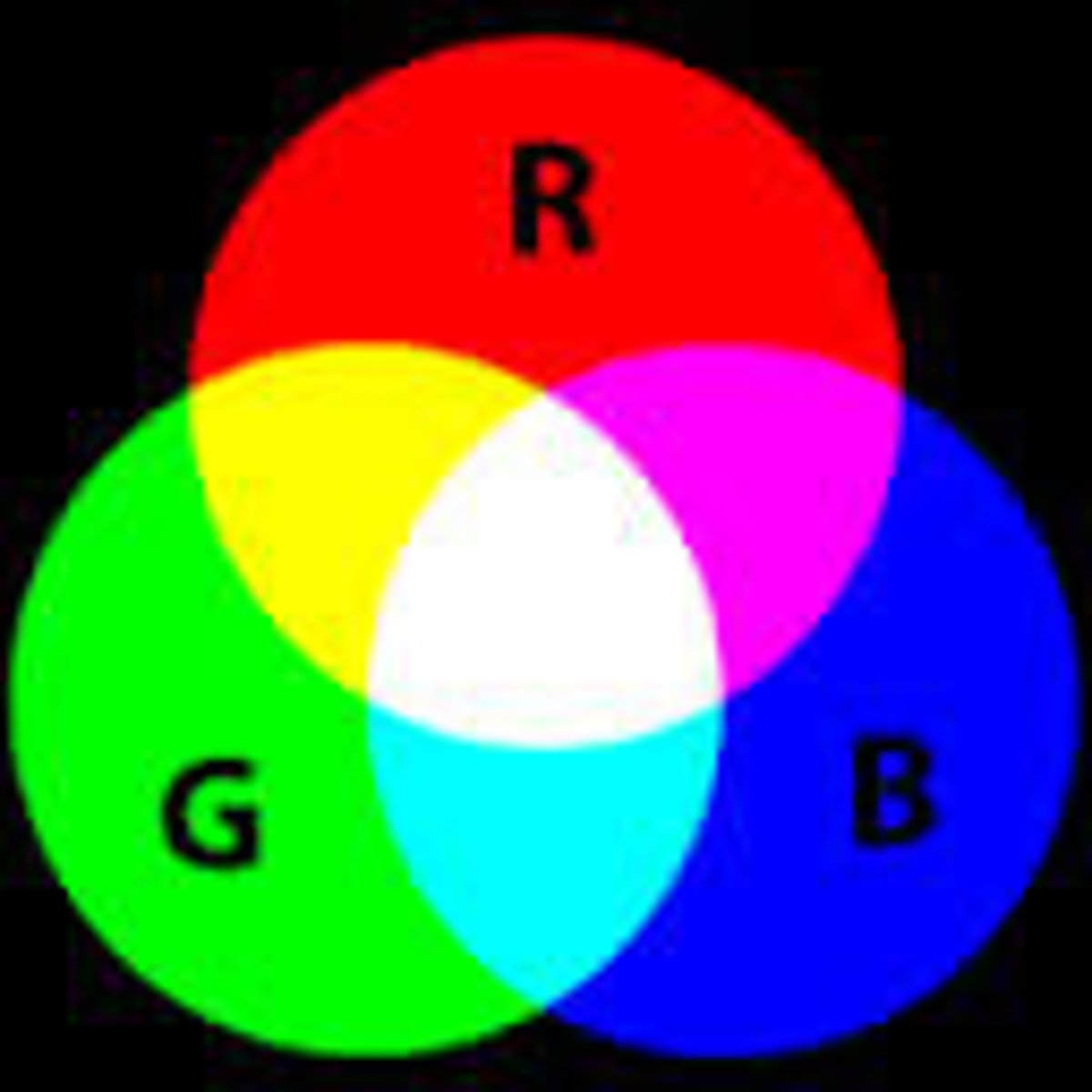
<p>the theory that the retina contains three different color receptors—one most sensitive to red, one to green, one to blue—which, when stimulated in combination, can produce the perception of any color.</p>
33
New cards

opponent-process theory

the theory that opposing retinal processes (red-green, yellow-blue, white-black) enable color vision. For example, some cells are stimulated by green and inhibited by red; others are stimulated by red and inhibited by green.

<p>the theory that opposing retinal processes (red-green, yellow-blue, white-black) enable color vision. For example, some cells are stimulated by green and inhibited by red; others are stimulated by red and inhibited by green.</p>
34
New cards

audition

the sense or act of hearing.
<p>the sense or act of hearing.</p>
35
New cards

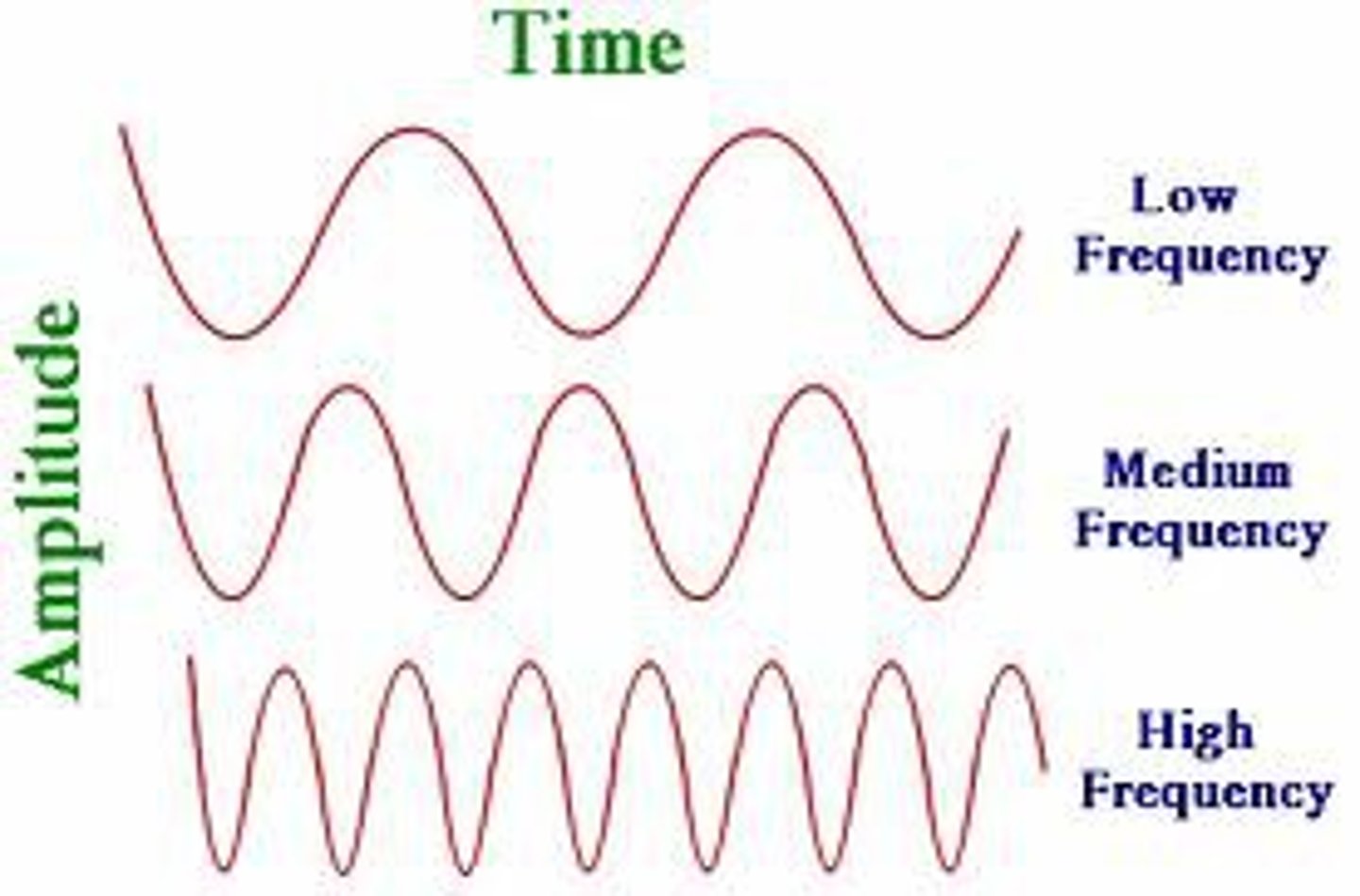
frequency

the number of complete wavelengths that pass a point in a given time (for example, per second).
<p>the number of complete wavelengths that pass a point in a given time (for example, per second).</p>
36
New cards

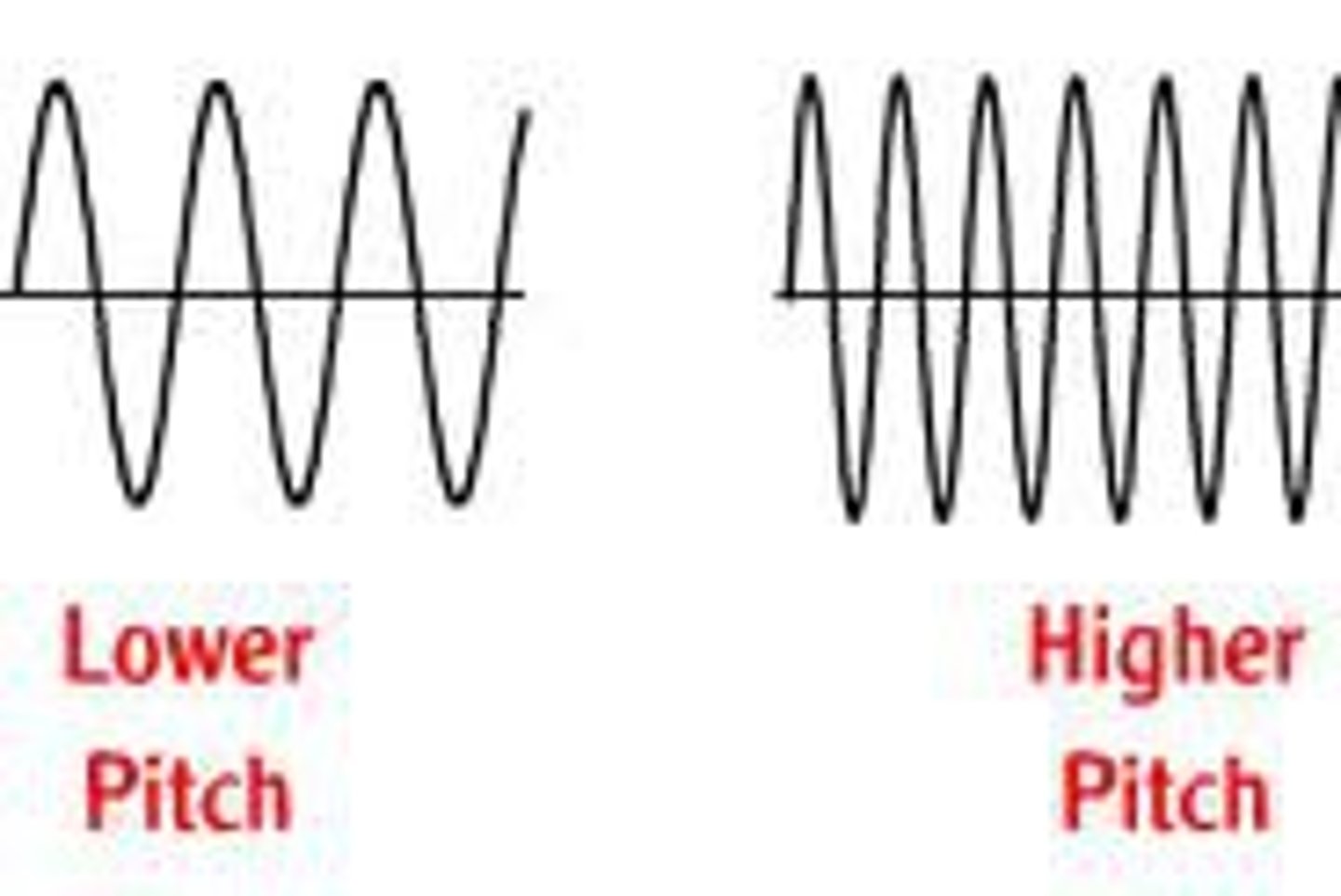
pitch

a tone's experienced highness or lowness; depends on frequency.
<p>a tone's experienced highness or lowness; depends on frequency.</p>
37
New cards

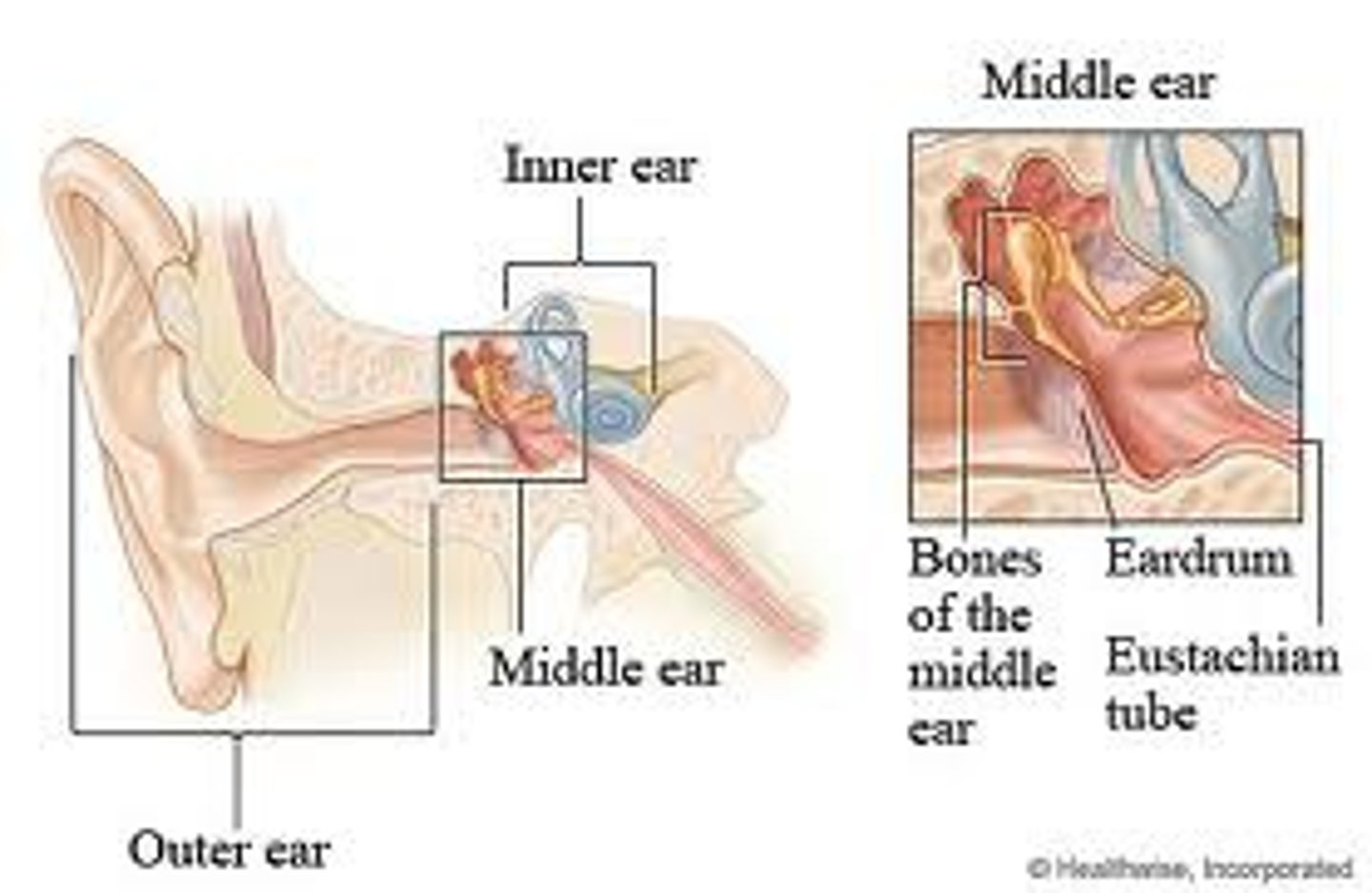
middle ear

the chamber between the eardrum and cochlea containing three tiny bones (hammer, anvil, and stirrup) that concentrate the vibrations of the eardrum on the cochlea's oval window.
<p>the chamber between the eardrum and cochlea containing three tiny bones (hammer, anvil, and stirrup) that concentrate the vibrations of the eardrum on the cochlea's oval window.</p>
38
New cards

cochlea

a coiled, bony, fluid-filled tube in the inner ear through which sound waves trigger nerve impulses
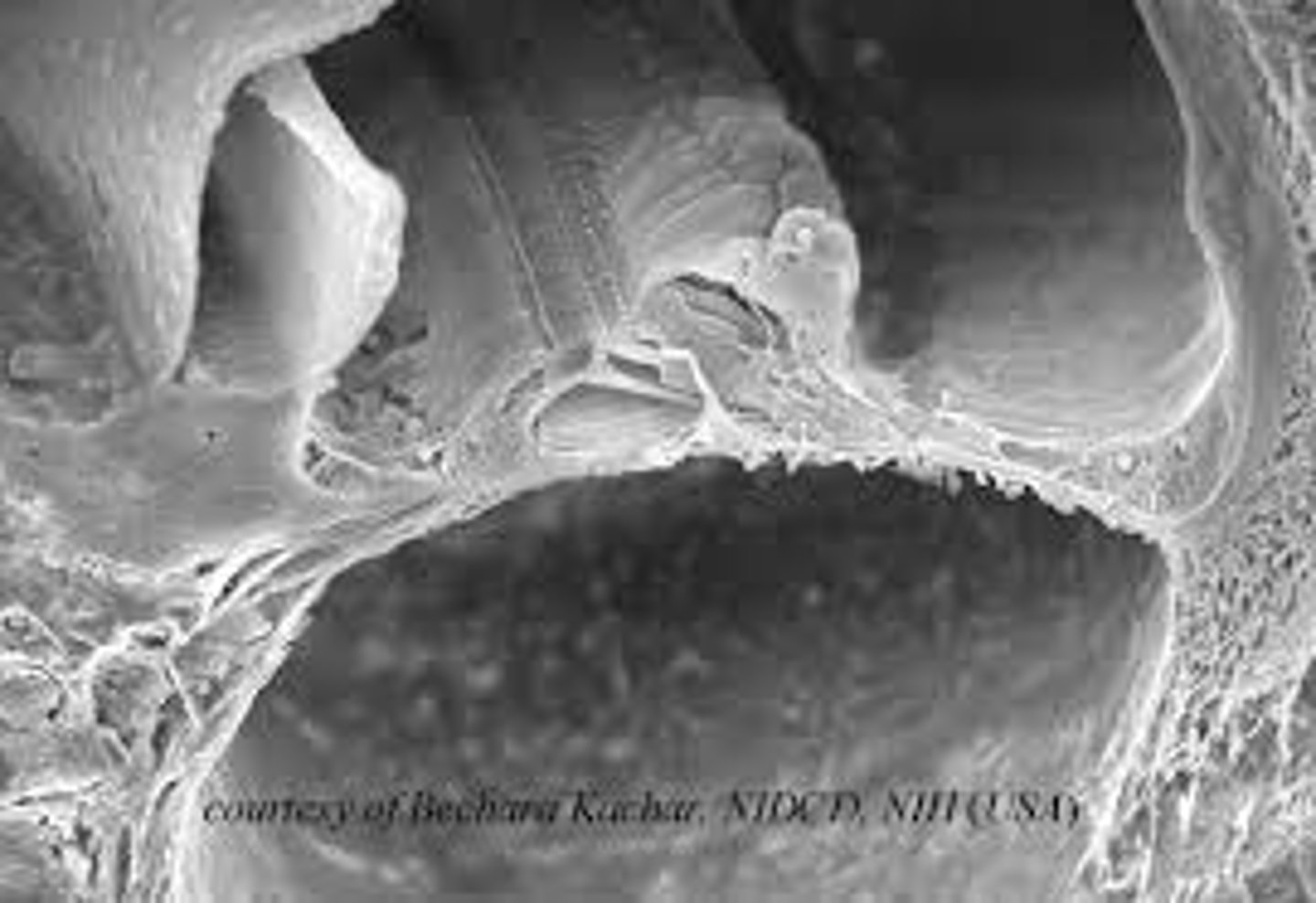
<p>a coiled, bony, fluid-filled tube in the inner ear through which sound waves trigger nerve impulses</p>
39
New cards

inner ear

the innermost part of the ear, containing the cochlea, semicircular canals, and vestibular sacs.
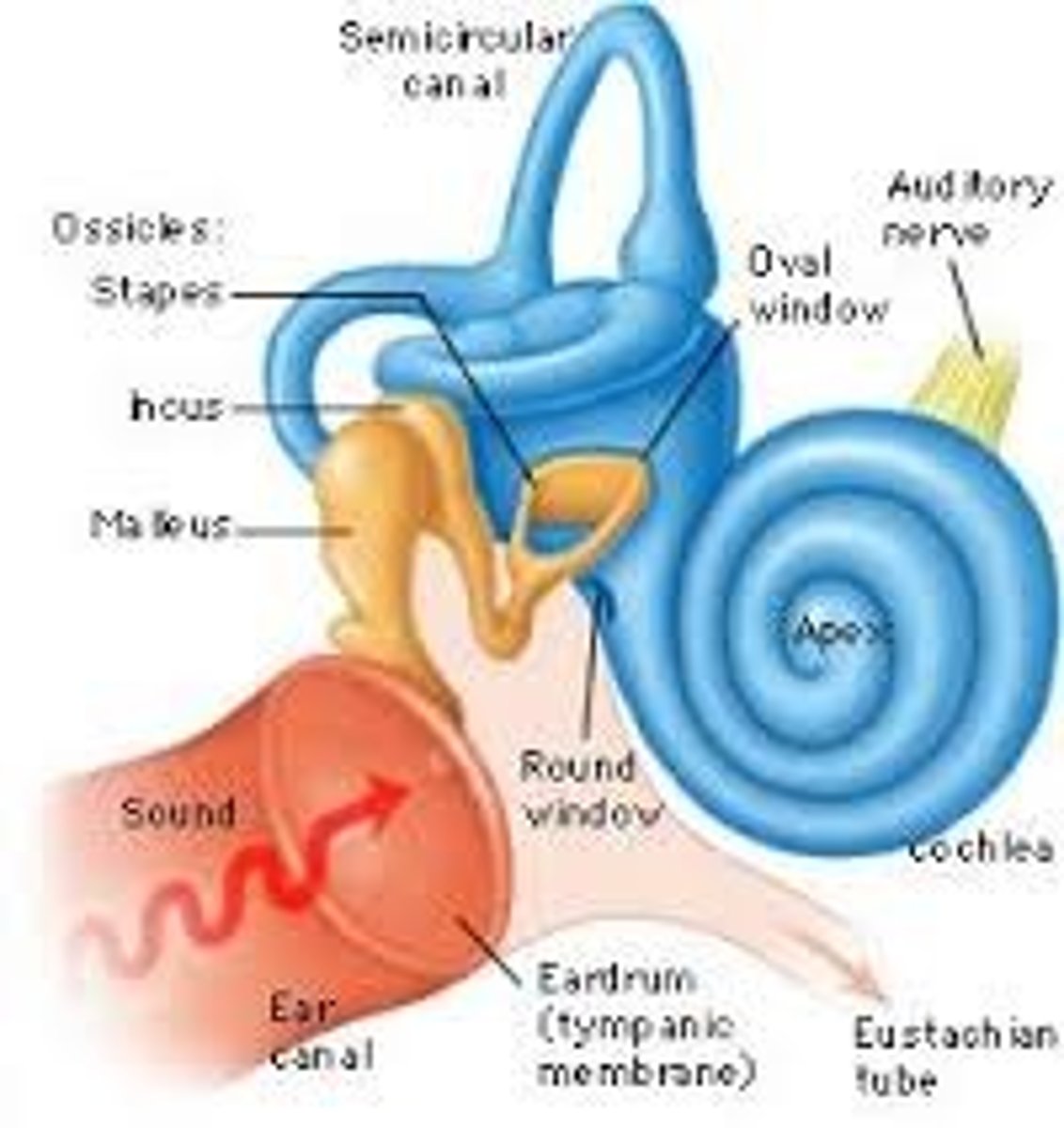
<p>the innermost part of the ear, containing the cochlea, semicircular canals, and vestibular sacs.</p>
40
New cards

place theory

in hearing, the theory that links the pitch we hear with the place where the cochlea's membrane is stimulated.
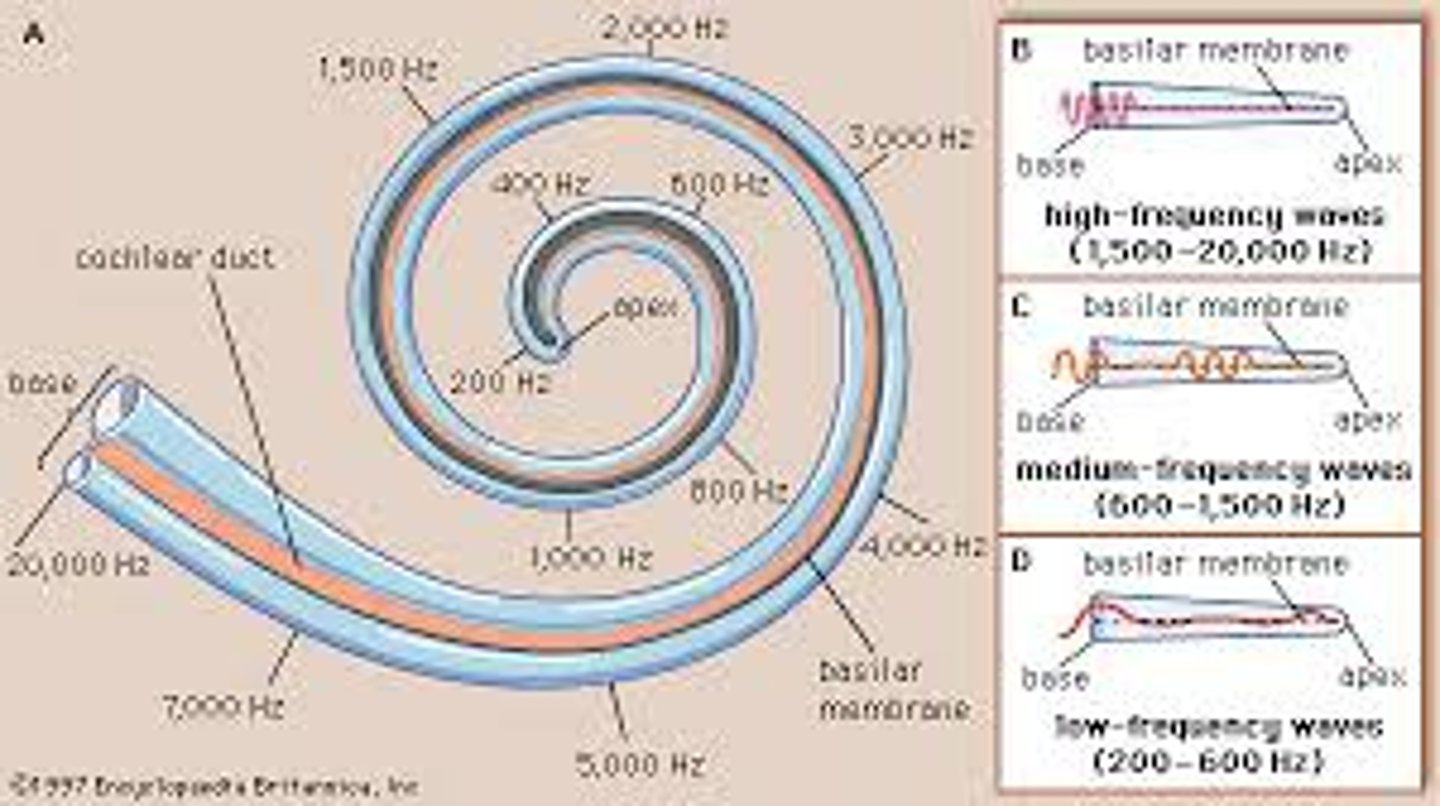
<p>in hearing, the theory that links the pitch we hear with the place where the cochlea's membrane is stimulated.</p>
41
New cards

frequency theory

in hearing, the theory that the rate of nerve impulses traveling up the auditory nerve matches the frequency of a tone, thus enabling us to sense its pitch.
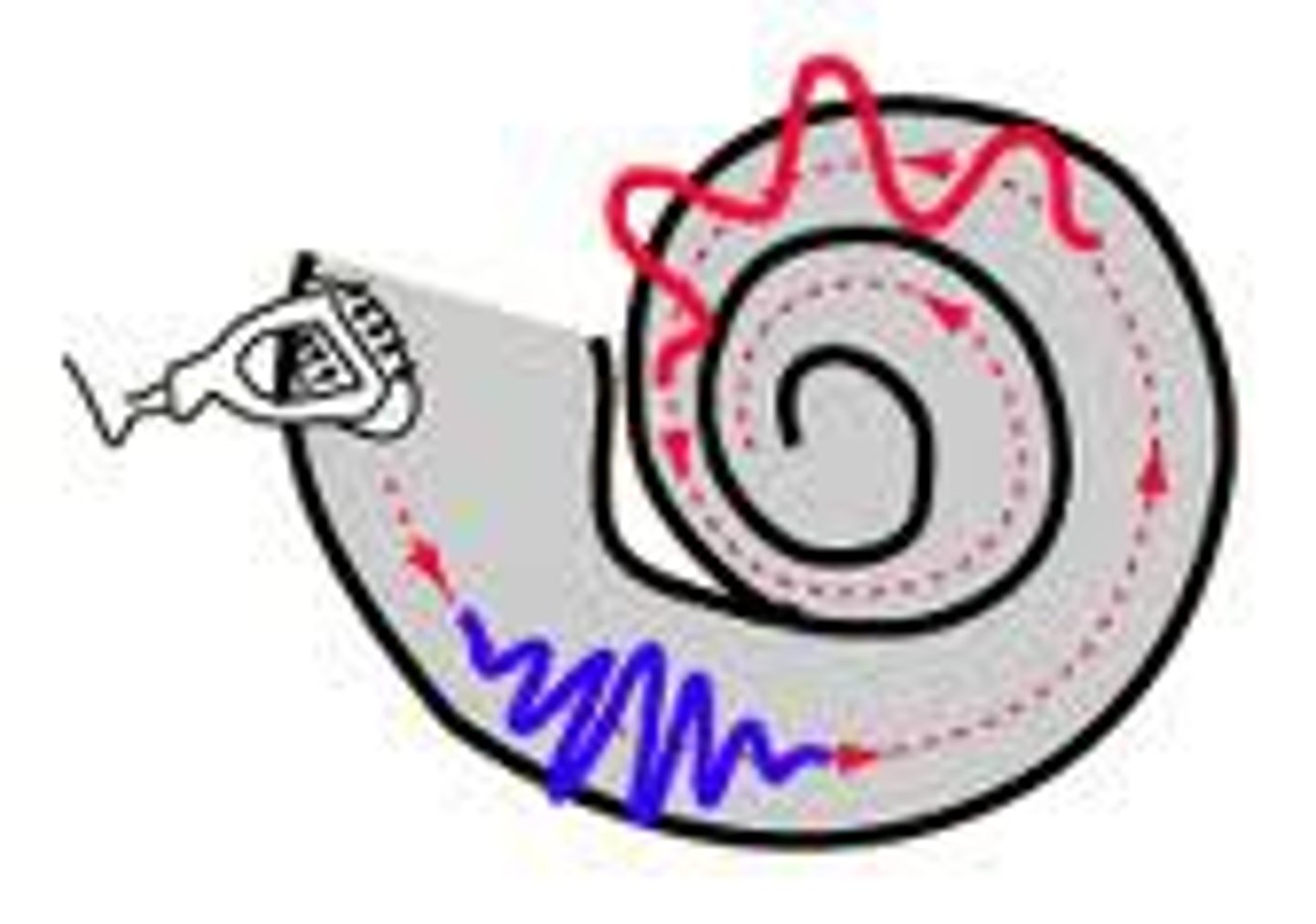
<p>in hearing, the theory that the rate of nerve impulses traveling up the auditory nerve matches the frequency of a tone, thus enabling us to sense its pitch.</p>
42
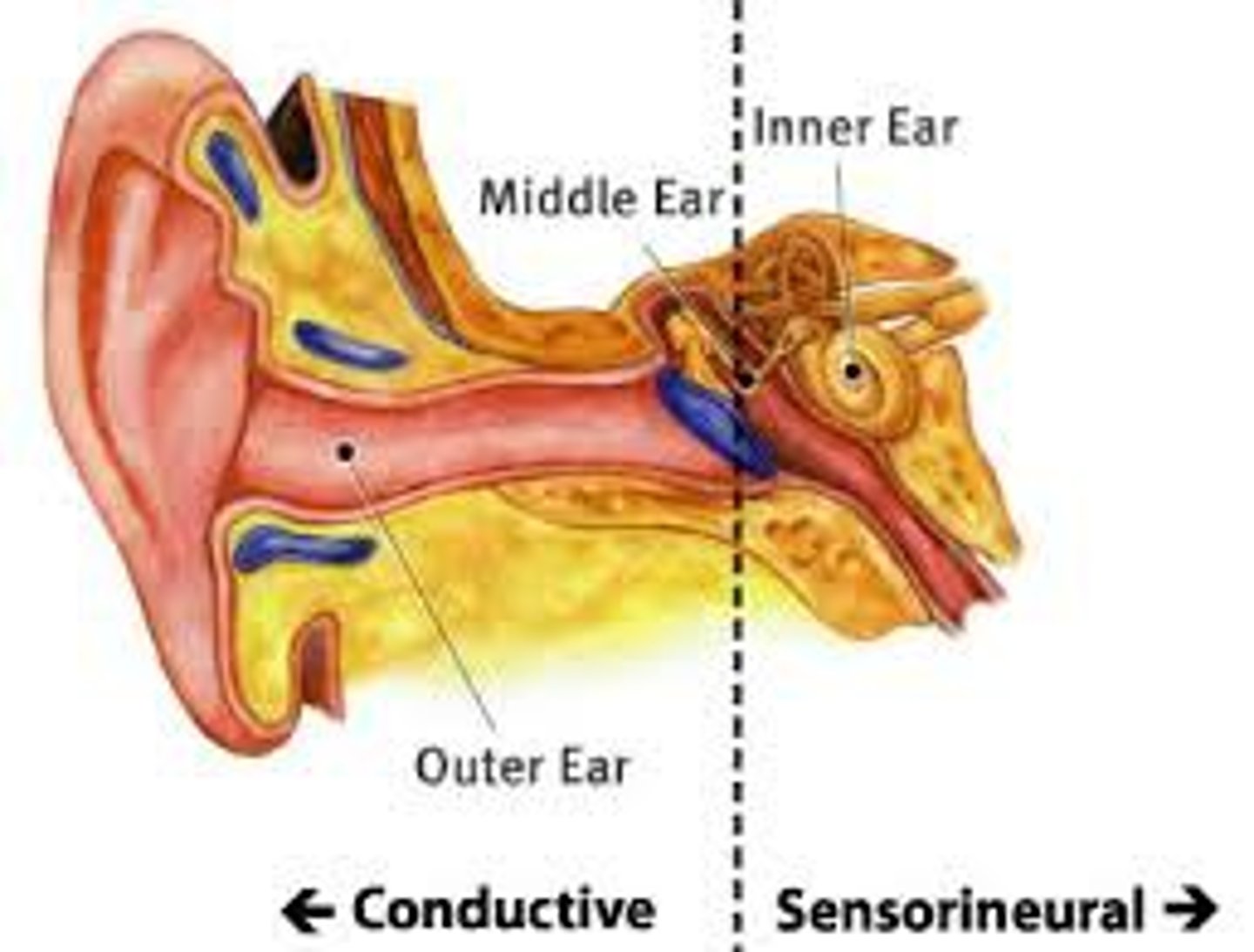
New cards

conduction hearing loss

hearing loss caused by damage to the mechanical system that conducts sound waves to the cochlea.
<p>hearing loss caused by damage to the mechanical system that conducts sound waves to the cochlea.</p>
43
New cards

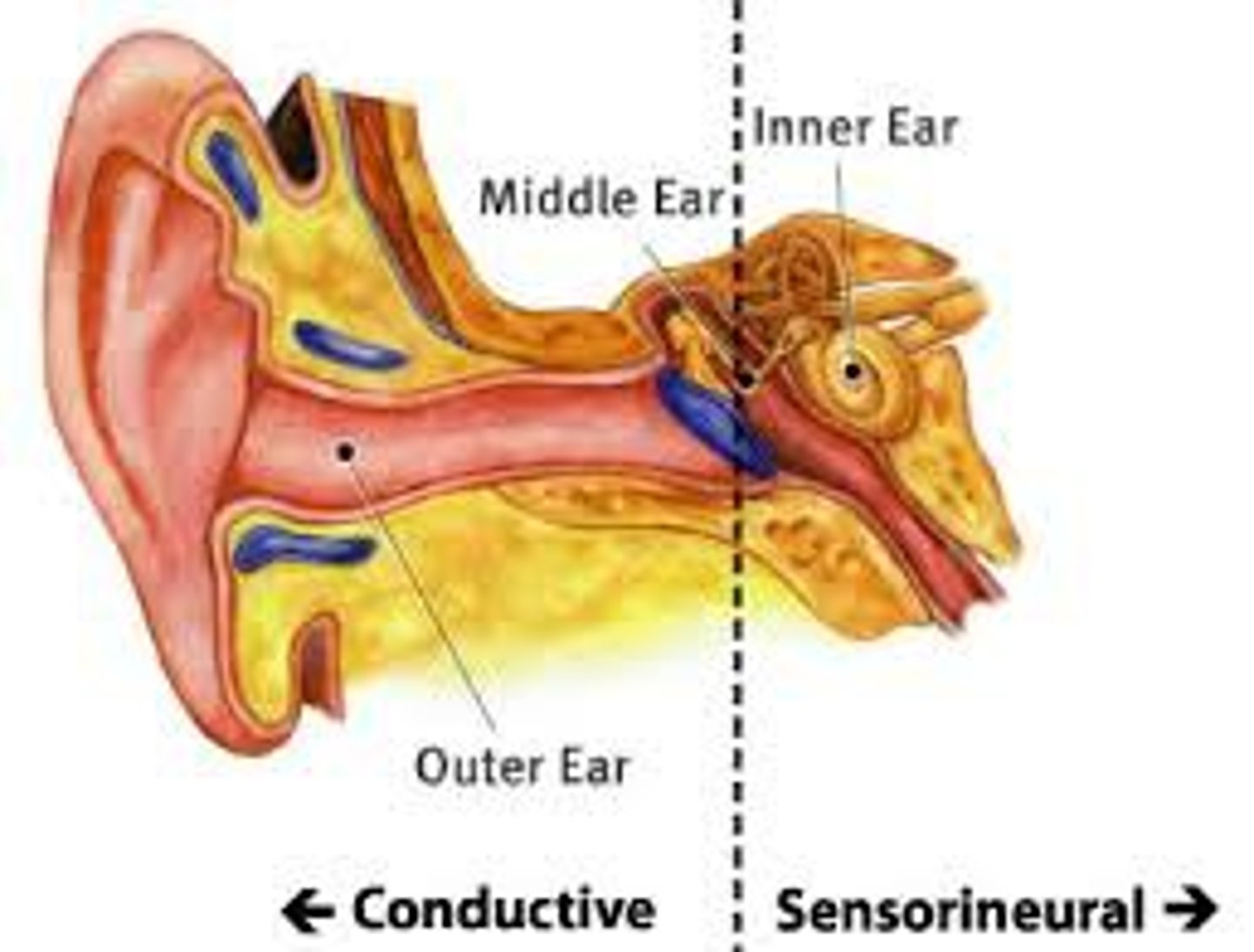
sensorineural hearing loss

hearing loss caused by damage to the cochlea's receptor cells or to the auditory nerves; also called nerve deafness.
<p>hearing loss caused by damage to the cochlea's receptor cells or to the auditory nerves; also called nerve deafness.</p>
44
New cards

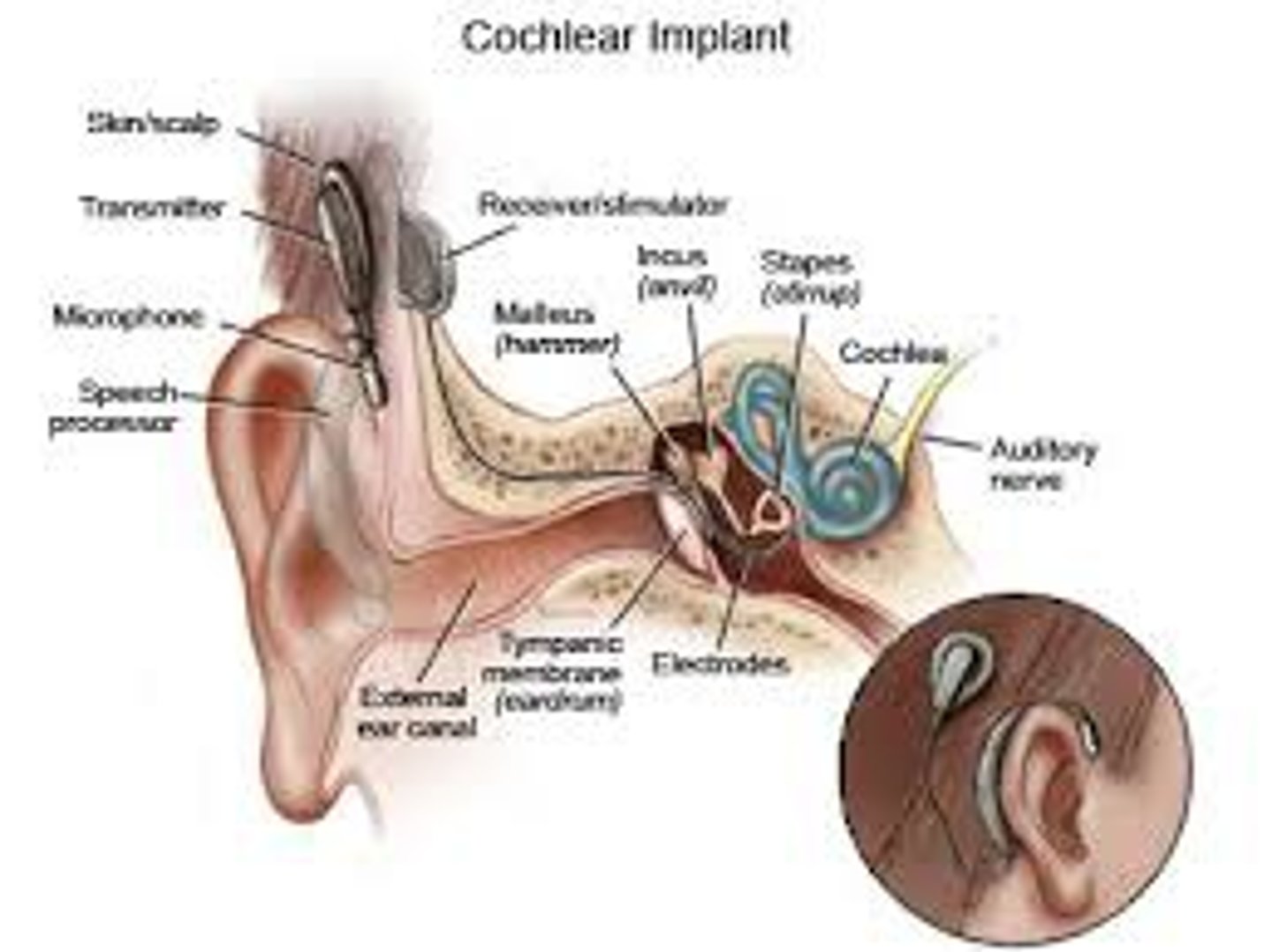
cochlear implant

a device for converting sounds into electrical signals and stimulating the auditory nerve through electrodes threaded into the cochlea.
<p>a device for converting sounds into electrical signals and stimulating the auditory nerve through electrodes threaded into the cochlea.</p>
45
New cards

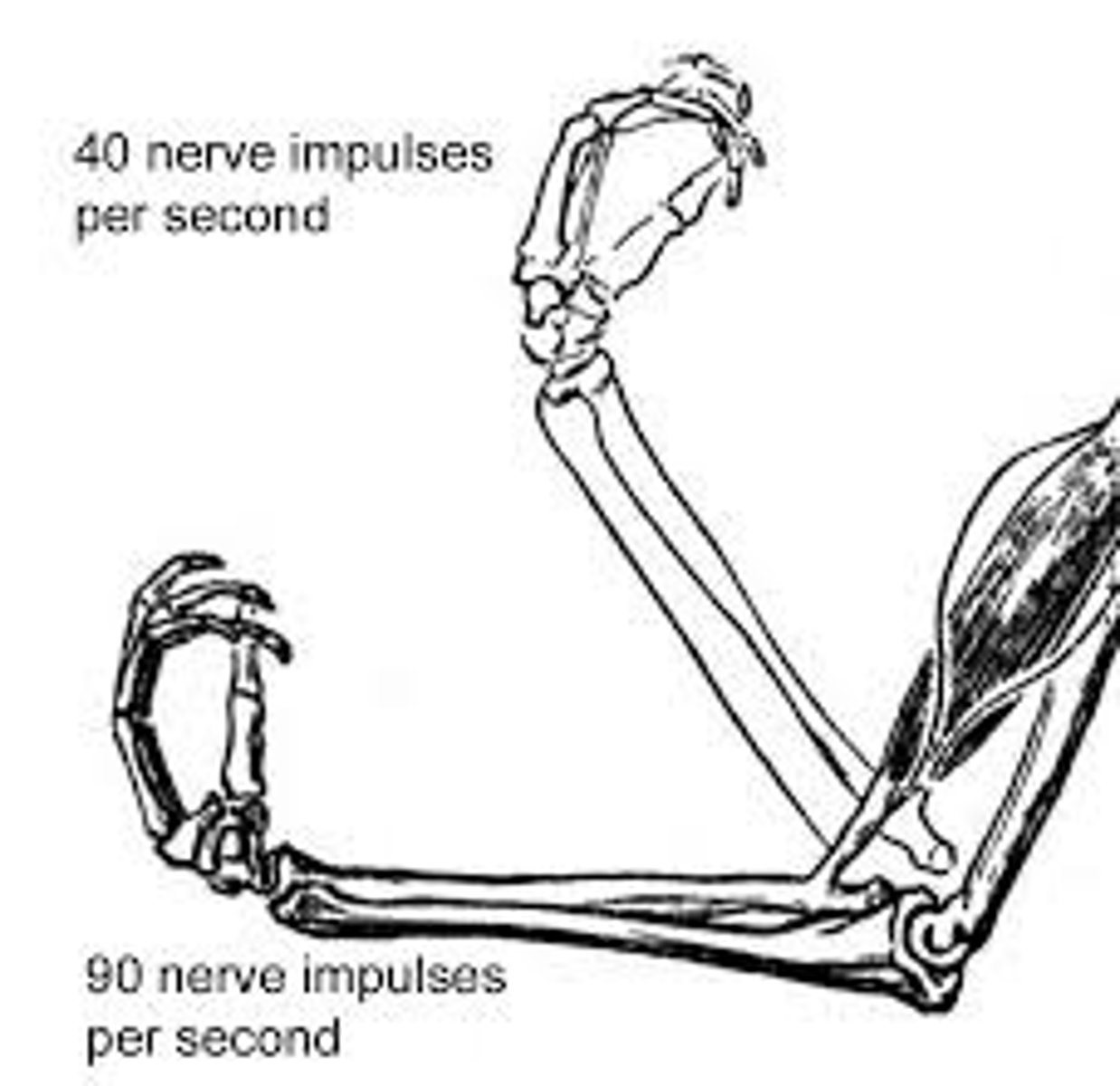
kinesthesis

the system for sensing the position and movement of individual body parts.
<p>the system for sensing the position and movement of individual body parts.</p>
46
New cards

vestibular sense

the sense of body movement and position, including the sense of balance.
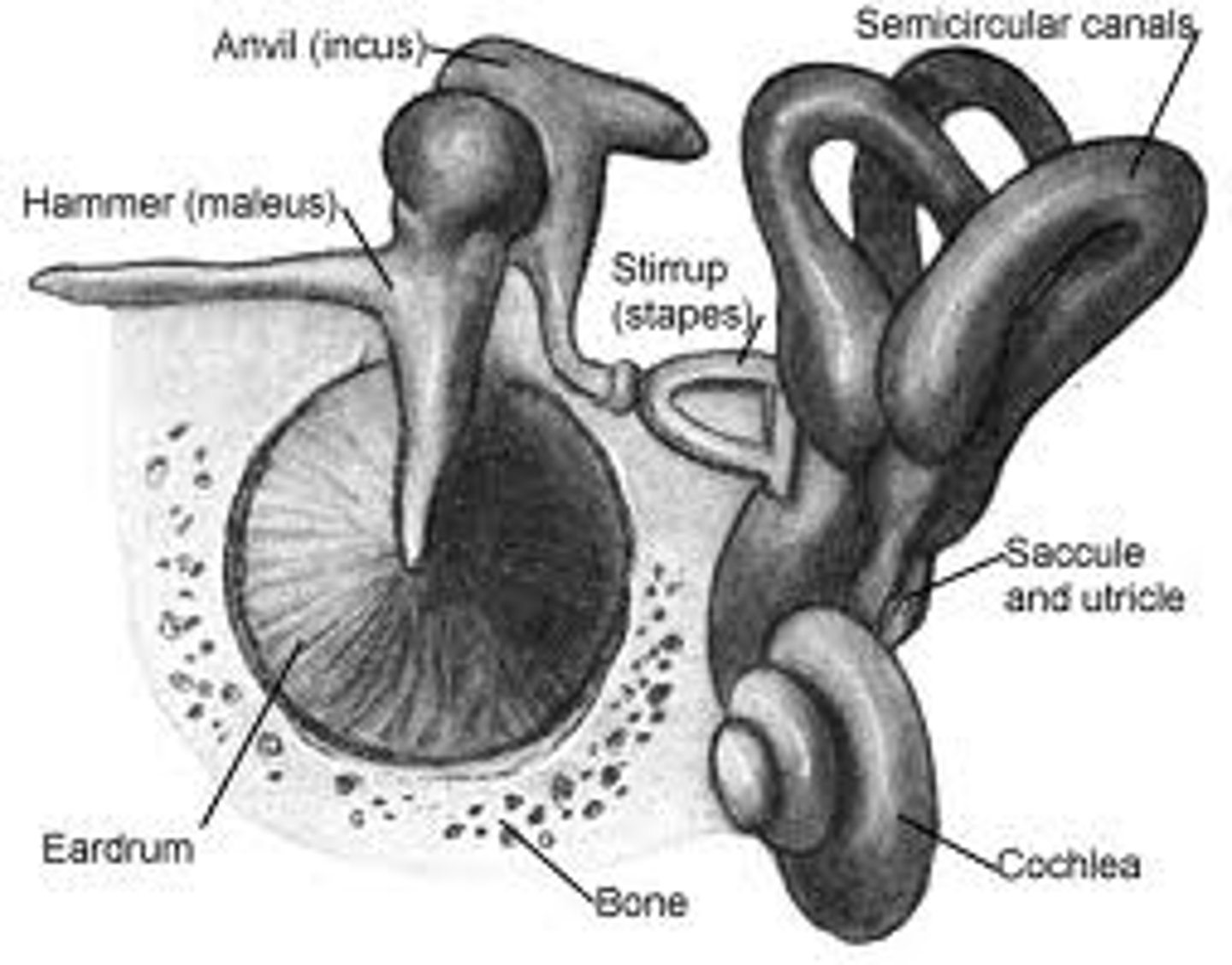
<p>the sense of body movement and position, including the sense of balance.</p>
47
New cards

gate-control theory

the theory that the spinal cord contains a neurological "gate" that blocks pain signals or allows them to pass on to the brain. The "gate" is opened by the activity of pain signals traveling up small nerve fibers and is closed by activity in larger fibers or by information coming from the brain.
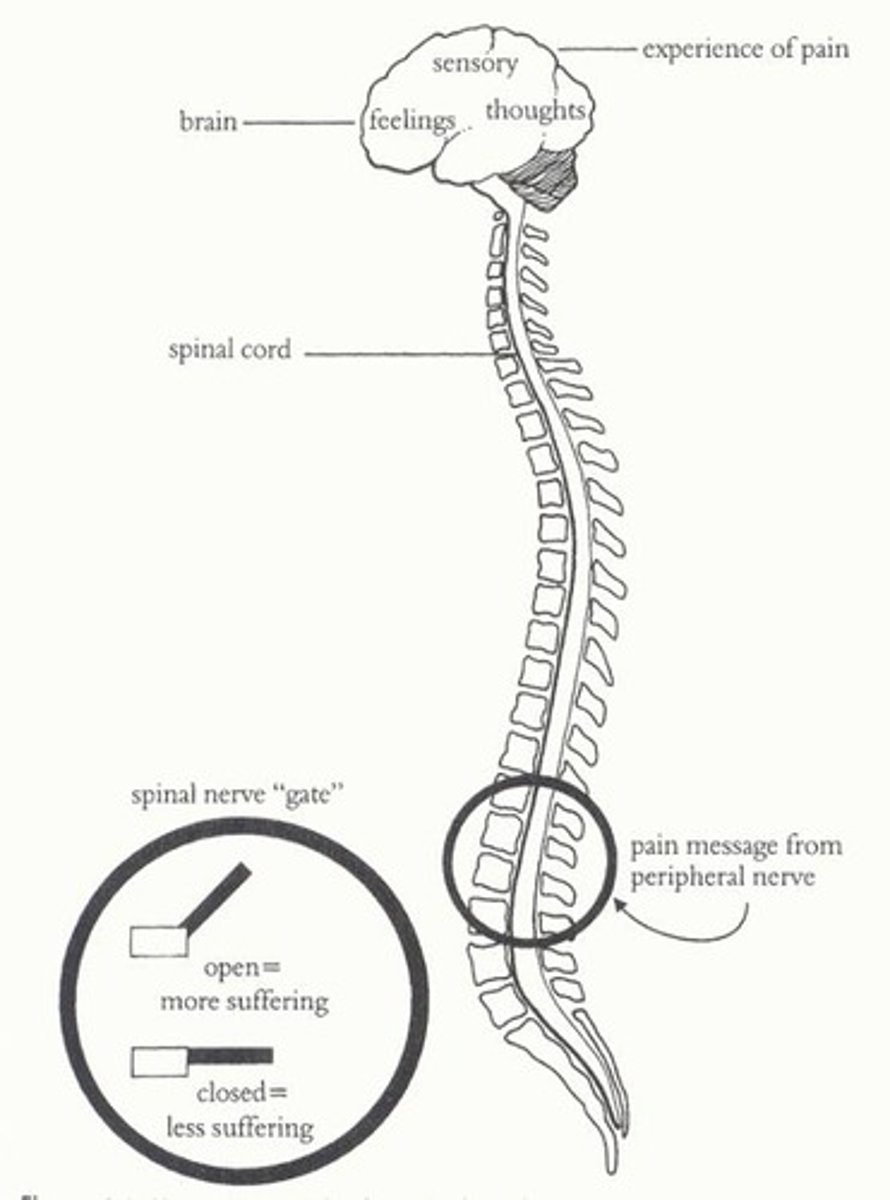
<p>the theory that the spinal cord contains a neurological "gate" that blocks pain signals or allows them to pass on to the brain. The "gate" is opened by the activity of pain signals traveling up small nerve fibers and is closed by activity in larger fibers or by information coming from the brain.</p>
48
New cards

sensory interaction

the principle that one sense may influence another, as when the smell of food influences its taste.

<p>the principle that one sense may influence another, as when the smell of food influences its taste.</p>
49
New cards

gestalt

an organized whole. These type of psychologists emphasized our tendency to integrate pieces of information into meaningful wholes
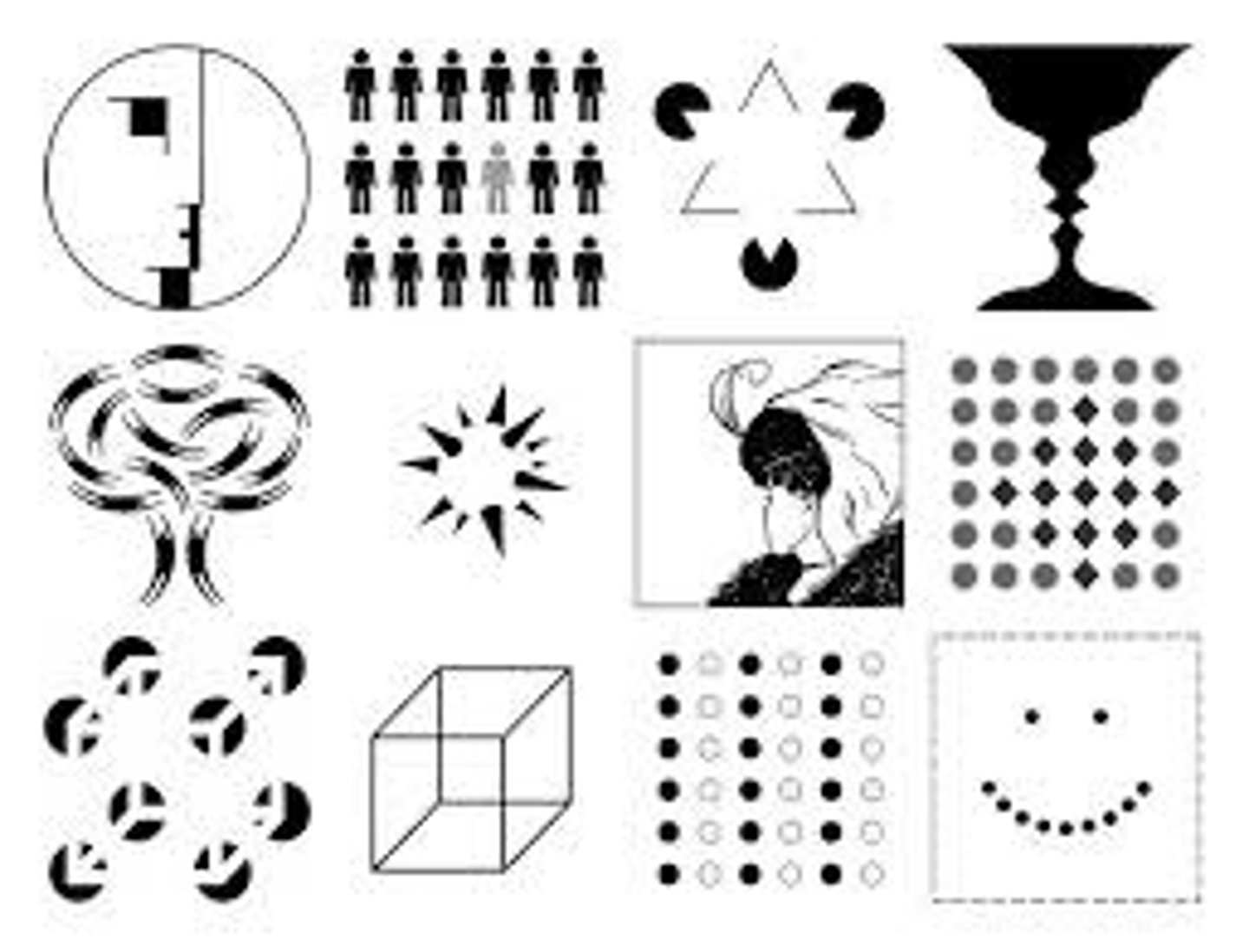
<p>an organized whole. These type of psychologists emphasized our tendency to integrate pieces of information into meaningful wholes</p>
50
New cards

figure-ground

the organization of the visual field into objects (the figures) that stand out from their surroundings (the ground).
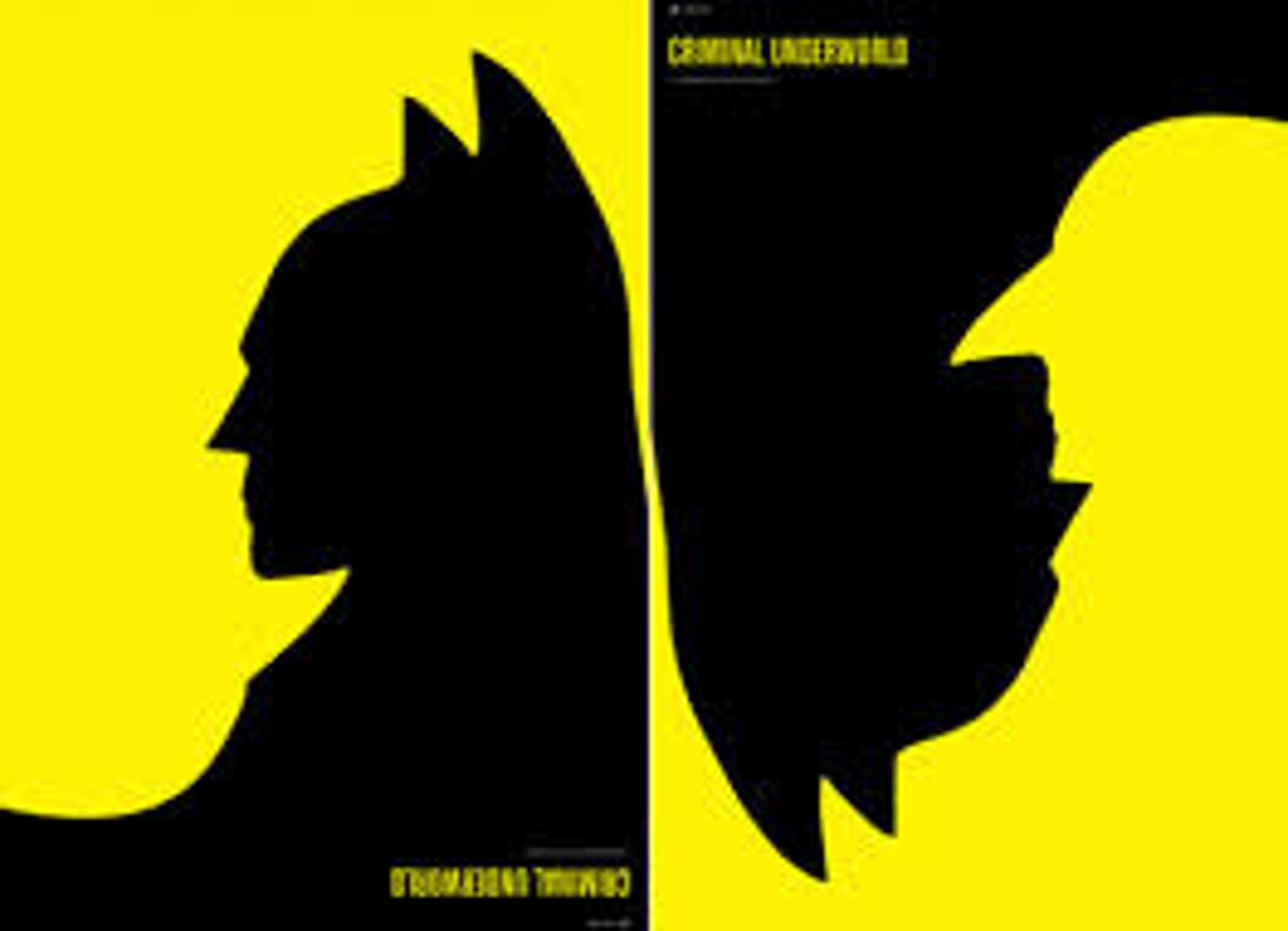
<p>the organization of the visual field into objects (the figures) that stand out from their surroundings (the ground).</p>
51
New cards

grouping

the perceptual tendency to organize stimuli into coherent groups.
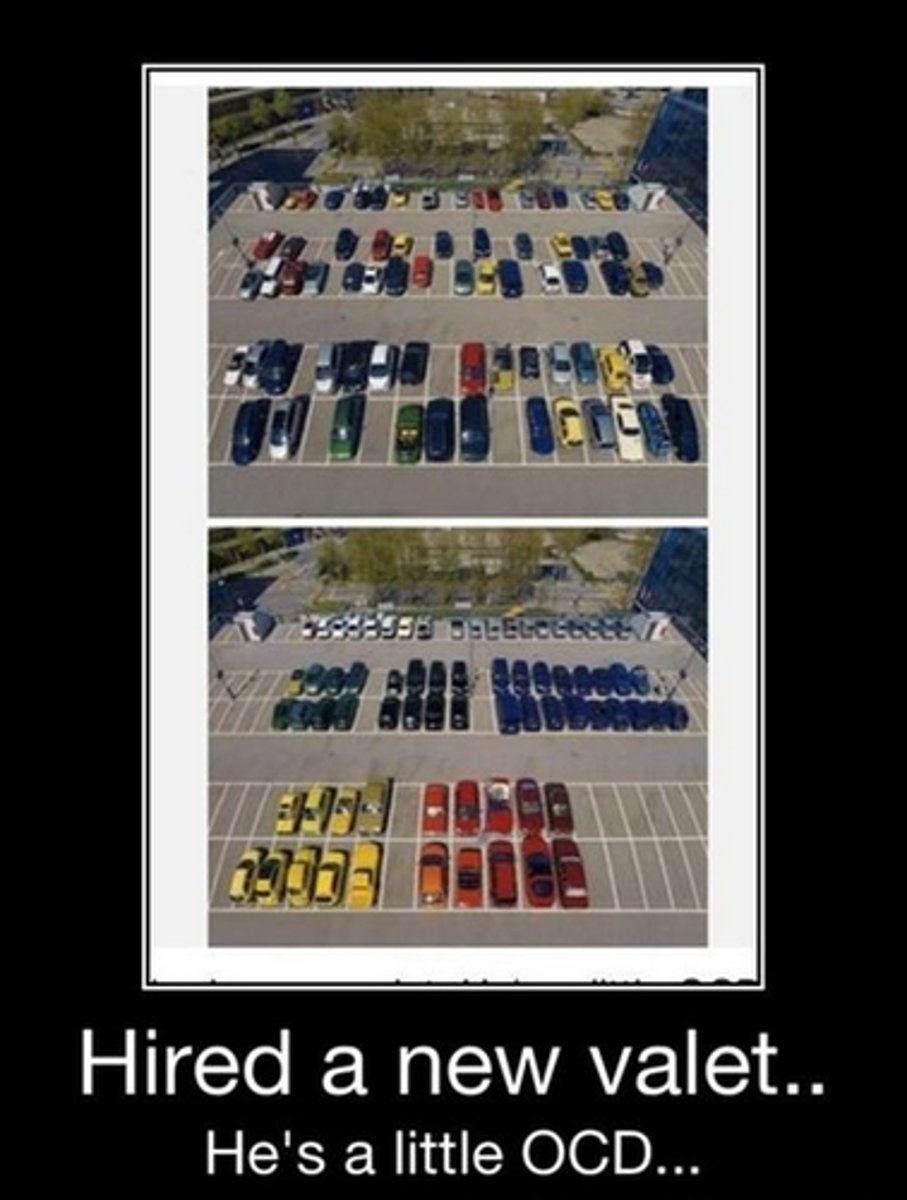
<p>the perceptual tendency to organize stimuli into coherent groups.</p>
52
New cards

depth perception

the ability to see objects in three dimensions although the images that strike the retina are two-dimensional; allows us to judge distance.
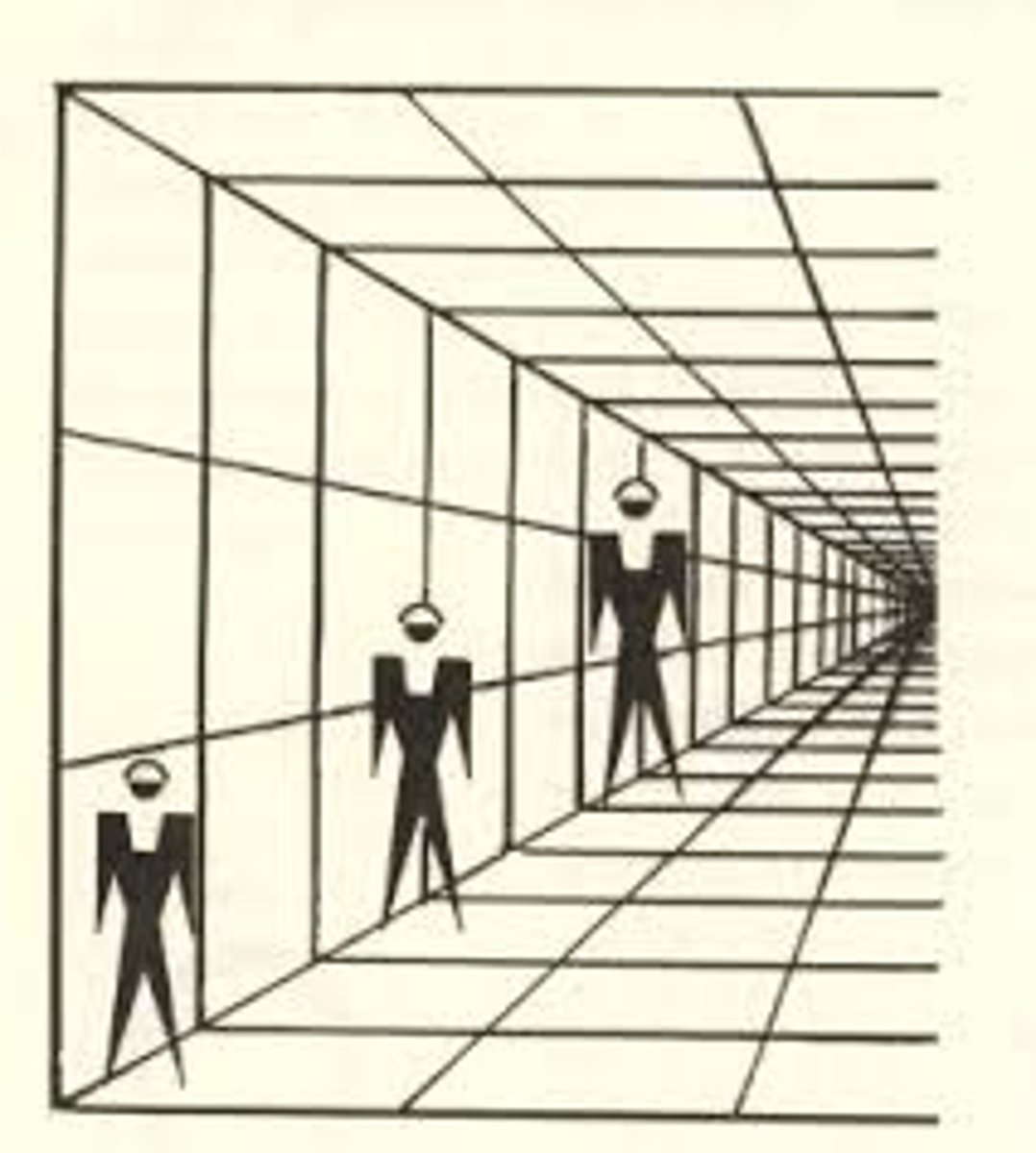
<p>the ability to see objects in three dimensions although the images that strike the retina are two-dimensional; allows us to judge distance.</p>
53
New cards

visual cliff

a laboratory device for testing depth perception in infants and young animals.

<p>a laboratory device for testing depth perception in infants and young animals.</p>
54
New cards

binocular cues

depth cues, such as retinal disparity, that depend on the use of two eyes.

<p>depth cues, such as retinal disparity, that depend on the use of two eyes.</p>
55
New cards

retinal disparity

a binocular cue for perceiving depth by comparing images from the retinas in the two eyes, the brain computes distance—the greater the disparity (difference) between the two images, the closer the object.
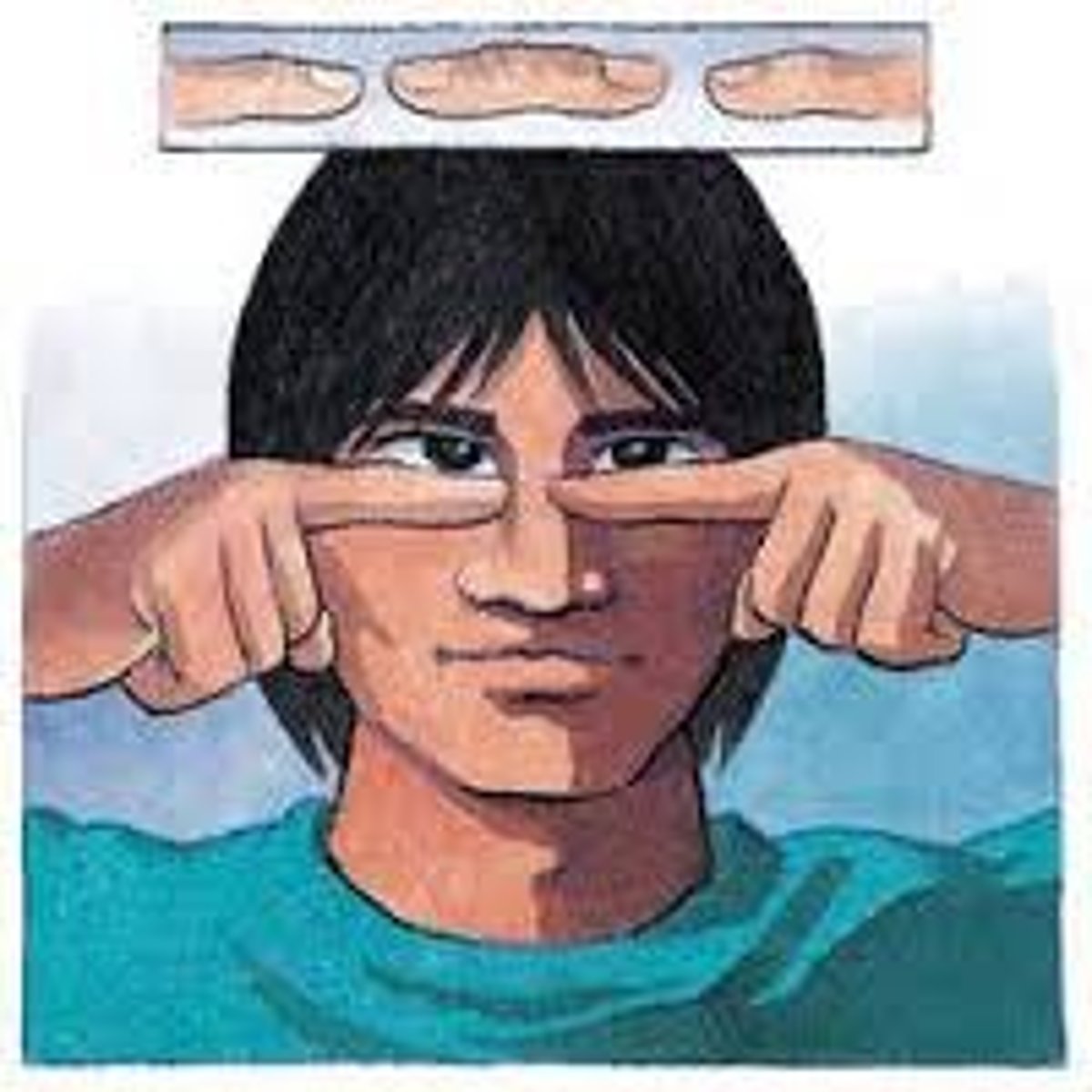
<p>a binocular cue for perceiving depth by comparing images from the retinas in the two eyes, the brain computes distance—the greater the disparity (difference) between the two images, the closer the object.</p>
56
New cards

monocular cues

depth cues, such as interposition and linear perspective, available to either eye alone.

<p>depth cues, such as interposition and linear perspective, available to either eye alone.</p>
57
New cards

phi phenomenon

an illusion of movement created when two or more adjacent lights blink on and off in quick succession.

<p>an illusion of movement created when two or more adjacent lights blink on and off in quick succession.</p>
58
New cards

perceptual constancy

perceiving objects as unchanging (having consistent shapes, size, lightness, and color) even as illumination and retinal images change.
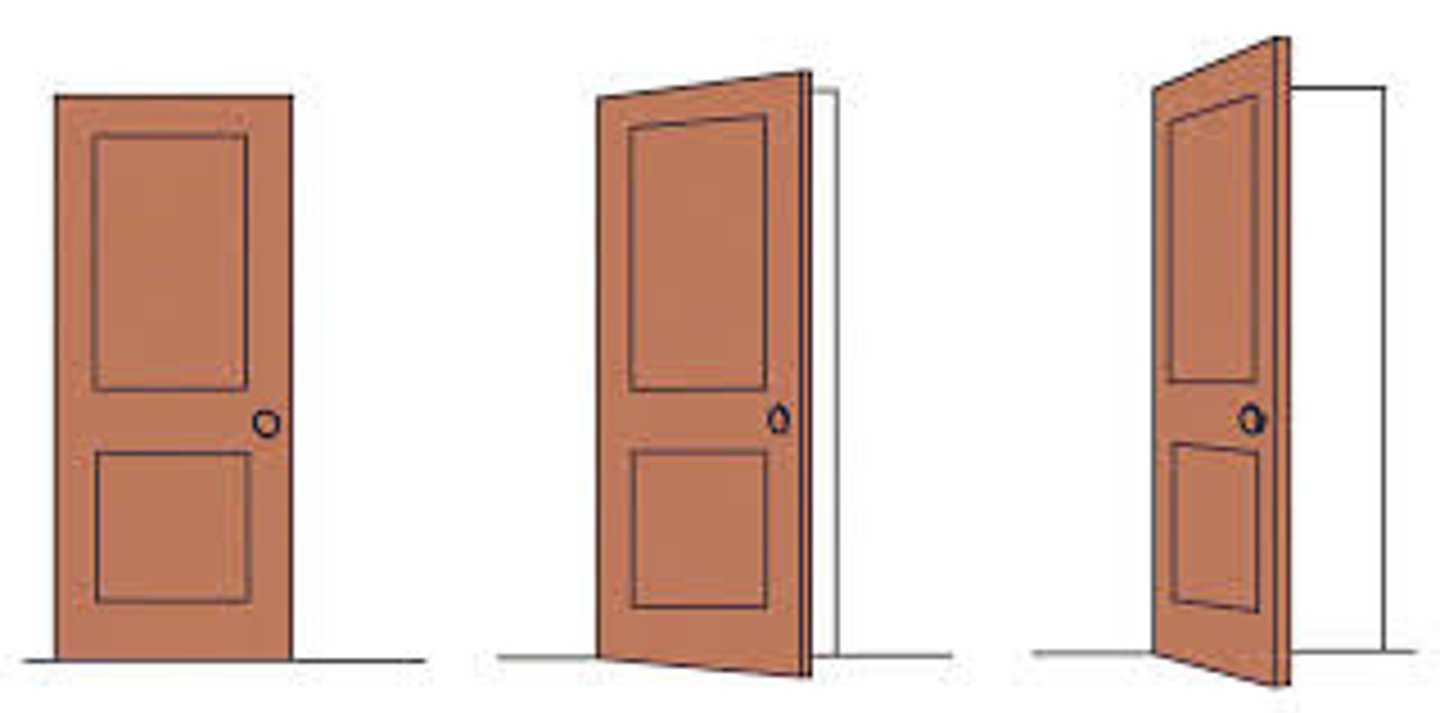
<p>perceiving objects as unchanging (having consistent shapes, size, lightness, and color) even as illumination and retinal images change.</p>
59
New cards

color constancy

perceiving familiar objects as having consistent color, even if changing illumination alters the wavelengths reflected by the object.
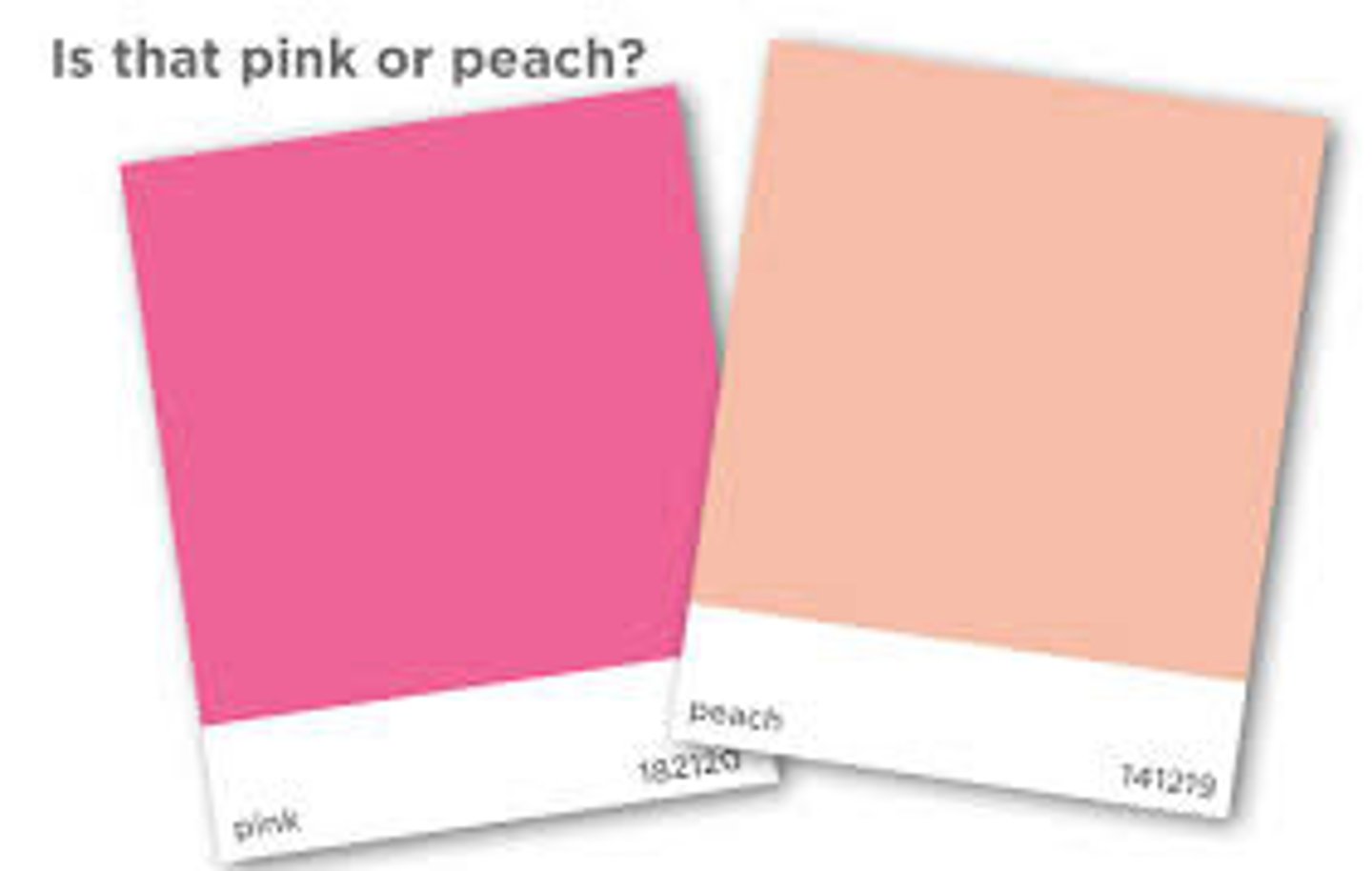
<p>perceiving familiar objects as having consistent color, even if changing illumination alters the wavelengths reflected by the object.</p>
60
New cards

perceptual adaptation

in vision, the ability to adjust to an artificially displaced or even inverted visual field.

<p>in vision, the ability to adjust to an artificially displaced or even inverted visual field.</p>
61
New cards

perceptual set

a mental predisposition to perceive one thing and not another.
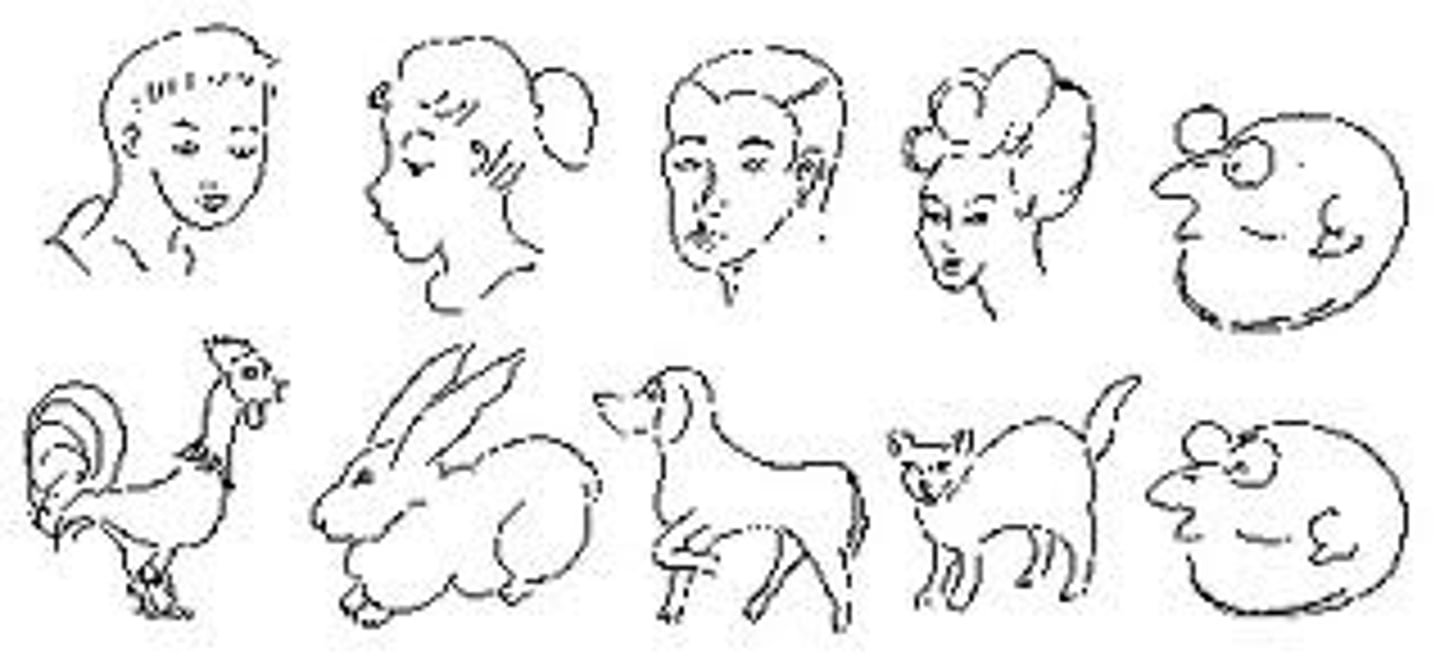
<p>a mental predisposition to perceive one thing and not another.</p>
62
New cards

extrasensory perception (ESP)

the controversial claim that perception can occur apart from sensory input; includes telepathy, clairvoyance, and precognition.

<p>the controversial claim that perception can occur apart from sensory input; includes telepathy, clairvoyance, and precognition.</p>
63
New cards

parapsychology

the study of paranormal phenomena, including ESP and psychokinesis.

<p>the study of paranormal phenomena, including ESP and psychokinesis.</p>

Explore top notes

Imperialism Rise in Nationalism • During the French and Industrial Revolution, nationalism continued to inspire nations to increase their political and economic power. • Nationalism became the ideal force in the political, economic, and cultural life in the world, becoming the first universal ideology-organizing all people into a nation state. Nationalism Defined • The strong belief that the interest of a particular nation-state is of primary importance. o Nation-State – a state where the vast majority shares the same culture and is conscious of it. It is an ideal in which cultural boundaries match up with political ones. • As an ideology, it is based on the idea that the individual’s loyalty and devotion to the nation-state surpass other individual/group interests. • Exalting one nation’s belief above all others and placing primary emphasis on promotion of its culture and interests, excluding the interests of others. Changing the World through a Nationalistic Vision • The French Revolution significantly changed the political world and how countries govern. • The Industrial Revolution significantly changed the economic world. • The Age of Imperialism (1870-1914) dramatically changed the political, economic, and social world. What is Imperialism? • Imperialism- The policy of extending the rule of authority of an empire or nation over foreign countries, or of acquiring and holding colonies and dependencies. Power and influence are done through diplomacy or military force. Reasons for Imperialism • There are 5 main motives for empires to seek to expand their rule over other countries or territories: 1. Exploratory • Imperial nations wanted to explore territory unknown to them. • The main purpose for this exploration of new lands was for resource acquisition, medical or scientific research. o Charles Darwin • Other reasons: o Cartography (map making) o Adventure 2. Ethnocentric • Europeans acted on the concept of ethnocentrism o Ethnocentrism- the belief that one race or nation is superior to others. • Ethnocentrism developed out of Charles Darwin’s “survival of the fittest” theory. Philosophers used the theory to explain why there were superior races and inferior races. o This became known as Social Darwinism. • Most imperial nations believed that their cultural values or beliefs were superior to other nations or groups. • Believed imperial conquest would bring successful culture to inferior people. 3. Religious • Imperial expansion promoted a religious movement of people setting out to convert new members of conquered territories. • With the belief that Christianity was superior, missionaries believed it was their duty to spread Christianity to the world. • Christian missionaries established churches, and in doing so, they spread Western culture values as well. • Typically, missionaries spread the imperial nation's language through education and religious interactions. 4. Political • Patriotism and Nationalism helped spur our imperial growth, thus creating competition against other supremacies. • It was a matter of national pride, respect, and security. • Furthermore, European rivalry spurred nations for imperial conquest. Since land equaled power, the more land a country could acquire the more prestige they could wield across the globe. • Empires wanted strategic territory to ensure access for their navies and armies around the world. • The empire believed they must expand, thus they needed to be defended. 5. Economic • With the Industrial Revolution taking place during the same time, governments and private companies contributed to find ways to maximize profits. • Imperialized countries provided European factories and markets with natural resources (old and new) to manufacture products. • Trading posts were strategically placed around imperialized countries to maximize and increase profits. o Such places as the Suez Canal in Egypt which was controlled by the British provided strategic choke hold over many European powers. o Imperial powers competed over the best potential locations for resources, markets, and trade. History of Imperialism • Ancient Imperialism 600 BCE-500 CE o Roman Empire, Ancient China, Greek Empire, Persian Empire, Babylonian Empire. • Middle Age Imperialism (Age of Colonialism-1400-1800s) o Great Britain, Spain, Portugal, France, Netherlands (Dutch), Russia. • Age of Imperialism 1870-1914 o Great Britain, Spain, Portugal, France, Germany, Belgium, Italy, Japan, United States, Ottoman Empire, Russia. • Current Imperialism...? o U.S. Military intervention (i.e. Middle East) o Russia’s Invasion of Ukraine. Imperialism Colonialism • Refers to political or economic control, either legally or illegally. • Refers to where one nation assumes control over the other. • Creating an empire, expanding into neighboring regions and expanding the dominance far outside its borders. • Where a country conquers and rules over other regions for exploiting resources from the conquered country for the conqueror's benefit. • Foreign government controls/governs a territory without significant settlement. • Foreign government controls/governs the territory from within the land being colonized. • Little to no new settlement established on fresh territory. • Movement to settle to fresh territory. Age of Colonialism WHEN? • Started around the late 1400s and ended around the late 1700s/early 1800s. WHY? • Primary Reason: European countries, wished to find a direct trade route to Asia (China & India) and the East Indies. o Quicker and relatively more effective than land routes over Asia. • Secondary Reason: Empire expansion (land power) WHO? • Countries involved: Great Britain, France, Spain, the Dutch & Portugal. • Individuals’ knowns as Mercantilists believed that maintaining imperialized territory and colonizing the region could serve as a source of wealth, while personal motives by rulers, explorers, and missionaries could therefore promote their own agenda. o This agenda being “Glory, God and Gold”. Mercantilism • Mercantilism was a popular and main economic system for many European nations during the 16th to 18th centuries. • The main goal was to increase a nation’s wealth by promoting government rule of a nation’s economy for the purpose of enhancing state power at the expense of rival national power. • It was the economic counterpart of political absolutism. Why did mercantilists want colonies? • Mercantilists believed that a country must have an excess of exports over imports. • By colonizing territory, it provided the nation with indispensable wealth of precious raw materials. • Therefore, the claimed territory served as a market and supplier of raw materials for the mother country. Which, in time, provided an excess of exports for the nation and thus created wealth. o Development of Trading Companies to support this economic system. Hudson Bay Company – (1670). Controlled primarily North America. o Dutch East Indie Trading Company (1682) o East Indian Trading Company (1600) o Royal African Trade Company (1672) WHERE? • European nations begun to colonize the America, India and the East Indies to create a direct trade route. • Great Britain was the leading power in India, Australia and North America, South Africa. • Spain colonized central and South America. • French held Louisiana, coastal land of Africa and French Guinea. • The Dutch built an empire in the East Indies. • The Portuguese was able to take control of present-day Brazil and the southern tip of South America and Japan. Age of Colonialism • As countries started to imperialize these regions, eventually the concept of colonization took hold: • This is what makes the Age of Colonialism extremely different! End of Colonialism • By 1800, colonialism became less popular • Why? o Revolutions (Spain, France & American) o The Napoleonic Wars o Struggle for nationalism and democracy. o Exhausted all money and energy to supervise their colonies. Waiting to wake again • Imperialism would stay quiet for close to 50 years before Great Britain and France’s economies revitalized. • The outbreak of the Industrial Revolution only encouraged and revitalized European nations to begin their conquest for new territory and resources. Age of Imperialism THE SCRAMBLE FOR AFRICA 1870-1914 Conditions Prior to Imperialism of Africa  European interest in exploiting Africa was minimal.  Their economic interests & profit in Africa primarily came through coastal trade that took place during the 1500-1700s.  The slave trade became the main source of European profit.  Furthermore, disease, political instability, lack of transportation and unpredictable climate all discouraged Europeans from seeking territory. Slave Trade & the Trans-Atlantic Slave Voyages  Forced labor was not uncommon during the 13-17th Centuries. Africans and Europeans had been trading goods and people across the Mediteranea for centuries.  This all changed from 1526 to 1867, as a new system of slavery was introduced that became highly “commercialized, racialized and inherited”  By 1690, the America and West Indies saw approximately 30,000 African people shipped from Africa. A century later, that number grew to 85,000 people per year.  By 1867, approximately 12.5 million people (about twice the population of Arizona) left Africa in a slave ship. What Changed? 1. End of the Slave Trade- Left a need for trade between Europe and Africa. 2. Innovation in technology- The steam engine and iron hulled boats allowed Europe 3. Discovery of new raw materials- Explorers located vast raw materials and resources and this only spurred imperialism with Europe in the wake of the Industrial Revolution. 4. Politics- Unification of Germany and Italy left little room to expand in Europe. Germany and Italy both needed raw materials to “catch up” with Britain and France so they looked to Africa. The Scramble for Africa  The scramble started in 1870.  Although some coastal land had previously been acquired before 1870, the need for territory quickly accelerated as European countries looked t get deeper into Africa.  Within 20 years, nearly all continents were placed under imperialistic rule. Who was Involved?  Great Britain  France  Germany  Italy  Portugal  Belgium  Spain (kind) Violent Affairs  Violence broke out multiple times when European nations looked to claim the same territory.  Germ Chancellor. Otto van Bismarck. Attempted to avert the possibility of violence against the European powers.  In 1884, Bismarck organized a conference in Berlin for the European nations. The Berlin Conference (1884-85)  The conference looked to set ground rules for future annexation of African territory by European Nations.  Annexation is the forcible acquisition and assertion of legal title over one state’s territory by another state, usually following military occupation of the territory.  From a distant perspective, it looked like it would reduce tensions among European nations and avert war.  At the heart of the meeting, these European countries negotiated their claims to African territory, made it official and then mapped their regions.  Furthermore, the leaders agreed to allow free trade among imperialized territory and some homework for negotiating future European claims in Africa was established. Further Path  After the conference, european powers continued to expand their claims in Africa so that by 1900. 90% of the African territory had been claimed. A Turn towards Colonization?  Upon the imperialization of African territory, European nations and little interest in African land unless it produced economic wealth.  Therefore, European governments put little effort and expertise into these imperialized regions.  In most cases, this emat a form of indirect rule. Thus, governing the natin without sufficient settlement and government from within the mother country. Some Exceptions  There were some exemptions through in Africa as colonization was a necessary for some regions i n Africa.  Some regions where diamonds and gold were present. Government looked to protectorate the regions and establish rule and settlement in the regions.  Protectorates: A state controlled and protected by another state for defense against aggression and other law violations. Would  Some examples include South Africa, Botswana, Zimbabwe and Congo. Conclusion  Although it may appear that the Berlin Conference averted war amid the African Scramble, imperialism eventually brought the world into worldwide conflict.  With the continued desire to create an empire by European nations. World War 1 would break out which can be linked to this quest at imperialism.
Updated 490d ago
note Note
Imperialism Rise in Nationalism • During the French and Industrial Revolution, nationalism continued to inspire nations to increase their political and economic power. • Nationalism became the ideal force in the political, economic, and cultural life in the world, becoming the first universal ideology-organizing all people into a nation state. Nationalism Defined • The strong belief that the interest of a particular nation-state is of primary importance. o Nation-State – a state where the vast majority shares the same culture and is conscious of it. It is an ideal in which cultural boundaries match up with political ones. • As an ideology, it is based on the idea that the individual’s loyalty and devotion to the nation-state surpass other individual/group interests. • Exalting one nation’s belief above all others and placing primary emphasis on promotion of its culture and interests, excluding the interests of others. Changing the World through a Nationalistic Vision • The French Revolution significantly changed the political world and how countries govern. • The Industrial Revolution significantly changed the economic world. • The Age of Imperialism (1870-1914) dramatically changed the political, economic, and social world. What is Imperialism? • Imperialism- The policy of extending the rule of authority of an empire or nation over foreign countries, or of acquiring and holding colonies and dependencies. Power and influence are done through diplomacy or military force. Reasons for Imperialism • There are 5 main motives for empires to seek to expand their rule over other countries or territories: 1. Exploratory • Imperial nations wanted to explore territory unknown to them. • The main purpose for this exploration of new lands was for resource acquisition, medical or scientific research. o Charles Darwin • Other reasons: o Cartography (map making) o Adventure 2. Ethnocentric • Europeans acted on the concept of ethnocentrism o Ethnocentrism- the belief that one race or nation is superior to others. • Ethnocentrism developed out of Charles Darwin’s “survival of the fittest” theory. Philosophers used the theory to explain why there were superior races and inferior races. o This became known as Social Darwinism. • Most imperial nations believed that their cultural values or beliefs were superior to other nations or groups. • Believed imperial conquest would bring successful culture to inferior people. 3. Religious • Imperial expansion promoted a religious movement of people setting out to convert new members of conquered territories. • With the belief that Christianity was superior, missionaries believed it was their duty to spread Christianity to the world. • Christian missionaries established churches, and in doing so, they spread Western culture values as well. • Typically, missionaries spread the imperial nation's language through education and religious interactions. 4. Political • Patriotism and Nationalism helped spur our imperial growth, thus creating competition against other supremacies. • It was a matter of national pride, respect, and security. • Furthermore, European rivalry spurred nations for imperial conquest. Since land equaled power, the more land a country could acquire the more prestige they could wield across the globe. • Empires wanted strategic territory to ensure access for their navies and armies around the world. • The empire believed they must expand, thus they needed to be defended. 5. Economic • With the Industrial Revolution taking place during the same time, governments and private companies contributed to find ways to maximize profits. • Imperialized countries provided European factories and markets with natural resources (old and new) to manufacture products. • Trading posts were strategically placed around imperialized countries to maximize and increase profits. o Such places as the Suez Canal in Egypt which was controlled by the British provided strategic choke hold over many European powers. o Imperial powers competed over the best potential locations for resources, markets, and trade. History of Imperialism • Ancient Imperialism 600 BCE-500 CE o Roman Empire, Ancient China, Greek Empire, Persian Empire, Babylonian Empire. • Middle Age Imperialism (Age of Colonialism-1400-1800s) o Great Britain, Spain, Portugal, France, Netherlands (Dutch), Russia. • Age of Imperialism 1870-1914 o Great Britain, Spain, Portugal, France, Germany, Belgium, Italy, Japan, United States, Ottoman Empire, Russia. • Current Imperialism...? o U.S. Military intervention (i.e. Middle East) o Russia’s Invasion of Ukraine. Imperialism Colonialism • Refers to political or economic control, either legally or illegally. • Refers to where one nation assumes control over the other. • Creating an empire, expanding into neighboring regions and expanding the dominance far outside its borders. • Where a country conquers and rules over other regions for exploiting resources from the conquered country for the conqueror's benefit. • Foreign government controls/governs a territory without significant settlement. • Foreign government controls/governs the territory from within the land being colonized. • Little to no new settlement established on fresh territory. • Movement to settle to fresh territory. Age of Colonialism WHEN? • Started around the late 1400s and ended around the late 1700s/early 1800s. WHY? • Primary Reason: European countries, wished to find a direct trade route to Asia (China & India) and the East Indies. o Quicker and relatively more effective than land routes over Asia. • Secondary Reason: Empire expansion (land power) WHO? • Countries involved: Great Britain, France, Spain, the Dutch & Portugal. • Individuals’ knowns as Mercantilists believed that maintaining imperialized territory and colonizing the region could serve as a source of wealth, while personal motives by rulers, explorers, and missionaries could therefore promote their own agenda. o This agenda being “Glory, God and Gold”. Mercantilism • Mercantilism was a popular and main economic system for many European nations during the 16th to 18th centuries. • The main goal was to increase a nation’s wealth by promoting government rule of a nation’s economy for the purpose of enhancing state power at the expense of rival national power. • It was the economic counterpart of political absolutism. Why did mercantilists want colonies? • Mercantilists believed that a country must have an excess of exports over imports. • By colonizing territory, it provided the nation with indispensable wealth of precious raw materials. • Therefore, the claimed territory served as a market and supplier of raw materials for the mother country. Which, in time, provided an excess of exports for the nation and thus created wealth. o Development of Trading Companies to support this economic system. Hudson Bay Company – (1670). Controlled primarily North America. o Dutch East Indie Trading Company (1682) o East Indian Trading Company (1600) o Royal African Trade Company (1672) WHERE? • European nations begun to colonize the America, India and the East Indies to create a direct trade route. • Great Britain was the leading power in India, Australia and North America, South Africa. • Spain colonized central and South America. • French held Louisiana, coastal land of Africa and French Guinea. • The Dutch built an empire in the East Indies. • The Portuguese was able to take control of present-day Brazil and the southern tip of South America and Japan. Age of Colonialism • As countries started to imperialize these regions, eventually the concept of colonization took hold: • This is what makes the Age of Colonialism extremely different! End of Colonialism • By 1800, colonialism became less popular • Why? o Revolutions (Spain, France & American) o The Napoleonic Wars o Struggle for nationalism and democracy. o Exhausted all money and energy to supervise their colonies. Waiting to wake again • Imperialism would stay quiet for close to 50 years before Great Britain and France’s economies revitalized. • The outbreak of the Industrial Revolution only encouraged and revitalized European nations to begin their conquest for new territory and resources. Age of Imperialism THE SCRAMBLE FOR AFRICA 1870-1914 Conditions Prior to Imperialism of Africa  European interest in exploiting Africa was minimal.  Their economic interests & profit in Africa primarily came through coastal trade that took place during the 1500-1700s.  The slave trade became the main source of European profit.  Furthermore, disease, political instability, lack of transportation and unpredictable climate all discouraged Europeans from seeking territory. Slave Trade & the Trans-Atlantic Slave Voyages  Forced labor was not uncommon during the 13-17th Centuries. Africans and Europeans had been trading goods and people across the Mediteranea for centuries.  This all changed from 1526 to 1867, as a new system of slavery was introduced that became highly “commercialized, racialized and inherited”  By 1690, the America and West Indies saw approximately 30,000 African people shipped from Africa. A century later, that number grew to 85,000 people per year.  By 1867, approximately 12.5 million people (about twice the population of Arizona) left Africa in a slave ship. What Changed? 1. End of the Slave Trade- Left a need for trade between Europe and Africa. 2. Innovation in technology- The steam engine and iron hulled boats allowed Europe 3. Discovery of new raw materials- Explorers located vast raw materials and resources and this only spurred imperialism with Europe in the wake of the Industrial Revolution. 4. Politics- Unification of Germany and Italy left little room to expand in Europe. Germany and Italy both needed raw materials to “catch up” with Britain and France so they looked to Africa. The Scramble for Africa  The scramble started in 1870.  Although some coastal land had previously been acquired before 1870, the need for territory quickly accelerated as European countries looked t get deeper into Africa.  Within 20 years, nearly all continents were placed under imperialistic rule. Who was Involved?  Great Britain  France  Germany  Italy  Portugal  Belgium  Spain (kind) Violent Affairs  Violence broke out multiple times when European nations looked to claim the same territory.  Germ Chancellor. Otto van Bismarck. Attempted to avert the possibility of violence against the European powers.  In 1884, Bismarck organized a conference in Berlin for the European nations. The Berlin Conference (1884-85)  The conference looked to set ground rules for future annexation of African territory by European Nations.  Annexation is the forcible acquisition and assertion of legal title over one state’s territory by another state, usually following military occupation of the territory.  From a distant perspective, it looked like it would reduce tensions among European nations and avert war.  At the heart of the meeting, these European countries negotiated their claims to African territory, made it official and then mapped their regions.  Furthermore, the leaders agreed to allow free trade among imperialized territory and some homework for negotiating future European claims in Africa was established. Further Path  After the conference, european powers continued to expand their claims in Africa so that by 1900. 90% of the African territory had been claimed. A Turn towards Colonization?  Upon the imperialization of African territory, European nations and little interest in African land unless it produced economic wealth.  Therefore, European governments put little effort and expertise into these imperialized regions.  In most cases, this emat a form of indirect rule. Thus, governing the natin without sufficient settlement and government from within the mother country. Some Exceptions  There were some exemptions through in Africa as colonization was a necessary for some regions i n Africa.  Some regions where diamonds and gold were present. Government looked to protectorate the regions and establish rule and settlement in the regions.  Protectorates: A state controlled and protected by another state for defense against aggression and other law violations. Would  Some examples include South Africa, Botswana, Zimbabwe and Congo. Conclusion  Although it may appear that the Berlin Conference averted war amid the African Scramble, imperialism eventually brought the world into worldwide conflict.  With the continued desire to create an empire by European nations. World War 1 would break out which can be linked to this quest at imperialism.
Updated 490d ago
note Note

Explore top flashcards

Unit 5: Genetics
Updated 375d ago
flashcards Flashcards (29)
La familia
Updated 784d ago
flashcards Flashcards (38)
CMS III Final: EM
Updated 255d ago
flashcards Flashcards (212)
2b: Cell structure
Updated 1171d ago
flashcards Flashcards (30)
deelsteppen
Updated 1065d ago
flashcards Flashcards (87)
PSYC 14
Updated 148d ago
flashcards Flashcards (64)
Unit 5: Genetics
Updated 375d ago
flashcards Flashcards (29)
La familia
Updated 784d ago
flashcards Flashcards (38)
CMS III Final: EM
Updated 255d ago
flashcards Flashcards (212)
2b: Cell structure
Updated 1171d ago
flashcards Flashcards (30)
deelsteppen
Updated 1065d ago
flashcards Flashcards (87)
PSYC 14
Updated 148d ago
flashcards Flashcards (64)