COMM385 Exam 1: Concept 6 - Argument (Logos and Friends)
 Call Kai
 Learn
Learn Practice Test
 Spaced Repetition
 Match
Match Flashcards
 Knowt Play
1/11

There's no tags or description
Looks like no tags are added yet.
Name | Mastery | Learn | Test | Matching | Spaced | Call with Kai |
|---|
No analytics yet
Send a link to your students to track their progress
12 Terms
Logos
One of the three “artistic proofs” of persuasion
The reason, logic, and evidence of an argument
Types of Argumentative Reasoning
Deduction
General —> Specific conclusion
Syllogism
Induction
Specific observation(s) —> General conclusion
Argument by example
Abduction
Incomplete observations —> Best prediction
Argument Structure Parts
Data
Minor Premise (specific)
Evidence
Explicit/Factual
Warrants
Major Premise (general)
Rules
Implications
Vary in step size
Vary in probability
A Simple Syllogistic Argument
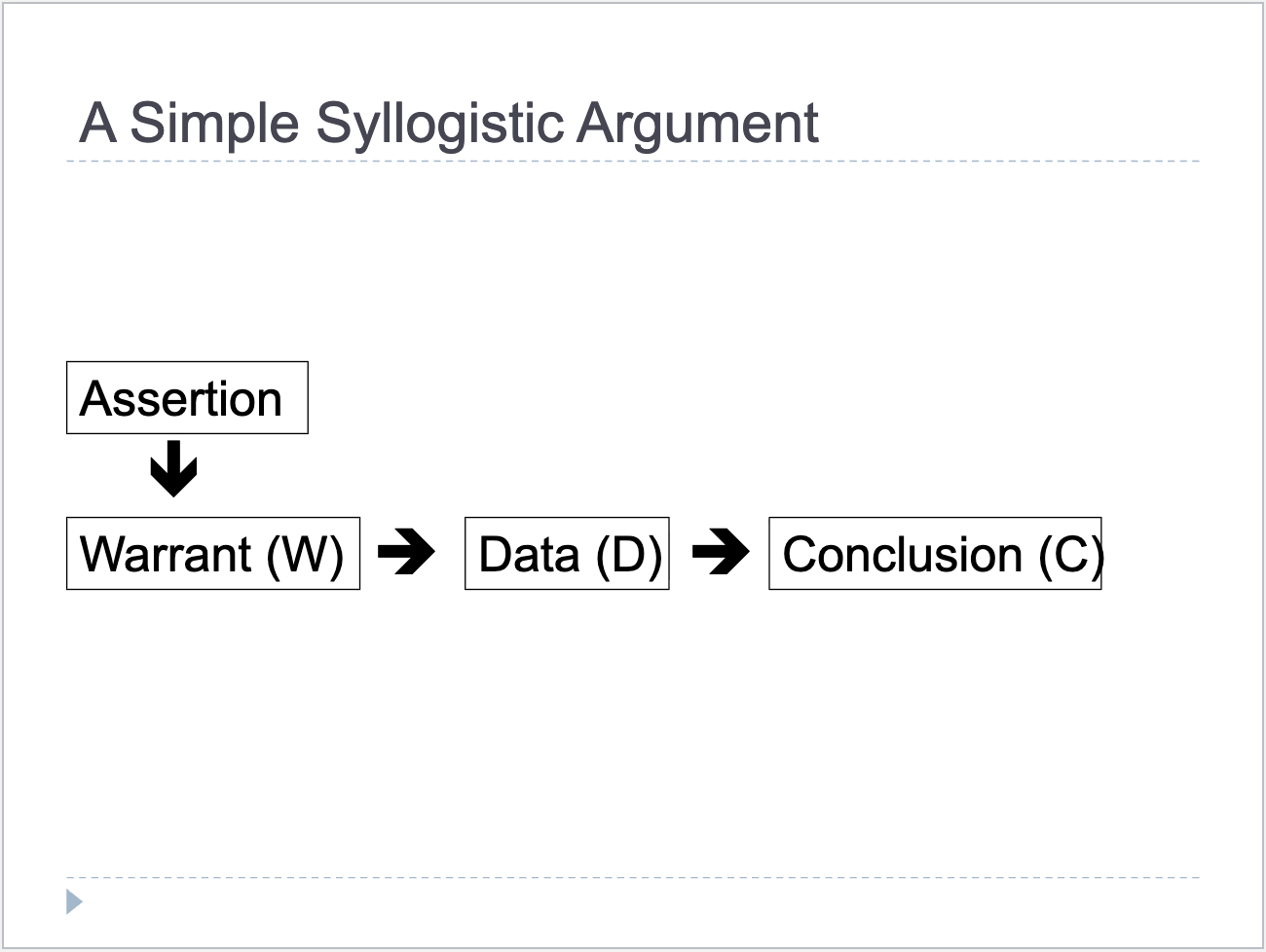
Argument Content Factors
Type of Evidence/Data
Statistical > testimonial (“this happened to me”) > anecdotal (a story you’ve heard) & analogical (?; not evidence at all, just an analogy)
Message Sidedness
One vs. Two
Two Refutational > One > Two Non-Refuational
Issue involvement, audience (un)favorability
Advertising or not
Argumentative Issues and Fallacies: Formal vs. Informal
Formal (Structural) Fallacies
Non Sequitur (warrant doesn’t match conclusions)
Informal (Reasoning) Fallacies
Post hoc ergo propter hoc: Issues of causation (causation ≠ correlation)
Onus probandi: Argument from ignorance
Circulus in demonstration/petitio principii: Begging the question (saying your conclusion)
Argumentative Issues and Fallacies: Red Herrings pt. 1
Red Herring (statement you make that are not actually relevant)
Ad hominem (argument directed against a person rather than the position they are maintaining)
Appeals to (“you should trust me because…”):
Authority, wealth, morality, novelty, nature, common sense, emotion
“Don’t look at the argument. Instead focus on your feelings or focus on the fact that I’m in charge.”
Argumentative Issues and Fallacies: Red Herrings pt. 2
Appeal to Probability/Change
Gambler’s fallacy (“I flipped heads five times in a row. The next one’s gotta be tails”)
Bandwagoning (argumentum ad populum)
Association fallacy (“Hey that person is fashionable, that means whatever he’s wearing is fashionable”)
Straw man fallacy (You present what your opponent is arguing, but the opponent is not actually arguing that)
Argumentative Issues and Fallacies: Faulty Generalizations
Cherry Picking (“I found an instance of this; therefore, it must be true”)
Accident (exception to the rule ignored)
False analogy (“we can all agree that one this is true. Therefore, we should all agree all other things are true”)
False dichotomy (“it either has to be only one thing or another”)
(More) Argument Structure Parts
Backing
While warrants are implications, backing is factual
Qualifications
Warrants don’t apply in all circumstances
Qualifications form a boundary for the warrant
Rebuttal
Conclusions do not always follow from warrants
Which rhetorical proof is most strongly aligned with what Toulmin (argument structure) is describing?
Logos
What are some elements of an argument that make it more effective?
Qualifiers, rebuttal, two-sided argument (only stronger sometimes, depending on the group of people involved/hearing the argument)

