Echinoderms
 Studied by 0 people
 Call Kai
 Learn
Learn Practice Test
 Spaced Repetition
 Match
Match Flashcards
 Knowt Play
1/20

There's no tags or description
Looks like no tags are added yet.
Name | Mastery | Learn | Test | Matching | Spaced | Call with Kai |
|---|
No analytics yet
Send a link to your students to track their progress
21 Terms
Are echinoderms deuterosomes or protosomes?
Deuterostomes (ass first).
Deuterosomes are a part of the larger group …
Bilaterians. Sister group of protosomes.
What are the Phylums includeded in Deuterostomes?
Phylum Echinodermata – sea stars, urchins, etc.
• Phylum Hemichordata – acorn worms, pterobranchs
• Phylum Chordata – tunicates, lancelets, vertebrates
Characteristics of Phylum Echinodermata
• all marine
• eucoelomate
• pentaradial symmetry
• endoskeleton (CaCO 3)
• water vascular system
• tube feet (in most)
• ring-like nervous system
• blood vascular system reduced or absent
• excretory organs absent
• monoecious
• typically free-swimming, bilaterally symmetric larval stage
Echinoderm Classes
Class Crinoidea – sea lilies
• Class Asteroidea – sea stars
• Class Ophiuroidea – brittle stars & basket stars
• Class Echinoidea – sea urchins
• Class Holothuroidea – sea cucumbers
Class Asteroidea – sea stars
Rocky, sandy, or muddy substrates
predators of esp. bivalves
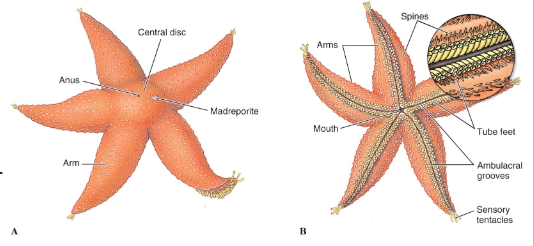
General Features:
5 arms (rays)
oral/aboral surface
tube feet in ambulacral grooves
madreporite - allows water into water vascular system
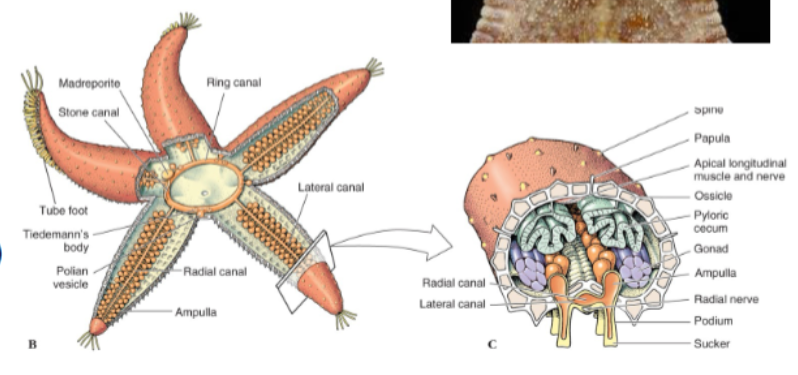
Sea Star Water Vascular System
Madreporite - allows water in
Stone Canal - connects to
Ring Canal - connects to
Radial Canals - connects to
Lateral Canals - connects to
Tube feet (podia) - with suckers, operated by ampullae
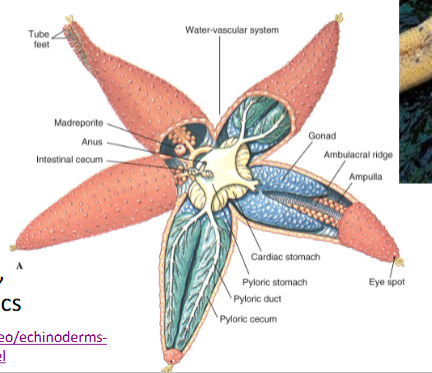
Sea Star Digestive System
mouth
esophagus
stomach
cardiac
pyloric
pyloric caecae (digestive glands)
anus
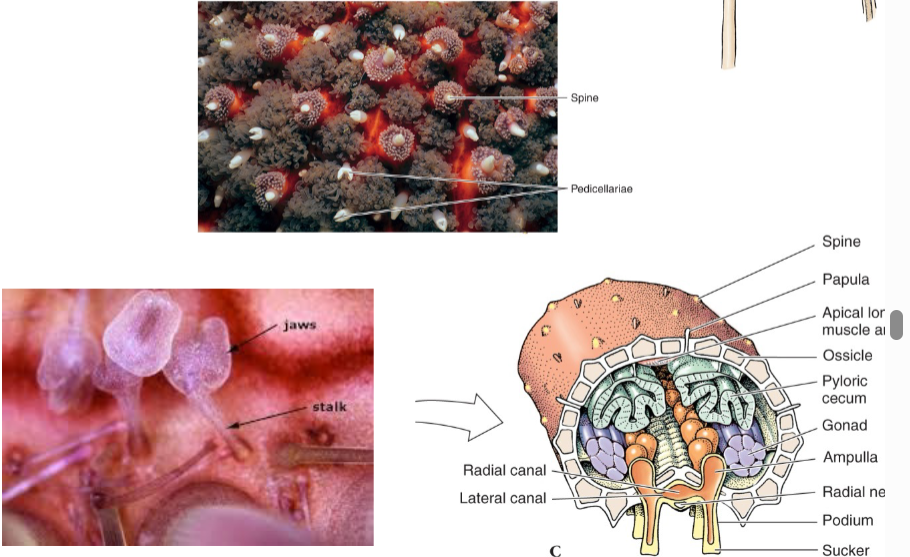
Sea Star Body Wall
Dermal ossicles
“catch” connective tissue
papulae (dermal gills) - respiration
pedicellariae - keeps them clean (pincers)
Spines
muscles
Sea Star Structure - gut wall and hemal system
coelom well developed
water vascular system derived from part of it
functions in respiration, circulation, excretion
hemal system present
function unclear; likely distributes nutrients

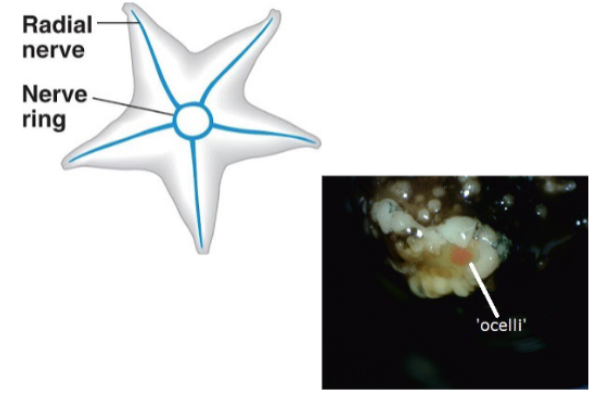
Sea Star Nervous System and Sense Organs
nervous system
nerve rings and radial nerves on both oral and aboral sides
sense organs not well developed
Sea Star Regeneration
famous for ability to regenerate missing arms
• can autotomize (cast off) if injured
• can also regenerate central disc if part remains
Sea Star Reproduction and Development
Monoecious - external fertilization.
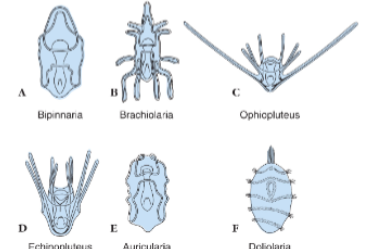
Primitive pattern is indirect development
bipinnaria larva > brachiolaria larva > metamorphosis > juvenile sea star
Many have Direct dev and eggs may be brooded.

Sea stars have larval types specific to classes of echinoderms - others:
Ophiuroids: Ophiopluteus
Echinoids: Echinopluteus
Holothuroids: Auricularia
Crinoids: Doliolaria
Sea Star Wasting Disease
Tissues disintegrate. Shown to be due to a bacterium
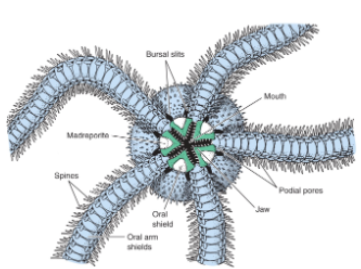
Class Ophiuroidea
Brittle stars and basket stars
5 arms
no pedicellariae, gills
ambulacral grooves closed
tube feet w/o suchers. Move via musculat action of arms
Generally feed on small particles
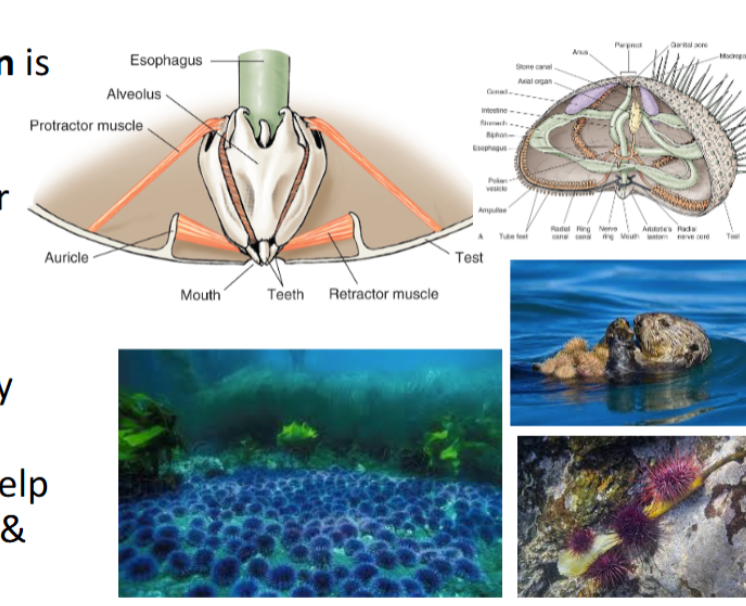
Class Echinoidea
Sea urchins and sand dollars
no arms
dermal ossicles form solid shell → test
Ambulacral grooves closed.
areas extend up sides
spines present, often used for locomotion
tube feet and pedicellariae well developed
Mosly herbivores, some may be carniovores
Class Echinoidea - Aristotle’s Lantern
complicated mouthpart structure used for feeding.
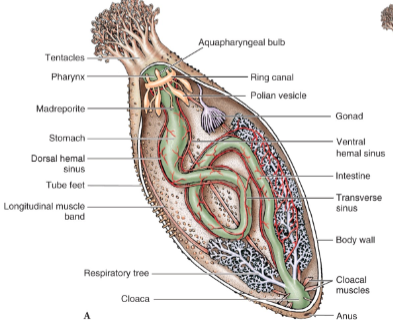
Class Holothuroidea
Sea cucumbers
elongated oral - aboral axis
Reduced ossicles
lie on side, tube feet typically dev on bottom side only
Oral tentacles around mouth
Respiratory tree off of cloaca
Feed on small particles
Can eject guts as defense mechanism
Class Crinoidea
sea lilies & feather stars
sessile (attached) for much of adult life, stalk present
typically deep water, but may be in shallows
arms with pinnules used for filter feeding
ambulacral grooves present, used for feeding, transporting food caught on pinnules
good fossil record

Phylum Hemichrodata
acorn worms
(Class Enteropneusta)
pterobranchs
(Class Pterobranchia)
grouped with echinoderms as clade Ambulacraria
tornaria larva resembles sea star bipinnaria larva
gill slits tie them to chordates (presumably lost in echinoderms)
 Note
Note  Flashcards (50)