4.2 SEXUAL REPRODUCTION IN PLANTS
 Call Kai
 Learn
Learn Practice Test
 Spaced Repetition
 Match
Match Flashcards
 Knowt Play
1/53

There's no tags or description
Looks like no tags are added yet.
Name | Mastery | Learn | Test | Matching | Spaced | Call with Kai |
|---|
No analytics yet
Send a link to your students to track their progress
54 Terms
Nectar function
Attract insects and pollinaters
Effective pollen transfer
Anther and stigma touch same part of bee
Prevent self pollination
Protandry Stigma mature before anther or protogony
Anther is below the stigma
Function of generative male nucleus
Fertilisation contain gametes formation of endosperm
Function of tube nucleus
Control growth of pollen tube through style
Produce enzymes to digest style
Conditions for germination
Water
Cotyledons swell and testa soften
Transport dissolve substances fluid medium for enzymes
Oxygen
Aerobic respiration ATP for metabolism
Suitable temperature
Speeds up rate of diffusion
Increase enzyme activity
Germination gibberellin, maize (dicot)
Non Endospermic
Imbibition - water
Water enter micropyle Cotyledons swell
Testa split Oxygen enter (aerobic)
Food reserver from cotyledons
Enzyme
Amylase digesting starch from cotyledons → maltose →Maltase→ glucose
Proteins and fats
ATP cell division, active transport, protein synthesis radicle plumule meristem sink
Emerging
Radicle emerge micropyle to root anchor absorb water Elongates cotyledons pushed - shoot
Photosynthesis begin
Germination of maize gibberellin (monocot)
Endospermic
Imbibition
Water enter micropyle seed swell
Starch protein fats in endosperm
Embryo produce Gibberellic acod (GA) by embryo
Hormone
GA diffuse → endosperm→ aleurone layer (protein rich)
GA switch genes aleurone layer - protein synthesis form enzymes
Protease hydrolyse aleurone layer → amino acids
Amino acids used to synthesis amylase
Amylase diffuse out aleurone → hydrolyse starch stored in endosperm
Glucose → endosperm → plumule and radicle
aerobic respiration ATP
Growth of seedling
Radicle emerge (root)
Plumule emerge up
Monocot - plumule has coleoptile
Radicle - coleorhiza protects
ATP in embryo
Cell division (mitosis)
Active transport
Growth
Double fertilisation
One nucleus fuse with ovum → Zygote
One nucleus fuse with 2 polar nuclei → endosperm nucleous
Disadvantage of self pollination
Less genetic variation risk of genetic faults
Pollen grains enable adaption terrestial
Pollen tube deliver male gametes to ovule n
No need for water /mobile gametes
Transferred via wind or insects
Broad bean structure and from where
Fruit- fertilised ovary
Embryo - zygote
Testa - integuments
Seed - ovule
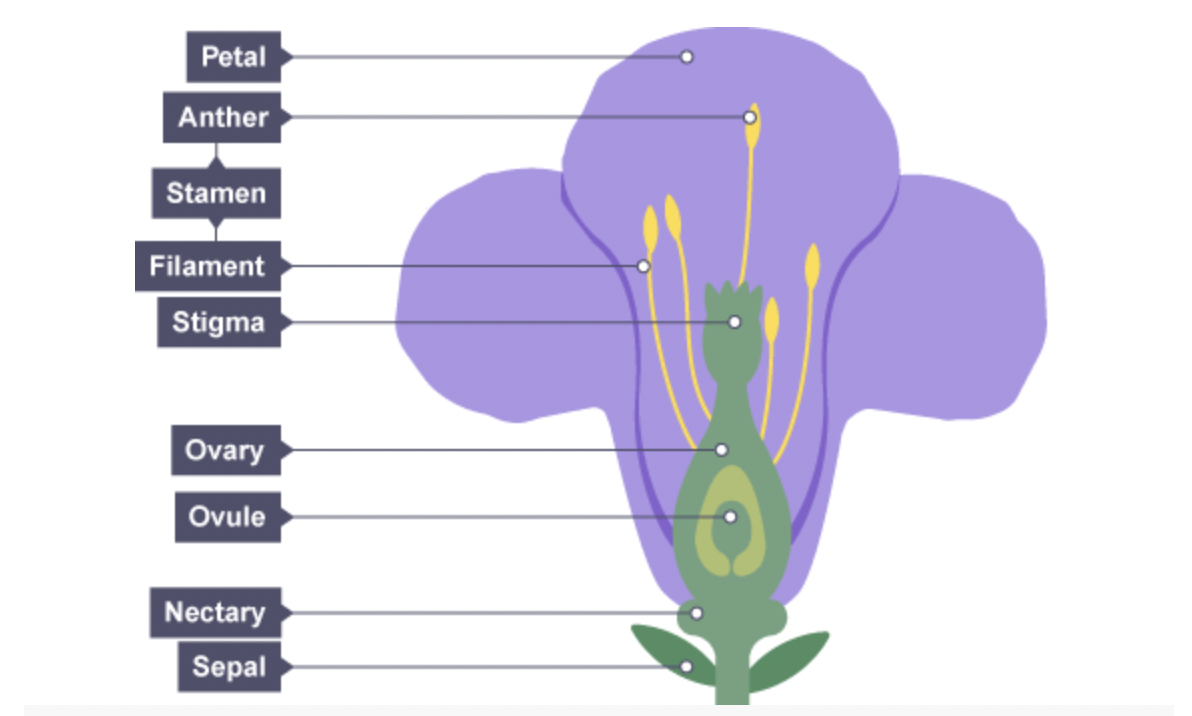
Insect pollinated flower structure
Stamen
Anther + Filament
Carpel
Stigma + Style
Ovary + Ovule + Embryo sac
Sepal - collection Calyx
Petal - collection coralla
Nectary
Receptacle
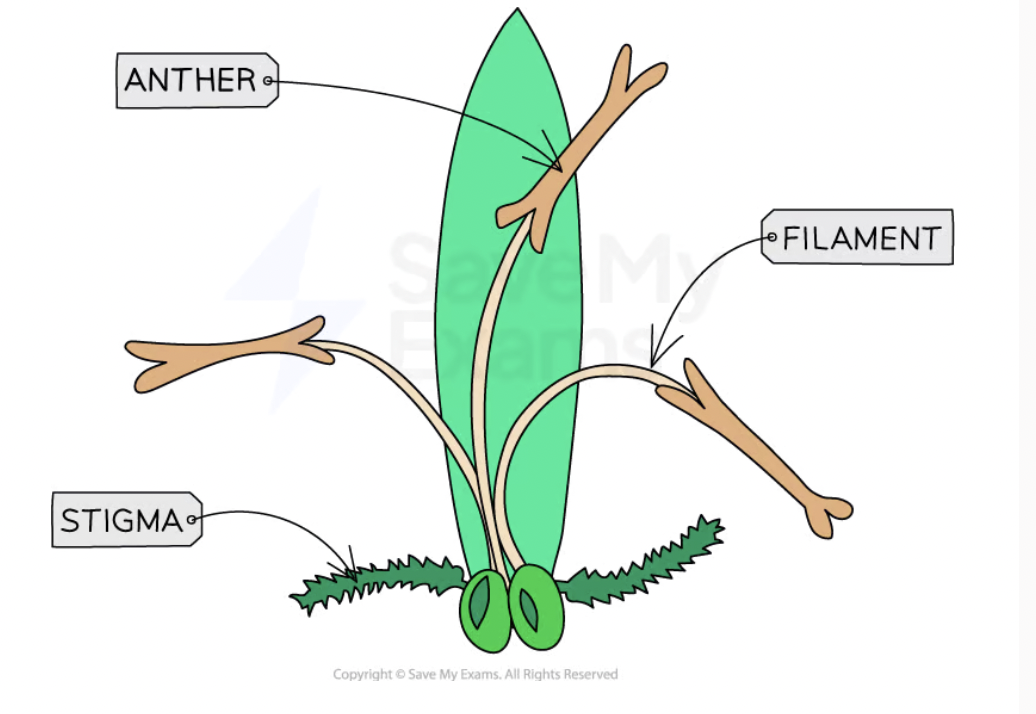
Insect and wind pollinators
Colourful bright fragrant petals - Small green absent
Nectar (sucrose ) - No nectar
Anther within flower - Anthers exposed
Stigma within flower - Large feathery exposed
Small quantity sticky heavy pollen - Large quantity light smooth pollen
Male gametes
Pollen grains
Female gametes
Ovule
Tapetum
Nourish developing structure of a mature pollen grain
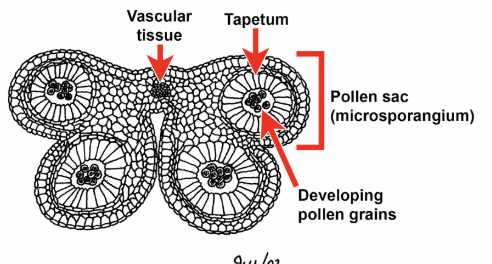
Anther slides
Epidermis -Fibrous layer
Lateral groove
Pollen sacs (microsporangia)
Tapetum
Vascular strand
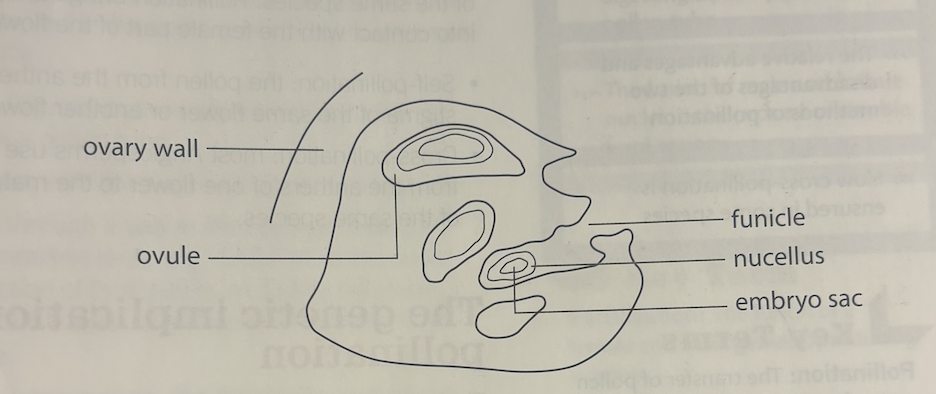
Ovary slide
Ovules
Ovary walle
Funicle
Nucellus
Embryo sac
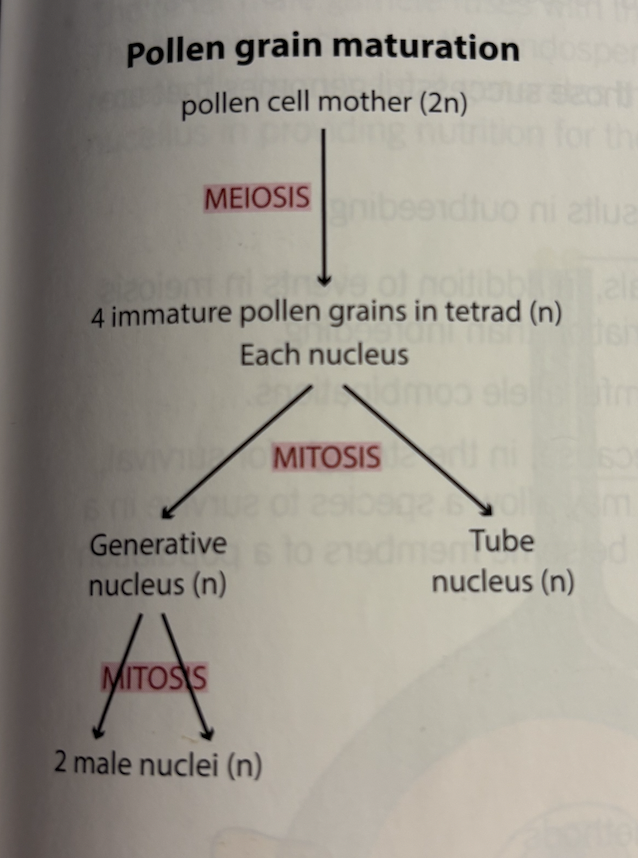
Pollen grain maturation
Pollen mother cells (2n)
Meiosis→
4 Immature pollen grains tetrad (n) each nucleus
Mitosis→ (mature pollen grain)
Tube nucleus (n) (move to tip guide pollen to ovule) → degenerate
Generative nucleus
Mitosis→
2 male nuclei (n)
Dehiscence
Opening of anther releasing pollen grains
Pollen mature outer layers dried out tension in lateral goove
Mature pollen grain (n) nucleus
Tube nucleus - guide pollen through style
Generative nucleus - Divide forming 2 male gametes (sperm)
Pollen wall
Exine tough outer
Intine thin inner
Ovule structure
Ovule inside ovary
Integuments - Protective layer
Micropyle - Small open for pollen tube entry
Nucellus - Tissue surround embryo sac
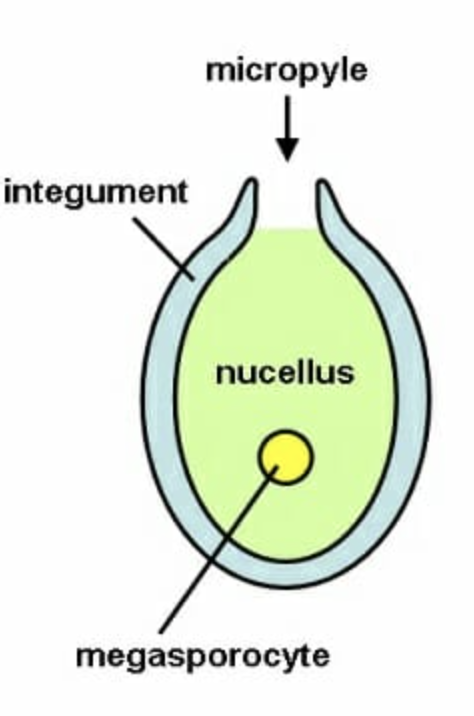
Megaspore formation
Megasporocyte (2n) in ovule
Meiosis→
4 haploid megaspores (n)
Three disintegrate
One haploid Megaspore
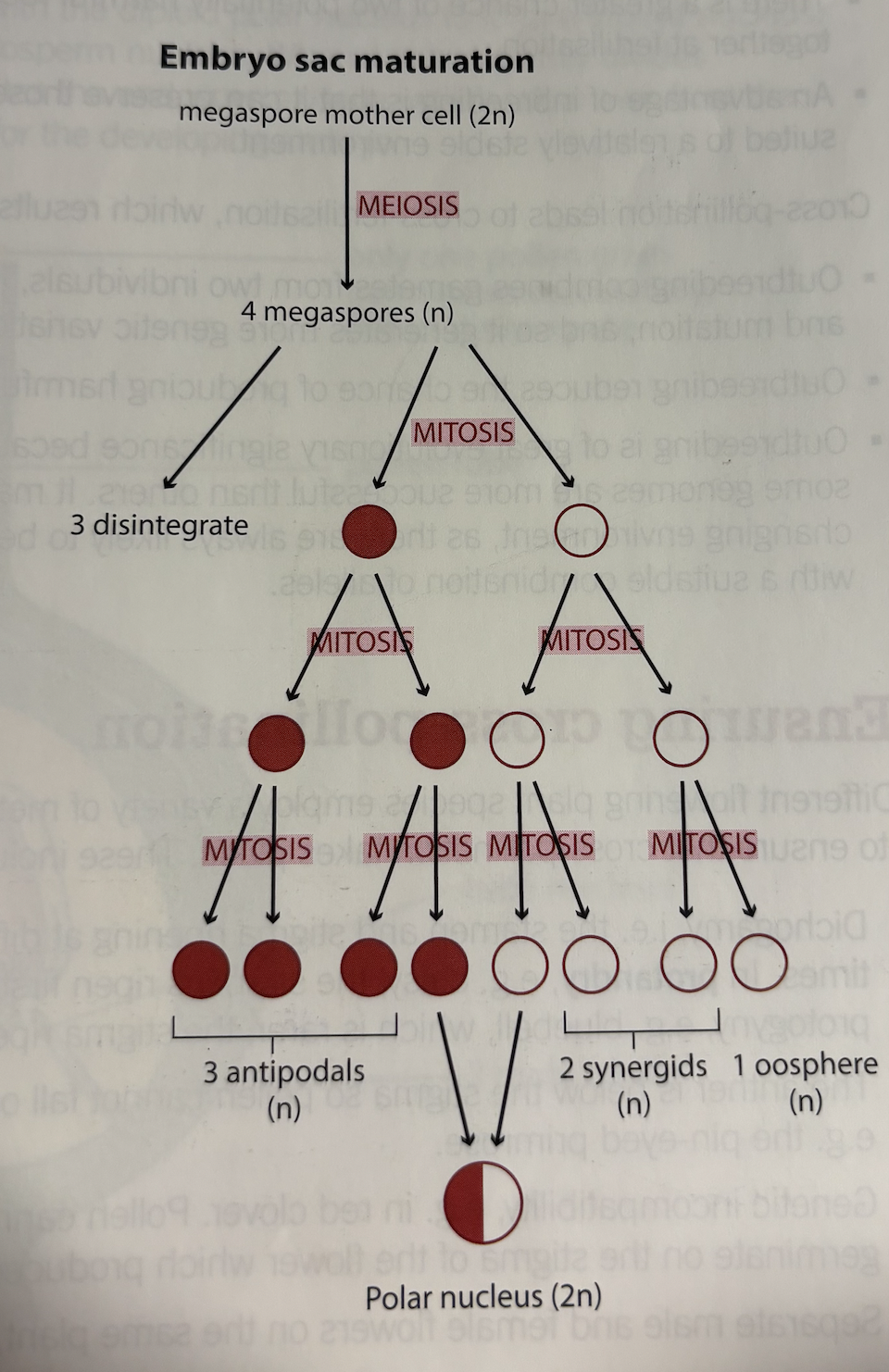
Embryo sac development (after megaspore)
Single megaspore (n) → Mitosis x3 → 8 haploid nuclei
Bottom- 1 egg 2 synergids (n)
Top - 3 antipodal cell
Center - 2 polar nuclei → fuse (2n)
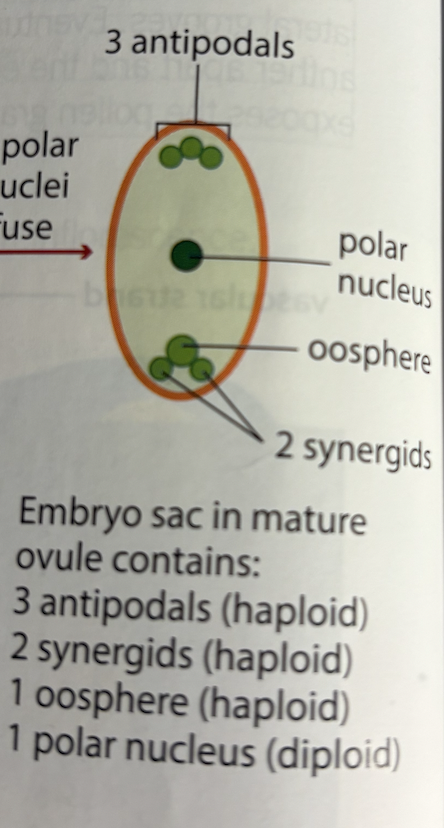
Embryo sac in mature ovule contains
3 antipodals (n)
2 synegrids
1 oosphere (n)
1 polar nucleus (2n)
Synergids (n)
Micropylar end - two
Attract / guide pollen tube towards egg cell
Help facilitate fertilisation
Integument
Protect the ovule
Later develop into seed coat - testa
Antipodals (n)
Chalazal end
Degenrate - early nutrition
Polar nuclei
Center
Fuse with sperm → triploid endosperm → embryo food
Pollination definition
Transfer pollen grains (anther) to mature stigma of plant of same species
Self-Pollination
Transfer pollen anther to stigma to same flower or plant
Self pollination Advantages and disadvantages
Advantages
Ensure reproduction when pollinators scarce
Preserve succesful genomes suited to stable environment
Disadvantages
Reduce genetic variation - dependant on crossing over meiosis
Less survival in changing environment
Self pollination adaptions
Small flower no scent nectar
Anther close to stigma
Stigma anther mature same time
Cross pollination definition
Transfer of pollen from anther to stigma of different plant of the same species
Cross pollination advantages and disadvantages
Advantages
Increased genetic variation → evolution better survival
Reduce interbreeding - chances of harmful allele combos
Disadvantages
Depend on pollinators / environment
Less reliable
Ensuring Cross pollination
Potandry stamen first potogyny stigma first
Anther below stigma - pollen wont fall
Genetic incompatibility
Separate male female plants
Dichogamy
Anther and stigma mature at different times
Herkogamy
Physical separation of male and female parts
Fertilisation
Fusion of female and male gamete → Zygote
Double fertilisation
2 Male gametes from pollen grain fertilise embryo sac
Zygote (2n) → Embryo
Triploid endosperm (3n) (foodstore)
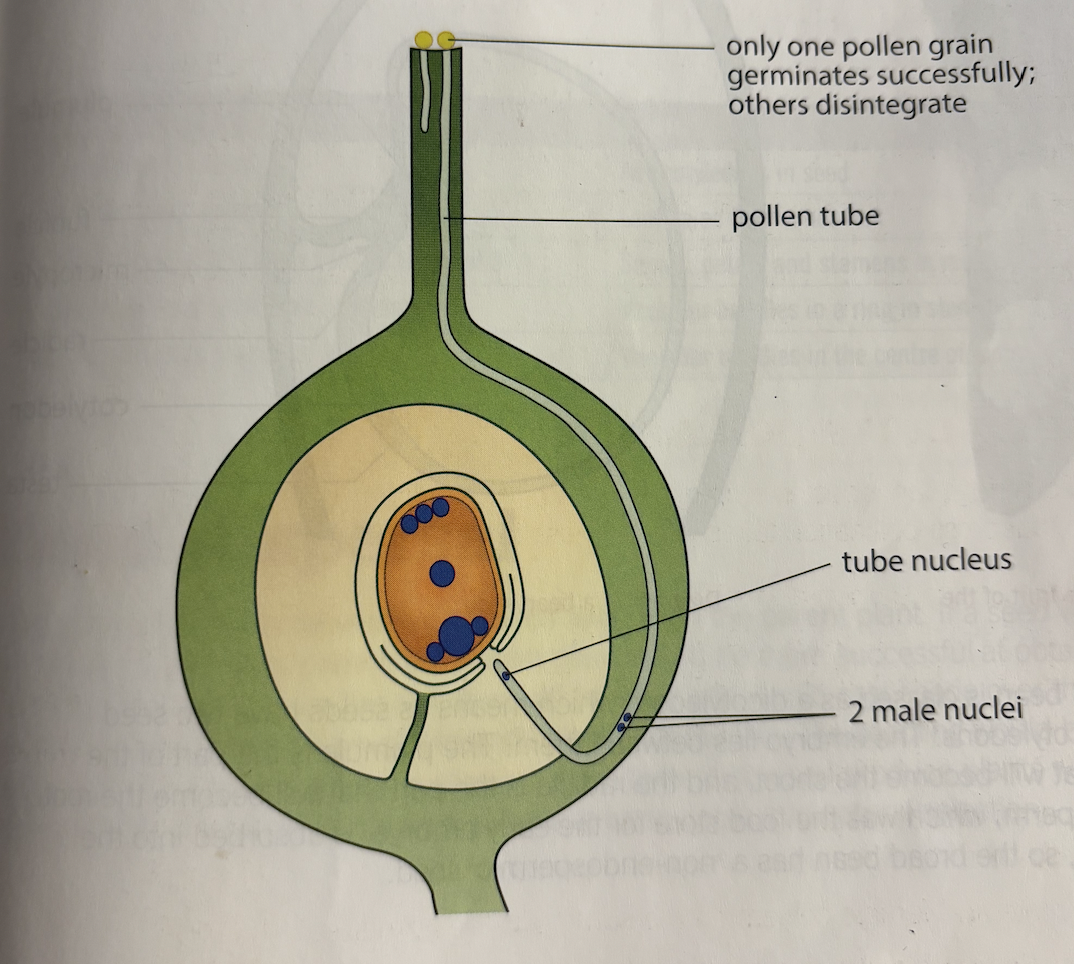
Double fertilisation process
Pollen tube formation
Pollen grain land on stigma
Tube nucleus direct pollen tube growth through style → ovule
Enzymes (hydrolases) digest tissue in style
Sperm cell
Generative nucleus divide → 2 male gametes (sperm)
Sperm behing in pollen tube)
Embryo sac - pollen tube enter through micropyle
Fertilisation
1 Sperm cell fuse + EGG → ZYGOTE (2n)
1 Sperm cell fuse + 2 POLAR NUCLEI → TRIPLOID ENDOSPERM (3N)
ZYGOTE → EMBRYO
ENDOSPERM → Nutrition (embryo)
Fruit
Ovule → Seed
Ovary → fruit
Ovary wall become pericarp
Exocarp - Outer
Mesocarp - Fleshy middle
Endocarp - Hard inner surround seed
Types of fruit
Fleshy - Apple tomato → soft mesocarp
Dry - Pea pod almond → Hard pericarp
Seed dispersal
Ensure seed reach suitable environment
Wind - Wing hairs light seeds - Dandelion
Water - Boayant - Coconut
Animals - hooks spines
Ingested - Fleshy fruit - Berries
Bursting - Dry plod splits
Structure Dicot -Vicia faba,
Hilum - scar where funicle attached
Micropyle - small pore
Testa - Outer coat
Two cotyledons - food storage
Radicle
Plumule
Non endospermic
Structure Monocot -Zea mays
Testa
Endosperm ( food store)
Single cotyledon ( scutellum)
Radicle
Plumule
Coleoptile (plumle sheat)
Plumule
Monocots and Dicots
One cotyledon in seed - Two cotyledons
Leaf veins are parallel - Leaf veins form network
Sepals, petals stamens multiples of 3 - Sepals petals stamen multiples of 4,5
Vascular bundles scattered in stems - In ring in Stems
Vascular bundles Scattered in roots - In centre of roots
Seed survival
Inhibitors only allow germination in spring ‘ vernalisation’ broken down in cold weather
Testa protects embryo
Food store supports early growth
Ability to remain dormant
Resistant to desiccation
Can be dispersed away from parent plant
Seed dispersal reasonings
Competition light water nutrients
Overcrowding
Disease transmission
Why does cross pollination increase genetic variation
Gametes come from different plants
Meiosis produces haploid gametes with different allele combinations
Random fertilisation produces unique offspring
Seed development
Ovule develops into a seed
Diploid zygote (2n) divides by mitosis
Forms diploid embryo
Embryo consists of plumule, radicle and cotyledon(s)
Triploid primary endosperm nucleus (3n) divides by mitosis
Forms endosperm tissue (food store)
Integuments develop into testa
Micropyle remains as a pore in the testa

