Electromagnetic induction
 Call Kai
 Learn
Learn Practice Test
 Spaced Repetition
 Match
Match Flashcards
 Knowt Play
1/19

There's no tags or description
Looks like no tags are added yet.
Name | Mastery | Learn | Test | Matching | Spaced | Call with Kai |
|---|
No analytics yet
Send a link to your students to track their progress
20 Terms
What is electromagnetic induction?
When a voltage is induced in a conductor or a coil when it moves through a magnetic field or when a magnetic field changes through it
What is EM induction used for?
To generate electricity
What is this called? How is this different from the motor effect?
Generator effect.
This is the opposite from the motor effect
In the motor effect, there is already a current in the conductor which experiences a force
In the generator effect, there is no initial current in the conductor but one is induced when it moves through a magnetic field
How can we create a current using electromagnetic induction?
By moving a wire across a magnetic field at right angles to cut through the magnetic field lines, a voltage is induced in the wire by generating a potential difference in the wire.
To create a current, the wire must be a part of a complete circuit. If not, only voltage is induced
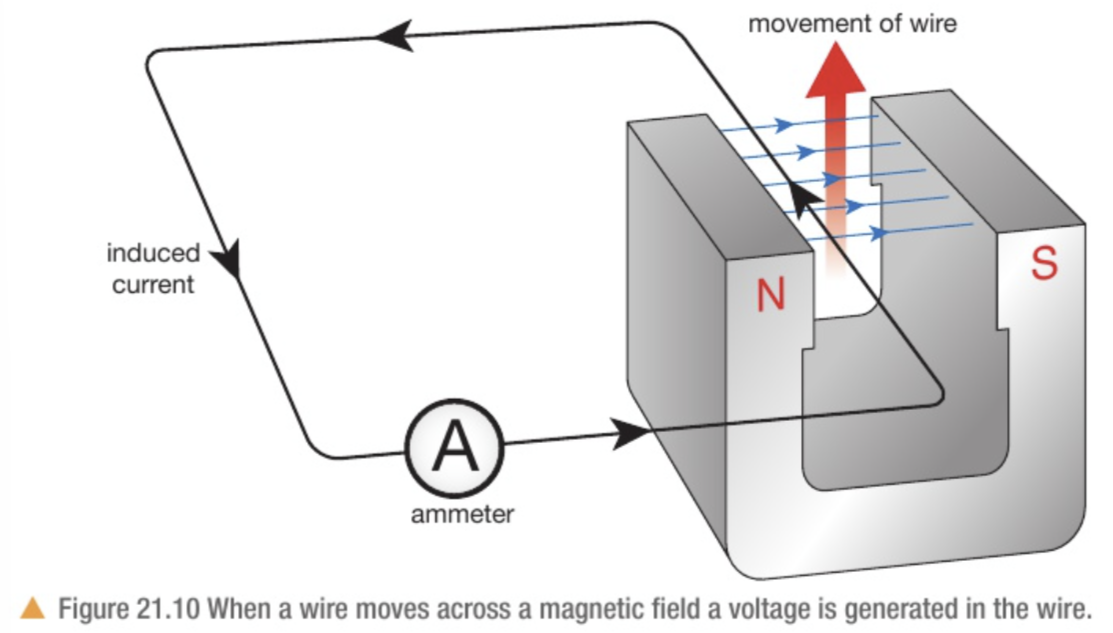
Describe the factors that affect the size of the induced voltage (and current)
We can increase the size of the induced voltage (and current) by:
Moving the wire/magnet more quickly
Using a stronger magnet so that there are more field lines ‘cut’
Wrapping the wire into a coil so that more pieces of wire move through the magnetic field (number of turns in the coil)
Not in textbook but: angle between the motion of the wire and field
Describe and explain another way we can generate a voltage and current.
By pushing a magnet into a coil
By doing so, the wires are cutting through the field lines, inducing/generating a voltage
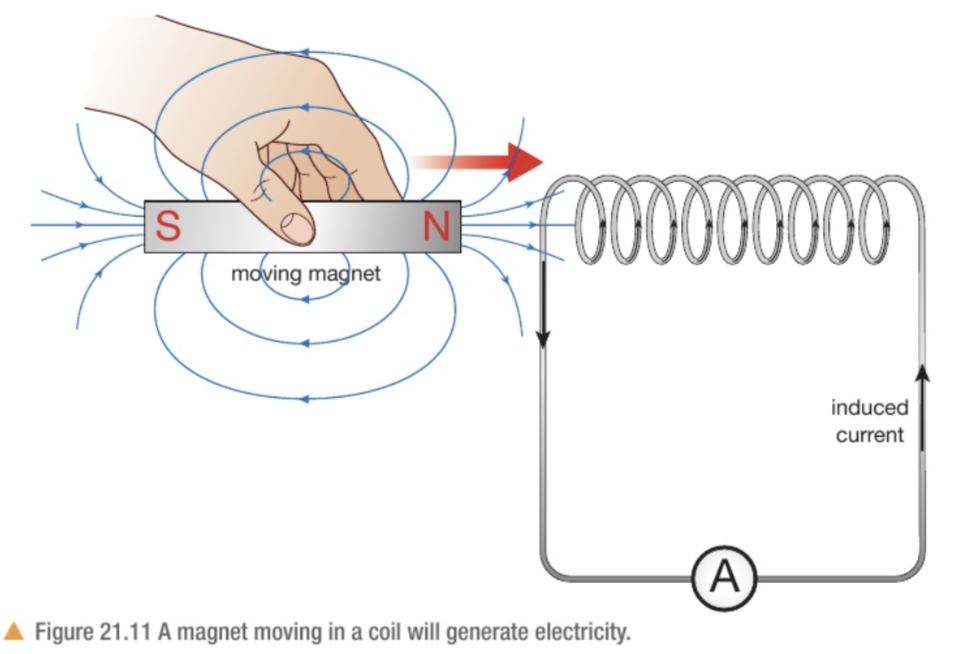
What happens if the wires and magnets are stationary?
No voltage/no potential difference is generated because there is no cutting of field lines
How can we increase the size of the induced voltage (and current)?
Moving the magnet more quickly
Using a stronger magnet
Using a coil with more turns
Explain the effect of increasing the speed at which the wire/magnet/coil is moved
Increasing the speed will increase the rate at which the magnetic field lines are cut
This will increase the induced potential difference
Explain the effect of increasing the number of turns on the coils in the wire
Increasing the number of turns on the coils for a given length of wire will increase the potential difference induced
Reducing the length of wire but maintaining the number of turns will also increase the potential difference induced
This is because each coil will cut through the magnetic field lines and the total potential difference induced will be the result of all the coils cutting the magnetic field lines
How can we reverse the direction of the induced potential difference/voltage/current?
By swapping the magnet’s poles
By reversing the direction of motion
BUT THERE IS NOT EFFECT ON MAGNITUDE
Generators
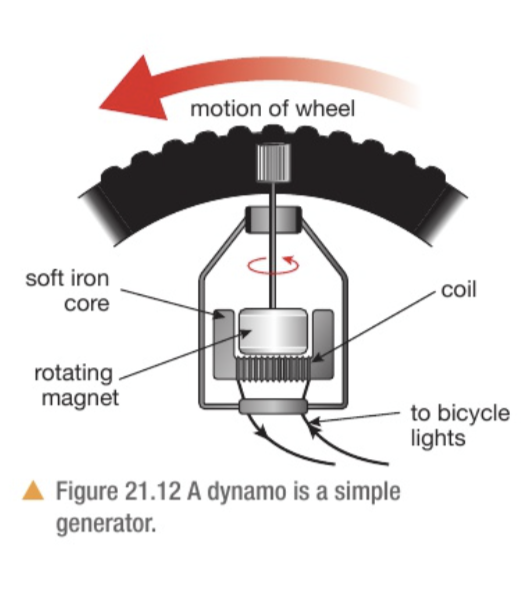
Explain how electricity is generated for this bicycle light
As the cyclist pedals, the wheel rotates and makes a small magnet within the dynamo turn around
As the magnet turns, its magnetic field turns too
The field lines cut through the coil inducing a current in it
This current is used to work the cyclist’s lights
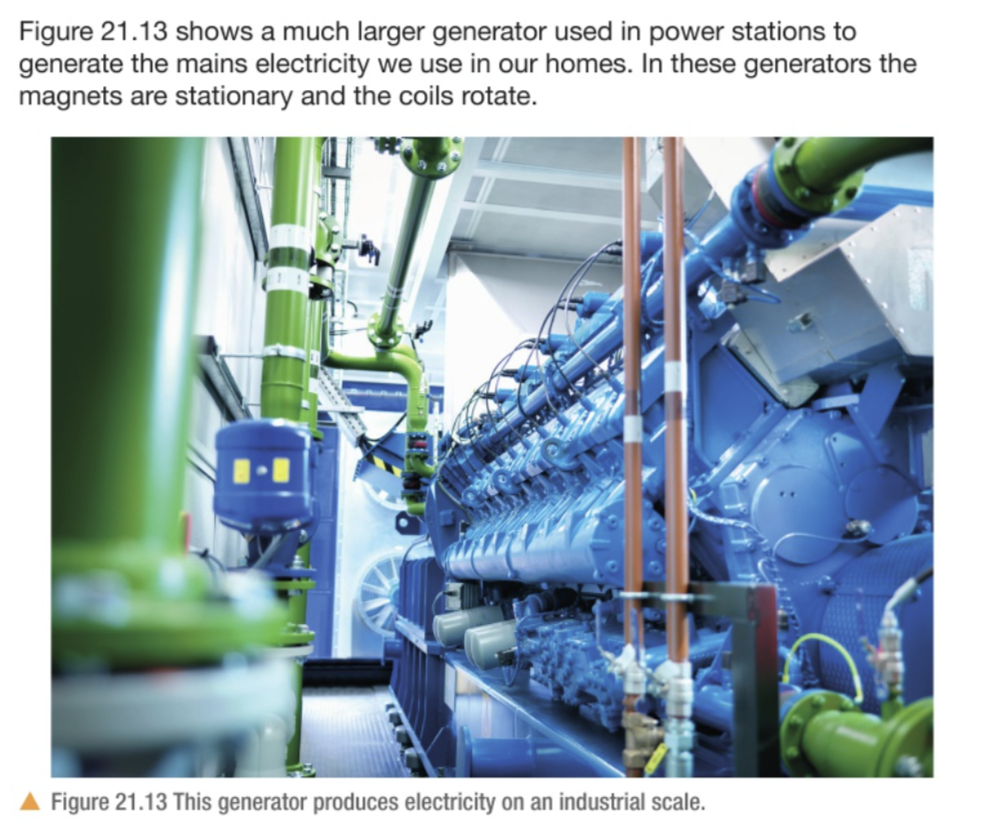
Explain why the size of the induced voltage in these generators are larger than the bicycle dynamo
These generators use much stronger magnets
They have many more turns of wire on the coil so more magnetic field lines are cut
The coil spins much faster, increasing the rate at which the magnetic field lines are cut
The generator effect can be used to generate 2 types of current
Generate a.c in an generator
Generate d.c in a dynamo
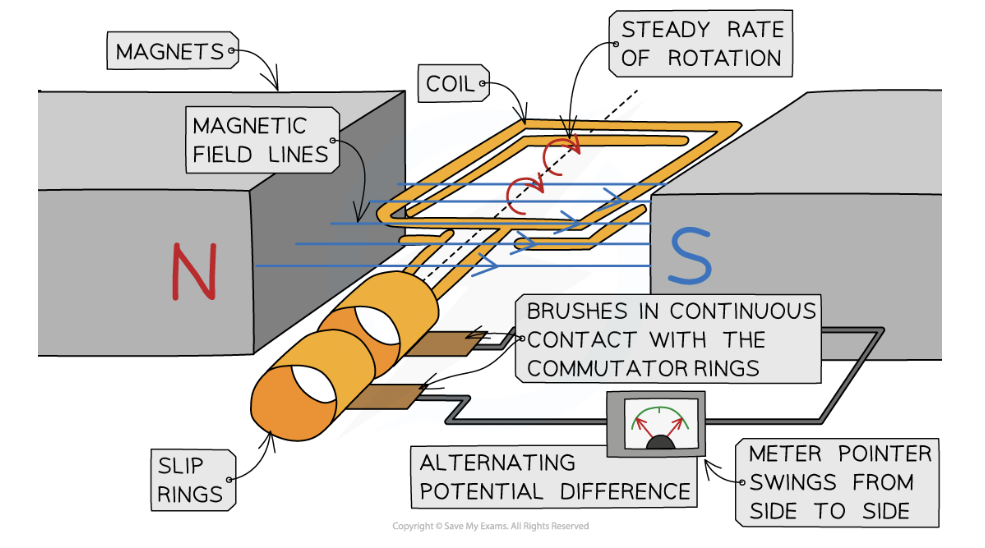
Describe how a simple alternator (a type of generator that produces an alternating current) generates a.c
A rectangular coil is forced to spin in a uniform magnetic field
The coil is connected to a circuit which contains a centre-reading meter by metal brushes that press on two metal slip rings
The slip rings and brushes provide a continuous connection between the coil and the meter
When the coil turns in one direction:
The pointer deflects first one way, then the opposite way, and then back again
This is because the coil cuts through the magnetic field lines and an alternating potential difference is induced in the coil
The alternating potential difference produces an alternating current (a.c.)
An alternating current may also be produced when a magnet rotates within a stationary coil
Both methods operate on the principle that p.d. is induced when a coil experiences a changing external magnetic field
The induced potential difference and the current alternate because they repeatedly change direction
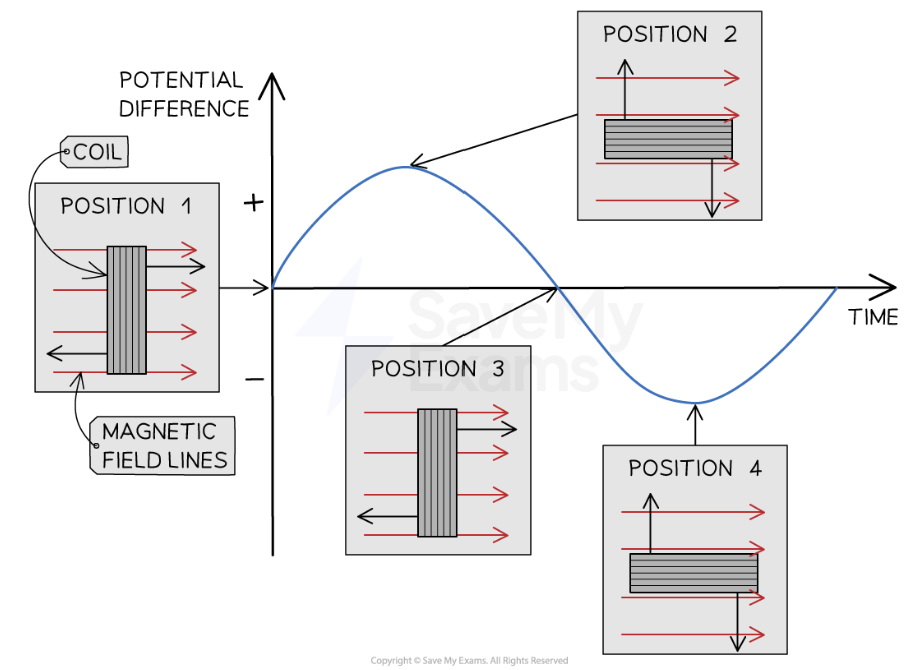
Explain the movement of the coil at each stage
Current is 0 because the movement of the coil is parallel to the magnetic field lines so no interaction/crossing of magnetic fields so no current is induced
Current is positive because the coil is moving perpendicularly to the magnetic field lines so there is interaction between both fields
Current is 0 again because of same reason
Current is negative because direction has reversed and coil is moving perpendicularly to the magnetic field lines so there is interaction between both fields
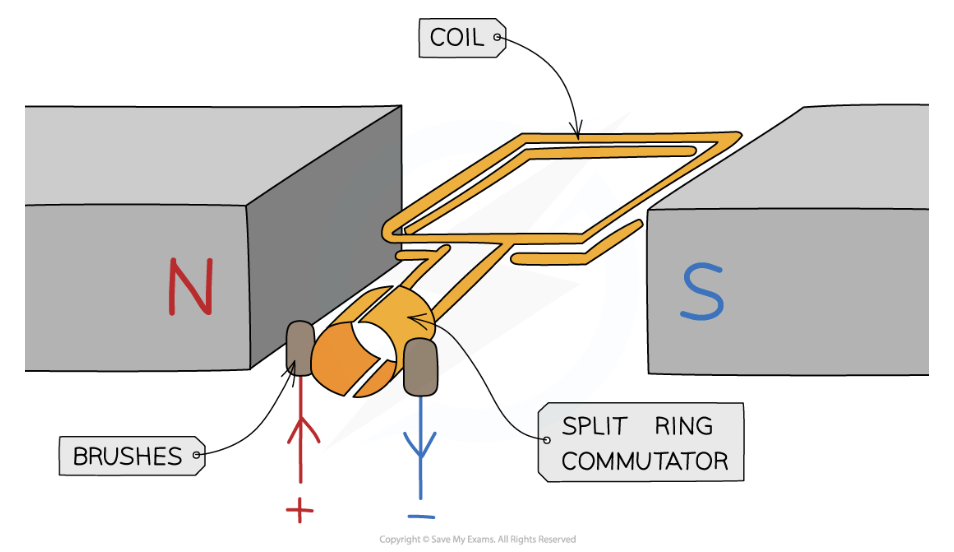
A dynamo is a type of generator that produces a direct current.
How is a simple dynamo different from an alternator?
The dynamo has a split-ring commutator instead of two separate slip rings
Explain how a dynamo generates direct current
As the coil rotates, it cuts through the field lines
This induces a potential difference between the end of the coil
The split ring commutator changes the connections between the coil and the brushes every half turn in order to keep the current leaving the dynamo in the same direction
This happens each time the coil is perpendicular to the magnetic field lines
Therefore, the induced potential difference does not reverse its direction as it does in the alternator
Instead, it varies from zero to a maximum value twice each cycle of rotation, and never changes polarity (positive to negative)
This means the current is always positive (or always negative)
Draw the diagram for how the current would look in a dynamo
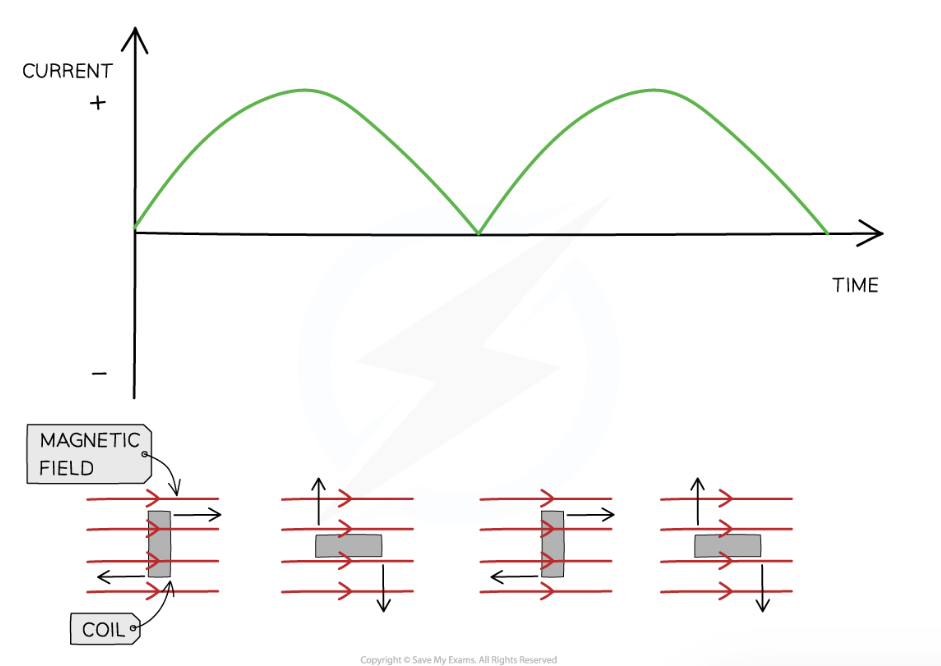
You are also expected to know that alternating current can be produced when a coil rotates in a magnetic field, or when a magnet rotates within a coil. The key is relative motion between the coil and the magnet.

