Ancient Civilizations, Greek Art, and Roman History Overview
 Studied by 0 people
 Call Kai
 Learn
Learn Practice Test
 Spaced Repetition
 Match
Match Flashcards
 Knowt Play
1/141

There's no tags or description
Looks like no tags are added yet.
Name | Mastery | Learn | Test | Matching | Spaced | Call with Kai |
|---|
No analytics yet
Send a link to your students to track their progress
142 Terms
Minoans
This civilization was dubbed 'the What???' after the mythological King Minos by Sir Arthur Evans.
Knossos
The principal community was centered around the palace complex at BLANK on the northern coast of Crete.
Sir Arthur Evans
He excavated Knossos and also put much effort into restoring it.
Topless female statues
The discovery of topless female statues wielding serpents fueled popular interest in excavations in the early twentieth century.
Doric columns
The palace had columns that tapered from top to bottom, resembling the Doric columns of later Greek architecture.
Therans
On the island of Thera (modern day Santorini), a high level civilization was discovered, featuring remarkable frescoes.
Akrotiri
An area on the island of Thera where a high level civilization was discovered, featuring frescoes that depicted pleasure boats and landscapes.
Obsidian
A prized trade commodity found in the Theran civilization.
The therans
Somewhere between 1627-1500 BC, the civilization came to an abrupt end due to a volcanic eruption.
Atlantis
The destruction of the civilization of Thera was perhaps an inspiration for the story of ___
Mycenaeans
The
were a mainland empire characterized by its strong city walls.
Trojan War
The Mycenaeans famously fought in the mythological ?
Agamemnon
the king of Mycenae led an expedition to the walls of the city of Troy, located somewhere in north-western Iona circa 1225 BC
Heinrich Schliemann
(1822-1890) was a shady and unscrupulous businessman who had become fascinated with Homer’s epics
Climate change
One of the theories regarding the collapse of the Mycenaeans.
Mediterranean piracy
Another theory regarding the collapse of the Mycenaeans.
Bronze Age
3000-1000 BC approximately
During the later third of it civilizations developed to a high level in Crete and the Peloponnesus including the rise of the Minoans and the Mycenaeans. It is named for the development of bronze artifacts, made with copper and a measure of tin.
Schliemann, Heinrich
He was an adventurer from America who profited from the 1849 Gold Rush and became fascinated with Homer.
d is credited with finding ancient Troy (although he took credit for a discovery by a certain Frank Calvert) and conducting and publishing the first major excavations there. He also found Mycenae
Thera
An island civilization of the Cycladic Islands that was destroyed by a volcanic eruption.
Somewhere between 1600 and 1450 BC
heavy rain destroyed the civilization and gravely affected the Late Bronze Age civilization on Crete
The volcano, still active, left deposits thirty-three feet thick and produced a seismic sea wave. Excavations have been conducted over the last forty years at the site of Akrotiri
Pumice plume
Somewhere between 1600 and 1450 BC a volcanic eruption sending a BLANK
(NOT THE WAVE
twenty-two miles high
accompanied by hot gas, ash, lava, and heavy rain
destroyed the civilization and gravely affected the Late Bronze Age civilization on Crete.
Seismic sea wave
The volcanic eruption produced a BLANK that gravely affected the Late Bronze Age civilization on Crete.
Akrotiri
On the island of Thera, this was the site of excavations in the 1960s and after, producing evidence of a highly sophisticated Late Bronze Age civilization
Athens
Originally a monarchy, BLANK
moved to an oligarchy ruled by three leaders, or archons
one who replaced the king, one in charge of military affairs, and one who attended to civil matters. These leaders were elected every ten years by a group of prominent members of the community.
Archons
Leaders elected every ten years by a group of prominent members of the community, responsible for different aspects of governance.
Areopagus Hill
A council made up of former archons appointed for life, served as a court.
Legislation of 683 BC
Resulted in an annual election of archons, rather than every ten years.
Archon Solon circa 638-558 BC
was able to make reforms that pushed Athens to a more democratic state rather than an oligarchy
sought to have the archons elected by the citizenry rather than only noble families. Solon established the Ekklesia,
made up of six thousand male citizens (no women or slaves were permitted to serve in this council).
Ekklesia
Council made up of six thousand male citizens; no women or slaves were permitted to serve.
Boule
a critical tool for managing the government of Athens in a more democratic fashion.
made up of 500 citizens and headquartered in the Athenian agora
council to the archons and which prepared laws for voting.
citizens were chosen by lot to serve thirty-six days in three shifts.
During their shift the representatives had to call four meetings.
Kleisthenes
Archon who became influential in 508 BC, continuing to push for democratic reforms.
Voting through random ballot
A practice where leaders lobbied citizens in their district to back them.
Gerrymandering
A modern phenomenon at odds with ancient Athenian democracy.
Acropolis
The prominent hill in Athens where major temples and shrines, including the Erechtheion and the Parthenon, were located.
Agora
The city center of Athens where government buildings, voting districts, stoas, law courts, and a prison were located.
Areopagus
Hill of Ares in Athens where the advisory council to the king and later oligarchy met.
declined in significance after the Archaic Period of the sixth century BC but remained important for murder trials
Geometric Period (1000-675 BC)
Period of the gradual rebirth of Greece and the beginning of the rise of Athens in importance.
Decoration of art is limited to
simple figures beginning again in the ninth century BC and
featuring simple geometric forms. Athens moves from a kingship to an oligarchy.
Battle of Marathon
A notable battle in the conflict between the Greek world and the Persians in 490 BC.
Battle of Thermopylae
Another notable battle in the conflict with the Persians in 480 BC.
Persian Defense Fund
Established by the Athenians and paid into by Greek city-states to support their defense against Persia.
which Pericles, chief general of Athens, used to lavishly embellish the acropolis and construct the Parthenon
Peloponnesian War
Conflict from 431-404 BC resulting from alliances formed against Athens due to its imperialistic policies.
Macedonia
Kingdom that filled the power vacuum after the Peloponnesian War.
Alexander the Great
Conqueror who won battles and stretched his influence from northern Greece to India.
Hellenistic Period
Period of conflict between 300 and 30 BC following Alexander's sudden death.
Panathanea
A major Athenian festival depicted in a frieze around the columns of the Parthenon.
Panathanaea
The major Athenian festival which featured the weaving of a peplos or robe for an old xoanon, or plank idol of the goddess Athena that was kept on the acropolis in a sacred building known as the Erectheion.
This procession was accompanied by libation bearers, cantering horses with riders, and high officials, with the tribute ending in the presentation of the robe to the idol, the whole scene depicted on a frieze running around above the columns of the Parthenon on the acropolis.
The most important BLANK festivals were held every four years.
Parthenon
Temple of Athena Parthenos built by Iktinos and Kallikrates working for general supervisor Phidias between 447 and 432 BC. It was located on the Acropolis in Athens.
Geometric Period
In the Blank Period (1000-675 BC),
Greek art relied on simple geometric forms to depict humans and animals. Human faces lack details on pottery.
Orientalizing Period
In the Blank Period (675-600 BC), the Greeks began to move toward naturalism in pottery and sculpture.
Archaic Period
In the BLANk Period (600-500 BC), major changes began to occur in Greek art, with increasing interest in the human form.
However, depictions are still subtractive, notable characteristics being almond shaped eyes and a faint smile.
Contrapposto
A rendering of the human form which adjusts the muscles and the bones of the body naturally and asymmetrically to show how a person might actually stand.
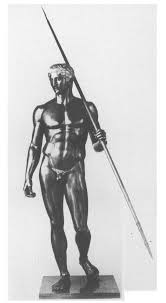
The most famous example is the Doryphoros of Polykleitos.
Polykleitos of Argos
Although none of his original works survive, his ideas were so important that many of his works were copied to varying degrees of success during the Roman period.
An iconic example of his work was the Doryphoros of Polykleitos, depicted below.
Lysippus of Sikyon
Mid-fourth century BC sculptor who brought sculpture more into the realm of realism and who also began to experiment with leg movement and a twisting body with turning head that allowed a fuller three-dimensional liberation from the block.
Phidias
Became known for overseeing the Athenian acropolis building program and for his giant statues, including Zeus at Olympia and the Athena statue at the Parthenon.
Kritios
Athenian sculptor who, about 480 BC, begins to deviate from the subtractive block look in his work.
The head begins to turn and the body, instead of being made with symmetrically placed parts and facing stiffly front, begins to show the effect of weight shift and the beginnings of a stance that reflects tension and relaxation of the legs over the entire body.
Lysippus of Sikyon
Mid-fourth century BC sculptor who brought sculpture more into the realm of realism
began to experiment with
leg movement and a twisting body with turning head that allowed
a fuller three-dimensional liberation from the block.
known for powerful portraits of Alexander the Great,
giving him deep-set eyes and a powerful twist of the neck along with a long-haired look that became a vogue in the middle and later fourth century BC.
Amphora
A large vessel to transport or hold wine or other liquids, often with a pointed toe for shipping.
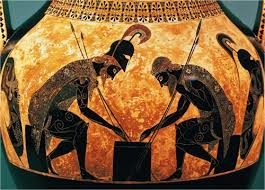
Black-Figure Vase Painting
A style of Athenian pottery where figures are painted in black on a rich orange surface, allowing for incised details.
Doric Order
One of the principle orders of the Greek temple associated with mainland Greece and buildings such as the Parthenon.
WHAT features
triglyphs and metopes as part of its entablature or upper temple area as well as simplified columns that lack bases.
Entasis
The slight swelling in the center of a column to counteract the optical illusion of a thinner appearance.Thus as the column proceeds from bottom to top the central part swells out slightly as the column overall tapers in
Ionic Order
An architectural style associated with the Greek east, known for its more ornate and decorative columns compared to the Doric order.
Greek Theater
A significant cultural development in Athens during the Classical Period, leading to the creation of tragedies and comedies.
Tragedy
A form of drama that became prominent in the fifth century BC, often exploring themes of morality and the nature of the gods.
Aeschylus
A notable tragedy writer from circa 525-455 BC, known for inspirational morality plays.
Sophocles
A prominent Greek tragedy writer from circa 496-405 BC, famous for works like Oedipus Rex and Antigone.
Oedipus Rex
A tragedy by Sophocles focusing on themes of blood-guilt and the unavoidable nature of prophecies.
Antigone
A tragedy by Sophocles about a protagonist who seeks to bury her deceased brother, who cannot be buried properly due to legal constraints.
Classical Period
The era when the Greek temple architecture was well established, leading to elaborate designs like the Parthenon.
Phidias
Athenian sculptor of large chryselephantine statues and overseer of the building program on the acropolis in the 440s and 430s.
His gigantic statues included a colossal Zeus for the pan-Hellenic site of Olympia
where the Olympics took place as well as the Athena Parthenos statue within the Parthenon
Colossal Zeus
A gigantic statue created by Phidias for the pan-Hellenic site of Olympia.
Athena Parthenos
A statue of Athena located within the Parthenon, created by Phidias.
Triglyphs
Three vertical grooves on the frieze of a Doric temple, alternating with metopes.
Metope
The plain space between triglyphs on a Doric frieze, often decorated with relief sculptures.
Doric in that surrounding the rounded echinus there was
a volute member sitting below the abacus.
The echinus was also elaborately decorated unlike the simple Doric echinus. Ionic also has a divided frieze and lacks triglyphs and metopes.
Volute
The spiral ornament found on the capital of Ionic columns, distinguishing them from Doric columns.
Chorus
Singers and dancers in the orchestra of the Greek theater. Often they attempt to instruct the viewer and lead characters on the appropriate moral course to observe but it is often to no avail until disaster strikes.
Romulus and Remus
Brothers nursed by a she-wolf in their infancy.
; BLANK
settled on the Palatine hill, name eventually killed his brother and assumed sole kingship of Rome.
Roman Republic
Established in 509 BC after the Latins revolted against Etruscan rulership, governed by elected consuls and several assemblies.
Cloaca Maxima
A sewer complex used by the Etruscans to drain the marshy area between the Palatine, Esquiline and Capitoline Hills into the Tiber.
Temple of Jupiter Capitolinus
The first gigantic temple in Rome, constructed by Etruscan king Tarquinius Superbus on the Capitoline Hill, honoring Jupiter Optimus Maximus.
Roman Forum
The equivalent of the Greek agora, a center of political, civil and religious life, hosting many temples and the Curia.
Comitium
An open space in front of the Curia or senate house with seats for at least one of the popular assemblies to meet, known to meet in the open air.
was removed to other places around the city by the first century BC.
Comitia was the name given to a variety of representative assemblies in Rome.
Curia
A Roman BLANK
was originally a subdivision of people, tribes of which there were originally three, but over time the name began to refer to their meeting place or senate house in the Forum.
Castrum
Military camps set up by Romans, which could be converted to semi-permanent settlements.
Punic Wars
Conflicts between Rome and the city-state of Carthage that lasted between 264 and 146 BC.
Hannibal
Carthaginian General who famously led a campaign to cross the Alps to reach Rome, but ultimately failed.
Etruscans
An ancient civilization that ruled Rome before the establishment of the Roman Republic and were responsible for significant developments in Roman infrastructure. (no)
Antigone
What is this from??
Sister of Ismene in the play of the same name by Sophocles.
She refuses to obey unfair laws and seeks to bury her brother,
killed in the Seven Against Thebes war between brothers.
She is condemned by King Creon for her actions which leads to tragedy for all and her suicide by hanging.
King Creon
The ruler who is named BLANK
who condemns Antigone for her actions of burying her brother, leading to tragic consequences.
The Forum hosted many temples, including?
Temple of Vesta, the Temple of Castor and Pollux, the temple of Saturn.
Temple of Castor and Pollux
Another temple located in the Roman Forum, dedicated to the twin brothers from Roman mythology.
Temple of Saturn
A temple in the Roman Forum dedicated to the god Saturn, symbolizing wealth and agriculture.
Palatine Hill
One of the seven hills of Rome, significant in the foundation myth of Romulus and Remus.
Esquiline Hill
Another of the seven hills of Rome, part of the area drained by the Etruscans.
Capitoline Hill
The hill on which the Temple of Jupiter Capitolinus was constructed, significant in Roman religion and politics.
Centurion
An important military officer, commanding a section of the legion and coordinating battle plans with the Legatus, or Head of the Legion.
Legatus
The Head of the Legion, typically a statesman and not a veteran like the centurions.
Gnaeus Pompeius Magnus or Pompey the Great was a BLANK
consul and member of the First Triumvirate.
He was an experienced general and put down the Spartacus rebellion in the 70s BC
Lex Gabinia
A law passed by the Roman senate in 67 BC that gave Pompey virtually unlimited powers to put down piracy in the east.
First Triumvirate
The ruling triad of Rome formed in 59 BC consisting of Pompey the Great, Julius Caesar, and Crassus.
forming WHAT
Marcus Licinius Crassus
(Crassus)
A member of the First Triumvirate who fancied himself a great general but was killed in a failed military campaign in Parthia in 54 BC.
 Note
Note  Flashcards (22)