Women in the workforce test 2
 Call Kai
 Learn
Learn Practice Test
 Spaced Repetition
 Match
Match Flashcards
 Knowt Play
1/25

There's no tags or description
Looks like no tags are added yet.
Name | Mastery | Learn | Test | Matching | Spaced | Call with Kai |
|---|
No analytics yet
Send a link to your students to track their progress
26 Terms
The Gender Pay Ratio vs. The Gender Pay Gap, definitions
The Gender Pay Ratio is equal to female earnings divided by male earnings.
Today it’s .8 to 1 so there is a .2 gap (women earn 80% of what men do)
males really no diff what number you use either weekly or annual
ratio is getting closer to 1
● The gender pay ratio over the life cycle reflects what happens to the ratio of a particular cohort of women as they age. We see a decrease in the gender ratio with age (this means that the gap between female and male earnings gets wider).
● Educational attainment: men continue to earn substantially more than women within each educational category.
Why has Gender Gap Narrowed?
the gap has narrowed even when examining hourly wages
start at entry level salary, promotions, age and men could be more promoted than women
gap gets bigger and ratio smaller
women having less than 2 children or no one having kids= not reason
Iceland: both women and men interrupt bc once you notice you interupt you will not invest or does through public policy
Pay Ratio Over Life Cylce
Decrease in gender pay ratio as cohorts age, meaning pay gap widens as women age
Most women interupt not disrupt(more expensive)
gap ages: 24-34 (gap smallest), 34-54(gap bigger), over 54(not as big or small)
Parenthood leads some women to put their careers on hold, whether by choice or necessity, but it has the opposite effect among men. b/c someone has to pick up the kids up and stop work
The gender gap has narrowed over time; however, men continue to earn more than women in each educational category. so edu makes no diff b/c ratio smaller for college, but gap bigger diff by state wages
no matter what men and women have diff pay
Why do we find men and women in different occupations?
● Expectations and Stereotypes
● Time; Flexibility
● Devaluation of female
dominated jobs
● Discrimination
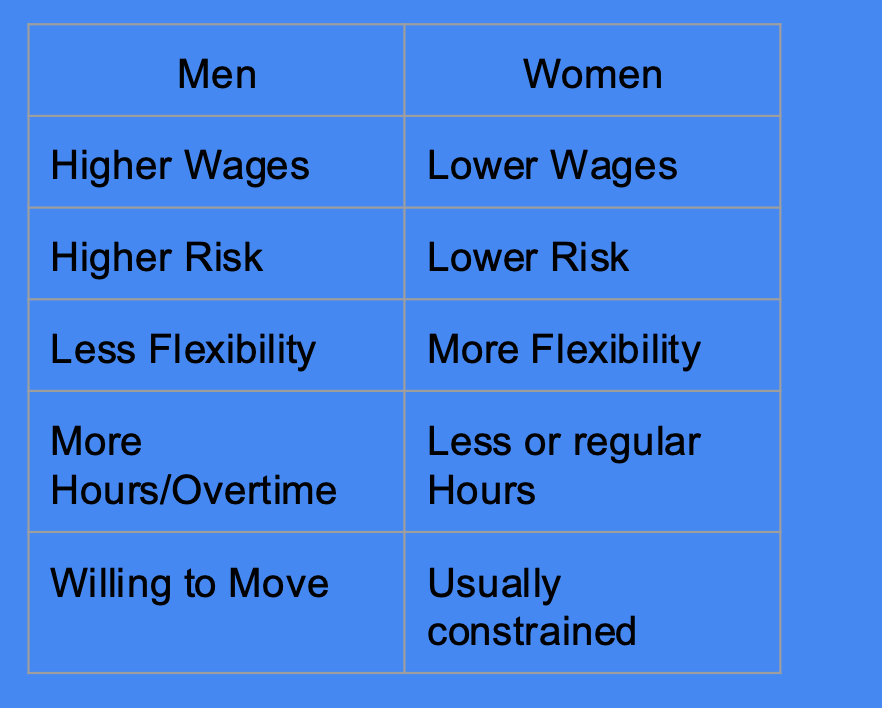
risky job= compensating differential b/c if not no one would do the job→ ex: window washer paid diff if doing it high up than ground b/c high up paid more
men and women diff elasticity b/c men respond to high paying jobs= highly segregated & women do not have the same effect of respond to high wages
men find/choice/pick risky job
risk aversion= women than men
flexbility= women time off and work hour
occupational bias= women will never make it
mobility= big issue for back examiner for on site supervision around the world highly men ; lots of going back and forth locations
Human Capital Theory
The human capital theory is used by economists to explain why some individuals invest in college while others do not, as well as why individuals choose varying fields of study.
Individuals and families make decisions regarding human capital investments based on expected costs and benefits of these investments, just as firms make analogous decisions with respect to physical capital.
Human Capital Investments= Investments in a worker’s stock of skills and knowledge to augment his/her productivity and earnings in the future
Physical Capital Investments= Investments in new plants, facilities, or machinery to augment the firm’s productive capabilities and increase output in the future.
Examples of Human Capital Investments: Formal Education, On-the-Job Training (OJT), Job Searching Geographic Migration
IQ= human capital outside of edu and training; creativity, trustworthiness, integrity, and punctuality
Capital nation brings with workers v.s. Physical capital
Rise in physical capital and diminish labor capital
People make a decision whether to invest in themselves or not, esp. After HS to continue edu or not.
Men and women make diff decisions when investing in themselves:
Overall, women invest in field of study that does not produce high wages
Men choose fields of studies that produces high wages
Level of Educational Attainment
Percent of the population completing bachelors degree or higher has been increasing over the past two decades= end up investing in their capital
Invest even more after 4 years of college
Much smaller stay in school forever
Not everyone invests in human capital, but on the rise
U.S. very educated nation
The educational level of American adults is on the rise as more college graduates go on to earn master’s, professional and doctoral degrees.
Reversal of Male Advantage in Higher Education b/c Women now are more likely to complete college than men.
College Field of Study
Gender Differences in Field of Study Are Persistent, But Narrowing. Significant Female Underrepresentation in some STEM Fields, particularly Engineering and Computer Science.
Highest paying jobs are highly segregated
Prefer majors in nursing, psych, etc. - women
M- preferred majors engineering, math, etc
Educational Investment Decision
Graph: looking at an individual decision (supply-side). First figure out the cost of education (direct) to figure out the deficit and the indirect cost too (wages you are foregoing). Add direct cost to opportunity cost. Not a flat line bc as they work over the years their wages increase, not at D their whole life bc more experience and become better at what you do. When you become better productivity is higher and will get raises over time. Older people are paid more because they have that experience due to increased productivity and usually mentor new workers. College grad will increase more than non-college grade bc of:
College wage premium: refers to how much a college-educated worker earns compared to high school educated workers:
For both men and women, college graduates earn more than high-school graduates. This earnings difference has grown more pronounced
Less educated women and men face greater challenges as their earnings situation has
deteriorated significantly.
College wage premium today is much higher than it used to be. People who invest in capital get higher wages.
Gross benefits: decided the high school education would not invest
Neoclassical: if the deficit low will invest in job
Human capital training and skills
Why are trades killing it? High wage and low skill. Since medium skilled jobs gone by substitution they go to that sector
Some degrees take so much investment
Earning profiles over the life span by education levels
Earning of college grad exceed those of high school graduates
Within each educational groups women earn less than men and women earning profile is flatter than men
Men with high school educated made more than college graduate women in 1970’s
While workers with a bachelor’s degree earn about double that of their co-workers without a college education, the difference between men’s and women’s earnings widens with more education.
College Wage Premium has increased significantly over time.
Education & Productivity
Education as a “Signal: Dr. Michael Spence’s Signaling Theory
Imperfect information Employers hire educated individuals because it signals higher productivity, and NOT because education provides skills.
Signaling model and gender differences in labor market outcomes
Imperfect info in what someone brings to the table.- ex: can have a prestigious degree but you are not fit due to qualities
Some people are better at school and they get money for it by scholarships etc. find money bc good at school.
Signaling can work with advance degree, degree signals investment and you invest more in HC and want a return on that investment, so will work harder.
Discontinuous worker:
How long you want to be in the LM is important
Females might drop out because of kids and stay out for many years and decide to go back but skills are depreciating. If expected, interruption won’t get the same gross benefits. Changes the dynamic. Will have a deficit and make little money and over time it will increase. Could be a reason people do not invest if they anticipate interruptions.
disruption = completely exiting LM
interruption= maternity leave, etc. coming back to LM
Reasons for gender diff in educations investment decisions
Expected work life and workforce disruptions- Assume women will invest less because of shorter work lives. Do education or nursing bc no commitment or choose jobs where if they interrupt or disrupt their skills will not depreciate.
Discrimination- been some time since college allowed women to get professions esp high end schools/ higher education discrimination.
Socialization- math scores, and personality.
Role models, mentoring and mentoring- help inspire or say what they should be esp to women not really to men
Men and women respond differently to grades: if women got c and d they will switch majors and men will stay even if they get bad grades. GPA in humanities higher than technical fields. Women elasticity to grades higher than men
How Do We Explain the Increase in Women’s Representation in College?
Increase in women expected work life
Anti-discrimination legislation
Increasing returns to investments in education for college educated men and women
Decreasing birth rates and some gain in terms of family friendly programs- no one is having kids, fertility rate very low and delaying age of having children. If you want it all but scared of recuperating costs, family workplace programs can change the dynamic of HCI. If you minimize disruption or interruption helps women and can change their decisions
College rate premium off the charts- most reason why not is do not like school bc return of investment of college is very high.
On the job training:
General training: completely transferable from one firm to the anther
Employers have no incentive to pay
Employee must bear all the cost and makes decisions by compare benefits to cost
Firm specific training: not transferable from one firm to another
Employer willing to pay some but not all the cost
Employee is not willing to pay bc benefits accrue only with continued employment with the firm
Cost are shared bc employer know you can take it with you somewhere else but will reap the benefits of that higher productivity
As soon as they pay they want a return of their investment- service agreement/terms and conditions. The bank examiner comes with a college degree takes 3 yrs of firm specific training and on the 4th yr leaves the employer will be mad, but if they have biases on people who will not complete it or something will avoid those candidates bc need commitment.
Many start not adding sex to decrease biases
Temporal Flexibility
Temporal Flexibility refers to flexibility of work schedules as they pertain to hours worked per day and per week, where the work is performed, and the need to work specific days and times.
As an alternative explanation for gender differences in occupations/earnings, certain occupations require or reward long/particular hours. Women may avoid these occupations OR if they work in these occupations women value flexibility and are willing to bear a wage penalty in exchange.
some occupations can be expensive= temporal flexibility and may not want people b/c of that
Compensating Differential: workers willing to provide longer hours or cover certain periods of time (the graveyard shift) receive a wage premium.
CD EX: corporate lawyer= ongoing relationship at any times for client if client calls at any time you will pick up and talk some firms have diff policies depends on firm and can produce diff wages. very little temporal flexibility and no substitution.
v.s.
pharmasits= you are scheduled, your kid is sick= just get someone else to cover, doesn’t care. has temporal flexibility and no penalty on wage or anything. substiutable.
CD EX2: lawyers diff demand from job like corporate v. DA b/c diff demand from job nand very diff
Psychological Attributes
Negotiating= women does not like to negotiate=men more comfortable doing this
Competitiveness= women avoid this/these types of jobs/situations
Attitudes toward Risk= women are risk averse, want stability in job and wage b/c women are agreeableness- men earn premium for being disagreeable women do not.
Gender Differences in Occupational & Earnings Outcomes Beyond Human Capital and Other Explanations
Nonmarket Time
Quitting
Family Location and Relocation
Male Marriage Premium and Motherhood Penalty= male earning increase before or after childbirth and for women their earning drop. trad m=breadwinner need to pay more b/c dependent for fam and women pick up more NMT men work hours therefore increase before child born wage. penalty harsher b/c feeds on itself and any other factors in wage. any impact on wage for women makes a difference. presence of children affects on women and educated does not matter experience
notion of productivity- women less productive than men, women more likely to get kids than men.
What is Labor Market Discrimination?
Exists when two equally qualified individuals are treated differently in the labor market solely on the basis of their gender, race, ethnicity, age, disability, or sexual orientation.
Why are we concerned about Labor Market Discrimination?
(1) Equity & Fairness
(2) Misallocation of resources- mismatch of skills with job
Equity and Efficiency
discrim can be overt or indirect (change decision tragectory & more damaging)
expect certain things and will avoid things and avoid HCI b/c anticipate discrim
Effects of Discrimination
Direct: Directly producing differences in labor market outcomes between men and women that are not accounted for by differences in productivity-related characteristics or qualifications.
Indirect: Lowers returns to human capital investments, thus women have less incentive to undertake investments in human capital; feedback effects on women’s behavior faced with discimination.
Assessment of Empirical Evidence: What conclusions can we make from the findings?
● Strong evidence of pay differences between men and women that are NOT accounted for by differences in an extensive list of measured qualifications
● Findings from homogeneous subgroups (such as lawyers or MBAs) provide further evidence
● Laboratory and field experiments provide evidence in hiring.
● Large payouts for sex discrimination court cases suggests further evidence.
Declining Gender Pay Gap
During the 1950’s and 1960’s, the gender pay ratio hovered around 59%.
The ratio began to rise in the 1980’s and by 2014, women full-time workers earned about 79% of what men did on an annual basis and about 83% on a weekly basis.
Explanations for the Decline in the Gender Pay Gap
★ Increase in explained portion of gender pay gap: improved qualifications for women (educational attainment, labor force attachment, shifts in occupations)
★ Decrease in unexplained portion of gender pay gap (or that which is unexplained by experience, education, occupation industry or union status)which has been influenced by:
○ Changes in attitudes toward women have decreased propensity for discrimination (it is less socially acceptable)
○ Improved measured (education and experience) and unmeasured skills (negotiating, assertiveness, etc.)
○ Labor market demand shifts that have favored women (white collar jobs) more than men (blue collar jobs)
Causes of Occupational Segregation
One= Human Capital Theory demonstrates that if women anticipate shorter work lives than men, it is in their economic self interest to choose occupations that require smaller educational investments and have low wage penalties for labor market interruptions. (Experience to Earnings Graph)
Two= Temporal Flexibility constraints whereby women choose fields of study that lead to occupations that do not require long hours, travel, or relocation. And within occupations, women choose positions that allow temporal flexibility and may forgo advancement
Three= Psychological attributes of women and traditional gender roles contribute to women choosing certain fields of study and occupations over others; lack of mentors.
Four= Discimination in hiring into male-dominated occupations, in promotions, and training (especially firm-specific training). Anticipations of discrimination may cause feedback issues.
Consequences of Occupational Segregation
One= Negative relationship between percent female in an occupation and the wage, even after controlling for education, experience and other factors. This means that predominantly female jobs pay less than predominantly male jobs.
Two= Glass escalator: Within female dominated occupations, men earn more than women. Glass ceiling: Women experience difficulties rising to higher ranks of hierarchies
Three= Within same occupational category (such as manager), women are more likely to be employed in lower wage firms and industries.
Four= Nonpecuniary consequences such as reinforcement of cultural norms (women as caregivers) and exaggerations of differences between men and women in social and economic roles

