Evolution Final for real
 Call Kai
 Learn
Learn Practice Test
 Spaced Repetition
 Match
Match Flashcards
 Knowt Play
1/160

There's no tags or description
Looks like no tags are added yet.
Name | Mastery | Learn | Test | Matching | Spaced | Call with Kai |
|---|
No analytics yet
Send a link to your students to track their progress
161 Terms
1855 human health discovery
John Snow maps the cholera outbreak in London and links it to the water
1858 human health discovery
Louis Pasteur develops germ theory of disease
1863 human health discovery
Robert Koch shows disease is caused by Vibrio Cholerae
1990s human health discovery
"Darwinian medicine" applies evolutionary principles to medicine
Sanitation and antibiotics
The battle against TB started with improved sanitation. Antibiotics helped push the disease to local extinction
The case of the flu virus
The flu virus evolves rapidly in response to the host's immune system because
-Large population sizes
- Short generation time
- High mutation rates
When is the evolution of the flu especially rapid?
At antigenic sites on the hemagglutinin protein of flu virus. Evolved at a constant rate since 1965 due to arms race of immune systems.
What causes pandemics?
When strains incorporate mutations at antigenic sites on hemagglutinin
What did they learn from frozen flu samples?
- Almost all strains die out as most mutations are neutral except for antigenic sites.
- Surviving strain is often the strain with the most antigenic mutations
Phylogeny of hemagglutinin (H) genes
- H genes have jumped across flu strains
- Pigs can host both bird and human strains
- H3 likely moved from birds to humans
Origin of pandemic flu strains
1. Two strains infecting the same host (human, pig) can allow RNA strands to recombine
2. This could create a new strain unrecognizable to hosts
3. Rapid virus spread (pandemic) can result
Evidence that antibiotics select for resistance
- Antibiotic resistance of bacteria in Iceland when use of penicillin was reduced
-Pattern implies that resistance is costly for bacteria
-From a pop perspective, minimize the use of antibiotics
Virulence
The harm done by a pathogen to the host
Coincidental virulence evolution
Accidental byproduct of selection for other traits
Short-sighted virulence evolution
Traits that enhance within host fitness may produce harmful side-effects (polio in nerve tissue is never transmitted)
Tradeoff virulence hypothesis
Natural selection favors strains that optimally balance the costs and benefits of harming the host
Virulence is higher in...
1. Vectorborne (malaria) vs directly transmitted pathogens (colds & flus)
2. Waterborne vs directly transmitted digestive / diarrhea-causing bacteria
What do vectors and water allow?
Disease transmission even from sick hosts
What are the "diseases of civilization"
Heart disease, strokes, cancer, myopia, and breast cancer. Diets and exercises have changed over the last 10,000 years
What does evolutionary psychology assert?
Human behavior is fundamentally shaped by natural selection, and the ultimate goal is to increase fitness
Why is evolutionary psychology limiting
Not ethically possible to do experiments to make strong conclusions
How much of animal genomes is unexpressed DNA
Around 10%, which is a lot. Viruses and prokaryotes have a little
What are mobile genetic elements, aka genetic parasites?
They contain only the sequence required to move. They are selfish, as duplication increases fitness.
Variation in mobile element content
Most of the unexpressed DNA in animals is from mobile elements. They aren't expressed but can alter transcription rates.
Alu elements
The most abundant transposable elements in primates. Humans have 500k copies but they are short
What is the primary source of new genes?
Duplication of existing genes
Segmental duplication
Duplication of stretches of chromosomes with many genes, single genes, or pieces of genes.
How does segmental duplication occur
From unequal crossing over during meiosis or by mobile element activity
Judicious use of antibiotics
The best defense against antibiotic-resistant bacteria is to avoid letting bacterial populations evolve resistance in the first place
What adaptation allowed icefishes to
dominate and speciate in ridiculously cold
Antarctic waters?
Antifreeze glycoproteins (
Heat shock proteins (HSPs)
Under periods of cellular stress, like high temperature, hsp genes are highly expressed to help cells deal with the stress
Anagenesis
Lineage changes, produces a new form
Cladogenesis
A lineage splits, producing new forms
Hybridization
Lineages combine, producing new forms
Three-step model of speciation
Isolation, divergence, secondary contact
Isolation in speciation
Gene flow is disrupted
Divergence in speciation
Genetic differences accumulate
Secondary contact in speciation
Populations re-establish contact and hybridize, outcomes vary
Mechanisms of isolation
Physical, dispersal & colonization, and vicariance
Allopatric speciation
Speciation initiated by physical/geographic isolation
Vicariance
The physical splitting of a habitat. (Pangaea or natural disasters)
Divergence
The accumulation of differences in genetics and phenotypes between isolated groups
Mechanisms of divergence
Adaptation to different habitats and assortative mating
Assortative mating
The type of mating that occurs when an organism selects a mating partner that resembles itself genotypically and/or phenotypically
Three possible outcomes of secondary contact
No speciation, very low fitness (postzygotic isolation), and reinforcement. Depends on relative fitness of hybrids
Postzygotic isolation
Hybridization that produces individuals with very low fitness. Often occurs due to genetic incompatibilites.
Reinforcement
When second contact occurs and populations evolve new traits to keep them separate.
Requirements of life
Ability to store and transmit information (genotype), ability to express stored info (phenotype), and ability for adaptive evolution.
Ribozymes
30-1000 ribonucleotides, single strand (folds like a protein), active site, and often forms and breaks phosphoester bonds.
Ribosomes are a "holdover" from the RNA world
- They translate info from proteins.
- They are highly conserved across taxa
- They consist of both proteins and RNA
- They require RNA adaptors (tRNA) to function
Four issues earliest replicator needed to solve
1. Going from simple inorganics -> larger molecules
2. Reactions must be favorable and have an energy source
3. Self-assembly of molecules into polymers such as RNA or polypeptides
4. Protection of biomolecules from harsh environments
How did simple inorganics -> larger molecules?
Possible from meteorites that often contain amino acids. However, both stereoisomers are usually present (they are not likely derived from living organisms)
Panspermia hypothesis
If microbes exist on other planets, could they have seeded Earth?
Radiation poses a problem (cold and vacuum aren't problematic)
Oparin-Haldane model: primordial soup
Reactions must be favorable and have an energy source
Methane + ammonia + H2 + energy = amino acids
Self-assembly of molecules into polymers
Clay may facilitate the 2nd step of the Oparin-Haldane model
Activated nucleotides join together on clay substrate
Minimum age of life, from fossil evidence
About 3.7 billion years. Better fossil evidence at 3.4 bya. Excellent fossils 1-2 bya.
The phylogeny of all living things
Small subunit ribosomal RNA: Highly conservative and useful for deep phylogeny
Horizontal gene transfer lesson
Use multiple genes to build phylogenies
Why is the tree of life so complicated and not tree-like?
Horizontal gene transfer
Fossilization and types of fossils
- Amber & freezing
- Permineralization & replacement
- Natural molds & casts
- Trace fossils
Ediacarian Biota
Represents the first assemblage of macroscopic fossils. Run-up to the more diverse Cambrian fauna.
The early animal radiations: Cambrian Explosion
The Burgess Shale Fauna reveals a massive variety of large, bilateral animals
What caused the Cambrian Explosion?
The extinction of the Ediacaran fauna and an increase in atmospheric oxygen
The fish-tetrapod transition
New fossils illuminate the origin of tetrapods in the Devonian era. Key bones in modern tetrapods can be recognized in transitional fossils
The dinosaur-bird transition
Origin of feathers predates the evolution of flight
The origin of mammals
Bones in lower jaw were incorporated into the middle ear of modern animals
Morphological diversity measured by what?
Occupancy of morphospace and periods/eras of natural history
Mass and background extinction
Constant, low rate of extinction side from 5 rare and large events
Evidence for the Cretaceous-paleogene extinction
- Iridium at the boundary
- Shocked quartz grains
- Microtektites
- A huge impact crater off the coast of Yucatan
Poisson Process
A process in which events occur continuously and independently at a constant average rate
Permian-Triassic extinction
Massive volcanic activity in Russia may have caused climate change that led to this event. Domination of terrestrial communities by the mammal-like reptile may reflect climatic instability during and after the event
Is the 6th mass extinction event underway?
Extinction follow in the footsteps of human dispersal around the world. The role of humans is especially clear in the case of New Zealand Moas.
Macroevolution: punctuated equilibrium and the importance of stasis
Early caricatures stressed a distinction between punctuated vs. constant change. However, recent data compilation and analysis indicate that substantial evolutionary change is punctuated but very rare.
Macroevolution: Why does stasis occur?
Stasis is not due to a lack of genetic variation.
Evolution above species level: traits that affect extinction rate
Attributes of whole species and genera, such as geographic range, may influence extinction rate. For example, marine taxa with planktonic larvae experience lower extinction rates.
Adaptive radiation
Rapid morphological diversification and occupancy of diverse ecological space. Can occur on a remote island following colonization, suggesting that ecological opportunity is the driver
Fossil & molecular divergence timing
Time-calibration of trees relies on fossil checkpoints and the clock-like regularity of molecular divergence.
What varies from branch to branch on time-calibrated trees?
Rates of morphological divergence
Was the Cambrian explosion really explosive?
Cambrian taxa may have originated much earlier than their appearance in the fossil record. Meaning it may be less explosive than fossils show
Did the end-of-Cretaceous mass extinction release mammals?
Time-calibrated trees indicate that many mammals originated and diversified long before
Altruism
Actor pays, recipient benefits
Altruism in nature
Cooperative and selfish behavior are common. Spiteful behavior is rare.
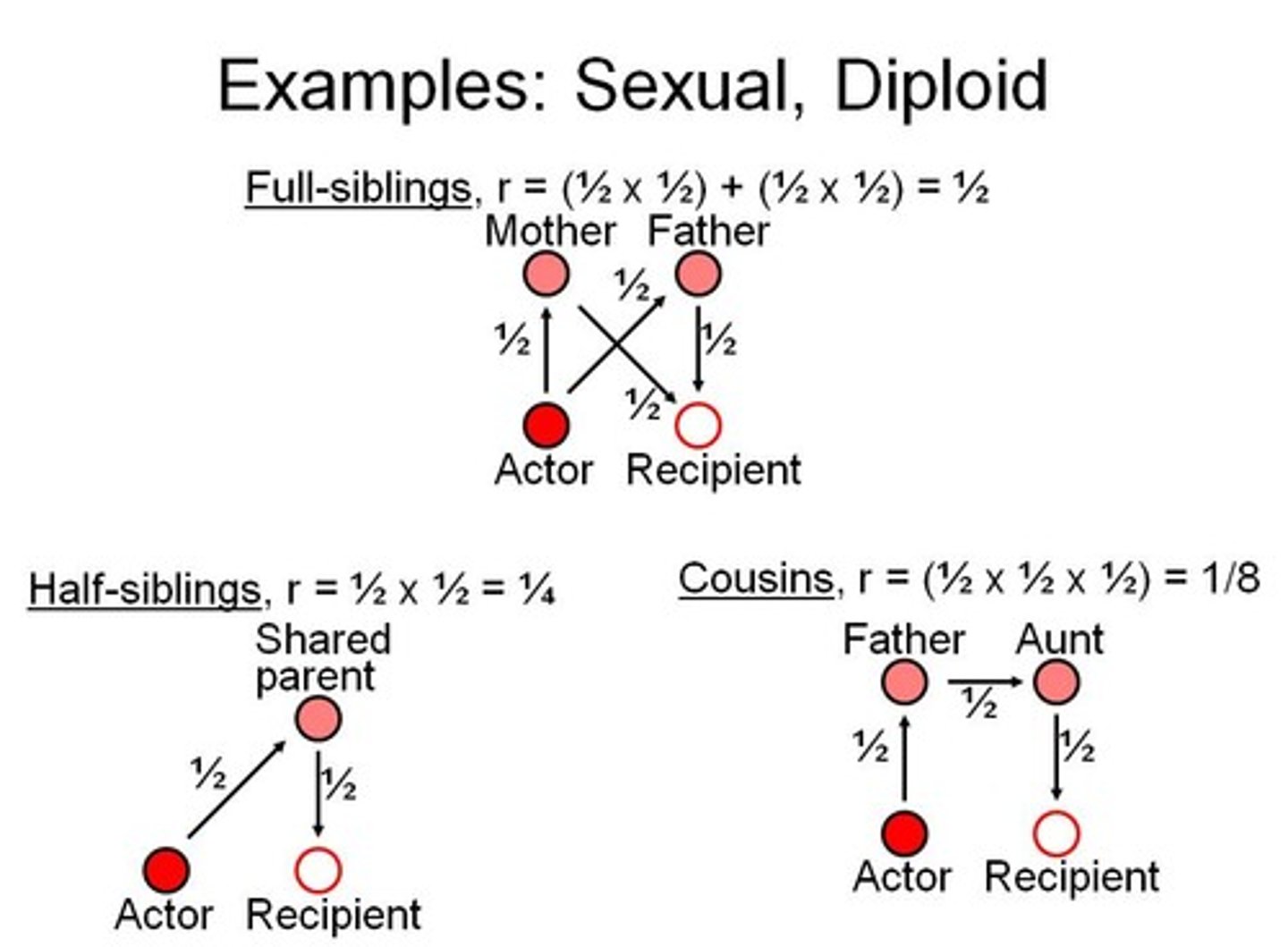
Coefficient of relatedness (r)
r = Probability that two alleles in 2 individuals are identical by descent. Similar to the inbreeding coefficient F (which measures whether 2 alleles within an individual are IBD)
Hamilton's rule
An allele for altruistic behavior will spread it Br > C.
B = benefit to the recipient
C = Cost to actors
r = coefficient of relatedness
Inclusive fitness
Direct fitness (actor's personal reproductive success) + Indirect fitness (change in relative's fitness due to actor's actions)
Kin selection
Selection for traits that increase indirect fitness
Parent-offspring conflict
Occurs when offspring favor their own well-being over parents' well-being
Siblicide, abortion, and infanticide
Fitness includes the number of young AND the survival of young. Therefore, it can be adaptive to reduce brood size during food shortages and overproduction of offspring.
Eusocial species traits
Overlap between parent and offspring generations.
Cooperative brood care
Specialized castes of non-reproductive individuals
Eusociality is an extreme form of altruism seen in...
Ants, bees & wasps. Termites, snapping shrimp & naked mole rats.
Haplodiploidy in Hymenoptera (ants, bees, and wasps)
Sisters are more closely related to each other than to their own daughters (if they could make daughters).
The haplodiploidy hypothesis states that female bees/ants should favor the production of sisters rather than their own offspring.
Haplodiploidy
To calculate r, the coefficient of relatedness:
- Follow paths from actor to recipient
- Tally proportion of genes shared
- Multiply to get r
What is a "Darwinian demon"?
Begin reproducing soon after birth, live forever, and produce an unlimited number of offspring
Why can't "darwinian demons" exist?
Trade-offs. Mainly between growth and reproduction. One must be prioritized.
Diversity in reproductive strategies
Some species reproduce once, and others many times.
Some species produce one-two eggs, and others millions.
Semelparous
Reproduce and die
Iteroparous
Reproduce multiple times
Life history
Pattern of energy allocation to growth vs. reproduction. Fundamental tradeoff between growth and reproduction
What does natural selection favor?
Growth vs reproduction rates that yield the highest total fitness.
Senescence
Late-life decline in fertility and survival

