Chapter 19
 Call Kai
 Learn
Learn Practice Test
 Spaced Repetition
 Match
Match Flashcards
 Knowt Play
1/290

There's no tags or description
Looks like no tags are added yet.
Name | Mastery | Learn | Test | Matching | Spaced | Call with Kai |
|---|
No analytics yet
Send a link to your students to track their progress
291 Terms
Sensory receptors
structures that detect stimuli
Can be structurally complex sense organs (the eye) or very simple endings of single neurons (dendritic endings in skin)
transducers
Receptors act as _________—they change one form of energy into another
Example: Visual receptors change light energy into electrical energy on the optic nerve
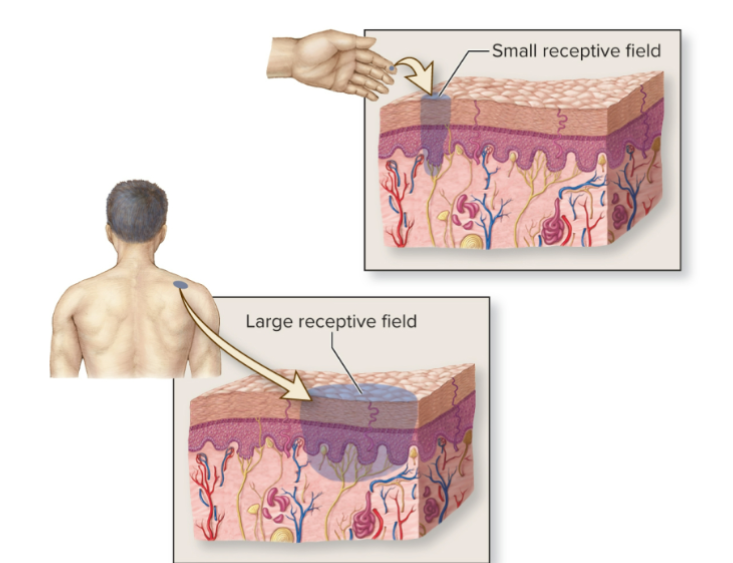
receptive fields
Receptors have ____________: Areas through which their sensitive ends are distributed
adaptation
Receptors exhibit _________: With prolonged exposure to a constant stimulus, they decrease action potential firing
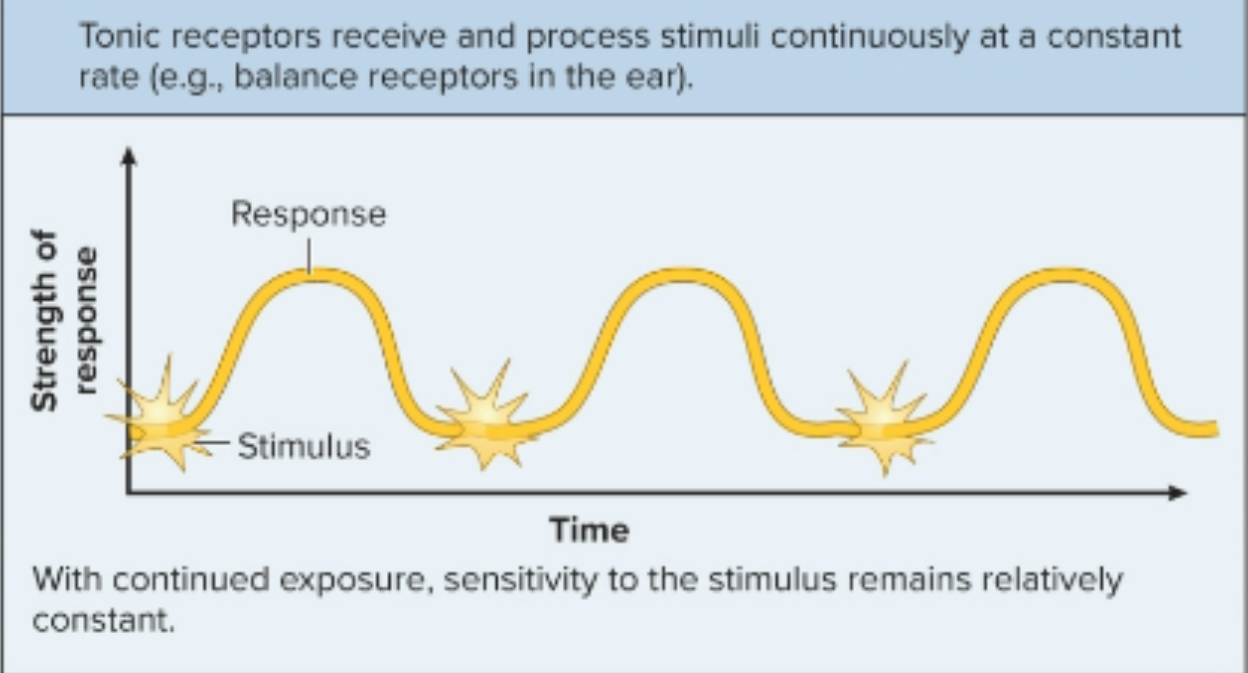
Tonic receptors
slowly adapt (only slowly decrease firing in response to a constant stimulus)
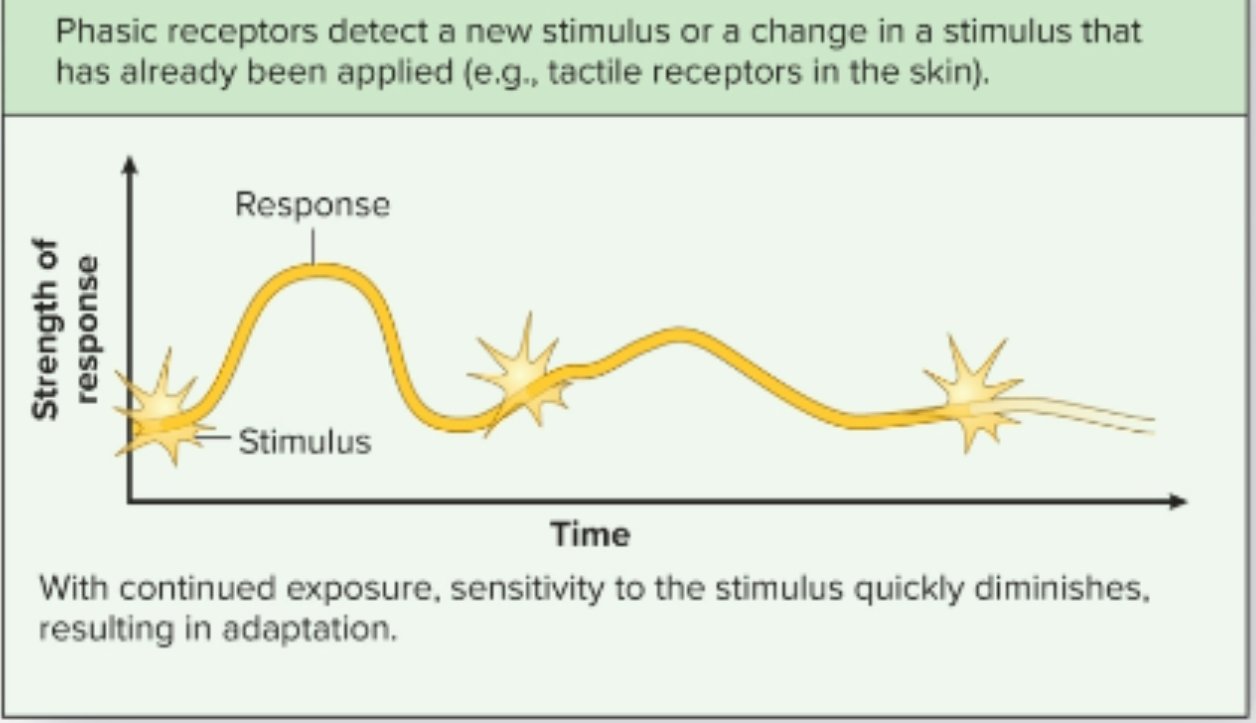
Phasic receptors
rapidly adapt to constant stimuli (fire only in response to changing stimuli)
General sense receptors
distributed throughout the skin and organs
Special sense receptors
housed in complex organs in the head
specialized, complex sense organs
Special senses are smell, taste, vision, hearing, and equilibrium
Receptor distribution, stimulus origin, modality of stimulus
Three criteria are used to describe receptors:
Somatic sensory receptors
found in skin, mucous membranes lining body cavities, joints, muscles, tendons
Monitor a variety of stimuli including texture, pressure, temperature, pain, vibration, and stretch
Visceral sensory receptors
in the walls of internal organs and blood vessels
Detect stretch, chemical concentrations, temperature, and pain
Exteroceptors
detect stimuli from external environment
Include receptors in skin, in body cavity linings and in special sense organs
detect stimuli in internal organs
Include stretch receptors in smooth muscle as well as receptors for pain, pressure, temperature, and chemical changes in viscera
Proprioceptors
detect stimuli pertaining to body position
Found in muscles, tendons, and joints
modality
Classification by ________ of stimulus depends on the stimulating agent
Chemoreceptors
Detect specific molecules dissolved in fluid
Thermoreceptors
Detect changes in temperature
Photoreceptors
Detect changes in intensity, color, and position of light
Mechanoreceptors
Detect touch, pressure, vibration, and stretch
Baroreceptors
Detect pressure changes within body structures
Nociceptors
Detect painful stimuli
Phantom pain
a sensation associated with a part of the body that has been removed
Phantom limb syndrome
Excitation of a CNS neuron that was formerly excited by the amputated limb is interpreted as pain in that limb
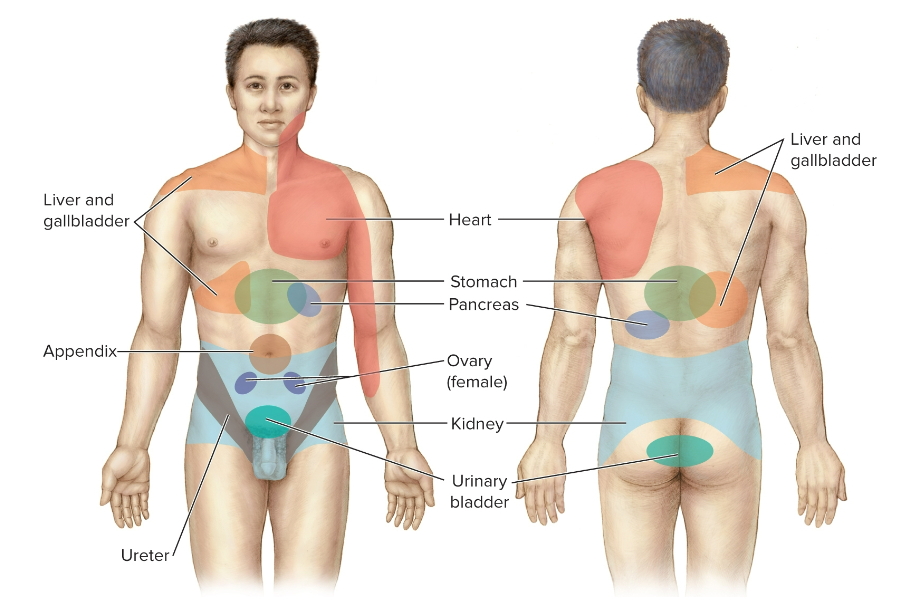
Referred pain
occurs when impulses from certain viscera are perceived as originating not from the organ but in a dermatome of the skin
T1–T5
Heart attack may be referred to dermatomes of _____
Source of referred pain
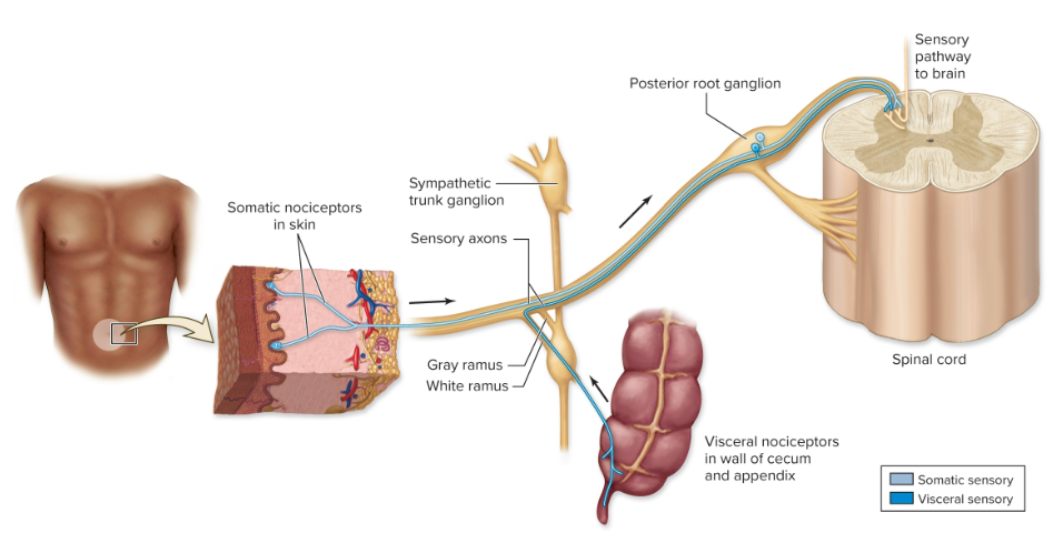
Common sites of referred pain
Tactile receptor
The most numerous type of sensory receptor
They are mechanoreceptors that react to touch, pressure, and vibration
Located in the dermis and subcutaneous layer
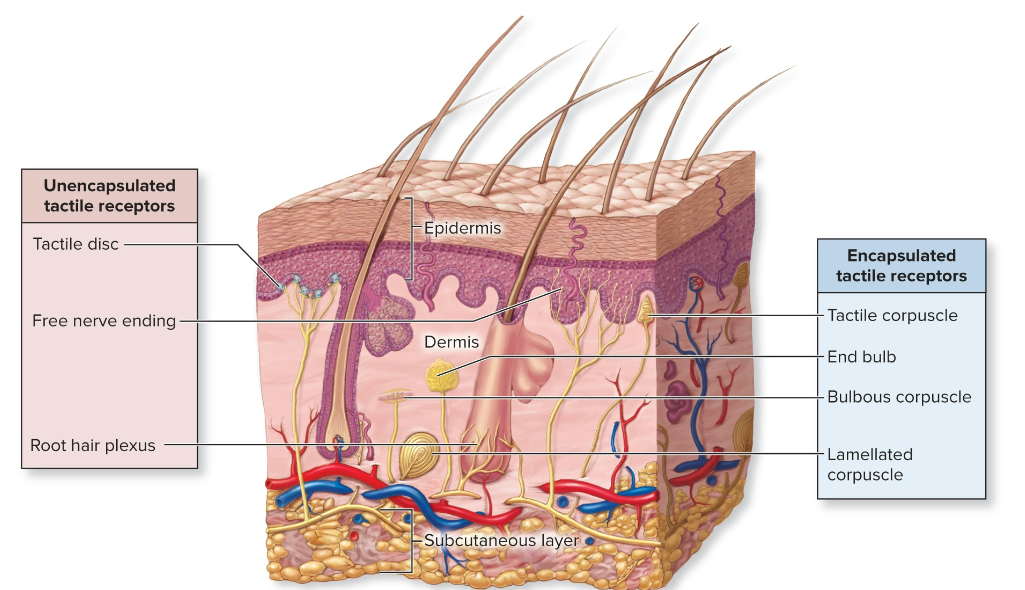
Unencapsulated
Type of tactile receptor whose endings not wrapped in connective tissue or glial cells
encapsulated
Type of tactile receptor whose endings are wrapped in connective tissue or glial cells
Free nerve endings, root hair plexuses, tactile discs
3 types of unencapsulated nerve endings
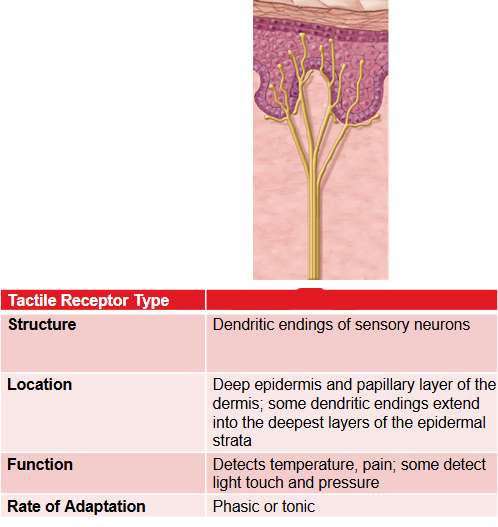
Free nerve endings
found in papillary layer of dermis and deep epidermis
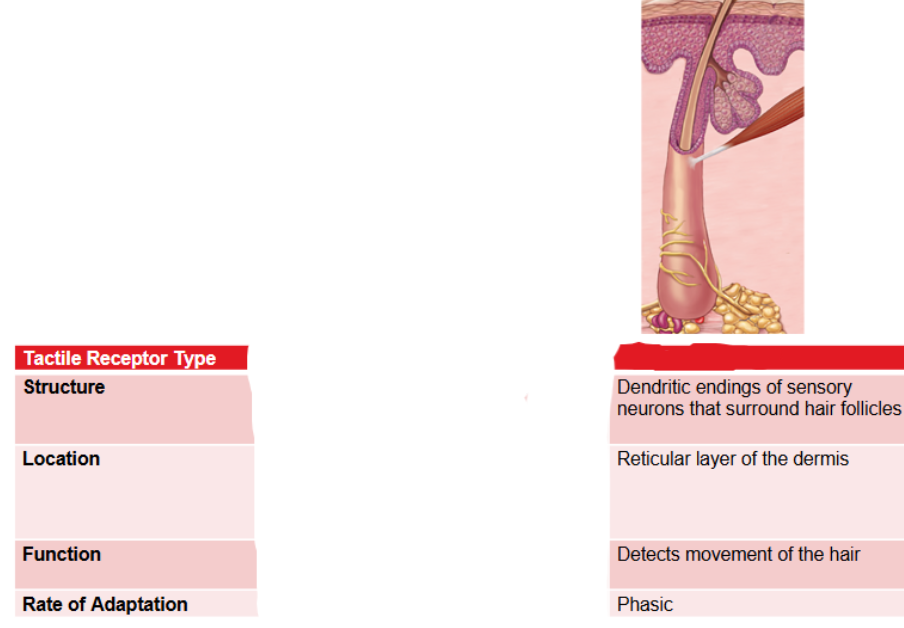
root hair plexuses
surround hair follicles in dermis
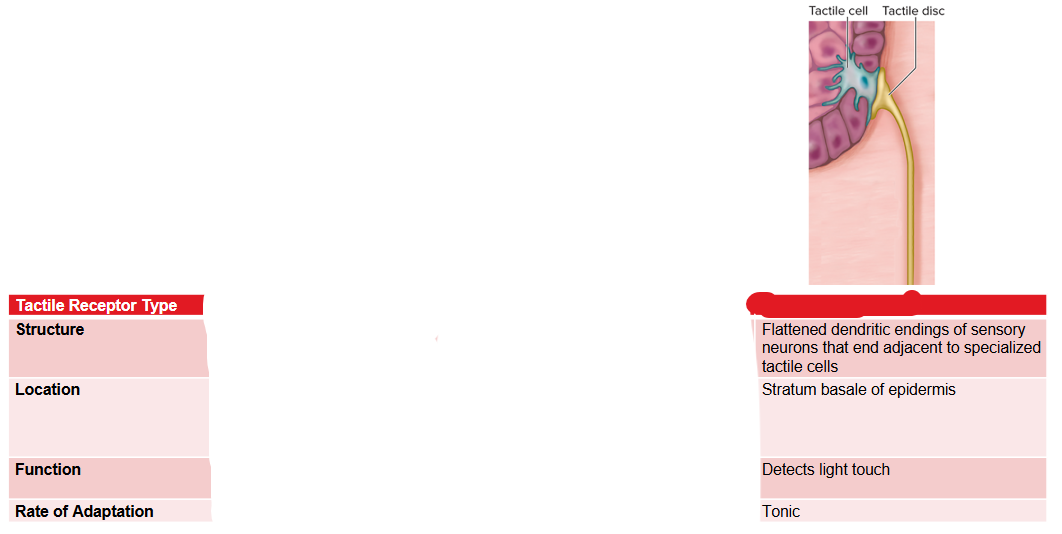
Tactile discs
associated with tactile cells in stratum basale of epidermis
tactile cells
Tactile discs: associated with ____________ in stratum basale of epidermis
End bulbs, Lamellated corpuscles, Bulbous corpuscles, Tactile corpuscles
Four types of encapsulated tactile receptors
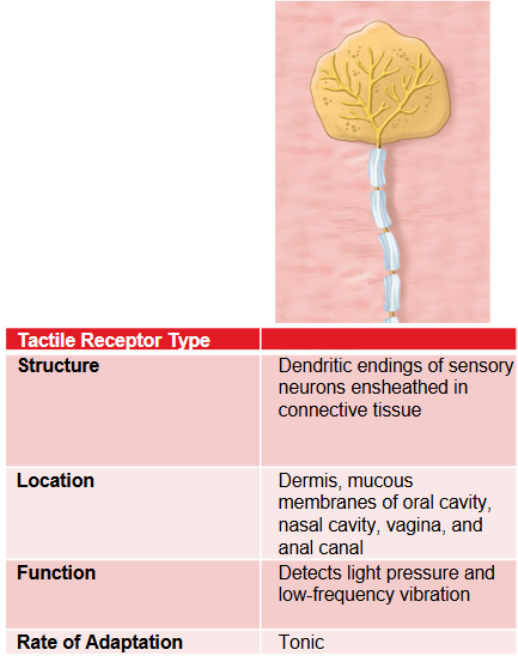
End Bulbs
in skin and mucous membranes of oral and nasal cavities, vagina, and anal canal
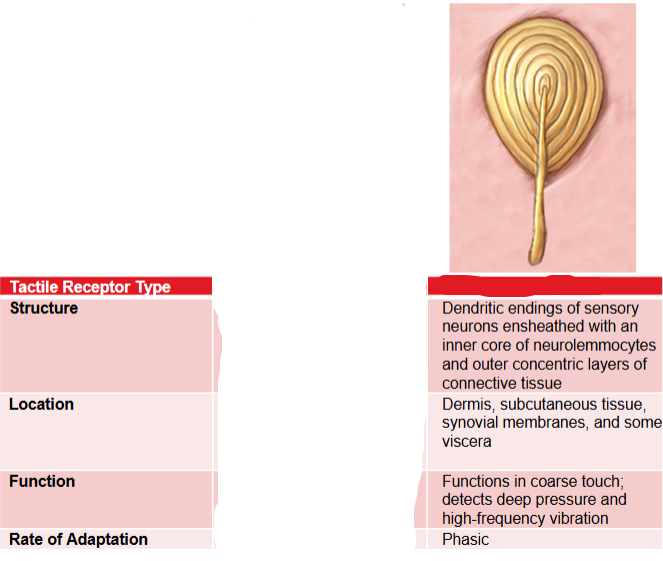
Lamellated corpuscles
in dermis, subcutaneous tissue, synovial membranes, and some viscera
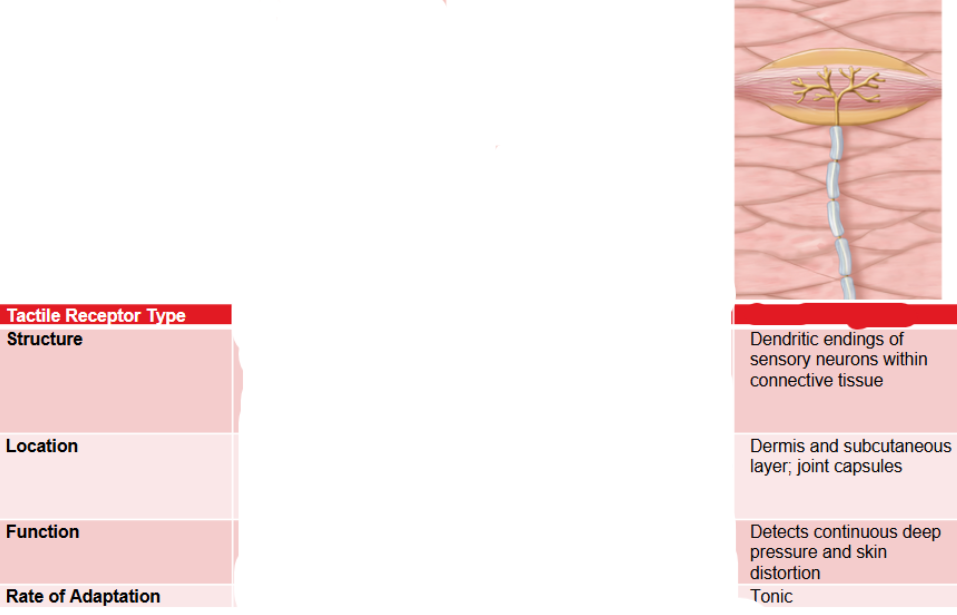
Bulbous corpuscles
in dermis and subcutaneous layer
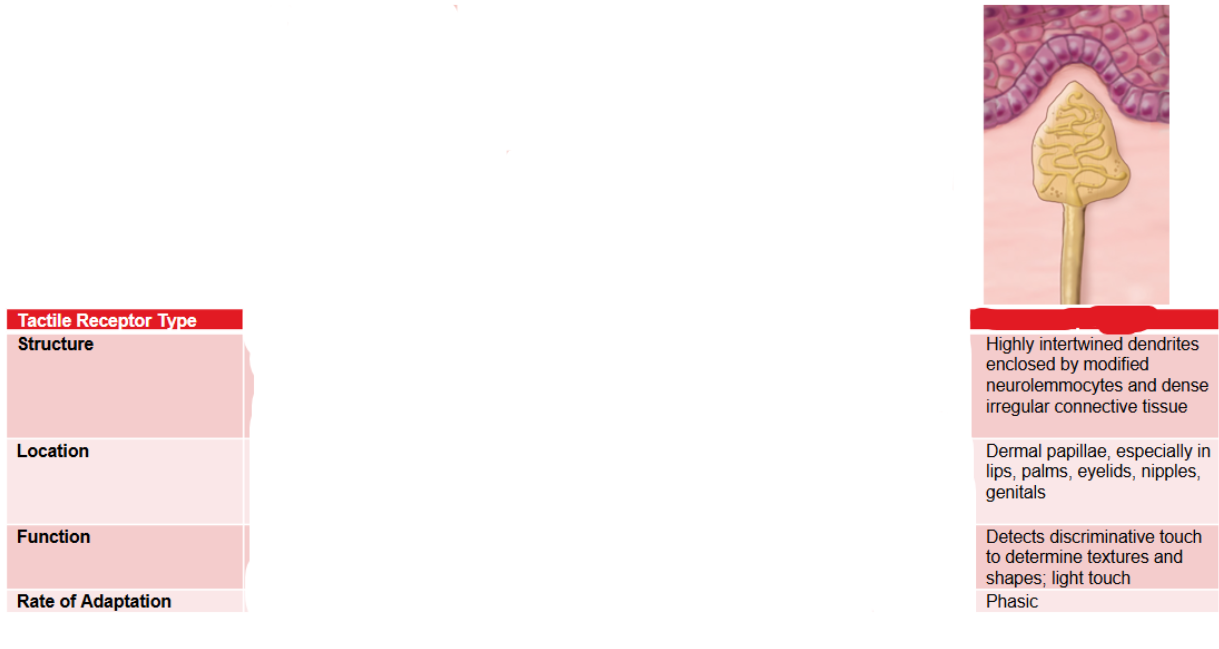
Tactile corpuscles
in dermal papillae, especially lips, palms, eyelids, nipples, and genitals
Free nerve ending
Root Hair plexus
Tactile/Merkel disc
End Bulb
Lamellated Corpuscle
Bulbous corpuscle
Tactile corpuscle
olfaction
the sense of smell
Odorants
dissolved in mucus of nasal cavity and detected
Sense of smell
Not as sensitive in humans compared to many other animals
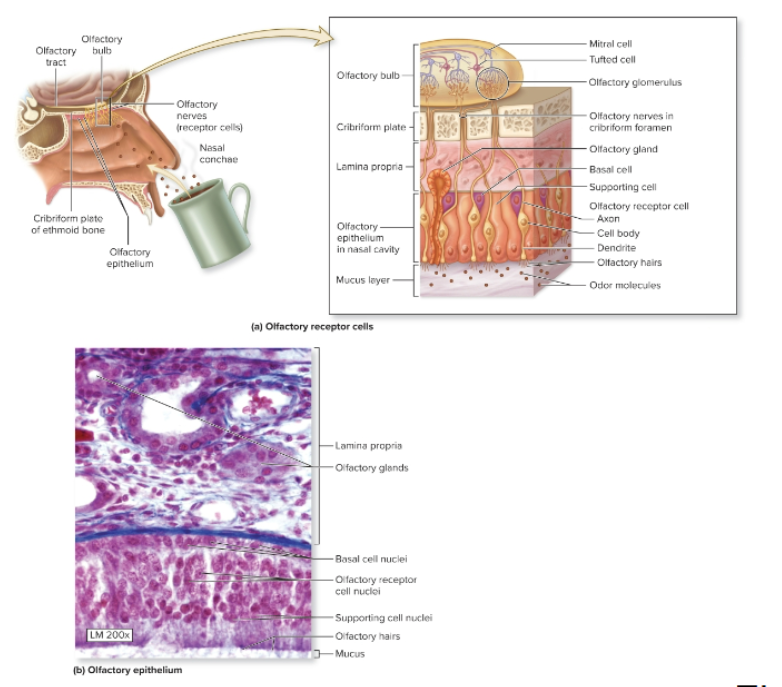
Olfactory epithelium
lining superior nasal cavity consists of three distinct cell types
Olfactory receptors, Supporting cells, Basal cells
lining superior nasal cavity consists of three distinct cell types- name the three cell types.
Olfactory receptor cells
detect odors
specialized bipolar neurons that are the primary cells in smell pathway
Supporting cells
sustain the olfactory receptor cells
Basal cells
replace olfactory receptors
neural stem cells that replace gustatory cells (regeneration every 7 to 9 days)
lamina propia
Deep to the epithelium is the
olfactory glands
Lamina propia contains mucin-secreting ___________
Olfactory organs
olfactory hairs (cilia)
Each Olfactory receptor cell has a single dendrite with many _______________ containing receptors for one odorant molecule
Depending on which receptor cells are stimulated, different smells will be perceived
olfactory nerves
Bundles of axons of olfactory receptor cells form
Sniffing or breathing deeply
needed to mix air with mucus of olfactory epithelium
eight
We recognize as many as ______ primary odors (for example, minty) and thousands of other chemical stimuli
Secondary odors are produced by combinations of chemicals and not recognized by all individuals
aging
Although olfactory receptor cells can be mitotically replaced, this declines with _______ (as does sensitivity to odors)
Olfactory bulbs
Axons from bipolar neurons of the nasal mucosa pass through foramina of cribriform plate and enter here
contain mitral and tufted cells
Olfactory bulbs contain about 2,000 olfactory glomeruli where olfactory cells converge
olfactory tracts
Neurons within olfactory bulbs project axon bundles, called ____________, to olfactory cortex of temporal lobe
Gustation
sense of taste
Gustatory (taste) cells
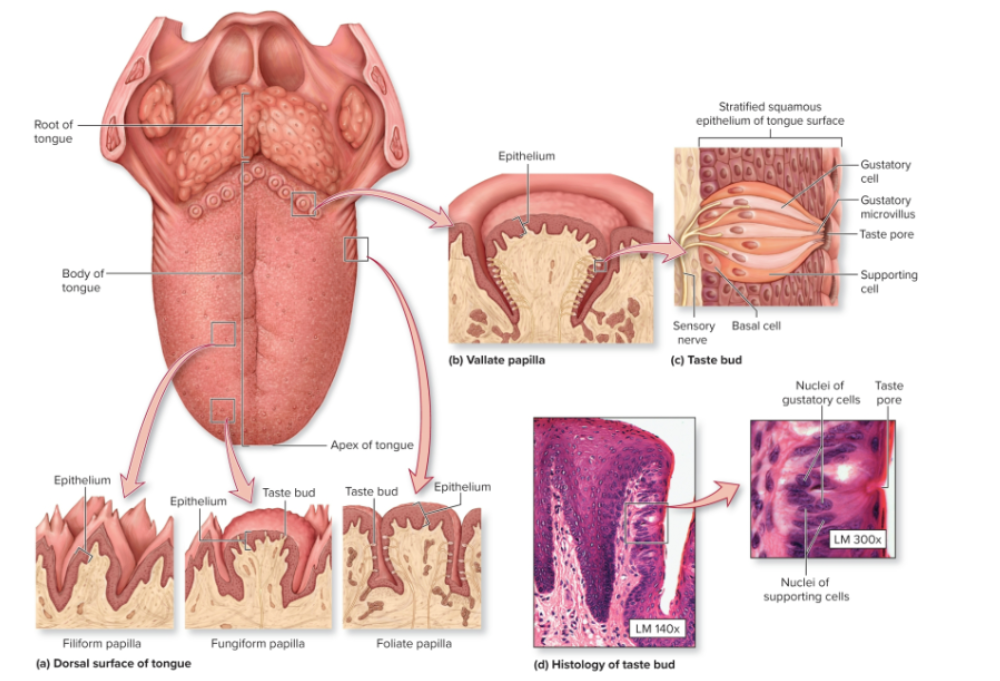
taste receptors housed in specialized organs termed taste buds
papillae
aste buds are located on the dorsal surface of the tongue in epithelial and connective tissues elevations called
Filiform, fungiform, vallate, foliate
4 types of papillae
Filiform papillae
Small numerous bumps lacking taste buds
Fungiform papillae
Mushroom-shaped bumps on tip and sides of tongue containing a few taste buds
vallate pappilae
Round bumps arranged in a “V” on posterior dorsal surface of tongue; contain many taste buds
foliate papillae
Subtle ridges on posterior lateral surface of tongue housing a few taste buds in early childhood
tastants
Gustatory cells detect ___________ (molecules and ions) in food
gustatory microvillus
Gustatory cells are neuroepithelial cells with a dendritic _____________ (taste hair) that is the receptive portion of the cell
taste pore
The taste hair extends through the ____________
Basal cells
neural stem cells that replace gustatory cells (regeneration every 7 to 9 days)
Tongue papillae and taste buds
Sweet, sugar, sour, bitter, umami
5 taste sensations
sour
taste sensations- acids
bitter
taste sensations- alkaloids
Umami
taste senation- amino acids
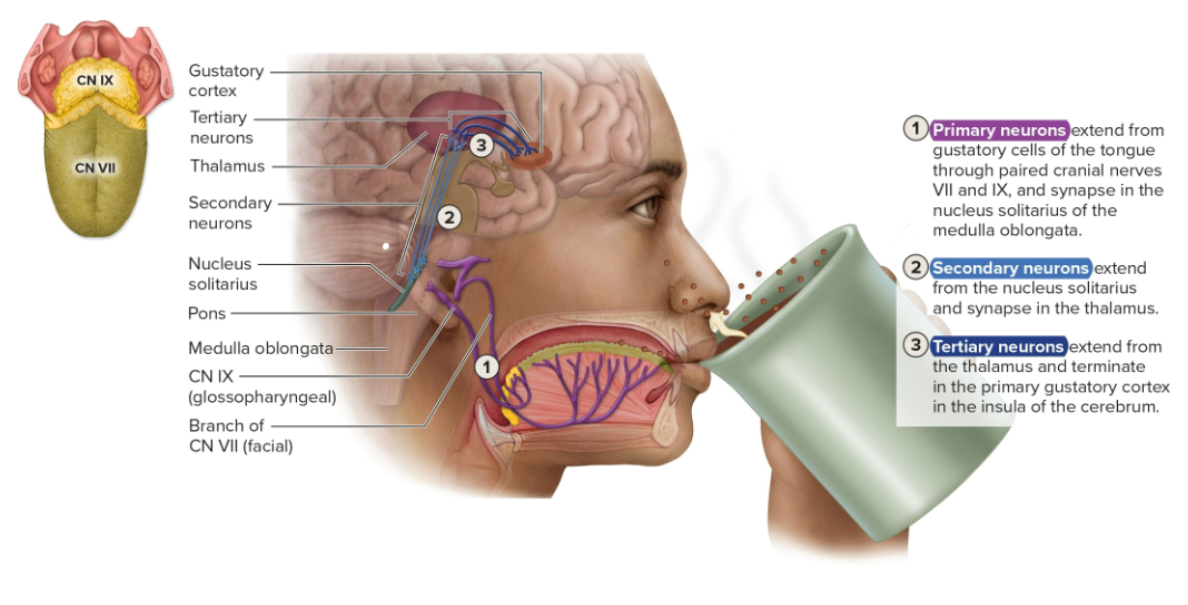
CN IX - glossopharyngeal
Taste buds from posterior two-thirds of tongue conduct gustatory information to CNS through which cranial nerve?
smell
Ability to taste relies heavily on sense of _________
Gustatory pathway
photoreceptors
Eyes use ___________ to help form visual images of the environment
Accessory structures
______________ of the eye protect against foreign objects and ensure that the eye surface remains clean and moist
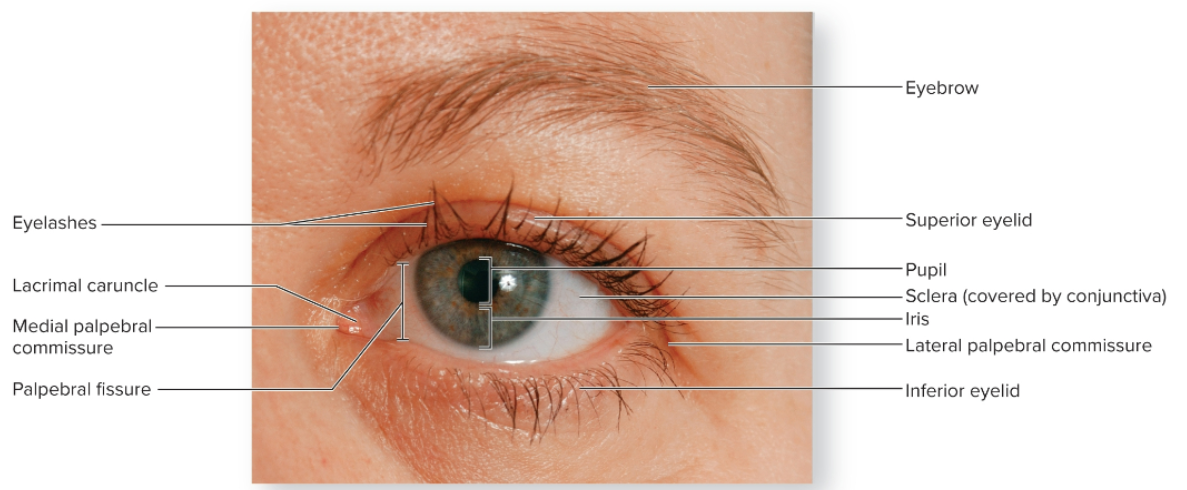
Eyebrow
thick short hairs along superior orbital ridge; prevent sweat from dripping into the eye
Eyelashes
hairs on margins of eyelids that prevent large foreign objects from contacting eyes
Eyelids
movable anterior protective coverings for eye
Tarsal glands
sebaceous glands within eyelids; secretion prevents overflow of tears and sticking together of eyelids
Palpebral fissure
space between eyelids
Medial and lateral palpebral commissures
corners of eyes
Lacrimal caruncle
medial pink bump containing ciliary glands that produce gritty secretion
Eye and accessory structures
Conjunctiva
lining over the anterior surface of eye and internal surface of eyelid
Stratified columnar epithelium
Space where it folds back on itself is conjunctival fornix
Contains blood vessels and nerves
Contains goblet cells that lubricate eye
Does not cover cornea
Conjunctival fornix
Space where conjunctiva folds back on itself

