Secondary Haemostasis & Lab Logic – Ultimate Flashcards (16)
 Studied by 0 people
 Call with Kai
 Learn
Learn Practice Test
 Spaced Repetition
 Match
Match Flashcards
 Knowt Play
1/15

There's no tags or description
Looks like no tags are added yet.
Name | Mastery | Learn | Test | Matching | Spaced | Call with Kai |
|---|
No study sessions yet.
16 Terms
What is the primary objective of Secondary Haemostasis?
To convert soluble Fibrinogen into a stable, insoluble Fibrin mesh that reinforces the initial platelet plug.
What enzyme family do most coagulation factors belong to?
Serine Proteases: They act like a "relay race," where each activated enzyme "cuts" and activates the next one in the chain.
Which factors are Vitamin K dependent, and why does this matter?
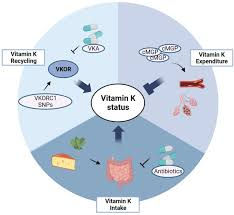
Factors II, VII, IX, and X. Without Vitamin K, the liver produces "PIVKA" (Proteins Induced by Vitamin K Absence), which cannot bind to calcium or platelets, leading to severe bleeding.
What is the "Extrinsic Tenase Complex"?
Composed of Tissue Factor (TF) and Factor VIIa. This is the "spark" that starts the cascade immediately upon tissue injury.
What is the "Intrinsic Tenase Complex"?
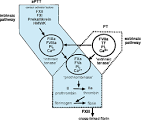
Composed of Factors IXa and VIIIa. This is the "engine" that maintains and amplifies the production of Factor Xa.
What is the "Prothrombinase Complex"?
Composed of Factors Xa and Va. Its sole job is to convert Prothrombin (II) into Thrombin (IIa).
Why is Thrombin (IIa) the most "important" enzyme?
It converts fibrinogen to fibrin, activates Factor XIII to stabilize the clot, and provides "positive feedback" to keep the cascade running.
What is the role of Factor XIII?
It is the Fibrin Stabilising Factor. It creates covalent cross-links between fibrin strands, making the clot permanent and strong.
Which test monitors the Extrinsic Pathway and which factor is most sensitive?
Prothrombin Time (PT). It is most sensitive to Factor VII (which has the shortest half-life).
Which test monitors the Intrinsic Pathway?
Activated Partial Thromboplastin Time (APTT). It monitors Factors XII, XI, IX, and VIII.
What is the role of Antithrombin (AT)?
A natural inhibitor that neutralises Thrombin and Factor Xa. Heparin massively increases its activity.
What is the "Protein C & S" pathway?
They are natural anticoagulants that "switch off" the co-factors Va and VIIIa, preventing the cascade from growing out of control.
What is Fibrinolysis and what is the key enzyme?
The process of dissolving a clot. The main enzyme is Plasmin, which is activated from plasminogen by tPA.
What is a D-Dimer and what does it tell a scientist?
It is a fragment of cross-linked fibrin. A positive result proves that a stable clot was formed and is now being broken down.
Why is D-Dimer a "Rule Out" test for DVT/PE?
It has high sensitivity (if you have a clot, it will be positive) but low specificity (it can be positive for many reasons like surgery or infection).
How does this link to DIC (Disseminated Intravascular Coagulation)?
In DIC, the cascade is "stuck" in the ON position. You use up all your factors and platelets (clotting) and then bleed from everywhere because none are left (consumptive coagulopathy).
 Note
Note  Flashcards (35)