GW BGZ 2024 Practical - Biomarkers of protein intake
 Call Kai
 Learn
Learn Practice Test
 Spaced Repetition
 Match
Match Flashcards
 Knowt Play
1/22

There's no tags or description
Looks like no tags are added yet.
Name | Mastery | Learn | Test | Matching | Spaced | Call with Kai |
|---|
No analytics yet
Send a link to your students to track their progress
23 Terms
What is the aim of the practical on biomarkers of protein intake?
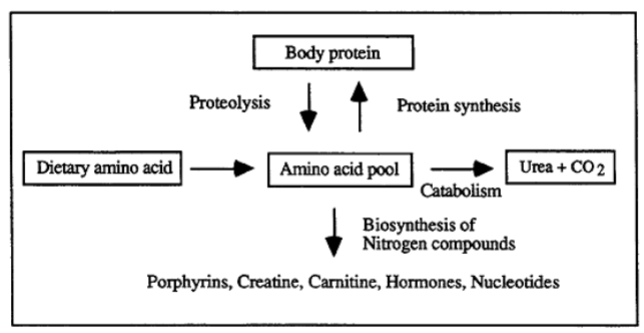
The aim is to investigate whether urinary urea excretion can be used as a biomarker of dietary protein intake. This is based on the physiological principle that dietary proteins are digested into amino acids, which are either used for body functions (e.g., tissue repair, enzyme synthesis) or broken down. When amino acids are catabolized, their nitrogen is converted into urea in the liver and excreted in urine.
Thus, measuring 24-hour urinary urea excretion provides an indirect estimate of protein metabolism and protein breakdown. Under the assumption of nitrogen balance (nitrogen intake ≈ nitrogen excretion), urinary nitrogen reflects dietary protein intake.
The practical integrates dietary assessment and biochemical analysis to evaluate the relationship between protein intake, nitrogen metabolism, and urea excretion.
What is meant by a biomarker of protein intake?
A biomarker is a measurable biological indicator that reflects a physiological or metabolic process. In this context, urinary urea excretion is used as a biomarker because it reflects nitrogen excretion from amino acid breakdown, which is directly linked to protein metabolism.
Since most nitrogen from protein catabolism is converted into urea, measuring urea in urine provides an objective estimate of protein breakdown and indirectly dietary protein intake.
Why is urea specifically used to assess protein intake?
Urea is the main end-product of nitrogen metabolism in humans. When amino acids are degraded, their amino groups are converted into ammonia, which is toxic. The liver converts ammonia into urea via the urea cycle.
Because:
Protein intake influences amino acid availability
Amino acid breakdown produces nitrogen
Nitrogen is excreted mainly as urea
There is a strong physiological link between dietary protein intake and urea excretion, making urea a useful biomarker.
What key assumption must hold true when using urinary nitrogen as a biomarker?
The assumption is that the individual is in nitrogen balance, meaning:
Nitrogen intake = Nitrogen output
This implies:
No growth (which would increase nitrogen retention)
No muscle loss, injury, or starvation (which would increase nitrogen loss)
If this assumption is violated, urinary nitrogen will not accurately reflect protein intake.
Why is a 3-day food diary used?
The 3-day food diary is used to estimate habitual dietary intake, specifically:
Total energy intake
Macronutrient intake (carbohydrates, fats, proteins, alcohol)
Fiber intake
The average protein intake (g/day) from these 3 days is later compared to biochemical measurements.
What are the most important rules for recording food intake?
Record immediately after consumption to avoid recall bias
Weigh food whenever possible for accuracy
Include:
Type of food
Brand
Quantity
Preparation method (boiled, fried, oil used, etc.)
Processing (fresh, frozen, canned)
Accurate recording is essential because errors directly affect nutrient calculations.
How do you convert recorded food into energy and macronutrient intake?
Food intake is translated into nutrients using food composition databases, such as:
NEVO (Dutch database)
Other international food tables
Each food item is matched with its nutrient composition per 100 g, allowing calculation of:
Energy intake
Macronutrients
Fiber
What are the energy conversion values for macronutrients?
Carbohydrates: 16.7 kJ/g
Protein: 16.7 kJ/g
Fat: 37.7 kJ/g
Alcohol: 29.3 kJ/g
Conversions:
1 kcal = 4.18 kJ
1 kJ = 0.24 kcal
Why is 24-hour urine collection necessary?
Because urea excretion varies throughout the day, a full 24-hour collection ensures:
Complete measurement of nitrogen excretion
Accurate estimation of daily protein breakdown
Discard the first morning urine (start time)
Collect all urine afterward for 24 hours
Include the first urine of the next morning
Record total time and volume
Avoid strenuous exercise
Use additional containers if needed
Why is the urine weighed?
To determine total urine volume:
Volume (L) ≈ weight difference (g)
This volume is required to calculate total urea excretion over 24 hours.
What is the principle of the enzymatic urea measurement?
Urea is measured using a UV spectrophotometric enzymatic assay:
Urea → ammonia (via urease)
Ammonia reacts with:
α-ketoglutarate
NADH
Produces:
L-glutamate
NAD⁺
The decrease in NADH absorbance at 340 nm is proportional to urea concentration.
Why measure absorbance at 340 nm?
Because NADH absorbs light at 340 nm, while NAD⁺ does not.
Thus, a decrease in absorbance reflects NADH consumption, which correlates with urea concentration.
Why is urea measured in duplicate?
To:
Improve accuracy
Detect experimental errors
Assess reproducibility
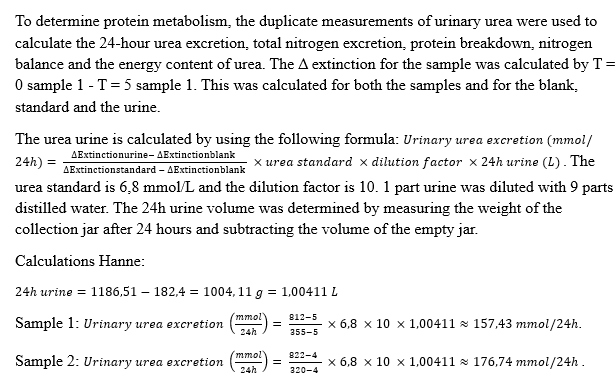
How is urinary urea excretion calculated?
Reference value: 170–580 mmol per 24 hours
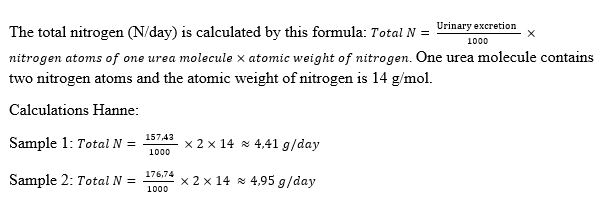
How is total nitrogen excretion calculated from urea?
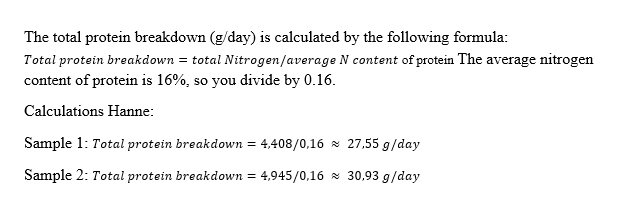
How is protein breakdown calculated?
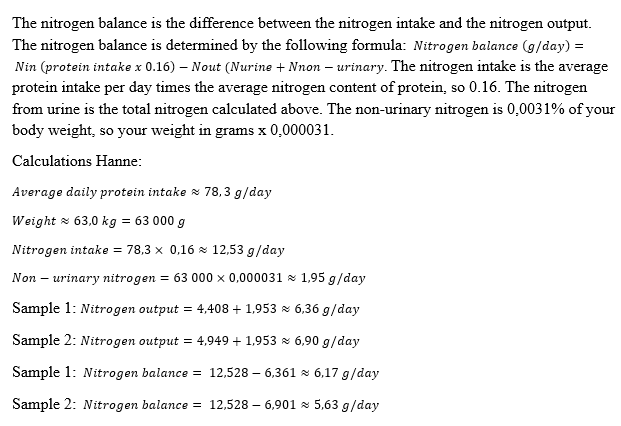
How is nitrogen balance calculated?
How do you interpret nitrogen balance?
Positive: intake > loss → growth or tissue gain
Negative: loss > intake → catabolism or illness
Neutral: intake ≈ loss → normal state
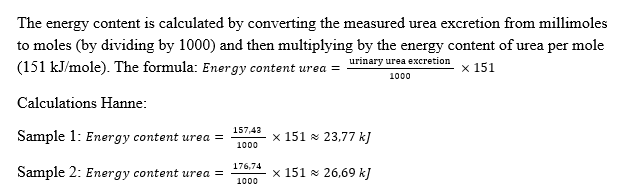
How is energy from urea calculated?
What could low urinary urea indicate?
Low protein intake
Incomplete urine collection
Measurement variability
Reduced protein breakdown
Why is there no perfect correlation between intake and breakdown?
Physiological factors (hormones, activity, energy balance)
Individual variability (metabolism, body composition)
Measurement errors (diet records, lab variability)
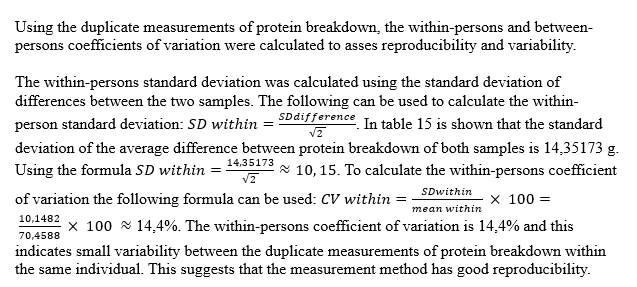
What does within-person coefficient of variation indicate?
It reflects variability between duplicate measurements in the same person.
Low values indicate good reproducibility.
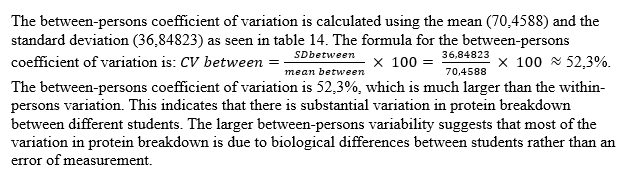
What does between-person coefficient of variation indicate?
It reflects differences between individuals.
High variability indicates biological differences in metabolism and intake.