IBA 550 TEST 1
 Note
Note Call Kai
 Learn
Learn Practice Test
 Spaced Repetition
 Match
Match Flashcards
 Knowt Play
1/34

There's no tags or description
Looks like no tags are added yet.
Name | Mastery | Learn | Test | Matching | Spaced | Call with Kai | Chat |
|---|
No analytics yet
Send a link to your students to track their progress
35 Terms
Globalization
The growing interconnectedness and interdependence of social, political, and economic environments on a global scale.
Market Globalization
The ongoing economic integration and increasing interdependence between national economies.
Drivers of Globalization
Factors that facilitate trade and economic globalization
Macro-drivers
Reduction of barriers to trade and investment
Technological advances
Reduction of barriers to trade and investment
Political cooperation
Removal of taxes
Decreased restrictions on foreign-owned businesses
Technological advances
Communications and shipping
1950 it was $20 to call from London to New York
Today it is virtually $0 (zoom)
Increased efficiency of trade
Inter-modal shipping containers
Shipping iPhones via plane vs sea.
Cost is 54 cents vs 1.2
Time is 30 days vs 15 hours
GDP
Gross Domestic Product, representing the total value of all goods and services produced in a specific geographic region.
Other Drivers
Political reform – adoption of free markets
Emerging markets
Integration of world financial markets (SWIFT network – messaging between banks and financial institutions to securely send info)
Natural Environment (Pros/Cons & Societal Impact / Winners and Losers)
Rich countries can move production to companies with less law and less minimum wage
Poor countries have weaker regulations
More manufacturing = More consumption
Less environmentally friendly practices
Jobs and Income (Pros/Cons & Societal Impact / Winners and Losers)
Argument: Manufacturing jobs are moved overseas
Counter: Countries on average are getting more wealthy. This made for a pay increase in skilled workers and in the workers in the countries of poverty.
The Poor (Pros/Cons & Societal Impact / Winners and Losers)
Argument: Widening the wealth gap
Counter: Some of the poorest countries have inequality due to their government not globalizing
National Sovereignty (Pros/Cons & Societal Impact / Winners and Losers)
WTO – World trade org
Argument – Too much power has been granted to super national orgs (having power that transcends national boundaries).
Counter: These organizations serve the collective interests and rely on persuasion instead of laws
CAGE Framework
A model encompassing Cultural, Administrative, Geographic, and Economic factors that influence international trade and business interactions.
Cultural
Language
Religion
Values – individualism vs collectivism (China, Korea, & Japan)
Social Norms
Administrative
Political environment
Colonial link
Trade agreements
Political hostility
Corruption
Geographic
Physical distance
Time zones
Land borders
Climate
Topography
Infrastructure
Economic
Relative wealth between countries
Similarity in profile
Market size
Labor costs
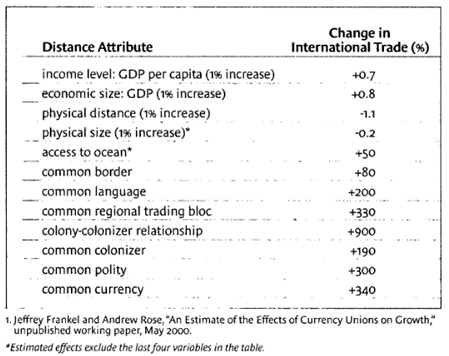
Distance Attributes and % Change in Trade
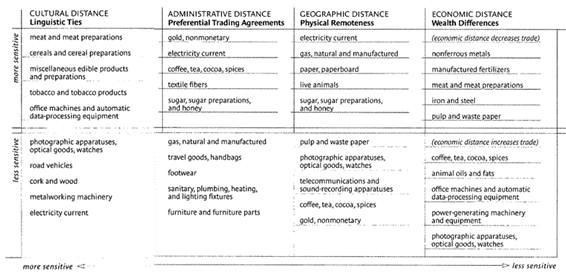
Distance vs Sensitivity
Paradox of consistency
The more consistent and profitable a firm is in their home market, the greater challenge it will have in a foreign market (Ex: NFL)
How do companies succeed in international markets
Innovation
Competitive Advantage of Nations Theory
Porter's Diamond model highlighting factors like Factor Conditions, Demand Conditions, Related and Supporting Industries, and Firm Strategy, Structure, and Rivalry that contribute to a nation's competitive advantage.
Factor Conditions
nations position in factors of production such as skilled labor or infrastructure
Labor – (more skilled or less costly)
Land
Natural resources
Capital
Infrastructure
Specialized knowledge (more developed countries have better education systems)
Italy and Japan had disadvantages in terms of location and geography, but this helped them to grow other advantages
Demand Conditions
Nature of home market demand
Home bias to demand
Fast food
Self checkout
Sophisticated Customers – Not just demanding more but demanding how to make it better. Helps more with product innovation. (Toyota in Japan vs the auto company in India)
Related and Supporting Industries
The presence or absence of supplier industries and other industries that are internationally competitive.
Telecommunications
Specialized knowledge sharing between industries in the same area
Sophisticated suppliers
Firm Strategy, Structure, and Rivalry
How companies are created, organized, and managed as well as the nature of domestic rivalry
Domestic Rivalries – Toyota vs Honda or Apple vs Microsoft.
Fit between nature of industry and nature of country – German culture is very planned out and structured. Logical that they fit well with engineering-oriented industries or rapid change like marketing or film.
Porter’s argument towards the government’s influence on markets
Argues for a limited role with government influence in markets
Government looks for a quick fix whereas companies invest time and effort in people and growth
Government’s role is to encourage competition and ensure safety and environmental standards
Industrial Policy
Government interventions and policies aimed at influencing global trade, supporting domestic sectors, and incentivizing R&D and manufacturing investments.
What Businesses Should Do
Accept or not accept – companies have to determine whether to accept subsidies or not. Some range from meeting a minimum investment to giving the government equity in their company
Pfizer – government bought 100 million doses
GM – government have more than $50 billion in funding for 60.8% of shares in GM
Engage and Educate – focusing on educating government officials on competing issues rather than advocating for a certain argument
Collaborate – Working upstream and downstream partners in the supply chain can lead to commercially successful outcomes that align with policy.
Understand that these subsidies are not always going to be here so have a strategy plan to survive without them.
The Fall and Rise of Industrial Policy
There has been skepticism of the government and these “administrative guidance” techniques.
After US investment failures in the solar panel market, synthetic fuels and the supersonic passenger jetliner, many governments intervened less.
The past 5 years, this has changed due to global warming and Covid-19.
Operation warp speed was a federal effort that supported multiple vaccine candidates to speed up development of mRNA vaccines to fight Covid-19. Because the government stepped in, companies were now willing to take larger risks than they would have in the past.
A more controversial and increasingly common type of intervention focuses on helping specific industries of sectors (Airbus).
With how incentives have helped the Chinese be the leading manufacturer of EVs, other governments are starting to intervene as well.
Friend-shoring and industry specific trade alliances add another challenge for global companies.
Industrial Policy Types
Horizontal
Vertical
Supply side
Demand side
Horizontal
apply to firms irrespective of their activities, their location or the technologies they use (R&D tax credits)
Vertical
apply to a specific sector or firm (renewable energy)
Supply-Side
apply to the costs of R&D or production to favor certain locations or materials (grants, subsidies, tax preferences, and tax credits)
Demand-Side
apply to the consumer typically affecting domestic consumption of products and increase the size of the market (tax credits for the purchase of an EV & Inflation Reduction Act)