"Medallion" & "View of a Pig" Jacks
 Studied by 0 people
 Call Kai
 Learn
Learn Practice Test
 Spaced Repetition
 Match
Match Flashcards
 Knowt Play
1/16

Earn XP
Description and Tags
Name | Mastery | Learn | Test | Matching | Spaced | Call with Kai |
|---|
No analytics yet
Send a link to your students to track their progress
17 Terms
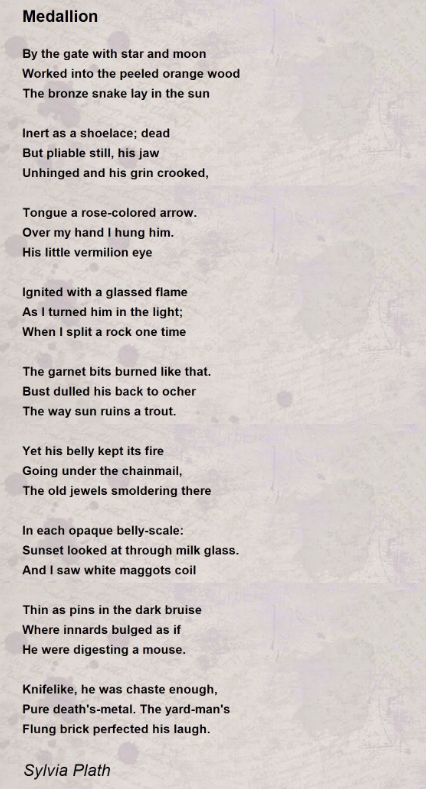
Analyse this poem. (6)
Introductory compound declarative sentence
Plath's introductory sentence uses a simile which describes the snake as the snake as 'inert as a shoelace; dead', but is immediately juxtaposed with the discourse marker 'but', reviving the snake somewhat within the dependent clause 'but pliable still’.
Pronouns & Consonance
The speaker anthropomorphises the snake through the use of third-person, personal he/him pronouns.
This is seen in the quote “over my hand I hung him”, which also uses gentle plosive consonance which may indicate the empathy from the speaker.
Semantic field
Plath seemingly utilises the common literary technique of presenting fire as an indicator of life through a fiery semantic field observable within descriptions of the snake, such as 'His little vermilion eye ignited with a glass flame' and 'his belly kept its fire...the old jewels smouldering there'.
This further laments upon both the previous life of the snake and the potential for life to continue despite its death, through the speaker's altruistic immortalisation of it.
Past progressive tense & aspect
The simile 'his innards bulged as if he were digesting a mouse', which like Hughes' speaker uses the past progressive tense and aspect while observing the snake's fate, which seemingly evokes a sense of life, or the potential for life, within the snake’s fatal wound.
What collection is “Medallion” from?
The Colossus (1960)
Structural techniques in “Medallion”
Tercets
Plosive consonance
Which typical traits of Plath does “Medallion” use?
Red colour symbolism
Consonance
Eyes
Which literary context is relevant to “Medallion”?
Plath seems more optimistic in this poem — she usually goes for absurdism but this poem seems hopeful/wistful rather than outright pessimistic
Reaction to the Movement movement — vulgar description
Which autobiographical context is relevant to “Medallion”?
During her time writing the Colossus collection, Plath went through the final stages of her therapy, and was increasingly writing about the topic of death. Therefore, the optimistic approach to death perhaps reflects her own internal conflicts, which she attempts to come to terms with through her poetry.
Plath was known to battle with mental health issues and faced multiple suicide attempts — this poem may reflect her continued grapple with her perspective on death/mortality.
Newman
“In many instances, it is nature who personifies [Plath].”
Stenskar
“Death is presented as […] a possible transition. In Medallion it is the place of liminality and the snake’s potential immortality”
Analyse this poem. (
What typical traits of Hughes does “View of a Pig” use?
Motif of violence
The pig’s eyes are closed — powerless (Hughes’ poetry typically uses eyes as an indication of authoritarianism). Contrasts the red eye in Medallion
Which literary context is relevant to “View of a Pig”?
Reaction to the Movement movement
Which autobiographical context is relevant to “View of a Pig”?
Hughes second collection Lupercal explores the integration and alienation of humankind from nature, so perhaps the negative perspective in this poem is a satirical account of animalistic human tendencies that ironically disconnect humans from the animal kingdom.
Hughes grew up surrounded and inspired by violence — here he interrogates its consequences
Varma
In View of a Pig, the pig is “inactive alongwith the depiction of the failure of the poet.”
Middlebrook
“Hughes and Plath write from one shared mind.”
How are these poems similar and different?
There are direct technical comparisons — e.g. the use of consonance and pronouns
Plath gives the snake power while Hughes takes it from the pig — seen e.g. through the eyes of the animals
Hughes may be a universal emblem for human attitudes (apathy) to the death of animals
 Note
Note  Flashcards (491)