STRUCTURES 1 - LECTURE 04 MOMENT IN EQUILIBRIUM
 Studied by 0 people
 Call with Kai
 Learn
Learn Practice Test
 Spaced Repetition
 Match
Match Flashcards
 Knowt Play
1/13

There's no tags or description
Looks like no tags are added yet.
Name | Mastery | Learn | Test | Matching | Spaced | Call with Kai |
|---|
No analytics yet
Send a link to your students to track their progress
14 Terms
moment of a force
the tendency to make an object or a point rotate.
- a force will only produce it about its point when applied at a distance.
- calculated as the product of a force's magnitude and the perpendicular distance from the force's line of action to the rotation point (called the moment arm).
- has magnitude and direction.
- expressed in terms of the product of length and force units (ex: lb x ft = lbft)
equation for moment of a force:
M₀ = fd (force x distance)
- also written as force x arm
what type of effect will a force have on a point that doesn't have any perpendicular distance from the line of action?
translational effect (it moves through a space wthout rotating).
what type of effect will a force have on a point that does have perpendicular distance from the line of action?
rotational effect (it moves by rotating on an axis).
- happens when nonconcurrent forces act on an object (must be balanced by an equal moment in the opposite direction; summation of moment has to equal 0 to prevent rotation).
when does a force not have any moment about a point?
when it passes through or acts on said point.
clockwise = ?
counter-clockwise = ?
clockwise = negative moment
counter-clockwise = positive moment
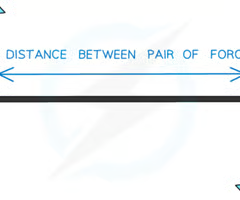
couple
two forces seperated by distance that have the same magnitude, parallel lines of action, and opposite senses.
- the moment of the two forces about a point ≠ 0 even though the sum of couple forces in any direction is = 0.
- the action of a couple will rotate the object at that point.
- to find magnitude of a couple, multiply one of the couple forces by the perpendicular distance.
external force/moment
an applied force that causes an object to translate, rotate, or stay at rest.
internal force/moment
an internal force within an object that develops in response to an eternal force/moment.
when is an object stationary/at rest?
when the internal and external forces are in balance.
the two types of external forces that act on a rigid body
applied forces and reactive forces
applied forces
forces directly applied on a structure (ex: snow load)
reactive forces
forces created by the action of one body on another body.
- usually occurs at the supports.
- realized by newton's 3rd law.
equations for the equilibrium conditions of nonconcurrent forces:
ΣFₓ = 0 (summation of forces in the horizontal direction = 0)
ΣFᵧ = 0 (summation of forces in the vertical direction = 0)
ΣM = 0 (summation of moments in any direction should = 0, meaning no external net rotation)
 Note
Note  Flashcards (121)