Heart and Lung worm in Dogs and Cats
 Studied by 0 people
 Call Kai
 Learn
Learn Practice Test
 Spaced Repetition
 Match
Match Flashcards
 Knowt Play
1/22

There's no tags or description
Looks like no tags are added yet.
Name | Mastery | Learn | Test | Matching | Spaced | Call with Kai |
|---|
No analytics yet
Send a link to your students to track their progress
23 Terms
Describe the following for Dirofilaria immitis.
Final Host
Intermediate Host
Site
Distribution
• A nematode (roundworm) parasite
• Final host: dog, wild dogs, cat, ferret, sea lion, (human, accidental FH, zoonotic)
• Intermediate host (IMH): mosquito - has an indirect life cycle
• Site: cardiovascular system
right ventricle, posterior vena cava, pulmonary artery
• Distribution: USA, warm temperate zones (Europe), tropics
• Not endemic in UK - identified in pets travelled or imported from Southern and Eastern Europe
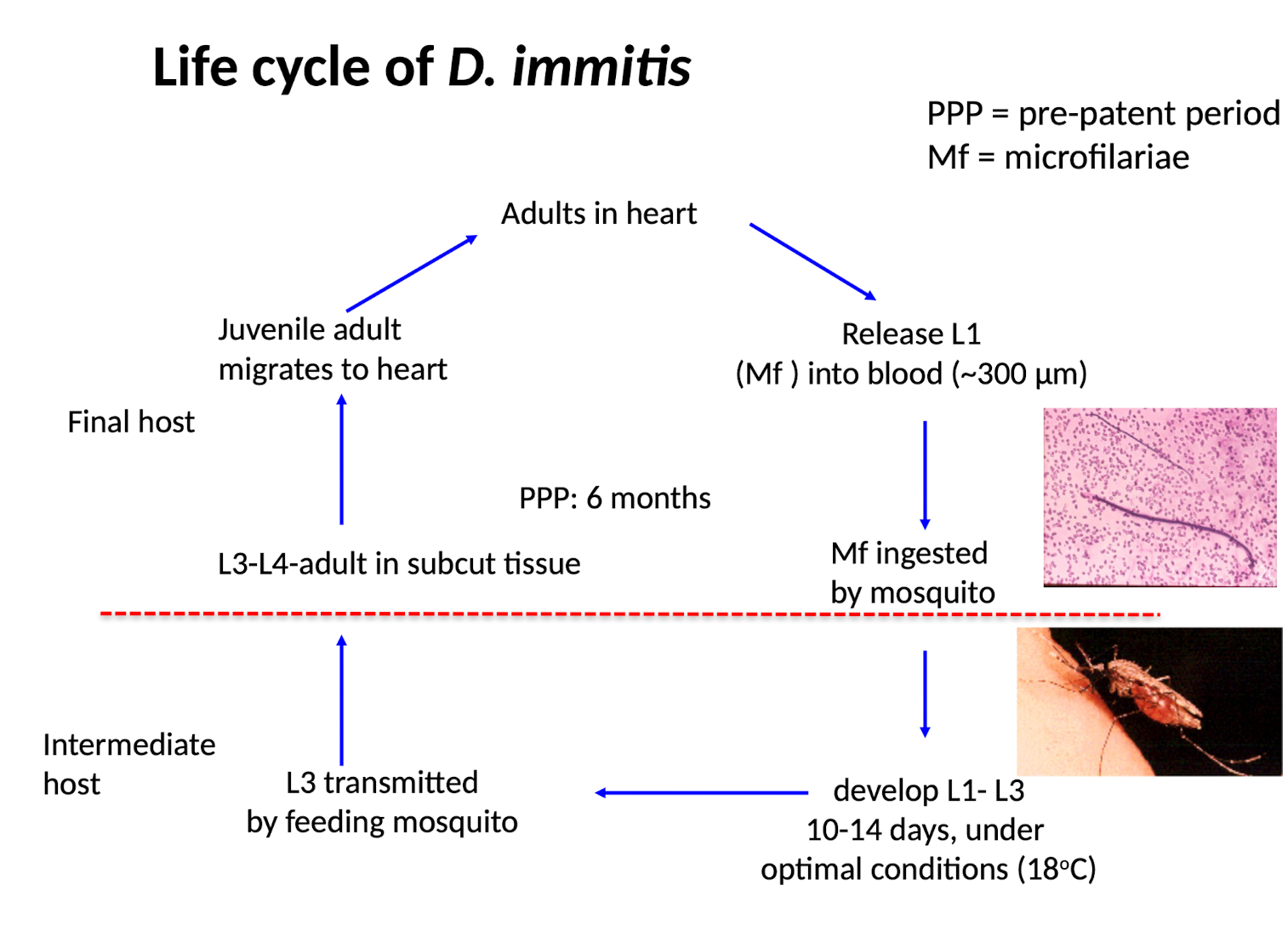
Describe the life cycle of D. immitis.
The eggs often hatch internally within the adult (MF) → released from female into the blood circulation
Describe the pathogenesis of D. immitis in dogs.
• Depends on worm burden
Low numbers, little apparent ill effect
High numbers, lots of problems
• Pathology associated with adults in heart
Adult females are 20-30cm long
• Impede blood flow
Giving rise to chronic congested right-sided heart failure
• Pulmonary embolism
Adults blocking vessels
Important if treat to kill adult worms
Need to consider level of the infection → Is it safe to administer treatment?
• Vena cava syndrome (blocked)
• Endocarditis in valves, pulmonary endarteritis
Local inflammatory response
• Glomerulonephritis
Deposition of immune complexes in kidney
What are the main clinical signs of D. immitis?
• Cardiovascular dysfunction
• Listless/gradual loss of condition
• Exercise intolerance
• Chronic soft cough
Important to confirm by diagnosis
How exactly can D. immitis be diagnosed?
• Clinical signs and history
— Has the dog been in an endemic area?
• Radiography or Echocardiography
• Detection of Mf in blood
Wet blood film- (Mf around 300 um long)
Stain dry blood film
• Detection of circulating antigen by ELISA
Immunochromatographic test
Referred to as SNAP test (10 mins)
Detects Ag released from female adult worms
What do antigen tests detect?
When can diagnosis or testing for heartworm?
• Antigen tests can detect a single female but not a male worm
Antigen is secreted by adult female worm
• Start testing by 6-7 months of age (PPP ~ 6 months)
• More sensitive to do SNAP test than Mf detection, particularly if animal on prophylaxis
Mf can be concentrated from blood to help detection
More chance to detect on the blood smear
Prophylaxis often stops the L1, L3 stages which makes it more difficult to detect Mf
• Some dogs have occult infections (adults but no Mf)
• And ~7% dogs have Mf but no antigen- so best to use both tests
Describe the distribution of D. immitis?
• Major pathogen in USA
• Spread rapidly over last two decades
Climate change?
• Present in Southern & Eastern Europe
• Only ever found in UK in imported/travelled dogs
• Mosquitoes present in UK that can transmit infection (but rarely warm enough to develop)
What are the main factors effecting the epidemiology of D. immitis in dogs?
• Density of dogs
• Numbers of strays & wild canids
• Mf can be present for long periods
• Poor immunity
• Poor owner compliance for prophylaxis
What are some of the factors affecting epidemiology of D-immitis mosquitoes?
• Distribution and spread of susceptible vectors
Environmental change/urban 'heat islands'
Introduction/spread of new vector species
Capacity for rapid population increase
• Short developmental period Mf-L3, 10-14 days
Temperature dependent development
Stop development if < 14°C (57°F)
• Some mosquitoes can survive for months
• Infection rates can vary 2-19%
But can be much higher in vicinity of infected dogs
What is the best control of D. immitis?
• Prophylaxis is the basis of control, since control is more simple than treatment!
- Tropics, treat all year round
- Temperate zones with mosquito season, treat 1 month before to at least 2 months after
- Recommended to treat year round - better compliance
How can D. immitis be treated prophylactically?
• Macrocyclic lactones (e.g. ivermectin/milbemycin-orally or selamectin/moxidectin topically) monthly
kill L3 and L4 up to ~6 weeks p.i.
• DEC (diethylcarbamazine) daily (not widely used)
• Prophylactic drugs do not kill adult worms
• MLs may have sterilising effect on female worms - but will not kill them, can reduce their ability to produce Mf
• But some evidence of treatment failures - resistance to drugs?
How should prophylaxis be given to dogs?
• Check Mf status of dog FIRST, Ideally dogs should be Mf-ve pre-treatment
• Ivermectin and particularly DEC also kill microfilariae at prophylactic doses
If Mf+ve dog treated - can induce anaphylactic shock partic. if high Mf counts
• Topical moxidectin seems to limit adverse reactions
• Prophylaxis targets the L3/L4
• In endemic areas, puppies should be on prophylaxis by 8 weeks of age
• Combine with mosquito repellent/ectoparasiticide
Other than prophylactic treatment, how can heartworm parasite be prevented?
• Keep animals indoors at peak mosquito biting times- usually dusk
• Insecticide collars or spot-on
• Attempt to reduce mosquito population, but very difficult
Ultimately, best to use multiple control measures
What parasite does D. immitis harbor?
What might targeting this parasite allow us to do?
• D. immitis harbours a bacterial endosymbiont - Wolbachia
• Killing Wolbachia with doxycycline sterilizes female- eventual death of adult worms
Does not happen immediately
• Combination of IVM and doxycycline kills adult D. immitis
What are the current treatment recommendations for D. immitis?
• AHS* now recommends combination treatment with ML and doxycycline prior to adulticidal therapy (Moxy-Doxy)
• ML clears Mf and prevents new infections
• Dox reduces pathology associated with dead adults, shrinks the worm mass
• Followed by melarsomine (Immiticide®) to kill adult worms
Not licensed in UK
Exercise must be restricted
For injected animals - surgical removal of adult worms in specialized heartworm clinics
Is there concern for D. immitis in cats?
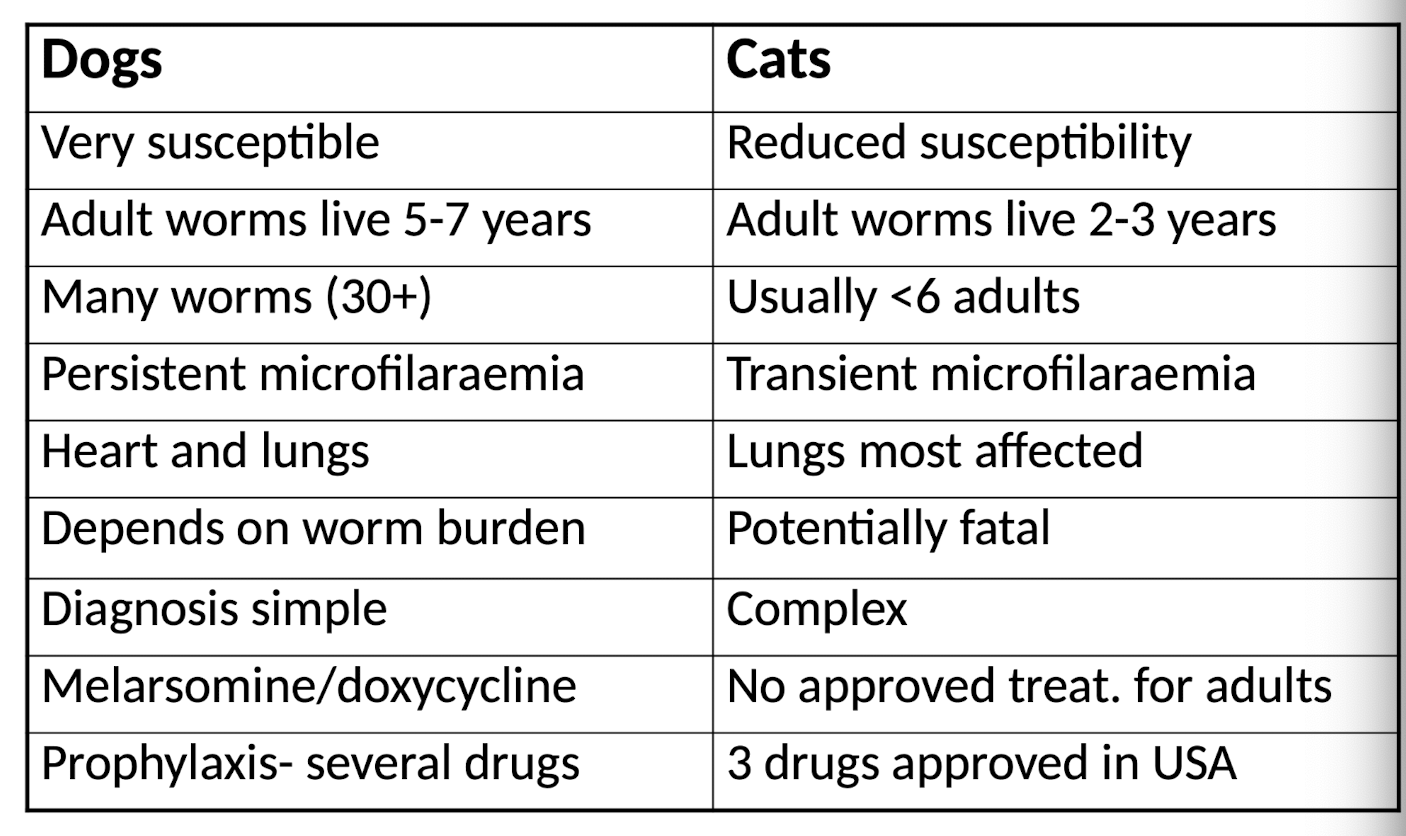
• Not well adapted to cats
• Very pathogenic in cats
• Adult worms live for shorter period of time compared to dog
• Mf are transient
• Prevalence generally 5-15% of that in local dog population
Briefly compare dog and cat infections with D. immitis.
What is the treatment and control of D. immitis in cats?
• Pathology in cats relates to the inflammatory response to worms/worm death and not from biomass of adults, as in dogs
Pathology related to the cat’s immune response
• If no clinical signs, can allow spontaneous recovery, with monitoring
• Melarsomine is very toxic in cats
• Chemoprophylaxis using ML compounds
Describe the main features of Angiostrongylus varosum.
Host
IMH
Site
The lungworm of dogs, sometimes called french heartworm or small heartworm of dogs
• Host: dog, fox
• IMH: molluscs - snails and slugs
• Site: right ventricle, pulmonary artery
Small brown worms - 2.5cm - less pathogenic due to size compared to D. immitis
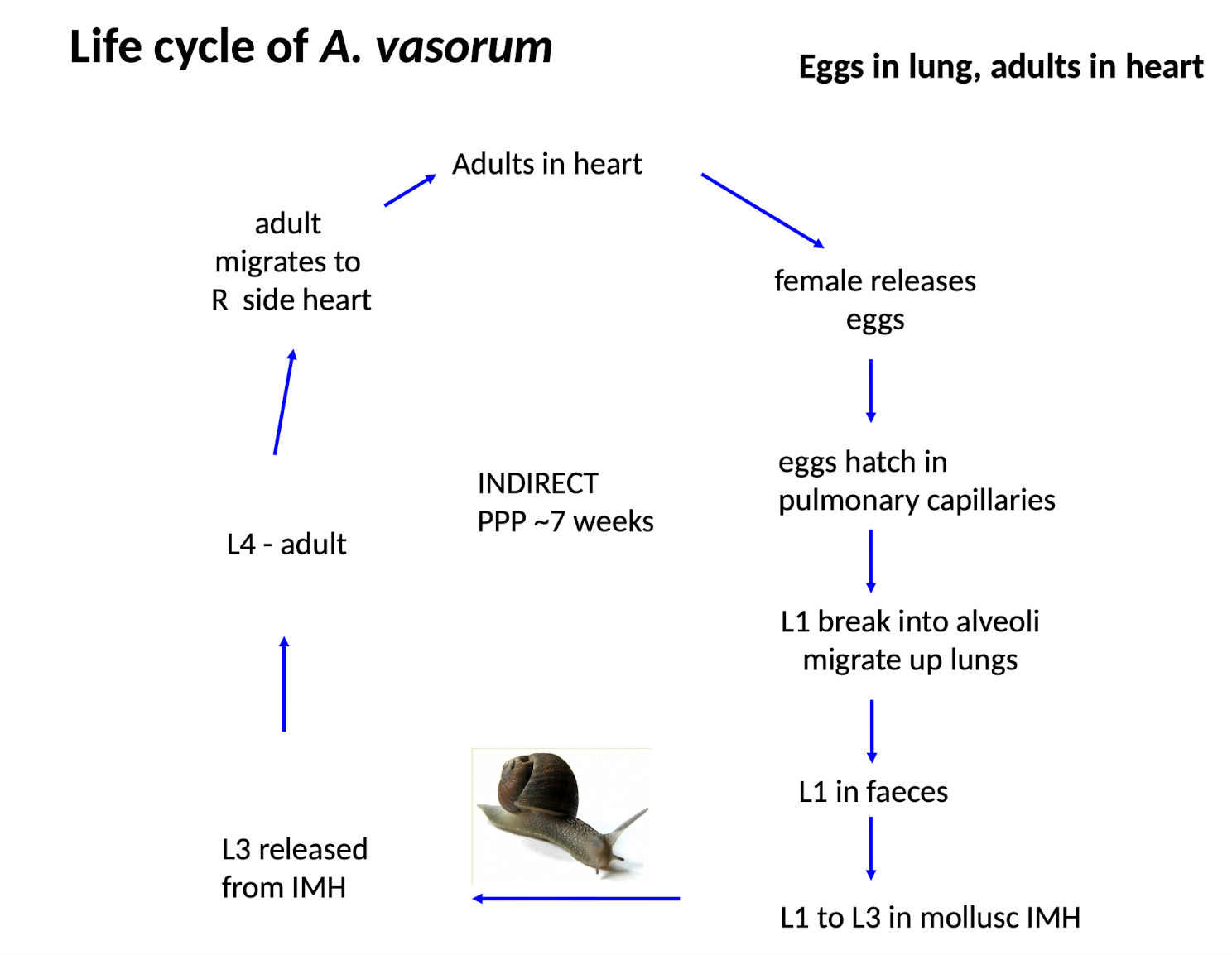
Describe the life cycle of A. vasorum.
Coughed up and swallowed after entering the lungs
Describe the pathogenesis of A. varosum.
• Chronic infection
• Pathology associated with adults in large vessels and eggs in pulmonary capillaries
• Chronic congestive cardiac failure
• Fibrosis in arteries - immune response to the infection
• Lung mottled, penetrating L1
• Bleeding (coagulation defect)
Infection often causes lower fibrinogen levels
What are the clinical signs of A. varosum.
• Early on - asymptomatic
• Later - increased respiratory rate/ cough on exercise
• Heavy worm burden, symptoms in resting dog
fainting
s.c. haematoma
• Can be associated with brain and spinal cord haemorrhage
Describe the diagnostic tests for A. vasorum.
• Diagnosis Baermann on faecal sample
• But sporadic, so should sample on 3 days to ensure detection
• L1, characteristic tail with small spine
• PCR
• Antigen test (IDEX)
Detects antigen in the blood stream of the infected dog
Not compromised by intermittent shedding of larvae in faeces
And a PCR test (but only used in research)
 Note
Note  Flashcards (44)