biology module 4 classification and evolution
 Studied by 0 people
 Call Kai
 Learn
Learn Practice Test
 Spaced Repetition
 Match
Match Flashcards
 Knowt Play
1/45

There's no tags or description
Looks like no tags are added yet.
Name | Mastery | Learn | Test | Matching | Spaced |
|---|
No study sessions yet.
46 Terms
taxonomy
practice of biological classification
name the taxonomic ranks from highest to lowest
domain
kingdom
phylum
class
order
family
genus
species
what is a species
a group of organisms that are able to reproduce to produce fertile offspring
what are binomials
scientific names given to individuals species, consists of the organisms genus and species name in Latin
what are the three domains of life
Bacteria (prokaryotes)
Archaea (prokaryotes)
Eukarya (eukaryotes)
archaea
Organisms within this domain are sometimes referred to as the extremophile prokaryotes, as archaea were first discovered living in extreme environments (although not all archaea do)
Archael cells have no nucleus (and so are prokaryotic)
They were initially classified as bacteria until several unique properties were discovered that separated them from known bacteria, including:
Unique lipids being found in the membranes of their cells
No peptidoglycan in their cell walls
Ribosomal structure (particularly that of the small subunit) are more similar to the eukaryotic ribosome than that of the bacteria
bacteria
These are organisms that have prokaryotic cells which contain no nucleus
They vary in size over a wide range: the smallest are bigger than the largest known-viruses and the largest are smaller than the smallest known single-celled eukaryotes
Bacterial cells divide by binary fission
eukarya
Organisms that have eukaryotic cells with nuclei and membrane-bound organelles are placed in this domain
They vary massively in size from single-celled organisms that are only several micrometres across, to large multicellular organisms many-metres in size, such as blue whales
Eukaryotic cells divide by mitosis
Eukaryotes can reproduce sexually or asexually
differing membrane lipids in bacteria and archaea
The membrane lipids found in the cells of Archaea organisms are completely unique
They are not found in any bacterial or eukaryotic cells
The membrane lipids of Archaea consist of branched hydrocarbon chains bonded to glycerol by ether linkages
The membrane lipids of Bacteria consist of unbranched hydrocarbon chains bonded to glycerol by ester linkages
differing ribosomal RNA in bacteria and archaea
Both Archaea and Bacteria possess 70S ribosomes
The 70S ribosomes in Archaea possess a smaller subunit that is more similar to the subunit found in Eukaryotic ribosomes than subunits in Bacterial ribosomes
The base sequences of ribosomal RNA in Archaea show more similarity to the rRNA of Eukarya than Bacteria
The primary structure of ribosome proteins in Archaea show more similarity to the ribosome proteins in Eukarya than Bacteria
composition of cell walls in bacteria and archaea
Organisms from the Bacteria domain have cells that always possess cell walls with peptidoglycan
Organisms from the Archaea domain also have cells that always possess cell walls, however these do not contain peptidoglycan
name the five kingdoms
Prokaryota
Protoctista
Fungi
Plantae
Animalia
prokaryota
This kingdom includes bacteria and blue-green bacteria
The main features of all organisms within Prokaryota include:
Most are unicellular (some can be found as filaments of cells or groupings of similar cells known as colonies)
Their cells have cell walls (not made of cellulose) and cytoplasm but no nucleus or mitochondria
They vary in size over a wide range: the smallest are bigger than the largest known viruses and the largest are smaller than the smallest known single-celled eukaryotes
Their cells divide by binary fission
Blue-green bacteria and some bacteria are autotrophic (they are photosynthetic)
Many bacteria are heterotrophic (feeding by decomposing living or dead organic materials)
protoctista
All Protoctista are eukaryotic, and this broad group of cellular life encompasses all eukaryotic cells that do not belong to the other three eukaryotic kingdoms
Members of this kingdom show great diversity in all aspects of life including structure, life cycle, feeding and trophic levels and well as modes of locomotion
Protoctists can exist as single-celled organisms or as a group of similar cells
A group of Protoctista known as protozoa possess cells similar to animal cells
Their cells have no cell wall
Another group of Protoctista known as algae possess cells similar to plant cells
Their cells have cellulose cell walls and chloroplasts
fungi
All fungi are eukaryotic cells
The cells of fungi:
Possess non-cellulose cell walls (often made of the polysaccharide chitin)
Don’t have cilia
Fungi are heterotrophs:
They use organic compounds made by other organisms as their source of energy and molecules for metabolism
They obtain this energy and carbon by digesting dead/decaying matter extracellularly or from being parasites on living organisms
Fungi reproduce using spores that disperse onto the ground nearby
Fungi have a simple body form:
They can be unicellular (like the common baker’s yeast Saccharomyces cerevisiae
Some consist of long threads called hyphae that grow from the main fungus body and form a network of filaments called the mycelium
Larger fungi possess fruiting bodies that release large numbers of spores (this is how many fungi reproduce)
plantae
Plants are multicellular eukaryotic organisms
Plant cells:
All have cell walls composed of cellulose
Possess large (and usually permanent) vacuoles that provide structural support
Are able to differentiate into specialized cells to form tissues and organs
Possess chloroplasts that enable photosynthesis (not all plant cells have chloroplasts)
Can sometimes have flagella
They are autotrophs
This means they can synthesize their organic compounds and molecules for energy use and building biomass from inorganic compounds
Plants have complex body forms
They have branching systems above and below the ground
animalia
Animals are also multicellular eukaryotic organisms
Animal cells:
Are able to differentiate into many different specialised cell types that can form tissues and organs
Have small temporary vacuoles (for example, lysosomes)
Have no cell walls
Sometimes have cilia
They are heterotrophs and have a wide range of feeding mechanisms
Communication within their complex body forms takes place through a nervous system and chemical signalling
molecular evidence for the theory of evolution by natural selection
DNA found in the nucleus of cells can be sequenced and used to provide evidence of evolutionary relationships between species and how the genetic code of species has changed as they have evolved
The differences between the nucleotide sequences in the analogous genes of different species can provide a lot of information:
The more similar the sequence the more closely related the species are
Two groups of organisms with very similar DNA will have separated into separate species more recently than two groups with less similarity in their DNA sequences
As a result, DNA sequence analysis and comparison can be used to create phylogenetic trees that show the evolutionary relationships between specie
fossil evidence for the theory of evolution by natural selection
Fossils are preserved remains of organisms or other features left by organisms, such as footprints, burrows and faeces
We can tell from fossils that environments (and the organisms living in these environments) have changed significantly over millions of years
Fossils, as well as the rocks they are found in, can be dated, allowing us to accurately put fossil organisms into a sequence from oldest to youngest (i.e to see how the organisms changed through evolutionary time)
Fossils also allow us to show similarities between extinct species (i.e. how related they are) and even between now-extinct, ancestral species and present-day species
what is variation
The term variation refers to the differences between living organisms
Variation can be:
between different species or within a single species
continuous or discontinuous
caused be genetic and/or environmental factors
interspecific variation
Interspecific variation is that which exists between individuals of different species
Interspecific variation can be useful for classifying organisms into species groups
Different species may show clear phenotypic variation that can help differentiate them
Some species have such similar phenotypes that they can be very difficult to distinguish, meaning that genetic variation must be used for classification
intraspecific variation
Intraspecific variation is that which exists between individuals of the same species
These differences are smaller than those found between individuals of different species
discontinuous variation
Discontinuous variation refers to differences that fall into discrete and distinguishable categories with no intermediates
E.g. there are four possible ABO blood groups in humans; a person can only have one of them
Discontinuous variation can be represented using a bar chart with bars that are clearly distinct from each other
continuous variation
Continuous variation refers to differences that show a range of values and can fall anywhere between two extremes
E.g. body mass and height are measured on a continuous scale
Continuous variation can be represented on a histogram with bars that touch each other, and will often show a characteristic bell-shaped curve
causes of discontinuous variation
Different genes have different effects on the phenotype
Different alleles at a single gene locus have a large effect on the phenotype
Remember diploid organisms will inherit two alleles of each gene, these alleles can be the same or different
causes of continuous variation at the genetic level
Different alleles at a single locus have a small effect on the phenotype
Different genes can have the same effect on the phenotype and these add together to have an additive effect
If a large number of genes have a combined effect on the phenotype they are known as polygenes
environmental factors for continuous variation
An accident may lead to scarring on the body
Eating too much and not leading an active lifestyle will cause weight gain
Being raised in a certain country will cause you to speak a certain language with a certain accent
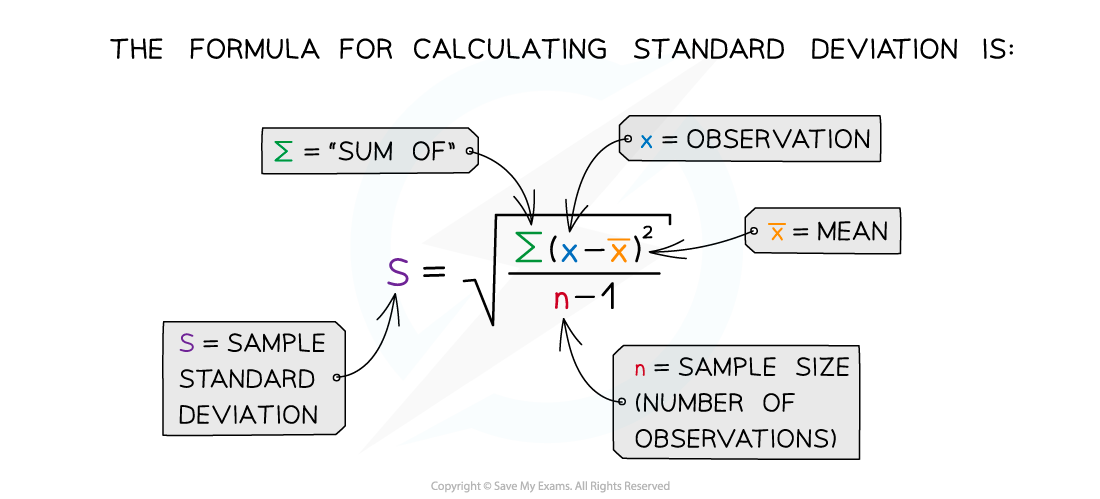
formula for standard deviation
what is a t-test used for
can be used to compare the means of two sets of data and determine whether they are significantly different or not
The formula for the t-test will be provided in the exam, but formulae for how to calculate the number of degrees of freedom is not provided in the exam and must be learnt
step 1 of t-test
Calculate the mean for each data set
step 2 t-test
Calculate the standard deviation for each set of data, s1 = standard deviation of sample 1 and s2 = standard deviation of sample 2
step 3 t-test
Square the standard deviation and divide by n (the number of observations) in each sample, for both samples:
step 4 t test
Add the values from step 3 together and take the square root:
step 5 t test
Divide the difference between the two means (see step 1) with the value calculated in step 4 to get the t value:
step 6 t test
Calculate the degrees of freedom (v) for the whole data set (remember the formulae for this will not be given in the exam):
step 7 t test
Look at a table that relates t values to the probability that the differences between data sets is due to chance to find where the t value for the degrees of freedom (v) calculated lies
step 8 t test
The greater the t value calculated (for any degree of freedom), the lower the probability of chance causing any significant difference between the two sample means
Identify where the t value calculated lies with respect to the confidence levels provided
what does the critical value of the t test tell us
If the t value is greater than the critical value (obtained from the table at a probability level of 0.05) then any difference between the means of the two data sets is said to be statistically significant
There is a less than 5 % probability that any difference is due to chance
The null hypothesis can be rejected
If the t value is less than the critical value (obtained from the table at a probability level of 0.05) then there is no significant difference between the means of the two data sets
The probability that any difference is due to chance is higher than 5 %
The null hypothesis is accepted
what is spearmans rank correlation
Spearman’s rank correlation determines whether there is correlation between variables that don’t show a normal distribution
steps of spearmans rank correlation
Step 1: Create a scatter graph and identify possible linear correlation
Step 2: State a null hypothesis
Step 3: Use the following equation to work out Spearman’s rank correlation coefficient r

Where:
rs = spearman’s rank coefficient
D = difference in rank
n = number of samples
Step 4: Refer to a table that relates critical values of rs to levels of probability
If the value calculated for Spearman’s rank is greater than the critical value for the number of samples in the data ( n ) at the 0.05 probability level (p), then the null hypothesis can be rejected, meaning there is a correlation between two variables
3 types of adaptation
anatomical
Physical features of an organism
E.g. the white fur of a polar bear provides camouflage in the snow so it has less chance of being detected by prey
physiological
Biological processes within an organism
E.g. mosquitos produce chemicals that stoa host's blood from clotting when they bite so that they can feed more easily
behavioural
The way an organism behaves
E.g. reptiles bask in the sun to absorb heat
convergent evolution
Organisms from different taxonomic groups may show similar adaptations even though they do not share a recent common ancestor
Shared adaptations between unrelated organisms arise due to convergent evolution
Convergent evolution occurs by natural selection as follows:
two species live in different parts of the world with similar environments
the species deal with the same selection pressures
the same characteristics are advantageous in the two environments, so individuals with these characteristics are more likely to survive and reproduce
over time the advantageous characteristics become widespread in both populations
genetic variation
Organisms of the same species have very similar genomes, but two individuals (even twins) will have differences between their DNA base sequences
These differences in DNA base sequences between individual organisms within a species population are called genetic variation
Genetic variation is transferred from one generation to the next and results in genetic diversity within a species
what are the two ways in which a bacterium inherits resistance to an antibiotic
Vertical transmission
Horizontal transmission
vertical transmission
Bacteria reproduce asexually by binary fission (the DNA of the bacterial chromosome is replicated and the bacterial cell divides in two, with each daughter cell receiving a copy of the chromosome)
Bacteria reproduce like this very rapidly (on average, every 20 minutes)
If one bacterium contains a mutant gene that gives it antibiotic resistance, all of its descendants (millions of which can be produced in a matter of hours) will also have the antibiotic resistance
This form of transmission enables antibiotic resistance to spread within a bacterial population
horizontal transmission
Plasmids (the small rings of DNA present in bacterial cells) often contain antibiotic-resistant genes
These plasmids are frequently transferred between bacteria (even from one species to another)
This occurs during conjugation (when a thin tube forms between two bacteria to allow the exchange of DNA) – DNA from the bacterial chromosome can also be transferred in this way
In this way, a bacterium containing a mutant gene that gives it antibiotic resistance could pass this gene on to other bacteria (even those from a different species). This is how ‘superbugs’ with multiple resistance have developed (e.g. methicillin-resistant Staphylococcus aureus – MRSA)
This form of transmission enables antibiotic resistance to spread within or between bacterial populations
 Note
Note  Flashcards (53)