Human Reproduction
 Call Kai
 Learn
Learn Practice Test
 Spaced Repetition
 Match
Match Flashcards
 Knowt Play
1/60

There's no tags or description
Looks like no tags are added yet.
Name | Mastery | Learn | Test | Matching | Spaced |
|---|
No study sessions yet.
61 Terms
Advantage of asexual reproduction
Produces genetically identical offspring adapted to a stable environment.
Advantage of sexual reproduction
Produces genetic variation needed for adaptation to changing environments.
Compare sexual and asexual life cycles
Asexual involves one parent and no gametes; sexual involves meiosis and fertilization, during which haploid gametes fuse.
Role of meiosis in sexual life cycle
Produces haploid gametes and breaks up parental allele combinations.
[In order to maintain the correct number of chromosomes in each generation, there must be a reduction in the number of chromosomes in the forming of eggs and sperm - halving from diploid to haploid. Meiosis is known as “reduction division” because it reduces the number of chromosomes in the daughter cells by half compared to the starting cell (D2.1.9). ]
![<p>Produces haploid gametes and breaks up parental allele combinations.</p><p><span style="background-color: transparent;"><span>[In order to maintain the correct number of chromosomes in each generation, </span><strong><span>there must be a reduction in the number of chromosomes in the forming of eggs and sperm</span></strong><span> - halving from diploid to haploid. Meiosis is known as “reduction division” because it reduces the number of chromosomes in the daughter cells by half compared to the starting cell (D2.1.9). ]</span></span></p>](https://knowt-user-attachments.s3.amazonaws.com/c8c97ebc-cf94-44e7-97d5-7d95e1312c51.png)
Role of fertilization in sexual life cycle
Fuses gametes to form a diploid zygote with new allele combinations.
Outcome of meiosis and fertilization
Production of individuals with new combinations of genetic material.
By uniting two gametes with half the number of chromosomes, the full chromosome number is restored each generation.
Why male gametes are smaller
They travel to the female gamete and have less food reserve.
Size difference between male and female gametes
Male gametes are small; female gametes are large.
Motility of male vs female gametes
Male gametes are motile; female gametes are non-motile.
Energy reserves in gametes
Male gametes have few reserves; female gametes have many.
Gamete production rate difference
Males produce many continuously; females produce few.
Male reproductive system structures
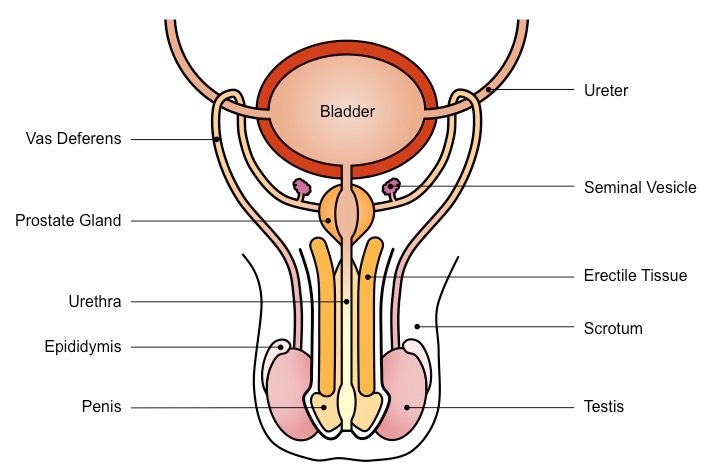
Penis, urethra, testis, scrotum, epididymis, sperm duct, prostate gland, seminal vesicle.
Function of testes
Produce sperm and testosterone.
Function of scrotum
Keeps testes cooler than body temperature.
Function of epididymis
Stores and matures sperm.
Function of sperm duct
Transports sperm to urethra.
Function of seminal vesicle
Secretes nutrient fluid for sperm.
Function of prostate gland
Adds alkaline fluid to semen.
Function of urethra (male)
Carries urine and semen out of body.
Function of penis
Transfers sperm to female reproductive tract.
Female reproductive system structures
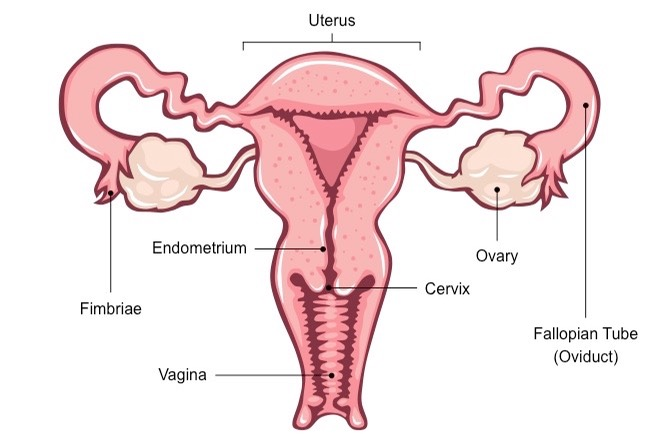
Ovary, uterus, vulva, vagina, cervix, oviduct, clitoris.
Function of ovaries
Produce eggs and sex hormones.
Function of oviduct
Transport eggs and site of fertilization.
Function of uterus
Supports embryo development.
Function of cervix
Controls passage between uterus and vagina.
Function of vagina
Receives sperm and serves as birth canal.
Function of vulva
Protects external reproductive organs.
Function of clitoris
Contains erectile tissue for arousal.
Draw a diagram of the male reproductive system, including the penis (with erectile tissue), urethra, testis, scrotum, epididymis, sperm duct, prostate gland and seminal vesicle.
Use this to check your drawing.
Draw a diagram of the female reproductive system, including the ovary, uterus, vulva, vagina, cervix and oviduct.
Use this to check your drawing.
Define ovarian cycle
Cycle of egg development and hormone secretion in ovaries.
Define uterine cycle
Cycle of changes in uterine lining.
Define menstrual cycle
Combined ovarian and uterine cycles.
Hormone that stimulates follicle development
FSH.
Hormone that triggers ovulation
LH.
Role of estrogen
Rebuilds endometrium and regulates feedback.
Role of progesterone
Maintains uterine lining after ovulation.
Negative feedback in ovarian cycle
Estrogen inhibits further FSH release.
Positive feedback in ovarian cycle
High estrogen causes LH surge.
Events of uterine cycle
Menstruation, rebuilding, and thickening of endometrium.
What happens during fertilization
Sperm membrane fuses with egg membrane and nucleus enters egg.
Fate of sperm tail and mitochondria
They are destroyed after entry.
Formation of diploid nuclei
Sperm and egg nuclei dissolve membranes and chromosomes combine.
Define in vivo fertilization
Fertilization inside the female body.
Define in vitro fertilization
Fertilization outside the body in a laboratory.
Hormonal difference in IVF
Hormones are given to induce superovulation.
Outline IVF process
Eggs collected, fertilized in lab, embryos implanted.
Role of FSH in IVF
Stimulates development of multiple follicles.
Role of oestradiol in IVF
Supports follicle and endometrium development.
Role of progesterone in IVF
Maintains uterine lining after embryo transfer.
Which hormone triggers ovulation during the menstrual cycle?
LH
What does FSH do?
FSH stimulates ovarian follicle development and estrogen production.
What does LH do?
LH triggers ovulation and stimulates the corpus luteum to produce progesterone.
What does estrogen do?
Estrogen is responsible for the development of secondary sexual characteristics, regulates the menstrual cycle, and triggers thickening of the lining of the uterus to prepare it for pregnancy.
What does LH do?
LH triggers ovulation and stimulates the corpus luteum to produce progesterone, which is essential for maintaining pregnancy.
Where is LH secreted?
Pituitary gland (hypothalamus sends signal to pituitary to release)
Where is FSH secreted?
Pituitary gland (hypothalamus sends signal to pituitary to release)
Where is estrogen secreted?
Ovaries (triggered by FSH)
Where is progesterone secreted?
Ovaries (triggered by LH)
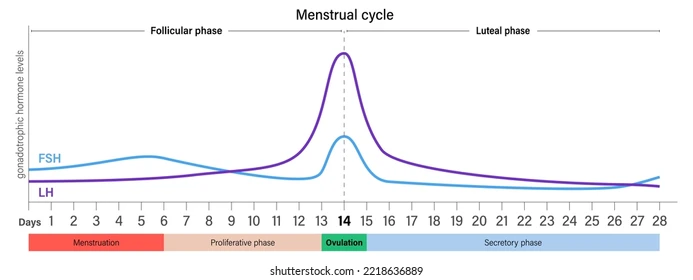
Draw a chart of the LH and FSH fluctuation throughout the menstrual cycle, starting during the menses.
.
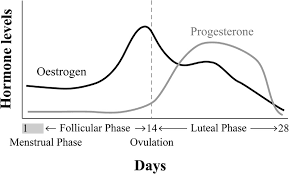
Draw a chart of the estrogen and progesterone fluctuation throughout the menstrual cycle, starting during the menses.
.
 Note
Note  Flashcards (43)