Lungworms of dogs & cats
 Studied by 0 people
 Call Kai
 Learn
Learn Practice Test
 Spaced Repetition
 Match
Match Flashcards
 Knowt Play
1/30

There's no tags or description
Looks like no tags are added yet.
Name | Mastery | Learn | Test | Matching | Spaced | Call with Kai |
|---|
No analytics yet
Send a link to your students to track their progress
31 Terms
What family are the relevant lungworms in? What are their characteristics?
Metastrongyles
Lungs or related blood vessels
Normally L1 in faeces
Have kinky tails typically
Normally indirect life cycle with mollusc host
Lympho-tracheal migration
What are the relevant lungworm species in dogs and cats?
Dogs:
Angiostrongylus vasorum (Heartworm of dogs)
Oslerus osleri
Crenosoma vulpis
Filaroides hirthi
Cats:
Aelurostrongylus abstrusus
Where are adult angiostrongylus vasorum found?
Pulmonary artery and right ventricle
What is the morphology of angiostrongylus vasorum?
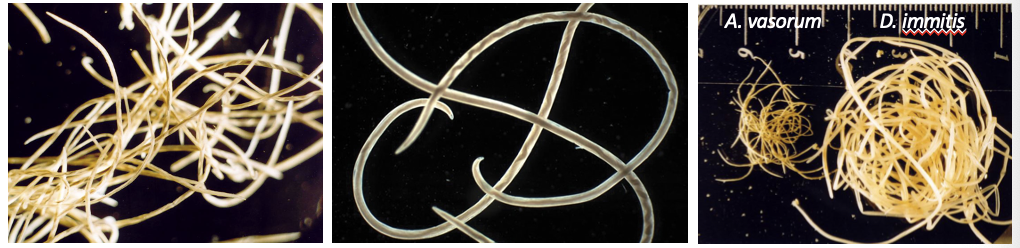
2cm long (a lot smaller than dirofilaria immitis)
Barber pole appearance in females
What are the hosts of angiostrongylus vasorum?
Intermediate host —> slugs and snails
Paratenic hosts (not required for life cycle) —> frogs
Found in foxes and dogs
Explain the lifecycle of angiostrongylus vasorum
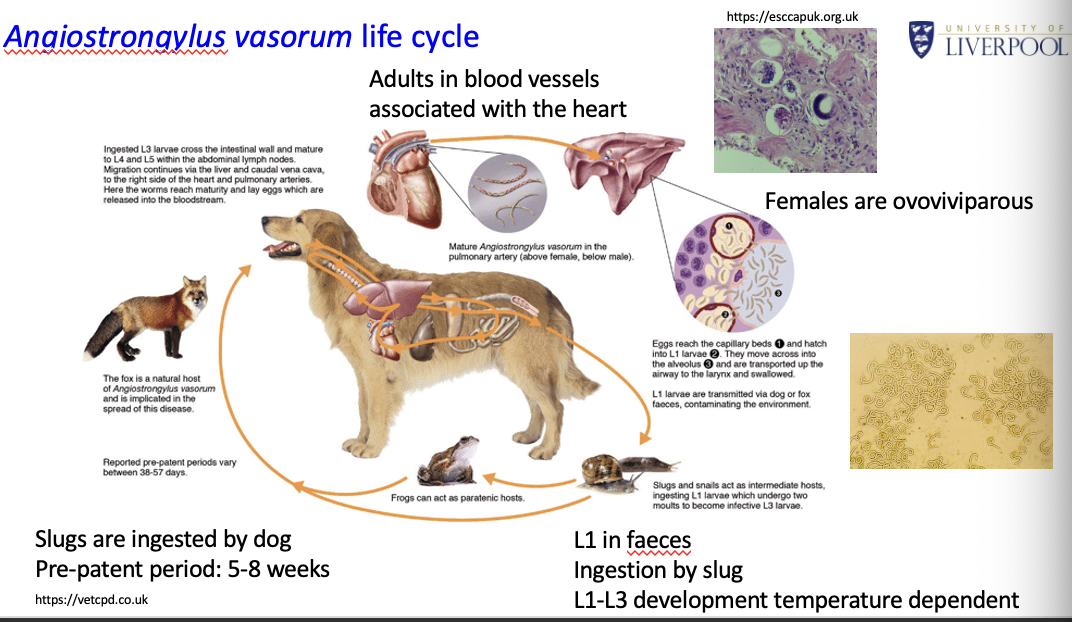
L1 in faeces, ingested by slug, development to L3 temp dependent
Slugs ingested by dog, L3 cross intestinal wall and mature to L4 and L5 within abdominal LN
Migration continues via liver and caudal vena cava to right side of heart and pulmonary arteries
Worms reach maturity and lay eggs (females are ovovivparous) which are released into bloodstream
Reach capillary beds and hatch into L1 (Ovoviviparous)
Move across into alveolus and transported up airway to larynx and swallowed
Passed in faeces
What would you expect in a positive angiostrogylus vasorum faecal smear?
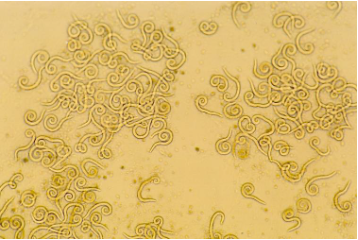
Low numbers because intermediate shedders
What is the PPP of angiostrongylus vasorum?
5-8 weeks
What are the clinical signs of angiostrongylus vasorum?
Often asymptomatic but can cause sudden death
Respiratory
Coughing
Dyspnoea
Weight loss
Pulmonary hypertension
Coagulopathies (parasite produces proteins causing this)
Fluctuating haematoma/bleeding disorders
Neurological (due to above bleeding near nerves)
How is angiostrongylus vasorum diagnosed?
Antigen SNAP test
Radiography
Enlarge heart & pulmonary artery
Patchy alveolar and interstitial pattern
Able to differentiate from other lungworms
L1 in faeces
Trans-tracheal wash or bronchoalveolar lavage
Baermann apparatus to detect L1
Low sensitivity
Repeat samples
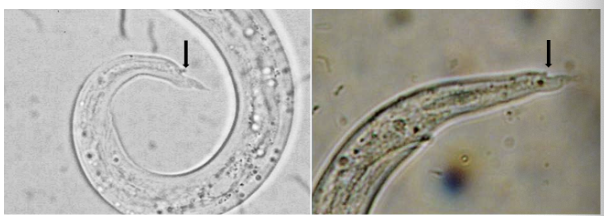
What morphological features would you use to distinguish L1 angiostrongylus vasorum from other worms?
Dorsal notch on tail of L1
300-400µm
How is angiostrongylus vasorum treated?
Typically MLs/BZs
Moxidectin
Milbemycin oxime
Fenbendazole
How is angiostrongylus vasorum controlled?
Corticosteroids for damage
Cage rest indicated during treatment (2-3 days)
Prophylaxis = monthly treatment with MLs
Prevent dogs from ingesting snails or slugs
Where is angiostrongylus found in the world?
Prevalent throughout Europe incl. UK
Fox as reservoir host
Increase in slug & snail population due to climate change
Contact more likely in natural grasslands, open areas
Risk of infection greatest in open grassy areas and wooland/scrub
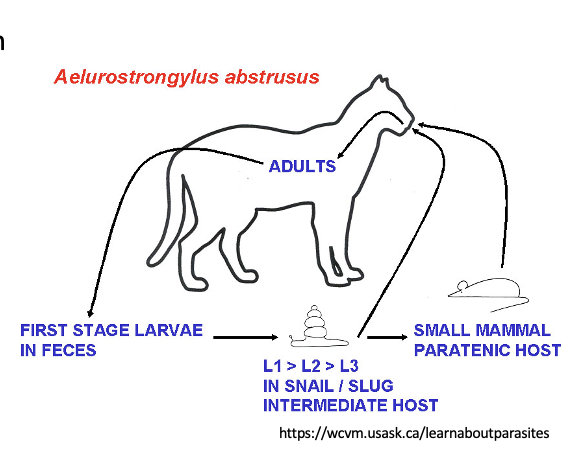
Describe the life cycle of Aelurostrongylus abstrusus
True lungworm both adults and larvae found in lungs of cats
Adults in lung parenchyma —> very small 10mm
L1 in faeces
Snail intermediate host (Develop to L3) then ingested by cat or paratenic host which is then ingested by cat
Paratenic hosts —> small mammal, frog, lizard
Larvae penetrate across intestinal wall into LN and blood system to make its way to lung
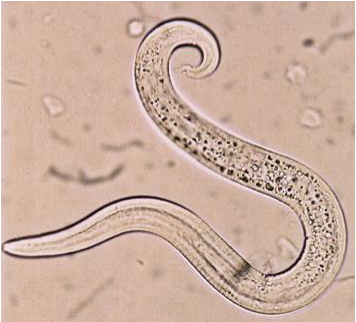
What is the diagnostic features of aelurostrongylus abstrusus?
S shaped tail of L1 = 350-400µm
What is the PPP of aelurostrongylus abstrusus?
5-6 weeks
How does aelurostronguylus abstrusus present clinically?
Normally asymptomatic because so small
Coughing/ resp disease
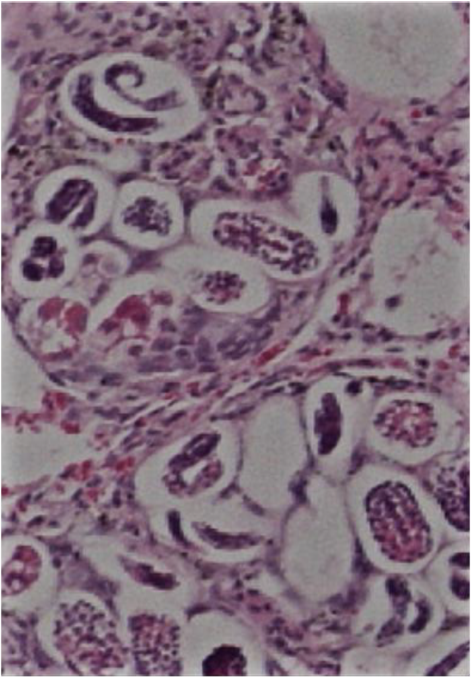
Can lead to hyperplasia of bronchioles, alveolar ducts & pulmonary arteries if high burdens
How is aelurostronguylus abstrusus diagnosed?
L1 in faeces —> Baermann technique
Fresh faecal samples in 3-7 day period
L1 in transtracheal wash or bronchoalveolar lavage
No antigen test
How is Aelurostrongylus abstrusus treated?
Bz and MLs
Fenbendazole —> for at least 3 days, up to 7 days.
Moxidectin, Emodepside
What are the features of the oslerus osleri life cycle?
Not typical metastrongyle
Direct lifecycle
Describe the life cycle of oslerus osleri
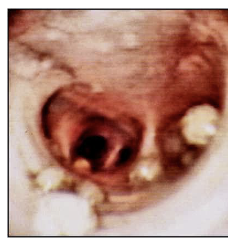
Adults in nodules in trachea of dogs
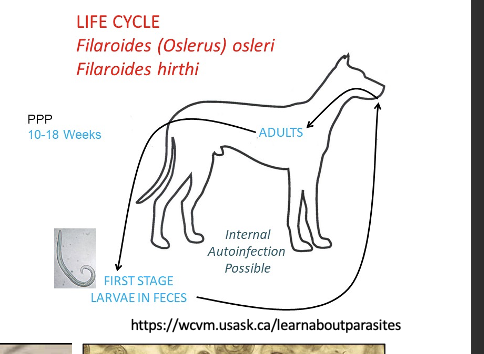
Direct lifecycle
Females are ovoviviparous
Larvated eggs/L1 are passed by the female.
L1 are released into the tracheal lumen, move up to the pharynx, swallowed & passed in faeces.
Then L1 is ingested passed through intestine via blood and lymphatic system to lungs
What is the infective stage of Oslerus osleri?
L1 larvae
What is the PPP Oslerus osleri?
10-18 weeks
How does autoinfection occur with O. osleri?
Infective L1 penetrate into the intestinal wall without leaving the host
Migrate to the trachea, and develop into adult parasites
How does transmission of oselrus osleri from bitch to pup occur?
L1 in sputum
Transmission mainly by the bitch grooming/licking its pup
Upon ingestion/introduction into the mouth of the pup, L1 cross the intestinal wall, travel via the lymphatics and blood system to the lungs and trachea.
How does oslerus osleri present clinically?
Tracheo-bronchitis
Coughing
How do you diagnose oslerus osleri?
Young dogs, 1-2 years old (PPP = 10-18 weeks)
Bronchoscopy to identify nodules
Larvae in faeces (low sensitivity)
Transtracheal wash or bronchoalveolar lavage cytology or tracheal swabs may reveal larvae or eggs
How is oslerus osleri treated?
Fenbendazole
What are the features of Crenasoma vulpis?
Adults found in lungs (specifically in mucus) of dogs and foxes
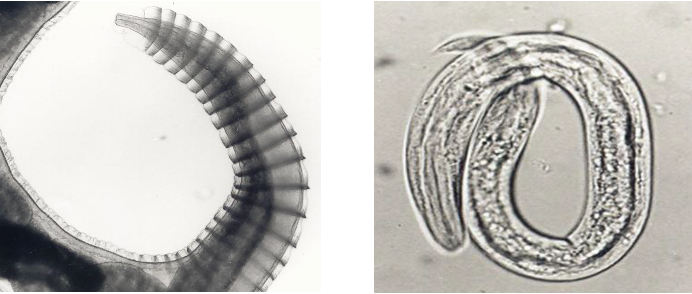
1.5 cm in size
Adult worm showing anterior cuticular rings
L1 has a straight pointed tail
What are the features of Eucoleus aerophilus?
Typically found in wildlife —> foxes
Faeco-oral route, infects resp tract
Not metastrongyle so eggs passed in faeces
Occasional infections of cats and dogs
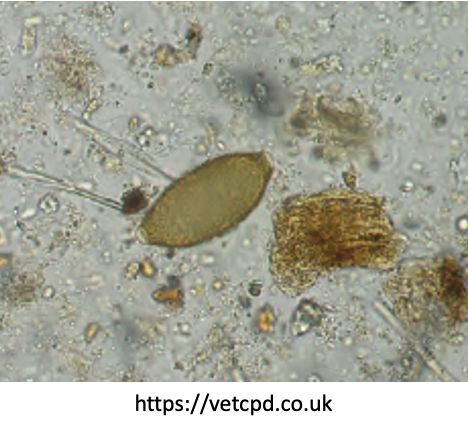
Diagnosis of ‘lemon’ shaped eggs