U.S. History 2nd Semester Unit 1
 Studied by 0 people
 Call Kai
 Learn
Learn Practice Test
 Spaced Repetition
 Match
Match Flashcards
 Knowt Play
1/134

There's no tags or description
Looks like no tags are added yet.
Name | Mastery | Learn | Test | Matching | Spaced | Call with Kai |
|---|
No analytics yet
Send a link to your students to track their progress
135 Terms
Pacific Railway Act
A 1862 law that authorized the construction of the first transcontinental railroad in the United States, providing land grants and financial support to railroad companies to promote westward expansion.
Transcontinental Railroad
built by Union Pacific, Central Pacific, mainly by Chinese and Irish immigrants. Promontory Point, Utah, 05/1869, railroad completed, track increased from 35k in 1865 to 192k in 1900
Comstock Lode
Henry Comstock’s silver mine in Virginia City, NA that produced over $340 million
Prostitution
most common employment for women in the west.
Saloon
offered free lunches and served as a social club, outnumbered churches and grocery stores in most cities.
Sand Creek Massacre
In 1864, Cheyenne attacked wagons and ranches in Colorado on Indian land. At the Fort Lyon peace talks, Chief Black Kettle and over 400 unarmed Cheyenne were killed
Indian Peace Commission
created two large reservations on the Great Plains.
Bureau of Indian Affairs
ran reservations and the army dealt with groups that didn’t report.
Great Plains
went west to the Rocky Mountains with less than 20 inches of rain per year.
Homestead Act
attracted settlers by offering them 160 acres after living there five years.
Wheat Belt
Wheat withstood drought, so it became the regional crop. Bonanza farms were corporate farms that covered up to 50,000 acres.
Ranching
Ranching grew because of open range, U.S. owned grasslands, with free grazing. Cattle were divided, branded, and moved by Cowboys, mainly former Confederates, Hispanics, and African Americans.
Chisholm Trail
One of the most famous cattle drives that took cattle to the Kansas Railroad provided 10 times the profit that ranchers could receive in Texas. It was normally a 90-day trip. Barbed Wire, created by Joseph Glidden, ended the cattle drives.
The Glided Age
A book written by Mark Twain and Charles Warner about 1870-1900, a time of growth as well as prosperity to the world, but under the surface, there was corruption, poverty, and a huge difference between the rich and poor. The top 10% earned 75% of the nation’s wealth, little differentiated political party beliefs.
Election of 1868
Federal troops helped African Americans vote. Ulysses S. Grant received nearly every African American vote. Narrowly defeated Horatio Seymour, who received most white votes. The currency was the main issue.
Grant vs. the Ku Klux Klan
3 men in Texas killed 300 former slaves, the KKK started in Tennessee, and other states planned to harass and kill former slaves, killing 4 in South Carolina and wounding 54, killing 81 in Louisiana.
Enforcement Acts
Congress passed laws enforced by Grant to stop KKK activity.
soft money
not based on the Gold Standard, always in danger of inflation, easier to pay off debts.
hard money
Based on the Gold Standard, money keeps its value.
Crime of ‘73
Congress stopped coining silver, reducing the money in circulation.
Whiskey Ring
government officials filed false tax reports, including Grant’s private secretary, whom he helped avoid jail time.
William Belknap
The Secretary of War accepted bribes to short supplies to Indian reservations.
Robber Barons
railroad owners who got wealthy off of society but gave nothing back, formed pools or monopolies by working together.
Jim Fisk + Jay Gould
worked with Grant’s brother-in-law to corner the gold market by artificially raising prices, the Federal Reserve sold gold to end their attempt, Gould also made a profit on the stock market, and embezzled from the RR.
Credit Mobilier
a construction company owned by Union Pacific that overcharged itself and made a fortune for investors, but the railroad was almost bankrupt. Congress gave additional grants to the railroad after congressmen and the Vice-President were given shares in Union Pacific.
Political Machine
provided important city services and jobs for votes, this was a corrupt system, but the only thing that helped the poor.
Tweed Ring
Led by William “Boss” Tweed, who controlled elections through Tammany Hall and took $200 million from NY citizens, Tweed died behind bars, giving Tilden a shot at the presidency in 1876.
Victoria Woodhull
In the 1870s, battled to fight sexual stereotypes, professed free love, published that prominent minister Henry Beecher had numerous affairs, and ran for President in 1872 as the Equal Rights candidate with Fredrick Douglass as her running mate.
Carrie Chapman Catt
took over the women’s suffrage movement, pushed for the vote if women kept doing their normal duties, won the right to vote in Wyoming in 1869
Women’s Christian Temperance Union
Led by Frances Willard, Carrie Nation, over 300,000 members, worked for Prohibition, 8 hour workday, the end of child labor, federally inspected food, kindergarten, uniform marriage and divorce laws.
Election of 1872
ran against Grant in 1872 as a Liberal Republican and Democrat, even though he published anti-Democratic stories in his newspaper, attacked as an atheist, communist, free-lover, vegetarian, and bail bondsman to former Confederate leader Jefferson Davis, Grant won the election.
Robber Barons
railroad owners that got wealthy off of society but gave nothing back, the formed pools or monopolies by working together.
Jim Fisk + Jay Gould
worked with Grant’s brother-in-law to corner the gold market by artificially raising prices, the Federal Reserve sold gold to end their attempt. Gould also made a profit on the stock market and embezzled from the RR
Panic of 1873
bank runs, the stock market crash, and 25 railroads going bankrupt lasted 6 years, 1000s of businesses closed, and 10,000s of unemployed African Americans lost $7 million in savings and lost confidence in savings industries.
Election of 1876
Rutherford B. Hayes v. Samuel Tilden, Tilden had more popular votes but not enough votes in the electoral college.
Compromise of 1877
Tilden lost because Hayes promised to end Reconstruction, and peace was brought by sacrificing Southern Black Rights.
Great Railroad Strike of 1877
RRs cut wages by 50%. 80,000 railroad workers went on strike, stopping the railroad in 11 states. Violence erupted. President Hayes ordered the army to stop the strike, In the end, over 100 people died and millions of dollars in property were lost.
Jim Crow
laws in the south to keep African Americans in a condition similar to slavery, literacy tests, poll taxes, grandfather clause
Bourbons or Redeemers
restored the white south, cut budges including education, led to convict leasing or using black labor.
poll tax
required voting citizens to pay a tax.
literacy test
required by all voting citizens.
grandfather clause
let poor whites vote if he had an ancestor voting in 1867.
sharecropping
The fate of several former slaves, paying a portion of crops to rent farm land, kept African Americans and poor whites in constant debt.
Election of 1880
James Garfield - former Union General, narrowly won, assassinated by Charles Guiteau
Charles Guiteau - Guiteau was a Stalwart looking for a government job.
Chester A. Arthur became president.
Pendleton Act (1883)
Government employees received civil service jobs based on exam scores.
1883-14,000 out of 117,000 federal government jobs became civil service exam positions.
1900-100,000 out of 200,000.
Slaughterhouse Cases
stated the 14th Amendment would give more protection to corporations than African Americans, and state governments were required to enforce civil rights violations.
spoils system or patronage
giving civil service or government jobs to the winning party
Roscoe Conkling - led the Stalwarts, a group that supported this system of rewarding supporters with government jobs
James G. Blaine - led the Half-Breeds for civil service reform
Alexander Graham Bell
In 1876, the telephone was invented, creating the Bell Telephone Company, which became the American Telephone and Telegraph Company.
Democratic Bloc
White southerners (white supremacists)
Catholics
Recent Immigrants (especially Jews)
Urban working poor (Pro-labor)
Most farmers
Republican Bloc
Northern whites (pro-business)
African Americans
Northern Protestants
Old WASPs (support for anti-immigrant laws)
Most of the middle class
American Railway Association
divided the country into four time zones in 1883
1884 Election
Mugwumps- Republicans supported Cleveland since James Blaine was corrupt.
Grover Cleveland- Democratic candidate, with an illegitimate child, first Democratic President since Buchanan (28 years), served non-consecutive terms,
Statue of liberty
1886, designed by Gustave Eiffel, erected in New York Harbor, a gift from France.
Cleveland’s Presidency
married in the White House, had a daughter named Ruth.
Presidential Succession Act
If Pres & VP die, Cabinet members take over
Santa Clary County V Southern Pacific Railroad
Corporations have the same rights as people under the equal protection clause.
Wabash v. illinois
In 1886, small businesses and farmers paid more for shipping than large corporations. The Supreme Court ruled that only the federal government could regulate interstate commerce. This created the Interstate Commerce Commission, which banned pools.
Election of 1888
Cleveland won the popular vote but lost the election to Benjamin Harrison.
Grand Army of the Republic
union vertans who lobbied for a pension, Harrison passed a Pension Bill, giving pensions to deserters and all troops who served, leading to young girls marrying old men for their pensions.
Harrison’s Presidency
6 new states: North Dakota, South Dakota, Montana, Washington, Idaho, Wyoming.
Oklahoma Sooners
the U.S. buys Native American Land and gives it away on a first come/first serve basis in the Oklahoma Land Rush
Frederick Jackson Turner
The Significance of the Frontier in American History. American democracy was formed by the American frontier. The safety valve thesis is the assertion that the frontier, as a place of opportunity and escape, diffused social discontent in America, preventing the bloody social revolutions in Europe.
Sherman Anti Trust Act
The Sherman Antitrust Act of 1890 prohibited companies from conspiring to establish monopolies, although the courts lacked the power to enforce the law
McKinley Tarrif
raised the tariffs, which led to the Panic of 1893, passed by the first Billion-Dollar Congress
Coca Cola
developed by Dr. John Pemberton in Atlanta as a cure for headaches, it soon became a national product that received warnings from church groups because of its inclusion of cocaine.
Chautauqua movement
education movement for the adult population
Education
Enrollment in 1870 was 7 million students and grew to 22 million students, or 78%, in 1920.
Higher Education
College enrollment increased from 52,000 in 1870 to 157,000 in 1890 and 600,000 in 1920.
nativism
hatred of immigrants and Catholics, focused on groups from Eastern Europe because of their political views, still focused on Catholics American Protective Association disliked Catholics and foreigners, and wanted to stop immigration.
Chinese Exclusion Act
In 1882, barred Chinese immigration and prevented citizenship until 1943.
U.S. vs Wong Kim
in 1898, protected the citizenship of Chinese Americans.
Battle of Little Bighorn
Custer claimed gold on Lakota Sioux land, starting a land rush, in 1876 the Lakota Sioux left their reservation under Crazy Horse and Sitting Bull to hunt buffalo that were being killed by professional hunters. George Custer and the army went after them, but they were all killed by Crazy Horse.
Battle of Wounded Knee
At the Lakota Sioux reservation in 1890, the Lakota were ordered to stop the Ghost Dance, a prayer to their gods to get rid of the white man. Many unarmed Lakota were killed in the final Native American resistance.
Indians were defeated by:
White man’s disease
Wars
Buffalo extermination
Loss of their land to White settlement
The railroad
William F. Cody (Buffalo Bill)
killed over 4,000 buffalo in 18 months to force Indians onto reservations, and started a wild west show in 1883.
Dawes Act
would assimilate Native Americans into society as farmers and ranchers, then dissolve the tribes. Native American land was sold and held in trusts for them. Few native Americans desired these opportunities.
Panic of 1893
the Bankruptcy of two Railroads, a stock market crash, and banks closing. Lasted for 4 years. President Cleveland made gold the sole basis for currency and had Congress repeal the Sherman Silver Purchase Act. The Democratic Party split.
Sears and Roebuck
sold products more cheaply by buying in large bulk to people across the nation using the mail from isolated farms to the cities, with 6 million catalogs in circulation by 1900.
Rise of Big Business
A sole proprietorship is owned by one person who takes all of the risk, but receives all of the profit. A corporation is owned by one or many people but treated by law as though it were a single person. Stockholders own the corporation and make money by selling stock or shares of the company.
Sole Proprietorship
owned by one person who takes all of the risk, but received all of the profit.
Corporation
owned by one or many people but treated by law as though it was a single person.
Stockholders
own the corporation and make money by selling stock or shares of the company.
Fixed costs
exist whether the company is operating or not.
Operating costs
occur when a company is in operation. Large corporations produce more cheaply, and survive by cutting prices to increase sales.
Lassez Faire
economy where the government does not interfere with
business.
Horizontal integration
combines firms doing the same business into one corporation.
Trust
merged businesses without violating laws. It lets a person to manage another person's property.
Monopoly
occurs when one company controls an entire market.
Andrew Carnegie
became a billionaire using the Bessemer process that made steel stronger and cheaper, he also began vertical integration of the steel industry, owning the different businesses it depends on. felt those who profited should give something back, so he created his Gospel of Wealth, using philanthropy, or great fortunes to further social progress. Gave away 350 of $400 million
John D. Rockefeller
started Standard Oil, the first monopoly, which controlled the world's oil market using horizontal and vertical integration, controlling all aspects of the business and keeping its funds out of banks in case of financial crises, 95% of the nation's oil, became wealthier with the invention of the automobile, he donated $500 million to education and medicine.
Origin of Species
Charles Darwin in 1859 wrote that man developed from lower life forms, survival of the fittest.
Herbert Spencer
took Charles Darwin's theory of evolution and applied it to human society and called it Social Darwinism. He felt human society evolved through competition and became better because only the fittest people survived.
immigration
traditionally came from western Europe, but changed by 1900s, industrialists helped create America as a land of opportunity to attract low wage immigrants to their factories, thousands of Russian Jews fled to NY, 25% of immigrants between 1820 & 1900 returned home
steerage
14-day cheap boat trip to Ellis Island
Dumbbell Tenement
cheap housing for the poor, mainly immigrants, Manhattan's
42,700 housed 1.6 million people
Jane Addams
started the Hull House, an early settlement house, taught immigrants English and survival skills, won the Nobel Peace Prize in 1931
Louis Sullivan
popularized & design of skyscrapers
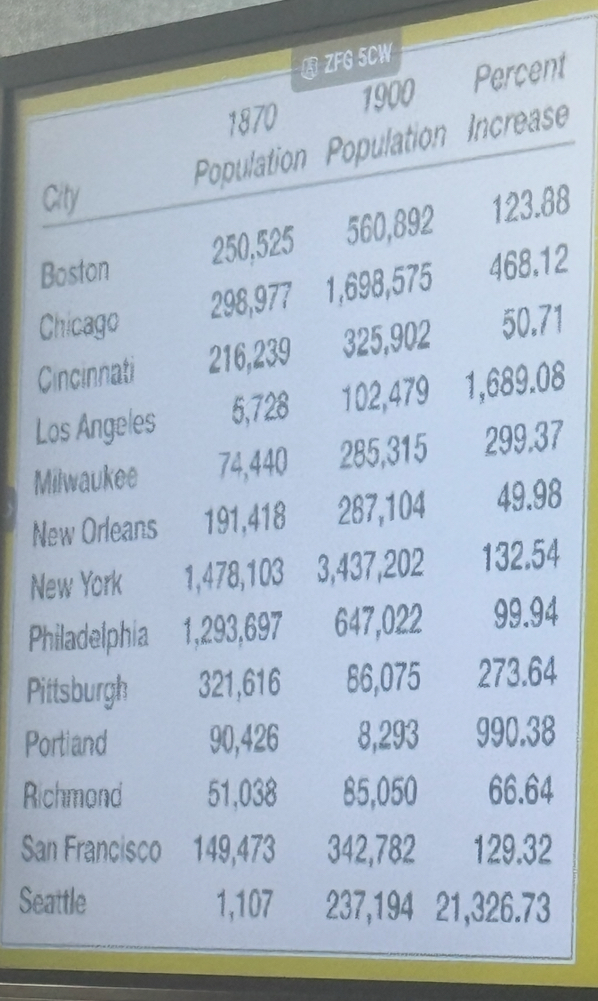
By 1890, Chicago, NY, & Philadelphia boasted over 1 million & New York was the 2nd largest city in the world, the elevated train & electric trolley allowed more people to work in the cities
Urbanization
1870-1900 the US population doubled and the city population tripled, the masses flocked to cities that were overflowing with garbage, contaminated water, horse urine and manure, roaming pigs, and untreated sewage, in NYC over 15,000 dead horses were removed annually, ethnic neighborhoods helped with assimilation.
2nd Industrial Revolution
started in Germany and US, improved transportation/ communication, electrical power, and applying scientific research to industry, US became the leader by 1894, the workplace lacked safety, in 1913, 25k died at work and 700k were seriously injured
Unions
workers that negotiate as 1, represents all workers and benefits
 Note
Note  Flashcards (24)