BCS 111 Lecture 7.2
 Studied by 0 people
 Call Kai
 Learn
Learn Practice Test
 Spaced Repetition
 Match
Match Flashcards
 Knowt Play
1/13

There's no tags or description
Looks like no tags are added yet.
Name | Mastery | Learn | Test | Matching | Spaced | Call with Kai |
|---|
No analytics yet
Send a link to your students to track their progress
14 Terms
Principles of visual imagery (Finke 1989)
-
Implicit encoding
features in an object
Can you picture mentally what the library reading room is like?
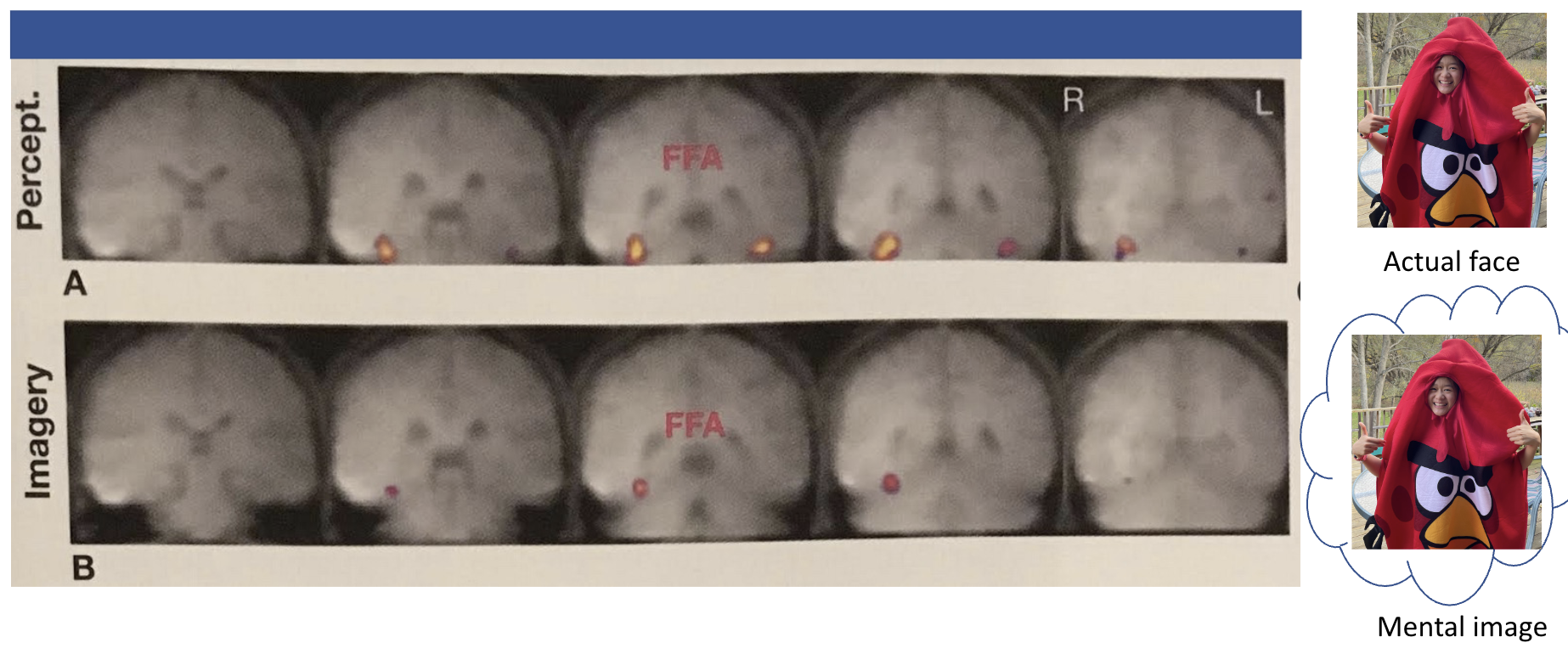
Perceptual equivalence
imaging an object similar to actually perceiving it
Perceptual equivalence (cont)
mentally imaging an object is similar to actually perceiving it
activation of fusiform face area (FFA) while seeing the actual face AND forming a mental image of it!!
Spatial equivalence
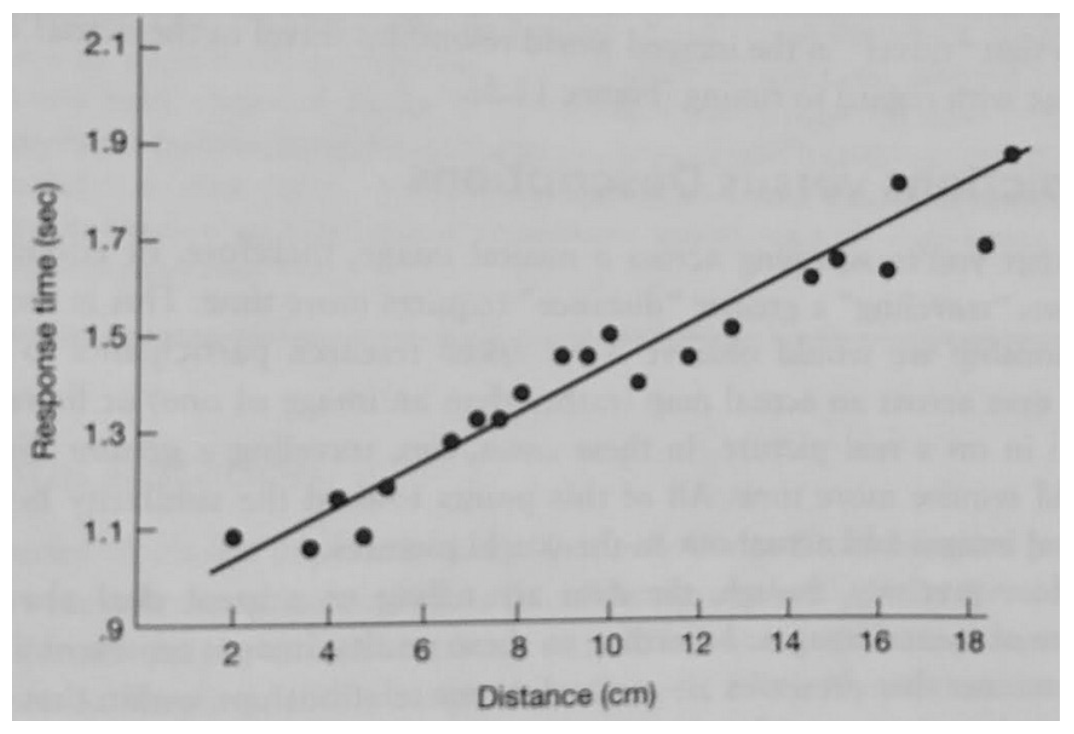
amount of time it takes to mentally scan from A to B is a function of the actual distance A-B in the image
Spatial equivalence: how to test this
Results from Kosslyn (1983)
The longer the distance in the image, the longer the scanning RT
The distance between objects on the image is just like the “distance” between objects in our mind!
Blind people
Spatial equivalence: also applies to blind people- they learned through tactile senses
Form a mental “sketch” of the object by touch
When asked to mentally scan an image or object “without” seeing it, spatial equivalence is also found in blind people.
Transformational equivalence
rotating an object similar to rotating a mental image
Structural equivalence
features of imaged object similar to actual obj.
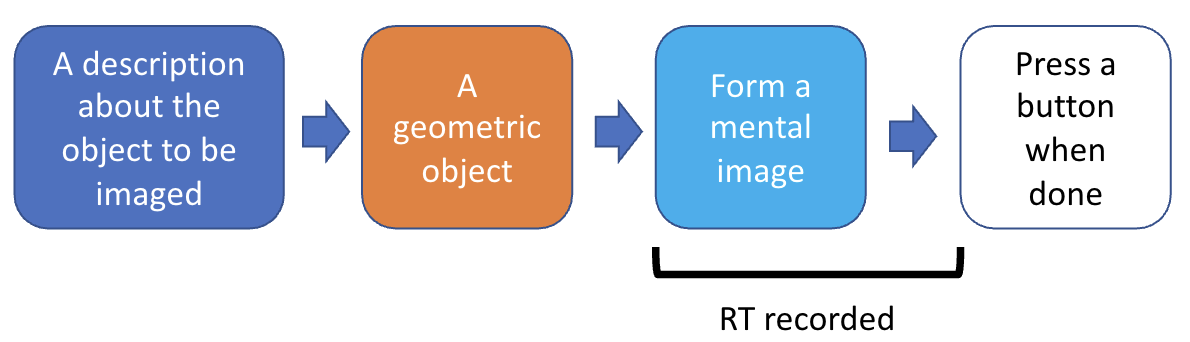
How to test Structural equivalence: Kosslyn et al. (1983)
(cont)
Key manipulation:
• Complexity of the verbal description: one group receives complex descriptions and another receives simple ones
(e.g., 9 small circles vs. a big circle)
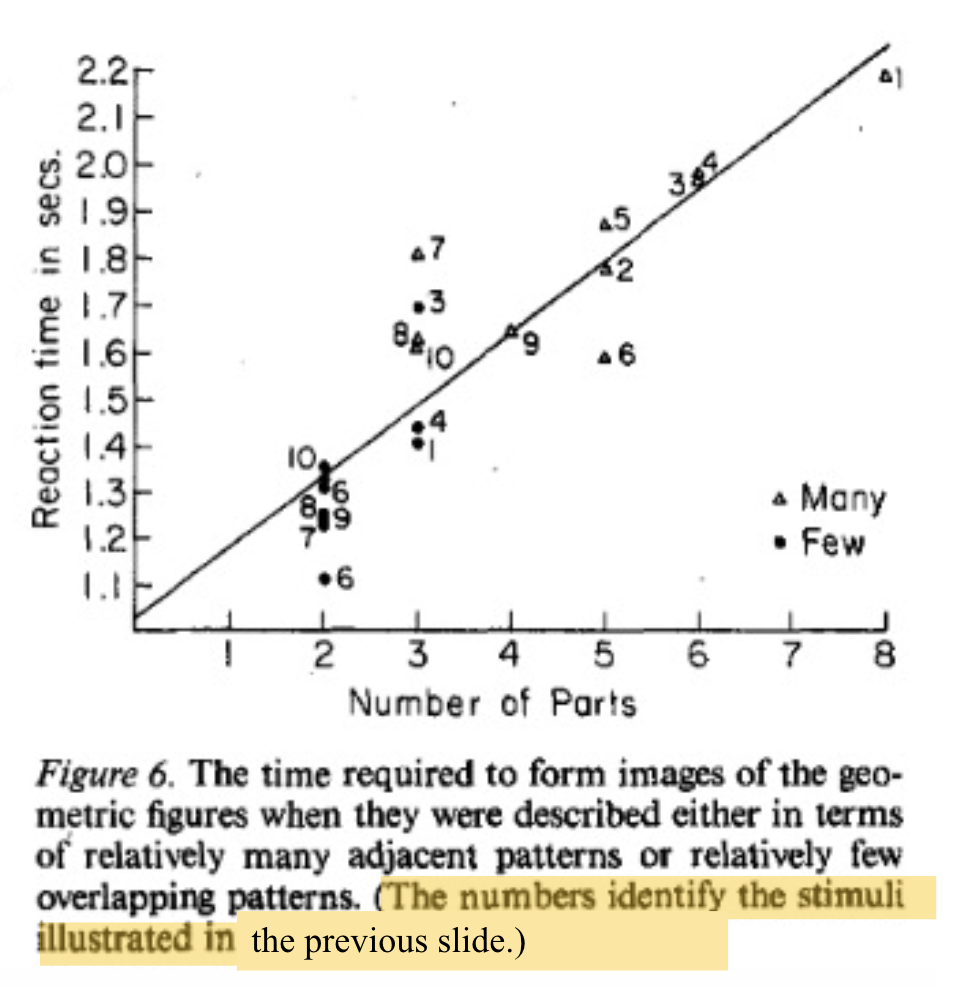
Structural equivalence: Kosslyn et al. (1983)
Finding 1:
Positive correlation between RT and # of parts
Complex objects require longer time to image
(cont)
Finding 2:
Complex description
slower
Effect of language on structural complexity
Interaction between the mental 3D space and the actual environment- Spatial cognition
Knowing where we are
Knowing where to go
e.g. Navigate through your room without lights
 Note
Note  Flashcards (105)