Accounting
 Studied by 0 people
 Call with Kai
 Learn
Learn Practice Test
 Spaced Repetition
 Match
Match Flashcards
 Knowt Play
1/113

Earn XP
Description and Tags
Name | Mastery | Learn | Test | Matching | Spaced | Call with Kai |
|---|
No study sessions yet.
114 Terms
What is accounting
Language of business - tells the financial story of the business
‘Process of identifying, measuring and comunicating economic information to permit informed judgements and deicsions by the users of the information
To provide financial information about the reporting entity that is useful to existing and potential investors, lenders and other creditors in making decisions about providing resources to the entity.
Accounting methods have developed over thousands of years and are still developing
What does accounting allow us to do
Make business decisions (accounting analytics)
decide prices, calculate costs of products/services, evaluate different options, take out a loan
Measure Business performance
Know how well an individual, group, division, factory, product is performing. Know how well we use our capital to generate returns
Report a business’ financial performance, position and liquidity
Explain entity concept
A business can be a sole trader
single owner
personal liability of owner for business debts
Drawings
Partnership, Limited liability partnership
two or more owners
personal liability of owners for business debts
partnership salary and profit share
Company
Multiple owners- shareholders
Limited liability of owners for business debts
dividends and capital growth
Private limited company (Ltd)
Public limited company (PLC)
Listed Company
Who uses accounting information
Investors/analysts
Lenders
Suppliers
General Public
Customers
Government
Employees
Management
What are internal users and what may they use accounting information for
Managers are internal users and will use it for
marketing decisions
finance decisions
production decisions
HR decisions
What are external users and what may they use accounting information for
Investors’ decisions - dividend stream, capital growth
Lenders decisions - Interest, capital
What are the differences between financial accounting and management accounting
Financial accounting reports on past events using historical info, management accounting involves planning for the future using past and projected future info
Financial accounting is highly regulated by (IFRS,US GAAP) whereas management accounting is unregulated however professional bodies have guidelnines
Financial accounting involves detailed annual financial statements, whereas management accounting involves frequent management reports
Financial accounting follows a set format for statements, whereas management accounting involves no pre set and often detailed reports
Financial accounting has external and general purpose for wide range of users, whereas management accounting is internally used and specific purpose for management
Why is accounting important to me
understand busieness/ personal finance
interpret financial info
make better financial decisions
be a better managemr/ business person
Explain the 3 step financial accounting system
Step 1: record transactions
(double entry bookkeeping - Duality)
Step 2: analyse and summarise
(trial balance)
Step 3: prpare accounts
Explain the Qualitative characteristics (IASB Conceptual Framework)
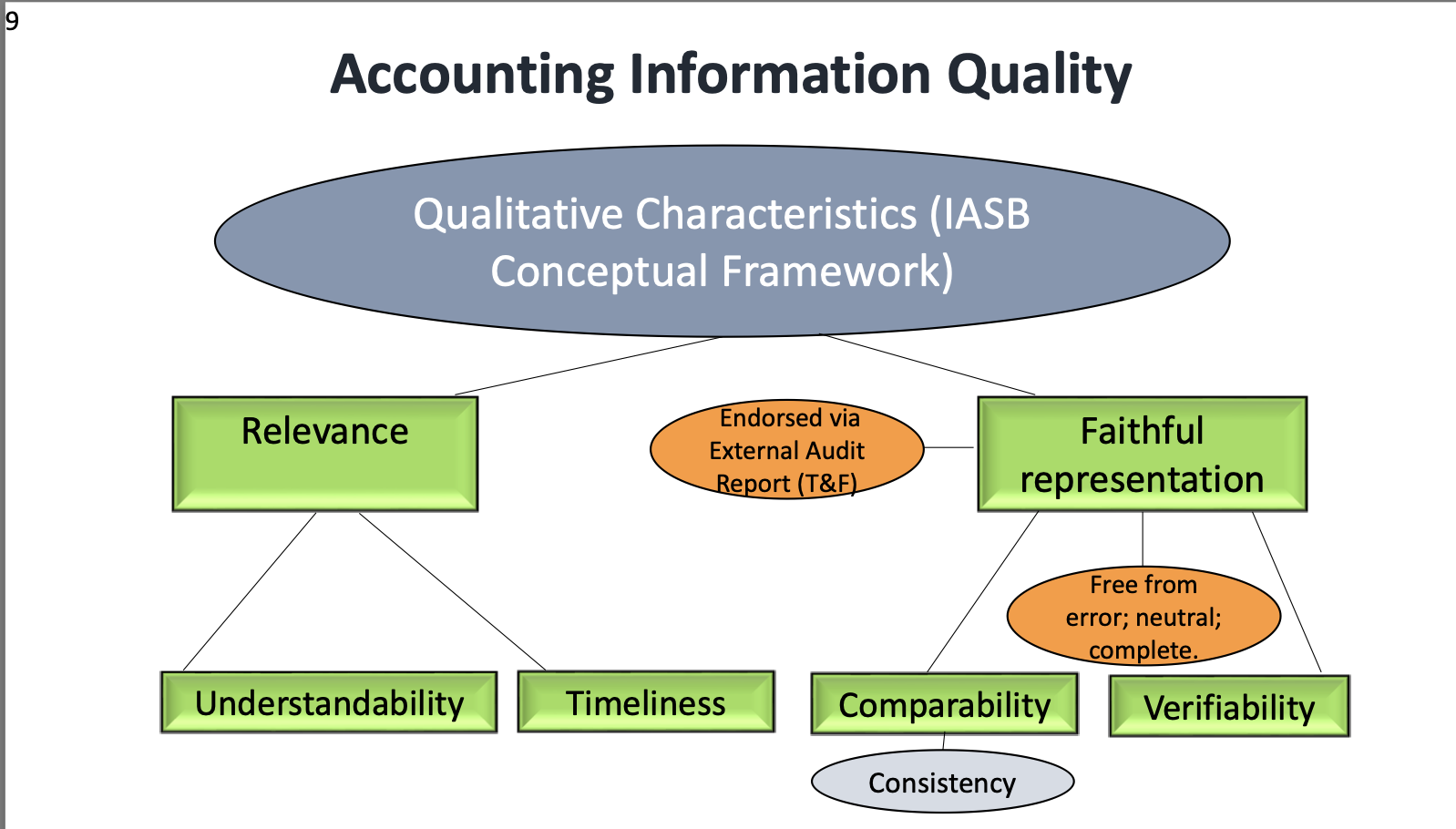
Explain the Acounting Environment
IFRS / US GAAP is a widely used accounting rules and principles
144 Countries require IFRS use, including 15 of the G20
Remaing 5 are US, China India, Japan, and indonesia
US accounting standards are US GAAP, broadly similar to IFRS
What are the major financial statements
Statement of Profit loss/ Income statement
reports profit or loss for a period of time
Statement of financial position/balance sheet
shows assets liabilities and equity of a business at a particular point in time
Statement of Cash flows
Provides information on cash movements in or out of a period of time
What is an asset
something owned
A present economic resource controlled by the entity as a result of past events
What is a liability
Something owed
A present obligation of the entry to transfer an economic resource as a result of past events
What is equity
Shareholders’ funds
Residual interest in the assets of the entity after deducting its liabilities
Assets - liabilities = equity
or equity = capital + profit
what is capital
amount owner (s) invest in a business
What is profit
Income - expenses (for a period of time)
What is the accounting equation
assets - liabilities = equity
or
assets = equity + liabilities
What is the affect of trading on equity
Proffits increase the net assets and increase equity
Losses reduce net assets, which reduces equity
hencee the accounting equation to reflect this
Assets = Equity + Profit ( or Loss) + Liabilities
What should be on the income statement
Sales revenue
Less cost of sales = - ( Purchases + less closing stock)
Gross profit = Sales Revenue less: cost of sales
Less: Expenses
Net profit = Gross profit less: Expenses
What should be on the SoFP
Assets:
Non current assets
Current assets:
inventory
trade receivables
bank balance
Liabilities:
Current Liabilities
net assets = asset - liabilities
Equity:
Ordinary share capital
Retained earnings (profit)
Total equity = ordinary share capital + profit
Explain the trial balance
Sales on credit are trade receivables
purchases on credit are trade payables
Total Db = Total Cr
DB = Assets / Expenses
Cr = Liabilities / Incomes
What are the limitations of accounting
IT is powerful, but can be devise as those in the know are in a position of power
It is subjective there is no right answer eg for the value of assets or profit an organisation owns/ makes
tells a financial story tellable in many ways- each potential biased
is partial- cannot measure everything in monetary terms- money measurements. Can create problems, ie ford pinto
Needs context. Limited value in interpreting accounting information without udetstatngin its context
Because not neutral - it sustains existing and inequitable social orders- critical accounting theory
Statement of financial position
Shows assets, liabilities and equity of a business at a particular date
provides a snapshot of the business
sometimes referred to as the balance sheet
encapsulates the accounting equation
A = C + L
What is the relationship between the SoFP, IS, CFS
statement of financial positions (point in time) are linked by IS and CFS (period of time)
Explain the layout of the assets section of SoFP
ASSETS
Non current assets
long term assets for example a car. XXX
Current assets
Short term assets for example inventory. XXX
Total Assets = (sum of above). XXX
Explain the layout of the liabilities section of SoFP
CAPITAL AND LIABILITIES
capital at the beginning of the period XXX
add profit for the year XXX
less drawings XXX
Capital at the end of the period XXX
non current liabilities
Long term liabilities XXX
Current liabilities
Short term liabilities. XXX
Total capital and liabilities XXX
Define non current assets
assets in long term use in the business
Define currrent assets
assets held by the business for < 1 year including inventory held for resale and cash balances
Current liabilities
Amounts due to be paid < 1 year including amounts owed to suppliers
non current liabilities
amounts due to be paid after a year, including long term loans
explain non current assets
3 main types:
tangibles: property, plant and equipment
intangibles: brand names, goodwill and patents
Investments ; share investments and derivatives
Valuation of tangible non-current assets
initially recorded at historic cost (purchase price). companies may use fiat values, ie the value that you could sell it for
The historic cost (or revalued amount) is used up by the business ie they wear out in use; wear out over time; become obsolete → economic benefits inherent in the asset reduce = depreciation
Define net book value
Historic cost/ revalue - accumulation of depreciation = Net book value (NBV)
Explain valuation of intangible/investment non current assets
intangibles
recorded at a cost only if purchased, not recognised if internally generated
brand names such as. Microsoft not shown as assets because usually internally generated
significant limitation of information value of financial statements
depreciation of intangibles is called Amortisation
Investments
recorded at their fair value
Explain market value (price) vs Book price
Price to Book ratio: (mv per share)/ (book value of net assets per share)
example price to book ratios (in 2020)
microsoft 12.92
Facebook 4.52
Nokia 1.31
what accounts for the difference?
assets stated at historic cost not at market value
assets mostly intangible on SoFP
Explain Depreciation
Non current assets benefit a business over a number of yeeats
Depreciation aims to spread (match) the cost of the asset over the years in which the benefit will be obtained
This is an example of the matching convention
2 main methods:
Straight line: equal annual amount: assets fall in value evenly
Reducing balance: Front end loaded; value falls mostly early on
What would the NBV look like for an asset that depreciates £200 a year and initially is worth 630
630, 430, 230, 30
Define Depreciation charge
amount charged (expense) to income statement to spread the cost of non-current assts over the life
Define Accumulated depreciation
Total depreciation charged to date on a asset since purchased
Define the net book value
cost of an asset minus the accumulated depreciation charged on it
What are current assets
Current assets are held for short term- ale or use in business’ normal operations
Examples include:
inventory
trade receivables
prepaid expenses
cash/bank or cash equibalent
Include at historic cost or net realisable cost (selling price) if lower _ Prudence
Explain the circulating nature of current assets
Inventories are sold on credit to customers, creating trade receivables which when customers pay receivables are converted to cash which is used to buy more inventory
Explain Liabilities
Present obligation of the entity to transfer an economic resource as a result of past events
Non current:
amounts to be settled in the longer term - ie after a year
examples include long term bank loans and debentures and loan stocks
current:
amounts to be settled in the short term ie within 1 year
examples include money owed to suppliers, bank overdrafts, non current liabilities in their last year
What are the limitations of the SoFP
Historic cost and historic nature
Estimates and judgements
which depreciation methods and rates to use
missing assets and money measurements
some intangible assets
Explain the nature of a limited company
limited company is a separate legal entity with perpetual existence
Owners (shareholders) granted Limited liability for company’s debts and losses
public company (plc) Ofers shared for sale to the public; private company (Ltd) cannot
to protect those dealing with it, limited liability included in the name, restrictions placed on the withdrawal of equity and audited annual financial statements are made publicly available
Governed by a board of directors, elected by shareholders
UK corporate governance code sets out how plc should be directed and controlled
Compare the two methods of financing: share capital
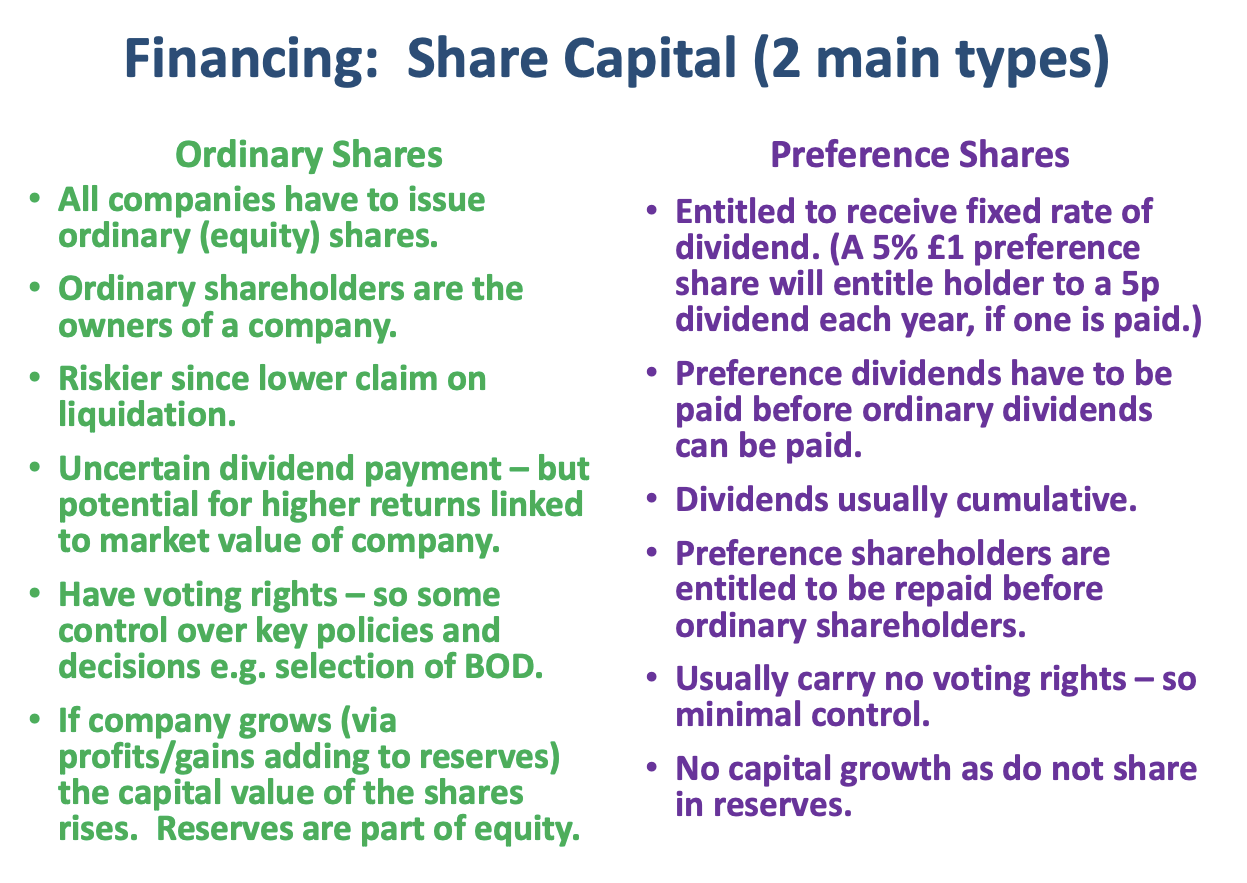
define authorised share capital
it is the maximum amount of share capital that can be issued
define the nominal value
it is the shares of the initial (par) value at which shares are issued. It is usually low ie, £1 to facilitate trading
Define a dividend
it is a payment made to company shareholders to reward them for investing
compare nominal value to market value
Once a company (plc) starts trading (and making profit`), their initial nominal share value may increase => market value
if a company with 50,000 £1 ordinary shares whose market value Is £1.50 want to raise £300,000 by a new issue of shares they will need to issue 200,000 shares.
This would be accounted for in the SoFP, as share capital (200,000) + share premium (100,000) = Capital raised (300,000). It is worth noting that share premium is a reserve account - part of equity section
Once a company issue shares any changes in the market price have no effect on company accounting records
Explain dividends
ordinary share dividends are a distribution of profits at the director’s discretion - ie distribution policy
distribution policy considers shareholders expectations - income vs capital growth
may be paid in two stages - interim (during the year) and final proposed (paid after year end)
What are loan capital and debentures
many businesses raise finance from loans as well as share capital
debentures are one form of (usually secured) long-term loan which can be listed on the stock exchange and traded like shares.
What must the annual report of a plc entail
Audited financial statements:
Income statement
statement of financial position
statement of changes in equity
cash flow statement
notes to the financial statements
Auditors report on the above
What are the uses for the SoFP
users can assess financial position of an entity to make informed decisions
shows how business are financed (equity and liabilities) and how its funds are used (assets) from which users can assess financial strength or risk
Provides basis for assessing value of a business/ shares
remember SoFP has limitations
for example it will not include key internally generated intangible assets
Explain the basic principles of corporate governance
responsibility: directors expected to manage/ lead within framework of prudent controls
Accountability: shareholders have right to receive company information and remove company directors
transparency: information to shareholders should be clear and understandable
Fairness: all shareholders to be treated equally and fairly
UK corporate governance code - Key principles
- leadership; effectiveness; accountability; renumeration; shareholder relations
Income statement
shows financial performance ( how much profit or loss has been made) over an accounting period
Link SoFP at the beginning and end of a reporting period, tells the story of what happened between two snapshots
presents income (revenue) less expenditure ( I - E) on an accruals basis ofr a particular concept
Accruals (matching) concept:
incomes/expenses recognised when they are learnt or used/ not when they are paid
matches expenses to the income they generate
ncude expenses in time periods they are used in, regardless of when they re paid
What is revenue ( income)
Income can be split into revenue and gains
revenue is income arising from ordinary activity of an entity such as sales, fees, interest, dividends, etc
gains are other items meeting the definition of an income such as unrealised gains from increases in revaluation of assets
What issues can we have when recognising revenues
multi part sales - such as mobile phone contracts
long term service provision of development contracts such as bridge, road or ship builiding
R&D projects eg pharmaceutical companoes
online trading - when is the point of sale?
what is the approach set out by IFRS 15 to revenue recognition
Recognise revenue (sales income) - when goods/ services are transferred to the customer - ie when contractual performance obligations are satisfied
Measurement - reflects consideration company expects to receive
A consistent policy should be adopted
Cost of Sales
cost of sales. = opening inventory ( stock) + purchases of inventory in the period - closing inventory (stock)
How do we value inventory
The lower of cost or net realisable value (NRV)
NRV = selling price - further costs before sale can be made
this is an application of prudence convention
Methods of deciding which entity is sold first
FIFO - first in first out
LIFO - last in first out (not acceptable in accounting standards)
AVCO - weighted average cost
different methods change the amount of gross profit (clearly accounting is a decision not an objective truth)
What is creative accounting?
The Use of accounting choices to produce overly positive views of a company’s activities and financial position for example by policy choices (estimation and judgement choices) as well as revenue manipulation through early recognition
what are potential Creative accounting objectives?
Management compensation (profit based bonuses)
Tax considerations
Competitive onsiderations
Conceal poor managerial decisions
Satisfy demands of majority investors concerning levels of return
Explain matching( accrual concept)
resources (revenue expenses) are used to generate revenue
Matching (accruals) concept links expenses to the revenue they generate (regardless of when we pay for them)
Our accounting year ends on 31st December 2019 and we paid 30k for 15 months insurance from 1st Jan 2019. How much insurance expense relates to the year ending 31st December 2019
£30k is taken in the Statement of Cash Flows
6K is recorded on the SoFP as a current asset
24K is an expense on the income statement
Explanation: 30k/15months = 2k/month hence 12×2k =24k …
what effects do prepayments have?
prepayments decrease the expense recorded
Prepayemnts are current assets that entice the business to a service in the future
Leccy bills paid up to 30th September 2019 total 9k, but at the end of the year we havent received a bull for the last 3 months of our financial year. How would this accrual (expense owed) be recorded
9k of cash payment onto the SoCF from payments already made
accrual of 3k recorded on the SoFP as a current liability (negative)
12k electricity expense recorded on Income statement
What effects do accruals have on the statements?
accruals increase the expense recorded
Accruals are owing at the date of the SoFP under current liabilities
What happens when trade receivables go bad?
not all debts owed to a business will be paid
bad debts are written off - ie removed from the trade receivable current asset (derecognised)
The amount written off becomes an expense and is included in the IS
Bad debt causes trade receivables to go down in the SoFP
Bad debt causes bad debt expense to go up on the IS
Why is cash flow important?
most users of financial statements appreciate the importance of cash in a business
Cash is the ‘lifeblood’ of an organisation
many profitable companies have gone bust because of mismanaged cash flow
Many business valuation models are based on predicted cash flows
Is the profit that a business makes a reliable indicator of its cash balances?
no - a profitable business less may have large sums tied up in inventory and trade receivables and may have invested in new non-current assets
What is the purpose of the Cash flow statement
Provides info about how cash is managed - generated, raised and spent
In conjunction with IS and SoFP provides info on liquidity, viability and financial adaptability
historical cash flow information may assist in judgements about future cash flows
define Cash
cash is cash in hand and current bank balance
It is worth noting that bank overdrafts are considered negative cash
define cash equivalents
short term, highly liquid investments readily convertible to cash
What are the inflows of cash
customers (trading)
interest received
dividends received
issue of shares
receipt of loans
sale of non-current assets
What are the outflows of cash
Suppliers (trading)
wages and salaries
overheads
interest paid
dividends paid
loan repayments
purchase of non-current assets
corporation tax paid
What is the cash flow cycle
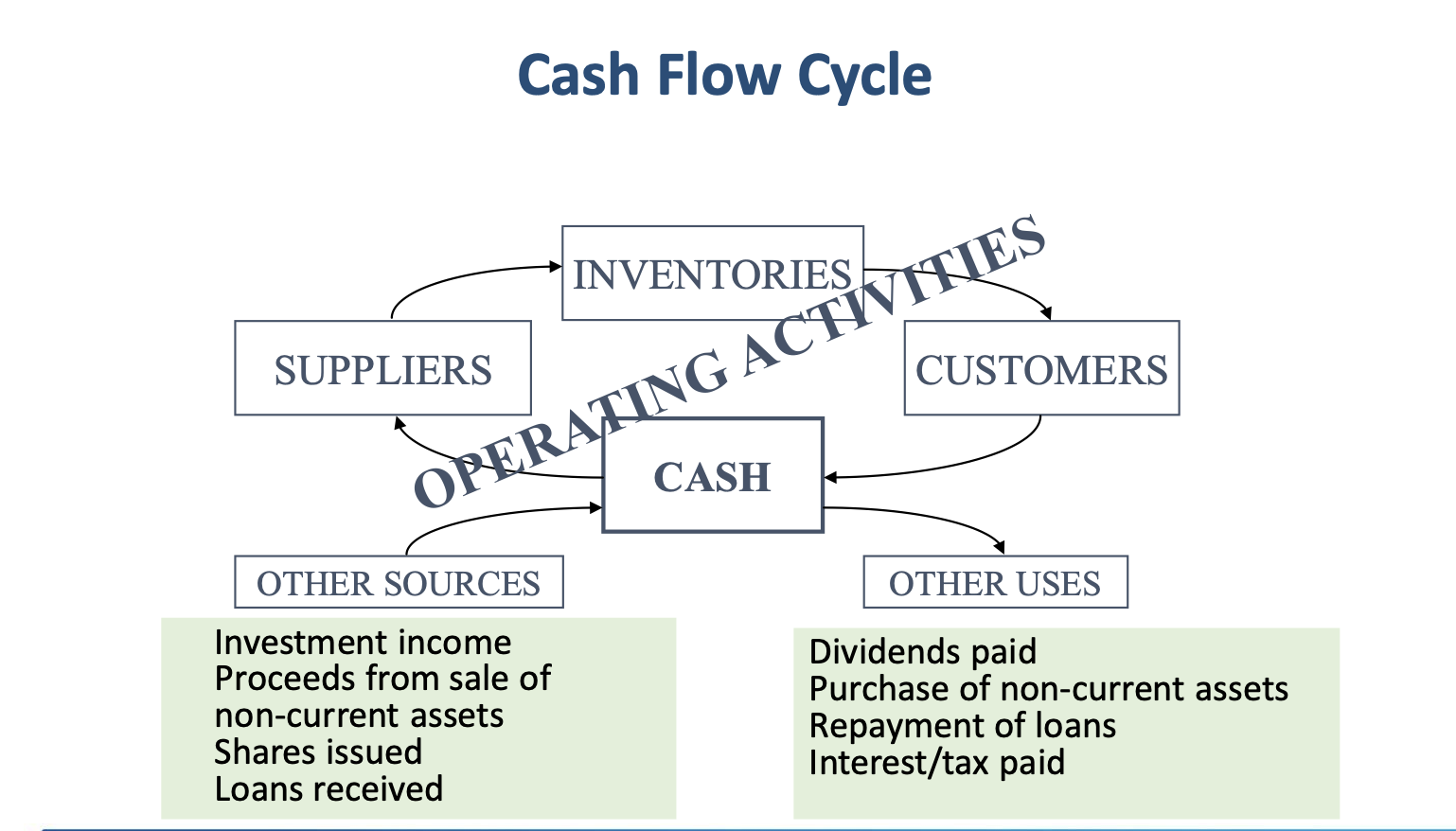
how can we categorise cash flows
cash flow is analysed into the sourcses and uses of cash according to activity
operating activities (arise from trading activities)
investing activities (arise from purchase/disposal of non current assets)
financing activities (arise from changes in long term financing)What
What Is the standard layout of the CFS
Cash flows from operating activiteies
±
Cash flows from investing activities
±
Cash flows from financing activitites
=
net increase (or decrease) in cash and cash equivalents over the period
what are the 2 methods of CFS
direnct and indirect (if a company chooses direct they also have to show indirect method)
Direct shows actual cash flows from sales purchases, payments of wages and overheads
Indirect reconciles operaing profits with operating cash flows
adjustments in the CFS
closing inventory - increases tie up cash (outflow) decreases release cash (inflow)
trade receivables - increase tie up cash (outflow) decreases release cash (inflow)
trade payables - decrease tie up cash (outflow) increases release cash (inflow)
Note depreciation - add back to profit as a non cash expense
explain the impact of Tax, interest and dividends on the CFS
these are 3 significant payments made by business during fincnaicl periods
the amounts recorded on the CFS will be the amounts actually paid
Payments of interstate and tax shown as deductions from the cash generated from operations
payments of dividends shown with cash flows from financing
What steps can be taken to ensure a business overdraft does not continue to grow?
raise additional long term funding through some means such as a loan
reduce inventory level
arrange longer credit terms from suppliers
if additional non current assets are needed consider lease or hire
collect trade receivables quicker
Why is cash management important
Liquidity is important as profitability
all areas of working capital must be carefully monitored and controlled
stock levels kept optimum - ties up cash, theft, storage costs
controls in place to ensure payments are made from trade receivables. (for example payment reminders and scrutiny before credit
Ensure tot are full advantage of credit from suppliers, helpful if the supplier term is longer than the customer credit term
Failure to manage cash ca lead to serious consequences
What are the potential consequences of poor cash management?
managemmnt tied up dealing with liquidity
increase interest charges
inability t negotiate favourable credit with suppliers
unlikely that funds will be available to support investment in non current assets or other growth/development plans
lenders recalling loans if their is default of payments
inability to pay suppliers
inability to pay employees
business failure
What are the purposes/usefulness of CFS
help users assess company’s liquidity
help users compare performance of different companies
historic cash flows useful indicator of the timing, amount and certainty of future cash flows
reveals how investing activities are financed, eg from internally generated resources, borrowijng, share issues or cash balances
tracking sources and uses of cash over several years shows financiang and investing patterns/ trends. This may help predict future management action
What are the limitations of CF analysis
only one years cash flow reviewed
investing and financing activities irregular
profit figures may give better indication in long term of company’s ability to pay dividends, wages, settle debts etc
historic cash flows- problems of predictions of future
What are the 4 common types of ratios
Profitability - How successfully the business is trading
Liquidity - How effectively cash is managed in the business
Financial Gearing - How efficient the financial structure of the business is
Investment - How much return the investors can get from shares
How can we interpret ratios
Ratios may be compared to:
past periods of the same company (time series comparisons or trend analysis
Similar business operating in the same industry across the same period (competitor comparisons)
Industry averages (cross sectional comparisons)
Analysts predictions and forecasts of performance
What are the profitability ratios
Return on Capital employed (ROCE)
100X Operating profit (PBIT)/(Equity + non-current liabilities)
Return on equity
100X profit after tax/Equity
Asset turnover (AT)
Sales/Capital Employed
Gross profit margin (GP margin)
100x Gross profit/sales
Expenses:sales
100xExpenses/sales
Operating profit margin (OP margin)
100x Operating profit (PBIT)/Sales
how can we connect ROCE, OP margin and Asset Turnover
ROCE = OP Margin * Asset turnover
What are common liquidity ratios
they are concerned with a business’ ability to meet short term (current) liabilities as they fall due
current ratio
Current Assets/Current liabilities: 1
Acid test ratio
(Current assets-inventories)/current liabilities : 1
what do the liquidity ratios tell us
Current ratio:
2:1 considered good result but depends on business nature/size eg manufacturing tend to have higher current ratio than supermarkets
Higher figure not always positive, may indicate levels of inventory, trade receivables or even cash are too high
Quick Ratio (acid test)
Measures availability of liquid resources (excludes inventory as it is the least liquid asset) to meet current liabilities
Measure of extreme short term liquidity
< 1: ! means company doesnt have enough liquid short term assets to cover short term liabilities
explain the working capital ratios
inventory days
365 X inventory/COS
trade receivable days
365 X TR’s/Credit Sales
Trade payables days
365 X TP’s/Credit Purchases
What is the working capital cycle
Working capital cycle = inventory days + trade receivable days - trade payable days
collect trade receivables as quickly as possible without antagonising customers
pay trade payables as slowly as credit terms allow without antagonising suppliers
keep inventories as low as possible whilst ensuring sufficient to meet demand
What is Financial Gearing
financial gearing measures extent of debt finance (fixed interest) in a business compared to equity (shareholders funds)
As the proportion of debt financing rises, gearing rises, which is an indicator of financial risk
What is the gearing ratio
the gearing ratio = 100x long-term (non-current) liabilities/(Equity + long term liabilities)
a rough guide would suggest:
low gearing <10 percent
moderate gearing 10-50 percent
high >50 percent
also preference shares are usually treated as debt and year end or averaged figures are used
what are the impacts of financial gearing
higher gearing = higher volatility of return to equity holders - ie risks of return erosion are greater
Equity share prices tend to be lower in highly geared companies
Additional borrowing is difficult for highly geared companies
Result:
companies sensitive to their gearing levels resulting in various accounting initiatives to achieve OFF BALANCE SHEET FINANCE - eg sale and lease back
 Note
Note  Flashcards (56)