Ancient Warfare Test #3
0.0(0)
 Studied by 5 people
 Call Kai
 Learn
Learn Practice Test
 Spaced Repetition
 Match
Match Flashcards
 Knowt Play
Card Sorting
1/170

Earn XP
Description and Tags
Last updated 5:46 AM on 3/20/23
Name | Mastery | Learn | Test | Matching | Spaced | Call with Kai |
|---|
No analytics yet
Send a link to your students to track their progress
171 Terms
1
New cards
S. Iran
Modern province of Fars
2
New cards
Cyrus
Persian Empire became prominent in the 6th C BC under ruler Cyrus
3
New cards
Persian Kings (descent)
All the kings of Persia claimed descent from Achaemenes (mythical ancestor), called Achaemenids
4
New cards
Persian Period of Expansion
Under Cyrus and then his son Cambyses, then Darius, period of expansion
5
New cards
Cyrus (expansion)
Lydia and the Babylonian Empire. At death empire was from the Mediterranean to the Indian Ocean
6
New cards
Cambyses (expansion)
Egypt
7
New cards
Darius I (expansion)
Parts of the Indus Valley, Central Asia, Libya, NE Greece (becomes largest empire in Near Eastern history)
8
New cards
Satrap
Governor, literally translated as “protector of the kingdom”
Usually high ranking Persian, other Persian nobles given estates throughout empire
Usually high ranking Persian, other Persian nobles given estates throughout empire
9
New cards
Darius I
Distant relative within the family tree of the Achaemenids Emerged after succession crisis following Cambyses death
10
New cards
Darius I (government structure)
Reorganised empire after series of rebellions.
Separates empire into 20 provinces, all governed by a satrap
Separates empire into 20 provinces, all governed by a satrap
11
New cards
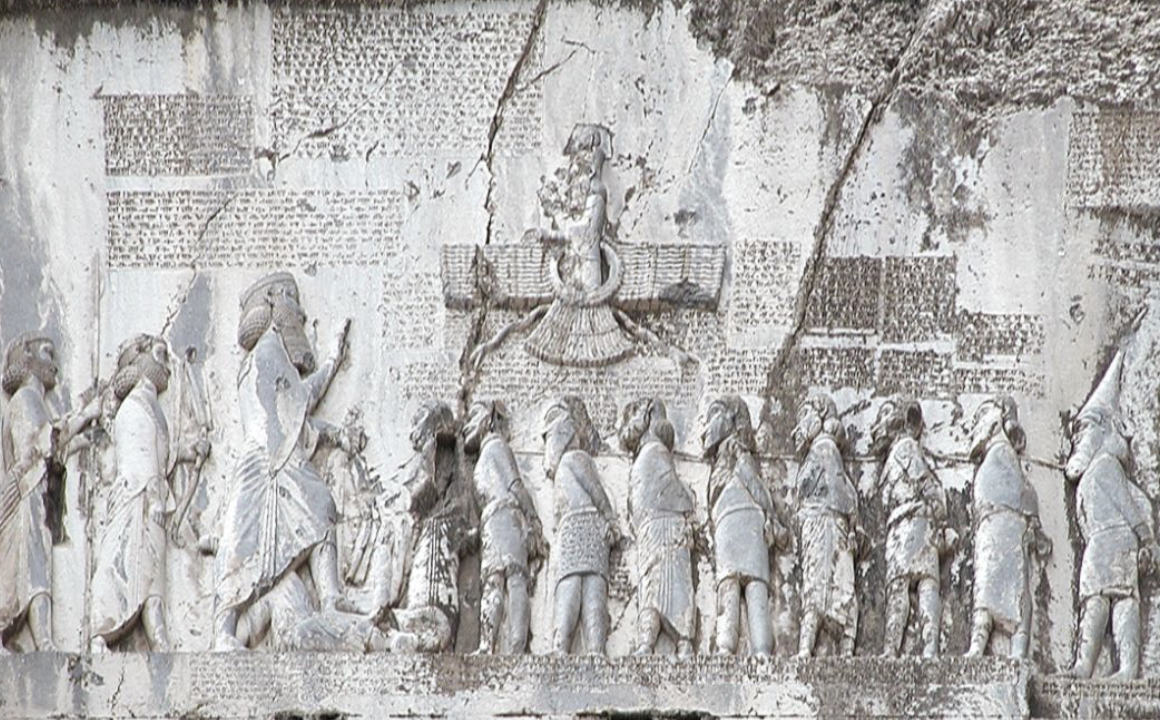
Behistun Relief with Darius I
12
New cards
Behistun Relief with Darius I
Rock face relief
Darius is tall figure (hierarchical proportions), steps on body of rival Guamata with captured rebels
Darius just came into power so he was trying to look cool
Rebels are small and in shackles
Ahuramasda is winged god in middle
Most detailed inscription you can find about war
Darius is tall figure (hierarchical proportions), steps on body of rival Guamata with captured rebels
Darius just came into power so he was trying to look cool
Rebels are small and in shackles
Ahuramasda is winged god in middle
Most detailed inscription you can find about war
13
New cards
King (in art)
Unifying figure
Appearance in art changed depending on what area of the empire you were in (e.g. in Egypt, seen as new pharaoh)
Appearance in art changed depending on what area of the empire you were in (e.g. in Egypt, seen as new pharaoh)
14
New cards
Ahuramazda
Royal family devoted to Ahuramazda and maintained order, justice, and truth on the behalf of the god
15
New cards
Persian Empire Administration
Generally effective
Respect for local gods and religious tradition of foreigners within the Empire
Official inscriptions were multilingual for the diverse Empire
Respect for local gods and religious tradition of foreigners within the Empire
Official inscriptions were multilingual for the diverse Empire
16
New cards
Persian Empire (provinces)
Provinces contributed resources, including local products, silver, and skilled labour
17
New cards
Network of Roads
Network of royal roads to ensure communication between the king and the provinces and improve the mobility of the army (main use, but not only use. Also used for commercial purposes)
18
New cards
The Persian Army (Royal Army)
10,000 elite soldiers, called ‘Immortals’ because numbers always at full strength, use long and short range weapons
19
New cards
The Persian Army
Royal Army
For important campaigns, the large army had more non-Persians than ethnic Persians
Satraps would assemble armies of local troops, esp. Infantry with some elite Persian troops, officers and cavalrymen
Hired mercenaries
For important campaigns, the large army had more non-Persians than ethnic Persians
Satraps would assemble armies of local troops, esp. Infantry with some elite Persian troops, officers and cavalrymen
Hired mercenaries
20
New cards
Persian Army (units)
Units of 1,000 men, divided into smaller units of 100, and then 10
21
New cards
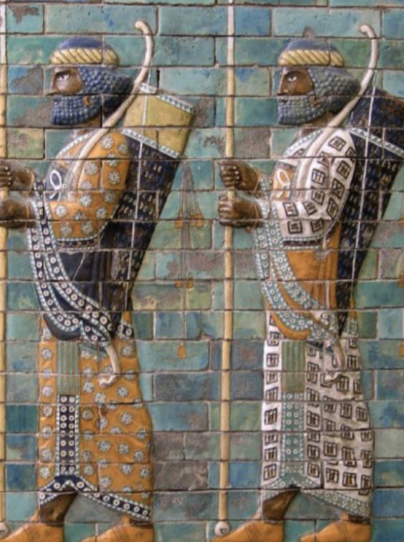
Two Persian Soldiers (“immortals” - no specialized fighting style cuz different types of weapons)
22
New cards
Persian Military Tactics
Long and short range combat
Calvary
Siegecraft and military engineering
Intelligence
Calvary
Siegecraft and military engineering
Intelligence
23
New cards
Persian Military Tactics (long and short range combat)
Used both bows and arrows as well as spears, axes, and swords
24
New cards
Persian Military Tactics (calvary)
large and important within the battle
Equipped with bows, javelins and spears
In open battle, would weaken opponents before the infantry arrived
Get into bow and spear range, attack, then retreat
Chase disorganised and fleeing enemies
Equipped with bows, javelins and spears
In open battle, would weaken opponents before the infantry arrived
Get into bow and spear range, attack, then retreat
Chase disorganised and fleeing enemies
25
New cards
Persian Military Tactics (Siegecraft and military engineering)
very advanced, continuing tradition of Near Eastern warfare
26
New cards
Persian Military Tactics (intelligence)
Used intelligence and negotiation with sympathisers on the enemy side
27
New cards
Persian Military Equipment
Armour, shields, weapons
28
New cards
Persian Military Equipment (armour)
Only a few elite troops had metal breastplates. Mostly they were made from cloth as mobility was more important than passive protection.
29
New cards
Persian Military Equipment (shields)
Very light; oval, crescent, or rectangular shaped
Rectangular shields (called **spara**) could also be planted in ground to provide protection for the archers
Rectangular shields (called **spara**) could also be planted in ground to provide protection for the archers
30
New cards
Persian Military Equipment (weapons)
short spears, axes, daggers, swords
Bows were main offensive weapon - foot soldiers would weaken enemy first with a bow before moving in to attack at close quarters
Bows were main offensive weapon - foot soldiers would weaken enemy first with a bow before moving in to attack at close quarters
31
New cards
Achaemenid Imperial Ideology (royal inscriptions)
Royal inscriptions show the moral and administrative qualities of the ruler and the orderly functioning of the empire under his leadership
32
New cards
Royal Inscriptions (war)
When war is mentioned in royal inscriptions, it’s very generic - statement is that the king was stopping disorder with the guidance of Ahuramazda
(exception: the Behistun relief which showed king stepping on enemy, shows Darius as capable of crushing opposition - Gaumata, shows what he could do to opposition)
(exception: the Behistun relief which showed king stepping on enemy, shows Darius as capable of crushing opposition - Gaumata, shows what he could do to opposition)
33
New cards
Royal Art
The royal administration used mostly images of peace rather than actual images of war - peace was understood to be the direct consequence of war and the victories won by the king
34
New cards
Tomb of Darius I (description)
King Darius I, Ahuramazda, the moon, altar
King is on platform supported by conquered soldiers in his empire, with their typical dress and weapons (Inscriptions says they are not prisoners)
King is on platform supported by conquered soldiers in his empire, with their typical dress and weapons (Inscriptions says they are not prisoners)
35
New cards
Tomb of Darius I (significance)
Darius acknowledging the contribution of foreigners to the functioning of the Empire
Following kings use same scene on tombs
Following kings use same scene on tombs
36
New cards
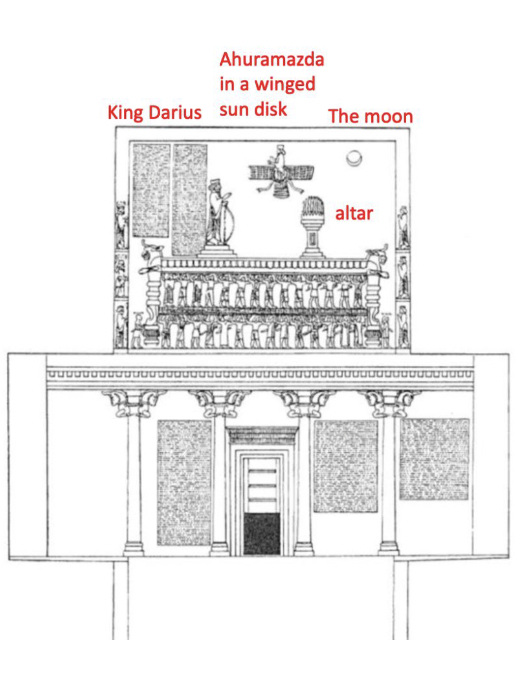
Tomb of Darius I
37
New cards
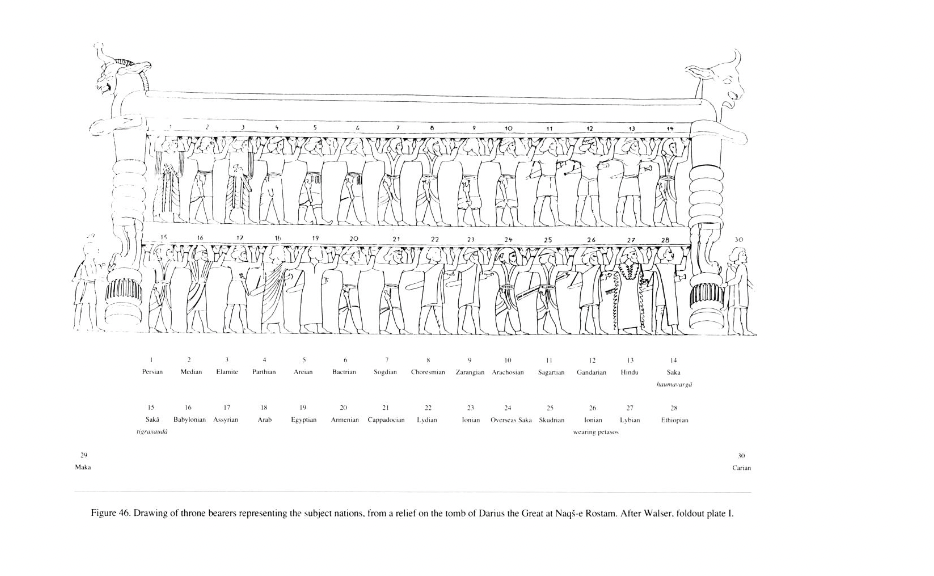
Detail of Throne of Darius
38
New cards
Lydia
Greek cities of the east coast of the Aegean were under the influence of Lydia. When Lydia fell, they went under Persian control (not under direct control, but paying tribute and providing support)
39
New cards
Ionian Revolt of the 5th C BCE
Rebellion of the Ionians (Greeks of this area)
6 years long
Only Athens and Eretria sent troops to help after the Ionians asks for help
Greeks take Sardis, the capital of Lydia and burn the town and local temple, which angered Darius
6 years long
Only Athens and Eretria sent troops to help after the Ionians asks for help
Greeks take Sardis, the capital of Lydia and burn the town and local temple, which angered Darius
40
New cards
Persian Army (5th C BCE)
Very mobile, light infantry, large and effective cavalry, use of missiles, good at siegecraft
41
New cards
Greek Army (5th C BCE)
Defensive, armoured infantry, little cavalry, hand-to-hand combat, ineffective in siege craft
42
New cards
First Persian Expedition
Darius I sends expeditionary force to take revenge on Athens and Eretria for helping the Ionians
Persians move through Europe, secure land positions with campaign in Thrace in 492 BC
Persians move through Europe, secure land positions with campaign in Thrace in 492 BC
43
New cards
First Persian Expedition (490 BC)
Persians land forces near Eretria, which they besiege, capture, and burn
Then land in Attica, at Marathon. Athens send their army with some allies (only from Plataea because other Greeks refused to come)
Then land in Attica, at Marathon. Athens send their army with some allies (only from Plataea because other Greeks refused to come)
44
New cards
Battle of Marathon (beginning)
Athenians attack Persians on the coast, positioned between hills and marshes
Larger Persian force couldn’t outflank them
Larger Persian force couldn’t outflank them
45
New cards
Battle of Marathon (battle)
Athenians move towards the Persians quickly, they reinforce their wings and enveloped the centre of the Persian forces The Persians were trapped, defeated, and fled to their ships and departed
46
New cards
Battle of Marathon (end)
Athens is ultimately victorious
Burial mound of Athenian dead at Marathon - the war dead seen as heroes
Burial mound of Athenian dead at Marathon - the war dead seen as heroes
47
New cards
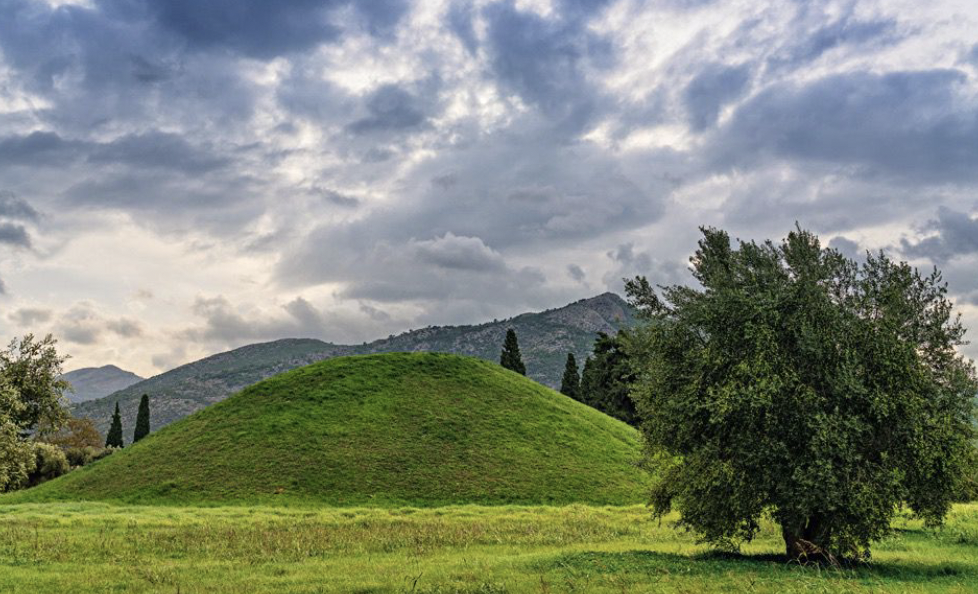
\
Burial Mound at Marathon (192 Athenians)
48
New cards
Second Invasion of Greece (year)
480 BC
49
New cards
Second Invasion of Greece (initial trigger)
Xerxes sends out the Persian army in 480 BC - cross the Hellespont and march south with support of their fleet that is supplied by subject areas along the Mediterranean
50
New cards
Second Invasion of Greece (Xerxes)
Son of Darius
Xerxes demands ‘earth and water’ from Greek cities which is really asking for complete submission
Xerxes demands ‘earth and water’ from Greek cities which is really asking for complete submission
51
New cards
Second Invasion of Greece (reason)
Some cities do surrender to Xerxes, others willingly side with Persians to settle scores with enemy Greek cities
Other cities chose to resist and form an alliance. Athens and Sparta are the most prominent members.
Other cities chose to resist and form an alliance. Athens and Sparta are the most prominent members.
52
New cards
Second Invasinon of Greece (Athens and Sparta)
Sparta has the most control (of the anti-Xerxes alliance) even though Athens provides most of the ships
53
New cards
Battle of Thermopylae (reason)
Greeks try to stop the Persians going through the pass of Thermopylae
54
New cards
Battle of Thermopylae (start)
Greeks hold back Persians for three days but have to retreat after the Persians discover a mountain pass that went around the Greek lines
55
New cards
Battle of Thermopylae (end)
A small Spartan force under the King Leonidas tries to slow down the Persians - eventually the King and his 300 knights were killed
The Persians now start the march towards Athens
The Persians now start the march towards Athens
56
New cards
Xerxes in Athens and the Battle of Salamis (entering Athens)
Persians reach Athens unopposed
Athenians flee to the small island of Salamis, following the advice of **Themistokles**
Athenians flee to the small island of Salamis, following the advice of **Themistokles**
57
New cards
Xerxes in Athens and the Battle of Salamis (in Athens)
The Persians enter Athens and burn the Acropolis in retaliation for the Greeks burning the temple in Sardis in the Ionian Revolt
58
New cards
Xerxes in Athens and the Battle of Salamis (actual battle)
Naval battle - hundreds of ships lined up in a narrow space BUT the huge number of Persian ships was actually their downfall - the crowded ships damaged each other, while the Greeks were able to maneuver between them
Greeks are victorious
Greeks are victorious
59
New cards
The Second Year of the Persian Invasion of Athens (context)
Xerxes goes back to Persia, but leaves part of the army with his general Mardonius
The Persians had to go back in Winter as campaigns are seasonal in the ancient world
The Persians had to go back in Winter as campaigns are seasonal in the ancient world
60
New cards
The Second Year of the Persian Invasion of Athens (Mardonius)
Mardonius stayed in Northern Greece for the winter before he moved south, where he burned the whole city of Athens after they wouldn’t accept his peace terms
Mardonius then goes to Boeotia where the terrain is favourable to Persian tactics, pro-Persian Greeks in the area, and waits for the Greeks (battle of Plataea)
Mardonius then goes to Boeotia where the terrain is favourable to Persian tactics, pro-Persian Greeks in the area, and waits for the Greeks (battle of Plataea)
61
New cards
Battle of Plataea (set up)
The Greek allied army lead by Spartan Pausanias enter the Boeotian plain and army sets up on the sloping terrain near the city of Plataea
62
New cards
Battle of Plataea (beginning)
Both armies held position until the Greek army tries to reposition themselves and the Persians think they’re retreating and so move into attack
63
New cards
Battle of Plataea (end)
Greeks are victorious, Mardonius is killed, area of Ionia is free
Soon after this battle they destroy Persia at **Mycale**
Soon after this battle they destroy Persia at **Mycale**
64
New cards
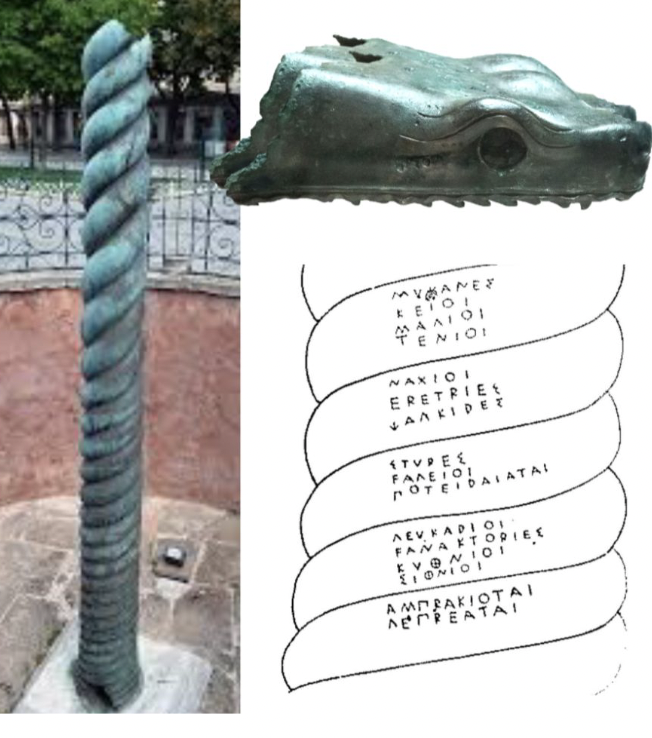
Remains of a serpent column from Istanbul
65
New cards
Reaction to Victory
The Greeks advertise their victory over the Persians through art (ex: Serpent column)
66
New cards
Remains of a serpent column from Istanbul
Battle of Platea
Column supported a bronze tripod that the Greeks offered in the sanctuary of Apollo at Delphi after the battle
Shows the names of those in the Greek alliance
Column supported a bronze tripod that the Greeks offered in the sanctuary of Apollo at Delphi after the battle
Shows the names of those in the Greek alliance
67
New cards
Delian league
After Persian Wars Greeks organised a league of cities to protect themselves against Persia called the Delian league - soon under Athenian control (rise of Athens will soon cause conflict with Sparta and its allies - aka the Peloponnesian War)
68
New cards
Aftermath of the Persian Wars and its Cultural Effects
Defeat of the Persians marked the end of the Persian Empire’s expansion
Persians now start to meddle with Greek affairs through bribing political leaders and providing money for Greek cities to fight each other
Persians now start to meddle with Greek affairs through bribing political leaders and providing money for Greek cities to fight each other
69
New cards
Barbarian
Someone who does not speak Greek (the Greeks share a language and so are united)
The Greeks saw the main difference between them and the Barbarians as being that the Greeks had freedom, allowed them to foster sense of responsibility for community (Persians fought out of fear)
The Greeks saw the main difference between them and the Barbarians as being that the Greeks had freedom, allowed them to foster sense of responsibility for community (Persians fought out of fear)
70
New cards
Pentecontor
Standard warship from Dark Ages to the end of the 6th C BC
Warship with 50 oars
Warship with 50 oars
71
New cards
Trireme (basics)
Ship with three levels of seated rowers (most difficult position was top, more extreme angle so had to be stronger, got paid more)
72
New cards
Trieme (weaknesses)
Couldn’t carry many supplies - need to land every night for supplies.
Prone to shipwreck in bad weather conditions
Expensive to build, equip, service, and repair
Prone to shipwreck in bad weather conditions
Expensive to build, equip, service, and repair
73
New cards
Trieme (significance)
Standard Greek worship for over 2 centuries
Need for wood to build ships causes Athens to conquer area in Northern Greece to get better access to wood
Need for wood to build ships causes Athens to conquer area in Northern Greece to get better access to wood
74
New cards
Trieme (crew)
Need large and well trained crew, captain, shipbuilders, etc.
Crew of around 170 people, mostly **Thetes** (lowest class of citizens)
Crew of around 170 people, mostly **Thetes** (lowest class of citizens)
75
New cards
Greek Naval Warfare (ramming)
Ramming becomes the preferred tactic over boarding
Captain trying to maneuver ship to ram side of enemy ship
Line of ships facing the enemy ready to ram the enemy
Captain trying to maneuver ship to ram side of enemy ship
Line of ships facing the enemy ready to ram the enemy
76
New cards
Greek Sea Battles According to Thucydides
Battle of Sybota
Battle of Rhium
Battle of Rhium
77
New cards
Battle of Sybota
Decks crowded with heavy infantry, archers and javelin-men, old type of naval battle that looked almost like a land battle (shows lack of skill)
No attempt to break the enemy line
Corinthians chase Corcyrans to the shore and pick up the bodies and their shipwrecks
No attempt to break the enemy line
Corinthians chase Corcyrans to the shore and pick up the bodies and their shipwrecks
78
New cards
Battle of Rhium (context)
Corinthians were not ready for a naval battle, they were carrying their troops
Form their ships into a tight circle and were not able to maneuver
Form their ships into a tight circle and were not able to maneuver
79
New cards
Battle of Rhium (battle)
Athenians circle them, gradually making the Corinthians get closer and closer, until there was too much disorder
Athenians won, set up trophy
Athenians won, set up trophy
80
New cards
Athens as a Naval Power
Themistokles convinced the Athenians to use the funds from the silver mines to build 200 ships for a war against Aegina
These ships were an asset against the war with Xerxes
Delphic oracle: “build a wooden wall”
These ships were an asset against the war with Xerxes
Delphic oracle: “build a wooden wall”
81
New cards
Evolution in Greek Warfare in the 5th-4th centuries BC
Wars became long and almost without seasonal intermission
Hoplite battles became more complex and sea battles were frequently decisive.
Hoplite battles became more complex and sea battles were frequently decisive.
82
New cards
Phalanx Evolves
Lighter helmets (pileos) and armour: phalanx more mobile and flexible (more affordable to be a hoplite)
Different battle order and simple maneuvers (lighter hoplites are able to accomplish this maneuvers)
Different battle order and simple maneuvers (lighter hoplites are able to accomplish this maneuvers)
83
New cards
Battle of Delium: first use of Greek tactical warfare
Thebans strengthen one part of their battle line and use cavalry to support the weaker side
Match their best soldiers with the enemies best soldiers, staggered approach
Match their best soldiers with the enemies best soldiers, staggered approach
84
New cards
Professionalization
Get first ‘generals’ at this time (specialised military experts) - some hired out by foreign powers
Junior officers and trainers (expert soldiers)
Semi-professional soldiers who trained all year
Junior officers and trainers (expert soldiers)
Semi-professional soldiers who trained all year
85
New cards
Mercenaries (professionalization)
Very effective but considered outsiders and expendable Career that could be undertaken by all class-levels
Historian Xenophon was a mercenary (wrote about experience in his ‘Anabasis’)
Historian Xenophon was a mercenary (wrote about experience in his ‘Anabasis’)
86
New cards
Non-hoplite fighters
Cavalry and light infantry to support phalanx
Engineers and artillery for siege warcraft
Engineers and artillery for siege warcraft
87
New cards
“New style” of peltast
Soldiers equipped with lighter and smaller shields and longer spears
88
New cards
The Greek Cavalry
Carried javelins, one-edged swords, lighter spears
Used for reconnaissance, raids, etc.
Horses had to presented every year to be fit for the cavalry
Owners received a sum of money as loan for the use of the horse and daily salary for upkeep
Used for reconnaissance, raids, etc.
Horses had to presented every year to be fit for the cavalry
Owners received a sum of money as loan for the use of the horse and daily salary for upkeep
89
New cards
The Rise of Macedon
King Philip II becomes king in 359 BC - responsible for military reforms, turns Macedon into power of Greek world
Takes control of Greece after Battle of Chaeronea
Takes control of Greece after Battle of Chaeronea
90
New cards
Battle of Chaeronea
Macedon against Athens and Thebes, 338 BC
91
New cards
Macedonian society (people)
Most of population were farmers and herders
92
New cards
Macedonian society (upper class)
Aristocracy in upper ranks of military, esp. the cavalry. Called the “companions”.
Young sons of upper class became royal pages.
Young sons of upper class became royal pages.
93
New cards
Macedonian society (king - control)
Hereditary position, claimed divine descent, lead army in the front line, controlled farmland, forests, gold and silver mines
94
New cards
Macedonian society (king - power)
Led the army fighting from the front line
Was an assembly of people that could ratify decisions and acclaim new king, but king not bound by their decisions
Power of king considered barbaric by the southern Greeks
Was an assembly of people that could ratify decisions and acclaim new king, but king not bound by their decisions
Power of king considered barbaric by the southern Greeks
95
New cards
The reforms of Philip II (pre-reform)
Philip II practically overhauled the Macedonian army
Prior to Philips’ reforms the Macedonian infantry was poorly equipped and trained
Their cavalry had always been well trained (companions)
Prior to Philips’ reforms the Macedonian infantry was poorly equipped and trained
Their cavalry had always been well trained (companions)
96
New cards
The reforms of Philip II (equipment)
Philip equipped his infantry with helmets (Phrygian type), greaves, Sarissa, and Macedonian shields. All the equipment was paid for and made by the state (MAK on spear butt).
97
New cards
Sarissa
Long pikes
98
New cards
Macedonian Shields
Macedonian shields were smaller and lighter than the Greek hoplon, and allowed the macedonian infantry to hold their sarissa with both hands since the shield had only one handle.
99
New cards
Macedonian Phalanx
Macedonian troops could form a new type of Phalanx (16 ranks deep and very compact) that took advantage of the length of their spears to reach the enemy before they could be in range to attack them
100
New cards
Macedonian Phalanx (4-5 ranks)
Troops in the first 4-5 ranks could reach the enemy with their sarrissas
Far more penetrating power since they could hold the sarissa with both hands
Far more penetrating power since they could hold the sarissa with both hands
 Note
Note  Flashcards (115)