LING 115 Midterm 2
 Studied by 1 person
 Call Kai
 Learn
Learn Practice Test
 Spaced Repetition
 Match
Match Flashcards
 Knowt Play
1/131

There's no tags or description
Looks like no tags are added yet.
Name | Mastery | Learn | Test | Matching | Spaced | Call with Kai |
|---|
No analytics yet
Send a link to your students to track their progress
132 Terms
conditions that cause pidgin languages to arise
speakers of more than two languages need to communicate and have no shared language
there is an imbalance in the power relations of the language groups
large workforce of migrant laborers and supervised by a small group of managers
must find a way to communicate
there is often limited contact between members of the dominant group and the subordinate group
vertical and horizontal contact
vertical contact: contact between workers/employees/laborers and managers/bosses
less frequent because workers have limited interactions with their superiors
horizontal contact: contact between workers/employees/laborers
more frequent
new pidgin languages
have vocabulary mostly drawn from the superstrate (dominant) language
very little grammar
don’t have enough contact to absorb the grammatical system
are restricted in how they can be used
are not developed well enough for much social interaction
superstrate vs. substrate languages
superstrate: language of the dominant group
substrate: languages of subordinate groups
hawaiian pidgin english
developed on plantations in hawaii in interactions between english-speaking managers and immigrant workers speaking japanese, chinese, portuguese, and philippino languages
workplace pidgins
laborers from different language backgrounds working on plantations such as migrant laborers and in (coal, diamond) mines
hawaiian pidgin english
fanakolo (south africa) mining community
trading pidgins
traders interact with groups speaking different/other languages
chinook jargon (pacific, nw, usa)
bazaar malay (se asia)
maritime pidgins
crews working on ships from different language backgrounds
sabir (mediterranean)
wartime/occupation pidgins
foreign soldiers interacting with local people
pidgin evolves
bamboo english (asia)
global distribution of pidgins/creoles
coastal areas of west africa, caribbean, southeast africa
pidgin/creole superstrates
many lexified by english, french, spanish, portuguese, dutch
pidgins with non-european lexifiers:
nubi (east africa) = arabic lexifier
fanakolo (south africa) = zulu lexifier
chinook jargon (pacific nw) = chinook lexifier
stage 1 of life cycle: early pidgin
spoken as a L2
simplification of superstrate input: grammar, sounds, vocabulary, morphology
very basic language and form of communication
much variation in the way people speak the new pidgin
little to no grammar
very variable word
meaning is communicated only through words and gestures, often ambiguous
restricted in what can be communicated– work-related information but not social interactions
development of early pidgins
elimination of functional words
simplification of superstate morphology
reduction of superstrate vocabulary size
renalaysis of words
adjustment of pronunciation of words borrowed from superstrate phonology/sounds
word order
elimination of functional words
substrate speakers simplify the grammar of the superstrate language and eliminate words such as
auxiliary verbs: will, have, did, is
determiners: the, a
complementizers: if, whether
superstrate english: the doctor is a good man
early pidgin english: doctor good man
simplification of superstrate morphology
on verbs: walked → walk, walks → walk
on nouns: many cats → many cat
reduction of superstrate vocabulary size
early pidgin vocabulary has 200-300 words
superstrate english vocabulary has 50,000 words
reanalysis of words
words from superstrate are given new meanings
examples from tok pisin (new guinea)
long → long = in, at, on, for
belong → bilong = of, belonging to
haus bilong john = on john’s house
on top of → antap = on
mary → female
hos meri = female horse
pik meri = female pig
adjustment of pronunciation of words borrowed from superstrate: phonology and sounds
superstrate english: 14 different vowel sounds
early pidgin english: 5-7 vowel sounds
principle of convergence: if the same sounds occur in both the superstrate and substrates → substrate speakers retain these in pidgin
pidgin sound system converges on sounds common in both superstrate and substrates
levelling = getting rid of sounds which aren’t shared
th → d or t
sh → s
f → p
nd → n
word order
“sara cooked yams” could be expressed as
sara yam cook
yam cook sara
sara cook yam
cook sara yam
stage 2 of life cycle: stabilized pidgins
spoken as L2
word order stabilization
speakers establish regular ways of ordering subjects, objects, and verbs
SVO, SOV, VSO, etc.
vocabulary starts to grow
allows pidgin to be used to talk about a wider range of topics
vocabulary is increased in a variety of ways
polysemy: a word can be used for more than one meaning
mole, crane, hia (kamtok pidgin)
development of stabilized pidgins
multifunctionality: a word used with different functions– verb, noun, adjective, etc.
further reanalysis of superstrate words
compound words are created
novel combinations of 2+ existing words to create a word with a new meaning
stage 3 of life cycle: expanded pidgin
spoken as L2
more complexity
stage 4 of life cycle: creole
spoken as L1
new native L1 speakers
rapid expansion of grammar, vocabulary, and domains of use
creolization
creole: when a pidgin becomes the L1/a mother tongue of speakers
used in all domains of life to talk about everything a person experiences
grammar becomes more complex
vocabulary increases considerably
vocabulary size increases significantly
by compounding and other word formation processes
reduplication: repeating a word, often to form an intensified version
enormous → bigbig
stare at → lukluk
walk fast → gogo
party → singsing
development of new grammatical words
“been” past tense in may creoles
mi bin kaekae wan krab → i ate a krab
future tense “bae” in tok pisin
bae hem i go → he will go
aspect markers arise specifying how an event unfolds over time (continuously, instantaneously, etc.
hem i stap tok-tok → he is talking
mi go finis → i have gone
determiners are created/reintroduced
determiners: word equivalents for “the” and “a”
classifiers are developed
predicate markers arise in some creoles
especially in creoles in south pacific
particle “i” is used between subjects and verbs
jim i bin go long singing → jim went to the party
development of classifiers
many languages of asia use special words when nouns occur with numbers
classifiers/CLs: words used to help count nouns in english
chinese, japanese, and korean: ben, satsu, kwon
like english two head of cattle
faster speech causes sound changes
when people are confident L1 speakers of a language, they speak it faster than L2 speakers and learners
significance of creolization
children developing creoles create all kinds of sophisticated grammatical elements
creole speakers spontaneously recreate types of grammar found in older languages
creoles can express the same kinds of complex thoughts and propositions that older languages can, and can be used in all areas of life
creoles diverge more and more from the superstrates they are related to
a single-origin theory of pidgins
hypothesis: all pidgins lexified by european-languages related to a single, early source
sabir: a maritime-trading language spoken in the mediterranean during the middle ages
relexification: words from one language A gradually replace the words in another language B, without affecting the grammar in language B
language B comes to be spoken mostly with words from language A
relexification examples
nw china: uyghur has been relexified with mandarin chinese– now has chinese words used with original uyghur grammar
saramaccan pidgin, spoken in suriname
originally a portuguese pidgin
later become an english pidgin, as english words were substituted for portuguese after british took over the portuguese territory
christopher taylor
relexified english with words from other languages
repeated lexification of sabir
suggestion: the trading pidgin sabir was lexified with portuguese words
spread as portuguese pidgin around the world
later relexified with words from english, french, dutch, and spanish by other traders
result: new english/french/dutch pidgins with some remaining portuguese words
hypothesis 2
many pidgins and creoles arise from the same mental processes of language acquisition that all children make use of when trying to develop language
could account for the similarities in pidgins
all created by same processes of analysis and reproduction
universal grammar approach
noam chomsky: all humans are born with part of their brain dedicated to understanding and producing language
general design principles of language are hard-wired in the brain in all humans in a fully parallel way
universal gramma: we are genetically pre-programmed to develop languages structured in the same basic way, because of the brain structures we are all born with
there is a special window of opportunity to make the best use of univeral grammar
access to UG is much stronger in children than adults (critical period hypothesis)
children are better, faster language learners than adults
it becomes increasingly difficult to learn new languages as we get older
universal grammar (pidgins and creoles)
UG is used by adults to create pidgin languages
children develop pidgins into much more complex creoles
pidgins and creoles resemble each other around the world because all humans have the same UG
same specialized tools to develop language
creoles are much more complex than pidgins because children have stronger access to UG and an early window of opportunity
adults struggle harder with limited UG access and create simpler pidgin languages
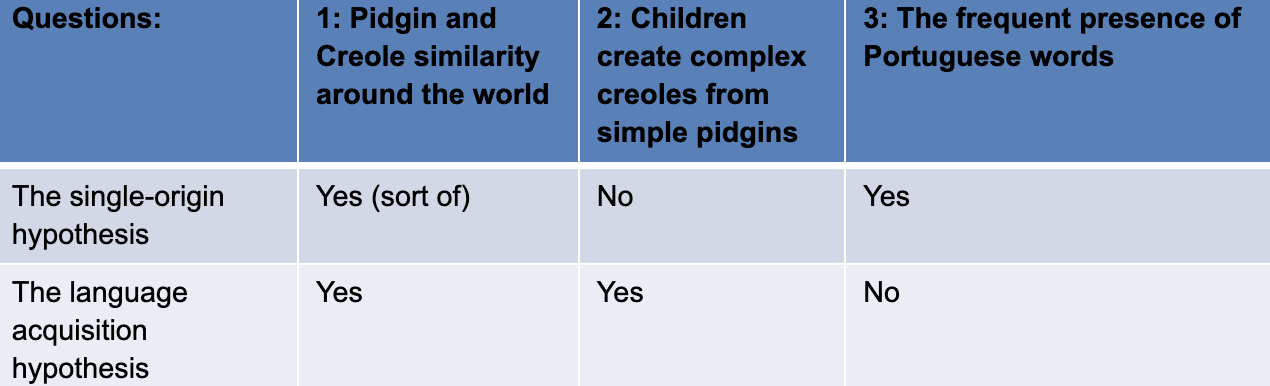
comparison of single-origin and language acquisition hypothesis
pidgin/creole sign language
in nicaragua during the 1970s, new schools for the deaf were set up
tried to teach lip-reading and spoken language
outside of class, young teenaege students innovated signs to communicate with each other
very basic and varied, like an early pidgin
younger children spontaneously developed this into a much more complex system with a larger vocabulary and shared signing conventions (creation of new grammar)
creation of a signed creole was possible because younger children still had strong access to UG
further outcomes
stable (extended) diglossia
decreolization
promotion into NL or OL
recreolization
stable (extended) diglossia
situation: an OL of a country where a pidgin/creole is widely spoken is not the superstrate of the pidgin
can lead to stable extended diglossia: pidgin/creole used for L functions, the OL for H functions
decreolization
situation: a creole and its superstrate language are spoken by members of a single population
over time, creole speakers and superstrate speakers come into contact more than in the past
creole words and grammar gradually get replaced with words and grammar from the standard form of the superstrate language
continuum of variation is found
some varieties closer to creole (basilect)
others closer to superstrate (acrolect)
guyanese creole has a range of varieties from the acrolect to the basilect
with de-creolization, a creole can “hide its tracks” over time so that its origins and identity as a creole are lost
promotion into NL or OL
some extended pidgins/creoles may be promoted into NL or OL roles and used in education
pidgin/creole may become standardized and used in newspapers and official documents
in new guinea, the pidgin tok pisin has been made into an OL
most widely used language in new guinea as an L2
bislama in vanuatu
workforce pidgin created on australian plantations and then brought back to vanuatu by returning laborers
vanuatu was jointly administered by the colonial powers britain and france
struggle for independence created nationalism and unity among the 100+ language groups
independent vanuatu
independence in 1980 = bislmama was made NL and OL alongside english and french (OLs)
bislama was not promoted for use in formal domains unlike english and french
no support for use of bislama in education at any level
studies showed that children school with bislama got higher grades and learned english better
teachers admitted it would be easier to teach in bislama
prejudices against value of pidgins are deep adn strong when compared with older european languages
recreolization
people sometimes switch from speaking a standard variety of english, french, etc. to the regular use of a creole language
referred to as recreolization of a person’s speech
a switch in the opposite direction to decreolization
recreolization = standard → creole
de-creolization = creole → standard
jamaican creole and gullah
english as a global language
total number of speakers: ¼ of the world’s population have some proficiency in english
global distribution of knowledge of english is across all continents
recognized as an OL in 55 states and used in OL functions in 11 more states
english is effectively an OL (or co-OL) in 1/3 of the world’s 195 states
widespread learning of english more than any other language
new young generations are able to speak some english
three circles of english
inner circle: english is the L1 of the majority
few countries but large combined populations
USA, UK, ireland, canada, australia, new zeland
outer circle: english is mostly an L2 and used in formal domains
english is often an OL and include many former british colonies in africa, asia
new distinctive forms of english are emerging in over 50 countries
india, malaysia, singapore, ghana, etc.
expanding circle: english is now strong in education and learned as the first foreign language
not an OL and not used domestically
most dynamic area of growth
total number of L2 speakers is equal to inner + outer circles
china, sweden, japan, germany, saudio arabia
3 main causes of the development of the english as a GL
dominance of britain as a naval, trading, and industrial power from 17thC to 19thC
20thC growth of USA as the world’s dominant economic power and major force of cultural influence
many late 20thC advances in technology spread knowledge and use of english further
first dispersal of english
first international spreading of english involved settlement of english-speakers in north america, australia, new zealand, and south africa (inner circle countries)
climate was more similar to europe = more appealing
settlers in these areas could more easily return to their home countries
second dispersal of english
to asia and africa
smaller numbers of settlers
india has 125 million speakers of english = second largest population of english-speakers in the world after the US
climate of africa was inhospitable to european settlers
english was used in government administration and trade
english kept as an OL in many countries after independence due to ethno-linguistic complexity
english felt to be ethnically-neutral (although foreign)
comparison of the spread of english and french colonial power and language
english spread more globally than french
raw materials produced in overseas colonies feed into the new industry developed in england
strengthening the position of english as an GL
in the 20thC, the british empire went into decline
debt from wars
usa emerges as world class super-power
economic, political, and cultural influence of the usa helps english become stronger in the first half of the 20thC
new international organizations
all multi-national organizations add english as an OL (one of a restricted number of OLs)
new technology
from the 1950s onward, new developments in technology establish english as the world’s first global language
help promote the international access to english and provide a motivation for people to learn english in even greater numbers
english now pulls far ahead of french and other languages in its global use and understanding
growth of film and tv industry
american and british films and tv shows become very popular with international audiences
short-wave radio use
affordable, effective radios are developed that allow people all over the world to listen to international radio programming, globally broadcast in english
international english broadcasts even made by non-english-L1 nations
use english because they can reach larger audiences
growth in the popular music industry
development of records, cassettes, cds, digital music, helps spread the availability and demand for popular music
american and british pop stars are very successful internationally, spreading english further
pop music by english L1 and L2 singers
improvements in printing and dissemination of written materials
international magazines and newspapers in english
scientific research now heavily published in english
computers and the internet
development of computers and the internet increases international communication
english is often used as a common language
speakers of other languages (especially smaller languages) access information on the internet via english
expansion of air travel
affordable, low-cost air travel boosts international tourism
increases the need for an “international
language, a lingua franca for use between travelers and local people
three additional areas of new growth
rapid expansion of english in late 20thC has also stimulated more global demand for english
marketing: use of english to promote the sale of products
use of english as a lingua franca among L2 speakers
education: new use of english as a medium of education in schools and universities around the world
marketing with english
global growth of english has led to english being perceived as a desired language with positive associations: success, modernity, and internationalism
english is now used extensively in advertising and fashion design, in countries where real knowledge of english may not be high across a population
ornamentation use of english: english words on clothes and souvenirs
english as a lingua franca/ELF
a more common language, useful for international commerce and other situations of contact
english is frequently being selected as the OL of multi-national organizations and companies from non-L1 english countries
the international language of air traffic
international ship-to-ship communication at sea
EU translation
in 1957, the EU had 6 member states
languages represented: french, dutch, italian, german
6 interpreters needed
in 2021, the EU has 26 members
total languages represented: 24
552 interpreters needed
to cut down costs, new pivot system adopted
speaker addresses the EU in german
german translated into english
english translated into all other languages
only 23 interpreters needed
english in education
south korean “english fever”
koreans spend $15 billion on english-learning each year
english-immersion schools, evening/weekend cramming schools, english villages: have villagers that are native english speakers
english learning in china
english is taught from elementary schol level
bilingual education is becoming increasingly popular
growth of english learning in europe
90% of secondary school students in europe now have a proficiency in english
universities are offering courses with “english as medium of instruction” (EMI)
value of EMI courses
EMI courses help domestic students in europe develop the english skills necessary for study abroad programs
young europeans who have studied abroad enjoy a much higher employment rate
those with strong english are estimated to earn 30-50% higher salaries
EMI programs also provide foreign revenue, as international students come to study in english
disadvantages of having a GL
pressure on small languages → language endangerment
L1 speakers of english stop learning other languages
knowlewdge of english becomes a new social class marker, creates inequality
challenges in the workplace relating to corporate english
english as a killer language
growth of english as GL causing language death?
global language endangerment is not just due to english, but all major regional languages
L1 speakers stop learning other languages
more restricted cultural knowledge of world
monolingual L1 speakers are less competitive in international business
speakers of other languages now increasingly multilingual
L1 speakers of english may get left behind
knowledge of english increases divisions in society
helps privileged elites hold onto power and employment
bottom line: a question of access to english learning
if access is provided by public education there are advantages for all
access to learning english is restricted in some countries
challenges with use of corporate english
adopting english as the OL of a multi-national company brings many advantages for business
employees worry that promotions are tied to english proficiency and not because of business skills
due to worries about job security, employees may not talk in meetings if their english is not good
some other languages can become the world’s new GL
spanish as a future GL
mandarin chinese as a future GL
spanish as a future GL
500 million speakers worldwide
L1 of the majority of the population in more countries than english
the OL in over 20 countries
but a restricted global distribution
heavily concentrated in central and south americas
mandarin chinese as future GL
could chinese become the world’s new GL in the next few decades
two challenges: demographic and linguistic
large population of speakers of chinese is clustered in one area of the world (asia) and not widespread in africa, the americas, south pacific
two major features of chinese are complex
chinese is a tone language
every syllable can be pronounced with a different intonation pattern/contour
chinese writing system is written using characters
to read a newspaper, you need to know over 3,000 different characters
most complex form of writing int he world
learning chinese requires a lot of time and personal commitment
chinese is unlikely to replace english as GL
machine translation replaces english as a GL
current forms of language software
substitution translation machines for english
programs like google translate work with written input and translate from one language to another
other software programs process spoken language and provide written representations (closed captions)
what is needed for a mobile translation device to replace english as a link language?
example: translation of spoken french to replace english as a link language
step 1: spoken french rendered into written form
step 2: written french translated into written arabic
step 3: written arabic input rendered into spoken arabic output
complications: problems of accuracy may occur at every stage, especially in steps 1 and 2
challenges for machine translation
accurate speech recognition
accuracy is only high when speech is relatively slow and clear pronunciation in the majority dialect
good quality, reliable results only in english and a few other major languages
progress with most of world’s english is poor
accurate translations between languages
currently, accuracy of translation between major languages is acceptable for simple sentences, but gets worse with more complicated text
translation accuracy between other langauges is much less developed and will take a long time to achieve
time lag problem
translation machines have to wait for speakers to complete their sentences before creating a translation into another language
will people be willing to accept a much slower form of communication?
additional concern about MT: how do we know if a machine has translated our words correctly?
english as a single global language could disappear
could english experience regional divergence to such an extent that it loses its ability to serve as a shared world language?
like latin, fracturing into french, italian, spanish, etc.
english is a pluricentric language: multiple geographic centers and standard forms
and many different non-standardized forms of english
nigerian english, singaporean english, india english
inner circle variation
model for learning english in africa, europe, and traditionally in india/south asia is standard british english (SBE)
model for learning english in south america and east asia is standard american english (SAE)
main differences between SBE and SAE are in vocabulary and pronunciation
outer circle and new world englishes
new distinctive forms of english in outer circle countries where english is spoken for a long time
result: local differences in english vocabulary, grammar, and pronunciation/accent
divergence and the future of english as a GL
possible future scenario: english is no longer a single language with mutually intelligible local varieties, but many mutually unintelligible forms
a family of languages like latin fragmenting into the romance languages
optimistic hope: stable bi-dialectism may develop and people around the world may speak 2 varieties of english
a distinctive local form and common global form
pronunciation of sounds, stress patterns, and rhythm is also distinctive in new world englishes
heavy divergence of english and malay, chinese, and tamil
deliberate divergence
cockney rhyming slang: east london, UK
originated by criminals to prevent outsiders from understanding them
a rhyming pair of words or complex words
A+B=C where B rhymes with C
AB=C where B rhymes with C
apples and pears → stairs
we’re in deep barney → we’re in deep trouble
barney = barney rubble
global attitudes to english
many outer circle countries were previously colonies dominated by britain
english is now seen as a global, international language with multiple local forms, free of past connections
major survey in india shows that english is now seen as a global, International language with multiple local forms, free of past connections
similar attitudes in west africa, nigeria, ghana, and sierra leone
attitudes to english in the expanding circle
L2 speakers from outer circle countries often view english positively as an indigenized language now
in expanding circle, no clear distinctive forms of english yet
english is not used in special ways to project a local national identity
however, the use of english may be involved in the projection of personal identity
creative use of english by L2 speakers
increasingly positive attitudes to english in L2 populations + greater confidence in its use
english is now being used by L2 speakers very successfully in new works of literature
prestigious awards and prize for literature by L2 writers, especially from india, west africa, and the caribbean
chinua achebe, woye solinka, arundhati roy, v.s. naipual, kiran desal, salman rushdie
attitudes to english among L2 writers
english should be celebrated for its ability to capture different ways of life and thinking around the world, modified as necessary to suit local needs
globalization with localization
historical population of north america
first settlers in the americas came from asia via a land bridge which connected siberia to alaska
established the indigenous population of north, central, and south america
at the time of the arrival of the first europeans, there were 2 million native americans in north america speaking 300 different langauges
early european settlers 1500-1800s
speakers of english, spanish, french
french speakers spread sparsely across a large region
“anglos” speakers of english are the majority group
anglos don’t try to block other groups from using their own languages in territories they have settled as pioneers
period of linguistic tolerance
anglo paranoia in the 19thC
changes in patterns of immigrations
previously, immigrants were heavily north european, protestant, english-speaking
19thC new immigrants increasingly from south and southeast europe and ireland
catholic, orthodox christian, jewish
asian– japanese and chinese
first defense of english
new calls for restrictions on the use and teaching of languages other than english/LOTEs
initiatives to close down schools offering other languages as mediums of education
by early 20thC, LOTEs only taught as subjects, not used as languages of instruction
world war i (1914-1918): attempts to prohibit all use of german in schools
meyer vs. nebraska
a teacher was charged with violating nebraska state law by teaching german to a student
supreme court ruled in favor of meyer, stating that attempts to forbid the teaching of LOTEs in schools violated the 14th amendment
19thC/early 20thC anglo pressure on native american/NA languages
na children are sent to boarding schools, off-reservation, where no use of NA languages is allowed
pressured to assimilate completely to anglo customs and language
19thC discrimination against asian americans
from 1870 on, no us citizenship was granted to asian immigrants
a ban on immigration 1882-1943 through the chinese exclusion act
warnings against learning LOTEs
psychologists and educators tell the public that learning more than one language can cause negative effects on children’s progress in school
claimed that learning LOTEs is nationally divisive, non-patriotic
teaching of LOTEs is banned from elementary schools until the 1960s
changes from the 1960s
a new tolerance for ethnic diversity and LOTEs
caused by political events and situations in english
in 1958, the soviet union launches te sputnik satellite
new attention drawn to the USSR
foreign languages and cultures studied by russians as part of attempts to extend soviet influence into asia/africa
national defense act 1958
promotes the study of non-western languages and culture to compete better with russia
establishment of peace corps in 1961
volunteers sent to 140 countries to help local people as teachers and technical advisors
young americans would go out and bring back potentially useful information to the us
1959 revolution in cuba
large numbers of immigrants from cuba arrive in florida
decision taken to educate young cuban children in both english and spanish to make them bilingual
very successful to new bilingual education programs
1968 bilingual education act
proposed by the governor of texas
to deal with very high drop-out rate of mexican-american students from schools in texas (89%)
inspiration: the bilingual education programs in florida
 Note
Note  Flashcards (34)