Lecture 3: Week 3: Juvenile Rights: Miranda

0.0(0)
Studied by 0 people
call kaiCall Kai
learnLearn
examPractice Test
spaced repetitionSpaced Repetition
heart puzzleMatch
flashcardsFlashcards
GameKnowt Play
Card Sorting

1/41

encourage image

There's no tags or description

Looks like no tags are added yet.

Last updated 9:14 PM on 4/1/26
Name
Mastery
Learn
Test
Matching
Spaced
Call with Kai

No analytics yet

Send a link to your students to track their progress

42 Terms

1
New cards

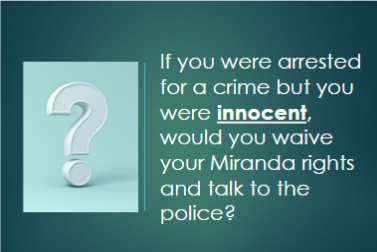
If you were arrested for a crime but you were innocent, would you waive your Miranda rights and talk to the police?

This is a trap question meant to show that innocent people often waive Miranda because they think “I’ve got nothing to hide,” but talking can still hurt you (misinterpretation, pressure, or leading questions). Research shows most people waive, including many innocent suspects.
<p>This is a trap question meant to show that <strong>innocent people often waive Miranda</strong> because they think “I’ve got nothing to hide,” but talking can still hurt you (misinterpretation, pressure, or leading questions). Research shows <strong>most people waive</strong>, including many innocent suspects.</p>
2
New cards

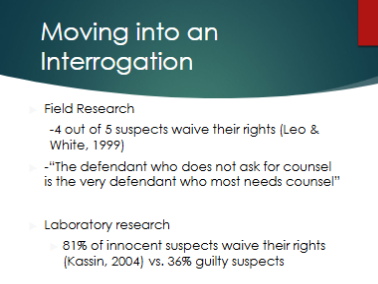
What does “Moving into an Interrogation” focus on (field vs. lab research)?

It compares real-world (“field”) research and controlled (“lab”) research showing how often suspects waive Miranda rights, including how frequently innocent people waive.
<p>It compares real-world (“field”) research and controlled (“lab”) research showing how often suspects <strong>waive Miranda rights</strong>, including how frequently <strong>innocent people waive</strong>.</p><p></p>
3
New cards

What does the field research show about waiving Miranda, and why is it important?

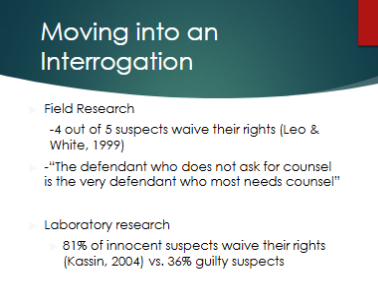
Field research shows 4 out of 5 suspects waive their rights (Leo & White, 1999). It matters because waiving is common, meaning many people talk without a lawyer—even though questioning can be risky.

  • It highlights the high frequency of waivers in real settings, emphasizing the vulnerability of suspects to coercive tactics during interrogations.
<p>Field research shows <strong>4 out of 5 suspects waive their rights</strong> (Leo &amp; White, 1999). It matters because waiving is <strong>common</strong>, meaning many people talk without a lawyer—even though questioning can be risky.</p><ul><li><p>It highlights the high frequency of waivers in real settings, emphasizing the vulnerability of suspects to coercive tactics during interrogations. </p></li></ul><p></p>
4
New cards

What does lab research show about waiving Miranda, and why is it important?

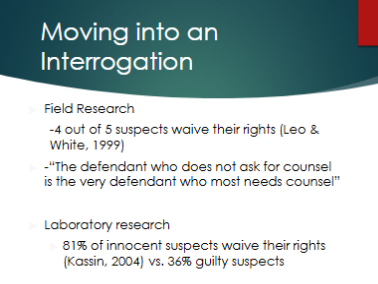
Lab research shows 81% of innocent suspects waive vs. 36% of guilty suspects (Kassin, 2004). It matters because it flips the assumption: innocent people are especially likely to waive, often because they think their innocence will protect them.

  • This highlights the misconception that innocence guarantees safety during interrogation, making innocent suspects particularly vulnerable to coercive tactics.
<p>Lab research shows <strong>81% of innocent suspects waive</strong> vs. <strong>36% of guilty suspects</strong> (Kassin, 2004). It matters because it flips the assumption: <strong>innocent people are especially likely to waive</strong>, often because they think their innocence will protect them.</p><ul><li><p>This highlights the misconception that innocence guarantees safety during interrogation, making innocent suspects particularly vulnerable to coercive tactics. </p></li></ul><p></p>
5
New cards

What is the key point of “Police Interrogation of Innocent Suspects”?

Interrogation systems are often designed around the assumption that police are questioning the guilty—yet innocent people are questioned too, and their behavior (fear/confusion) can be misread.

  • The key point is that police interrogation techniques often assume guilt, leading to misinterpretation of innocent suspects' behaviors, such as fear or confusion, which can result in false confessions.
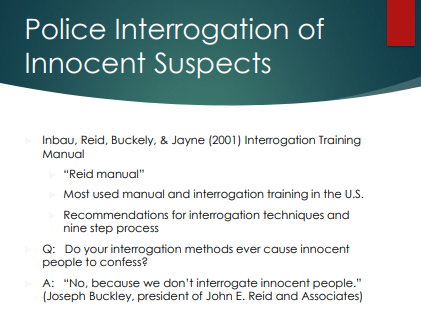
<p>Interrogation systems are often designed around the assumption that police are questioning the guilty—yet <strong>innocent people are questioned too</strong>, and their behavior (fear/confusion) can be misread.</p><ul><li><p>The key point is that police interrogation techniques often assume guilt, leading to misinterpretation of innocent suspects' behaviors, such as fear or confusion, which can result in false confessions. </p></li></ul><p></p>
6
New cards

What is the Inbau, Reid, Buckley, & Jayne (2001) Interrogation Training Manual, and why is it important?

It’s a major interrogation training guide (the “Reid manual”) that recommends interrogation techniques and a nine-step process. It matters because it strongly influences how interrogations are conducted.

  • It’s a comprehensive interrogation training guide known as the "Reid manual" that outlines a systematic nine-step process for police interrogations. Its importance lies in its widespread influence on law enforcement practices, shaping how interrogators approach suspects during questioning.
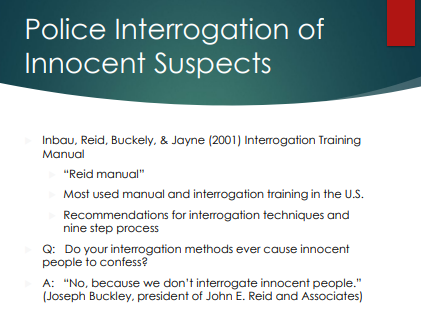
<p>It’s a major interrogation training guide (the <strong>“Reid manual”</strong>) that recommends interrogation techniques and a <strong>nine-step process</strong>. It matters because it strongly influences how interrogations are conducted.</p><ul><li><p>It’s a comprehensive interrogation training guide known as the "Reid manual" that outlines a systematic nine-step process for police interrogations. Its importance lies in its widespread influence on law enforcement practices, shaping how interrogators approach suspects during questioning. </p></li></ul><p></p>
7
New cards

What is the most used manual/interrogation training method in the U.S., and what does that mean?

The Reid manual / Reid Technique is described as the most used interrogation training in the U.S. This matters because one dominant approach can shape interrogation practices nationwide.

  • It shapes law enforcement practices, potentially leading to increased risk of false confessions.
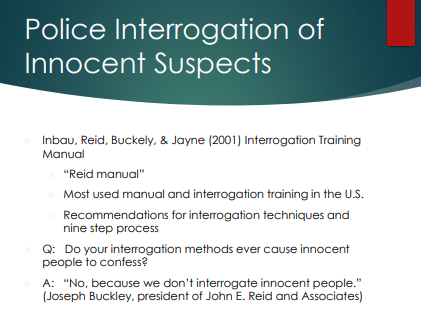
<p>The <strong>Reid manual / Reid Technique</strong> is described as the <strong>most used interrogation training in the U.S.</strong> This matters because one dominant approach can shape interrogation practices nationwide.</p><ul><li><p>It shapes law enforcement practices, potentially leading to increased risk of false confessions. </p></li></ul><p></p>
8
New cards

Do interrogation methods ever cause innocent people to confess (according to the slide’s quote)?

The Reid training response claims: “No, because we don’t interrogate innocent people.” (Joseph Buckley, president of John E. Reid & Associates). The point of including this is to highlight the assumption behind the method (that interrogations target guilty people), even though research shows innocent suspects are often questioned and waive rights.

  • Yes, interrogation methods can lead to false confessions from innocent people due to the pressure and psychological tactics used during the process.
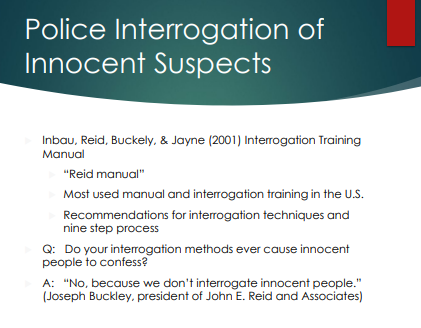
<p>The Reid training response claims: <strong>“No, because we don’t interrogate innocent people.”</strong> (Joseph Buckley, president of John E. Reid &amp; Associates). The point of including this is to highlight the <strong>assumption</strong> behind the method (that interrogations target guilty people), even though research shows innocent suspects are often questioned and waive rights.</p><ul><li><p>Yes, interrogation methods can lead to false confessions from innocent people due to the pressure and psychological tactics used during the process. </p></li></ul><p></p>
9
New cards

What are Miranda Rights?

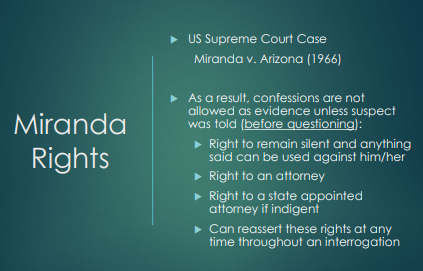
Rights police must inform you of before custodial questioning. They include:

  • Right to remain silent (and anything said can be used against you)

  • Right to an attorney

  • Right to a state-appointed attorney if indigent

  • You can reassert these rights at any time during interrogation

    • Miranda Rights are legal protections that law enforcement must inform individuals of before custodial questioning. These rights include the right to remain silent, the right to an attorney, and the right to a state-appointed attorney if the individual cannot afford one. Additionally, individuals can reassert these rights at any time during the interrogation process.
<p>Rights police must inform you of <strong>before custodial questioning</strong>. They include:</p><ul><li><p><strong>Right to remain silent</strong> (and anything said can be used against you)</p></li><li><p><strong>Right to an attorney</strong></p></li><li><p><strong>Right to a state-appointed attorney if indigent</strong></p></li><li><p>You can <strong>reassert</strong> these rights at any time during interrogation</p><ul><li><p>Miranda Rights are legal protections that law enforcement must inform individuals of before custodial questioning. These rights include the right to remain silent, the right to an attorney, and the right to a state-appointed attorney if the individual cannot afford one. Additionally, individuals can reassert these rights at any time during the interrogation process. </p></li></ul></li></ul><p></p>
10
New cards

What case led to Miranda Rights?

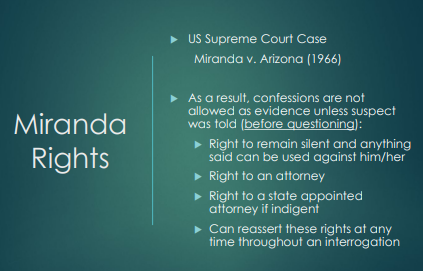
Miranda v. Arizona (1966) — a U.S. Supreme Court case.

  • This case established the requirement that individuals in police custody must be informed of their rights to remain silent and to an attorney prior to interrogation.
<p><strong>Miranda v. Arizona (1966)</strong> — a U.S. Supreme Court case.</p><ul><li><p>This case established the requirement that individuals in police custody must be informed of their rights to remain silent and to an attorney prior to interrogation. </p></li></ul><p></p>
11
New cards

Miranda v. Arizona (1966): what was the key legal issue and outcome?

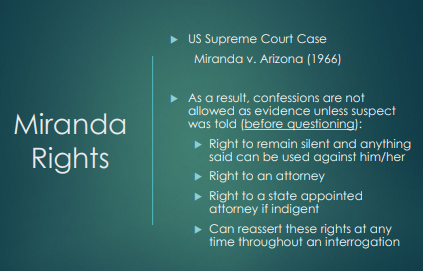
Outcome: Confessions can’t be used as evidence unless the suspect was told their rights before questioning (Miranda warning).

The core issue was protecting people during custodial interrogation by requiring procedural safeguards.

  • The key legal issue revolved around whether individuals in police custody should be informed of their rights to avoid coercive interrogations. The outcome required law enforcement to provide Miranda warnings to ensure that confessions are admissible in court.
<p><strong>Outcome:</strong> Confessions can’t be used as evidence unless the suspect was told their rights <strong>before questioning</strong> (Miranda warning). </p><p>The core issue was protecting people during <strong>custodial interrogation</strong> by requiring procedural safeguards. </p><ul><li><p>The key legal issue revolved around whether individuals in police custody should be informed of their rights to avoid coercive interrogations. The outcome required law enforcement to provide Miranda warnings to ensure that confessions are admissible in court. </p></li></ul><p></p>
12
New cards

What happened as a result of Miranda v. Arizona (1966) regarding confessions?

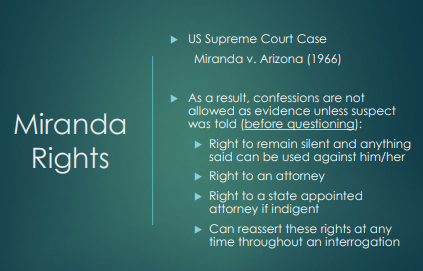
Confessions are not allowed as evidence unless the suspect was informed (before questioning) of the required rights (Miranda warning).\

  • As a result of Miranda v. Arizona (1966), any confession obtained during custodial interrogation cannot be used as evidence in court unless the individual was informed of their rights, including the right to remain silent and the right to an attorney, prior to questioning.
<p><strong>Confessions are not allowed as evidence</strong> unless the suspect was informed (before questioning) of the required rights (Miranda warning).\</p><ul><li><p>As a result of Miranda v. Arizona (1966), any confession obtained during custodial interrogation cannot be used as evidence in court unless the individual was informed of their rights, including the right to remain silent and the right to an attorney, prior to questioning. </p></li></ul><p></p>
13
New cards

What rights do Miranda warnings give you?

  • Right to remain silent + anything you say can be used against you

  • Right to an attorney

  • Right to a state-appointed attorney if indigent

  • You can invoke/reassert rights at any time during questioning
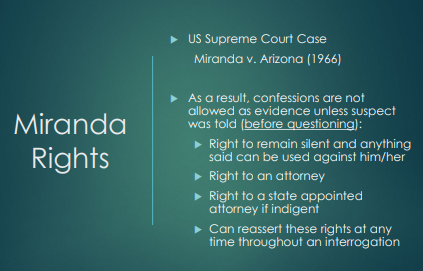
<ul><li><p><strong>Right to remain silent</strong> + anything you say can be used against you</p></li><li><p><strong>Right to an attorney</strong></p></li><li><p><strong>Right to a state-appointed attorney if indigent</strong></p></li><li><p>You can <strong>invoke/reassert</strong> rights at any time during questioning</p></li></ul><p></p>
14
New cards

What does Miranda ONLY apply to, and why?

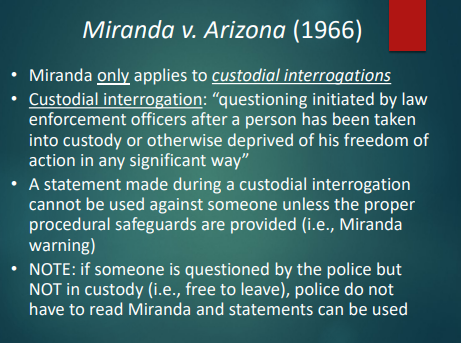
Custodial interrogations only. That means police questioning after you’re in custody or your freedom is significantly restricted. If it’s not custody (you’re free to leave), police don’t have to Mirandize you.

  • This requirement exists to protect suspects' Fifth Amendment rights against self-incrimination during situations where they may feel compelled to speak.
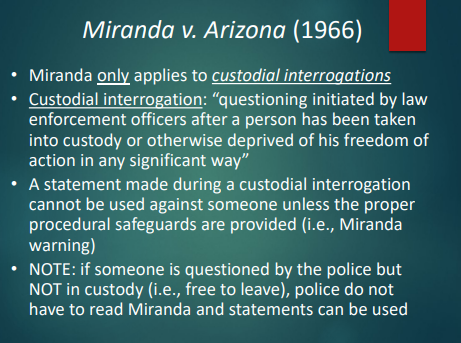
<p><strong>Custodial interrogations only.</strong> That means police questioning after you’re <strong>in custody</strong> or your freedom is significantly restricted. If it’s not custody (you’re free to leave), police don’t have to Mirandize you.</p><ul><li><p>This requirement exists to protect suspects' Fifth Amendment rights against self-incrimination during situations where they may feel compelled to speak. </p></li></ul><p></p>
15
New cards

What is a custodial interrogation?

“Questioning initiated by law enforcement officers after a person has been taken into custody or otherwise deprived of his freedom of action in any significant way.”

  • It involves a situation where an individual is not free to leave, necessitating the presence of Miranda rights.
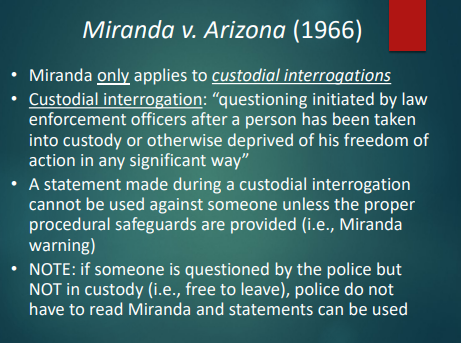
<p>“Questioning initiated by law enforcement officers after a person has been taken into custody or otherwise deprived of his freedom of action in any significant way.”</p><ul><li><p>It involves a situation where an individual is not free to leave, necessitating the presence of Miranda rights. </p></li></ul><p></p>
16
New cards

Can a statement made during custodial interrogation be used against someone, and why?

Not unless proper safeguards are provided—meaning the person must be given the Miranda warning first. Without it, the statement is typically suppressed.

  • This requirement is in place to ensure that the individual's Fifth Amendment rights against self-incrimination are upheld during police questioning.
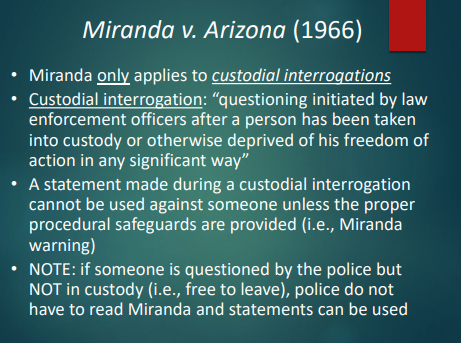
<p><strong>Not unless</strong> proper safeguards are provided—meaning the person must be given the <strong>Miranda warning</strong> first. Without it, the statement is typically <strong>suppressed</strong>.</p><ul><li><p>This requirement is in place to ensure that the individual's Fifth Amendment rights against self-incrimination are upheld during police questioning. </p></li></ul><p></p>
17
New cards

When do police NOT have to read Miranda rights?

When someone is questioned by police but is NOT in custody (free to leave). In that situation, Miranda warnings aren’t required and statements can be used.

  • When an individual is not in custody, meaning they are free to leave. In such cases, police are not required to provide Miranda warnings, thus any statements made can be used in court.
<p>When someone is questioned by police but is <strong>NOT in custody</strong> (free to leave). In that situation, Miranda warnings aren’t required and statements <strong>can be used</strong>.</p><ul><li><p>When an individual is not in custody, meaning they are free to leave. In such cases, police are not required to provide Miranda warnings, thus any statements made can be used in court. </p></li></ul><p></p>
18
New cards

What two options does a suspect have after being read Miranda?

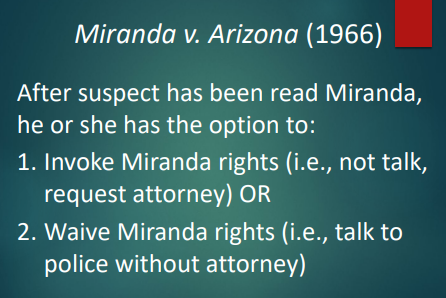
  • Invoke Miranda rights (don’t talk / request attorney)

  • Waive Miranda rights (talk to police without attorney)

    • After being read their Miranda rights, a suspect can either invoke those rights, which means they choose to remain silent and request an attorney, or waive their rights, allowing them to speak to police without an attorney present.
<ul><li><p><strong>Invoke</strong> Miranda rights (don’t talk / request attorney)</p></li><li><p><strong>Waive</strong> Miranda rights (talk to police without attorney)</p><ul><li><p>After being read their Miranda rights, a suspect can either invoke those rights, which means they choose to remain silent and request an attorney, or waive their rights, allowing them to speak to police without an attorney present. </p></li></ul></li></ul><p></p>
19
New cards

What happens IF a suspect chooses to WAIVE Miranda and answer questions?

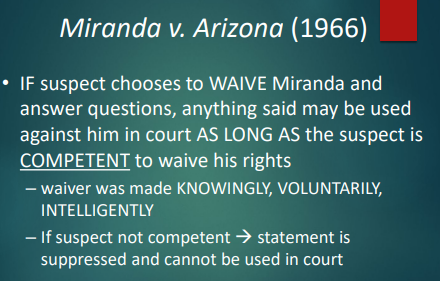
Anything said may be used against them in court, as long as the suspect is competent to waive the rights.

  • This means the suspect understands their rights and the implications of speaking to the police.
<p>Anything said <strong>may be used against them in court</strong>, <strong>as long as</strong> the suspect is <strong>competent to waive</strong> the rights.</p><ul><li><p>This means the suspect understands their rights and the implications of speaking to the police. </p></li></ul><p></p>
20
New cards

What does “competent” mean in waiving Miranda rights and making statements?

The waiver must be made knowingly, voluntarily, and intelligently. If the suspect is not competent, the statement is suppressed and cannot be used in court.

  • Competent refers to the suspect's mental ability to understand their rights, the nature of the interrogation, and the consequences of their statements. If deemed incompetent, any waiver of Miranda rights may be invalidated.
<p>The waiver must be made <strong>knowingly, voluntarily, and intelligently</strong>. If the suspect is <strong>not competent</strong>, the statement is <strong>suppressed</strong> and cannot be used in court.</p><ul><li><p>Competent refers to the suspect's mental ability to understand their rights, the nature of the interrogation, and the consequences of their statements. If deemed incompetent, any waiver of Miranda rights may be invalidated. </p></li></ul><p></p>
21
New cards

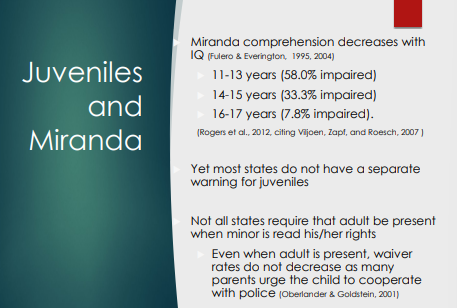
What’s the main issue with juveniles and Miranda rights?

Many juveniles don’t fully understand Miranda rights and may waive them without truly understanding the consequences. Comprehension is linked to age and IQ, warnings aren’t standardized, and adult presence doesn’t always help.

  • This raises concerns about whether their waivers are knowing and voluntary, leading to potentially unfair legal outcomes.
<p>Many juveniles <strong>don’t fully understand</strong> Miranda rights and may waive them without truly understanding the consequences. Comprehension is linked to <strong>age and IQ</strong>, warnings aren’t standardized, and adult presence doesn’t always help.</p><ul><li><p>This raises concerns about whether their waivers are knowing and voluntary, leading to potentially unfair legal outcomes. </p></li></ul><p></p>
22
New cards

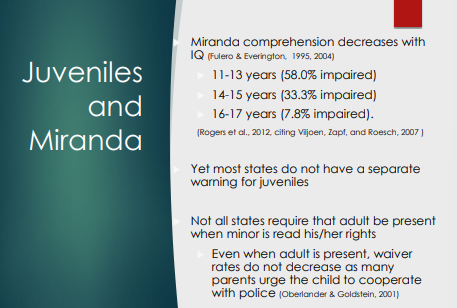
How does Miranda comprehension change with IQ, and what does that mean?

Miranda comprehension decreases as IQ decreases (Fulero & Everington, 1995, 2004). Meaning: youth (and others) with lower IQ are more likely to misunderstand rights, making waivers less likely to be truly knowing/intelligent.

  • This suggests that individuals with lower IQs may not fully grasp their rights, leading to potential invalid waivers of Miranda protections in legal situations.
<p><strong>Miranda comprehension decreases as IQ decreases</strong> (Fulero &amp; Everington, 1995, 2004). Meaning: youth (and others) with lower IQ are more likely to <strong>misunderstand rights</strong>, making waivers less likely to be truly knowing/intelligent.</p><ul><li><p>This suggests that individuals with lower IQs may not fully grasp their rights, leading to potential invalid waivers of Miranda protections in legal situations. </p></li></ul><p></p>
23
New cards

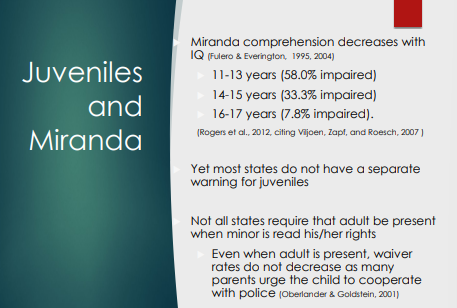
Do most states have a separate Miranda warning for juveniles? Explain.

No. Most states do not have a separate juvenile-specific warning, even though youth often understand Miranda less well.

  • This lack of specialized warnings can lead to misunderstandings, further complicating the waiver process and raising concerns about the validity of any waivers made by juvenile suspects.
<p><strong>No.</strong> Most states <strong>do not</strong> have a separate juvenile-specific warning, even though youth often understand Miranda less well.</p><ul><li><p>This lack of specialized warnings can lead to misunderstandings, further complicating the waiver process and raising concerns about the validity of any waivers made by juvenile suspects. </p></li></ul><p></p>
24
New cards

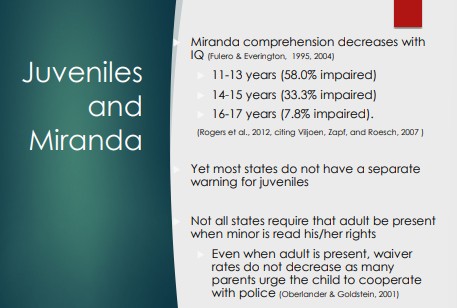
Do all states require an adult be present when a minor is read Miranda rights? Explain.

No. Not all states require an adult to be present when a minor is read their rights.

  • This lack of requirement can lead to situations where juveniles are interrogated without adequate support, potentially impacting their understanding and the validity of any waivers they provide.

Even when adult is present, waiver rates do not decrease as many parents urge the child to cooperate with police (Oberlander & Goldstein, 2001)
<p><strong>No.</strong> Not all states require an adult to be present when a minor is read their rights.</p><ul><li><p>This lack of requirement can lead to situations where juveniles are interrogated without adequate support, potentially impacting their understanding and the validity of any waivers they provide. </p></li></ul><p>Even when adult is present, waiver rates do not decrease as many parents urge the child to cooperate with police (Oberlander &amp; Goldstein, 2001)</p>
25
New cards

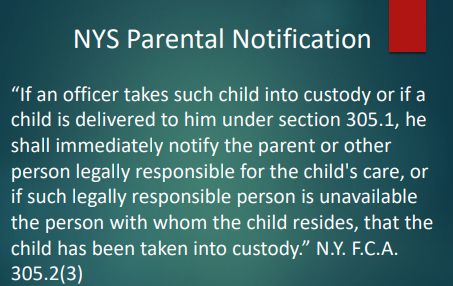
What is NYS Parental Notification? Explain simply. (N.Y. F.C.A. 305.2(3))

If an officer takes a child into custody, the officer must immediately notify the child’s parent/guardian (or if unavailable, the person the child lives with) that the child is in custody. (N.Y. F.C.A. 305.2(3))

  • This law ensures that parents or guardians are informed as soon as a minor is detained, promoting parental involvement and oversight in the juvenile justice process.
<p>If an officer takes a child into custody, the officer must <strong>immediately notify</strong> the child’s <strong>parent/guardian</strong> (or if unavailable, the person the child lives with) that the child is in custody. (N.Y. F.C.A. 305.2(3))</p><ul><li><p>This law ensures that parents or guardians are informed as soon as a minor is detained, promoting parental involvement and oversight in the juvenile justice process. </p></li></ul><p></p>
26
New cards

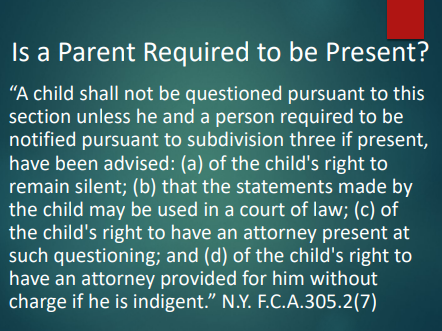
In NY, is a parent required to be present for questioning? Explain. (N.Y. F.C.A. 305.2(7))

A child can’t be questioned unless the child and the notified person if present have been advised of the child’s rights (silence, statements can be used, attorney present, free attorney if indigent). So the parent is not always required to be present, but if they are present, they must be advised too. (N.Y. F.C.A. 305.2(7))

  • In New York, a child can only be questioned if the child and the notified individual, if present, have been informed of the child's rights. Thus, while a parent is not always required for questioning, if they are present, they too must be advised of these rights.
<p>A child can’t be questioned unless the child <strong>and</strong> the notified person <strong>if present</strong> have been advised of the child’s rights (silence, statements can be used, attorney present, free attorney if indigent). So <strong>the parent is not always required to be present</strong>, but <strong>if they are present</strong>, they must be advised too. (N.Y. F.C.A. 305.2(7))</p><ul><li><p>In New York, a child can only be questioned if the child and the notified individual, if present, have been informed of the child's rights. Thus, while a parent is not always required for questioning, if they are present, they too must be advised of these rights. </p></li></ul><p></p>
27
New cards

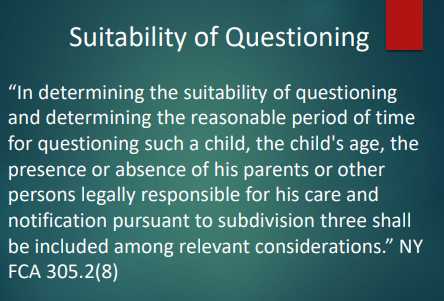
What does “Suitability of Questioning” mean in NY (and what factors matter)? (NY Family Court Act 305.2(8))

It means deciding whether questioning is appropriate and how long it should last depends on factors like:

  • the child’s age

  • whether parents/guardians are present or absent

  • whether parent notification happened
    (NY F.C.A. 305.2(8))

'Suitability of Questioning' refers to the assessment of whether it is appropriate to question a child and the duration of that questioning. This assessment takes into account several factors, including the child's age, whether parents or guardians are present, and whether parent notification has occurred. These factors help ensure that the questioning process is conducted respectfully and with consideration for the child's wellbeing, as seen in NY Family Court Act 305.2(8).
<p>It means deciding whether questioning is appropriate and how long it should last depends on factors like:</p><ul><li><p>the child’s <strong>age</strong></p></li><li><p>whether <strong>parents/guardians are present or absent</strong></p></li><li><p>whether <strong>parent notification</strong> happened<br>(NY F.C.A. 305.2(8))</p></li></ul><p><span>'Suitability of Questioning' refers to the assessment of whether it is appropriate to question a child and the duration of that questioning. This assessment takes into account several factors, including the child's age, whether parents or guardians are present, and whether parent notification has occurred. These factors help ensure that the questioning process is conducted respectfully and with consideration for the child's wellbeing, as seen in NY Family Court Act 305.2(8).</span></p><p></p>
28
New cards

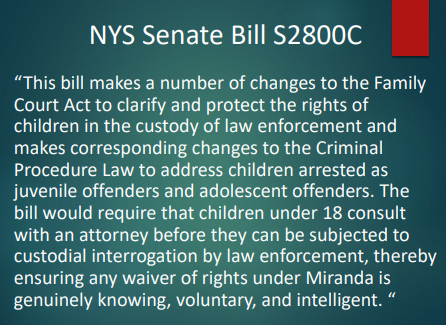
What does NYS Senate Bill S2800C say, and why is it significant?

It would require children under 18 to consult with an attorney before custodial interrogation, to ensure any Miranda waiver is truly knowing, voluntary, and intelligent. Significance: it strengthens protections so kids don’t waive rights without legal advice.

  • This bill mandates that minors must have legal counsel before any questioning to help safeguard their rights during the interrogation process. It is significant because it aims to prevent minors from unintentionally waiving their rights without proper understanding.
<p>It would require children under 18 to <strong>consult with an attorney before custodial interrogation</strong>, to ensure any Miranda waiver is truly <strong>knowing, voluntary, and intelligent</strong>. Significance: it strengthens protections so kids don’t waive rights without legal advice.</p><ul><li><p>This bill mandates that minors must have legal counsel before any questioning to help safeguard their rights during the interrogation process. It is significant because it aims to prevent minors from unintentionally waiving their rights without proper understanding. </p></li></ul><p></p>
29
New cards

When is a youth “in custody” for Miranda purposes? Use JDB v. North Carolina (2011) as the example.

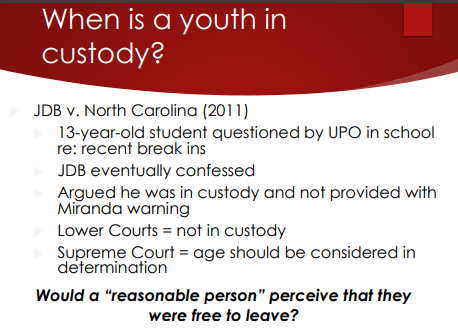
Custody depends on whether a reasonable person would feel free to leave—and age must be considered (JDB v. North Carolina, 2011).

  • A youth is considered "in custody" for Miranda purposes when a reasonable person, especially a minor, would not feel free to leave. In JDB v. North Carolina (2011), the Court ruled that a 13-year-old's age is a crucial factor in determining if they are in custody during questioning, highlighting how minors experience situations differently than adults.

Example: a 13-year-old questioned at school by a UPO about break-ins confessed; lower courts said not custody, but the Supreme Court said age matters in deciding custody.
<p>Custody depends on whether a <strong>reasonable person would feel free to leave</strong>—and <strong>age must be considered</strong> (JDB v. North Carolina, 2011). </p><ul><li><p>A youth is considered "in custody" for Miranda purposes when a reasonable person, especially a minor, would not feel free to leave. In JDB v. North Carolina (2011), the Court ruled that a 13-year-old's age is a crucial factor in determining if they are in custody during questioning, highlighting how minors experience situations differently than adults. </p></li></ul><p>Example: a <strong>13-year-old</strong> questioned at school by a UPO about break-ins confessed; lower courts said not custody, but the Supreme Court said <strong>age matters</strong> in deciding custody.</p>
30
New cards

Are Miranda warnings standardized? What does that mean?

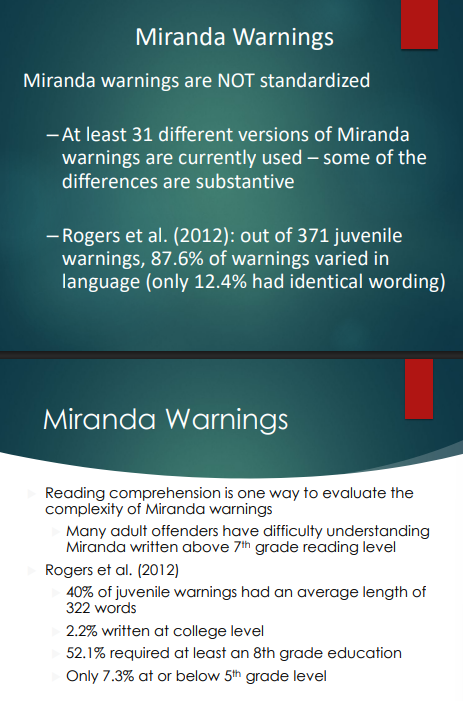
No. Miranda warnings are not standardized, meaning the wording changes across places—and some differences are substantive, so a suspect’s understanding can depend on the version used.

  • Standardized means that they can vary in wording and content from one jurisdiction to another, impacting a suspect's comprehension of their rights.
<p><strong>No.</strong> Miranda warnings are <strong>not standardized</strong>, meaning the wording changes across places—and some differences are <strong>substantive</strong>, so a suspect’s understanding can depend on the version used.</p><ul><li><p>Standardized means that they can vary in wording and content from one jurisdiction to another, impacting a suspect's comprehension of their rights. </p></li></ul><p></p>
31
New cards

How many versions of Miranda warnings are used, and why do the differences matter?

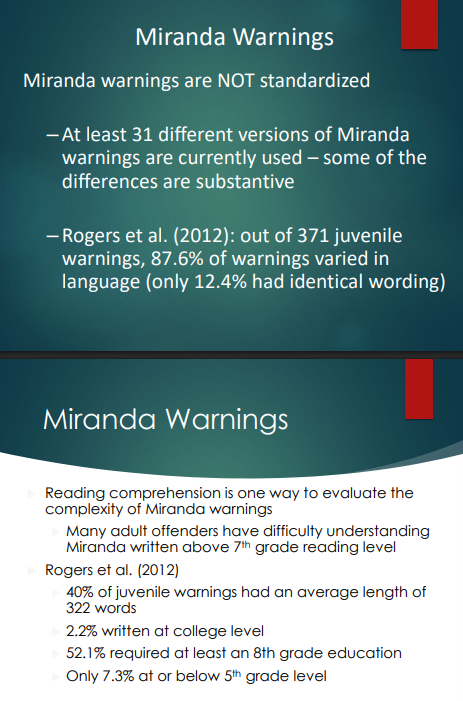
At least 31 different versions are used. Differences matter because wording changes can affect how well juveniles understand their rights—and some differences change the meaning in important ways.

  • Differences in wording can impact comprehension significantly, especially for juveniles, as different formulations may lead to varying interpretations of rights.
<p>At least <strong>31 different versions</strong> are used. Differences matter because wording changes can affect <strong>how well juveniles understand</strong> their rights—and some differences change the meaning in important ways.</p><ul><li><p>Differences in wording can impact comprehension significantly, especially for juveniles, as different formulations may lead to varying interpretations of rights. </p></li></ul><p></p>
32
New cards

What did Rogers et al. (2012) find about variation in juvenile Miranda warnings?

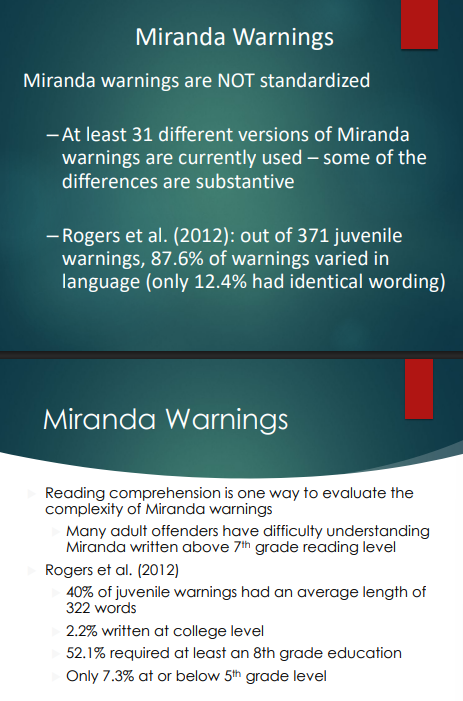
In 371 juvenile warnings, 87.6% varied in language (only 12.4% were identical). This shows major inconsistency in what youth are told.

  • The study found that the overwhelming majority of juvenile Miranda warnings differ in phrasing, highlighting significant inconsistencies in how rights are communicated to youth, which can impact their understanding.
<p>In <strong>371 juvenile warnings</strong>, <strong>87.6% varied in language</strong> (only <strong>12.4%</strong> were identical). This shows major inconsistency in what youth are told.</p><ul><li><p>The study found that the overwhelming majority of juvenile Miranda warnings differ in phrasing, highlighting significant inconsistencies in how rights are communicated to youth, which can impact their understanding. </p></li></ul><p></p>
33
New cards

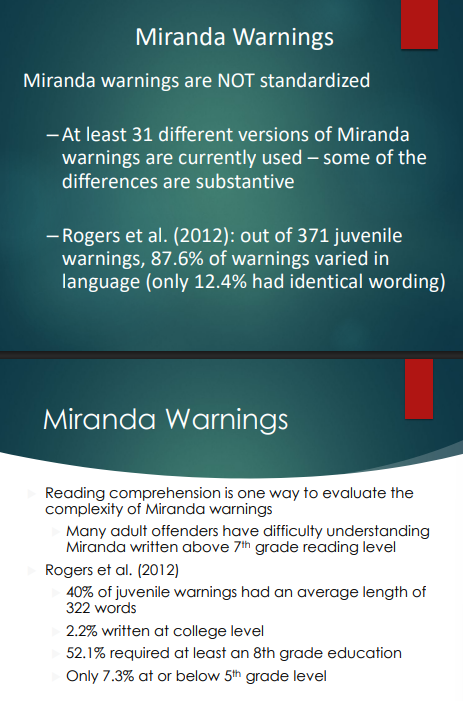
What is one way to evaluate the complexity of Miranda warnings?

Reading comprehension / reading grade level of the warning.

  • Evaluating the reading level can indicate whether the warnings are understandable for juveniles.
<p><strong>Reading comprehension / reading grade level</strong> of the warning.</p><ul><li><p>Evaluating the reading level can indicate whether the warnings are understandable for juveniles. </p></li></ul><p></p>
34
New cards

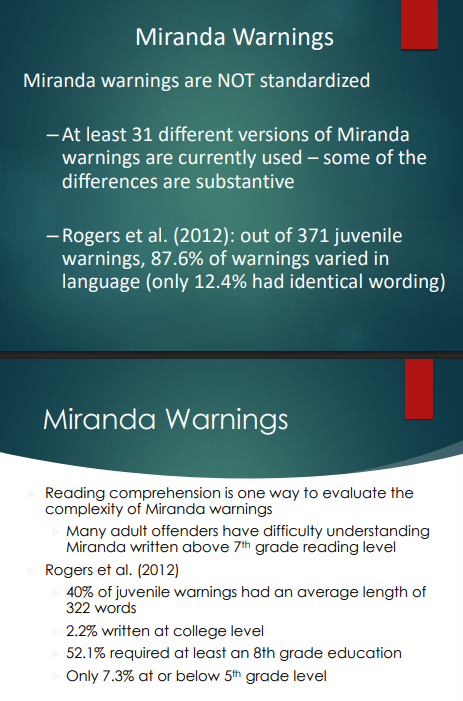
What did Rogers et al. (2012) find about reading level/complexity of juvenile Miranda warnings?

Many warnings were too hard:

  • 40% averaged 322 words

  • 2.2% written at college level

  • 52.1% required at least an 8th grade education

  • Only 7.3% were at or below 5th grade level
    Meaning: lots of youth may not understand the wording.

Many warnings were overly complex, with 40% averaging 322 words, and only 7.3% suitable for individuals at or below a 5th grade reading level. This indicates that a significant number of youth may struggle to comprehend their rights.
<p>Many warnings were too hard:</p><ul><li><p><strong>40%</strong> averaged <strong>322 words</strong></p></li><li><p><strong>2.2%</strong> written at <strong>college level</strong></p></li><li><p><strong>52.1%</strong> required at least an <strong>8th grade</strong> education</p></li><li><p>Only <strong>7.3%</strong> were at or below <strong>5th grade</strong> level<br>Meaning: lots of youth may not understand the wording.</p></li></ul><p>Many warnings were overly complex, with 40% averaging 322 words, and only 7.3% suitable for individuals at or below a 5th grade reading level. This indicates that a significant number of youth may struggle to comprehend their rights. </p><p></p>
35
New cards

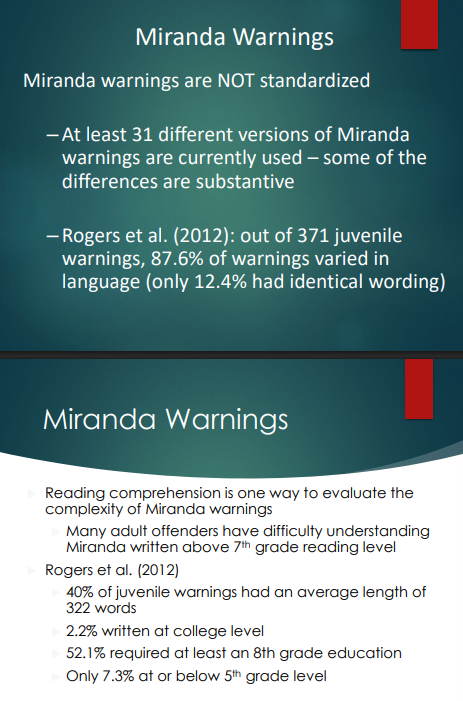
Explain how reading comprehension is used to evaluate Miranda complexity.

You can compare the warning’s wording to a grade reading level—if it’s above what many youth (or even adults) can read/understand, then the warning may not be truly comprehensible.

  • This evaluation identifies whether Miranda warnings are written at an appropriate reading level for juveniles, ensuring they can understand their rights.
<p>You can compare the warning’s wording to a <strong>grade reading level</strong>—if it’s above what many youth (or even adults) can read/understand, then the warning may not be truly comprehensible.</p><ul><li><p>This evaluation identifies whether Miranda warnings are written at an appropriate reading level for juveniles, ensuring they can understand their rights. </p></li></ul><p></p>
36
New cards

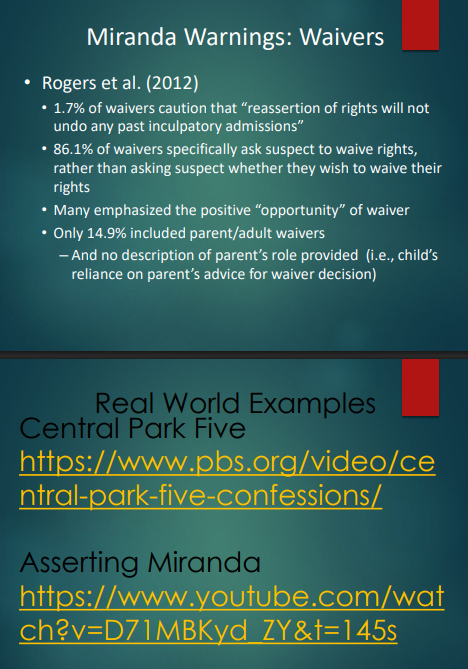
What did Rogers et al. (2012) find about Miranda waiver forms (and why it matters)?

  • Only 1.7% warned that reasserting rights won’t undo past admissions

  • 86.1% directly asked suspects to waive (instead of asking if they wish to waive)

  • Many framed waiver as a positive “opportunity

  • Only 14.9% included parent/adult waivers, and didn’t explain the parent’s role

Why it matters: waiver forms can nudge people toward waiving and not understanding consequences.

  • The findings of Rogers et al. (2012) showed that many Miranda waiver forms had misleading language and practices that could lead individuals, especially juveniles, to unknowingly waive their rights without fully understanding the implications. This raises concerns about the fairness and comprehension of the waiver process in juvenile justice.
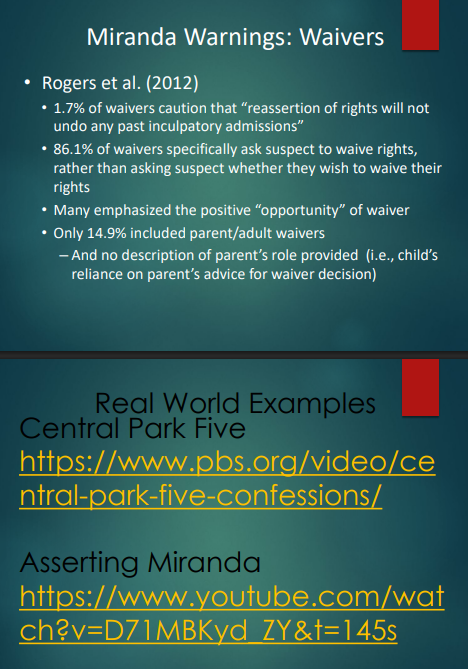
<ul><li><p>Only <strong>1.7%</strong> warned that reasserting rights <strong>won’t undo past admissions</strong></p></li><li><p><strong>86.1%</strong> directly asked suspects to <strong>waive</strong> (instead of asking if they <em>wish</em> to waive)</p></li><li><p>Many framed waiver as a positive “<strong>opportunity</strong>”</p></li><li><p>Only <strong>14.9%</strong> included parent/adult waivers, and <strong>didn’t explain</strong> the parent’s role</p></li></ul><p>Why it matters: waiver forms can <strong>nudge</strong> people toward waiving and not understanding consequences.</p><ul><li><p>The findings of Rogers et al. (2012) showed that many Miranda waiver forms had misleading language and practices that could lead individuals, especially juveniles, to unknowingly waive their rights without fully understanding the implications. This raises concerns about the fairness and comprehension of the waiver process in juvenile justice. </p></li></ul><p></p>
37
New cards

Explain the two real-world examples related to Miranda rights.

  • Central Park Five: example of juveniles giving confessions under interrogation—used to discuss whether rights were meaningfully protected and how confessions can happen in high-pressure situations.

  • Asserting Miranda video: shows a juvenile basically being pushed to sign papers and not clearly understanding; the mom also doesn’t understand—illustrating how youth/parents can fail to grasp Miranda and how asserting rights can break down in real life.

    • The Central Park Five case illustrates the dangers of false confessions from juveniles under interrogation pressures, highlighting concerns about the protection of their rights. Additionally, the Asserting Miranda video depicts a juvenile coerced into signing documents without comprehending the situation, showcasing the challenges youth and their guardians face in understanding Miranda rights.
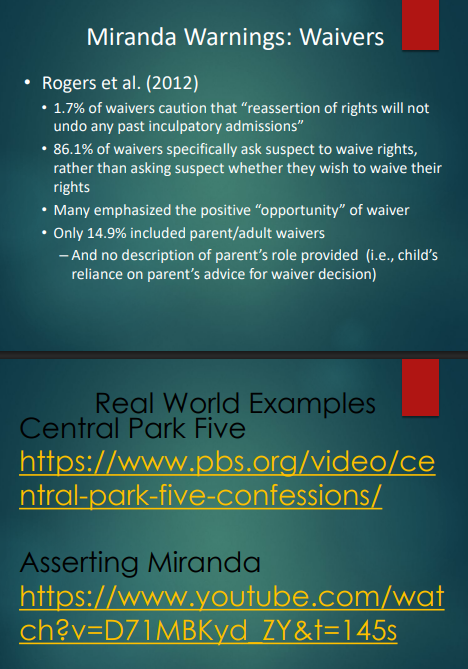
<ul><li><p><strong>Central Park Five:</strong> example of juveniles giving confessions under interrogation—used to discuss whether rights were meaningfully protected and how confessions can happen in high-pressure situations.</p></li><li><p><strong>Asserting Miranda video:</strong> shows a juvenile basically being pushed to <strong>sign papers</strong> and not clearly understanding; the mom also doesn’t understand—illustrating how youth/parents can fail to grasp Miranda and how asserting rights can break down in real life.</p><ul><li><p>The Central Park Five case illustrates the dangers of false confessions from juveniles under interrogation pressures, highlighting concerns about the protection of their rights. Additionally, the Asserting Miranda video depicts a juvenile coerced into signing documents without comprehending the situation, showcasing the challenges youth and their guardians face in understanding Miranda rights. </p></li></ul></li></ul><p></p>
38
New cards

Central Park Five: what happened, what question did it raise, what right was violated, and what was the outcome?

Based on your slide, the key use is “confessions.”

  • What happened: juveniles gave confessions during police questioning (PBS clip).

  • Question raised (Miranda focus): were the confessions obtained with a truly knowing/voluntary/intelligent waiver and were Miranda protections meaningfully applied to juveniles?

  • Right implicated/violated (Miranda context): Miranda-related protections tied to custodial interrogation (right to remain silent / counsel / valid waiver).

  • Outcome (in the bigger story): the case became a major real-world example used to question interrogation/confession reliability with youth.

    • The Central Park Five refers to a group of five Black and Latino teenagers wrongfully convicted of assault and rape, whose confessions were coerced during police interrogations. This case raised critical questions about the validity of Miranda rights for juveniles and whether those rights were effectively upheld, highlighting serious concerns regarding the understanding and application of such rights during interrogations.
<p><strong>Based on your slide, the key use is “confessions.”</strong></p><ul><li><p><strong>What happened:</strong> juveniles gave <strong>confessions</strong> during police questioning (PBS clip).</p></li><li><p><strong>Question raised (Miranda focus):</strong> were the confessions obtained with a <strong>truly knowing/voluntary/intelligent</strong> waiver and were Miranda protections meaningfully applied to juveniles?</p></li><li><p><strong>Right implicated/violated (Miranda context):</strong> Miranda-related protections tied to <strong>custodial interrogation</strong> (right to remain silent / counsel / valid waiver).</p></li><li><p><strong>Outcome (in the bigger story):</strong> the case became a major real-world example used to question interrogation/confession reliability with youth.</p><ul><li><p>The Central Park Five refers to a group of five Black and Latino teenagers wrongfully convicted of assault and rape, whose confessions were coerced during police interrogations. This case raised critical questions about the validity of Miranda rights for juveniles and whether those rights were effectively upheld, highlighting serious concerns regarding the understanding and application of such rights during interrogations. </p></li></ul></li></ul><p></p>
39
New cards

What is the role of a forensic evaluator in Miranda/juvenile cases?

If the defense argues the juvenile wasn’t competent to waive Miranda and statements should be suppressed, a forensic evaluator (psychologist) may evaluate the situation and youth’s capacity and give expert testimony on competency to waive rights.

  • The forensic evaluator assesses the juvenile's mental state and understanding of their rights to determine if they can competently waive Miranda.
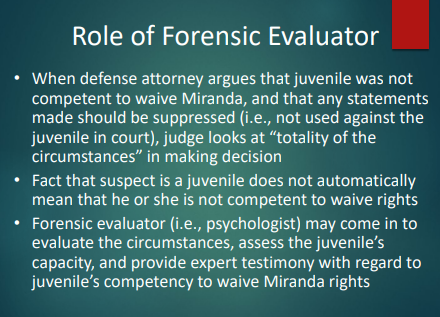
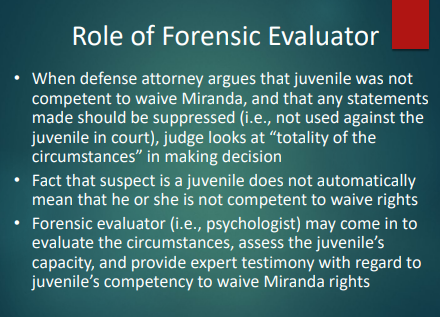
<p>If the defense argues the juvenile wasn’t competent to waive Miranda and statements should be suppressed, a <strong>forensic evaluator (psychologist)</strong> may evaluate the situation and youth’s capacity and give <strong>expert testimony</strong> on competency to waive rights.</p><ul><li><p>The forensic evaluator assesses the juvenile's mental state and understanding of their rights to determine if they can competently waive Miranda. </p></li></ul><p></p>
40
New cards

What does it mean that the judge looks at the “totality of the circumstances”?

The judge considers all relevant factors together (age, understanding, how warnings were given, presence/absence of parent, pressure, etc.) to decide whether the waiver was truly knowing, voluntary, and intelligent.

  • This approach ensures a comprehensive evaluation of the circumstances surrounding a juvenile's waiver of rights during interrogation.
<p>The judge considers <strong>all relevant factors together</strong> (age, understanding, how warnings were given, presence/absence of parent, pressure, etc.) to decide whether the waiver was truly <strong>knowing, voluntary, and intelligent</strong>.</p><ul><li><p>This approach ensures a comprehensive evaluation of the circumstances surrounding a juvenile's waiver of rights during interrogation. </p></li></ul><p></p>
41
New cards

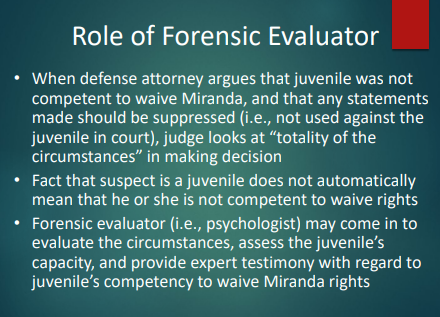
If a suspect is a juvenile, does that automatically mean they’re not competent to waive Miranda rights? Explain.

No. Being a juvenile does not automatically make someone incompetent. Competency is decided case-by-case using the totality of the circumstances.

  • Competency depends on individual understanding and circumstances, not age alone.
<p><strong>No.</strong> Being a juvenile does <strong>not automatically</strong> make someone incompetent. Competency is decided case-by-case using the <strong>totality of the circumstances</strong>.</p><ul><li><p>Competency depends on individual understanding and circumstances, not age alone. </p></li></ul><p></p>
42
New cards

When might a forensic evaluator come in, and what do they do?

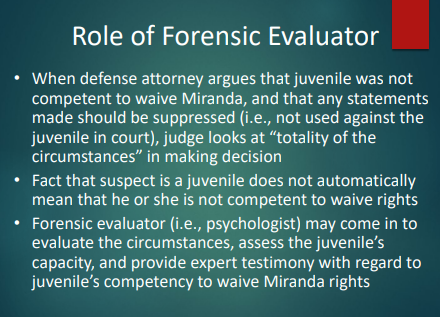
When the defense claims a juvenile’s Miranda waiver wasn’t competent and wants statements suppressed, a forensic evaluator (psychologist) may:

  • review the circumstances of interrogation

  • assess the youth’s capacity to understand/waive rights

  • provide expert testimony about competency

    • The forensic evaluator comes in when the defense argues that a juvenile did not competently waive their Miranda rights, assessing the youth's understanding and circumstances surrounding the waiver. They review the interrogation context, evaluate the juvenile's mental state and capacity, and provide expert testimony on the competency of the waiver.
<p>When the defense claims a juvenile’s Miranda waiver wasn’t competent and wants statements suppressed, a forensic evaluator (psychologist) may:</p><ul><li><p>review the <strong>circumstances of interrogation</strong></p></li><li><p>assess the youth’s <strong>capacity to understand/waive</strong> rights</p></li><li><p>provide <strong>expert testimony</strong> about competency</p><ul><li><p>The forensic evaluator comes in when the defense argues that a juvenile did not competently waive their Miranda rights, assessing the youth's understanding and circumstances surrounding the waiver. They review the interrogation context, evaluate the juvenile's mental state and capacity, and provide expert testimony on the competency of the waiver. </p></li></ul></li></ul><p></p>

Explore top notes

note
Unit 1 - The New Government
Updated 850d ago
0.0(0)
note
yo
Updated 200d ago
0.0(0)
note
1.1 Understanding Social Problems
Updated 1114d ago
0.0(0)
note
Action Potential
Updated 1318d ago
0.0(0)
note
French Grade 7-9 Structures
Updated 649d ago
0.0(0)
note
P1: Energy, Work, Power
Updated 381d ago
0.0(0)
note
Biology: Nervous System
Updated 1247d ago
0.0(0)
note
Unit 1 - The New Government
Updated 850d ago
0.0(0)
note
yo
Updated 200d ago
0.0(0)
note
1.1 Understanding Social Problems
Updated 1114d ago
0.0(0)
note
Action Potential
Updated 1318d ago
0.0(0)
note
French Grade 7-9 Structures
Updated 649d ago
0.0(0)
note
P1: Energy, Work, Power
Updated 381d ago
0.0(0)
note
Biology: Nervous System
Updated 1247d ago
0.0(0)

Explore top flashcards

flashcards
Chemistry Exam Two
27
Updated 1133d ago
0.0(0)
flashcards
unit 7
132
Updated 413d ago
0.0(0)
flashcards
talk to me in korean level 1
256
Updated 944d ago
0.0(0)
flashcards
science... oh the misery..
110
Updated 492d ago
0.0(0)
flashcards
Pharmacology Table Review
78
Updated 1077d ago
0.0(0)
flashcards
Bio Chapter 6 WORKING
39
Updated 1211d ago
0.0(0)
flashcards
10.3, 10.4, 10.5
36
Updated 1100d ago
0.0(0)
flashcards
Chemistry Exam Two
27
Updated 1133d ago
0.0(0)
flashcards
unit 7
132
Updated 413d ago
0.0(0)
flashcards
talk to me in korean level 1
256
Updated 944d ago
0.0(0)
flashcards
science... oh the misery..
110
Updated 492d ago
0.0(0)
flashcards
Pharmacology Table Review
78
Updated 1077d ago
0.0(0)
flashcards
Bio Chapter 6 WORKING
39
Updated 1211d ago
0.0(0)
flashcards
10.3, 10.4, 10.5
36
Updated 1100d ago
0.0(0)



