science... oh the misery..
 Call Kai
 Learn
Learn Practice Test
 Spaced Repetition
 Match
Match Flashcards
 Knowt Play
1/109

Earn XP
Description and Tags
everybody wants to be my enemy..
110 Terms
Law of conservation of energy
Energy cannot be created or destroyed, just transferred or transformed
Units of energy
joules (J) and calories
Potential energy
stored energy due to changes in an object’s position
Chemical energy
energy stored in chemical bonds
Elastic energy
the energy of stretched or compressed objects
Nuclear energy
energy stored in atoms
Heat energy
kinetic energy in the from of vibration of particles
Electrical energy
energy caused by movement of electrons
Light energy
energy in moving waves of light
Energy transfer
when energy is moved from one place or object to another
Energy transformations
when energy is changed from one form to another
Conduction
transfer of heat by the direct contact of matter
Convection
when fluids have a difference in temperature and moves away from heat source
Radiation
energy transmitted in the form of rays or particles
Waves
movement that carries energy from one place to another without carrying matter
Medium
material that can transmit a wave
Oscillation
movement back and forth in a regular rhythm
Transverse waves
vibrations occur perpendicular to the direction of the wave
Amplitude
height of the wave (volume)
Wavelength
distance between the waves
Frequency
number of complete waves passing each second (hertz)
Decibels
A unit of measurement for loudness
Speed equation
Speed = frequency × wavelength
Longitudinal waves
vibration of the medium is parallel to the wave motion
Compressions
where particles are closer together
Rarefactions
where particles are further apart
Pitch
how ears interpret the frequency of sound waves
Law of reflection
angle of incidence = angle of reflection
Electromagnetic radiation
waves that consist of perpendicular electric and magnetic field oscillations
Refraction
the bending of light that occurs as it passes from one medium to another
Dispersion
the spreading of white light into its full spectrum of colours due to refraction
Longer wavelength
less energy
ROYGBIV
red, orange, yellow, green, blue, indigo, and violet
Concave
curves inward
Convex
curves outward
Convex mirror
disperses light
Concave mirror
converges light
Lense for short sightedness
concave lens
Lens for farsightedness
convex lens
Focal point
where light rays meet
Real image
where light actually converges
Virtual image
where light appears to have converged
Reflection
light bouncing off a substance
Absorption
light is absorbed by objects
Transmission
the movement of light through matter
Angle of incidence
angle of the incoming ray
Angle of reflection
angle of the outgoing ray
What atoms are made up of
neutron, proton and electron
Inside an atoms nucleus
neutrons and protons
Surrounds the nucleus
electrons
Specialised cells
have a unique structure allowing it to perform a specific function in an organism
Connective tissue
connects and supports parts of the body, transports nutrients and waste
Epithelial tissue
connects inner and outer surfaces of the body to protect them
Blood
liquid circulating around the body responsible for transporting nutrients and waste
Red blood cells
carry oxygen
White blood cells
part of the immune system and defends against infections
Platelets
responsible for blood clotting
Components of blood
red blood cells, white blood cells, platelets
Arteries
large, thick vessels carrying blood away from heart
Veins
large, thin vessels carrying blood to the heart
Capillaries
small, thin vessels carrying blood directly to cells, goes both ways
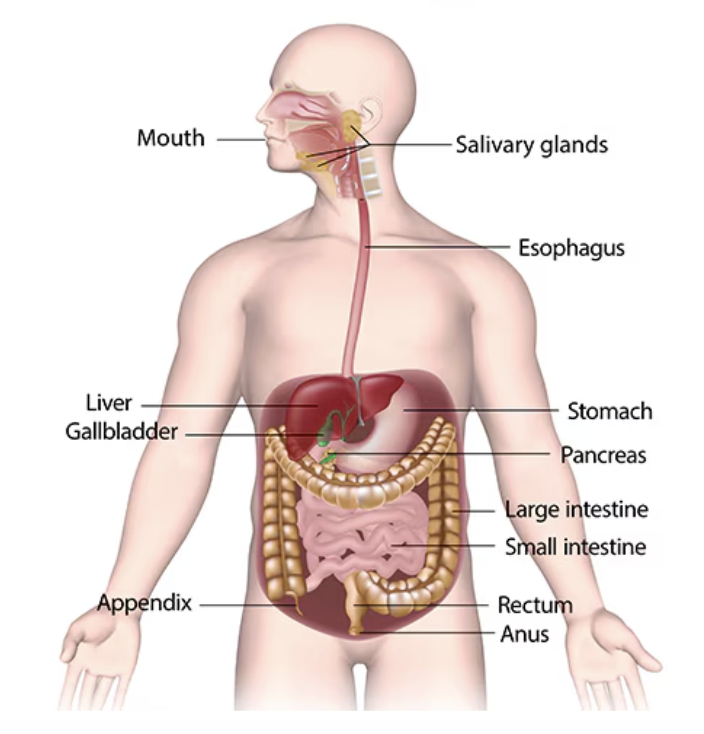
What’s this
Digestive tract
Small intestine
long, absorbs nutrients
Large intestine
final absorption and converts chyme into faeces
Cellular respiration
an energy producing reaction in cells that uses oxygen and produces carbon dioxide
Inhalation
ribcage goes upwards and outwards, diaphragm contracts pulling downwards, volume of chest increases
Exhalation
ribcage goes downward and inwards, diaphragm goes upwards, volume of chest decreases
Epiglottis
separates food and air, food is directed to oesophagus and air is directed to the trachea
Bronchi
two largest tubes, attached to the trachea
Bronchioles
smaller tubes branching out from the bronchi
Alveoli
one cell thick air sacs at the end of a bronchiole, is the site for gas exchange
Gas exchange
diffusion (capillaries and alveoli)
Pancreas
releases juices into small intestine, helping digestion + neutralise stomach acid
Liver
produces bile (breaks down fats)
Gallbladder
stores extra bile, releasing into small intestine
Tissue
A collection of specialised cells working together
Organ
A collection of different tissues working together
Connective tissue
Tissue that connects and supports other cells, tissues, and organs, transporting nutrients and waste.
Muscular system
Moves the body and contracts organs
Circulatory system
Heart contractions circulate blood through vessels, delivering nutrients and removing cell waste
Nervous system
transmits signals throughout the body
Autotrophs
Organisms producing their own food
Accessory organs
Release acids, chemicals, and signals aiding digestion
Mechanical digestion
Breaking down food through physical movements in the body
Chemical digestion
Breaking down food using chemicals in the body
Peristalsis
Contractions in the oesophagus that move food to the stomach
Villi
Small, fingerlike projections in the small intestine that absorb nutrients
Digestive System
Breaks down food into nutrients for absorption by cells
Respiratory System
System for gas exchange, removes carbon dioxide and takes in oxygen
Blood
Liquid circulating in the body, delivering oxygen/nutrients and removing waste
Plasma
Liquid in blood containing water, nutrients, and cell waste, holds other blood cells together
Platelets
Small fragments aiding in blood clotting
Heart
Muscular organ pumping blood throughout the body
Atria
heart chambers receiving and passing blood to ventricles
Ventricles
heart chambers pumping blood out of the heart
Physical change
reaction changing a substance’s properties and appearances, no new substance
Chemical change
reaction when a substance’s composition changes, new substance is formed
Chemical reaction
atoms are rearranged to form a new substance(s)
Exothermic (external)
releases energy to surroundings (creates bonds)
Endothermic (internal)
takes in energy from surroundings (to break bonds)