AQA A Level Biology - Gas Exchange
 Studied by 0 people
 Call with Kai
 Learn
Learn Practice Test
 Spaced Repetition
 Match
Match Flashcards
 Knowt Play
1/41

There's no tags or description
Looks like no tags are added yet.
Name | Mastery | Learn | Test | Matching | Spaced | Call with Kai |
|---|
No analytics yet
Send a link to your students to track their progress
42 Terms
what SA:V ratio does a small organism have?
large
what SA:V ratio does a large organism have?
small
why do single celled organisms not need a circulatory system?
substances can diffuse directly into/out of the cell across the membrane
there is a high enough rate due to the short distance
why do large organisms require a circulatory system?
diffusion across outer membranes is too slow
because some cells are deep within the body so there is a large diffusion distance
there is a low SA:V ratio so it is difficult to exchange enough substances to supply a large volume through a small SA
therefore, need it to move substances from exchange surfaces to other parts of the body
how else may large organisms allow efficient exchange of substances around the whole body?
have a body shape that increases surface area without increasing volume
how does metabolic rate relate to SA:V ratio?
affects rate at which organisms exchange substances with their environment
slow metabolic rate - small SA:V ratio
high metabolic rate - large SA:V ratio
describe the structure of the leaf
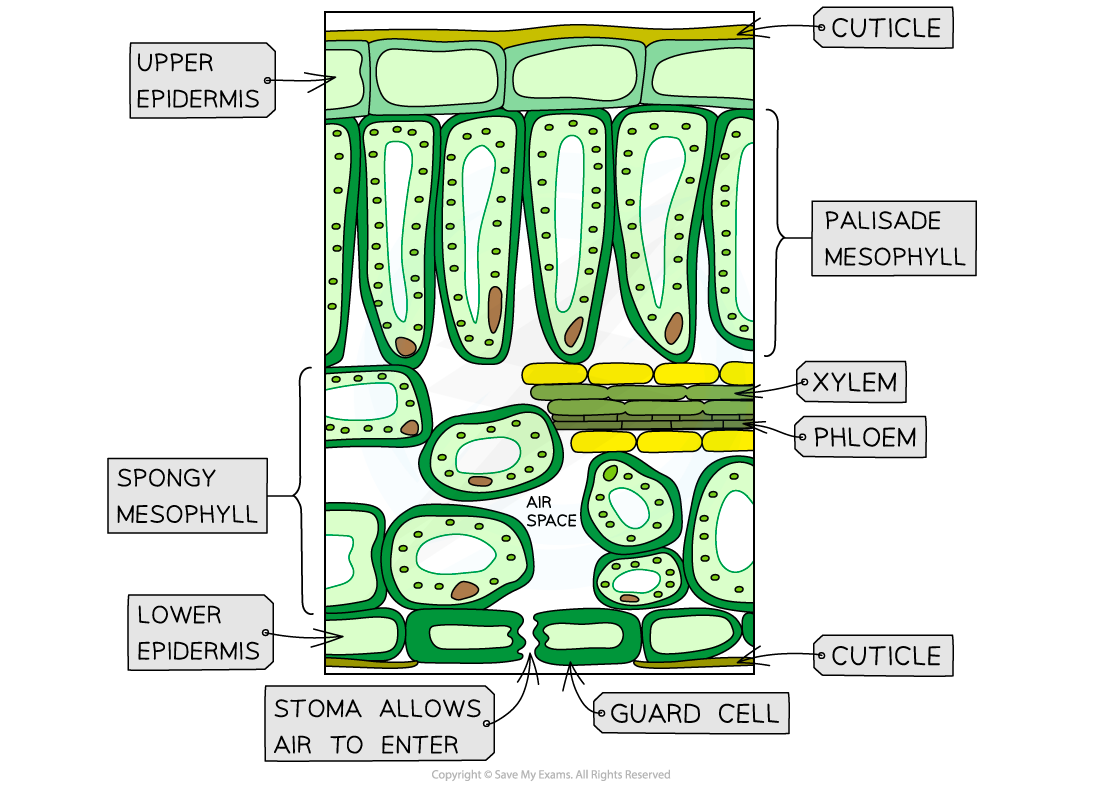
what are the adaptations of a normal leaf for gas exchange?
air spaces in spongy mesophyll layer, irregular shaped cells - increase surface area for gas exchange
guard cells - open to allow CO2 in and O2 out, maintaining a steep conc. gradient
very thin, large, flat leaves - short diffusion distance, large surface area
what are the adaptations of xerophytes for efficient gas exchange whilst reducing water loss? (don’t explain)
small/needle shaped leaves
rolled up leaves
thick waxy cuticle
sunken stomata
hairs on leaves
green stem
reduced SA of above ground parts
thicker epidermis
compact spongy mesophyll
stomata close during day
explain the adaptations: small needle shaped leaves, reduced SA of above ground parts, compact spongy mesophyll
needle leaves - lower surface area so less water loss
reduced SA - lower surface area of parts exposed to sun, so less SA for water loss by evaporation/transpiration
compact SM - reduced surface area for gas exchange of water vapour so less water loss
explain the adaptations: thick waxy cuticle, thick epidermis, green stem
thick cuticle - waterproof so reduces water loss from upper surface of leaf
thick epidermis - increased diffusion distance so les water can get through to upper surface of leaf, so less water loss from upper surface of leaf
green stem- can photosynthesize, less need for leaves, less SA exposed to sun, less water loss
explain the adaptations: rolled leaves, sunken stomata, hairs on leaves, closed stomata in day
rolled leaves: trap water vapour inside of leaves, creating a humid environment, less steep concentration gradient, less water loss and stomata can stay open
sunken stomata: pits trap a layer of very humid air, so less steep concentration gradient so less diffusion and water loss
hairs on leaves: trap air that becomes saturated with water vapour, less steep water potential gradient, less water loss
stomata close: prevents water loss at hottest part of day
why can insects not have diffusion of gases through the outer surfaces?
have a tough exoskeleton made of chitin
covered with a cuticle
completely impermeable so no gas exchange
describe the structure of the insect gas exchange system
have no lungs
have small openings in cuticle that can open+ close called spiracles
these open into tracheae, highly branched gas filled tubes
branch into smaller open ended tubes called tracheoles, which lead to muscles/organs
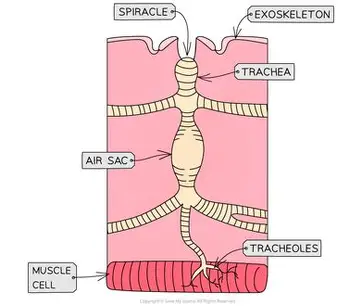
what do tracheoles contain?
fluid containing dissolved oxygen (haemolymph)
when muscles are at rest, fluid is drawn into tracheoles (stores additional O2)
when contracting the fluid is drawn into tissues (draws O2 into tissues)
what controls the opening and closing of the spiracles?
increasing carbon dioxide concentration
describe the adaptations of the insect gas exchange system
high numbers of tracheae and tracheoles
tracheoles penetrate insect tissues
fluid movement
abdominal pumping
ends of tracheoles are moist and permeable
describe the adaptation of high numbers of tracheae and tracheoles
increases surface area for gas exchange
describe the adaptation of tracheoles penetrating insect tissues
reduces diffusion distance for gas exchange
delivers gas directly to cells- diffusion in gas phase is faster than when dissolved
describe the adaptation of fluid movement in tracheoles
reduces diffusion distance in times of high stress - exercise
increases surface area
draws O2 into tissues when need + stores excess when it isn’t
describe the adaptation of abdominal pumping
moves air in and out of spiracles
removes CO2 and draws in O2
maintains a steep concentration gradient
describe the adaptation of the ends of tracheoles being thin, moist and permeable
short diffusion distance
allows gases to dissolve facilitating diffusion
how do fish obtain oxygen?
obtain dissolved oxygen in water
water passes over gills, gas exchange takes palce
why is it difficult for fish to obtain enough oxygen?
lower concentration of oxygen in water than in air
water is more dense than air so more energy required to move it
describe the structure of the gills
made up of lots of filaments
filaments are made up of a lot of slices called lamellae
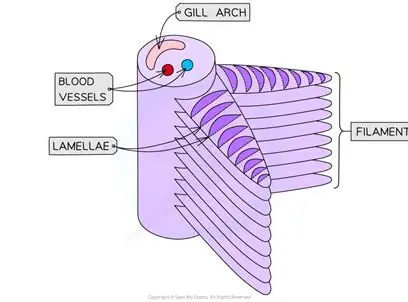
describe the adaptations of the fish gas exchange system
lots of filaments and lamellae increase surface area, also contain lots of capillaries for short diffusion distance and conc gradient
very thin lamellae - water flows across and between each lamellae reducing diffusion distance
countercurrent exchange
describe the principle of counter current exchange
water and blood flow in opposite directions through the lamellae
so equilibrium concentration of O2 is never reached
so concentration gradient is maintained for full length of the lamellae
blood is always meeting water with a slightly higher concentration of O2
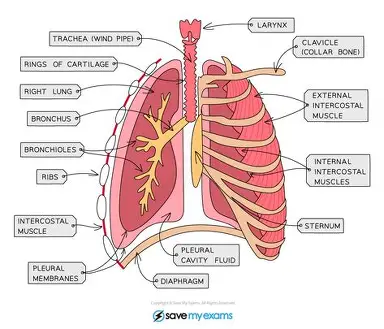
describe the structure of the human gas exchange system/lungs
trachea (windpipe) splits into 2 bronchi
each of these split into many bronchioles, which lead to alveoli
2 layers of muscle between ribs - internal and external intercostal muscles
what does ventilation consist of?
inspiration
expiration
describe the process of inspiration
ACTIVE process
external intercostal muscles contract
internal intercostal muscles relax
rib cage moves up and out
diaphragm contracts, moves down and flattens
volume of thorax increases and pressure decreases
air is drawn into lungs
describe the process of expiration
PASSIVE process (can become forced, particularly during exercise)
external intercostal muscles relax
(internal intercostal muscles only contract during forced)
rib cage moves down and in
diaphragm relaxes, moves up, curves upwards
volume of thorax decreases, pressure increases, air expelled from lungs
describe the adaptations of the alveoli
moist - gases can dissolve, facilitates diffusion
one cell thick, permeable, walls - short diffusion distance
millions of alveoli - large surface area for diffusion
dense capillary network - short diffusion distance, maintenance of concentration gradient
constant ventilation - maintains steep concentration gradient
alveoli walls are elastic - stretch on inhalation, recoil on exhalation - aids exhalation by forcing air out
blood arriving at alveoli - high in CO2, low in O2, blood that leaves is low in CO2 and high in O2 - steep concentration gradient
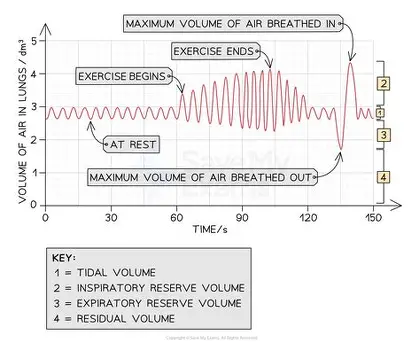
what can be used to measure lung function?
spirometer (device you breath into)
produces a spirometer trace
what does a spirometer trace show you?
tidal volume
breathing rate
residual volume
vital capacity
what is tidal volume?
volume of air in each breath
what is breathing rate?
number of breaths per minute
what is residual volume?
volume of air always in the lungs even when fully compressed (to prevent collapse)
what is vital capacity?
maximum volume of air that can be breathed out during a single breath
tidal volume + expiratory reserve volume
what is the ventilation rate?
tidal volume x breathing rate
measured in litres/second or similar
describe the disease tuberculosis
caused by alveoli destroying bacteria that live in nodules in lungs - can remain dormant
destroy alveoli and form scar tissue
reduces SA of lungs, less gas exchange can occur, increases diffusion distance
describe the condition asthma
lungs/airways are inflamed, goblet cells produce a lot of mucus, fluid enters airways, smooth muscle contracts constricting airways
reduces air flow in and out of lungs, reduces concentration gradient in alveoli
describe the condition emphysema
caused by long term smoking
elastic tissue is broken down and elastic tissue is trapped
alveoli burst, bronchioles collapse and trap air in alveoli, alveoli cannot recoil
difficult to expel air, less SA for gas exchange, lower concentration gradient
 Note
Note  Flashcards (20)