ALL BIOLOGY
 Call Kai
 Learn
Learn Practice Test
 Spaced Repetition
 Match
Match Flashcards
 Knowt Play
1/567

There's no tags or description
Looks like no tags are added yet.
Name | Mastery | Learn | Test | Matching | Spaced | Call with Kai |
|---|
No analytics yet
Send a link to your students to track their progress
568 Terms
What are plasmids?
Plasmids are small loops of extra DNA that aren't part of the chromosome. Plasmids contain genes for things like drug resistance and can be passed between bacteria.
How big are Eukaryotic cells?
10-100 micrometers
prokaryote cells
1-10 micrometers
How are nerve cells specialised?
- They have lots of dendrites which make connections to other nerve cells
- The axon carries nerve impulses from one place to the other
- The nerve endings contain lots of mitochondria so that they have enough energy to create transmitter chemicals
- They are long and thin which increases distance
- They have an insulated myelin sheath to increase speed of transmission
How are muscle cells specialised?
- They are long so they have lots of space to contract
- Contain special proteins which allow them to slide smoother
- Contain lots of mitochondria for energy as they do lots of chemical reactions
- Can store glycogen to be used for cellular respiration
How are sperm cells specialised?
- Long tail means it can swim fast to reach the egg
- Adapted for reproduction, contains half a set of chromosomes
- Middle section is full of mitochondria which is needed for energy transfers
- Nucleus is huge to store genetic information
- Acrosome stores digestive enzymes to break down the outer layers of the cell
How are root hair cells specialised?
- Large surface area so that more water can move into the cell
- Large permanent vacuole speeds up the movement of water by osmosis from the soil to the root hair cell
- Have mitochondria for energy transfers eg to transport mineral ions
How are photosynthetic plant cells specialised?
- They contain chloroplasts which trap the light needed for photosynthesis
- They are positioned in the plant to absorb as much light as possible
- Their large permanent vacuole keeps the cell rigid to support the stem.
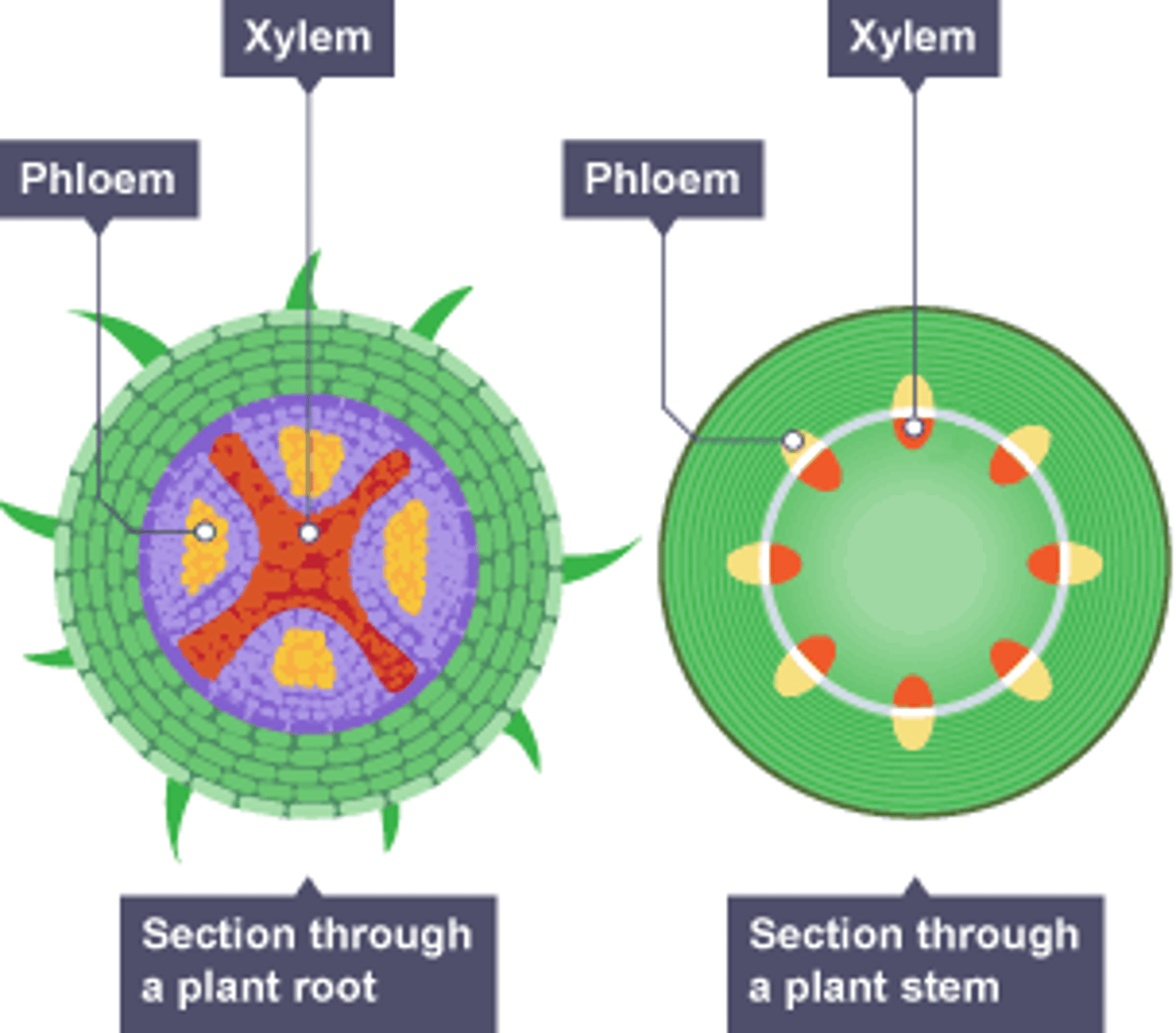
How are xylem cells specialised?
- They have a special chemical called lignin which builds up in spirals within the cell walls
- Xylem cells are dead, hence they form long hollow tubes
- Spiral structure makes them strong and allows them to withstand high water pressure
- Transport water and mineral ions up while supporting the stem
How are phloem cells specialised?
- Cell walls between the cells break down to form sieve plates in which water carrying dissolved food freely moves
- Lack of internal structures to make room for food
- Have companion cells to keep them allive
- Lots of mitochondria in companion cells for energy transfers
What is the function of a mirror in a microscope?
To reflect light up through the slide
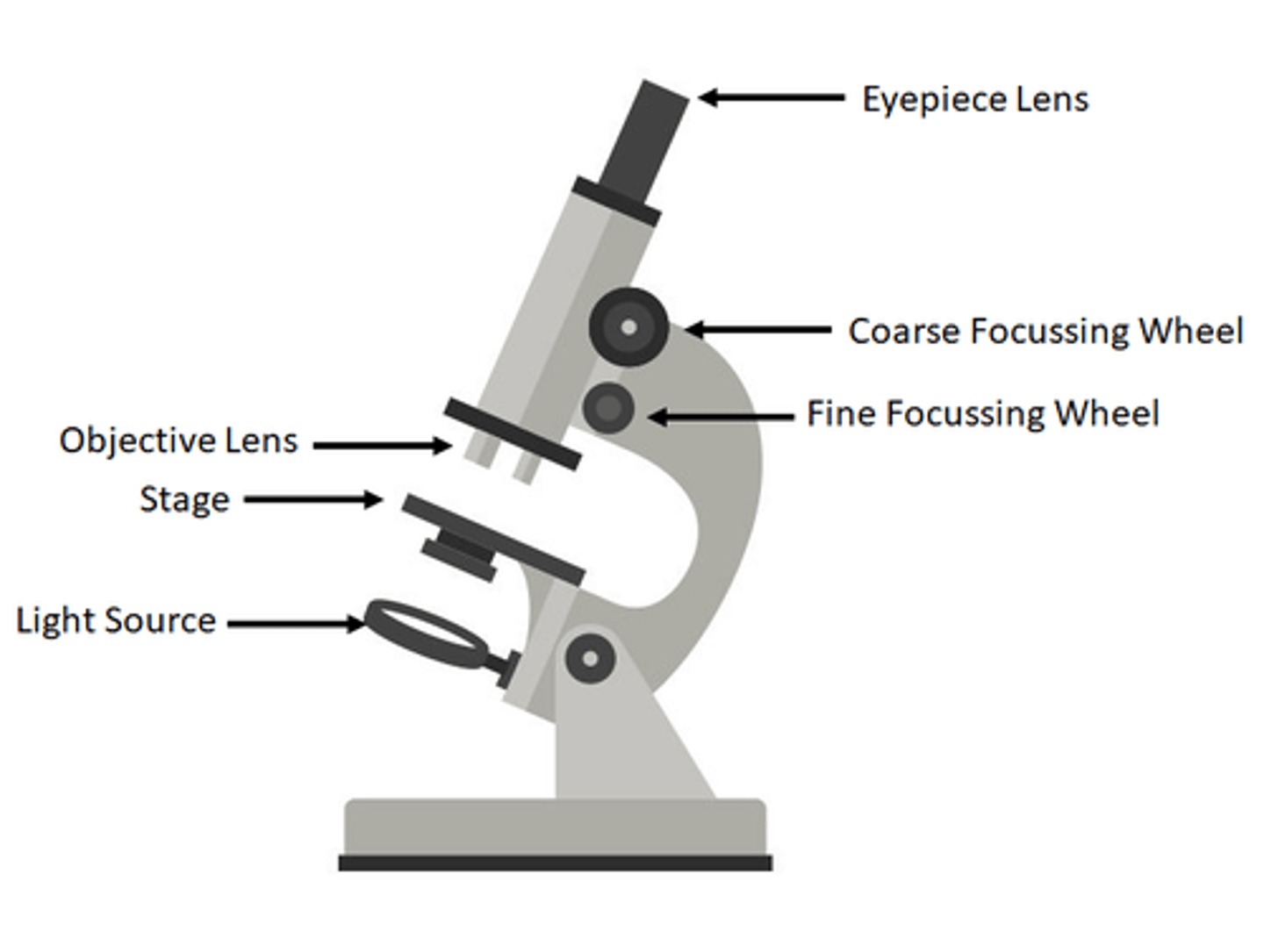
What is the function of the focussing knob?
To move the stage or objective lenses up and down so the image becomes clear and shop
What is the purpose of the low power objective lens?
To locate the specimen
Give two words for the name of the sample you look at through a microscope
Object or Specimen
What is the thin square of glass that protects your sample called?
Cover slip
What word do you use to describe placing the object on the slide?
Mounting
What is the name of the flat plate to which you attatch the slide
Stage
What magnification is usual for the eyepiece lens?
x10
Why might you look at the slide from the side
To ensure the slide isn't touching the object lens
Explain how you can alter the illumination.
By adjusting the iris or condenser
How are red blood cells adapted?
- Shape is a biconcave disk (large surface area)
- Contains haemoglobin to bind to oxygen
- No nucleus means more space for oxygen
What are the advantages and disadvantages of using a TEM (Transmission electron microscope)
Advantages:
- Very high magnification (can see tiny structures very clearly)
- Very high resolution (can see internal structures clearly)
- Magnification 500,000X
Disadvantages:
- Expensive to buy and maintain
- Require specialist training to use
- Specimens must be dead
- Complicated sample preparation
- Produces black and white images
- Only views thin slices of specimens
What are the advantages and disadvantages of using Light microscopes?
Advantages:
- Easy to use
- Cheap to buy and maintain
- Rely on light
- Organism is alive
- Colour
- Magnification 1500X
Disadvantages:
- Resolution limited to 0.2 micrometers
- Cannot see subcellular structures
What happens to plant cells in a hypertonic solution?
- Water leaves the cell
- Vacuole gets smaller
- Cell volume decreases
- The cell is plasmolysed/flaccid
- The cell wall is rigid
- Cell membrane pulls away from the cell wall
What happens to plant cells in a hypotonic solution?
- Water enters cell
- Vacuole gets bigger
- Cell volume increase
- The cell wall is rigid and strong
- The cell is turgid
What happens to animal cells in a hypertonic solution?
- Water leaves cell
- They crenate and shrink
What happens to animal cells in a hypotonic solution?
- Water enters cell
- They enlarge and burst (lysis)
Explain how you would conduct a required practical into the effect of a range of salt or sugar solutions on the mass of plant tissue due to osmosis
- Independent variable: Concentration of salt/sugar solution
- Dependent variable: Change in mass of plant tissue (often % change)
- Control variables (keep the same):
• Volume of solution in each tube
• Time left in solution
• Temperature
• Size and shape of potato pieces (length, diameter)
• Same type of plant tissue (same potato)
1) Pour equal volumes (eg 10cm³) of different salt/sugar concentrations into labelled test tubes or beakers:
0.0,0.1,0.2,0.3,0.4
2) Cut the plant tissue by using a knife to create potato cylinders of equal length and diameter. Measure with a ruler and trim to ensure all are the same size
3) Measure the initial mass by patting the potato pieces gently to remove surface moisture. You can have 3 pieces per concentration to calculate a mean.
4) Put each potato piece into a different concentration of solution. Ensure they are fully submerged.
5) Leave for a set time (eg 30 minutes - 1 hour) to ensure osmosis has occured.
6) Remove the potato pieces out of the solutions and blot dry with paper towel to remove excess solution.
7) Measure the final mass and record it.
8) Calculate the %change in mass and plot a graph of concentration of solution (x axis) to %change in mass (y axis)
Sources of error / improvements
- Not blotting potato equally (affects mass)
- Cylinders not exactly the same size (different SA)
- Leaving them for different times
- Balance not precise enough
- Improve by using more repeats, more concentrations and a more accurate balance
Why do we use %change in mass for the osmosis practical over just change in mass?
Because different potato pieces may start with different masses, and using %change lets you fairly compare them.
What is active transport?
The movement of substances from a low concentration to a high concentration using carrier proteins and energy from respiration.
How are the lungs adapted for gas exchange?
- Large surface area due to millions of alveoli (diffusion increases)
- Very thin walls (short diffusion distance)
- Moist lining (allows gases to dissolve to diffuse)
- Rich blood supply (maintains steep concentration gradient by bringing low oxygen blood)
- Ventilation (breathing constantly refreshes air hence maintaining gradient)
How are fish gills adapted for gas exchange?
- Each gill has gill filaments with small flat gill lamellae which increase SA:V ratio
- Gill lamellae and arteries are one cell thick (short diffusion path)
- Lots of capillaries allow for a steep concentration gradient)
- Counter-current flow (blood and water move in opposite directions which keeps gradient high along the whole gill)
What is the function of the Cytoplasm?
Gel like substance where chemical reactions take place
What is the function of a permanent vacuole?
Contains cell sap, changes it's size due to the amount of water it holds
What are the similarities and differences between Prokaryotic and Eukaryotic cells?
Similarities:
- Both cells have cytoplasm and a cell membrane
- Both cells have genetic material
Differences:
- Eukaryotic cells have their DNA ecnlosed in a nucleus, inside a prokaryotic cell it is free in the cytoplasm
- Eukaryotic cells don't have plasmids
- Prokaryotic cells have flagella
- Eukaryotes have linear and double stranded DNA while prokaryotes have circular and single stranded
- Eukaryotic cells have a cytoskeleton whereas prokaryotes do not
- Prokaryotes don't have membrane - bound organelles
- Eukaryotic cells are much larger than prokaryotic ones
What is the purpose of flagella?
Provide movement for cells
What is the purpose of the high power objective lens?
To provide greater magnification and see in more detail.
What is the piece of glass that you place your sample on called?
Slide
Explain why you might add a stain to the object you're looking at
So you can see it clearer and to make the features stand out
Which objective lens do you use first?
Low power
What is the formula for magnification?
Magnification = Image size / Real size
What is resolution?
The ability to clearly distinguish the individual parts of an object
What is diffusion?
The spreading out of particles in a gas or solution resulting in the net movement of those particles from an area of higher concentration to an area of lower concentration.
What osmosis?
The net movement of water molecules from a dilute solution to a more concentrated solution through a selectively permeable membrane.
What is a solute?
A substance that is dissolved in a liquid
What is a solvent?
A liquid that can dissolve a solute
What is a solution?
The resultant liquid formed when a solute is dissolved in a solvent
What is a hypertonic solution?
Where the solution has a greater concentration than another solution
What is an isotonic solution?
Solutions that have the same concentration
What is a hypotonic solution?
Where the solution has a lower concentration than another solution
What are the key differences between Plant and Animal cells?
- Plant cells have chloroplasts while animal cells don't
- Plant cells have a cell wall, while animal cells just have a cell membrane
- Plant cells can have a vacuole
What is the function of the Cell Membrane?
Selectively allows substances into and out of the cell (it is selectively permeable)
What is the function of mitochondria?
The site of cellular respiration (energy is released)
What is the function of the Nucleus?
Genetic material is found here, controls the activities of the cell
What is the function of ribosomes?
Synthesis of proteins
What is the function of the cell wall?
Made of cellulose - protects and gives structure and strength to the plant cell
What is the function of Chloroplasts?
Contains chlorophyll, which absorbs sunlight for photosynthesis
How are leaves adapted for gas exchange?
- Large surface area
- Thin (short diffusion path)
- Lots of stomata which allow CO2 and O2 in and out
- Guard cells open/close stomata to control gas exchange
- Air spaces in spongy mesophyll allow gases to diffuse freely inside the leaf
How are root hair cells adapted for gas exchange?
- Long 'hair' extension massively increases surface area
- Thin cell wall (short diffuse path)
- Many mitochondria for active transport of mineral ions
What is the function of the oesophagus?
Muscular tube which moves ingested food to the stomach
What is the function of the stomach?
Digests food as it is very acidic. Proteins are absorbed/digested and Hydrochloric acid is high.
What is the function of the pancreas?
Creates the enzymes for digestion, moves them into the small intestine.
What is the function of the large intestine?
Reabsorbs water and stores and eliminates undigested food
What is the purpose of the rectum?
Stores faeces
What is the purpose of the Anus?
Faeces passes through here
What is the purpose of the small intestine?
Food and nutrients absorbed into the blood here
What is the purpose of the gall bladder?
To store bile
What is the purpose of the liver?
To produce bile
What is bile?
A bitter, greenish-brown alkaline fluid that neutralises acidic food coming from the stomach into the small intestine. It also emulsifies fats to increase their surface area.
How is a carbohydrate converted into glucose?
Through amylase (carbohydrase)
How are proteins converted into amino acids?
Through protease (eg pepsin)
How are fats/lipids converted into fatty acids/glycerol?
Through Lipase
What are the 5 different organ systems?
- The Nervous system
- The Respiratory system
- The Circulatory system
- The Digestive system
- The Urinary system
What is an organism made up of?
Lots of cells, which create tissues, which create organs, which create organ system.
What is an organism?
A living thing
What is differentiation?
The process by which a cell changes to become specialised for its job
Where is amylase made and used?
Where made:
- Salivary glands
- Small intestine
- Pancreas
Where used:
- Small intestine
- Mouth
Where is protease made and used?
Where made:
- Small intestine
- Pancreas
- Stomach
Where used:
- Stomach
- Small inestine
Where is lipase made and used?
Where made:
- Small intestine
- Pancreas
Where used:
- Small intestine
Why is digestion so important?
So that substances that are too big to be absorbed are converted into smaller molecules that can be absorbed by the small intestine into the blood stream.
What is glucose used for in humans?
Respiration
What are fatty acids and glycerol used for?
- Insulation
- Hormones
- Protection around organs
- Cell membranes
What are amino acids used for?
- Protein synthesis
- Muscle repairing and growth
- Enzyme creation
- Maintanance
What is the lock and key hypothesis?
The idea that the enzyme has a fixed shape and only the right substrate will fit into the active site
What do enzymes do?
Speed up chemical reactions by lowering activation energy
What is a catalyst?
A substance which changes the rate of a chemical reaction without being changed itself
Why are enzymes so important in your body?
We need them for digestion otherwise the process would be extremely slow and all chemical reactions in our body would not be fast enough.
What is a substrate?
The reactant that an enzyme acts on
What is saturation point for enzyme reaction?
When all enzyme molecules are occupied. No matter how much more substrate is added, the rate will not increase. If you alter the concentration of the enzyme then rate will change accordingly.
What is denaturing?
When an enzyme's conditions are not optimum and its shape changes so it will not fit the substrate anymore
What is the purpose of the cuticle?
It is a waxy layer that holds in moisture and keeps the plant from drying out.
What is the purpose of the epidermis?
Outermost layer of the skin that protects and creates a waterproof barrier
What is the purpose of the palisade mesophyll?
Contains lots of chloroplasts which carry out photosynthesis
What is the purpose of the spongy mesophyll?
Contains some chloroplasts but has a large SA and big air spaces for better diffusion of gases within the leaf.
What is the purpose of stomata?
Allow gases in and out
What is the purpose of guard cells?
Control the opening and closing of the stomata
Stem cell photo
What are the three tissues in the stomach and their function?
Muscular:
Allows food to be churned and mixed with digestive juices to break it into smaller pieces
Epithelial:
Covers the inside and outside of the stomach to protect the stomach from acid.
Glandular:
Produces digestive juices with protease, HCL and Mucus to protect the stomach lining
What is a tissue?
A group of cells that act together to perform a specific function.
What is an organ?
A group of different tissues that work together to perform a certain function.

