exam 2 Sensation and Perception - Space Perception & Binocular Vision
 Call Kai
 Learn
Learn Practice Test
 Spaced Repetition
 Match
Match Flashcards
 Knowt Play
1/48

There's no tags or description
Looks like no tags are added yet.
Name | Mastery | Learn | Test | Matching | Spaced | Call with Kai |
|---|
No analytics yet
Send a link to your students to track their progress
49 Terms
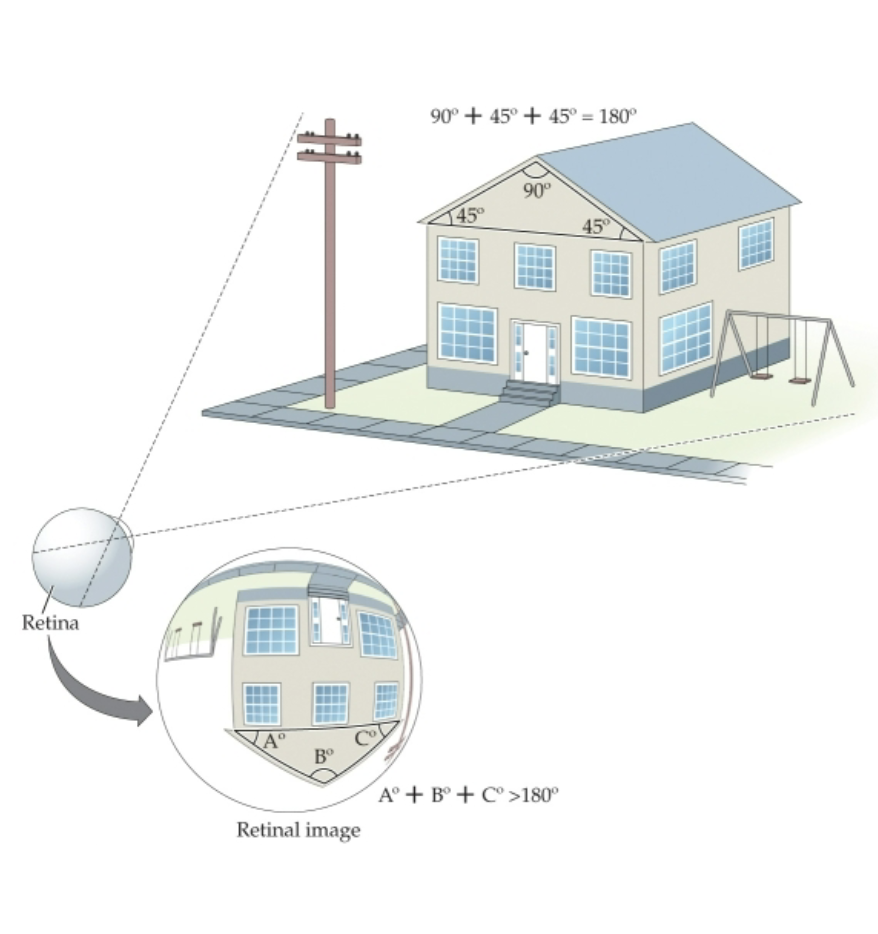
Brain does/does not use objective measurements for depth: no Euclidian Geometry (e.g., parallel lines stay parallel, angles add up)
Brain Does Use:
• 2 non-matching, distorted, __ 2D Images with blind spots.
• __ understanding of non-Euclidean geometry & line perspective.
• Binocular Disparity
• Past experience
• Metrical & Nonmetrical depth cues
does not.
inverted.
Innate.
What are the 2 Types of Depth Cues?
• Nonmetrical depth cues show depth order but not exact distance (Basically what’s closer and what further but not exact measurements).
• Metrical depth cues provide measurable depth info. (Basically provide quantitative information about distance).

Metrical Depth is broken down into 2 types:
↪ ?: Indicate how far objects are from one another but not __ distances.
↪ ?: Give __ distance measurements, though human accuracy is limited compared to some animals.
Relative. exact.
Absolute. precise.
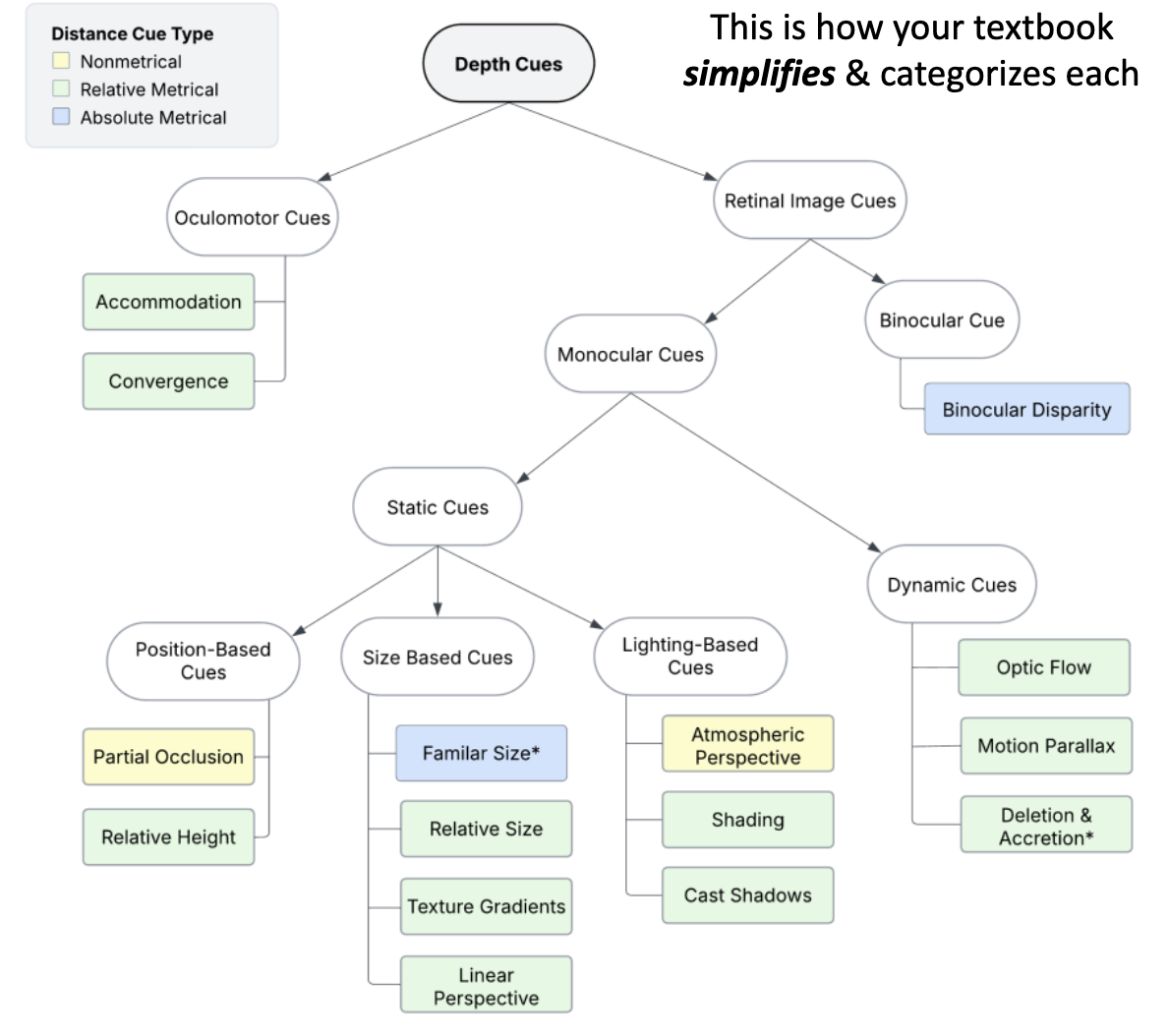
Depth cue: provides info about __ relationships.
2 Kinds:
spatial.
1. Oculomotor – use eye muscle feedback to estimate.
2. Retinal Image Based – use info from 1 or both eyes.

Oculomotor Cues has two subunits:
Accommodation.
Convergence.

Oculomotor – Physiological Cues for Depth
Oculomotor cues rely on __ & can provide absolute metrical depth info for close objects – but we don’t use it that way. Is ? for most, at best.
Oculomotor Cues has two subunits:
eye muscle feedback. relative (not precise measurement).
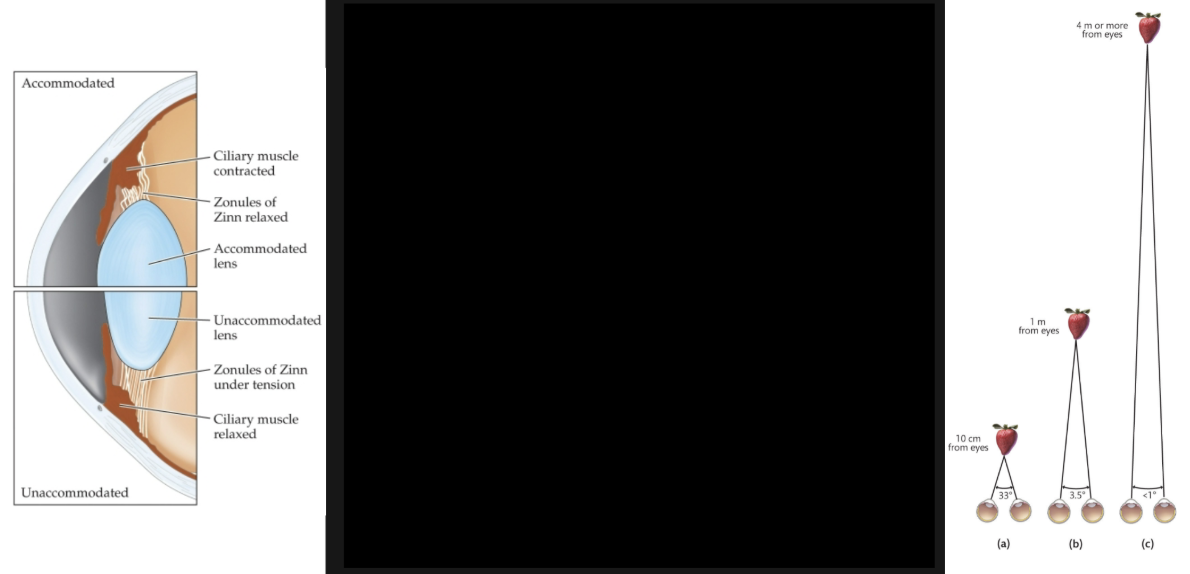
↪ Accommodation – Ciliary muscles adjust the lens to focus on near objects. Provides depth info but is limited beyond 1-2 meters.
↪ Convergence – Eyes rotate inward to focus on close objects. Stronger than accommodation but only effective within 2 meters.

Retinal Image Based Depth Cue has two subunits:
• Monocular Cues – rely on 1 eye. Have 2 kinds: static & dynamic
• Binocular Cues – rely on differences between images from both eyes

Static Monocular Cues – aka 2D Pictorial Cues
Static Monocular Cues have 3 categories:
• Position-Based Cues:
↪ Partial Occlusion.
↪ Relative height
• Size-Based Cues:
↪ Familiar size.
↪ Relative size.
↪ Texture gradients.
↪ Linear perspective.
• Lighting-Based Cues:
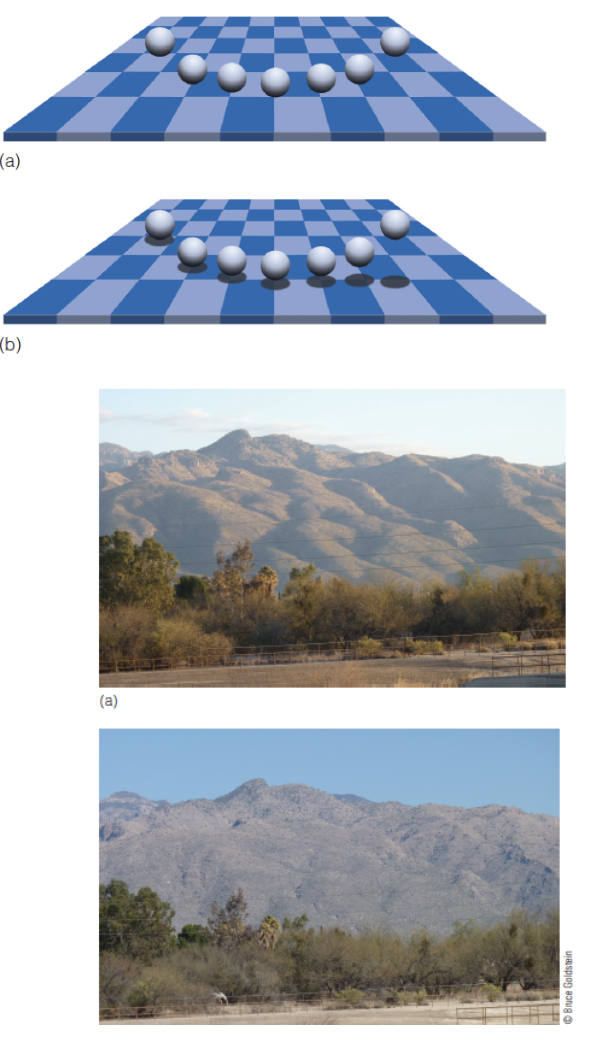
↪ Atmospheric Perspective.
↪ Shading.
↪ Cast shadows.
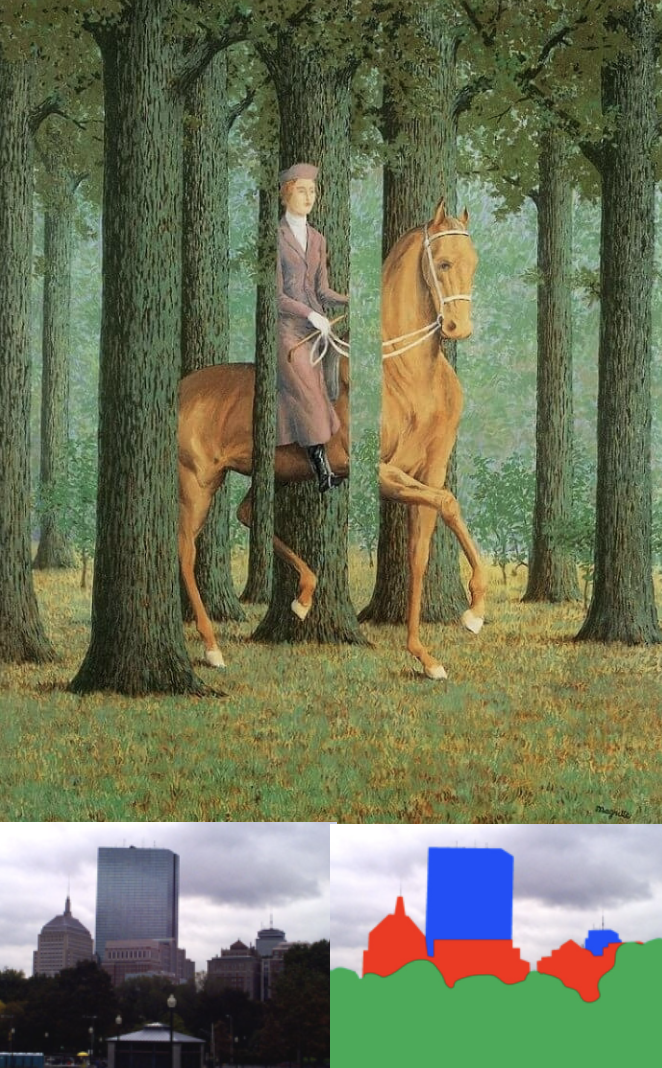
Static Monocular Cues – Position-Based Cue - Partial Occlusion
• Non-metrical/Metrical
• Simple but effective – If object A covers part of B, __ is closer.
• Most reliable/unreliable depth cue – Works in nearly all visual environments with 1 eye & no movement.
• Pervasive in __ – Used constantly for depth perception (We rely on this all the time!)
Nonmetrical, Ordinal – Only gives depth order, not relative or absolute distances.
A.
MOST RELIABLE DEPTH CUE.
daily life.
Static Monocular Cues – Position-Based Cue - Relative Height AKA Relative Position
Objects lower in the visual field on the ground appear __; those higher appear ?.
• Horizon Line Effect: ?
• Inverted for __: Higher in the visual field = closer.
• Works with __ to enhance depth perception.
closer. farther.
Near the horizon = farther; farther from the horizon = closer.
Ceiling Objects.
Relative Size.
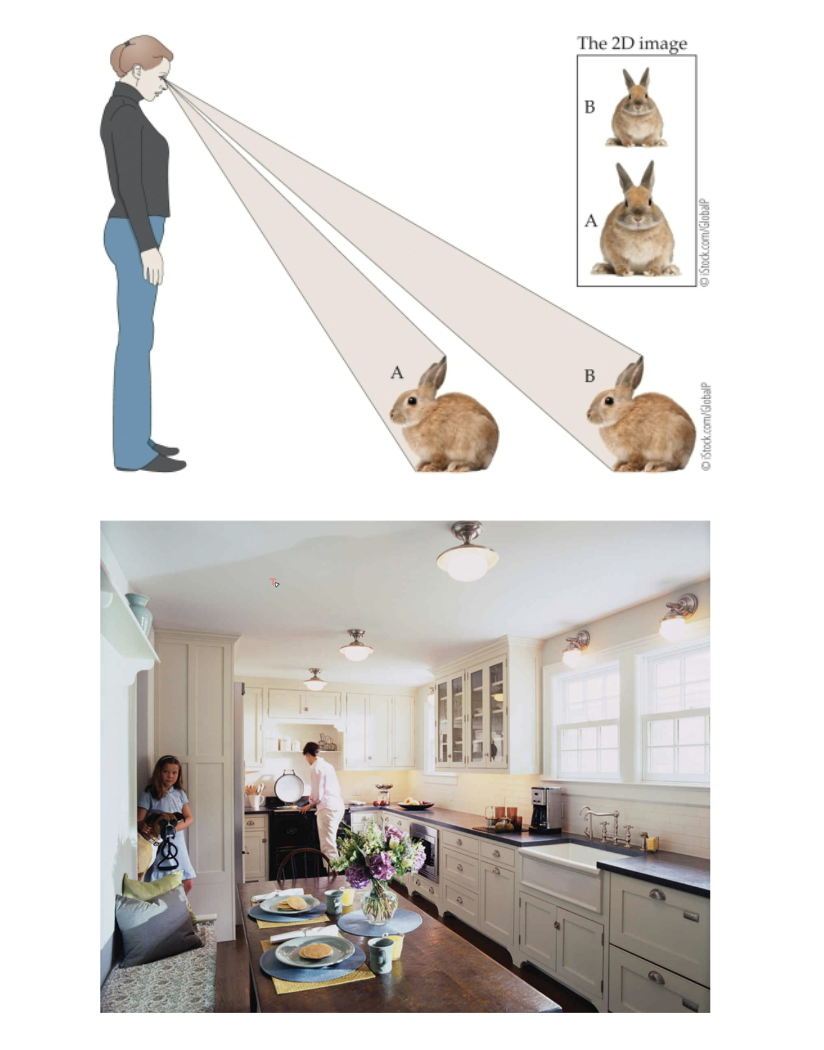
Static Monocular – Size-Based Cues - Familiar Size
Size Based cues provide relative/absolute depth info.
• Familiar Size: Uses knowledge of an __ to estimate depth.
• Can work alone or with __.
• If actual size is known, can provide relative/absolute depth info.
relative.
object's typical size (Here, your brain uses stored knowledge about how big something normally is. Basically, If you see a person who appears tiny in your visual field, your brain thinks: “People aren’t that small — so they must be far away.”).
relative size.
absolute.
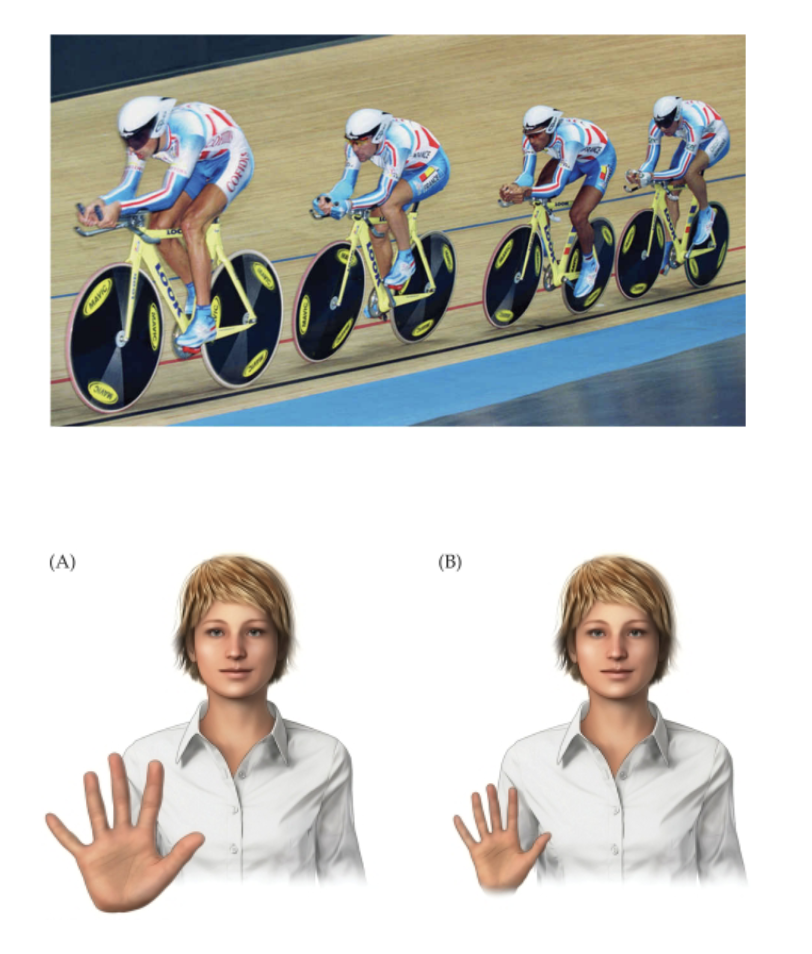
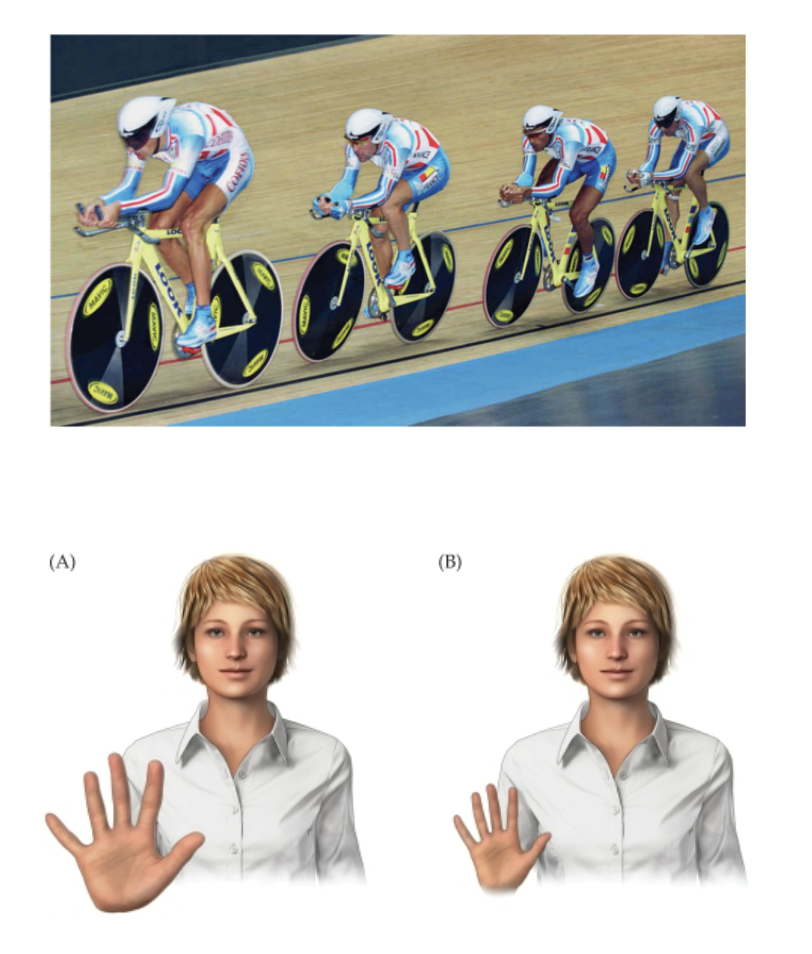
Static Monocular – Size-Based Cues - Relative Size
Size Based cues provide relative/absolute depth info.
• Relative Size: Compares the sizes of objects without needing to know __; providing relative distance.
• Smaller objects are perceived as closer/farther away.
relative.
exact dimensions.
farther away.
Static Monocular – Size-Based Cues - Texture Gradients
Size Based cues provide relative/absolute depth info.
Texture Gradient: When surface elements maintain consistent size and spacing, their retinal image shrinks/grows with distance, creating depth perception.
• The farther objects are = ?
• Most noticeable on __ surfaces extending into the distance.
• Strongly influenced by ? and ?.
relative.
shrinks.
the smaller, less detailed, and more densely packed they appear.
ground.
relative size & relative height.

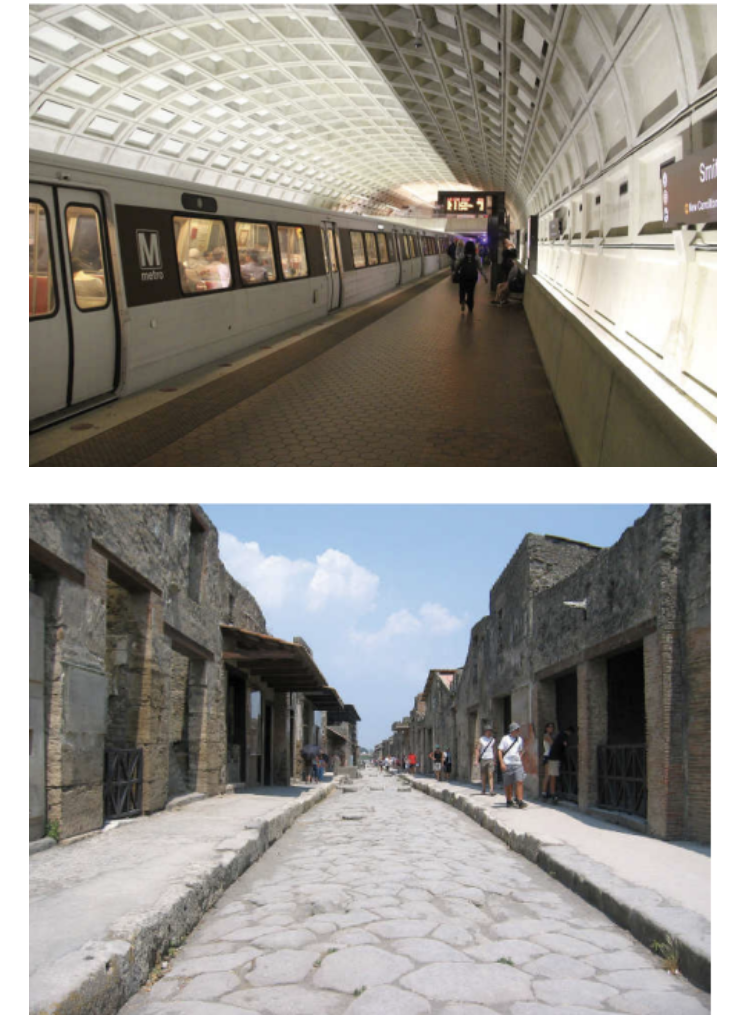
Static Monocular – Size-Based Cues - Linear Perspective
Size Based cues provide relative/absolute depth info.
Linear Perspective AKA Perspective Convergence
• __ appear to converge toward a ? in the distance.
• Works even though the lines remain __ in reality.
• A strong depth cue/weak depth cue in man-made and natural scenes.
• Common in railways, roads, and architecture.
relative.
Parallel lines. vanishing point.
parallel.
strong depth cue.
Static Monocular Cues – Lighting-Based Cues - Atmospheric Perspective
Atmospheric Perspective AKA Aerial Perspective
• Relies on __ to signal depth.
• Non-metrical/Metrical - Distant objects appear ?
• ? and ? make far objects seem farther away.
• Stronger in __ environments with vast landscapes, such as mountains or canyons.
Light scattering.
• Nonmetrical, Ordinal – Distant objects appear hazy due to moisture, dust, and particles in the air.
Blurred edges and lower contrast.
natural.

Static Monocular Cues – Lighting-Based Cues - Shading
Shading
• The brain naturally assumes light comes from above/sideways, as from the ?.
• Objects with light on top and shadow below appear raised/indented, while the reverse looks raised/indented.
• Illusion: Flip shading to make the same object appear ? or ?.
• This 2D cue is crucial in interpreting __ shapes and ?.
above. sun.
raised. indented.
convex or concave. (Basially, Light-on-top = raised (convex) If an object is: Brighter on top and Darker on the bottom, our brain interprets it as bulging outward (convex), like a bump. However, if Light-on-bottom = indented (concave). If shading is reversed: Darker on top and Brighter on bottom, our brain interprets it as curving inward (concave), like a dent or hole. If you flip the shading of the exact same image, it can suddenly switch from looking like: A bump → to a dent or A dent → to a bump. Nothing about the shape changed — only the shading direction.)
3D. navigation.
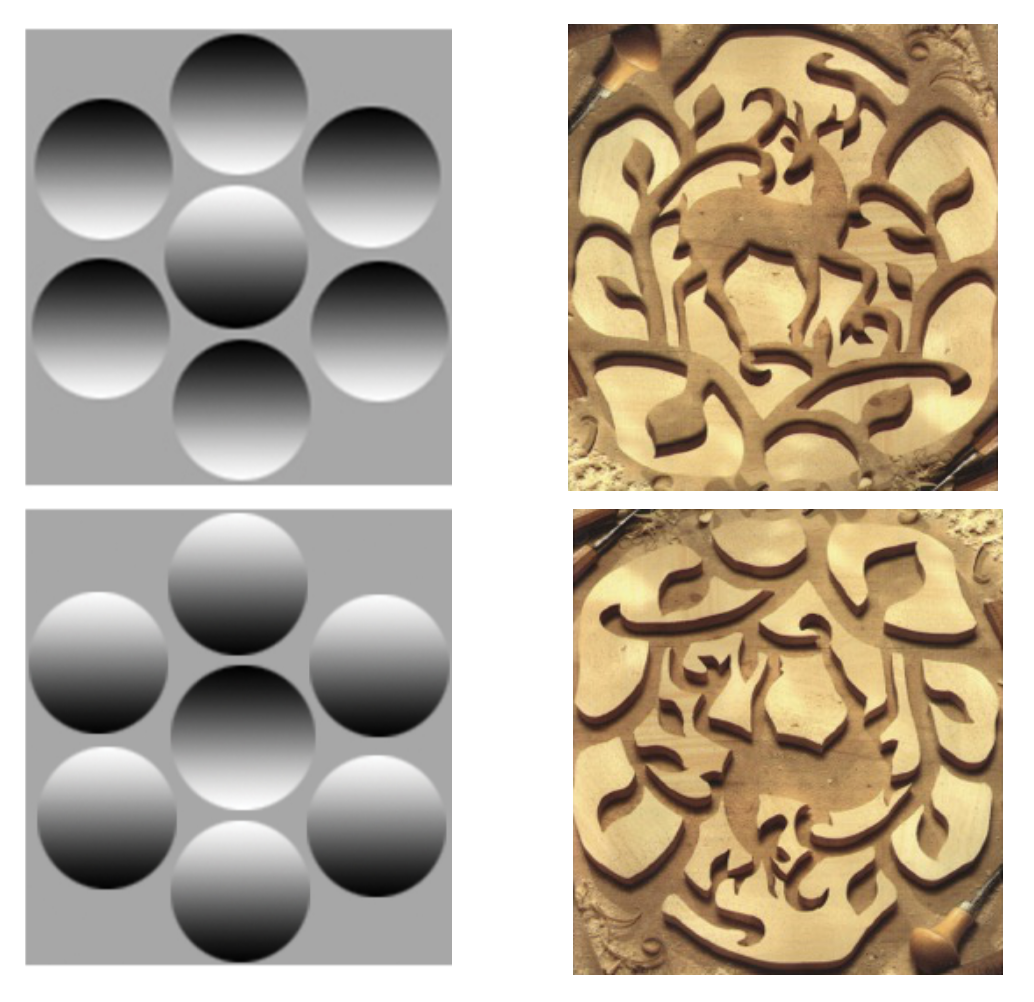
Static Monocular Cues – Lighting-Based Cues - Cast Shadows
Cast Shadows
• Shadows provide depth cues by indicating an object's position relative to a __ in real world situations.
• Effectiveness depends on the viewer's assumptions about light direction and object size.
• Long shadow – closer/farther from low light source.
• Objects farther from a light source or in shadowed areas appear lighter/darker due to ?.
• Close shadow – closer/farther from light source.
light source.
farther.
darker. reduced illumination.
light directly overhead / close.
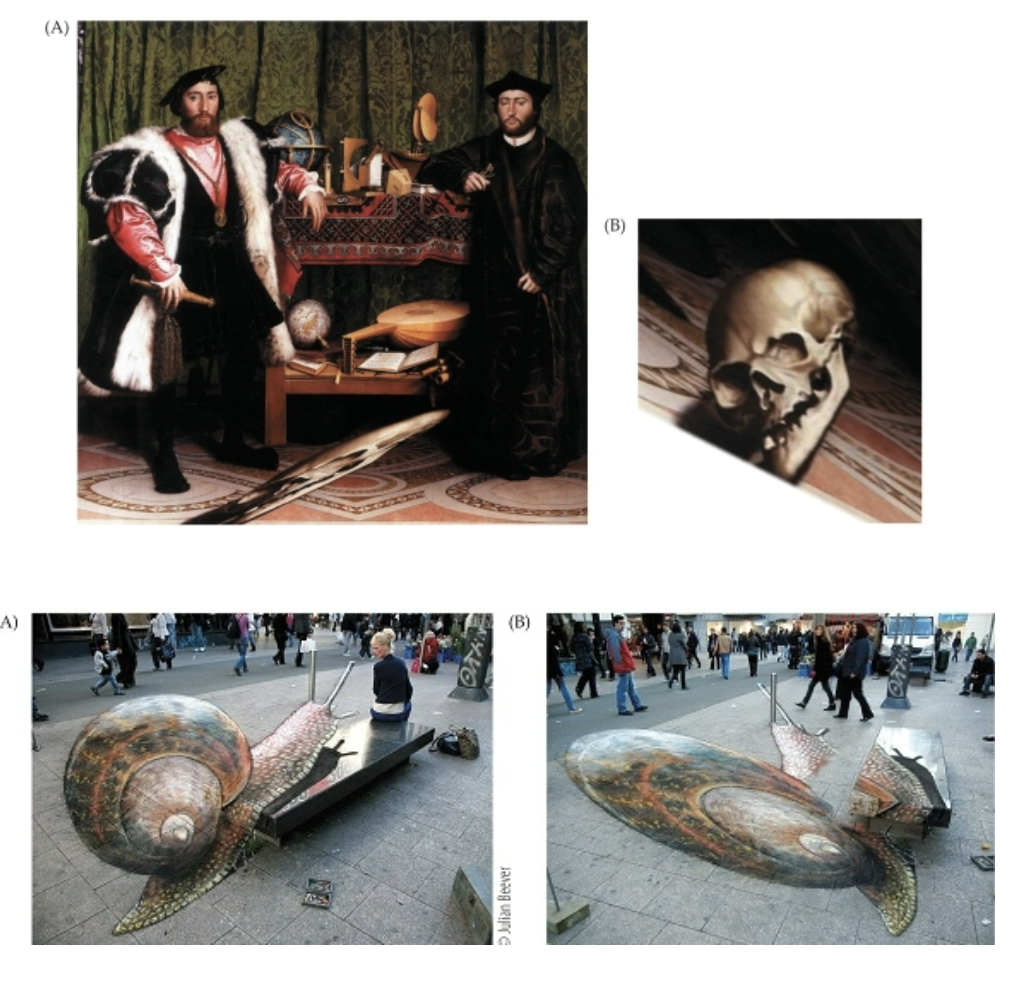
Extreme Applications of Static Monocular Cues
• T/F: 2D projections can distort images in ways the brain cannot automatically correct.
• Surface orientation does not compensate for these distortions. (Basically?)
• Anamorphic art manipulates perspective, creating images that only appear correct from ? or with curved/flat mirrors.
• Pushes __ to extremes, as seen in Holbein’s painting & pavement art.
TRUE.
(Basically, Normally, your brain adjusts for Slanted surfaces, Tilted objects, Viewing angles. This is called shape constancy — your brain recognizes an object as the same shape even when viewed from an angle. But with extreme distortions, the brain can’t automatically “undo” the projection. The image just looks warped or wrong.).
specific vantage points or curved mirrors.
linear perspective.
Dynamic Monocular Cues
Motion-based depth cues arise from? All of them are relative/absolute metrical or Nonmetrical.
Name the three Dynamic Cues?
retinal image changes as we move; are all relative metrical.
• Optic Flow: The whole visual scene expands as we move forward and contracts as we move backward. (Think of When driving forward, the road seems to flow outward from a point ahead of you).
• Motion Parallax: Closer objects appear to move faster across retina than distant ones. (Think of Looking out a car window: Nearby trees zip by quickly while Mountains in the distance barely seem to move).
• Deletion & Accretion: Objects are gradually covered (deletion) or revealed (accretion) as the viewpoint shifts.
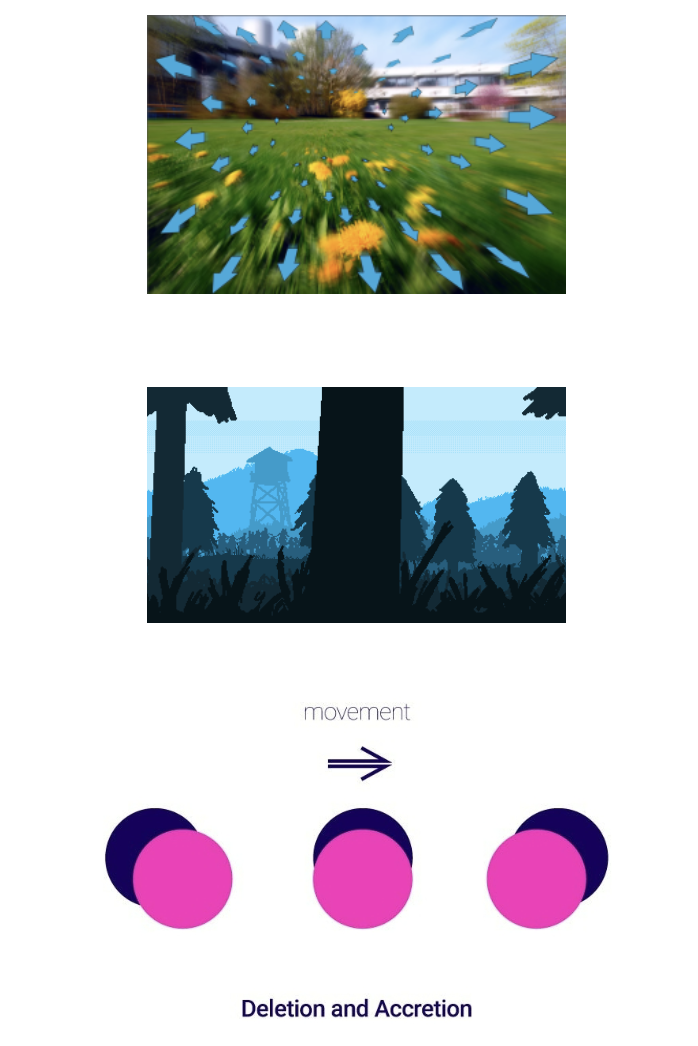
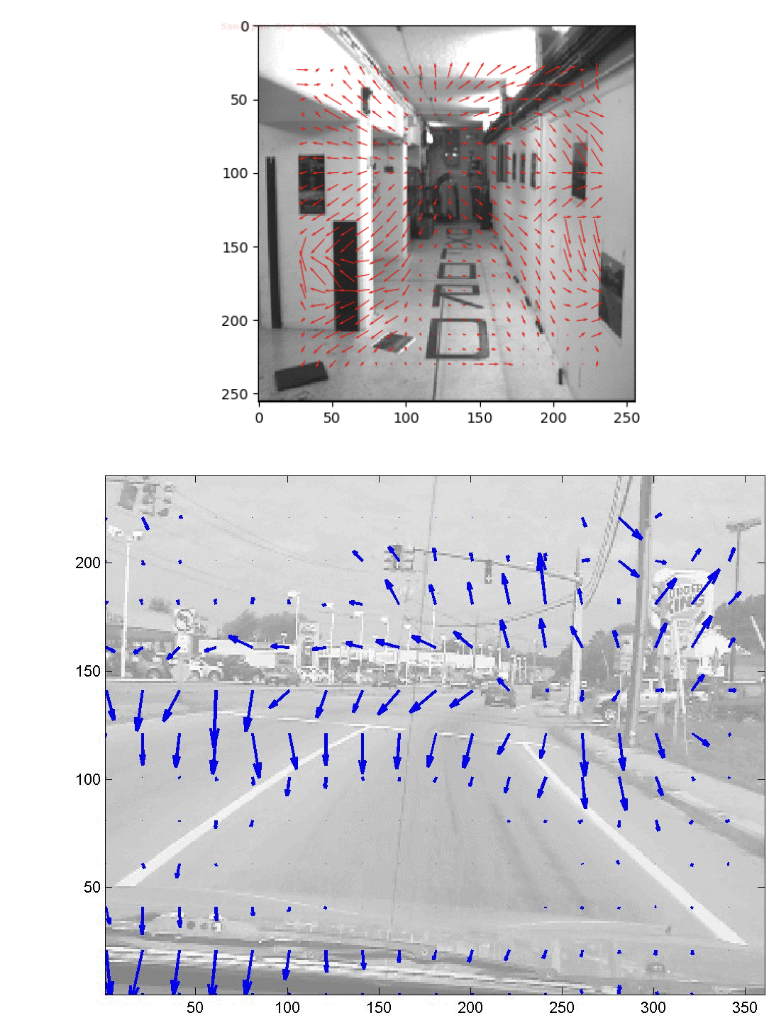
Depth from Motion – Dynamic Monocular Cues - Optic Flow
• Optic Flow: The pattern of motion in a visual scene created by the observer’s ? or ? movement.
• Objects in our view appear to expand outward/inward as we move forward from a central point; moving backward contracts/spreads the scene.
• Objects closer appear to move slower/faster, while distant objects move slower/faster.
• Focus of expansion – ?
forward or backward.
outward. contracts.
faster. slower.
the visual field point where there is no motion, indicates travel direction.
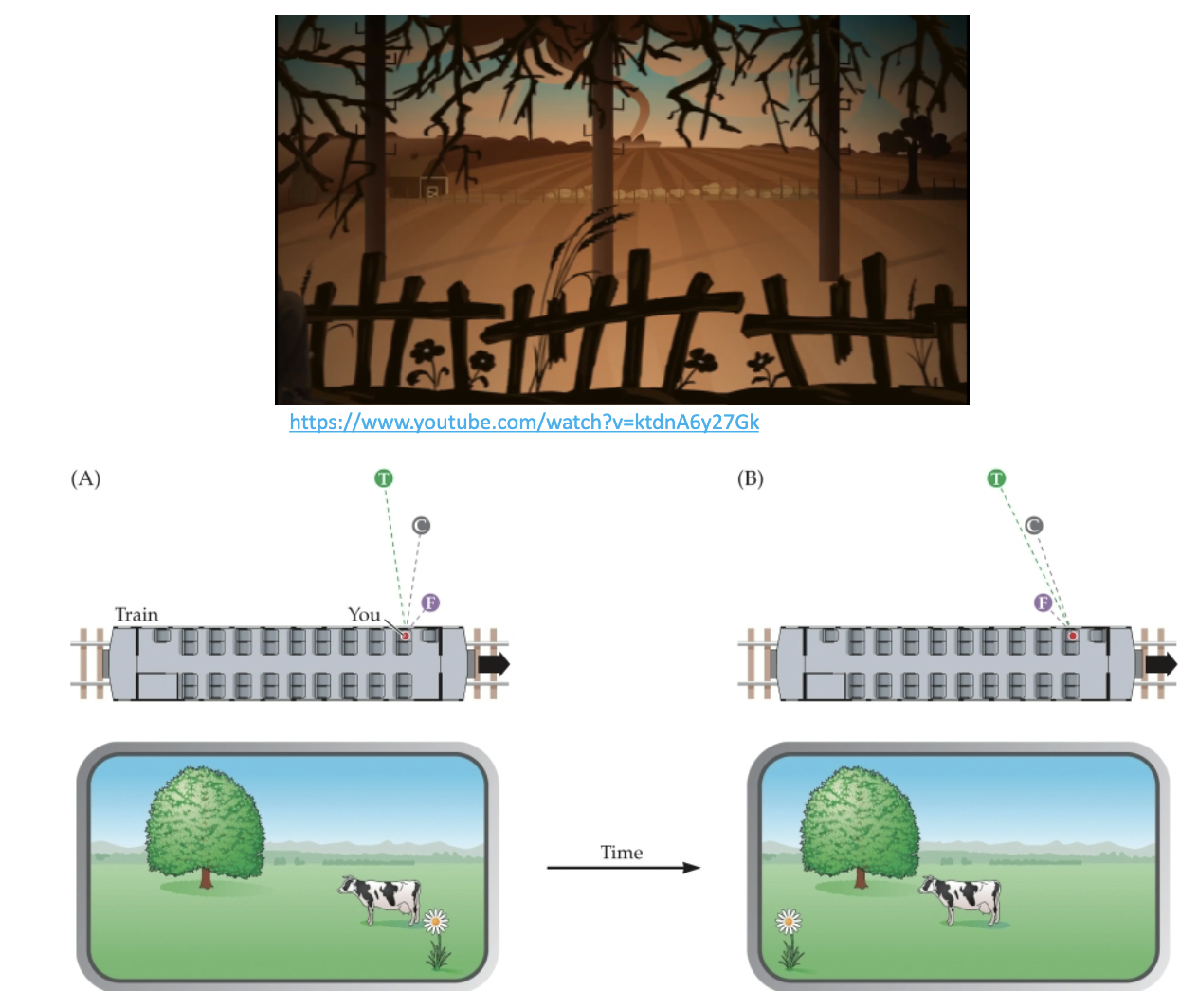
Depth from Motion – Dynamic Monocular Cues - Motion Parallax
Motion Parallax
• Occurs when an observer moves ? or ?, away from Optic Flow.
• Head movements and relative motion between objects reveal depth.
• Closer objects move slower/faster across the visual field than distant ones.
sideways. turns their head.
faster.
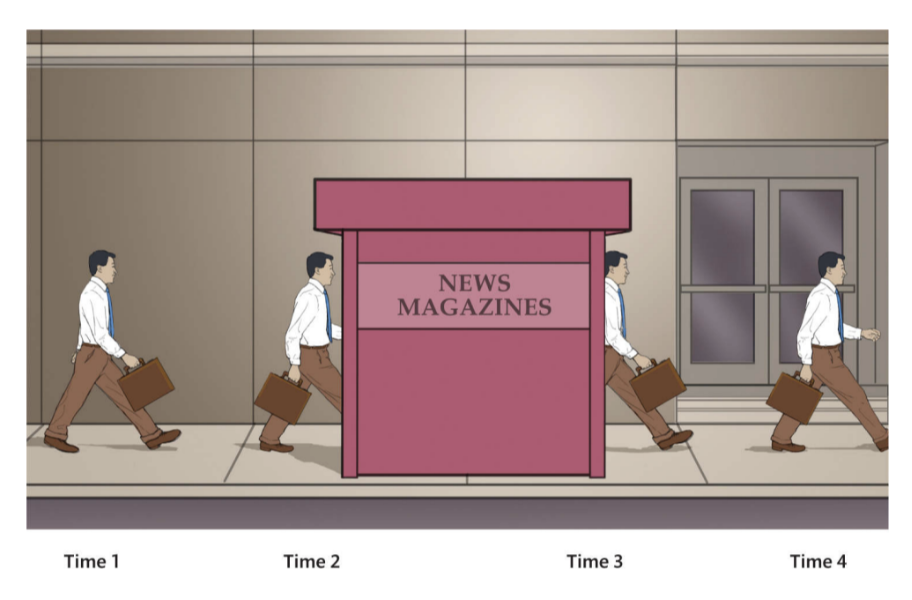
Depth from Motion – Dynamic Monocular Cues - Deletion & Accretion
Deletion & Accretion
• Deletion: An object is gradually covered/revealed as it is occluded.
• Accretion: An object is gradually covered/revealed as it emerges from behind another.
• Indicates how much distance separates objects based on the ? & extent of the __ process.
• Faster deletion/accretion suggests __ objects, while slower changes indicate ? distance.
covered.
revealed.
speed and covering/uncovering.
closer. greater.
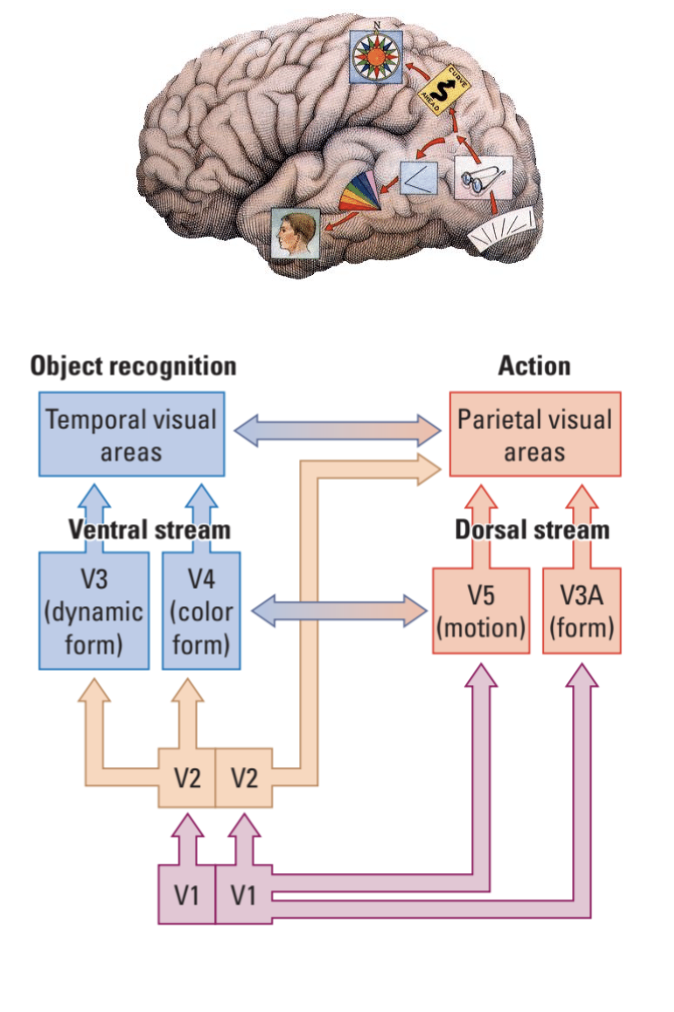
Binocular Vision
Binocular Vision – Static/Dynamic Depth Cues from two eyes.
• Nonmetrical – Specialized neurons in the __ pathway categorize depth by coding near vs. far relationships without precise measurements.
• Mostly Relative Metrical – ? cells in the __ pathway process disparity with precision finer than individual photoreceptor spacing, for exact depth calculations.
• Gives __ depth if paired with certain other cues.
Static.
Recall: The ventral pathway (often called the “what” pathway) runs toward the temporal lobe and is involved in object recognition.
Hyperacuity cells (detect very tiny differences between the two eye images). Recall: The dorsal pathway (the “where/how” pathway) runs toward the parietal lobe and is involved in: Spatial processing, Movement, and Visually guided actions.
Absolute.
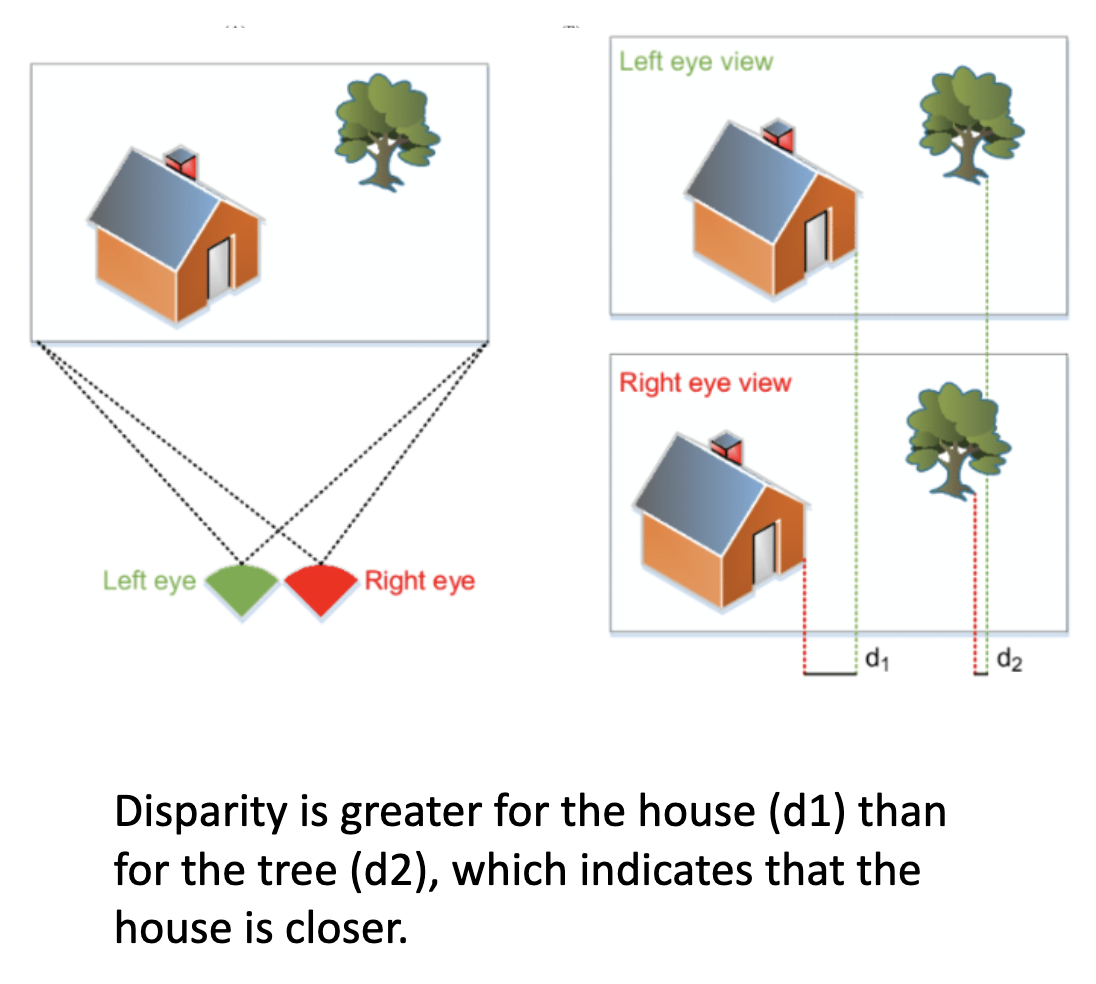
Binocular Disparity & Stereopsis
Binocular Disparity - Depth calculation based on degree of retinal disparity (imbalance) between the __.
• Greater disparity = closer/farther objects; smaller disparity = closer/farther objects. (Basically?)
• Provides relative depth, but combined with ? or ?, can yield absolute depth.
Stereopsis: ?
two eyes.
closer. farther. (Basically, If an object is close to you: The left and right eye images are more different. The object shifts position more between the two retinas. This creates large disparity. Your brain interprets: Large difference between the eyes = object is close. If an object is far away: The two eyes’ images are more similar. There’s small disparity. Your brain interprets: Small difference = object is far).
vergence (how much your eyes rotate inward to focus on something close) or familiar size.
Brain’s ability to vividly perceive depth using disparity, creating a strong 3D effect.
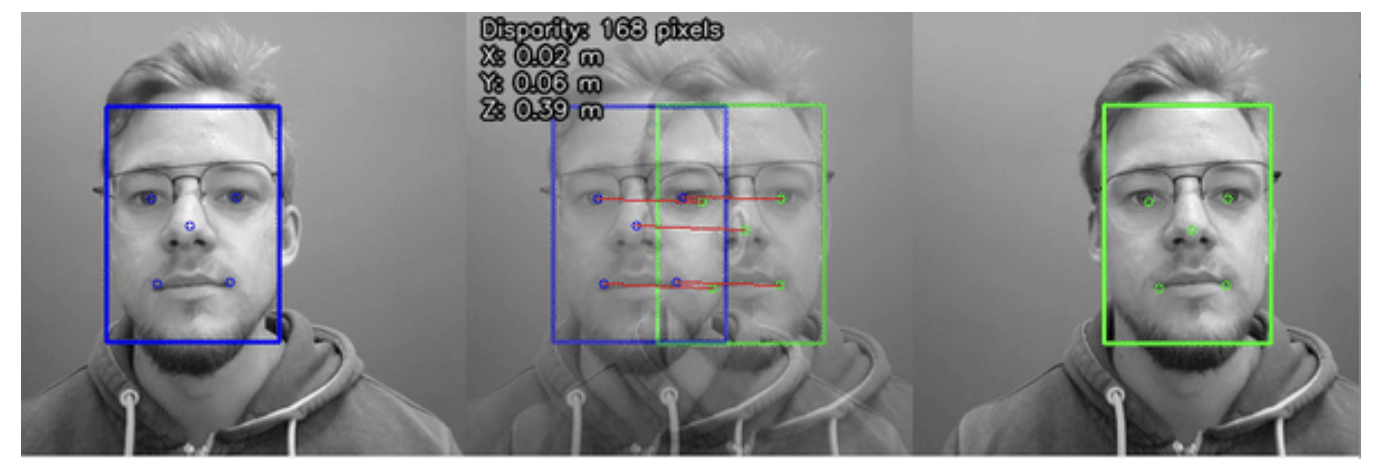
Virtual Binocular Disparity
(This is describing how machines simulate binocular disparity the same way your brain does — but using cameras instead of eyes.)
• This is virtual binocular disparity – on a special camera with __ lenses.
• The middle image represents the __, which highlights ?.
• The camera mimics how our brain processes disparity – matching points between __to reconstruct depth.
two.
computed disparity map. differences between the two eye’s perspectives.
two images.
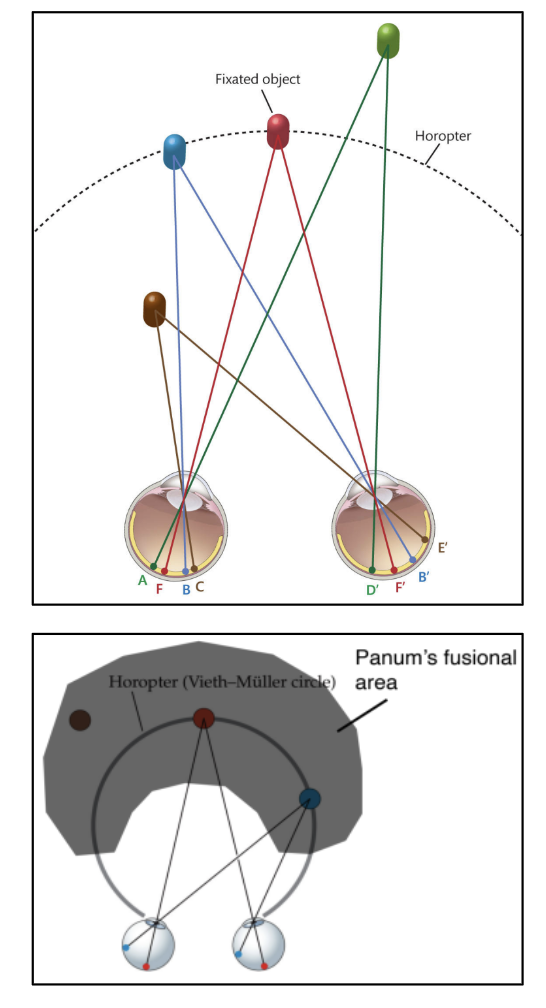
Binocular Disparity & the Horopter
Horopter: an __ that varies depending on biological factors. Has ? & ? Points.
• Objects ON the horopter fall on __ points, appearing at the same depth (no ?).
• Are seen as __ images when viewed with both eyes.
• Panum’s fusional area: ? (Basically?)
empirically measured curve. Corresponding & Noncorresponding.
corresponding. no disparity.
single.
The region of space, in front of and behind the horopter, within which binocular single vision is possible. (Basically, Even when an object is slightly off the horopter, the brain can often still fuse the two images into one. This region around the horopter is called Panum’s fusional area. It extends a little in front of and behind the horopter. Within this area, objects still appear as single images, not double, despite small disparities. Beyond Panum’s area: Disparity is too large. The brain can’t fuse the images. You see double vision (diplopia)).
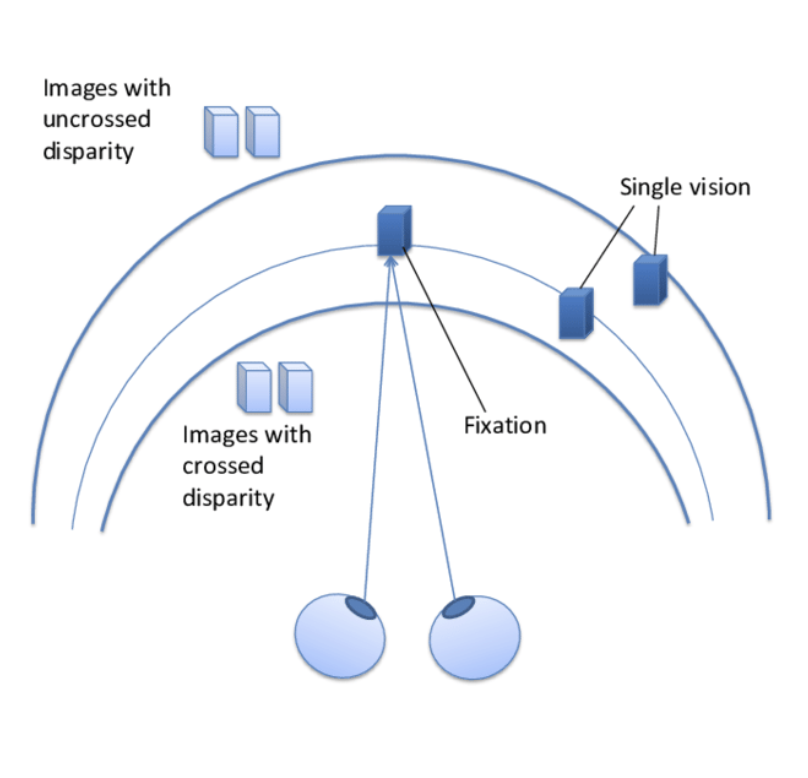
Binocular Disparity & Off the Horopter
• Objects off the horopter fall on corresponding/noncorresponding points, creating ?, which the brain uses for __.
• Greater disparity = closer/farther objects; smaller disparity = closer/farther objects.
• If visible in both eyes, stimuli falling outside of Panum’s fusional area will appear __.
• Diplopia: ?
noncorresponding. binocular disparity (2 images). stereopsis (depth perception).
closer. farther.
diplopic.
Double vision.
Binocular Disparity: 3 kinds
What are the 3 types of Disparity?
1. Zero disparity: object at horopter; no disparity.
2. Crossed disparity: objects in front of the horopter. Larger disparity for closer objects.
• Objects closer than the horopter shifted right in left eye, and left in right eye.
3. Uncrossed disparity: objects behind the horopter. Larger disparity for farther objects.
• Objects farther than horopter shifted left in left eye, shifted right in right eye.
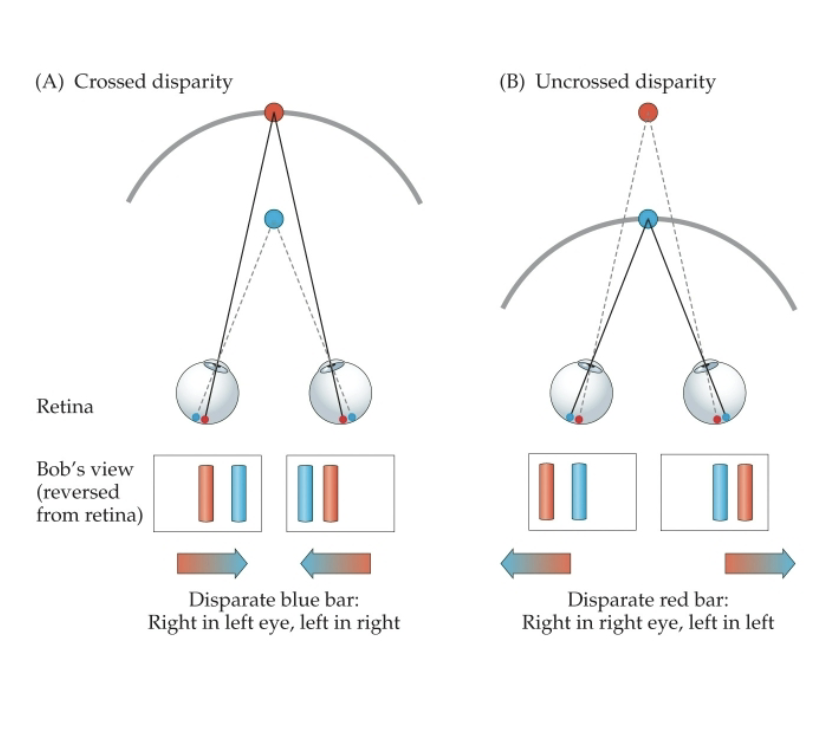
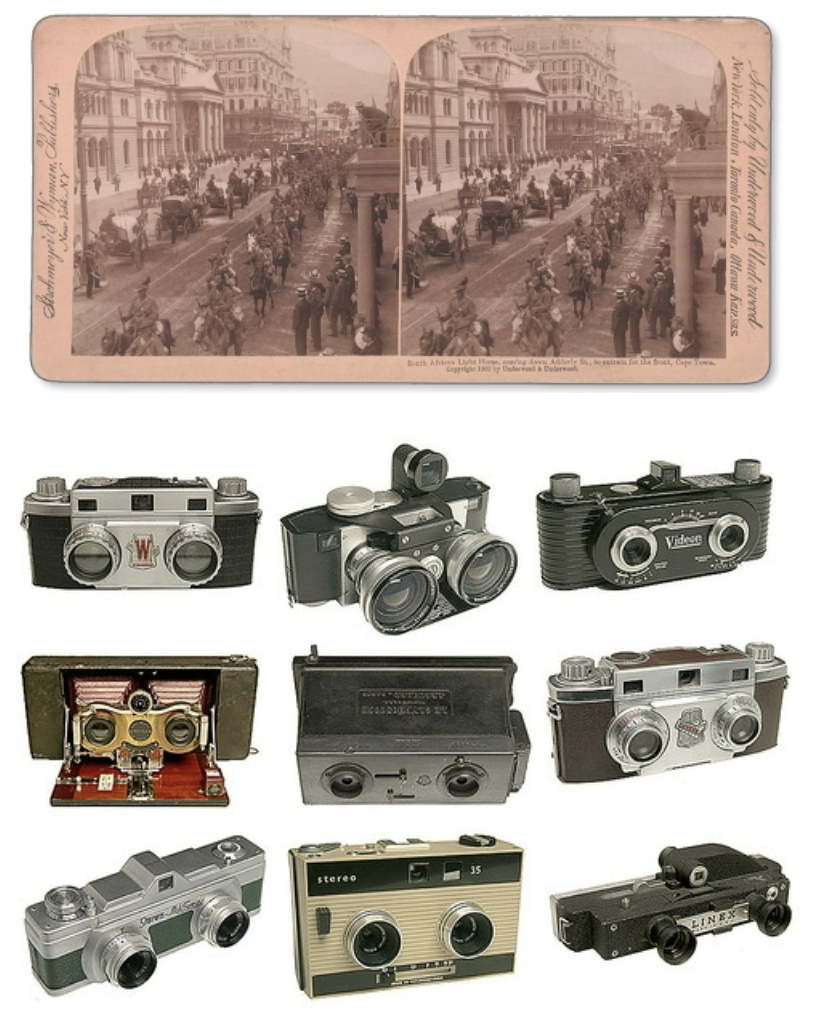
Binocular Disparity: Stereoscope
Stereoscope: Presents two 2D images that are slightly __ – one to each eye.
• Matches natural interocular distance to mimic __ vision.
• Images fall on corresponding/non-corresponding retinal points, creating ?.
• The brain fuses them into __, vivid depth from flat pictures.
• Foundation for ?, ?, & ?.
offset horizontally.
natural.
non-corresponding. binocular disparity.
stereopsis (the brain's ability to create a single, three-dimensional image by merging slightly different images received from each eye).
stereograms, VR, & free fusion.
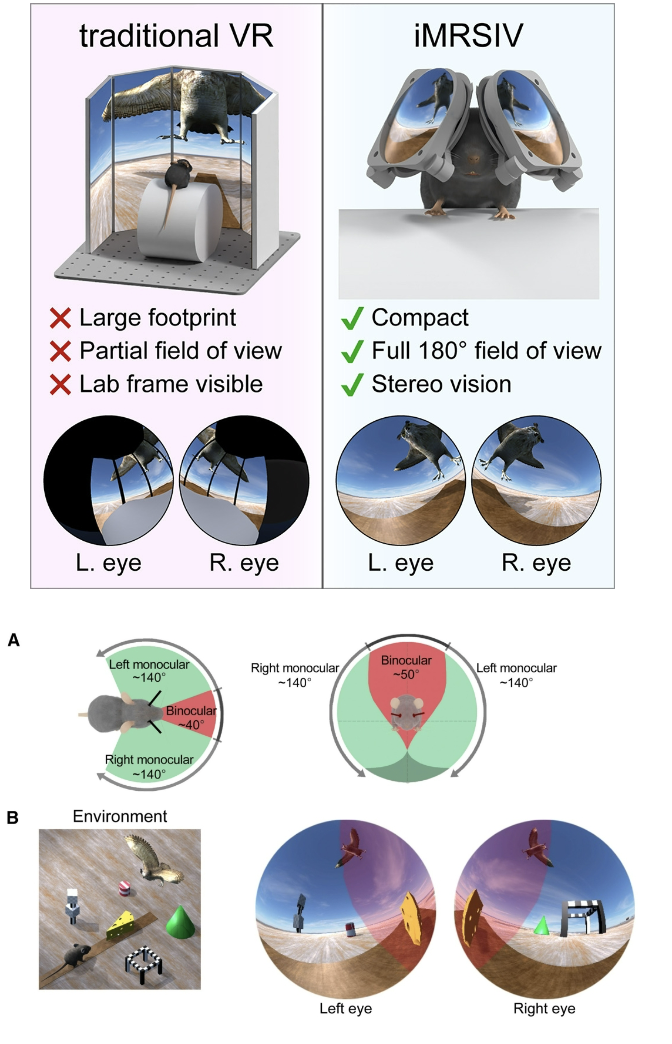
Modern Dynamic Stereoscope: Virtual Reality
Modern stereoscope = ? (Basically?)
• VR headsets present __, one to each eye.
• Uses __ rendering that updates with head movement.
• Combines binocular disparity with ? & ? cues for more realistic depth.
• Research tool for studying __ in humans & animals.
Virtual Reality. (Basically, means that today’s VR headsets work on the same basic visual principle as the 19th-century stereoscope — but in a far more advanced, dynamic way).
two slightly different images (A classic stereoscope (like those popular in the 1800s) showed two slightly different pictures, one to each eye. Because your eyes are about 6–7 cm apart, each eye naturally sees the world from a slightly different angle. Your brain compares these small differences — called binocular disparity — and interprets them as depth. Modern VR headsets do exactly the same thing: One screen (or part of a screen) per eye. Slightly offset images. Brain fuses them into a 3D scene. So at its core, VR = digital stereoscope).
dynamic.
motion parallax & vergence.
depth perception.
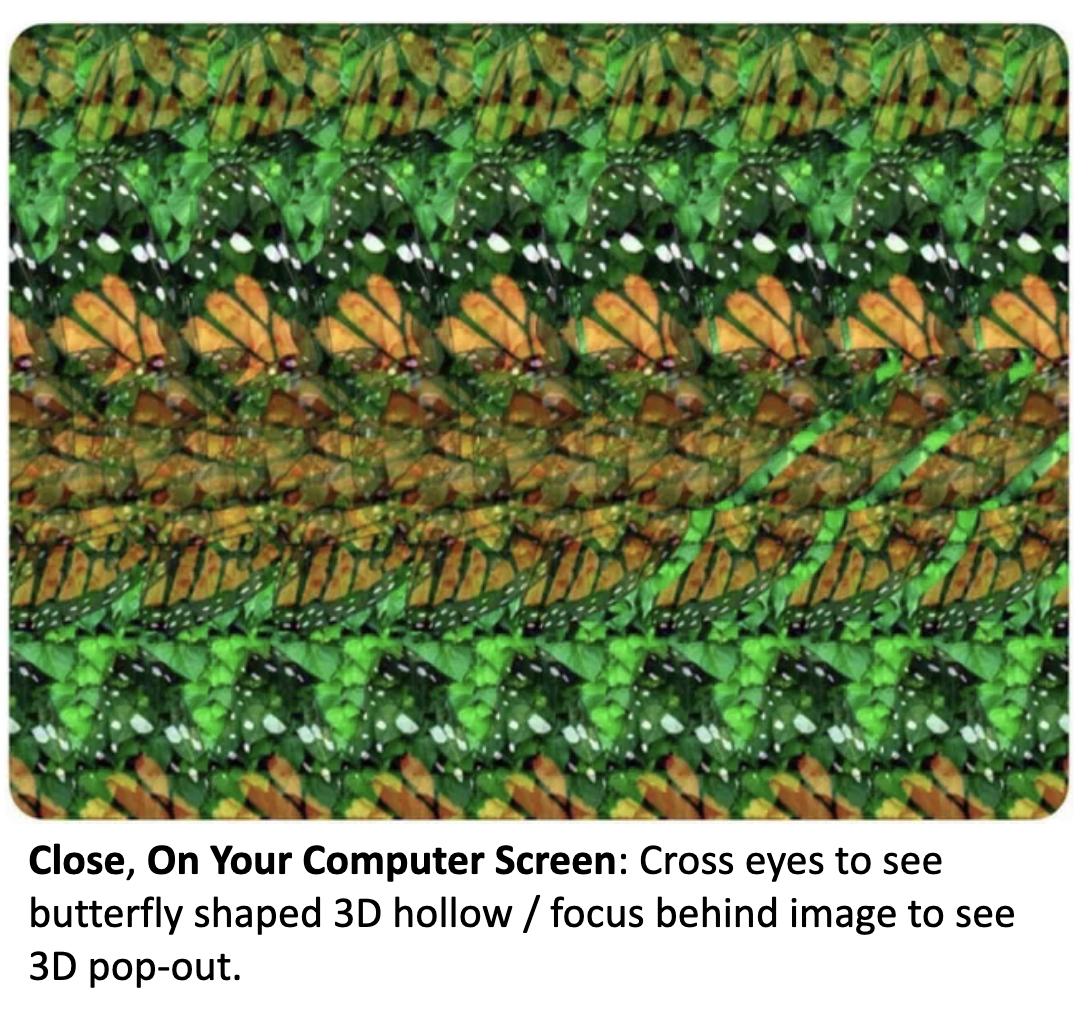
Binocular Disparity: Stereoscope
Free fusion: __ to view a stereogram without a stereoscope. (Basically?)
• Reveals how __ alone can drive depth perception.
“Magic Eye” – Relies on ? .
• Must Be Close! Relax eyes; focus in front of or behind the image.
• Longer directions & more examples at end.
converging (crossing) or diverging (uncrossing) the eyes. (Basically, A stereogram is an optical illusion that creates the perception of a three-dimensional (3D) image from a two-dimensional (2D) pattern. Free fusion means deliberately changing how your eyes aim in order to combine two flat images into one 3D percept — no stereoscope required).
binocular disparity.
free fusion.
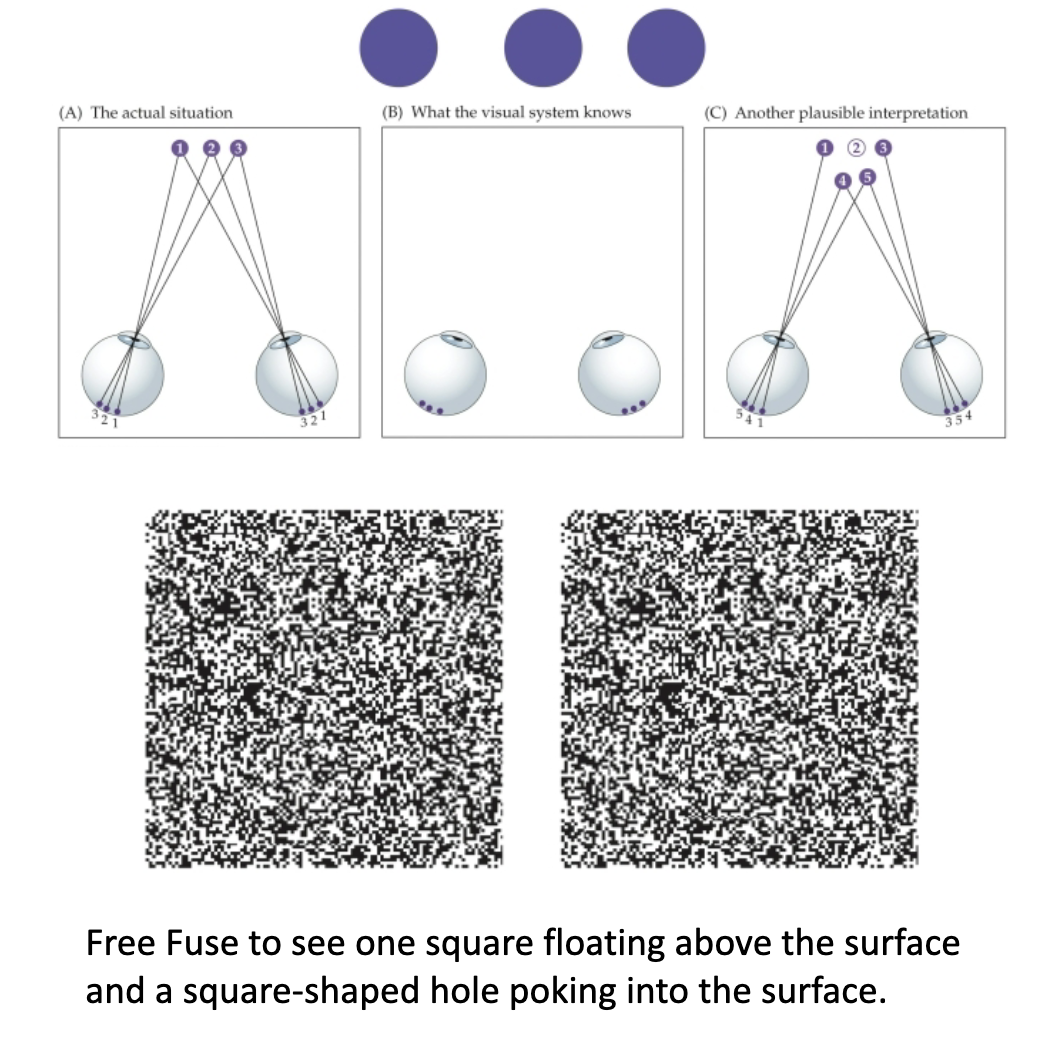
Binocular Vision: Correspondence Problem
Correspondence problem: which retinal points from left & right eyes should __?
↪ Ambiguous — same input can have __ matches.
Random dot stereograms (RDS): isolate __ without ?.
↪ Show stereopsis arises from __ alone, prior to ? .
match.
multiple.
(Basically, Imagine looking at a wall of identical dots. If: 100 dots appear in the left eye. 100 dots appear in the right eye. Which dot matches which? Many possible matches exist. The same visual input can produce multiple possible depth interpretations. This makes the problem ambiguous. If the brain matches the wrong points: Depth will be computed incorrectly. Objects may appear in the wrong place or at the wrong distance. So before depth can even be calculated, the brain must solve this matching puzzle.)
disparity. objects.
disparity. object recognition.
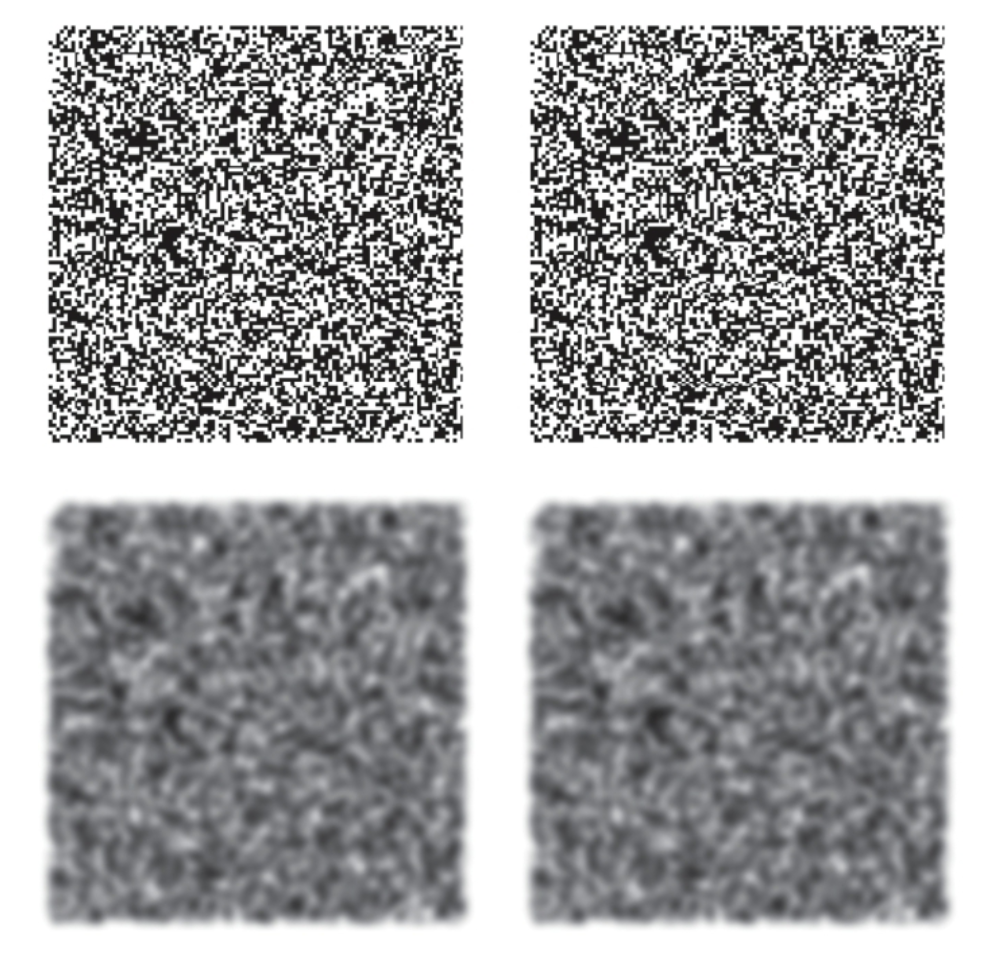
Binocular Vision: Solving Correspondence Problem
Visual system simplifies disparity matching using 3 key strategies:
(Basically, explains how the brain makes the correspondence problem manageable. Since there are many possible matches between the two eyes, the visual system applies simplifying rules (constraints) to narrow the options. Think of these as built-in assumptions that usually work well in the real world.)
• Low-frequency anchor: relies on coarse structures first, down-weighting fine detail (blur). (Basically, the brain first matches large, blurry structures, then refines with detail.)
• Uniqueness constraint: each feature matched only once.
• Continuity constraint: assume smooth depth except at object edges.
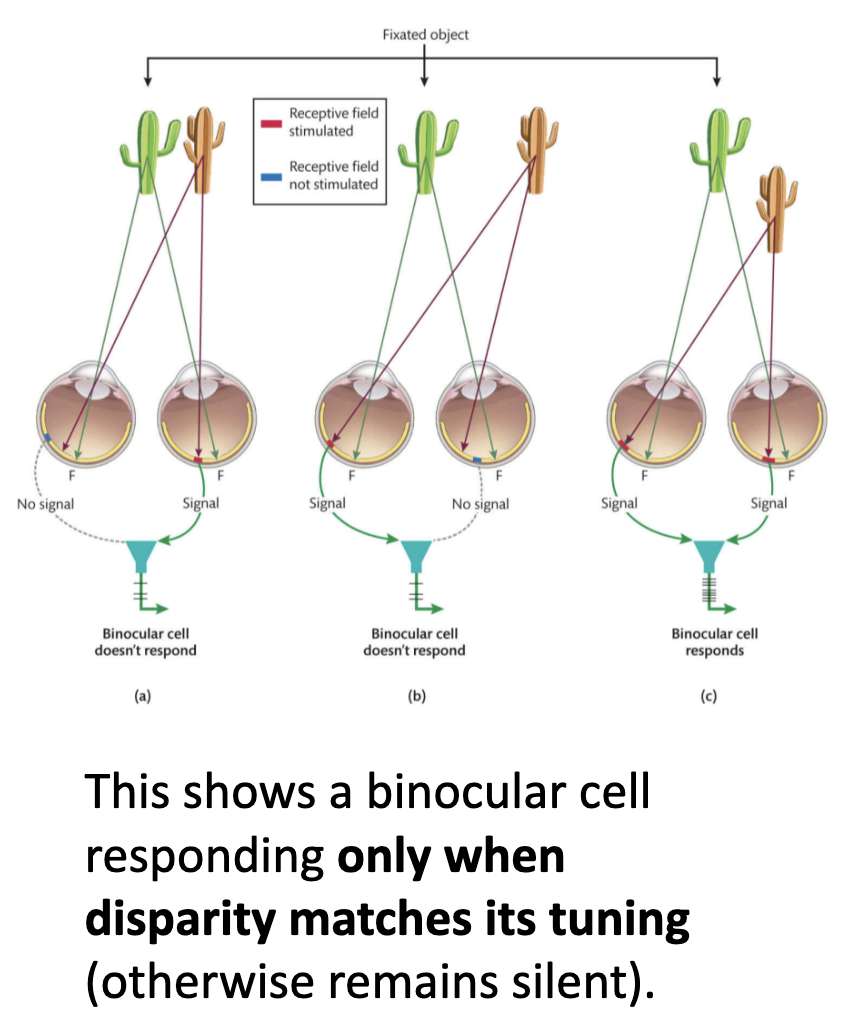
Binocular Disparity Neurons
How is stereopsis implemented in Brain?
• Researchers discovered (1970s) that certain neurons respond specifically to binocular disparity. These neurons were found in: ?
—> detect differences in object position between __ eyes (1977).
—> Individually tuned for both amount & type of __ (crossed vs. uncrossed).
↪ Only fire when retinal images have the __!
Disparity-detecting neurons found V1, V2, V3 and extends to dorsal stream (MT/V5, parietal lobe).
two.
disparity. (Basically, Some neurons respond best to: Small disparities (objects near fixation) or Large disparities (objects far in depth)).
right disparity!
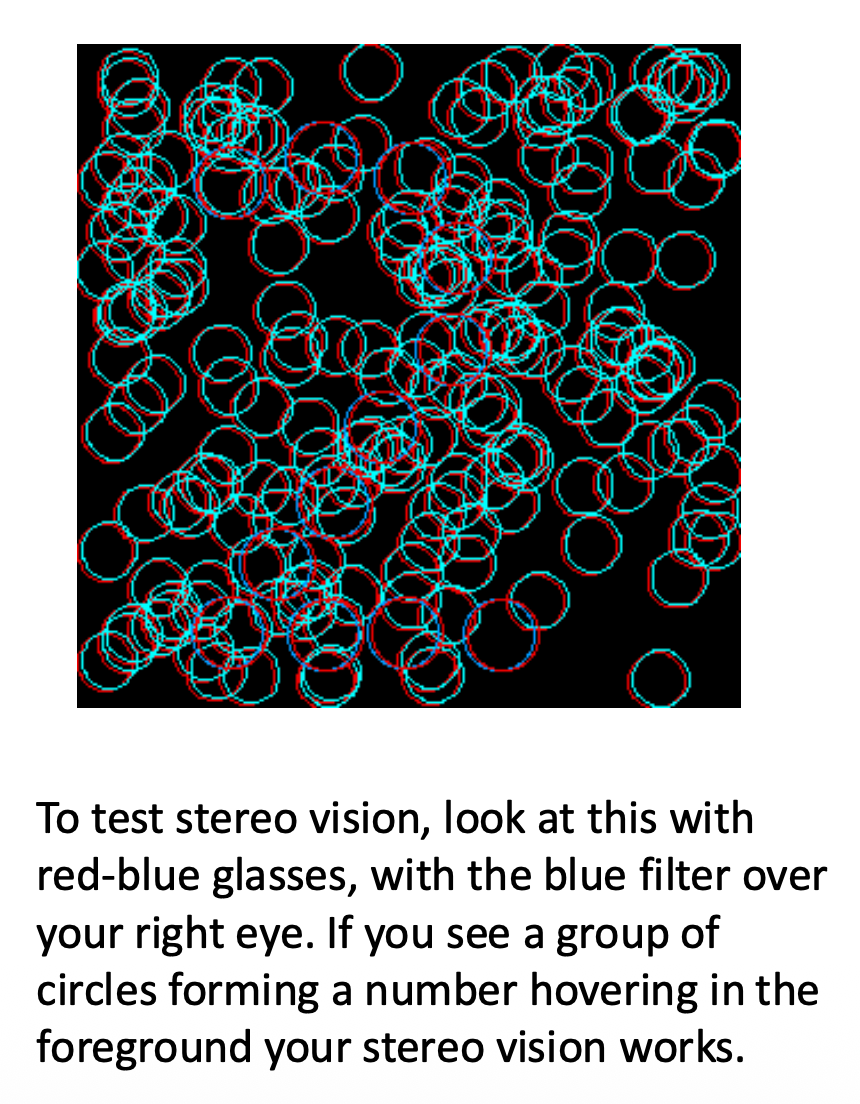
Development of Binocular Vision: Stereo Blindness
Stereo blindness: ?
• What percentage of the population has Stereo blindness?
• Free fusing does not give __, although in focus.
• Usually from __, such as ?.
• T/F: Most people who are stereo blind do not realize it. Not necessary for modern life.
An inability to make use of binocular disparity as a depth cue.
3-5%.
depth.
childhood visual disorder. strabismus (cross-eyed).
TRUE.
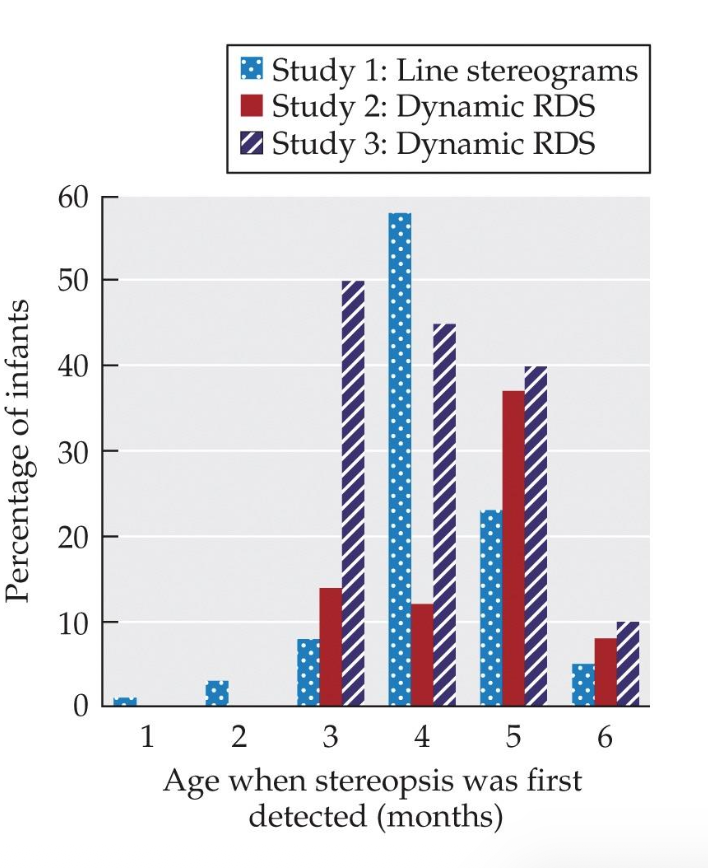
Development of Binocular Vision: Stereoacuity
Abnormal visual experience, especially during the __ period, can disrupt binocular vision.
?: A measure of the smallest binocular disparity that can generate a perception of depth.
• Shows up suddenly in infants 3 – 5 __.
• Stereoacuity is often tested using __ stimuli.
↪ T/F: Dichoptic Stimuli: Referring to the presentation of two stimuli, one to each eye.
critical.
Stereoacuity.
months.
dichoptic (One image is shown to the left eye. A slightly different image is shown to the right eye).
TRUE!
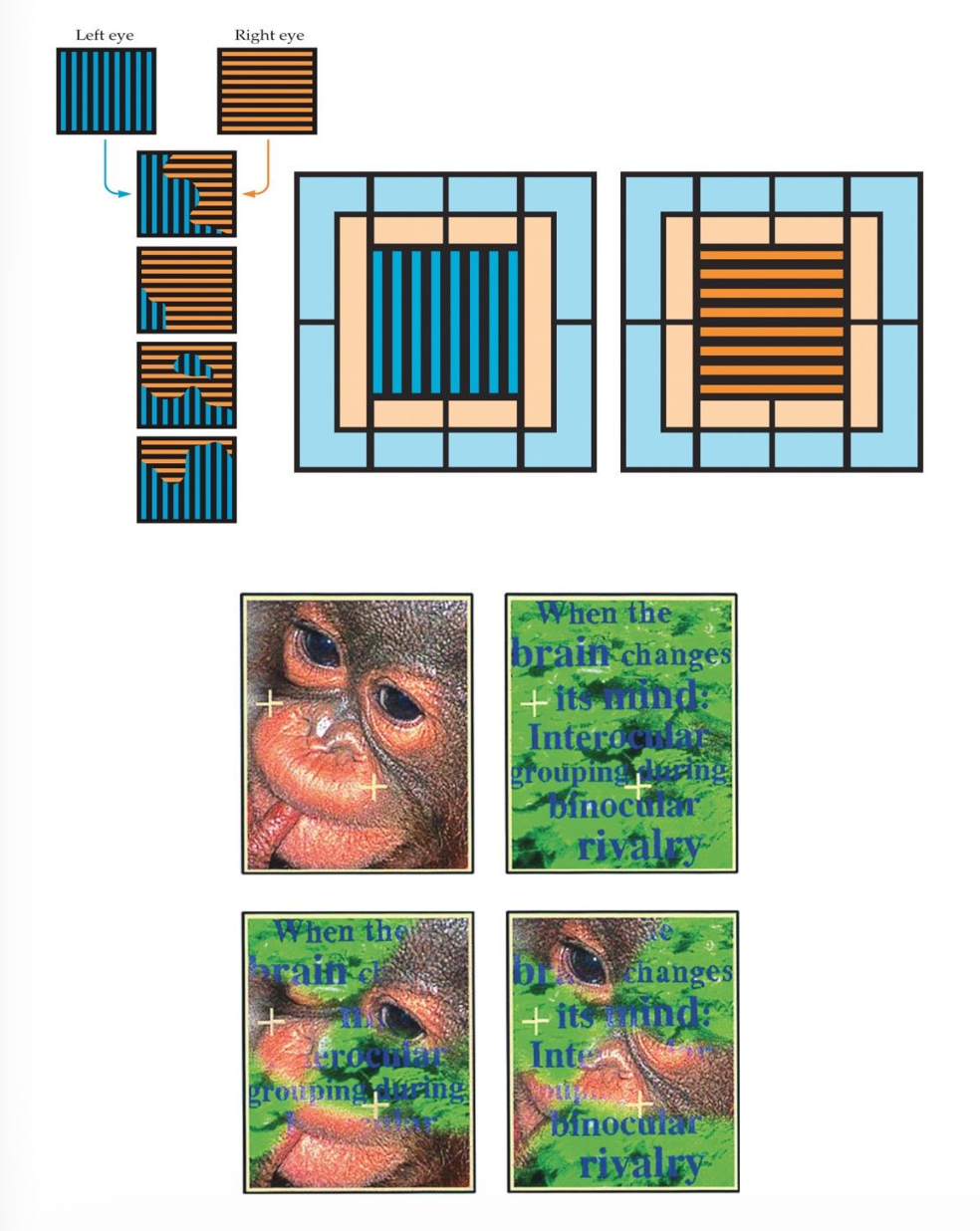
Development of Binocular Vision: Cooperation & Rivalry
Cooperation enables stereopsis/disrupt development, while rivalry can enables stereopsis/disrupt development.
• Binocular cooperation: ?
• Binocular rivalry: ?
• __: The stronger image is prioritized while the other is temporarily suppressed.
• In misaligned eyes, rivalry leads to __, affecting stereo vision.
enables stereopsis. disrupt development.
Both eyes normally work together to create a unified depth perception.
When each eye sees different images, perception alternates rather than merging. (Basically, Instead of merging, your perception switches back and forth. Example: one eye sees stripes, the other sees dots → you alternate between them).
Dominant eye effect.
chronic suppression. (Basically, Suppression stops double vision. But it also prevents proper 3D depth development. If your eyes cooperate, you get normal 3D vision—but if they compete (rivalry), the brain may ignore one eye, which can weaken or prevent depth perception).
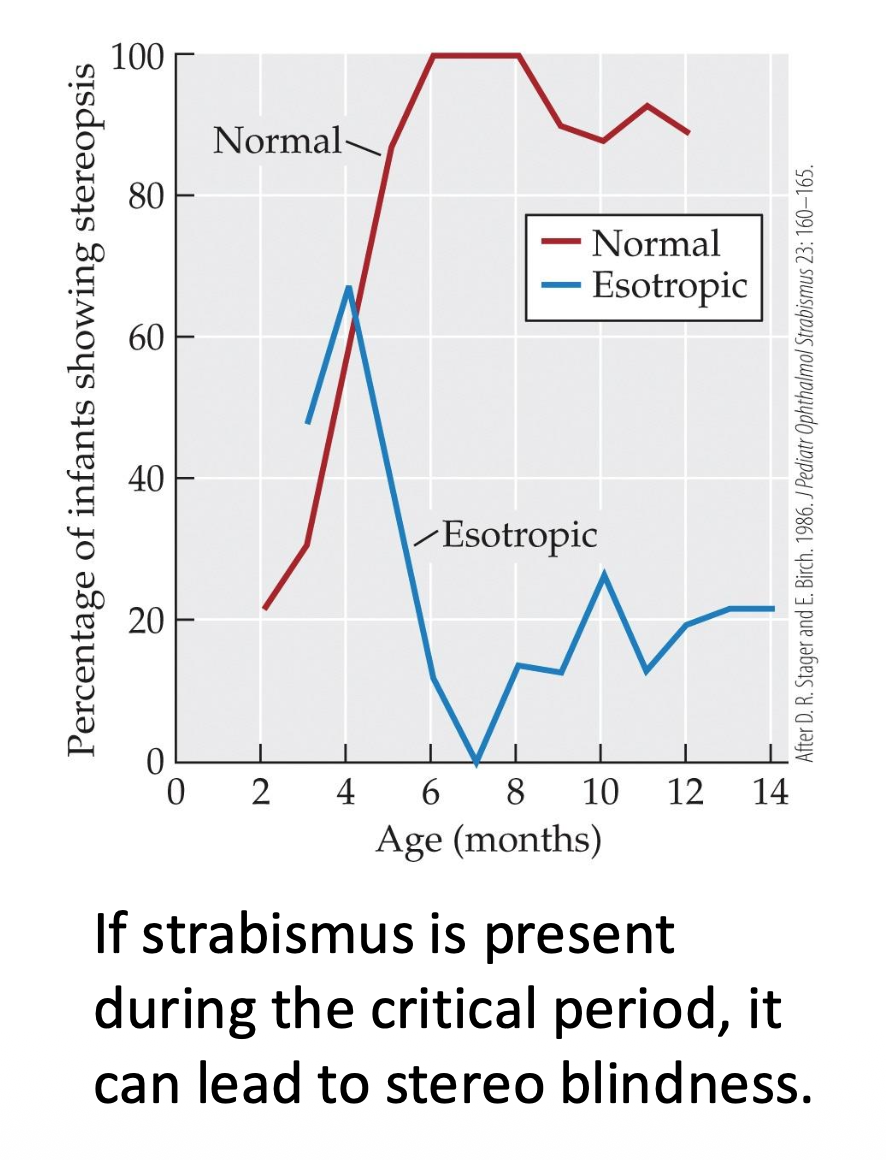
Development of Binocular Vision: Stabismus
Strabismus: A misalignment of the two eyes such that a single object in space is imaged on the fovea of one eye, and on a __ of the other (turned) eye.
What are the 2 types of Strabismus?
• Suppression: In vision, the __ of an unwanted image.
• __ blindness
non-foveal area.
• Esotropia: Strabismus in which one eye deviates inward.
• Exotropia: Strabismus in which one eye deviates outward.
inhibition. (Basically, The brain ignores the image from the misaligned eye. Prevents double vision. But also means one eye isn’t really being used).
Stereo. (Basically, is a visual condition in which a person cannot perceive depth using binocular (two-eye) vision. Without both eyes working together: The brain can’t develop proper 3D depth perception).
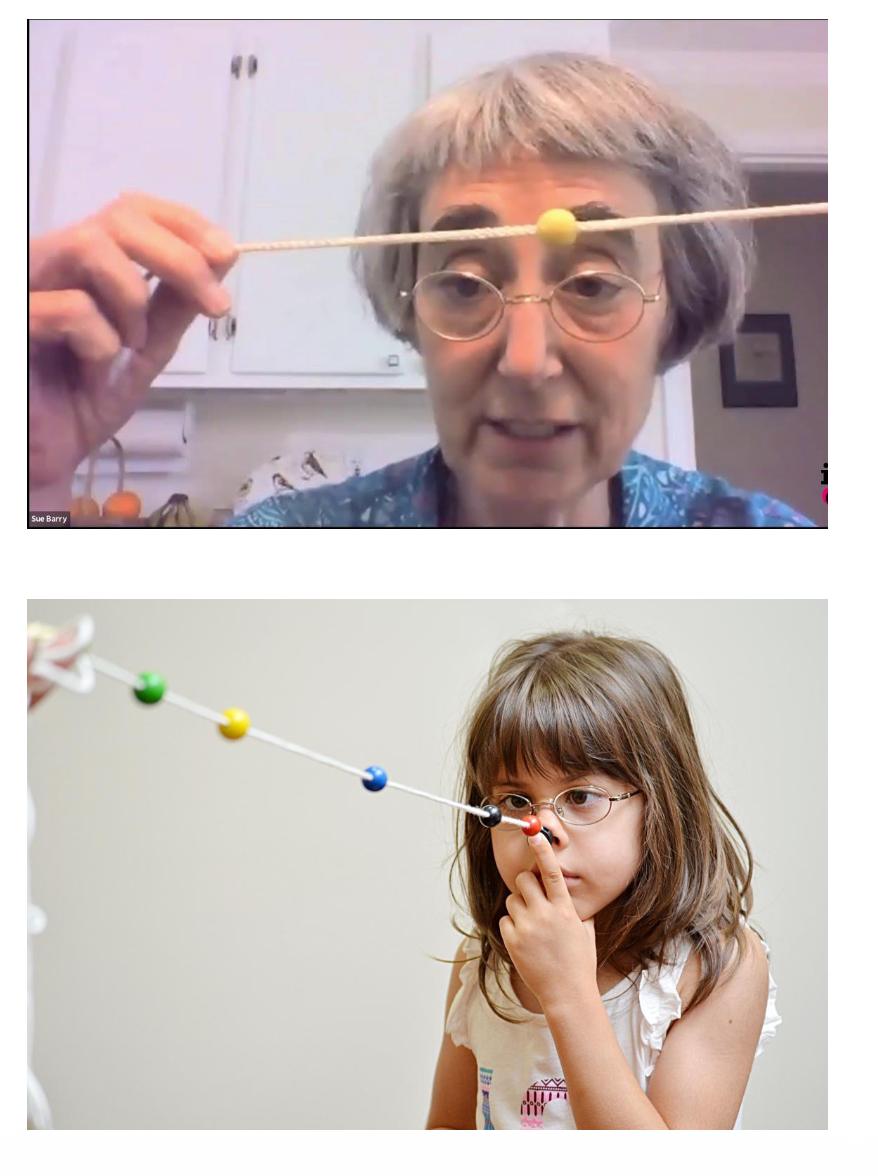
Development of Binocular Vision: Correcting Strabismus
Recovering stereo vision – Case Study
• Susan Barry was born with strabismus, preventing __.
• At age 48, she used __ to improve eye coordination.
• Unexpectedly developed __.
• Challenges idea that __
stereo vision.
Brock String exercises. (Basically, These are simple tools to train eyes to coordinate and focus together. Involves looking at beads on a string at different distances).
stereo vision.
binocular vision must develop in childhood.
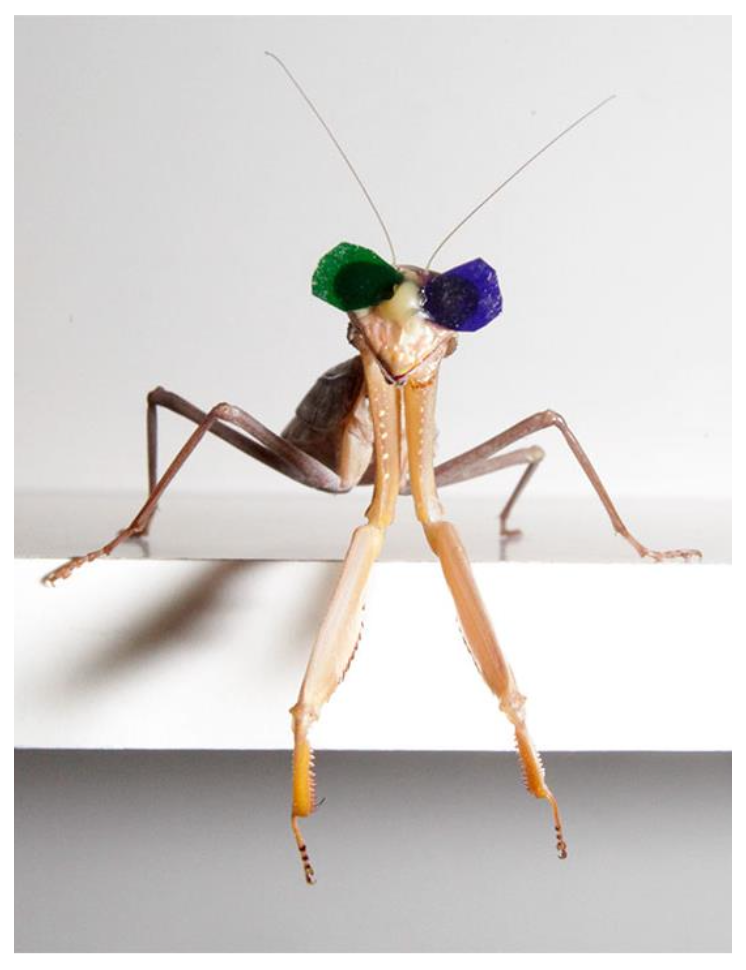
Stereopsis: Preying Mantises
Do hunting insects use Stereopsis?
• So far, we only know of 1 insect that uses stereopsis: __ (1983, 2016).
• Researchers tested mantises with tiny 3D anaglyphic glasses.
• 3D movies of bugs triggered __ at the correct depth (2 cm).
• __ movies did not elicit a response.
• Results: Mantises rely on __ to hunt moving prey (1983).
The Praying Mantis.
strikes.
2D.
stereoscopic vision.
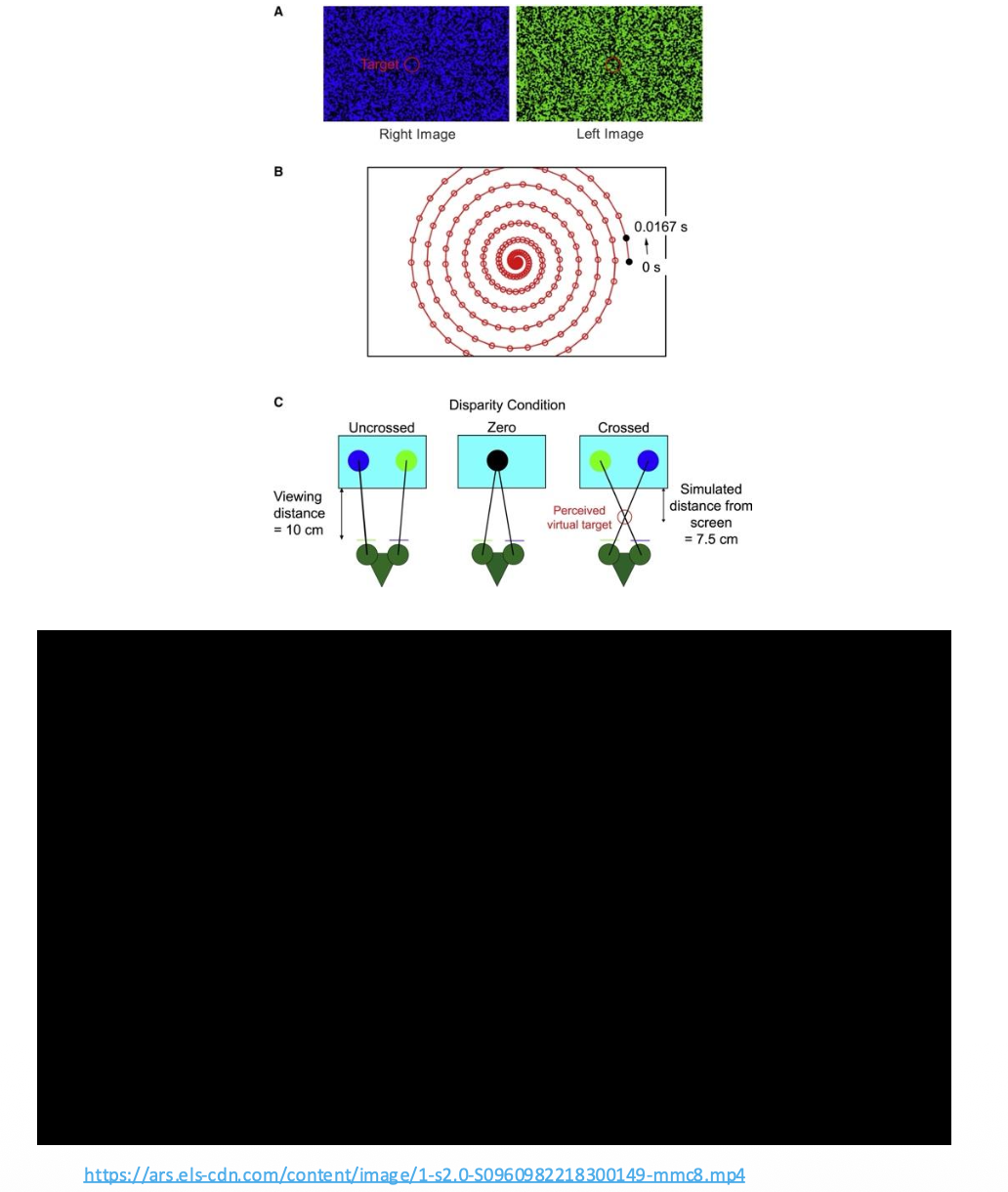
Stereopsis Comparative Study: Insects & Mollusks
Do they need an Object, though?
• Mantis stereopsis detects depth in __ without object recognition.
• Demos that __ precedes object recognition in vision in multiple species.
• However, Mantises rely on __ change across both eyes, unlike primates.
random-dot images.
Correspondence.
temporal.
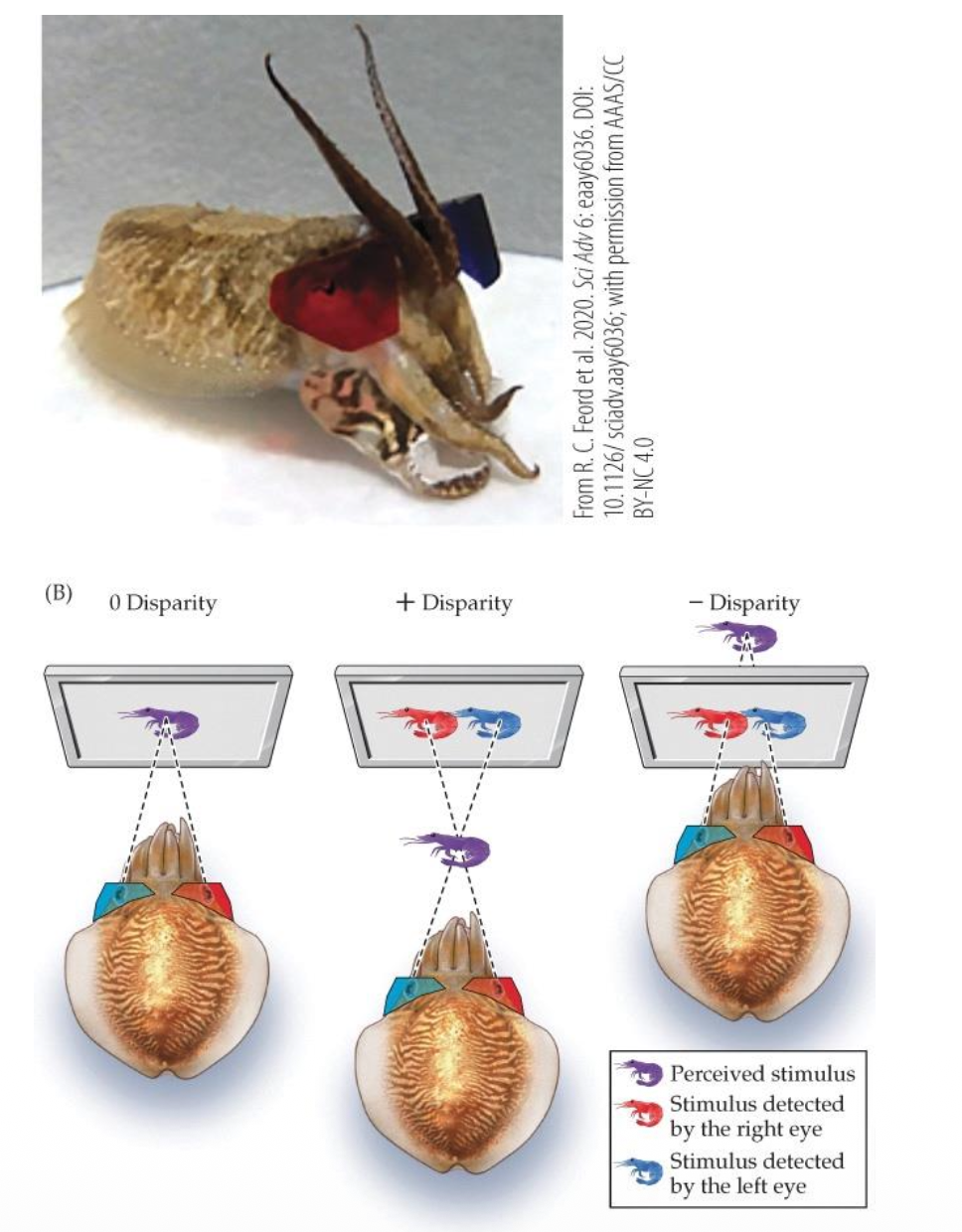
Stereopsis Comparative Study: Mollusks
Stereopsis in Hunting Marine Molluscs
• Cuttlefish tested for stereopsis by presenting cartoon shrimp at different depths.
↪ Using __, they strike at the correct perceived distance.
↪ Hunting differs from mantises, which wait for prey to enter range.
↪ T/F: Cones differ from mantises, need to use red-blue anaglyphic glasses (basically, to test binocular disparity, each eye must see a slightly different image. Red-blue anaglyphs allow researchers to send different images to each eye, isolating stereopsis).
disparity.
TRUE!
Combining Depth Cues: Perceptual Committees
Depth perception: multiple __ working together.
• T/F: One cue dominates all.
• Additional cues enhance ? & ?.
• The visual system automatically integrates cues, sometimes leading to __.
• __ often arise from perceptual committees resolving ambiguity.
cues.
FALSE! No cue dominates all.
accuracy & reliability.
errors.
Illusions.
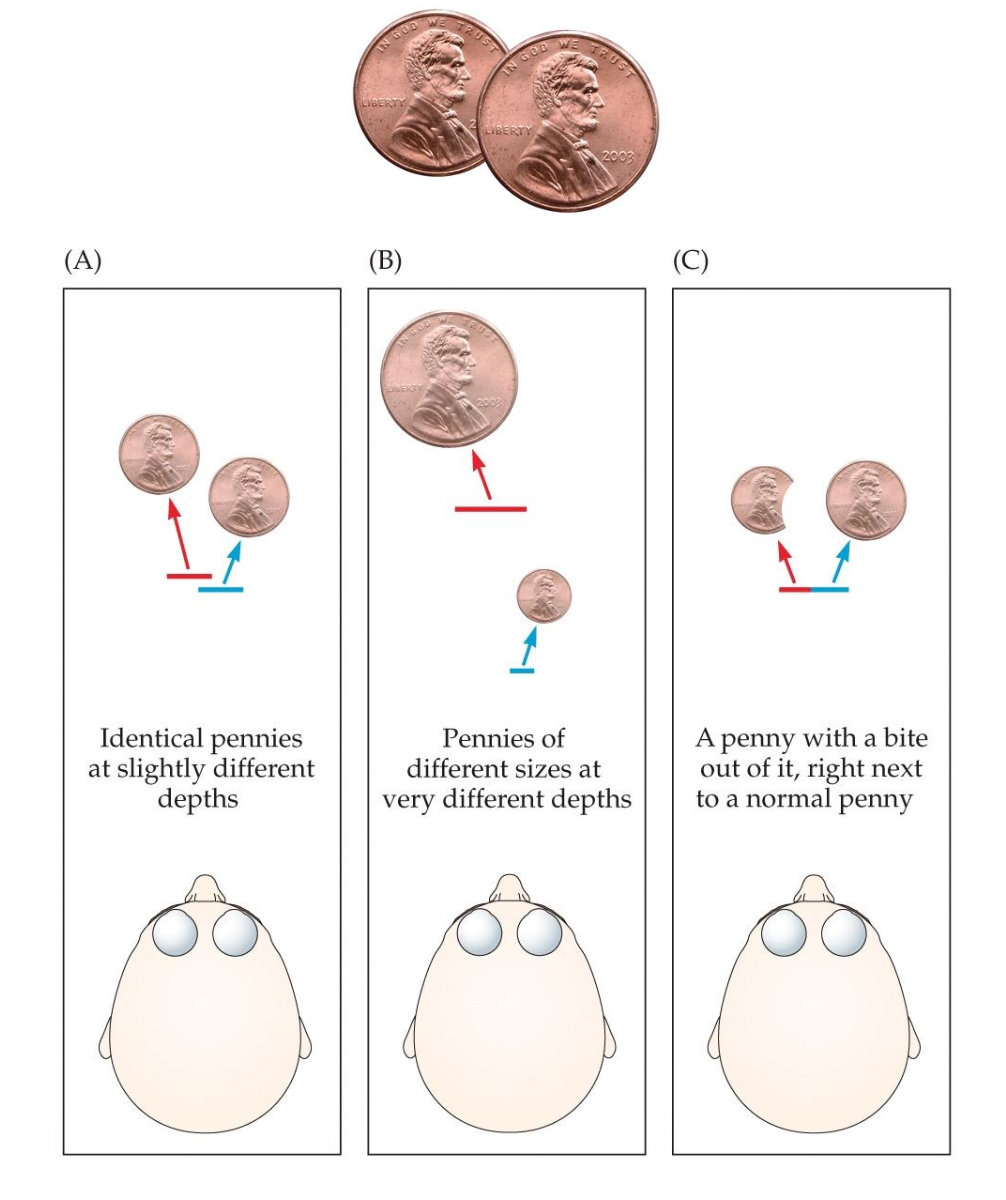
Combining Depth Cues: Perceptual Committees
Depth perception combines sensory input with __.
The __ explains how we estimate probability in depth perception.
T/F: Our brains favor the most likely interpretation of ambiguous depth cues.
__ influences whether we perceive depth accurately or see illusions.
prior knowledge. (Basically, Think of it like a committee: Sensory cues = committee members presenting evidence. Prior knowledge = committee members sharing past experience).
Bayesian approach. (Basically, Chooses the most likely explanation based on both evidence (current cues) and prior knowledge).
TRUE!
Prior experience.
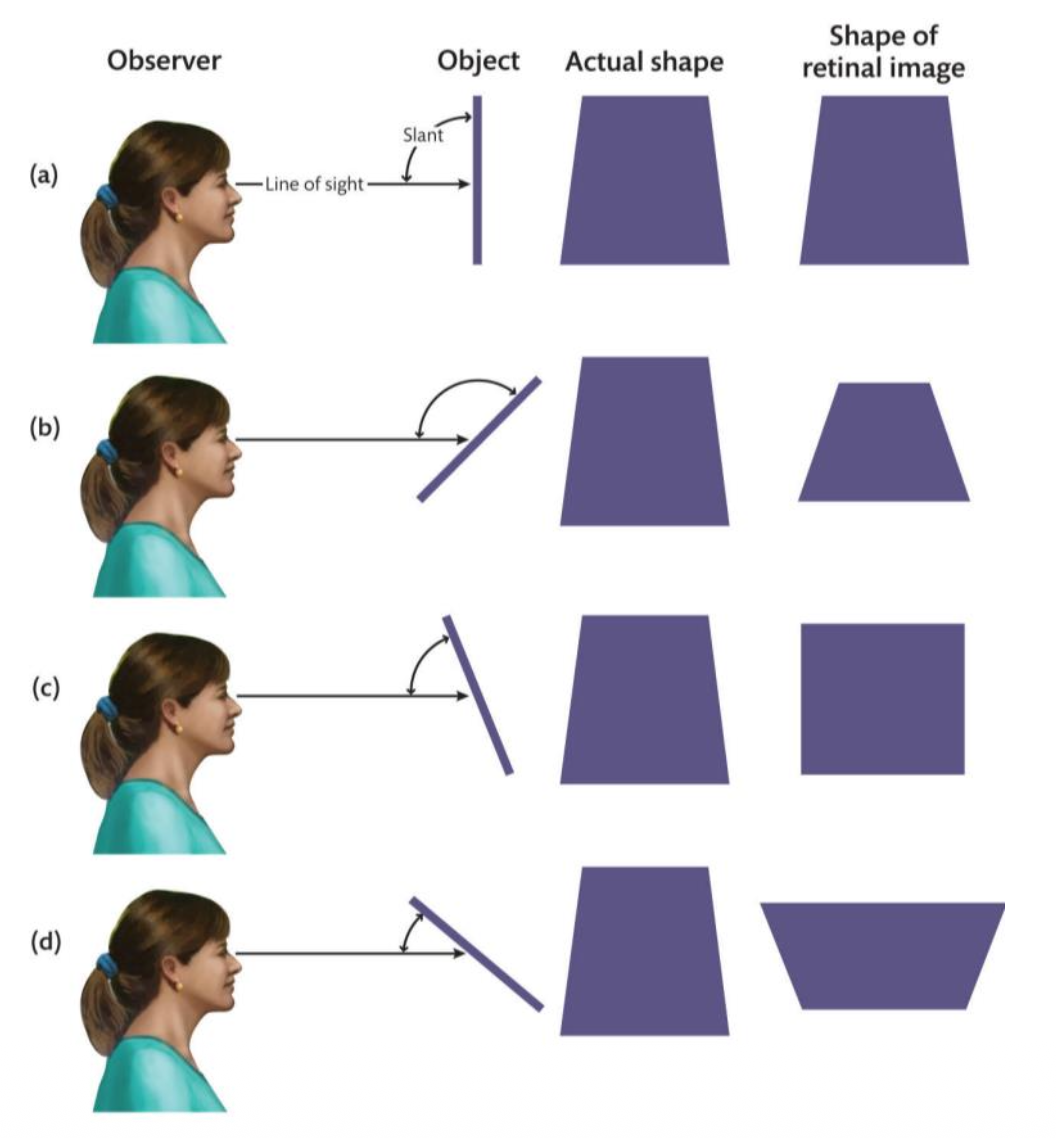
Perceptual Committee Goals: Constancy
Size Constancy: __ remains stable, even as distance (retinal image size) varies.
• Perceived size & perceived distance related.
Shape Constancy: __ remains stable, even retinal image shape varies.
• Shape-Slant Invariance: Shape perception adjusts based on __ cues.
• T/F: Without these constancies, objects would seem to change size and shape as they move.
Object size. (Basically, A car driving away looks smaller on your retina, but you know it’s still the same car, not shrinking).
Object shape. (Basically, A door viewed from the side looks like a skinny rectangle on your retina, but you perceive it as a full door).
slant.
TRUE.
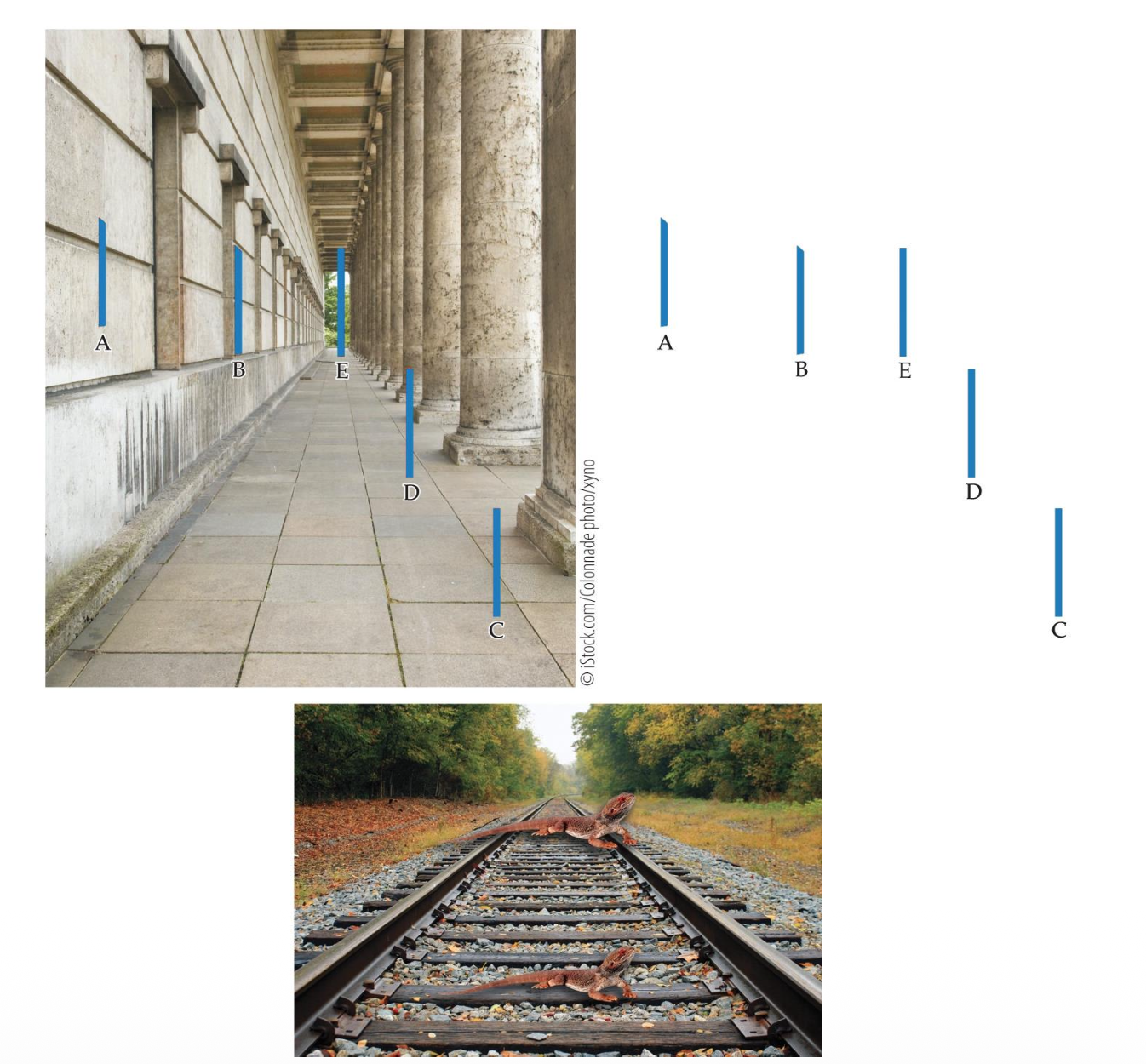
Combining Depth Cues: Illusions
Ponzo Illusion
• Linear perspective: converging lines mimic depth (railroad tracks, roads).
• Relative height & size: higher objects seem farther away.
• Texture gradients: fine detail fades into distance.
• Brain interprets upper bar as closer/farther → must be smaller/larger in reality.
(Basically, The upper bar is interpreted as farther away because of converging lines and height cues. But both bars have the same retinal size. Brain concludes: “If the upper bar is farther, it must be larger in reality” → it appears bigger. Big takeaway: The Ponzo illusion shows that your brain combines multiple depth cues automatically—sometimes leading to misperceptions).
farther. larger.
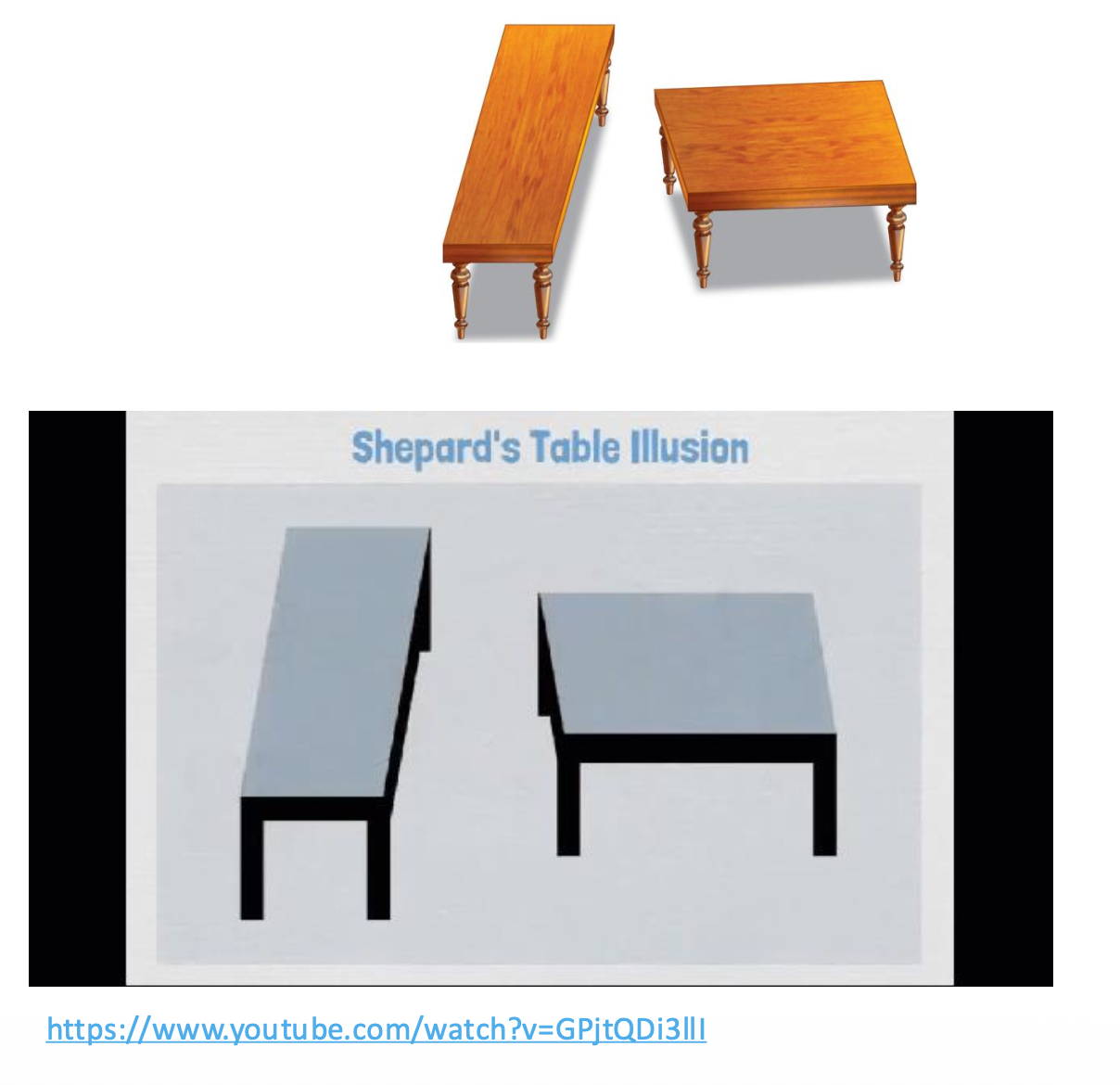
Combining Depth Cues: Illusions
Shepard’s Tabletop Illusion
• Two identical/different tabletops drawn with different depth cues.
• Perspective & foreshortening: angles suggest different depths.
• Size constancy: brain expects real proportions in 3D.
• Top surfaces appear stretched or compressed, though they’re the same.
identical.
(Basically, The illusion shows how your brain automatically combines multiple depth cues. When cues suggest contradictory shapes, the brain’s “best guess” can distort perceived size or shape).
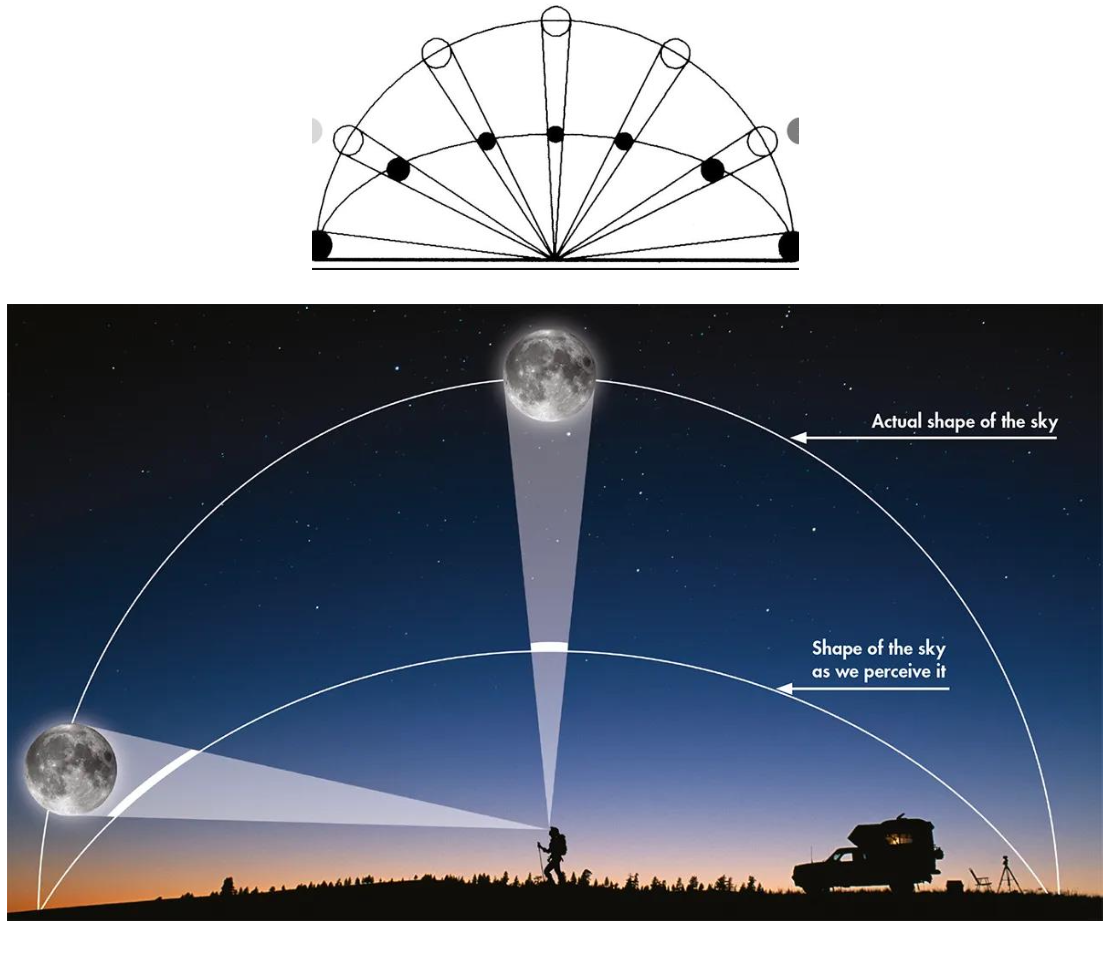
Combining Depth Cues: Illusions
Moon Zenith vs at Horizon
• Moon appears larger on __.
↪ Not caused by atmosphere – caused by __.
• Familiar objects provide size comparisons at horizon.
• Overhead moon lacks __ + flattened-sky effect.
• Shows how ? & ? cues shape perception.
horizon. (Important: it’s not actually bigger—it’s a perception trick).
spatial interpretation.
reference points. (Basically, When the Moon is high in the sky: There are no nearby objects to compare it to. The sky looks like a flat dome (called the “flattened sky” effect). Objects compared to surroundings affect perceived size: Horizon Moon = compared to buildings → looks huge. Overhead Moon = nothing to compare → looks smaller)).
size constancy & relative size.
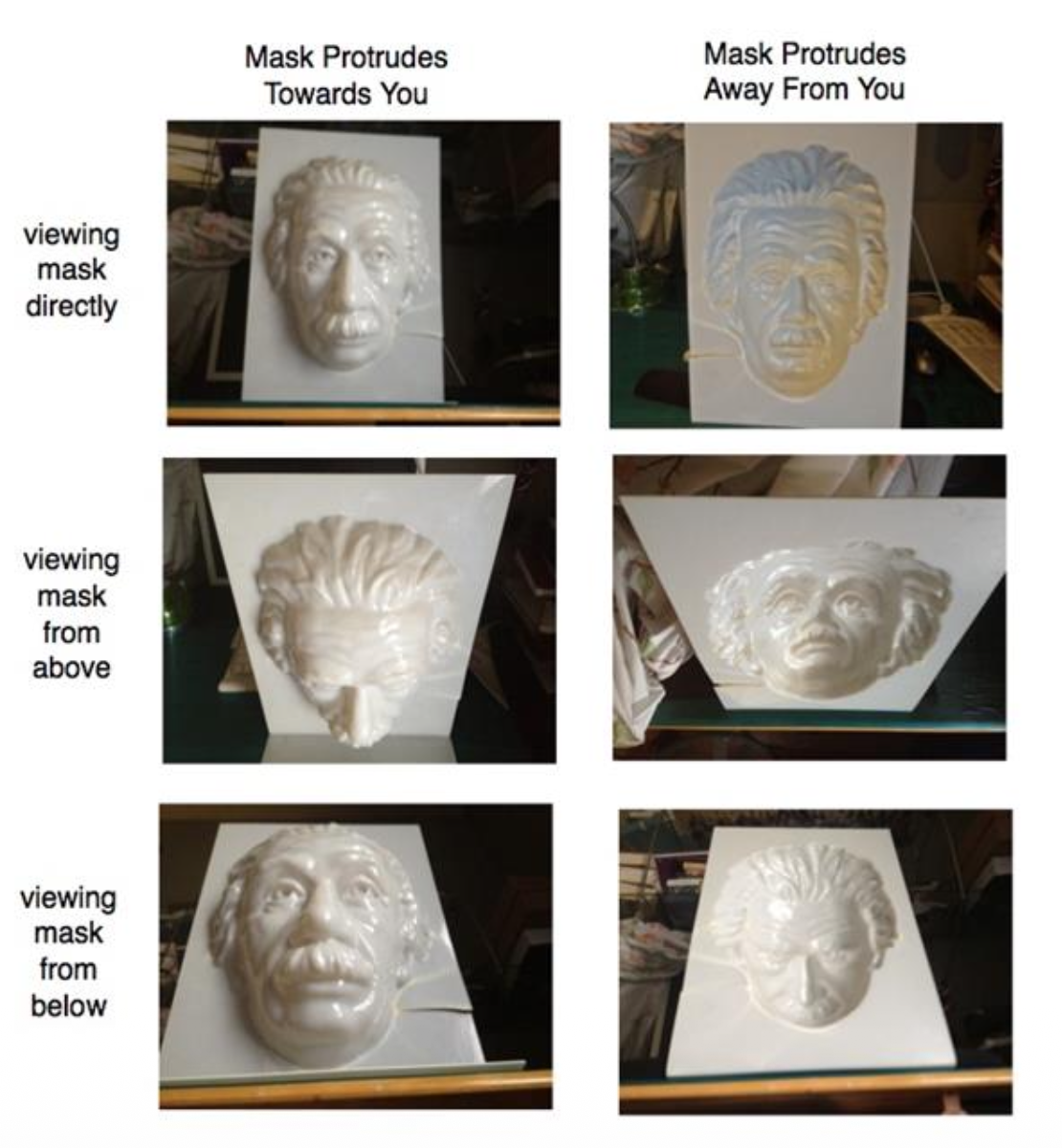
Combining Depth Cues: Illusions
Hollow Face Illusion
• A concave mask appears __.
• __ cues conflict with depth perception.
• The brain resolves ambiguity in favor of __ 3D Facial structure.
• Drunk, high, or schizophrenic? Probably won’t see the illusion/will see the illusion clearer.
convex (protruding outwards).
Lighting.
familiar.
won’t see the illusion.

