Social Psychology - Lecture 8
 Call Kai
 Learn
Learn Practice Test
 Spaced Repetition
 Match
Match Flashcards
 Knowt Play
1/37

There's no tags or description
Looks like no tags are added yet.
Name | Mastery | Learn | Test | Matching | Spaced | Call with Kai |
|---|
No analytics yet
Send a link to your students to track their progress
38 Terms
medium
• anything that humans use in order to communicate some kind of message facilitated by some type of technology, other than interactions
4 elements that determine emergence of mass medium
Purpose of, or need for, communication
Technology for public communication
Social organization for production and distribution
Governance in “the public interest”
What has more influence: the medium or the message?
• medium is the message → medium has as much influence as message/information
What are hot and cold media?
• cold medium (e.g. telephone): not informationally rich → you need to add a lot in your head
• hot medium (e.g. TV): almost overwhelmed by amount of information that is provided to you → makes you more passive than when receiving message via cold medium
Why is there more extreme behavior online, both positive and negative? (3)
• lack of visibility: non-verbal cues, eye contact, effects of negative behavior
• anonymity
• opportunity
What is the shift from the literary mind to the online mind?
• literary mind: deep concentration, logical argumentation, …
• online mind: skimming (F-reading), permanently distracted, no coherence
How do we relate to Google?
• consider it to be part of our cognitive system → misattribution of knowledge & overconfidence: people tend to think that they already had knowledge they were looking for and overestimate future performance
What are the effects of using Google as an external memory system? (3)
• could forgo remembering things “ourselves”
• would need to prioritize remembering where we can retrieve information (as opposed to actual info itself)
• would have more capacity left for creative problem solving
thin ideal
• association of thin with good → misrepresentation on TV
What are the effects of exposure to idealized images on self-perception?
• detrimental effect on self-perception
→ exposure to thin media related to perception of thin ideas as desirable and achievable
→ small effects on body satisfaction, internalisation, eating behavior
What is the cycle of the effects of the thin ideal on self-perception?
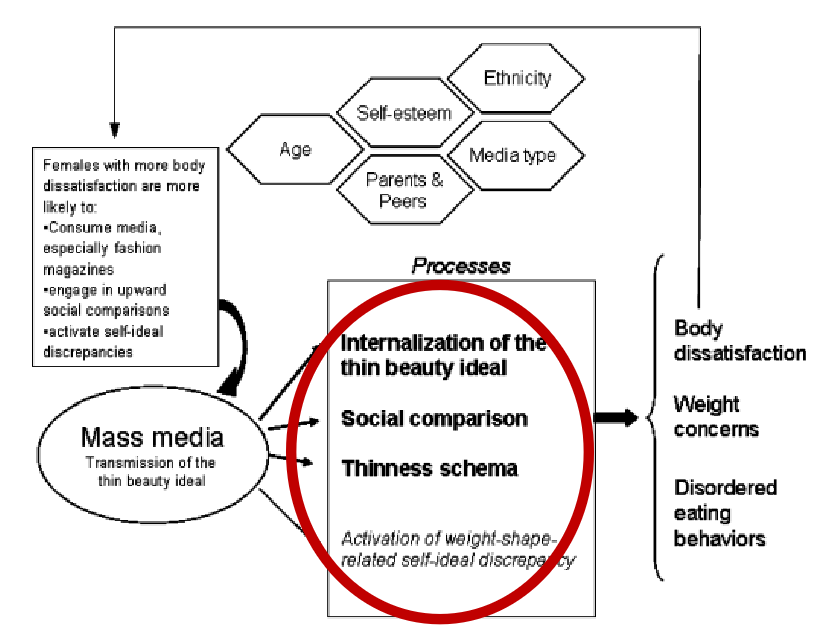
What is the overall effect of upwards social comparisons on body image and self-esteem?
• overall negative effects on body image and self-esteem, supposedly as result of contrast effects
self-discrepancy theory
• difference between person we think we are (actual self) and personal standard based on ideal self (based on hopes, wishes, aspirations) and/or ought self (based on obligations, responsibilities)
• comparisons between actual and “possible” selves drives self-regulatory behavior
What is the effect of female-objectifying videos on ideal body weight and actual-ideal discrepancy
• occurs only in women who score low on self-esteem
How can we counteract the effects of female-objectifying videos on ideal body weight and actual-ideal discrepancy?(4)
• more knowledge about influencing seems to be related to weaker impact of idealized images
• but: warning messages don’t seem to have any/even opposite effect
• effect of intervention on self-perception → e.g. girls write warning letter to peer and play role play, watching film
• some indication that men and women counterargue implied messages of some forms of idealization
agenda setting effect
• exposure in media tends to predict perceived personal relevance of topics
When are news more likely to be read?
• when it covers something unusual
→ news filter: personal above the abstract, drama + conflict + action, novelty, connection with important theme
What also makes news influential?
• the way news are framed
What is often a goal of e.g. Putin’s propaganda?
• not to convince anyone of their side of story, but to create environment where everything is true and nothing is true → truth feels unknowable
weaponized relativity
• fighting not just consensus, but very idea that there could be a meaningful truth around
Which heuristics affect the influence of fake news? (3)
• familiarity: prior exposure increases later belief in headline
• source: depending on who shares news they are more believable
• emotion: people experiencing more emotion more likely to believe false news
How does google produce search results? (2)
• relevance as popularity? → does this differ from more traditional information searches?
• relevance as match to preferences? → confirmation bias?
filter bubbles
• result of biased information processing, resulting in exposure to tailored selection of information that is in line with pre-existing attitudes
On which 3 levels do filters operate?
• individual: cognitive and motivational processes (confirmation bias, maintaining positive self-view, cognitive dissonance reduction, motivated skepticism)
• social: preference for similar individuals, forming shared social identity
• technological: algorithms designed/trained to maximize screen time (and advertising revenue), thus resulting in less varied information
post-truth situation
• belief is choice/stance that I make
• fragmented news can lead to it
How are women represented in media?
• fewer women in entertainment media than men
• overrepresentation in ads for household and beauty products
• female characters more often portrayed as lust objects than as full characters
What may influencers and bespoke advertisements may convey?
• ideologies that are more potent, because they go unnoticed, e.g. “consumption increases/enhances happiness”
What does the impact of cultivation depend on?
• type of motivation of viewer
→ increased accessibility info by watching TV, information processed more deeply through more attention & empathy in TV programmes, information source discounted given accuracy motivation
Why may the influence of narrative be stronger?
• due to degree of transportation: less counter-argumentation “suspension of disbelief”, stronger with more perceived similarity and identification with characters and greater perceived realism
conundrum of product placements
• explicit product placement activates persuasion knowledge → more recall, but more negative attitude in prominent product placement
• weaker positive impact of product placement through evaluative conditioning
What are digital footprints a predictor of?
• digital footprints (likes, demographics, language) predictive of Big Five personality traits → based on that, products can be matched to mood
Which developments can be used to make advertising easier to implement? (2)
• GenAI to create large range of different messages
• machine learning models to infer personality from reading habits
dark forest theory
• increasingly life-like but life-less state of being online → open/publicly available spaces overrun with bots, advertisers, trolls, data scrapers, clickbait, …
• all living creatures hidden beneath ground/up in trees → if they reveal themselves risk being attacked by automated predators
Which roles were there in the fake news game? (4)
• the denier
• the alarmist
• the clickbait monger
• the conspiracy theorist
What is the theory behind the fake news game?
• gamified exposure to fake news roles and science denial lead to reduction in perceived reliability of fake news → turned out to be true
inoculation theory
• mental inoculation: exposure to weakened version of persuasion attempt strengthens resistance against subsequent persuasion attempt
Why is inoculation theorized to work? (2)
• threat: signals that one’s attitude is vulnerable to attack
• refutational preemption: providing arguments to help with refutation
umbrella protection
• boosting resistance to different as well as same messages → fake news game could possibly offer this

