WEEK 3: Theory of Constructed Emotion (Feldman Barrett)
 Studied by 0 people
 Call Kai
 Learn
Learn Practice Test
 Spaced Repetition
 Match
Match Flashcards
 Knowt Play
1/97

There's no tags or description
Looks like no tags are added yet.
Name | Mastery | Learn | Test | Matching | Spaced | Call with Kai |
|---|
No analytics yet
Send a link to your students to track their progress
98 Terms
Classical view
each emotion has a special neural circui
Faculty psychology
ancient idea that the mind has separate “rooms” for thinking, feeling, and acting
Emotion categories
discrete groups of emotional experiences we label
Neural signature
a unique brain activity pattern supposedly linked to one specific emotion
Degeneracy
different neural patterns can create the same functional outcome or behaviour
neuron
brain cell that sends and receives electrical signals
population thinking
categories have natural variation, not identical copies
classical view
inputs → fear state → fear responses
fingerprint view
each emotion has a unique “fingerprint” of facial movements, body responses and actions
brain- main function
keep body’s internal systems balanced (allostasis)
Internal milieu
body’s internal environment
Metabolic resources
energy & material the body needs to function
visceromotor regions
brain areas that control internal organs
amygdala
brain structure involved in processing significance and uncertainty
ventral striatum
motivation & reward
Insula
processes body sensations
Oribitofrontal cortex
decision-making
Anterior cingulate cortex
monitoring and control
Medial PFC
front-middle brain for complex thinking
Rich Club Hubs
most connected brain regions, coordinate activity across whole brain
Brain “hot spots”
regions that activate frequently
SMA
movement planning station
MCC
pay attention and keep going station
vmPFC
decision-making
pgACC
feeling and thinking
aINS
body feelings sensor
PMC/MC
movement control
MCC/SMA/MC
movement and effort areas
vIPFC
thinking and control
angular gyrus
understanding area
embodied simulation
recreating sensory and motor experiences in your mind
intrinsic activity
ongoing brain activity, in the absence of sensory input
Interoception
sensing signals from inside body
affect
basic feelings of pleasure/displeasure and arousal/calm
valence
pleasant/unpleasantness
arousal
activation/calm
consciousness
subjective awareness of experiences
affective niche
aspects of environment relevant
pINS (posterior insulation)
processes body sensations
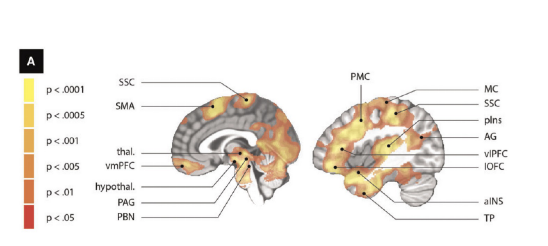
vmPFC
integrates body and thinking
SSC (somatosensory cortex)
touch and kinesthesia
MC (motor cortex)
plan movement
Simulations
Imagining experiences activates the same brain areas as the real experiences including, motor control regions
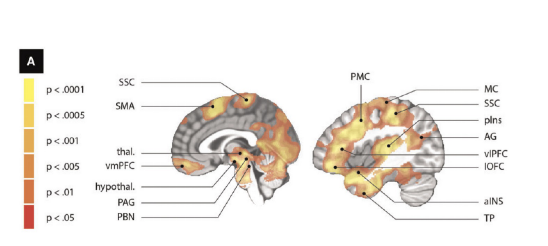
prediction signals
brain guesses what will happen (top-down feedback signals)
prediction error
difference between prediction and real experience
bayesian filters
mathematical weighing of predictions against evidence
forward models
predictions about the sensory consequences of actions
bottom-up signals
sensory info coming from the world
feedforward signals
sensory input carrying prediction errors
Stimulus → Response (S→ R) theory
perception → emotion → behaviour
concept
collection of past experiences used to predict and categorize current situations (create meaning from sensory input, guide action)
category
group of different instances treated as similar for some purpose
categorization
making sense of sensory input using concepts
ad-hoc concepts
flexible concepts created online for specific situations
bayesian priors
initial predictions before seeing current evidence (can be supporting or disproving)
Pattern completion
filling in missing information based on past knowledge
situated conceptualization
making sense of a situation in a context
mental inference fallacy
assumption that observed behaviour reveals internal mental states (WRONG)
agranular (limbic) regions
least organized layers (coarse), SEND precautions about what the body needs
dysgranular regions
moderately organized, relay predictions
granular regions
highly organized (sensory areas), receive predictions
prediction flow
layers of less organized areas → up to more organized areas
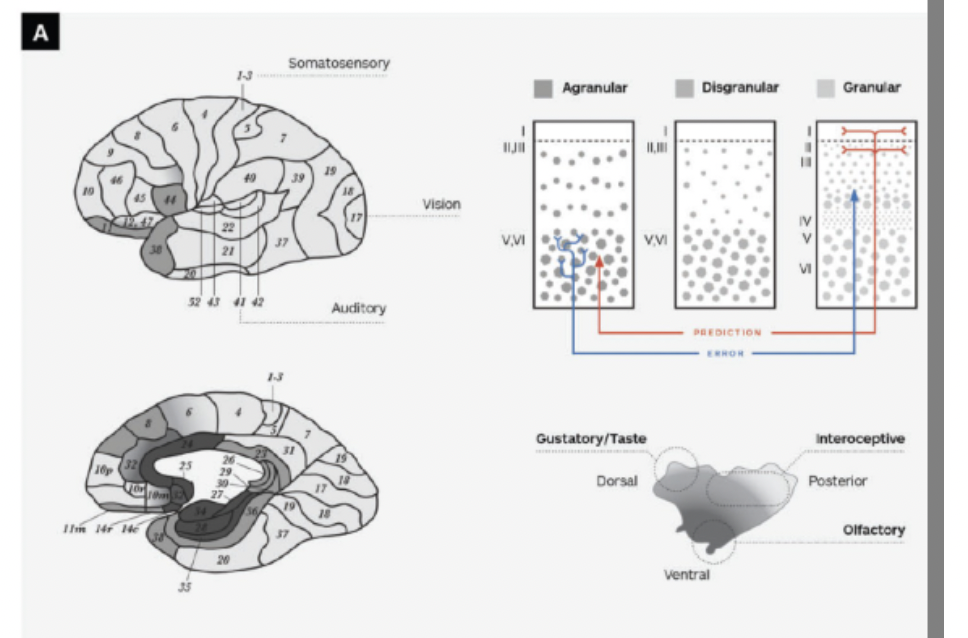
error flow (concept learning)
more organized → less organized areas
AG/PC/mPFC - 3 types of concepts
emotion, sensory-motor, semantic processing (meaning)
emotional experience and regulation areas
overlapping networks
concept pathway
limbic cortex (body regulation) → predictions to sensory and motor areas → core networks
visceromotor predictions
limbic cortices → hypothalamus → control ANS, neuroendocrine system (hormones), immune system → come back via vagus nerve and spinal cord (feedback)
motor predictions
body predictions → movement predictions (motor cortex) → prediction errors flow back to limbic areas to anticipate and prepare movements
sensory predictions
visceromotor predictions → sensory areas → predictions back to sensory areas
default mode network
creates predictions (concepts) using past experience, runs internal model
salience network
decides which prediction errors are salient (determines attention)
frontoparietal control network
maintains and sculpts predictions long-term, flexible control and maintaining goals
precision signals
predictions about reliability of sensory info
gain
how strongly neurons respond to input
reticular neurons
thalamus structures that filters sensory input
thalamortical pathways
thalamus → cortex (carries sensory information)
event perception
understanding unfolding situations, not just individual objects
default mode network
runs simulations and generates predictions
cortical hubs network
connection hubs that link other networks
salience network
insula and frontal areas
Theory of Constructed Emotion
past experience → categorize sensory input from body and the world
construction
building mental experiences from multiple ingredients
conceptual act
using concepts to categorize and make sense of situations
natural kind
a category that exists in nature independent of human observers
essentialist error
mistaking a statistical average for a real thing
pattern classification
using stats to identify brain patterns for different categories
Multivariate Pattern Analysis (MVPA)
finding brain pattern thru stats
equipotentiality
false idea that all brain regions do everything equally
decorticate
cerebral cortex removal
pseudo-affective reflexes
automatic motor responses that look emotional but lack allostatic purpose
Sham rage
reflexive aggressive behaviour without functional context
pattern generators
brainstem circuits that coordinate behaviour
fear conditioning
learning to associate neutral stimulus with threat
freezing behaviour
immobility response
Iowa Gambling Task
decision-making task that measures learning based on wins/losses
Loss aversion
tendency to avoid losses more than seek gains
Urbach-Wiethe disease
amygdala damage → damaged fear response (but still shows fear from CO2 inhalation)
amygdala
important for fear, but not necessary or sufficient always
 Note
Note  Flashcards (23)