Biology final
0.0(0)
 Studied by 0 people
 Call Kai
 Learn
Learn Practice Test
 Spaced Repetition
 Match
Match Flashcards
 Knowt Play
Card Sorting
1/105

Last updated 3:42 AM on 5/30/23
Name | Mastery | Learn | Test | Matching | Spaced | Call with Kai |
|---|
No analytics yet
Send a link to your students to track their progress
106 Terms
1
New cards
What does the law of segregation state?
Organisms inherit two copies of each gene, one from each parent and organisms only donate one copy of each gene in their gametes. Thus, the two copies of each gene segregate, or separate, during gamete formation.
2
New cards
What does Mendel’s law of independent assortment state?
allele pairs separate independtly of each other during gamete formation, or meiosis
3
New cards
What are autosomes?
chromosomes that contain genes for characteristics not directly related to the sex of an organism
4
New cards
If two parents are heterozygous for brown eyes, and they have children; what is the phenotypic ratio of the children? (Brown eyes are dominant to Blue eyes)
3 brown eyes 1 blue
5
New cards
In order for a person to have a recessive disorder, what must their genotype be?
homozygous recessive
6
New cards
If two parents, heterozygous for a recessive disorder, mate and have children, what is the genotype of the offspring who will have the disorder? What is the phenotypic ratio of unaffected to affected offspring?
two lowercase letters, 3:1
7
New cards
If two parents have the genotype Gg for a genetic disorder caused by a dominant allele, what are the chances their children will inherit the disorder?
3/4 or 75%
8
New cards
When Gregor Mendel crossed true-breeding tall plants with true-breeding short plants, all the offspring were tall. Why?
Because the trait of being tall was dominant to the trait of being short plus the parent plants were heterozygous containing the allele of being tall.
9
New cards
What are the sex chromosomes for a female? A male?
female: xx male: xy
10
New cards
A female is born with attached earlobes, which is a recessive phenotype. What are the possible genotypes of her parents?
Ee and Ee, ee and ee, Ee and ee
11
New cards
Typically, how many chromosomes are in the human karyotype?
46
12
New cards
What are some of the things shown on a karyotype?
changes in chromosomes, location of a gene on a chromosome, birth defects (down syndrome)
13
New cards
What is a multiple allele trait? Give an example.
traits controlled by one gene with more than two alleles, blood type
14
New cards
What is a polygenic trait? Give an example.
traits produced by two or more genes, example is human skin color
15
New cards
What are the possible genotypes and phenotypes of blood type?
Phenotypes: A, B, AB, and O
Genotypes: IAIA or IAi, IBIB or Ibi, IAIB, ii
Genotypes: IAIA or IAi, IBIB or Ibi, IAIB, ii
16
New cards
What is an epistatic gene?
Gene that can interfere with the expression of other genes.
17
New cards
What is incomplete dominance? Give an example.
when a heterozygous phenotype is somewhere between the two homozygous phenotypes
example: cross between homozygous red and white flowers have pink offspring flowers
example: cross between homozygous red and white flowers have pink offspring flowers
18
New cards
What is codominance? Give an example.
when both traits are fully and separately expressed
example: cross between homozygous red and white flowers have offspring that have spots of red and white
example: cross between homozygous red and white flowers have offspring that have spots of red and white
19
New cards
A cross of a red cow (IRIR) with a white bull (IWIW) produces all roan offspring (IRIW). This type of inheritance is known as what?
codominance
20
New cards
What is crossing over and when does it occur in Meiosis?
The exchange of genes, prophase 1
21
New cards
What is gene linkage?
when genes are so close on a chromosome that they are segregated and inherited together
22
New cards
What is epigenetics?
the study of the changes in an organism caused by the modification of the gene expression rather than the alteration of the actual genetic code itself
23
New cards
Where are sex-linked genes located?
in the sex chromosome
24
New cards
Why is colorblindness more common in males than females?
Since it is a recessive disorder, it makes it harder for females to get it because males have only one x and females have two, males only need it on their x, females need it on both
25
New cards
For a female to have a recessive sex-linked trait, what must her genotype be?
X (lowercase letter) X (lowercase letter)
26
New cards
In a pedigree, what does a shaded circle indicate? A half-shaded circle?
Shaded circle means they have the disorder, half-shaded means they are a carrier
27
New cards
Can males be carriers of a recessive disorder? Of a sex-linked trait? Explain.
No, because if the disorder is on the x (they only have one) that means they automatically have the trait or disorder and can’t carry it since they do not have another x to mask it out
28
New cards
How can you tell if a pedigree is for an autosomal recessive trait, rather than an autosomal dominant trait?
If it is recessive both parents will not have the disorder, but offspring can, skips generations, but if it is dominant at least one of the parents have to be affected and no generations are skipped
29
New cards
What are the three parts of a nucleotide?
phosphate group, deoxyribose sugar molecule, nitrogen containing base,
30
New cards
What is the difference between hydrogen bonds and covalent bonds?
a hydrogen bond is an attraction between a slightly positive hydrogen atom to a slightly negative atom and a covalent bond is chemical bond formed when two atoms share one or more pairs of electrons
31
New cards
What are the base-pairing rules?
A to T and C to G
32
New cards
How is DNA different from RNA?
DNA contains deoxyribose and RNA contains ribose
33
New cards
What are the functions of mRNA, tRNA and rRNA?
mRNA: messenger, message translated to form a protein
tRNA: transfer, carries the amino acids during protein synthesis form the cytoplasm to the ribosome
rRNA: ribosomal, forms part of ribosomes, a cell’s protein factories
tRNA: transfer, carries the amino acids during protein synthesis form the cytoplasm to the ribosome
rRNA: ribosomal, forms part of ribosomes, a cell’s protein factories
34
New cards
Explain the process of transcription. Where does it take place?
process of copying a sequence of DNA to produce a complementary strand of RNA, occurs in the nucleus
1. transcription complex recognizes the start site and begins to unwind the segement of DNA
2. forms base pairs, G with C and A with U(T), RNA polymerase moves along the DNA, closes back together
3. the completed strand of RNA separates from the DNA templete, transcription complex falls apart
1. transcription complex recognizes the start site and begins to unwind the segement of DNA
2. forms base pairs, G with C and A with U(T), RNA polymerase moves along the DNA, closes back together
3. the completed strand of RNA separates from the DNA templete, transcription complex falls apart
35
New cards
Explain all the steps of translation. Where does it take place?
process that converts, or translates, an mRNA message into a polypeptide, ocurrs in the cytoplasm
1. exposed codon attracts complementary tRNA bearing an amino acid, pairs with mRNA codon, brings it very close together
2. ribosome forms a peptide bond between the two amino acids and breaks the bond between the first tRNA and its amino acid
3. ribosome pulls mRNA strand the length of one codon, first tRNA shifts into exit site to recharge, first site is empty again exposing next mRNA codon
1. exposed codon attracts complementary tRNA bearing an amino acid, pairs with mRNA codon, brings it very close together
2. ribosome forms a peptide bond between the two amino acids and breaks the bond between the first tRNA and its amino acid
3. ribosome pulls mRNA strand the length of one codon, first tRNA shifts into exit site to recharge, first site is empty again exposing next mRNA codon
36
New cards
What is genetic engineering?
changing of an organism’s DNA to give the organism new traits
37
New cards
What are restriction enzymes? Where do they come from?
enzymes that cut DNA moelcules at specific nucleotide sequences, they come from bacteria
38
New cards
What is PCR?
polymerase chain reaction, technique that produces millions or billions of copies of a specific DNA sequence in just a few hours
39
New cards
What is gel electrophoresis? How does it separate DNA fragments?
when an electrical current is used to separate a mixture of DNA fragements from each other, does this by a current pulling them through the gel DNA is negatively charged making it attracted to the posivtive on the other end, lengths are determined by restriction maps (smaller move faster, larger slower) and the restrction enzyms cut it
40
New cards
What do the bands on a restriction map represent? Which pieces of DNA are larger, smaller?
the lengths of DNA fragments between restriction sites in a strand of DNA, larger stay closer to where the start (negative) smaller are closer to where they end up (positive)
41
New cards
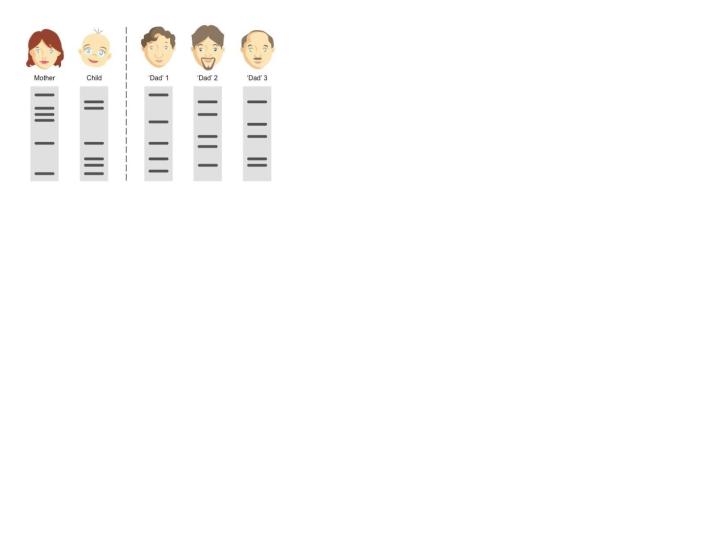
Who is the Daddy?
3
42
New cards
What is a clone?
genetically identical copy of a gene or of an organism
43
New cards
What is a plasmid?
closed loops of DNA that are separate from the bacterial chromosome and that repicate on their own within the cell
44
New cards
What is a transgenic organism? How is it produced?
has one or more genes from another organism inserted into its genome, produced by recombinant DNA technology
45
New cards
What is recombinant DNA?
DNA that that contains genes from more than one organism
46
New cards
The restriction site of a restriction enzyme is
Show where the enzyme cuts the DNA below. How many pieces of DNA result from the cuts?
A T C G A A T T C G C C A T G C C A G A A T T C C C C
T A G C T T A A G C G G T A C G G T C T T A A G G G G
Show where the enzyme cuts the DNA below. How many pieces of DNA result from the cuts?
A T C G A A T T C G C C A T G C C A G A A T T C C C C
T A G C T T A A G C G G T A C G G T C T T A A G G G G
3
47
New cards
Who was Charles Darwin? Explain his studies on the Galapagos Islands.
a famous biologist, studied the idea of evolution and found that many organisms are able to adapt on the islands
48
New cards
What is variation?
the difference in the physical traits of an individual from those of other individuals in the group to which it belongs
49
New cards
What is adaptation?
a feature that allows an organism to better survive in it environment
50
New cards
What is Natural Selection? What does it act directly on?
a mechanism by which individuals that have inherited beneficial adaptations produce more offpsing on average than do other individuals
51
New cards
What is a population?
all the individuals of a species that live in an area
52
New cards
Overproduction –
Descent with modification –
Descent with modification –
overproduction: while having many offpsring raises the chance that some will survive, it also results in competition between offspring for resources
decent with modification: natural selection will result in species with adaptations that are well suited for survival and reproduction, more will have the trait in every following generation
decent with modification: natural selection will result in species with adaptations that are well suited for survival and reproduction, more will have the trait in every following generation
53
New cards
What are homologous structures? What do they tell us about evolution?
features that are similar in structure but appear in different organisms and have different functions, tells us that organisms share a common ancestor
54
New cards
Explain analogous structures.
structures that perform a similar function, but are not similar in origin like a bat wing and butterfly wing
55
New cards
What is a vestigial structure and how does that show evidence of evolution? Give an example.
are remnants of organs or structures that had a function in an early ancestor, example is the wings of an ostrich (don’t fly) shows that maybe they once did fly
56
New cards
What is the founder effect?
genetic drift that occurs after a small number of individuals colonize a new area
57
New cards
What is the importance of genetic variation in a population’s gene pool?
allows species to adapt to future environmental changes
58
New cards
What are the sources of genetic variation? List and describe their importance.
mutations: random change in the DNA of a gene, which forms a new allele, could be a better feature for the organism and their environment
recombination: new allele combinations form in offspring, alleles are arranged in new ways, happens during meiosis
recombination: new allele combinations form in offspring, alleles are arranged in new ways, happens during meiosis
59
New cards
What is gene flow? Does it increase/decrease genetic variation?
the movement of alleles from one population to another, increases genetic variation
60
New cards
What is genetic drift? Does it increase/decrease genetic variation?
changes in the allele frequencies due to chance, decreases genetic variation
61
New cards
What does it mean to be the *same* species?
they are able to mate and reproduce fertile offspring
62
New cards
What is speciation?
the rise of two or more species from one existing species
63
New cards
What does it mean to be reproductively isolated?
occurs when members of different populations can no longer mate successfully with one another
64
New cards
List and describe the 3 types of isolation that lead to reproductive isolation.
behavorial isolation: differences in courtship or mating behaviors
geographic isloation: involves physical barriers that divide a population into two or more groups
temporal isolation: exists when timing prevents reproduction between populations
geographic isloation: involves physical barriers that divide a population into two or more groups
temporal isolation: exists when timing prevents reproduction between populations
65
New cards
What is convergent evolution? Give an example.
evolution toward similar characteristics in unrelated species, dolphins (mammals) and sharks (fish), similar tail fins
66
New cards
What is divergent evolution?
when closely related species evolve in different directions that become increasingly different, kit fox and a red fox grew up in differnt environments, but have a common ancestor
67
New cards
What is coevolution? Give an example.
the process in which two or more species evolve in response to changes in each other
68
New cards
What does a mutation affect?
a mutation affects the DNA in the gene
69
New cards
What is a half-life?
the amount of time it takes for half of the isotope in a sample to decay into a different element, or its product isotope
70
New cards
Explain how radiometric decay is used to determine the age of a fossil.
uses the natural decay rate of unstable isotopes found in materials (fossils)
71
New cards
Chlorine-36 decays to Argon-36 and the half-life is 300,000 years. How old would a fossil be after:
· One half-life?
· Two half-lives?
· Three half-lives?
· One half-life?
· Two half-lives?
· Three half-lives?
150,000
75,000
37, 500
75,000
37, 500
72
New cards
When do we theorize the 1st cells appeared on earth?
3\.8 billion years ago, or 750 million years ago
73
New cards
What theory explains Eukaryotic cell development?
endosymbiotic theory
74
New cards
What is the difference between niche and habitat?
a niche is composed of all of the physical, chemical, and biological factors that a species needs to survive, stay healthy, and reproduce an a habitat is all of the abiotic and biotic factors in the area in which an organism lives
75
New cards
What is the difference between a food chain and a food web?
a food chain is a sequence that links species by their feeding relationships and a food web is a model that shows the complex network of feeding relationships and the flow of energy within and sometimes beyond an ecosystem
76
New cards
What are the trophic levels in a community?
producer, primary consumer, secondary consumer, tertiary consumer
77
New cards
How much energy is transferred between trophic levels, how much energy is lost as heat?
10 percent is transferred, 90 percent is lost
78
New cards
What is a keystone species?
species that has an unusually large effect on its ecosystem
79
New cards
What is ecological equivalence?
species that occupy similar niches but live in different geographical regions
80
New cards
What is niche partitioning?
example: two squirrels live in the same tree but one eats nuts from the ground, but one eats nuts from the top of the tree (niche is divided)
81
New cards
What is competitive exclusion?
states that when two species are competiting for the same resources, one species will be better suited for the niche, and the other species will be pushed into another niche or become extinct
82
New cards
What is succession?
the sequence of biotic changes that regenerate a damaged community or create a community in a previously uninhabited area
83
New cards
What is the difference between primary succession and secondary succession?
primary: the establishment and development of an ecosystem in an area that was previosuly uninhabited
secondary: the reestablishment of a damaged ecosystem in an area where the soil was left intact
secondary: the reestablishment of a damaged ecosystem in an area where the soil was left intact
84
New cards
What are the three types of symbiosis?
commensalism, mutualism, parasitism
85
New cards
What impact do births, deaths, immigration, emigration have on a population?
they determine the populations growth rate and capacity
86
New cards
Explain clumped, uniform, and random dispersion of a population.
clumped: live close in groups for mating, protection, access to food and resources
uniform: competition for limited resources lead to individuals living at specific distances from each other
random: they are spread randomly withing an area or volume
uniform: competition for limited resources lead to individuals living at specific distances from each other
random: they are spread randomly withing an area or volume
87
New cards
What are the conditions for exponential growth of a population?
when resources are abundant
88
New cards
What are the conditions for logistic growth of a population?
when resources are limited
89
New cards
What is carrying capacity?
the maximum number of individuals of a particular species that the environment can normally and consistently support
90
New cards
What has increased Earth’s carrying capacity?
migration, agriculture, medical advances, and communication, technology
91
New cards
What are density-dependent limiting factors for population growth?
limiting factors that are affected by the number of individuals in a given area
92
New cards
What are density-independent limiting factors for population growth?
the aspects if the environment that limit a population’s growth regardless of the density of the population
93
New cards
How is an ecosystem impacted by loss of biodiversity?
lowers an ecosystem’s productivity and energy levels, it reduces the ecosystem’s stability and makes it more difficult for the ecosysem to handle future change
94
New cards
What is a renewable resource? Nonrenewable resource?
Renewable: resources that cannot be used up or can replenish themselves overtime
Nonrenewable: used faster than they form
Nonrenewable: used faster than they form
95
New cards
What leads to biomagnification?
when toxic chemicals are consumed indirectly by organisms through food
96
New cards
What is an umbrella species?
its protection means a wide range of other species will also be protected
97
New cards
What is an indicator species?
species that provides a sign or indication of the quality of the ecosystem’s environmental conditions
98
New cards
What is an invasive species? Give two examples.
species that can harm an environment take over, reproduce quickly, parasite and burmese python
99
New cards
What are the different types of pollution?
air, water, and land
100
New cards
What are the main greenhouse gases?
carbon dioxide, methane, and water
 Note
Note  Flashcards (46)