Eduqas Alevel RS Theme 2E: Arguments against the existence of God, Carl Jung
 Studied by 0 people
 Call Kai
 Learn
Learn Practice Test
 Spaced Repetition
 Match
Match Flashcards
 Knowt Play
1/33

There's no tags or description
Looks like no tags are added yet.
Name | Mastery | Learn | Test | Matching | Spaced | Call with Kai |
|---|
No analytics yet
Send a link to your students to track their progress
34 Terms
who is Carl Jung
swiss psychiatrist that started off similar to freud and saw the view as the subconscious as too narrow and does not see religion as a mental heal problem/ neurosis
what does Jung think God is
a creation of the mind, pshyic in reaction to part of the archetypes that we think we have
what is the collective unconscious
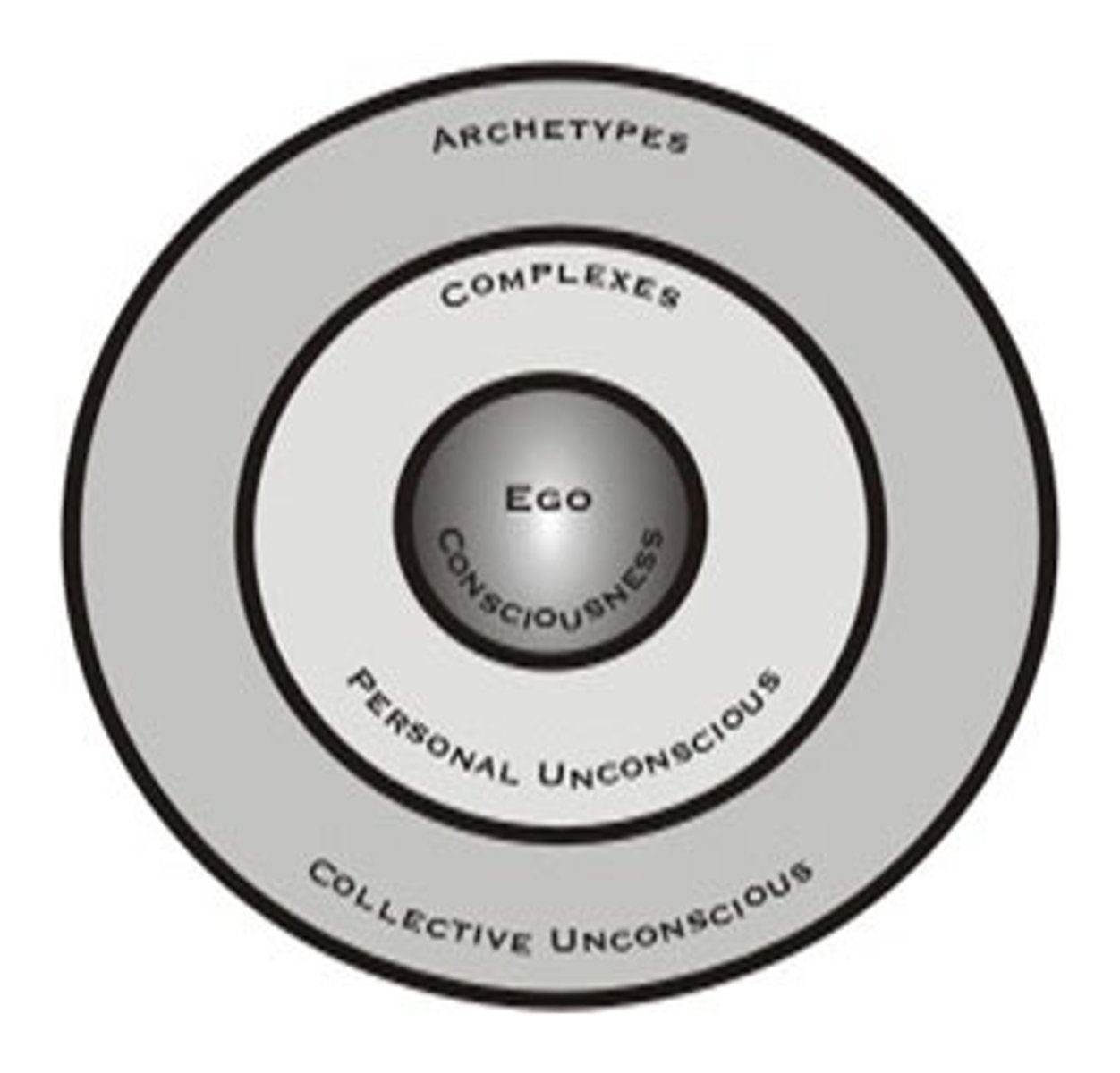
Carl Jung's concept of a shared, inherited reservoir of memory traces from our species' history. These are unconscious elements that are shared with other people 'it is not individual but universal' with behaviour which is 'more or less the same everywhere in al individuals'. You cannot access these
what Is the personal unconscious
Jung's name for the unconscious mind as described by Freud, where memories have been repressed for whatever reason which can lead to neurosis at a later date if not dealt with
what is evolution and heredity to Jung
he sees it as a blueprint for the psyche in the same way it does genetically. It consists of primordial images from early human history. These images a like predispositions to act like our ancestors. Jung links these predispositions to mythical and religious themes. We have it through hierarchy, inherit, provide a blue print for the psyche.
what's the Miss miller case
Jung talks about archetypes, Miss miller was a schizophrenic patient who had wild dreams and fantasies. She was very good at recording her experiences and wrote them as poems. In one she saw herself as moth and she was being drawn towards the son. Jung then saw this connection and said the sun was God. therefore means her dreams were being drawn to God. This is where Jung made his connection with archetypes and religion.
some argue and say that it is just natural to have a drawn to the sun as we don't know what it is and can never get a full answer as we can't go there
what are archetypes
universal symbolic representations of particular types of people, objects, ideas, or experiences. Jung says that they are the original pattern and blueprint used to create our selves.
what are the characteristics of the archetypes
1. they are not passed down, but rather a disposition to react in a certain way to the world
2. they direct and influence human behaviour
3. some are very common as a result
4. unable to access them until they are projected outwards
5. shown through myth and symbol
6. also dreams and day dreams
what is our goal with archetypes
to balance them and therefore balance our conscious and unconscious, through interaction with the archetypes such as myths, symbols and dreams to avoid neurosis.
what are the 4 main archetypes
the persona, the shadow, the anima and animus and the self
what is the persona
how we prevent ourselves in the world, its forever changing so that you can change in different environments, the persona recognises the different masks we wear in different social situations and groups, it acts to shield our ego from negative images. According to Jung, the persona may appear in dreams and take different forms.
Over the course of development children learn that they must behave in certain ways in order to fit in with societies expectations and norms. It allows people to adapt to the world around them and fit in, but to can lead to people becoming lost with their own sense of self
what is the shadow
Repressed feelings, dark side of the psyche; sometimes the primitive side or raw emotions or projection of our negative traits on to others, you don't want let it become a part of you too much. it is the repressed ideas of weakness, desires, instincts ad shortcomings- envy, greed, prejudice, hate and aggression, vulnerability. These agent dispositions are present in all of us, Jung believes although people sometimes deny this element of their own psyche and instead project it onto others.
the shadow can appear in dreams, visions, and make take a variety of forms, snake, monster, demon, dragon
what is the anima and animus
Sex inappropriate qualities (men being feminine and women being masculine). it represents the true self rather than the image we present soothers and serves as the primary source of communication with the collective unconscious. Jung believed that physiological changes as well as social influences contributed to the development of sex roles and gender identities. animus = male aspect, anima = female aspect. These archetypal images are based upon both what is found in the collective and personal unconcoious. The collective unconscious may contain notions about how women should behave etc
what is the self
the self Is an archetype that represent the unified unconsciousness and consciousness of an individual. Creating the self occurs through a process known as individuation, in which various aspects or personality are integrated. Jung saw the as a circle or mandala working from the in (self) to out (consciousness and life). It represents the unified psyche as a whole, Jung suggested that there were two different centres of personality. The ego makes up the centre of the personality.
For Jung the ultimate aim was for an individual to achieve a self of sense of cohesive self , similar in many ways to Maslow's concept of self actualisation
what is individuation
the process of attaining and balance through integrating the conscious and unconscious parts of the mind. The aim is to free the self of false wrappings of the persona and other archetypes brought out by the suggestive primordial images found in the collective unconscious. If you don't have this balance it can lead to neurosis (unlike freud who said that the belief in religion leads to neurosis)

what is the projected self
Jung says that the projected self is made up of archetypes, they are often contradictory but help us to conform in society. As a result, we suppress our true self because it does not conform to the archetype from our collective unconscious
what is the true self
Th traits of the true self, must be integrated with our consciousness. Only then do we realise our true self. This is why it is symbolically abstract, like mandalas. The process by which a person moves towards their true self is called individuation.
what is the aim for the archetypes and the self
ultimately it aims to balance our personality. It is known as self development or self realisation.
what does Jung say we need to gain individuation
in order to achieve individuation we need religion. It is religion that ,maintains the balance of the mind. It prevents neurosis. He says any process or attitude which is governed by archetypes may be termed 'religious'. As a result individuation is a religious process.
what is the most powerful way to interact with the archetypes
you believe religion making it more powerful, we believe so strongly in it it helps us develop our collective unconscious/ archetypes, compared to Harry Potter it is something we believe, we don't believe in HP but we do with religion as we believe it helps us deeper
what does individuation aim to balance
balance conflicts like good and evil. Such as the lotus flower - the top is how you present yourself (projected self), below is your true inner self (true self) which is different, it is not pretty underneath, dark, fighter like the shadow archetype
what are the three examples of religion does Jung use
1. Jesus: Jung saw Him as a 'psychic reality; (only in the mind) inside the deepest level of the human psyche. He is perfect but incomplete, lacking a shadow. Separation of Jesus at birth symbolises from our parents. His death symbolises the necessary sacrifice of the ego in order to be more complete - you just have to be wiling to loose something, you don't actually have to
2. The Eucharist: Recalls how God sent HIs son to be sacrificed. But He rises again. It symbolises the sacrificing of the selfish part of the ego. As a result the self is transformed.
3. The Holy Trinity: seen as one sided, as it lacks opposites. All are perfectly good. Jung believed that there is need to be a fourth contrasting element to provide the energising opposition for the process of actualisation.
why does Jung use Jesus, the eucharist and the trinity as symbols of individuation
the religious symbols show jesuit has the ultimate self, He is perfect, we are still growing but Jesus is already whole and balanced
Jung sees the archetype self as
the same symbolism as a deity. the self he says is the God within us, it is impossible for Jung to distinguish between the symbol of the self and the God image. God is the self, to achieve individuation you need to balance all of the archetypes which involves self, God, you have to balance ad become with God
what is the God within
Jung's idea that God is built within us with the archetypes we have known to be in the collective unconscious, this can be developed like mandalas, God or a religious quest
how do mandalas help with the self
the self helps with individuation through producing images of wholeness. One form of this is the mandala, for Jung it is archetypal symbol of the self. It represents balance and wholeness, organising principle around a central point. It is used ritually and in meditation to symbolise the journey to wholeness or enlightenment with the journey and the self at the centre.
how does God help with the self
another key symbol of wholeness is God. the images created by the God archetype are the same as those created by the self archetype. Therefore it is through religious images that the personality can grow. Individuation uses religious imagery to grow the self and balance the personality. So if you reject religion you are making individuation almost impossible and therefore more likely to experience neurosis
how does a religious quest help with the self
we are on a quest to discover the true self, through individuation, and the symbols of the self are indistinguishable from symbols of God, then Jung says we are, in its widest since on a religious quest. We are aiming to find the God within , the self. As a result, for Jung, God is not an external being but rather an expression of the collective consciousness. Therefore a religious experience with God is actually an encounter with the self. This does not for Jung belittle it, instead he says it is passive and subscribes to the definition of religious experiences given by Otto
what are the key strengths of Jung
1. a source of comfort
2. promotion of a mindset
how is source of comfort a strength
For Jung, he believes that religion was an error but a positive one as it gave humanity purpose and strength. The archetypes were a way of interpreting dreams, myths and religious traditions, it was a revolutionary survival tool.
-> WW1 horrors meant that religious ad political certainties were torn down leaving people with a lack of faith in religion, people turned to science and technology as it seemed more stable than religion, but the lack of support and necessary to perfect the archetypes lead to disharmony between the conscious and unconscious, this then lead to depression and neurosis.
-> Jung said of his 35 patients ' non of them has been truly healed who did not regain his religious outlook" So when his patients found religion again they helped them and made them develop their individuation despite religion being fake
-> without religion he said it would be difficult to interpret and understand the symbolic meaning of the unconscious archetypes and therefore difficult to attain wholeness.
how is promotion of the mindset a strength
religion promotes wholeness. "people who are more involved in religious practices and who are more religiously committed seem to cope better with stress" One reason this is because religion gives people a sense of purpose and meaning in lie, and that helps them to make sense of negative things that happen to them.
2005 study: older adults in san Francisco found that being religious served as a buffer against depression for those with poorer health
2013 study: patient being treated for mental health issues such as depression or anxiety responded better to treatment if they believed in God.
what are the key weaknesses of Jung
1. lack of empirical evidence
2. reductionist view
how is lack of empirical evidence a weakness
Jung spoke about the innate God archetype, which he couldn't prove, and our a priori disposition to manifest a God archetype which he couldn't prove. Gordon Allport says that it is not due to collective unconscious, but rather due to conformity to society we have come up with this. Jung has been criticised for the lack of firm empirical evidence to support his theories. Although he collected data from studying his patients, there are many aspects of psychology which make it a difficult subject to test using empirical evidence.
-> the human mind is not accessible to external observation; although behaviour can be observed, the inner thought process that lead to those behaviours cannot. He based his theories on observations and interpretations that are often private and subjective, no t suited for the scientific credit he wants to give it.
-> American Psychologist Gardner Murphy criticised Jung's methods saying that Jung was far too quick to rush to conclusions, His criticism was that Jung saw that one mental phenomenon was somewhat like another
-> there are plenty of of people who live healthy and happy lives without religion
how is the reductionist view a weakness
Jung: believes that it all comes from the collective unconscious, says there is no way to prove Gods existence, reduces belief to search for inner wholeness and Jesus is unimportant as a man and instead Jesus as an archetype is important
however... Christians would reject this definition of christ as an archetype, he broadens religion out so much that there is basically no such thing as a non believer, where does this leave the problem of evil and suffering. He doesn't take into accountability non theist faiths
-> Jung tried to show that religion is no more than a human construct, if God Is no more Ethan the human collective unconscious then it follows that God did not exist before there were any people, and if christ is understood as no more than a symbol of the self, then it follows that the historical Jesus is not important
 Note
Note  Flashcards (125)