4.4 - Cerebral Palsy
 Call Kai
 Learn
Learn Practice Test
 Spaced Repetition
 Match
Match Flashcards
 Knowt Play
1/49

There's no tags or description
Looks like no tags are added yet.
Name | Mastery | Learn | Test | Matching | Spaced | Call with Kai |
|---|
No analytics yet
Send a link to your students to track their progress
50 Terms
cerebral palsy
____________ is a non-progressive neurological difference of lesion that occurs in the early developing CNS, “catch all term”
posture; motor control
cerebral palsy causes differences in _________ and _________ creating different permanent disorders
T (could be wheelchair, running, etc)
T/F: cerebral palsy has a WIDE variety of presentations
neurological insults
hypoxic/ischemia
infections
CVA
what are the 4 main causes for the many reasons for why cerebral palsy occurs
perinatal (43%) → prenatal (34%) → undetermined (16%) → postnatal (6%)
list in order the timing periods of when CP occurs/diagnosed
F
T/F: neuroimaging will always diagnosis CP
low birth weight
maternal infection
neonatal seizures
what are the 3 poor prognostic risk factors for CP
tone
asymmetries
atypical development and reflexes
lack of developmental progression
what findings are you expected to find during an initial PT assessment with someone who has CP
spastic (velocity dependent)
___________ presentation of tone:
hypertonic
hypotonic (floppy)
___________ presentation of tone:
low tone
dystonic (more common with low tone trunk posture and spasticity in extremities)
___________ presentation of tone:
mixed tone with awkward joint angles
ataxic
___________ presentation of tone:
uncoordinated and unbalanced
athetoid
___________ presentation of tone:
writhing movements
diplegic
hemiplegic
triplegic
quadriplegic
**note: this “plegic” not “paralysis” so talking about the cound involved
what the 4 distributions of involvement for CP
gross motor functional class system (GMFCS)
the _______________ is a method to describe the child’s level of independent functioning
least severe = 1
most severe = 5
what is the scoring for gross motor functional class system (GMFCS)?
least severe =
most severe =
before 2nd birthday
between 2nd and 4th birthday
between 4th and 6th birthday
between 6th and 12th birthday
between 12th and 18th birthday
(we will mostly stay with the 6th to 18th range for this class)
what age bands does the GMFCS cover
1
level ______ of the GMFCS:
Walks without restriction; limitations in more advanced gross motor skills
2
level ______ of the GMFCS:
Walks without assistive devices; limitations walking outdoors, and in the community
3
level ______ of the GMFCS:
Walks with assistive mobility devices; limitations walking outdoors, and in the community
4
level ______ of the GMFCS:
Self-mobility with limitations; children are transported or use power mobility outdoors, and in the community
5
level ______ of the GMFCS:
Self-mobility is severely limited even with the use of assistive technology
assistive device = can leave it behind
gait trainer = strapped in
what’s the difference between an assistive device (lvl 3) and a gait trainer (lvl 4)… the big ticket question
GMFCS - gross motor function classification system
MACS - manual ability classification system
CFCS - communication function classification system
what are the 3 different outcome measures for people with CP
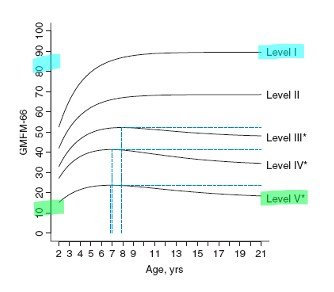
F (the graph shows a decline but it is not due to degeneration, the decline is the effect of growth; ex. rapid growth spurts creates longer level arms and physics takes over, if muscles are spastic they can’t keep up with growth so they get tighter)
T/F: CP is a progressive disease
3, 4, 5
what levels of the GMFCS do we typically see a decline in during adolescence
normal to shortened
what is the life expectancy with someone with CP
cognition
the better someone moves, the better their ___________
hamstrings
adductors
plantar flexors
what are 3 common muscle groups to go through muscle tendon releases and transfers with someone who has CP
7-10 years
if a child with CP has a surgery before the ages of ____-_____, the odds of them getting another surgery is high
baclofen
people with CP are often prescribed _________ to decrease their spasticity
ordal
taking (oral or intrathecal) baclofen causes systemic effects
intrathecal
taking (oral or intrathecal) baclofen causes more regional effects
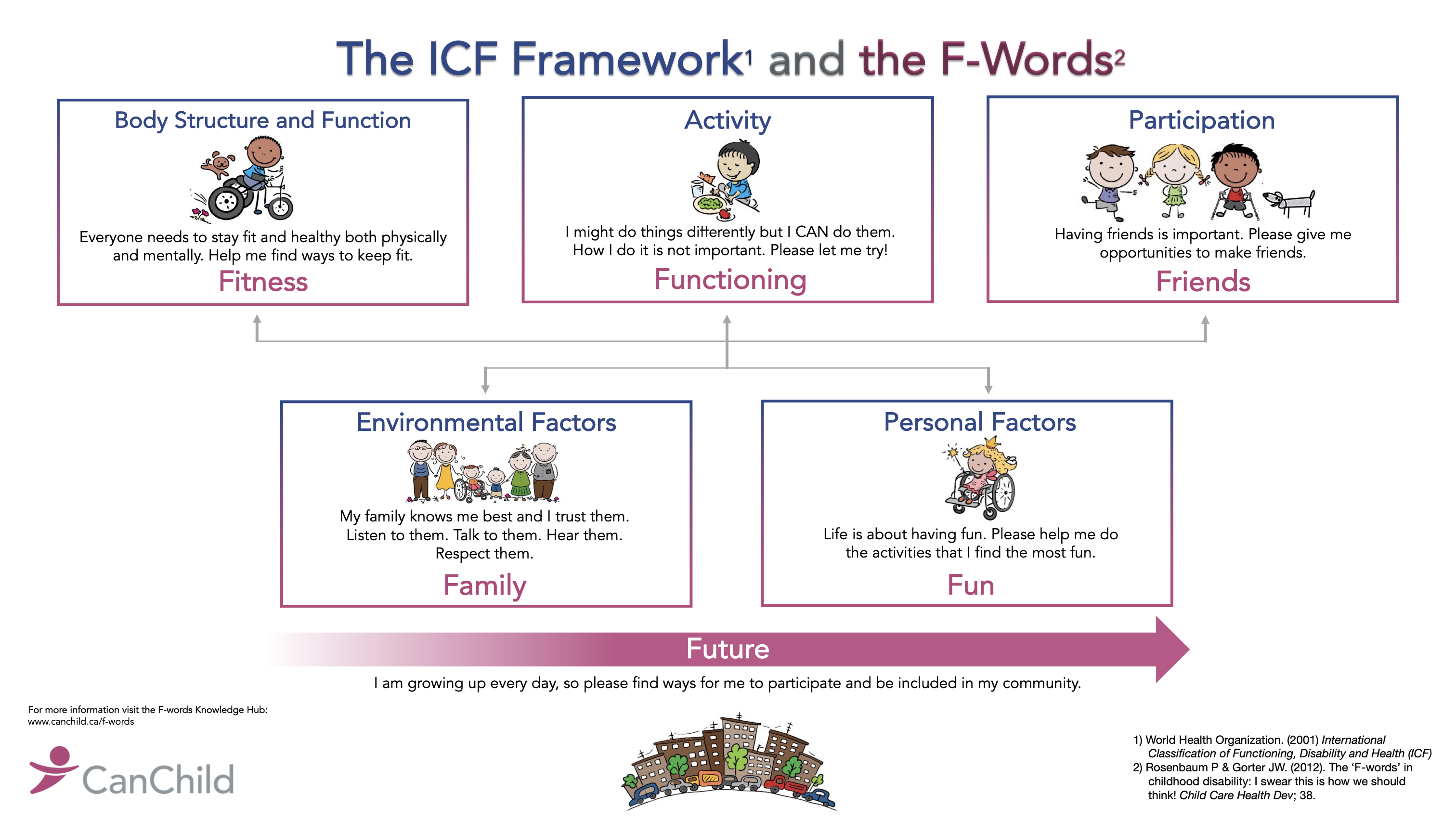
BSF = fitness
activity = functioning
participation = friends
environmental factors = family
personal factors = fun
what are the ICF framework F words
include info on test and measures, slide 23 after asking buck question
5 mo - 21 years
what age range does the gross motor function measure (GMFM) cover
Lying and rolling
Sitting
Kneeling
Standing
Walking, Running, and Jumping
what are the 5 categories of the gross motor function measure (GMFM)
higher
the (lower or higher) the score on the gross motor function measure (GMFM), the more functional the child
66
gross motor function measure (GMFM) 66 or 88:
shorter
88
gross motor function measure (GMFM) 66 or 88:
longer version
66
gross motor function measure (GMFM) 66 or 88:
valid for children with CP and without AFOs of adaptive equipment
88
gross motor function measure (GMFM) 66 or 88:
valid for children with down syndrome, OI, and in process for other neuro progressive disorders
88
gross motor function measure (GMFM) 66 or 88:
does not give any norm references
66
gross motor function measure (GMFM) 66 or 88:
does have norm references for ages and GMFCS levels
88
gross motor function measure (GMFM) 66 or 88:
gives % of function, the higher they are the more functional
hypertonia assessment tool (HAT)
early childhood assessment of balance (ECAB)
modified ashworth scale
tardieu scale
what are test and measures used to assess PRIMARY body structure and function for CP
spinal alignment and range of motion measure (SAAROMM)
functional muscle strength
what are test and measures used to assess SECONDARY body structure and function for CP
tardieu (measures the distance from the R1/first catch to R2/end range = therapeutic zone)
the __________ test tells you the therapeutic zone of spasticity which you can use when considering casting
spinal; functional
when assessing a child’s body structure and function, look at their _________ alignment and ROM as well as ___________ muscles strength
she’s sneaky like that
i would look at the links to the outcome measures in canvas for scoring

